Vol.3, No.13, 2013
Editorial Board
Prof. Dr. Sanjay Kumar
Dept. of Biotechnology, Ministry of Science and Technology, India Dr. Chiung Ting Chang
Maastricht University, Netherlands Prof. Dr. Venus S. Solar
Manila Central University, Philippines Dr. Eng. Rares Halbac-Cotoara-Zamfir
"Politehnica" University of Timisoara Romania Prof. Dr. P. Satheeshkumar
Central Marine Fisheries Research Institute, India Prof. Dr.Ibrahim Hassan
Alexabdria University, Egypt Prof. Dr.Jagruthi Joshi Novartis Healthcare, India Dr. Nabil Miled
Sfax University, Tunisia Prof. Dr. Carlos K B Ferrari
Federal University of Mato Grosso (UFMT), Brazil Prof. Dr. H. A. Ibrahim,
Suez Canal university, Egypt Dr. Arda YILDIRIM
Gaziosmanpasa University, Turkey Dr.Nexhbedin Beadini
Faculty of Medical Sciences, State University of Tetova, Macedonia Dr.Sheqibe Beadini
Faculty of Medical Sciences, State University of Tetova, Macedonia
Paper submission email: [email protected]
ISSN (Paper)2224-3208 ISSN (Online)2225-093X
Please add our address "[email protected]" into your email contact list.
This journal follows ISO 9001 management standard and licensed under a Creative Commons
Attribution 3.0 License.
Vol.3, No.13, 2013
Vol 3, No 13 (2013)
Table of Contents
Articles
A Pilot Study on effects of vaccination on immunity of broiler chickens
Ojiezeh, T. I, Ophori, E. A., Eghafona, N. O., Echeonwu, G. O. N, Joannis, T. M., Akele,
R. Y.
1-4
Adverse Drug Reactions among Critically Ill Patients at Cairo University Hospital:
Frequency and Outcomes
Hanan Ahmed El Sebaee, Yousria Abd El Salam Seloma
5-13
Women Farmers Organisations’ Perceived Effect of Child Labour Activities in Oyo West
Local Government Area of Oyo State, Nigeria
Oyeyinka, R. A., Ayansina, S.O., Adekunmi, A.O., Arowolo. O.O.
14-21
Cerebrovascular Stroke Recurrence among Critically Ill Patients at a Selected University
Hospital in Egypt
Warda Youssef Mohammed Morsy, Hanaa Ali Elfeky, Rasha Alsayed Ahmed
22-33
Dry Matter Accumulation in Maize as Influenced by Row Arrangement, Nitrogen and
Phosphorus Levels in Maize (Zea Mays L)/ Castor (Ricinus Commumis L.) Mixture
Arunah U.L, E.B. Amans, M. Mahmud, A. Ahmed, G. L. Luka, A. S. Isah, B.A. Babaji,
E.C Odion
34-41
Effect Of Ginger Infusion On Chemotherapy Induced Nausea And Vomiting In Breast
Cancer Patients
Rahmi Muthia, Wedya Wahyu, Dachriyanus .
42-46
Effect of Soil Conservation Investment on Efficiency of Cassava Production in Oyo State
of Nigeria
Job Olatunji Oladeebo, Adepeju Aderinola Oyeleye, Mutiu Oladapo Oladejo
47-52
Evaluation of a Tool for Assessing Clinical Competence of Msc Nurse Students
Margaret Chege, Peter Mwaniki, Timothy Abuya
53-59
Hope Level and Life Satisfaction among Patients with Colostomy and their Family
caregivers
Naglaa Fawzy Hanafy Taha, Manal Mohamed Moustafa
Vol.3, No.13, 2013
Comparison of Informational Needs among Newly Diagnosed Breast Cancer Women
Undergoing Different Surgical Treatment Modalities
Labiba Abd El-kader Mohamed, Hanan Ahmed El-Sebaee
73-84
The Role of Ripe Musa sapientum (Plantain) Peels in the Removal of Phosphorus and
Nitrogen from Aqueous Solution
Akpor OB, Nwonuma CO, Edewor-Kuponiyi TI, Amira OJ
85-96
Genetic Variation of Coconut Tall (Cocos nucifera L., Arecaceae) in Bali, Indonesia
Based on Microsatellite DNA.
Eniek Kriswiyanti, I Gede Rai Maya Temaja, I Made Sudana, I Gusti Ngurah Alit
Susanta Wirya
97-101
Combining Ability and Inheritance of Growth Traits in Rabbits
A.S. Adenaike, T.O. Osisanya, O.D. Ogunsola, A.O. Asine, M. Wheto, D.O. Ogunlakin,
A.S. Amusan, C.O.N. Ikeobi
102-107
Supplementation with Goat Follicular Fluid in the In Vitro Maturation Medium toward
Cumulus Expansion and Nucleus Transformation
Nolasco Da Costa, Sri Wahjuningsih, Nurul Isnaini
108-113
Reduced Levels of Some Iron Parameters of Protein Energy Malnourished Children in
Calabar, Nigeria
Naomi Ernest, Patience Akpan, Emmanuel Uko
114-120
Study of Nursery Business in Harbin Region
Shah Saud, Chen Yajun, Shah fahad, Muhammad Abdullah, Muhammad Maroof
Ajmal, Arooj sadiq
121-129
The Incidence of Anemia and the Impact of Poor Glycemic Control in Type-2 Diabetic
Patients with Renal Insufficiency
Babatunde Ishola Adejumo, Uchechukwu Dimkpa, Chinwe Obianuju Ewenighi, Tosan
Amos Erhabor, Uchunor G.A., Odia S.I., Ukatu Esmond, Oji O.J., Besong E.E.
130-136
Performance of Yankasa Rams Fed Andropogon gayanus (Gamba Grass) Hay
Supplemented with Faidherbia albida (Acacia) Pods
I. Ajiji, H.D. Nyako, S.A. Ashom
137-141
Identification and Characterization of Actinomycetes for Biological Control of Bacterial
Scab of Streptomyces scabies Isolated from Potato
Hend Abdulhmeed Hamedo, Abeer Hamdy Makhlouf
142-153
Fluctuation of Daytime Air Humidity in The Mangrove Forest Edges
Tinny Kaunang, Ch.S. Medellu
154-159
Hepatoprotective Activity Combination Between Morinda Citrifolia Linn (Mengkudu)
Extract And Virgin Coconut Oil (Vco)
Rudi Alexander Repi, Mokosuli Yermia Semuel, Jantje Ngangi, Harry Maurits
Sumampouw
Vol.3, No.13, 2013
Sexava Nubila Behavioral Analysis In Every Changes Of Imitation Sound From Level
Of Intensity
Bahrun ., Jootje Warouw, Sartje.J. Rondonuwu, Max Tulung
Vol.3, No.13, 2013
Genetic Variation of Coconut Tall (
Cocos nucifera
L., Arecaceae)
in Bali, Indonesia Based on Microsatellite DNA.
Eniek Kriswiyanti*, I Gede Rai Maya Temaja**, I Made Sudana** and I Gusti Ngurah Alit Susanta Wirya**
*Post Graduate Student of Agriculture Faculty andDepartment of Biology Mathc and Natural Science Faculty , Udayana University Campus Bukit Jimbaran, Kuta Bali Indonesia**Faculty of Agriculture, Udayana
University Campus Sudirman, Denpasar, Bali Indonesia Corresponding author, Email :[email protected]
The research was funded by Director General of Higher Education, Ministry of Education and Culture of Republic Indonesia (grant of Doctorate Student) and Udayana University, Bali Indonesia
Abstract
The coconut has important roles for economics, traditional medicine and culture, especially for Hindu’s ceremonial purpose in Bali Island (Indonesia). Each coconut cultivar has unique characteristics. The aimed of this research was to determine genetic variation of coconut tall (Cocos nuciferaL., Arecaceae) in Bali, based on DNA microsatellite. Six pairs microsatellite markers were used to determine heterozygosity.
The results showed that total of 80 alleles were detected by microsatellite with an average of 13.33 alleles per locus, there were 12 alleles on microsatellite locus CnCirA3, 12 alleles on locus CnCirC3, 16 alleles on locus CNZ05, 14 alleles on CNZ09 , 17 alleles on CNZ21, and 9 alleles on microsatellite primer pairs CNZ51. The mean values of gene diversity (He) and observed heterozygosity (Ho) were 0.8835 and 0.5421, respectively. The highest heterozigosity was onbulan tallcoconuts cultivar (0.816), the lowest heterozygosity was onbluluk tallcoconuts (0.35).
Keywords:unique characteristic, microsatellite, allele, heterozygosity, coconut
1.Introduction
Coconut (Cocos nuciferaL.) is one of the primary sources of income for most Indonesian farmers. Coconut fruit is processed into various products like vegetable oil, raw material for food, industry, medicine, cosmetic and oleo chemicals. Total land area plantation of coconut is about 3.7 million hectares, with 97% of overall production from farmers (Novarianto, et al., 2005). In Bali, beside of its economic value, parts of coconut tree (leaves, fruit, young flower) also used for ceremonial and medicinal purposes, which called “nyuh madan” . Morphologically, some coconut plants differ in some characters, which is very unique and specific to its individual plant. Based on the unique characters, there were more than twenty unique coconuts identified that differ individually. Some of them are ancakwhich has branches on its trunk; the be julithas plicated lamina leaves, thebingin‘s root grow from nodes of stem, theBojog‘s fruit husk is colored like the hair of long tailed monkey. Differences in fruit color such as white, green, yellow and red were used to distinguish between the bulan, gadang, gading and surya coconuts respectively. Inflorenscentia spicata was characteristic of bluluk, while theudangandmulungwere characterized by red mesocarpium. TheRangdacoconut has petiole and the apex of the stem were twisted. Thesudamalawas characterized by many kinds of unique characters, which some of them are doubled spatha, and flat apex of male spikelet (Kriswiyanti, 2012).
To study its genetic diversity, simple sequence repeats (SSR) microsatellite markers were used. This technique had been used successfully by many scientists to characterize the genetic diversity of the coconut population (Perera et al.2001; Manimekalai and Nagarajan 2006; Kumar et al., 2011). The microsatellite analysis of the 9 coconut populations with 8 primers revealed a total of 37 alleles (Devakumar et.al., 2010). From the used 26 SSR markers, detected a total of 188 alleles with an average of 7.23 per locus (Liu, et.al., 2011). In this research, genetic variation of tall coconut (Cocos nucifera L., Arecaceae) was determined based on DNA microsatellite, using alleles size on each individual of tall coconut. The alleles data from each accession can be applied to predict natural breeding for unique coconut conservation purpose.
Materials and Methods
Vol.3, No.13, 2013
were ‘tall coconut’ category (nyuh ancak, biasa, bulan, bingin, gadang, gading, kebo, srogsogan, mulung, rangda, bluluk, sudamala, surya, udang, kapas, be julit, bojog, macan, naga, pudak ). DNA extraction and detection of microsatellite polymorphisms were analysed at Forensics and Primata Laboratory Udayana University, Bali Indonesia.
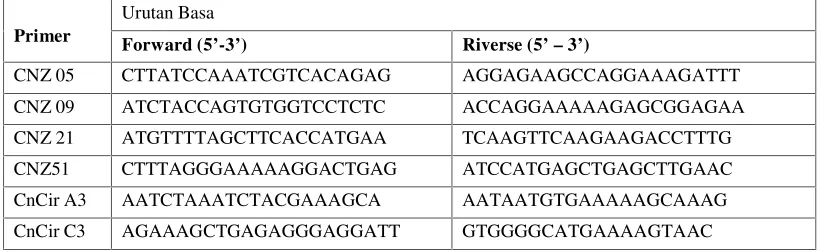
DNA extraction:DNA was extracted from fresh coconut young leaves using a CTAB based protocol modified from Doyle and Doyle (1987). The primer sequences and associated information are given in Table 1 (Pandin, et.al., 2008).
SSR analysis
Polymerase Chain Reactions (PCR) assay and gel analysis : DNA was amplified in 13μ L reactions containing 2μ L sample, 3.5μ L H2O, 6.5μ L Mastermix (Qiagen), and 1μ L primer. The PCR programmed for 30 cycles of 45 seconds each at 94°C, 1 min at the different annealing temperatures standardized for the individual SSR locus, and extension for 1 min 30 seconds at 72°C. The first cycle was preceded by a 5 min denaturation at 94°C and the last cycle ended with 5 min extension at 72° C. Reaction products were separated on 6% polyacrylamide (denatured) and visualized with silver nitrate staining (Tegelstorm, 1984).The alleles were scored based on the size of each PCR amplified fragment by electrophoresis all samples in a single gel. Allele size were determined by semilog plotting of distance migration of amplicon on PAGE (Hutchinson, 2001). Diversity values based on allele frequencies were calculated for each microsatelite locus and coconut cultivar using Nei’s methods (1987).
Table .1 Details of microsatelites primer used in the analysis
Primer
Urutan Basa
Forward(5’-3’) Riverse (5’ – 3’)
CNZ 05 CTTATCCAAATCGTCACAGAG AGGAGAAGCCAGGAAAGATTT
CNZ 09 ATCTACCAGTGTGGTCCTCTC ACCAGGAAAAAGAGCGGAGAA
CNZ 21 ATGTTTTAGCTTCACCATGAA TCAAGTTCAAGAAGACCTTTG
CNZ51 CTTTAGGGAAAAAGGACTGAG ATCCATGAGCTGAGCTTGAAC
CnCir A3 AATCTAAATCTACGAAAGCA AATAATGTGAAAAAGCAAAG
CnCir C3 AGAAAGCTGAGAGGGAGGATT GTGGGGCATGAAAAGTAAC
Results
From 58 extracted DNA samples, some sample were successfully amplified on each primer used. For examples locus CNZ09 on figure 1, C and D were not successfully amplified.
Figure 1. An example of allelic polymorphisme at microsatellite locus CNZ09 in 12 individuals coconut tall from some village in Bali island . A.Be Julit tallBabung, BBe Julit tallBuruan, CBe Julit tall Tuwed D.Be Julit tall Tamblang, E.Biasa tall Pejeng, F.Bingin tall Jelekungkang, G.Bingin tall Babung, H. Biasa tall Babung, I.Ancak tallPikat, J.Surya tallJelekungkang, K.Gadang tallBabung, L.Rangda tallBabung
Genetic Variation (Heterozigosity)
Total number of investigated alleles, number alleles, heterozygosity, and variation alleles length of twenty tall coconut cultivars for each SSR locus were showed in Table1. The combination of six SSR loci generated a total of 80 alleles, with a mean of 13.33 allele per locus and ranging from nine (CNZ51) to seventeen alleles (CNZ21).
Vol.3, No.13, 2013 Coconut Name Description Expected Heterozigosity Observed Heterozigosity Number of sample
(He) ± SD (Ho)
Ancak tall branched trunk 0.6458 0.2186 0.5766 3
Bejulit tall plicated lamina of young leaves 0.5989 0.163 0.6833 3
Biasa tall Ordinary tall 0.4835 0.351 0.264 3
Bingin tall the root growth from nodes trunk 0.6331 0.259 0.6067 3
Bojog tall
fruit husk colored like the hair of long
tailed monkey 0.6043 0.177 0.4716
3
Bulan tall White fruit 0.8166 0.154 0.776 3
Gadang tall Green fruit with sweet water 0.6777 0.333 0.6067 3
Gading tall Golden yellow fruit 0.8042 0.2106 0.526 3 Srogsogan
tall Damage endosperm = kopyor 0.4525 0.225 0.36
3
Mulung tall Green fruit with red mesocarp 0.5805 0.2061 0.608 3
Rangda tall
petiole and the apex of the stem were
twisted 0.4199 0.363 0.358
3
Bluluk tall Inflorescentia spicata 0.35 0.418 0.415 4
Sudamala tall
Double spatha, reduction of some male spikelet , tip of primordial
leaves like hook 0.6833 0.178 0.553
3
Surya tall Red fruit and tip lamina (old) 0.7137 0.208 0.555 3 Udang tall Brown fruit with red mesocarp 0.6102 0.131 0.34 3
Kapas tall Edible white husk (immature) 0.4166 0.52 0.333 2
Kebo tall Small nut with thick husk 0.6498 0.392 0.5 3
Macan tall Black spot on fruit skin 0.6748 0.186 0.416 3
Naga tall Green fruit colour, angled of stem 0.6833 0.2185 0.4666 3
Pudak tall Brown fruit colour, spatha>2 0.3832 0.525 0.33 2
Mean 0.5941 0.4872
Table 1. Number of alleles per locus, heterozigosity and variation in allele length of Bali tall coconut, using 6 SSR loci
Primer Number of amplified samples Number of allele Gene diversity/ Expected Heterozygosity (He±SE) Observed Heterozygosity (Ho)
CnCirA3 32 12 0.8922±0.0001 0.4687
CnCirC3 40 12 0.862±0.0005 0.45
CNZ05 42 16 0.9093±0.0012 0.7619
CNZ09 47 14 0.8612±0.0003 0.4893
CNZ21 42 17 0.9204±0.0002 0.5714
CNZ51 43 9 0.8561 ±0.0005 0.5116
Mean±SD 13.333±2.9 0.8835±0.027 0.5421
Heterozygosity among the coconut cultivars was showed in Table 2. The expected heterozygosity range 0.35 ( Bluluk tall) to 0.8166 (Bulan tall), with a mean of 0.5941.
Vol.3, No.13, 2013 Discussion
The alleles size of several locus from tall coconut that explored during this research differed to that found in other studies of coconut tree population using same SSR markers. Alleles size on locus CnCirA3 range 210-280 bp, with highest frequency on 255bp allele (0,203). Rajeshet.al.,(2008) and Ribeiro et al (2010) found 228-240bp alleles sizes. The alleles sizes on the CNZ21 locus that range 180-300bp with highest frequency on 240 bp (0,207), on locus CNZ51 range 110-230 bp with the highest frequency 0,221 on 140 and 160 bp. Pandin et al (2009) found 270bp on loci CNZ21 and 110bp on loci CNZ5 .
Total alleles were found in this research were 80 elleles , with range 9-17 alleles and mean values was 13,3. This result had more variation than others. Perera et al. (2001) found 56 alleles sizes range 3-10 on 33 samples coconut in Srilangka used 8 loci. Thirty seven alleles were found on tall and dwarf from nine population from Agatti and Kavaratti Island, Lakshadweep, India (Devakumar et.al., 2010). Other research that used 8 microatellites loci from 14 accession from Kidu India coconut population, found 28 alleles with mean two alleles per locus (Kumar et al., 2011). Overall, genetic diversity in tall coconuts in Bali was very high (Table 1). Mean values of gene diversity (He) and observed heterozygosity (Ho) were 0.8835 and 0.5421, respectively. The highest expected heterozygosity was on loci CNZ21 (0.9204), and the lowest gene diversity on CNZ51 (0.8561). Genetic variation found in this result higher than others research, e.g research coconut population in Brazil, Phillipina, India, Sri Langka (Perera et al, 2003; Devakumar et al., 2010; Liu, at al.,2011; Xiao, et al., 2013).
Genetic variation on the tall coconut cultivars range value 0.35-0.8166 (Table 2), high expected heterozygosity on bulan tall (0.816), and lowest on bluluk tall (0.35). The estimate of heterozygosity was high (0.590) for Laccadive Micro Tall and Laccadive Small Tall was lowest (0,240) (Devakumar, et.al 2010). Genetic diversity of 10 coconut accessions from six location in Hainan province, China; expected heterozygosity of Haikou Green Tall accession was significantly higher (0.4753) than other tall type (Liu et al., 2011)
Higher heterozygosity was determined by number of alleles variation and frequency. Higher diversity in tall coconuts in Bali, Indonesia was caused by germplasm variation or natural mutation.
References
Devakumar, K; V.Niral, B.A Jerard, C Jayabose, R Chandramohanan and P M Jacob. (2010). Microsatellite Analysis of Distint Coconut Accsseions from Agatti and Kavaratti Island Lakshadweep, India. Scientia Hort 125 (2010) : 309-315
Doyle J.J. and Doyle J.L. (1987). A Rapid DNA Isolation Procedure for Small Amount of Leaf Tissue. Phytochem. Bull. 19 : 11-15.
Hutchinson, F.(2001). DNA Band Size Semi-Log Plotting: Estimation Size of DNA Band by Semi-Log. Cancer Research Center : Science Education Patnership.
Kriswiyanti, E.(2012). Diversity of Coconut Cultivar (Cocos nuciferaL., Arecaceae) in Bali Island, Indonesia. Research report, Department of Biology Udayana University
Kumar, S. P; Manimekalai, R. and Kumari B.D.R. 2011. Microsatellite Marker Based Characterization of South Pasific Coconut (Cocos nuciferaL.) Accessions. Int. J. Plant Breed. Genet., 5: 34-43.
Liu, X; Tang,H; Li, D and Hou, L. (2011). Genetic Diversity of Coconut Cultivars in China by Microsatellite (SSR).Moleculer Plant Breeding 2 (2):
Manimekalai, R and Nagarajan, P. (2010) : SSR and ISSR Markers Based Population
on Genetic Structure of Coconut (Cocos nuciferaL.) Germplasm Accssion Indian J. of Plant Genetic Resources, 23 (1) : 77-82.
Nei, M.(1987). Moleculer Evolusionary Genetic. Columbia University Press, New York, USA
Noel, K K J., Edmond, K.K., Konan, K J L and Eugene, K.K. (2011). Microsatellite gene diversity within Philippines dwarf coconut palm (Cocos nuciferaL.) resources at Port-Bout d’Ivoire. Scientific research Essays 6 (28): 5986-5992.
Vol.3, No.13, 2013
(eds). International Plant Genetic Resources Institute–Regional Office for Asia, the Pacific and Oceania IPGRI-APO), Serdang, Selangor D.E, Malaysia, 608-617.
Pandin, D.S., Hartana, A., Aswidinnoor, H. and Setiawan, A. (2008). Parentage analysis of Mapanget Tall Coconut No.32 (DMT-32) population via gene flow based on Micro-satellite Markers (SSR). Littri Journal, 14 (4) : 131-140.
Pandin, D.S.(2010). DNA Marker in Coconut (Cocos nuciferaL.) Breeding Programm. Perspektif 9 (1): 21-35.
Perera, L; Russel, R., Provan, J.and Powell, W. (2001). Levels and Distribution of Genetic Diversitybof Coconut (Cocos nuciferaL., var Typica from typica) from Sri Lanka by Microsatellite Markers. Euphytica 122 : 381-389.
Perera L., Russell J.R., Provan J., and Powell W., 2003, Studying genetic relationships among coconut varieties/populations using microsatellitemarkers, Euphytica, 132(1): 121-128.
Sambrook, J., Fritsch, and Maniatis, T. (1989). Moleculer Cloning. A Laboratory Manual Second Edition. Cold Spring Harbor Laboratory Press.
Tegelstöm H. (1986). Mitochondrial DNA in Natural Population : an Improved Routine for Screening of Genetic Variation Base on Sensitive Silver Staining. Electrophoresis. 7: 226-229
Vol.3, No.13, 2013
This academic article was published by The International Institute for Science, Technology
and Education (IISTE). The IISTE is a pioneer in the Open Access Publishing service based
in the U.S. and Europe. The aim of the institute is Accelerating Global Knowledge Sharing.
More information about the publisher can be found in the IISTE
’s homep
age:
http://www.iiste.org
CALL FOR JOURNAL PAPERS
The IISTE is currently hosting more than 30 peer-reviewed academic journals and
collaborating with academic institutions around the world. There
’s
no deadline for
submission.
Prospective authors of IISTE journals can find the submission instruction
on
the
following
page:
http://www.iiste.org/journals/
The IISTE editorial team
promises to the review and publish all the qualified submissions in a
fast
manner. All the
journals articles are available online to the readers all over the world without financial, legal,
or technical barriers other than those inseparable from gaining access to the internet itself.
Printed version of the journals is also available upon request of readers and authors.
MORE RESOURCES
Book publication information:
http://www.iiste.org/book/
Recent conferences:
http://www.iiste.org/conference/
IISTE Knowledge Sharing Partners