Media Peternakan, December 2013, pp. 185-191 ISSN 0126-0472 EISSN 2087-4634
Accredited by DGHE No: 66b/DIKTI/Kep/2011
Online version: htp://medpet.journal.ipb.ac.id/ DOI: 10.5398/medpet.2013.36.3.185
*Corresponding author:
E-mail: [email protected]
GHRH|
Hae
III Gene Polymorphism in Dairy and Beef Catle at National Livestock
Breeding Centers
A. O. R���R���a,*, C. Sumantria, & A. A�ggrae��b
aDepartment of Animal Production and Technology, Faculty of Animal Science, Bogor Agricultural University Jln. Agatis, Kampus IPB Darmaga, Bogor 16680, Indonesia
bIndonesian Research Institute for Animal Production Jln. Veteran III, Desa Banjarwaru, Ciawi - Bogor 16002, Indonesia
(Received 26-07-2013; Reviewed 09-10-2013; Accepted 02-12-2013)
ABSTRACT
This study was aimed to identify polymorphism of growth hormone releasing hormone (GHRH) gene in 89 heads of Holstein-Friesian (HF) dairy catle from Lembang Artiicial Insemination Center/ LAIC (17 bulls), Singosari Artiicial Insemination Center/SAIC (32 bulls), and Cipelang Livestock Embryo Center/CLEC (40 cows); as well as in 4 breeds of female beef catle from CLEC for compari-son, providing Simmental (13 cows), Limousin (14 cows), Brahman (5 cows), and Angus (5 cows). This study used PCR-RFLP method by using HaeIII restriction enzyme. The enzyme cut the GHRH gene at nucleotides of GG|CC at the base positions of 118, 312, and 406 and produced 4 fragments of 118, 194, 94, and 45 bp respectively. Genotyping the GHRH gene produced two types of allele, namely A (312, 94, and 45 bp) and B (194, 118, 94, and 45 bp). These two alleles resulted in three types of genotype, namely AA (312, 94, and 45 bp), AB (312, 194, 118, 94, and 45 bp), and BB (194, 118, 94, and 45 bp). Frequency of the B allele was dominant to the A allele. Chi-Square analysis showed that all of HF dairy and beef catle observed were in Hardy-Weinberg equilibrium (X2 < X2
(0.05)). The highest heterozygosity value was 0.471 for HF bulls in LAIC, while the lowest one was for HF bulls in SAIC. Heterozygosity values in Simmental and Limousin catles were higher than that of in HF catle. The GHRH gene in HF and beef catle was polymorphic, the exception was for Brahman with the only B allele. This result will improve the understanding of the polymorphism of GHRH gene in dairy and beef catle.
Key words: beef catle, genetic polymorphism, GHRH|HaeIII, Holstein Friesian, PCR-RFLP
ABSTRAK
Penelitian ini bertujuan untuk mengidentiikasi keragaman gen GHRH pada 89 ekor sapi Friesian Holstein di BIB Lembang (17 pejantan), BBIB Singosari (32 pejantan), dan BET Cipelang (40 betina); serta empat bangsa sapi pedaging betina dari BET Cipelang sebagai pembanding, me-liputi Simental (13 ekor), Limousin (14 ekor), Brahman (5 ekor), dan Angus (5 ekor). Penelitian ini menggunakan metode PCR-RFLP dengan enzim restriksi HaeIII. Enzim HaeIII memotong sekuen gen GHRH pada nukleotida GG|CC di posisi basa 118, 312, dan 406 pb, sehingga menghasilkan 4 fragmen dengan panjang 118, 194, 94, dan 45 pb. Genotyping gen GHRH menghasilkan 2 tipe alel, yaitu alel A (312, 94, dan 45 pb) dan alel B (194, 118, 94, dan 45 pb). Kedua alel tersebut menghasilkan 3 genotipe, yaitu genotipe AA (312, 94, dan 45 pb), AB (312, 194, 118, 94, dan 45 pb), dan BB (194, 118, 94, dan 45 pb). Frekuensi alel B lebih tinggi daripada alel A. Frekuensi alel A dan B di BIB Lembang adalah 0,235 dan 0,765, BBIB Singosari 0,234 dan 0,766, dan BET Cipelang 0,225 dan 0,775. Analisis Chi-Kuadrat menunjukkan bahwa sapi perah FH dan sapi pedaging pengamatan dalam keseimban-gan Hardy-Weinberg (X2 < X2
(0,05)), kecuali pada sapi FH di BIB Lembang, sapi Brahman, dan Angus di BET Cipelang. Nilai heterozigositas tertinggi adalah 0,471 untuk sapi FH pejantan di BIB Lembang, sebaliknya, nilai terendah adalah 0,344 untuk sapi FH pejantan di BBIB Singosari. Nilai heterozigosi-tas sapi FH lebih rendah daripada sapi Simmental dan Limousin. Gen GHRH pada sapi FH dan sapi pedaging menunjukkan polimorik, kecuali pada sapi Brahman yang hanya memiliki alel B.
INTRODUCTION
Indonesian dairy catle population are currently around 597 heads (DGLAH, 2011). The current national dairy catle milking problem is that a lower milk produc -tion compared to that of total milk demand. The capac-ity of milk production of domestic dairy catle therefore should be increased, as the milking ability of HF dairy cows has just met around 35% of the national demand. One atempt that can be done to increase domestic milk production is by increasing both population and pro -ductivity of national HF dairy catle.
To improve productivity of dairy cows can be done by several ways including the improvements on feeding, management, and genetic factors. Increasing genetic improvement of animals through conventional selection is commonly performed by evaluating their perfor -mance, but this method requires a long term process. Nowadays selection program has come to molecular ap -proach that can give fast and eicient results. Progress in molecular technology allows selection to be done at molecular (DNA) level. A wide genetic polymorphism at DNA level has been identiied, which can be used in the application of molecular selection program. The use of DNA marker in the selection program is often called as marker assisted selection (MAS) that is expected to increase selection response much beter than that of without the use of DNA marker. DNA markers can be identiied through nucleotide mutation in certain seg -ments of genes to give an efective selection. Molecular selection has been focused on the genes relating to im -portant traits, such as milk yield and milk fat production in dairy catle, as well as growth and carcass weight in beef catle (Achtung et al., 2001).
Growth hormone releasing hormone (GHRH) afects growth, development, and various metabolic regulation activities (Frajman et al., 2008); increases pro -ductivity in dairy catle, such as increased milk produc -tion and milk fat (Shingu et al., 2004); as well as increases productivity in beef catle, such as average daily gain, fat thickness and meat content of carcass (Pierzchala et al., 2003; Franco et al., 2005). On the other occasion, GHRH treatment might induce insulin resistance in lactating Japanese Black cows (Shingu et al., 2008).
The GH gene pathway contains various interdepen -dent genes, such as IGF1 (insulin-like growth factor-1), PIT1 (pituitary-speciic transcription factor-1), GHRH, and others. These genes are potential to be used as can -didate markers because of their important physiological efects associated with economic traits (Franco et al., 2005; Biziene et al., 2011). The GH gene has been used as a genetic marker for growth traits in some species, providing also catle (Jakaria et al., 2007). The GHRH gene product is released by the hypothalamus and acts on the adenophosphyse to stimulate secretion of growth hormone (Anderson et al., 2004; Rejduch, 2008). GHRH, also known as growth-hormone-releasing factor (GRF or GHRF) or somatocrinin, is a 44-amino acid peptide hormone produced in the secretory neuron of the hypo -talamus (Hartman, 2000). The polymorphism of GHRH gene has been reported in some species such as catle (Kmiec et al., 2007; Dybus & Greziak, 2003; Piatkowska
et al., 2011; Sumantri et al., 2011), pig (Cho et al., 2009; Pierzchala et al., 2003; Franco et al., 2005), and bufalo (Sumantri et al., 2010).
Two National Artiicial Insemination Centers (LAIC and SAIC), and CLEC are expected to produce supe -rior livestock breeding stock. LAIC and SAIC have main functions to provide replacement of superior bulls and superior sperm continuously by producing and distrib -uting frozen semen, while CLEC has main functions for production, storage and distribution of catle embryos as well as embryo transfer applications.
In regarding to produce livestocks with high productivity requires the genetic improvement by con -sistent selection. Genetic improvement has been made in the basic knowledge of animal genetic characteristics that afect the traits considered. The GHRH gene is a major gene that can be considered as a potential gene (marker) in the selection for giving genetic improvement of both growth and milk production traits in dairy catle. Particular atention should be paid to the catle of having homozygous GHRH AA genotype, which were found to be characterized by the highest values for the following traits: milk yield (kg), fat yield (kg), protein yield (kg) as well as total fat and protein yield (kg) and fat protein content (%) (Kmiec et al., 2007; Dybus & Greziak, 2006).
This research therefore was aimed to identify the GHRH|HaeIII gene polymorphism in HF dairy catle and beef catle at National Livestock Breeding Centers as an initial information for making genetic improvement of meat and milk production through molecular selection.
MATERIALS AND METHODS
Sample Sources
Blood samples used totally were 126 catles, that were collected from 49 HF bulls from LAIC (17 heads), SAIC (32 heads), and HF cows from CLEC (40 heads); as well as a number of 37 heads of 4 breeds of female beef catle, consisting of Simmental (13 cows), Limousin (14 cows), Brahman (5 cows), and Angus (5 cows) from CLEC. Blood samples were already extracted as DNA collections at the Laboratory of Livestock Molecular Genetic, Livestock Breeding and Genetic, Faculty of Animal Science, Bogor Agricultural University.
DNA Extraction
Blood samples were collected from each catle in 10 mL non anticoagulant polypropylene tubes. Blood samples then were mixed with 96 % ethanol. The pro -cess of DNA isolation used phenol-chloroform method (Sambrook et al., 1989) then were dissolved in TE bufer. Genomic DNA was stores at -20 °C until ampliication with polymerase chain reaction (PCR).
Polymerase Chain Reaction (PCR)
Vol. 36 No. 3 GHRH|HaeIII GENE POLYMORPHISM IN DAIRY
forward 5’-TGA AGG ATG CTG CTC TGG GT-3 ‘and reverse 5’TGC ATG ATA TTC CTG TCC TGG A-3’ (Gen Bank access number AF242855). The PCR was performed in a inal volume of 15 µL for each reaction containing 1 µL of DNA sample, 9.7 µL water destillated, 0.1 µL primers, 0.05 µL Taq polymerase, bufer 1.25 µL, 0.1 µL dNTPs, and 0.25 µL MgCl2. The reaction mixture was subjected to an initial 5 min of denaturation 94 °C, followed by 35 cycles of denaturation 94 °C for 45 sec, annealing 45 sec at 62 °C, extension 1 min at 72 °C, and a inal extension 5 min at 72 °C.
PCR-RFLP Analysis
Visualization of ampliication was analyzed on agarose gel 1,5 % containing 2.5 µL EtBr (ethidium bro -mide), 0.5X TBE bufer (1 M Tris, 0.9 M Boric acid, 0.01 M EDTA pH 8.0) with a 100 bp ladder as a molecular weight marker for conirmation of the length of PCR product. For digestion by using enzyme and determina -tion of RFLP, 5 µL of PCR products was added to 0,3 µLHaeIII enzyme, 1 µL destilated water, and 0.7 µL R bufer. The mixture was then incubated at 37 °C for 16 hour. The digestion products were separated by hori -zontal electrophoresis (100 volts, 40 min) in 2% agarose gel in 0.5 X TBE and 2.5 µL ethidium bromide visualized on UV transiluminator.
Data Analysis
Genotype and allele frequencies. PCR-RFLP data were analyzed by calculating allele and genotype frequencies (Nei & Kumar, 2000). Genotype frequency, determined by the calculation of the ratio of a speciic genotype in each population, was calculated by the following for -mula:
xii= nii/N
Allele frequency was calculated as ratio of a certain allele to the overall alleles at a certain locus in a population. Allele frequency of GHRH gene | HaeIII was calculated by the following formula:
xi= (2nii + ∑nij)/2N
Description:
xii = Frequency of genotype AiAi xi = Frequency of allel Ai ni = Number of genotype AiAi nij = Number of genotype AiAj N = Total samples
Hardy-Weinberg equilibrium (HW). Hardy-Weinberg equilibrium was tested by the χ2 (Chi-Square) (Nei & Kumar, 2000):
x2= ∑ (O - E)2/E
Description:
χ2 = Hardy Weinberg equilibrium test O = Observed number of genotype A11 E = Expected number of genotype A11
Degree of freedom (df) was according to Allendorf & Luikart (2007):
df = (Number of genotype - i) – (Number of allele - j)
Heterozygosity. Heterozigosity was tested (Weir, 1996) by the following formula:
Ho= ∑ nij/N
i ≠j
Ho = Heterozosity observation nij = Number of heterozygous animal N = Number of observed animal
Heterozygosity expectation (He) based on allele frequencies (Nei & Kumar, 2000) was calculated by the following formula:
q
He= 1 - ∑ xi2 i=1
Description:
He= Heterozigosity expectation xi = Frequency of allele
q = Total alleles
Fixation index. Fixation index in each source was ob -tained from equation:
FISki= (Xkii - X2
ki)/ [Xki (1 - Xki)
Description:
Xkii= Frequency of homozygot genotype i in k population Xki = Frequency of allele i
RESULTS AND DISCUSSION
GHRH Gene Ampliication
Ampliication of the GHRH gene resulted an amplicon with the length of 451 bp, which is located in
partial exon 2, intron 2, and partial exon 3. Moody et
al. (1995) who conducted a study using Hereford and Angus cows, discovered the diversity of the GHRH gene in intron 2. The ampliication fragment of the GHRH gene was performed in the thermocycler machine with
an annealing temperature of 62 oC. The ampliication of
the GHRH gene fragment was carried on GeneAmp® PCR System 9700 (Applied Biosystem). The success rate of the GHRH gene ampliication in this study was 100%. Gene segment ampliication products were visualized on 1.5% agarose gel as shown in Figure 1. Position of annealing primers of the GHRH gene sequences was shown in Figure 2.
GHRH|HaeIII Ge�e Polymorph�sm
was a base change at position 4474, from the base C (Citosin) changing to A (Adenine), it caused HaeIII cut -ting the fragments (bands) resul-ting an A allele. Figure 3 showed that the diversity found in intron 2 region of the GHRH gene. Intron is an internal space between pro -tein-coding bases and will disappear during the process of transcription or splicing (Kim et al., 2007).
Results from the PCR-RFLP analysis of the GHRH|HaeIII gene segments were polymorphic. There were three genotypes identiied, namely AA, AB, and BB genotypes that were derived from two alleles, namely A and B alleles. Nei & Kumar (2000) stated that an allele was polymorphic if frequency of that allele was equal or less than 0.99.
Three variant genotypes were found in HF bulls and cows as well as in four breeds of female beef catle from this study, these were AA, BB, and AB genotypes (Figure 3). Genotyping the GHRH|HaeIII gene, showed for the resulted three fragments of 312, 94, and 45 bp, identiied for the AA genotype; four fragments of 194, 118, 94, and 45 bp for the BB genotype; and ive frag -ments of 312, 194, 118, 94, and 45 bp for the AB geno
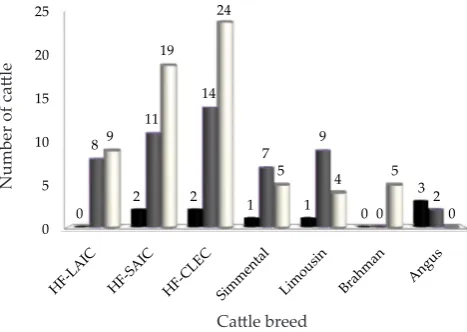
-type. Identiication of the GHRH gene polymorphism in catle has been done by PCR-RFLP using HaeIII restric-tion enzyme by Moody et al. (1995) who reported the presence of two types of alleles, namely A and B alleles with three kinds of genotypes, namely AA, AB and BB genotypes. The diversity of GHRH|HaeIII gene in HF catles and beef catles (Simmental, Limousin, Brahman, and Angus) were indicated by the number of genotypes that appeared from each breed (Figure 4).
Genotype and Allele Frequencies of the GHRH Gene
Results of the GHRH|HaeIII gene analysis showed that the frequency of the BB genotype (0.584) in dairy cows in LAIC, SAIC, and CLEC was higher compared with the AB genotype frequency (0.371) and the AA genotype frequencies (0.045). For beef catle at CLEC showed that freuency of the AB genotype (0.486) was
M 1 2 3 4 5 6 7 8 9 10 11 12 13 14
400 bp
100 bp
451 bp
Figure 1. Growth hormone releasing hormone gene ampliica -tion results in 1.5% agarose gel. M= Marker; No. 1-14 = Number of sample.
Figure 2. Primer position, PCR product and the diference in growth hormone releasing hormone gene sequences (GenBank access number AF242855) and HaeIII re-striction enzyme. The botom line shows the primer; bold text shows the restriction site; bold underlined shows the mutation site; A allele has A base sequence at position 4474; B allele has C base sequence at posi -tion 4474.
M 1 2 3 4 5 6 7
400 bp 300 bp
200 bp
100 bp
312 bp
194 bp
118 bp 94 bp
45 bp
AA BB AB AB AB AB AB
Figure 3. Growth hormone releasing hormone gene fragment using PCR-RFLP method with HaeIII restriction en-zyme on 2% agarose gel. M= Marker; 1-7= Number of samples; AA, AB, BB= Genotype.
Figure 4. The diversity of GHRH|HaeIII gene (■= AA; = AB;
□= BB) in Holstein Friesian and Beef Catle. HF catle= Lembang AIC/LAIC (♂), Singosari AIC/SAIC (♂), and Cipelang LEC/CLEC (♀); Cipelang LEC Beef Catle (♀)= Simental, Limousin, Angus and Brahman.
RINI ET AL. Media Peternakan
%) ))" #$ / !$%('! / $ !&"$ . !&"$ ))" . !#$)" !#%*(!$ $*( $ ' #$
!*' !+'(!),% - $ !$ %"()!$ '!(!$ $ ))"
Catle breed
Num
ber o
f c
at
le
'%2/# '02)'61',+ ,$ #+# *-)'$'!1',+ /#02)10 '+ %/,0# #) ,1# /(#/ , 2* #/,$ 0*-)#
'%2/# /'*#/ -,0'1',+ -/,"2!1+"1&# "'$$#/#+!#'+ %#+# 0#.2#+!#0 #++( !!#00 +2* #/ +" #01/'!1',+ +65*#
higher than those of the AA (0.135) and the BB (0.378) ones. Brahman beef catle had the only BB genotype (1.000). Frequencies of the AB genotype in Simmental (0.538) and Limousin (0.643) were higher than those
of the AA and the BB genotypes. For Angus catle, fre
-quency of the AA genotype (0.600) was higher those of the other genotypes. Genotype and allele frequencies of the GHRH gene of HF catle and beef catle are shown in Table 1.
Frequency of the B allele (0.770) for HF bulls in LAIC, SAIC, and HF cows in CLEC was higher than
that of the A allele (0.230). Further, frequency of al
-lele A and B of HF bulls in LAIC, SAIC, as well as HF cows in CLEC were succesively 0.235 and 0.765; 0.234 and 0.766, as well as 0.225 and 0.775. For beef catles in CLEC showed frequencies of both the A and B alleles were in Simmental for 0.346 and 0.654, Limousin 0.393 and 0.607, and Brahman 0.000 and 1.000. Brahman catle were monomorphic as the only B allele was found. However, diferent occasion was found in Angus catle, as the A allele had a higher ferquency (0.800) than the B allele (0,200). Moody et al. (1995) also found the same condition in Angus catle for a high frequency for the A allele (0.700).
Previous study of genetic diversity of the GH gene|AluI in HF dairy catle at the same these livestock breeding stations by Misrianti et al. (2012) reported that all HF catle observed had only two genotypes, namely LL and LV genotypes, without VV genotype. Frequencies of the LL genotype reported very high
compared to the LV genotype, were 0.84-0.95 vs. 0.05
to 0.16. Genotype frequencies of the GHR|AluI gene in
native/local catles and some commercial beef catles as reported by Zulkharnaim et al. (2010) reported also three
types of AA, AG, and GG genotypes. Genotype frequen
-cies of Bali catle were for AA (0.988), GG (0.006) and AG (0.006), stated that as a monomorphic evidence of this gene. Contrastly, genotype frequencies of this gene were mostly diferent for Limousin GG (0.667), AA (0.238) and AG (0.095), Simmental AG (0.529), GG (0.471) and AA (0.000), Pesisir AA (0.604), GG (0.375) and AG (0.021) stated as polymorphic evidences.
Dybus & Grzesiak (2006) in their study on the evaluation of the diversity of GHRH gene with milk
production in Poland dairy catle. From that study iden
-tiied three genotypes and two alleles, by the genotypes of AA (0.0545), AB (0.3133) and BB (0.6322); as well as
by the alleles of A (0.2111) and B (0.7889). Cows hav
-ing AA and AB genotypes were reported of produc-ing more fat in their milk. In similar to the previous study, Szatkowska et al. (2009) reported for Jersey catle that the AA cows produced a higher fat composition but a lower milk production compared to those of the AB or BB cows. The results indicatet that genetic polymorphism of a certain fragment of the GHRH|HaeIII gene could be used as MAS for selecting breeding cows for having high genetic ability in producing milk fat and other milk composition.
According to Cheong et al. (2006), the GHRH gene was such a genetic marker for meat production. They reported that there was a relationship between genotype diversity of GHRH gene with the percentage of carcass weight and muscular parts of longisimus in Korean native beef catle (Hanwoo). The results showed that the GHRH gene diversity could be an important factor in afecting meat and carcass in beef catle.
Hardy-Weinberg Equilibrium
Focussing in HF dairy catle, results showed that HF bulls in SAIC and HF cows on CLEC were in Hardy-Weinberg equilibrium; while focussing in beef catle showed that Simmental and Limousin were in Hardy-Weinberg equilibrium with Chi-squared value χ2 <χ2
(0.05).
The values of Hardy-Weinberg equilibrium analysis in the GHRH gene as tested by Chi-square (χ2) are shown
in Table 2.
Hardy-Weinberg law states that the frequency of genotypes in a large population should always be in bal -ance when there were no selection, migration, mutation and genetic drift (Noor, 2008). However, the Hardy-Weinberg equilibrium in HF cows in LAIC, Brahman and Angus catle in CLEC could not be calculated be -cause they were not qualify of Hardy-Weinberg testing.
Heterozygosity
Heterozygosity value is the most accurate way to measure the genetic diversity of population (Nei & Kumar, 2000). Heterozygosity values are inluenced by number of samples, number of alleles and allele frequencies. Javanmard et al. (2005) suggested that heterozygosity values below 0.5 (50%) as an indicator of a low variation of a gene in the population. The results Breed
(heads)* Source
Genotype Allele
AA AB BB A B
Holstein Friesian HF ♂
(17) LAIC 0.000(0) 0.471(8) 0.529(9) 0.235 0.765 HF ♂
(32) SAIC 0.063(2) 0.344(11) 0.594(19) 0.234 0.766 HF ♀
(40) CLEC 0.05(2) 0.35(14) 0.600(24) 0.225 0.775 Sub total (89) 0,045
(4) 0.371(33) 0.584(52) 0.230 0.770 Beef catle
Simmental ♀
(13) CLEC 0.077(1) 0.538(7) 0.385(5) 0.346 0.654 Limousin ♀
(14) CLEC 0.071(1) 0.643(9) 0.286(4) 0.393 0.607 Brahman ♀
(5) CLEC 0.000(0) 0.000(0) 1.000(5) 0.000 1.000 Angus ♀
(5) CLEC 0.600(3) 0.400(2) 0.000(0) 0.800 0.200 Sub total (37) 0.135
(5) 0.486(18) 0.378(14) 0.378 0.622 Note: (...) *= Number of samples; ♂= Bulls; ♀= Cows; LAIC= Lembang
Artiicial Insemination Center; SAIC= Singosari Artiicial Insemi -nation Center; CLEC= Cipelang Livestock Embryo Center. Table 1. Genotype and allele frequencies of the growth hormone
releasing hormone (GHRH) gene
showed that heterozygosity values of HF catle ranged from 0.344 to 0.471 (Table 3). The observed heterozygos -ity values were greater than the expected heterozygos-ity values for the exection in HF bulls in SAIC. The highest heterozygosity value of 0.471 was found in HF bulls in LAIC. The observation heterozygosity values in beef catle ranged from 0.000 to 0.643. The lowest heterozy -gosity in beef catle was in Brahman catle due to no any variation in its genotype (0.000), whilst the highest one was in Limousin catle (0643). A high heterozygosity value showed the diversity of the GHRH|HaeIII gene in the population was high.
Based on the analysis, it was also showed that Ho and He values in HF bulls and HF cows were almost similar (Ho= 0.371 and He= 0.355). This similar occasion
was also found in beef catle (Ho= 0.486 and He= 0.470). However, a diferent occasion occurred in Limousin catle that resulted a higher heterozygosity value (Ho= 0.477 and He= 0.643). Generally, the expectation for a high heterozygosity value is that as a genetic identiier in explaining level of genetic diversity in a population of domestic livestock (Moioli et al., 2004).
Fixation Index
Fixation index can be used to determine breeding patern and selection in population. The value of ixation index could be positive or negative, it was inluenced by selection, inbreeding, and assortative mating. The high-est ixation index value was in SAIC HF catle (0.046A), whilst the lowest one was in CLEC (-0.003A and -0.003B)
(Table 4). Fixation index values in this study were spreading. These indicated that there was no-occurrence of ixation of GHRH gene or no identifed one allele type, meaning for a random mating still occurring. Further, the GHRH gene was in ixation in Brahman beef catle in CLEC due to a monomoric occurence.
Note: (...) *= Number of samples; ns= not signiicant at level α= 0.05, nc= not calculable; χ2 (0,05)= 3.84; ♂= Bulls; ♀= Cows; LAIC= Lembang Artiicial Insemination Center; SAIC= Singosari Artiicial Insemi -nation Center; CLEC= Cipelang Livestock Embryo Center.
Breed (heads)* Source χ2
Holstein Friesian
HF ♂ (17) LAIC nc
HF ♂ (32) SAIC 0.057 ns
HF ♀ (40) CLEC 0.001 ns
Sub total 0.186 ns
Beef catle
Simmental ♀ (13) CLEC 0.467 ns
Limousin ♀ (14) CLEC 1.691 ns
Brahman ♀ (5) CLEC nc
Angus ♀ (5) CLEC nc
Sub total 0.044 tn
Table 2. Hardy-Weinberg equilibrium of growth hormone re -leasing hormone (GHRH) gene
Note: (...) *= Number of samples; ♂= Bulls; ♀= Cows; LAIC= Lembang Artiicial Insemination Center; SAIC= Singosari Artiicial Insemi -nation Center; CLEC= Cipelang Livestock Embryo Center.
Breed (heads)* Source Ho He
Holstein Friesian
HF ♂ (17) LAIC 0.471 0.360
HF ♂ (32) SAIC 0.344 0.359
HF ♀ (40) CLEC 0.350 0.349
Sub total 0.371 0.355
Beef catle
Simmental ♀ (13) CLEC 0.538 0.453
Limousin ♀ (14) CLEC 0.643 0.477
Brahman ♀ (5) CLEC 0.000 0.000
Angus ♀ (5) CLEC 0.400 0.320
Sub total 0.486 0.470
Table 3. Heterozygosity values (Ho) and expected (He) of growth hormone releasing hormone (GHRH) gene
Note: LAIC= Lembang Artiicial Insemination Center; SAIC= Singosari Artiicial Insemination Center; CLEC= Cipelang Livestock Embryo Center.
Source Allele FISki
Holstein Friesian
Lembang AIC A -0.307
B -0.313
Singosari AIC A 0.046
B 0.040
Cipelang LEC A -0.003
B -0.003
Sub total A -0.045
B -0.050
Beef Catle
Simmental/Cipelang LEC A -0.189
B -0.189
Limousin/Cipelang LEC A -0.350
B -0.346
Brahman/Cipelang LEC A 0
B 0
Angus/Cipelang LEC A -0.250
B -0.250
Sub total A -0.033
B -0.038
Table 4. Index ixation value of growth hormone releasing hor -mone (GHRH) gene in Holstein Friesian and beef catle
CONCLUSION
higher frequency in B allele. HF and beef catle are in Hardy-Weinberg equilibrium, with low level diversity of the GHRH|HaeIII gene in HF catle. This result will improve the understanding of the polymorphism of GHRH gene in dairy and beef catle.
ACKNOWLEDGMENT
The authors acknowledge the head of Lembang Artiicial Insemination Center, Singosari Artiicial Insemination Center, and Cipelang Livestock Embryo Center for providing blood samples.
REFERENCES
Achtung, T. L., D. S. Buchanan, C. A. Lents, S. M. Barao, & G.
E. Dahl. 2001. Growth hormone response to growth hor -mone-releasing hormone in beef cows divergently selected for milk production. J. Anim. Sci. 79: 1295-1300.
Allendorf, F. W. & G. Luikart. 2007. Conservation and The Ge-netic of Population. Blackwell Publishing, Australia. Anderson, L. L., S. Jeftinija, & C. G. Scanes. 2004. Growth Hor
-mone secretion: molecular and cellular mechanism and in vivo approaches. Exp. Biol. Med. 229: 291-302.
Bizine, R., I. Miceikiene, L. Baltrenaite, & N. Krasnopiorova. 2011. Association between growth hormone gene poly -morphism and economic traits in pigs. Vet. Med. Zoot. 56: 27-31.
Cheong, H. S., D. H. Yoon, L. H. Kim, B. L. Park, Y. H. Choi, E. R. Chung, Y. M Cho, E. W. Park, I. C. Cheong, S. J. Oh, S. G. Yi, T. Park, & H. D. Shin. 2006. Growth hormone-re -leasing hormone (GHRH) polymorphisms associated with carcass traits of meat in Korean catle. J. BioMed. Cent. 7: 1471-2156.
Cho, E. S., D. H. Park, B. Kim, W. Y. Jung, E. J. Kwon, & C. W. Kim. 2009. Association of GHRH, H-FABP and MYOG polymorphisms with economic traits in pig. J. Anim. Sci. 22: 307-312.
DGLAH (Directorat General Livestock and Animal Health). 2011. Livestock and Animal Health Statistic. Ministry of Agriculture, Republic of Indonesia, Jakarta.
Dybus, A. & W. Grzesiak. 2006. GHRH/HaeIII gene polymor-phism and its associations with milk production traits in Polish Black-and-White catle. Arch. Tierz. Dummerstorf 49: 434-438.
Frajman, P., V. Margeta, & G. Kralik. 2008. Candidate genes for slaughter traits in pigs. Krmiva. Zagreb. 5: 267-273. Franco, M. M., R. C. Antunes, H. D. Silva, & L. R. Goulart.
2005. Association of PIT1, GH, and GHRH polymorphism with performance and carcass traits in Landrance pigs. J. Appl. Genet. 46: 195-200.
Hartman, M. L. 2000. Physiological Regulations of Growth Hor -mone Secretion. 2nd ed. Cambridge University Press, UK. Jakaria, D. Duryadi, R. R. Noor, B. Tappa, & H. Martojo. 2007.
Evaluasi keragaman genetik hormone pertumbuhan (GH) pada sapi pesisir Sumatera Barat menggunakan penciri. Med. Pet. 30: 1-10.
Javanmard, A., N. Asadazadeh., M. H. Banabazi., & J.
Tavako-l�a�. 2005. The allele and genotype frequencies of bovine pituitary speciic transcription factor and leptin genes in Iranian catle and bufalo populations using PCR-RFLP. Irianian J. of Biotechnol. 3: 104-108.
Kim, E., A. Goren, & G. Ast. 2007. Alternative splicing: current perspective. Wiley Periodicals, Inc., BioEssays 30: 38-47. htp://dx.doi.org/10.1002/bies.20692
Kmiec, M., I. K. Luczak, H. Kulig, A. Terman, H. Wierzbicki, & A. Lepczynski. 2007. Associations between GHRH/HaeIII
restriction polymorphism and milk production traits in a herd of dairy catle. J. Anim. Vet. Adv. 6: 1298-1303. Misrianti, R., A. Anggraeni, E. Andreas, & C. Sumantri.
2012. Growth hormone gene polymorphism and its as -sociation with partial cumulative milk yields of Holstein Friesian dairy catle. Med. Pet. 35: 145-151. htp://dx.doi. org/10.5398/medpet.2012.35.3.145
Moioli B., F. Napolitano, & G. Catillo. 2004. Genetic diversity between Piedmontese, Maremmana, and Podolica catle breeds. J. Hered. 95: 250-256. htp://dx.doi.org/10.1093/ jhered/esh032
Moody, D. E., D. Pomp, & W. Barendse. 1995. Restriction frag-ment lenght polymorphism in ampliication products of the bovine growth hormone releasing hormone gene. J. Anim. Sci. 73: 3789.
Nei, M. & S. Kumar. 2000. Molecular Evolution and Phyloge -netics. Oxford University Press, New York.
Nei, M. 1987. Molecular Evolutionary Genetics. Columbia Uni -versity Press, New York.
Noor, R. R. 2008. Genetika Ternak. Penebar Swadaya, Jakarta. Piatkowska, E. C., M. Szewczuk, & S. Zych. 2011. Association
between genetic polymorphism of growth-hormone-re -leasing hormone and the yield, chemical composition and technological parameters of cow milk. Arch. Tierz. Dum -merstorf 54: 323-325.
Pierzchala, M., T. Blicharski, & J. Kuryl. 2003. Growth rate and carcass quality in pigs are related to genotype at loci POU1F1/RsaI (Pit1/Rsa1) and GHRH/AluI. J. Anim. Sci. 21: 159-166.
Rejduch, B. 2008. Genes associated with production and health in farm animals. J. Cent. Eur. Agric. 9: 829-836.
Sambrook, J., E. F. Fritsch, & T. Maniatis. 1989. Molecular Cloning, A Laboratory Manual. 2nd ed. Cold Spring Har-bour Lab. Press, New York.
Shingu, H., K. Hodate, S. Kushibiki, Y. Ueda, E. Touno, M.
Sh��oda, & S. Ohash�. 2004. Hormonal and lactational re-sponses to growth hormone-releasing hormone treatment in lactating Japanese black cows. J. Dairy Sci. 87: 1648-1693. htp://dx.doi.org/10.3168/jds.S0022-0302(04)73321-4 Shingu, H., K. Hodate, S. Kushibiki, E. Touno, A. Oshibe, Y.
Ueda, M. Shinoda, & S. Ohashi. 2008. Efects or growth hormone-releasing hormone treatment on milk production and plasma hormones and metabolites in lactating Japa-nese Black cows under negative energy balance. J. Anim. Sci. 87: 1247-1253. htp://dx.doi.org/10.2527/jas.2008-1220 Sumantri, C., R. Diyono, A. Farajallah, A. Anggraeni, & E.
Andreas. 2010. Pemanfaatan famili gen hormon pertum -buhan (GH, GHR, GHRH dan PIT-1) untuk mendeteksi keragaman genetik kerbau di Kabupaten Pandeglang dan Lebak Provinsi Banten. JITV. 15:286-296.
Sumantri, C., M. Imron, Sugyono, E. Andreas, M. Restu, & A. B. L. Ishak. 2011. Growth hormone gene family (GH, GHR, GHRH, and Pit-1) polymorphisms and its associa -tion with superovula-tion response, ovula-tion rate and em -bryo quality in Em-bryo Transfer Station (BET) of Cipelang. JITV 16: 127-140.
Szatkowska, I., A. Dybus, W. Grzesiak, M. Jdrzejczak, & M. Muszyska. 2009. Association between the growth hormone releasing hormone (GHRH) gene polymorphism and milk production traits of dairy catle. J. of App. Anim. Res. 36: 1. htp://dx.doi.org/10.1080/09712119.2009.9707044
Weir, B. S. 1996. Genetic Data Analysis II : Method for Discrete Population Genetic Data. 2nd ed. Sinauer Associates. Sun -derland.
Zulkharnaim, Jakaria, & R. R. Noor. 2010. Identiikasi ker -agaman genetik gen reseptor hormon pertumbuhan (GHR|Alu I) pada sapi bali. Med. Pet. 33: 81-87. htp:// dx.doi.org/10.5398/medpet.2010.33.2.81