Working Papers in
Urban Language &
Literacies
______________________________________
Paper
91
Enregisterment, agency & language
shift: Kazakh as baby talk
Juldyz Smagulova (
KIMEP University)
2012
Enregisterment, agency and language shift:
Kazakh as baby talk
JULDYZ SMAGULOVA KIMEP University
Language Center
2 Abai Avenue, Almaty 050010, Kazakhstan
[email protected] and [email protected]
Abstract
The paper examines how babies in urban Kazakh families are socialized into being Russian-speaking through an analysis of code-switching in baby-directed talk. Drawing on work on registers and footing, I show that Kazakh is systematically enregistered as ‘baby talk’– a specific register directed to infants and toddlers in their preverbal stage. I suggest that through this metapragmatic typification of linking Kazakh to talking with and like babies adults re-produce powerful social stereotypes associating Russian with more autonomous agency and thus status, power, authority and knowledge. I further argue that such language practice contributes to maintenance of Russian among urban Kazakhs despite official and grass-root level revitalization efforts in independent Kazakhstan. (Language socialization, language shift, code-switching, agency, register, baby talk, Kazakh, Russian, Kazakhstan)
Introduction
This paper examines cross-generational language practices among linguistically and culturally russified urban Kazakhs. The prime focus of the chapter is on spontaneous caregiver-child interactions in the home setting. The investigation is further narrowed down to bilingual
grandparents’ language choices in talk directed to a preverbal child. The aim of the analysis is to provide an initial outline of local processes linked to ongoing language shift from Kazakh to Russian. One of the main things that drew my attention to baby talk was an observation I made after listening to my recordings of family interactions: the audio recordings of adult-child interaction in urban Kazakh families showed a remarkable difference in the adult’s language choices between talking to babies and talking to older kids. It was hard to ignore that babies were more likely to be addressed in Kazakh. Naturally, this observation raised questions: In a situation of ongoing language shift from Kazakh to Russian, how and why has Kazakh become linked to a specific register of talking to young children? What might be the implications of these language socialization practices for processes of language shift?
I begin answering these questions by first showing that shift to Kazakh systematically co-occurs with other features of ‘baby talk’ – a specific register directed to infants and toddlers in their preverbal stage (Fergusson 1964, Garrett 2008, Ochs, Solomon & Sterponi 2005). I then demonstrate that Kazakh tends to be used for pretend, play and scripted activities, and for marking sequence boundaries in talk, while Russian is used for real, serious and authority-laden activities and main talk. Finally I examine the relationship between code-switching and whether adults perceive the baby as an object of minding or an independent social actor by looking closely at physical and non-verbal actions as well verbal practice in adult-child interaction. I suggest that through enregistering Kazakh as baby talk, adults reproduce a social order which privileges Russian and devalues Kazakh by indexically linking choice of Kazakh with
Background information
The history of Kazakh in urban areas has been one of rapid displacement of Kazakh as a home language by Russian. The process of language shift among urban Kazakhs was similar to language loss by immigrant families. Relocation to a city, demographically, politically and socially dominated by Russians and Russian-speaking Slavs, was akin to moving to another country: after settling in a city, Kazakh monolingual speakers became bilingual in Kazakh and Russian; their children grew up monolingual Russian speakers. A peak in Russian orientation came to the 1960s and 1980s, when an increasing number of Kazakh parents adopted Russian as the language of child-rearing. The absence of Kazakh-medium schools after the educational reforms of the late 1950s allowing free parental choice of the language of education resulted in massive language shift in urban areas, leading to the formation of a Russian monolingual generation or at best, passive bilinguals.
After 1991 independence, there have been considerable state and grass-root level efforts to restore Kazakh as an official language and revive it as a home language in urban families. However, amid physically palpable transformation of broader political and public discourse in favor of Kazakh and largely successful reinstatement of Kazakh as a language of the state, education, and mass-media (Smagulova 2008), the shift to Russian among urban Kazakhs continues. There are real forces that continue to outweigh ethnic loyalty and potential socio-economic benefits of knowing Kazakh. In urban areas, the use of Kazakh is still associated with rural backwardness, lower social status, lower quality of education, and limited economic opportunity. Even though the presence of Kazakh in urban areas has increased dramatically, Russian remains a dominant choice in urban public domains, a regional lingua franca, a
“language of wider econotechnical communication” (Fishman 2002: 673), and popular culture.
Theoretical framework
The paper is based on the overarching argument that language shift is rarely a direct result of macro-level socio-political or economic processes. Kulick suggests that
“[t]o evoke macrosociological changes as a ‘cause’ of shift is to leave out the step of explaining how such change has come to be interpreted in a way that dramatically affects everyday language use in a community” (1992:9),
and in line with this, I will argue that in order to understand the causes and nature of language shift, we need to take a closer look at local language practices such as child-adult everyday interaction.
My analysis of child-adult interaction relies on the approach developed within language socialization research (see Schieffelin & Ochs 1986 for a programmatic paper and Duranti, Schieffelin & Ochs 2011 for the edited volume of current research). This examines child-directed talk “within its socio-cultural and historical context, as a practice influenced by a community’s ideologies concerning care giving, childhood, development, learning, competence, and communication” (Ochs, Solomon & Sterponi 2005:552). Central for language socialization enquiry is a focus on language and other semiotic resources as both a means and endpoint of the socialization process (ibid). This dynamic view recognizes that language is not only “a tool to express, represent, or transmit ideas from one speaker to another”, but also a powerful tool of socialization and the “production of experience”:
Specific linguistic forms come to be regularly and conventionally associated with particular situational features in such a way that when the form is used it evokes the larger contextual frame. (Budwig 2001:295)
Ochs & Schieffelin (1986) argue that such an indexicality-based model allows researchers to explain not only why children acquire particular linguistic forms, but also why they do not, despite the presence of the form in the input from experts. So the analysis of language
socialization practices helps to explain why and how children may not be learning the languages of their bilingual or multilingual communities. In multilingual communities, different languages may be valued differently, and adults’ practices of language choice and code-switching may signal the values attached to each language. Through their participation in social activities involving code selection, children acquire values associated with each code and this cultural knowledge impacts on the acquisition of codes (Ochs & Schieffelin 2006:188).
The focus of the present paper is on code-switching in child-adult interactions as one among a range of semiotic resources available to speakers. For my examination of code-switching, understood as “systematic, skilled, and socially meaningful” (Woolard 2004:74), I have adopted conversation analytic and interactional sociolinguistic approaches (Agha 2005, Auer 1998, Gafaranga 2010, Goffman 1981, Rampton 1995 and 2006, Schegloff 2007). Code-switching is one of the many contextualization strategies available to speakers (Auer 1984b; Halmari & Smith 1994). In fact, referring to Goffman, Cromdal & Aronsson (2000) argue that code-switching is a prototypical way of accomplishing shifts in footing – it accomplishes a variety of actions within a single encounter, both in terms of production formats and participation frameworks. For the current analysis understanding code-switching as a contextualization cue allows me to focus on local codes, Kazakh and Russian, as means of creating meaning here and now, and to examine the relationship between code-switching and subtle shifts in footing during a single interaction. While I do not deny “the existence of transcontextual meaning potential” in Kazakh and Russian, as majority/minority language, prestige language, dominant language, ethnic language, official language, etc. (cf Cromdal & Aronsson 2000:453), these are not taken as “consequential prior or apart from the interaction” (ibid).
Language practices such as code-switching or voicing that are taken for granted and seem natural are “semiotic transformations or effects” (Gal 1998:321). Therefore,
“the task is to explicate how linguistic forms, when interpreted through particular linguistic ideologies, come to be seen as evidence of the moral, intellectual, aesthetic qualities of speakers and to demonstrate that, when linked to ideas about knowledge, identity, groupness, and beauty, linguistic ideologies provide the justification for widely varying political arrangements” (Gal 1998:329).
By observing signifying practices such as code-switching, register shifts and voicing, we can gain insight into some of the key mechanisms through which the language ideologies come to structure language use, and how the sociolinguistic change takes place.
The analysis of code-switching and register shift in child-directed talk in this paper is based on two of Agha’s arguments about register. Firstly, encounters with registers are
“encounters in which individuals establish forms of footing and alignment with voices indexed by speech and thus with social types of persona, real or imagined, whose voices they take them to be” (Agha 2005:38). In other words, registers are not only associated with specific semiotic repertoires, but also with culturally recognized activities, actors, interlocutor’s roles and
show that a shift to the baby talk register creates a particular social occasion, indexing interactional roles and relationships in a particular type of social practice.
Data collection and analysis
The paper draws on self-recorded audio data of natural interaction between adults and children at home in one urban family (out of four who participated in my study), and there is a specific reason for selecting this subset for analysis. Many middle-aged and younger adults have a reduced command of Kazakh, so their use of Russian for interacting with children is no longer based on choice. I wanted, though, to avoid posing an adult’s lack of proficiency in Kazakh as the only cause of language shift, as is often claimed by parents and teachers in Kazakhstan. Instead, I wanted to explore whether the implicit language ideologies surfacing in caregivers’ everyday language practices might motivate the maintenance of Russian in urban areas. In consequence, my analysis paper focuses on language practices of bilingual grandparents for whom Russian is a second language.
In this family, I made about twenty hours of audio recordings over a period of three months (November 2006 – January 2007), followed by 5 hours during May 2008. I annotated all the interactional audio data, and then gave a broad transcription to all the self-recordings by the grandfather (about 7 hours)1. In this subset of data, I then selected episodes of talk around or with the baby that contained code-switching between Kazakh and Russian (around 200 minutes), I transcribed this in greater detail, and analyzed episodes of baby-directed talk in the most
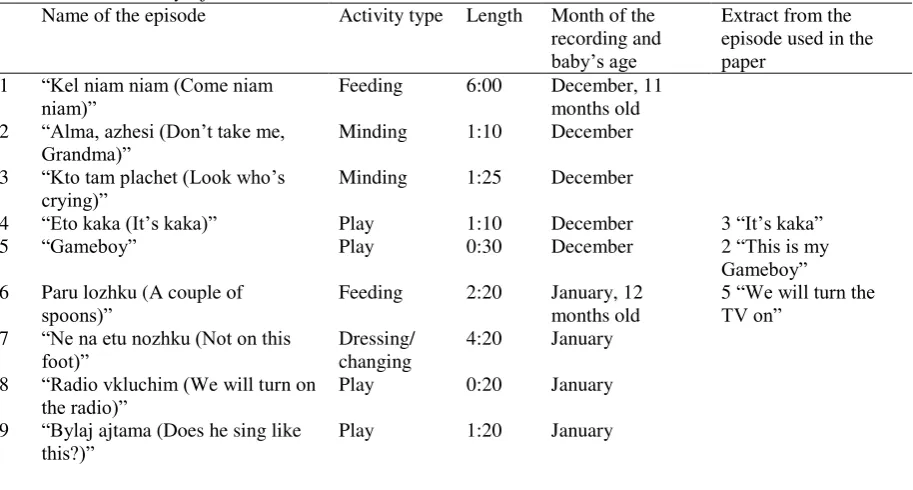
frequently occurring child-centered activities, which I divided into three broad categories: nurturing (e.g., feeding, changing, soothing, and minding – merely being present to ensure the child’s safety), pedagogizing (e.g., labeling, prompting and questioning) and entertaining (e.g., play, games, singing songs, listening to music, playing on game consoles and watching TV). The total time of these episodes is 34 minutes 45 seconds. Play activities are the most frequently occurring material in the data and the selection below reflects this. There are 12:55 minutes of play activities. This is followed by feeding activities (10:20 minutes), minding activities (6:35 minutes), and dressing/changing activities (6:00 minutes):
TABLE 1. Summary of data.
Name of the episode Activity type Length Month of the recording and
niam)” Feeding 6:00 December, 11 months old
2 “Alma, azhesi (Don’t take me,
Grandma)” Minding 1:10 December
3 “Kto tam plachet (Look who’s
crying)” Minding 1:25 December
4 “Eto kaka (It’s kaka)” Play 1:10 December 3 “It’s kaka”
5 “Gameboy” Play 0:30 December 2 “This is my
Gameboy”
6 Paru lozhku (A couple of
spoons)” Feeding 2:20 January, 12 months old
5 “We will turn the
10 “Pokazhi iazyk i glaza (Show me
your tongue and eyes)” Play 1:00 January
11 “Vot tak nado (Do like this)” Play 1:30 January 12 “Ladno vstan” (Okey, get up)” Dressing/
changing
1:40 February, 13 months old 13 Miachik kerek pa? (Do you want
to play ball?)” Play 6:00 February 4 “You want the ball”
14 “Tak, deti, segodnia sadik kak vam? (Well, kids, how was the
Unfortunately, there are no previous studies of the baby talk register in Kazakh or Kazakh-Russian bilingual families, but both my personal experience as a mother and my fieldwork observations allow me to conclude that it involves many of the language modifications found in Anglo-European cultures (Ervin-Trip & Strage 1985, Ferguson 1964, Mitchell 2001, Ochs, Solomon & Sterponi 2002, Ringler 1981, Snow 1977, Snow & Ferguson 1977). In general, caregivers in the urban Kazakh families I have observed modify their speech by making it grammatically, syntactically and lexically simpler and redundant. The pitch of their voice when talking to babies is higher, vowels are often lengthened, the pace is slowed, and prosodic contours are exaggerated. They also tend to use more interrogatives and affectives and the topic of the talk is limited to the here-and now. Below is the list of some of the features of baby talk that I frequently encountered in my data:
TABLE 2. Selected features of baby talk in participant families.
Level Features
Phonology Slower pace, exaggerated intonation, longer pauses, increased rhythmicity, vowel lengthening, high pitch, volume variation
Morpho-syntax Simple, short sentences, use of diminutives and other affective markers, present tense, speaker in third person, addressee in third person
Lexicon Limited vocabulary, special words, endearments
Discourse Repetitions, interrogatives, vocatives, praising, taking the baby’s turn
After laying out the preliminaries, let me now offer a detailed analysis of code-switching in baby-directed talk.
Kazakh as baby talk
In this section I show that the practice of talking to babies is linked to speaking Kazakh. Auer argues that “establishing coincidence between language alternation and change of footing is the most important evidence for the alleged use of code-switching as a contextualization strategy” (Auer 1984a:18-19), and in line with this, I demonstrate that code-switching in baby-directed talk tends to co-occur with other features of the baby talk register, indicating that code-switching to Kazakh is one of the contextualization cues signaling the shift in activity and/or speaker’s and addressee’s alignment.
‘Repetitions’ refers to the repetition of elements in prior tone units. I have selected these
particular categories not only because they are very prominent features of the baby talk but also because they are comparatively easy to recognize and classify in my sample, unlike speech acts such as commissives or constatives.
The quantitative data clearly points to differences between child-directed talk in Kazakh and in Russian. Specific features of baby talk such as expressing affection and asking questions make up more than half of the utterances in Kazakh. At the same time, baby-directed talk in Kazakh is much more likely to be modified phonologically by pitch raising.
TABLE 3. Comparison of frequencies of ‘baby talk’ features in Kazakh and Russian.
Tone unit features Kazakh Russian
Total number of tone units (also shown as lines in transcript)
199 110 Directives 18 (9%) 55 (50%) Praising 1 (0.5%) 4 (3.6%) Affectives 61 (30.7%) 5 (4.5%) Interrogatives (rhetorical) 29 (19.6%) 5 (4.5%) Interrogatives (1st pair part) 10 (5%) 4 (3.6%) Displays distinct phonological modifications 155 (77.9%) 41 (37.3%) Repetitions 43 (21.6%) 19 (17.3%)
The two examples that follow illustrate this, and demonstrate that code-switching is one of the contextualization cues signaling register shift. In the first example, we can see the different language choices that the grandfather makes when addressing his older and younger
grandchildren. His language choice during this exchange is typical for two grandparents in this family: Kazakh is used almost exclusively in their talk between themselves as well as in their self-talk, probably because it is their dominant language. In contrast, when conversing with their older grandchildren, they tend to speak Russian with rare inclusions of Kazakh. What is
noteworthy in this episode is the difference in the adult’s language choices when addressing the older children and the baby. The grandfather talks Russian exclusively with his preschool
grandchildren, but as soon as his attention is re-focused on the baby, he switches to the baby talk register, which coincides with a code switch to Kazakh.
(1) “Segodnia sadik kak vam? (How was kindergarten today?)”
Sagi (Grandad), Edige (Baby, 13 months old), and the 6-year old twins (Ernar and Dariga) are in the children’s room. Sagi is playing with Edige when the twins come and start searching for their Gameboy cartridges. The twins are focused on their task; they talk with each other as they go through the toys. The kids are facing the shelves standing along the wall and away from Sagi, who is sitting in the middle of the room. At this moment, Grandad Sagi decides to discuss their experience of school that day, but twins are not interested. (Kazakh is in bold. See appendix for transcription conventions.)
1. Grandad: ((loud, attention getter))↑TAK,
‘now’
2. (.)
3. ((resembles teacher talk, rising intonation))
segOdnia sadik KAK vam?
7. Dariga: ((hurriedly)) khorosho
‘good’
8. Grandad: ((slight disbelief)) ↑DA?
‘yes?’
9. ((imitating Dariga’s generally rather whining and lisping
speech style; higher pitch))
‘you didn’t fight with anyone?’
16. ((in Kazakh, with the intonation of self-talk))
mynAU qolyna TAghy tusipty ghoi.
The episode can be divided into two segments. In the first half (lines 1-14), Sagi interacts with his older grandchildren. In the second half he re-focuses his attention on the baby (lines 15-21). The episode starts when Sagi, having already spent the whole evening taking care of his
youngest grandson with minimal interaction with his older grandchildren, attempts to engage the 5-year old twins in conversation about school. He starts talking in a distinct teacher-like way (rising pitch and volume, careful articulation), projecting himself as a caring adult whose responsibilities include talking about school and social problems (line 1-2). Even though the twins show little interest in discussing school (a long silence in line 4 instead of a second pair part), Sagi tries hard to get the kids’ attention by calling them (lines 5-6). Finally Dariga gives a curt response to the question ‘how was kindergarten today?’ (line 3) - ‘good’ (line 7). Grandad immediately responds with an attempt to engage the children in conversation by doubting Dariga’s reply (‘really’ in line 8 and ‘you didn’t fight with anyone?’ in 9). However, as the kids continue to ignore him (another long silence in line 10), Sagi gives up his agenda and helps the twins with their search (line 11-12).
The grandfather’s baby-directed talk is bilingual, and it is significant that he switches to Kazakh after he switches to the baby talk register: he starts with an endearment in Russian characterized by high pitch, ‘my golden, my golden’ (lines 16-17), and then continuing in high pitch, he switches to Kazakh - “qajda kettin?” (‘where are you going’) (lines 20-21). This demonstrates how shifting to baby talk register and code-switching co-occur.
Extract 2 is another example of the co-occurrence of Kazakh and baby talk. It shows a 5-year old child shifting to the baby talk register when talking to his little brother, and in doing so, he also speaks in pretend Kazakh.
(2) “Eto moj Gameboy (This is my Gameboy)”
Just a minute earlier Ernar let the Baby (11 months old) hold his Gameboy. However, almost immediately he starts
pulling the toy out of the baby’s hands. Both grandparents are here with them so Ernar cannot use force and has to
find a way of getting the toy out of the baby’s grasp.
1. Ernar: ((slyly and softly while pulling his Gameboy from the
baby’s hands))
eto MO:J Gameboj,
‘this is my Gameboy’
2. ((high pitch, sing-song intonation))
erkENbAJ erkENbA:J,
‘nonsense + diminutive suffix, nonsense + diminutive suffix’
Lines 2-4 sound distinctively Kazakh despite being nonsense. There is no such word as “erken” in Kazakh, but it resembles the word “erke” which means ‘spoiled’ usually referring to a child. “Baj” is a productive diminutive suffix in child-directed talk, in creating male first names (e.g., Alibaj, Qunanbaj), and in everyday talk, it often negatively indexes Kazakh-ness (e.g., Qazaqbaj about a person who is ‘too Kazakh’). “Balam’’ translates as ‘mychild’ and is habitually used as a form of address to younger addressees. As in the previous examples, the shift to the baby talk register coincides with a shift to Kazakh. Ernar starts speaking in Russian by saying ‘this is my Gameboy’ (line 1), and this utterance is not marked either phonologically or otherwise. However in line 2, he switches to the baby talk register. Even though the boy does not speak the language, he pretends to talk in Kazakh while modulating his pitch, adding the diminutive suffix, and repeating the utterances. This exchange further substantiates the claim that Kazakh is a typical feature of the local baby talk register.
Agha maintains that “a register is social regularity: a single individual’s metapragmatic activity does not suffice to establish the social existence of a register unless confirmed in some way by evaluative actions of others” (2004:26). The ‘metapragmatic evaluation’ of language refers to “capacity of linguistic forms to index culturally recognizable activities, categories of actors” (ibid), and the existence of a register implies that certain types of metapragmatic typification not only occur, but also recur, in the evaluative behavior of many speakers (p.26). The examples above show that family members of different ages typify Kazakh in a similar way, assigning it the same metapragmatic meaning. Indeed, the data from two other families with babies, as well as my personal experience, confirm that many speakers in this particular community implicitly associate baby talk with Kazakh. Even those who do not speak the language frequently use Kazakh endearments when interacting with babies.
language choices? The following sections seek to answer this, revealing implicit ideologies organizing the local maintenance of Russian.
The functional distribution of Kazakh and Russian
In this section I will show how code-switching seems to signal shifts in speakers’ interpretation of the ongoing activities that they are engaged in. The data suggests that Kazakh tends to be used for pretend, play and scripted activities, while Russian is more likely to emerge in
non-play/serious and authority-laden activities. By privileging Russian for serious activities, adults systematically project children as fundamentally Russian-speaking.
The quantitative data in the previous section (Table 3) showed a dramatic difference in functional distribution of Russian and Kazakh. While grandparents speak more Kazakh than Russian to their infant grandchild, the bulk of the things they say in Kazakh are affectives and interrogatives (as is typical of baby talk). Together they make 55.3 percent of the tone units produced in Kazakh, while only 12.6 percent of the Russian sample are endearments and
questions. In contrast, half of the utterances in Russian are directives, compared to only 9 percent of the Kazakh sample. This striking contrast in language choices suggests that by relying on Russian for serious tasks and activities, the adults are reproducing a social structure where Russian is the dominant language. The example below exemplifies the pattern identified quantitatively, and shows how a language ideology privileging Russian is enacted in ritualized baby-adult interaction.
Extract 3 shows the contrastive use of Kazakh and Russian for play and non-play tasks. This interaction starts with Sagi expressing his endearment while hugging and kissing his grandchild (lines 1-3). Then Sagi invites the infant to play the pointing and labeling game by enquiring what the baby wants “ne kerek?” (‘what do you want’) in lines 8-13. But as soon as he lets the Edige move off his lap (line 15), the child either grabs or tries to reach for some object (line 16) which Sagi regards as unsuitable. He tells Edige that he does not need it ‘you don’t need this, it’s kaka’ (lines 17-22), gets up to put it away (line 23), and returns to asking what the child wants (lines 25).
(3) “Eto kaka (It’s kaka)”
Sagi (Grandad) and Edige (Baby, 11 months old) are sitting in the middle of the room. Edige is on his grandfather’s laps. Around them are various things and toys.
1. Grandad: ((very high pitch while kissing and hugging))
‘endearment’
Code-switching from Kazakh to Russian marks a shift in footing from play to serious authority-laden activity. It happens at the crucial moment when the caretaker prevents a potentially risky situation by intervening with ‘you don’t need this’ (line 17). A decrease in volume accompanies the shift to Russian, and this also seems to mark the seriousness of the situation (lines 17-25). But when the problem is resolved, grandad re-invites Edige to play and simultaneously, he shifts back to baby talk, switches to Kazakh, and speaks at normal volume (line 25).
This exchange illustrates several points. Firstly, it exemplifies the division of labor between Kazakh and Russian revealed in the quantitative analysis: affectives like ‘where is my golden?’ (lines 1, 3, 15 and 24) and interrogatives ‘what do you want?’ (lines 8, 10, 13, and 25) are in Kazakh, while warning ‘it’s kaka’, directing ‘look up there’ and informing ‘we will put it (here)’ are in Russian. Secondly, the exchange again displays the co-occurrence of Kazakh with other features of the baby talk register – phonological modifications, repetitions, use of
stereotypical endearments and rhetorical questions. Finally, the structure of the interaction sequences reveals that code-switching signals a shift from main talk to sequence boundaries. In this example serious main talk is in Russian (lines 17-22), it is bracketed by Kazakh. In fact, the flow of talk in Kazakh, involving ritualized prompts (‘tell me’in line 5), questions (‘what do you want?’ repeated in lines 8, 10, 13, and 25) and endearments in question format like ‘where is my golden?’ (line1) and ‘where is my dear?’ (line 3), allow the caregiver to maintain conversation-like engagement in an adult-baby interaction when there is little expectation of verbal reply. Snow (1977) argues that the use of turn-passing devices such as questions are “directed towards keeping the conversation going” (p. 20), and as these turn-passing units are often not followed by any behavior which could be interpreted as communicative, speakers are “forced into conversational repair procedures such as repetition or taking the baby’s turn” (p.20). So all in all, Kazakh maintains a pretend conversation, and quite often it sounds like self-talk. This resonates well with the first point: Kazakh and Russian are not only used contrastively for play vs. real activities, but also for pretend vs. real talk.
After that, he answers his own question (line 3) and repeats it three more times (lines 7-9), subsequently making the baby kick the ball (lines 11 and 13). (From what I observed earlier, he lifts Edige and slightly swings him, so that the child’s feet push the ball). The episode finishes with Sagi urging the child to kick the ball by himself.
(4) “Miachik kerek (You want a ball)”
Grandad is playing with his grandchild (Baby, 13 months old) in the children’s room. The child must have pointed or otherwise communicated that he is interested in the ball. Grandad responds by initiating a pointing and labeling game and then starts teaching the child to kick the ball.
1. Grandad: ((lines 1-9 are high pitch))NE kerek?
7. Grandad: ((lines 7-9 in sing-song intonation))miachik kerek,
‘(you) want the ball’
14. ((soft, almost whispering, urging))
ajDA tep tep tep.
‘come on, kick it, kick it, kick it’
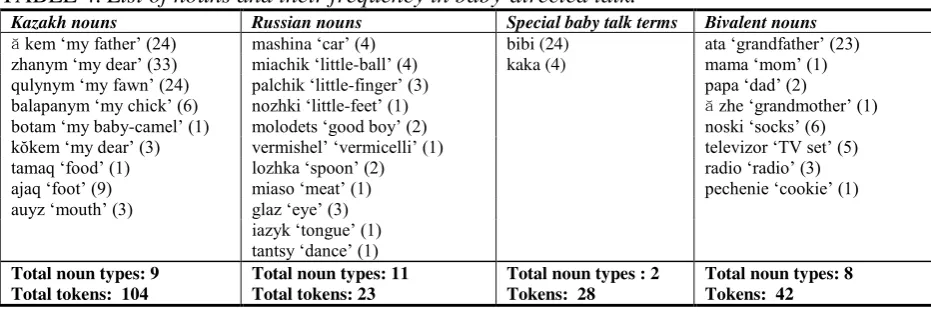
Although the matrix language in the above exchange is Kazakh, the labeling of the object is in Russian – grandad uses the Russian “miachik” (‘ball’) throughout, and this strategy of supplying Russian words is systematic and consistent. The table below shows all the nouns used by the grandparents in the sample of 16 episodes of baby-directed talk listed at the beginning of the paper (Table 1). The numbers in parenthesis show the number of the noun tokens:
TABLE 4. List of nouns and their frequency in baby-directed talk.2
Kazakh nouns Russian nouns Special baby talk terms Bivalent nouns
ӑkem ‘my father’ (24) mashina ‘car’ (4) bibi (24) ata ‘grandfather’ (23)
zhanym ‘my dear’ (33) miachik ‘little-ball’ (4) kaka (4) mama ‘mom’ (1)
qulynym ‘my fawn’ (24) palchik ‘little-finger’ (3) papa ‘dad’ (2)
balapanym ‘my chick’ (6) nozhki ‘little-feet’ (1) ӑzhe ‘grandmother’ (1)
botam ‘my baby-camel’ (1) molodets ‘good boy’ (2) noski ‘socks’ (6)
kŏkem ‘my dear’ (3) vermishel’ ‘vermicelli’ (1) televizor ‘TV set’ (5) tamaq ‘food’ (1) lozhka ‘spoon’ (2) radio ‘radio’ (3) ajaq ‘foot’ (9) miaso ‘meat’ (1) pechenie ‘cookie’ (1) auyz ‘mouth’ (3) glaz ‘eye’ (3)
The table shows that the number of tokens of Kazakh nouns is much higher than the occurrence of Russian nouns (104 vs. 23). However, closer inspection reveals that the list of Kazakh nouns consists mostly of nouns used as a part of endearment formulas. The first six nouns in the left-most, Kazakh column appear in the caregivers’ talk only in a possessive form, and that leaves only the last three that were used to label the objects around the child (13 tokens). On the other hand, the list of Russian nouns used outside endearment formulas is four times longer (3 Kazakh nouns vs. 11 Russian nouns) and their number of tokens is almost double (13 tokens vs. 23 tokens). This quantitative data shows clearly that the adults tend to label the objects around the baby in Russian. In doing so, they enrich the child’s repertoire with Russian lexical items while providing relatively little new input in Kazakh. Again, these language practices suggest that the adult conceives of the child as fundamentally Russian-speaking.
Further evidence that the adults see the baby as Russian-speaking comes from observing Sagi engage the child in the verbal game of labeling in Kazakh. Sagi was pointing at the body parts and naming them in Kazakh: “ajaq”(‘foot’), “bas”(‘head’), “kŏz”(‘eye’), “qulaq” (‘ear’). But then he prompted Edige to repeat by saying “Skazhi ajaq” (‘Say foot’), revealing that he perceives Kazakh only as a second language for the child. So even in this attempt to teach some Kazakh, we can see that the caregiver regards the baby as primarily Russophone, needing to learn Kazakh through Russian.
To sum up: Kazakh in baby-directed talk is more likely to emerge in pretend or highly ritualized activities. Russian, on the other hand, is used for real and authority-laden activities. This differentiated practices perpetuates the social dominance of Russian and shows that caretakers project children as principally Russian-speaking.
Code-switching and the child’s agency
In this section, I develop the argument that patterns of code-switching are related to whether the adult perceives the baby as an object of minding or as an independent social actor. I explore this relationship by looking closely at physical and non-verbal actions as well as speech in two episodes of adult-child interaction.
The first example illustrates code-switching triggered by the shift in the baby’s perceived alignment, and it occurs at the end of a feeding activity. The excerpt starts when baby Edige pushes the tray and makes a protesting sound. Grandad interprets these non-verbal actions as a request to let the child down from the chair. He agrees to stop the feeding with ‘okay’ (line 3) and ‘let’s take it off’, referring the tray (line 4). But before doing so, it sounds as though he still has some things to do, and so to distract the baby, he starts talking very loudly about his
intention to turn on the TV, which is presented as a really exciting activity for the child (lines 6-7). (In fact, the TV set isn’t turned on later; right after the episode finishes, they move to the children’s room to play.) In lines 9 and 11, Sagi asks Edige to wait, and up to this moment, he has been speaking Russian. But then, when he takes the tray off and takes the baby down, he switches from Russian into Kazakh and the baby talk register, using numerous repetitions and endearments in high pitch (lines 12-22).
(5) “Televizor vkluchim (We will turn the TV on)”
Sagi (Grandad) is almost done feeding Baby (12 months old) his supper. The baby is in a high chair, Sagi is on the chair facing the child. Now the baby wants to get down, he shows that by pushing the tray of his high chair.
1. Baby: ((pushing the tray of his high chair)) ah 2. (.)
3. Grandad: ((quietly)) ladno;
‘okay’
4. ((almost whisper)) davaj snimem.
5. (.) ((around this time he clears the tray))
6. ((loud))↑chas teleVIZOR vkluchim,
‘now we will turn the TV on’
7. ((fast))VKLUchim VKLUchim televizor,
‘we turn on, we will turn on the TV’
17. ((higher pitch, sing-song intonation))ayuzin sŭrtem
‘(I) will wipe your mouth’
18. ((very high pitch, sing-song intonation))
ayuzin sŭrtemin.
21. ((high pitch))menim zhanym QA:Jdeken osyndai?
‘where is such a soul of mine’
22. ((long pause, activity finishes, Baby runs away))
What happens in line 12 that can explain the dramatic shift from Russian to Kazakh? It is still the same ongoing task – rounding up the feeding activity –and the adult’s alignment is broadly the same. What appears to be different is the way Sagi treats the child: at the beginning, the infant is construed as a social actor who has some “agentive resistance” (Scollon 2001) and may throw a tantrum if not distracted. However, in the second part of the episode, the baby is handled as a “non-person”, on whom certain actions are carried out: Edige is taken out of the chair, put down on the floor, held, and his mouth is wiped. All this is accompanied by baby talk in Kazakh, and Sagi also switches to 1stperson singular ‘I’ (lines 15-17), presenting himself as the only actor in this situation. In short, it seems to be a shift in perception of the child’s agency that triggers the shift in code and register.
begins playing her role by saying that she will catch the baby (line 4). This is followed by Sagi’s feigned fright (line 5), and the two adults continue the exchange until line 14.
(6) “Pojmaju pojmaju (I will catch you)”
Anar (Grandma) is playing cards with the twins; Sagi (Grandad) with Edige (Baby, 13 months old) on his lap are watching them. A few minutes before this episode Anar (Grandma) has played a catching game with the baby which he appeared to be thoroughly enjoying. Several turns earlier Sagi commented that Edige wants to play more. This episode captures the second round of the catching game.
1. ((Grandma is playing cards with the twins))
2. Grandad: ((teasingly as he swings the baby to and away from
Grandma, inviting her to play))
5. Grandad: ((pretend panic, high pitch))uuuu
6. (.)
15. ((Grandma disengages and turns her attention to the
card game, it’s her turn to play))
During this sequence Sagi talks in an especially dramatic way with very high pitch and
extremely exaggerated intonation, suggesting that he is ventriloquating for the child, projecting Edige as an independent player who has initiated the game. The use of the 1st person singular pronoun ‘me’ in utterance ‘you won’t catch me’ (lines 10 and 11) supports this interpretation, and in speaking for the baby like this, Sagi not only constructs him as Russian-speaking but also projects him as a discursive agent with his own intentions and something to say.
In line 15, however, Grandma disengages from playing with the baby and refocuses on the game of cards with the twins, and this shift is marked by Sagi’s code-switching from Russian to Kazakh, even if it still sounds as a continuation of the game (lines 16-18). At this point Sagi stops playing the baby’s part and moves into a typical baby talk ‘we-view’, using endearments (line 19) and discursively merging himself with the child ‘we will run away’ (lines 16 and 18). At the same time, he gets very physical: he hugs, squishes, and then kisses the baby.
be positioned as objects upon which adults carry out actions such as picking up, holding,
hugging, kissing, feeding, undressing and dressing, and in my data, this type of speech co-occurs with Kazakh and the baby talk register. But child-directed talk can also ascribe “social agency to the infant even when there is little behavioral possibility of agency” (Scollon 2001: 88), and in the examples above, we have seen Sagi speaking on behalf of the baby and interpreting his actions as meaningful, all in Russian. More generally, when adults perceive the child as a more active agent capable of protesting, showing his will, or following instructions and obeying the rules, they again tend to switch to Russian. Likewise, where grandparents issue directives, warn, urge, agree, prohibit, or do anything implying agency on the child’s part, this also occurs in Russian.
Scollon argues that by the second year of a child’s life, child-directed talk moves “predominantly into the domain of acceding agency to the child by others and by the child’s increasing assertion of social agency” (Scollon 2001:88). By that time, a child also moves to the verbal stage of his or her development and the need for baby talk diminishes. A study by Kaye (1980) comparing the speech of 36 mothers to their children during their first year of life and then two years later, shows a decrease in the modifications characteristic of the baby talk register (among other things), and attributes this to the infant’s status changing from a potential to an actual conversant. So we should not find it surprising that Kazakh, co-occurring strong with baby talk, a register used with ‘non-persons’, fades out of the caregiver’s speech by the time the child reaches his second birthday.
Concluding discussion
In this paper, I have analyzed primary language socialization practices in-depth. My goal has been to identify implicit language ideologies that contribute to the ongoing maintenance of Russian, in spite of widespread aspirations for the revitalisation of Kazakh. Analysis of baby-adult interaction in urban Kazakh homes shows that baby-adults project young pre-verbal children as being fundamentally Russian-speaking.
The data reveals that speaking Kazakh is indexically linked to the practice of talking to babies. Drawing on Agha’s work on registers and Goffman’s work on footing, I have shown that code-switching in baby-directed talk co-occurs with other features of the baby talk register, such as pitch and volume modifications, syntactic and lexical simplification, extensive use of special lexicon and endearments. I have argued that this code-switching is one of the contextualization cues signaling the shift in activity and/or speaker’s and addressee’s alignment.
I have also argued that adults are more likely to use the baby talk register, and consequently Kazakh, when they construct the child interactionally as a ‘non-person’, as someone with a low level of agency. Adults are more likely to speak Kazakh when they are handling the baby physically as an object of minding, for example, hugging and kissing the child, picking it up, changing his/her clothes. In contrast, speaking Russian tends to emerge when the child is treated as a more independent social actor capable of following instructions and obeying rules. So issuing directives or agreeing with the baby is typically in Russian. In this way, caretakers re-produce powerful social stereotypes about what it means to be adult, independent, powerful and knowledgeable.
Metapragmatic practices and typifications like these lead predictably to a diminishing use of Kazakh in child-directed talk, when the time comes to move beyond the baby talk register. This in turn feeds language shift to Russian. A new parent often starts speaking to her newborn in both Kazakh and Russian, hoping to raise a bilingual child, but then gradually stops using any Kazakh by the time the child moves beyond the pre-verbal stage. I have heard the story so many times from other parents, and I have personally repeated this journey with all three of my
children. But only now, after taking a very close look at the child-adult interactional practices at a micro-level, have I been able to gain some understanding of why and how children grow up monolingual in Russian despite their caregivers’ commitment to raise bilinguals.
References
Agha, Asif (2004). Registers of language. In Alessandro Duranti (ed.), A companion to linguistic
anthropology, 23–45. Oxford: Blackwell.
_______ (2005). Voice, footing, enregisterment. Journal of Linguistic Anthropology 15:38–59. Auer, P. (1984a). Bilingual conversation. Amsterdam: Benjamins.
_______ (1984b). On the meaning of conversational code-switching. Ergebnisse und Methoden Moderner
Sprachwissenschaft 20:87–112.
_______ (1998). Codeswitching in conversation. London: Routledge.
Budwig, Nancy (2001). Language socialization and children’s entry into schooling (preface to special issue). Early Education & Development 12(3):295–302.
Cromdal, Jakob, & Aronsson, Karin (2000). Footing in bilingual play. Journal of Sociolinguistics 4 (3):435–457.
Duranti, Alessandro, Ochs, Elinor, & Schieffelin, Bambi (eds.) (2011). The handbook of language
socialization. Oxford: Blackwell.
Ervin-Trip, Susan, & Strage, Amy (1985). Parent-child discourse. In van Dijk (ed.), Handbook of
discourse analysis, Vol. 3, 67–77. London: Academic Press London.
Ferguson, Charles (1964). Baby talk in six languages. American Anthropologist 66 (6/2): 103–114. Fishman, Joshua (2002). Language shift reversal. In R. Mesthrie (ed.), Concise encyclopedia of
sociolinguistics, 673–378. Oxford, UK: Elsevier.
Gafaranga, Joseph (2010). Medium request: Talking language shift into being. Language in Society 39:241–270.
Garrett, Paul (2008). Researching language socialization. In Kendall King, & Nancy Hornberger (eds.),
Encyclopedia of Language and Education. 2nd edition, Vol. 10: Research Methods in language
and Education, 189–201. New York: Springer.
Gal, Susan (1998). Multiplicity and contention among language ideologies: A commentary. In Bambi Schieffelin, Kathryn Woolard & Paul Kroskrity (eds.), Language Ideologies: Practice and theory, 317–331. Oxford: Oxford University Press.
Goffman, Erving (1981). Forms of talk. University of Pennsylvania Press.
Halmari, Helena, & Smith, Wendy (1994). Code-switching and register shift: Evidence from Finnish-English child bilingual conversation. Journal of Pragmatics 21(4):427–445.
Kaye, Kenneth (1980). Why don’t we talk ‘baby talk’ to babies. Journal of Child Language 7:489–507. Kulick, Don (2005 [1992]). Language shift and cultural reproduction. Cambridge: Cambridge University
Press. Oxford: Oxford University Press.
Mitchell, Robert (2001). Americans’ talk to dogs: Similarities and difference with talk to infants.
Research on Language and Social Interaction 34(2):183–210.
Ochs, Elinor, Solomon, Olga, & Sterponi, Laura (2005). Limitations and transformations of habitus in child-directed communication. Discourse Studies 7(4-5):547–583.
Ochs, Elinor & Schieffelin, Bambi (2006). The impact of language socialization on grammatical development. [online]. Available from: https://files.nyu.edu/bs4/public/Bambi--Website_Assets
/BBS%20PDFs/ LangSocGramDevel_cpt.pdf. [accessed on 16 May, 2008].
Rampton, Ben (1995). Crossing: Language and ethnicity among adolescence. London: Longman. ________ (2006). Language in late modernity: Interaction in urban schools. Cambridge: Cambridge
University Press.
Ringler, Norma (1981). The development of language and how adults talk to children. Infant Mental
Health Journal 2(2):71–83.
Schegloff, Emanuel (2007). Sequence organization in interaction: A primer in conversation analysis. Cambridge: Cambridge University Press.
Schieffelin, Bambi, & Ochs, Elinor (1986). Language socialization. Annual Review of Anthropology 15:163–191.
Smagulova, Juldyz (2008). Language policies of Kazakhization and their influence on language attitudes and use. International Journal of Bilingual Education and Bilingualism 11(3&4):440–475. Snow, Catherine (1977). The development of conversation between mother and babies. Journal of Child
Language 4:1–22.
Snow, Catherine, & Ferguson, Charles (eds.) (1977). Talking to children: Language input and
acquisition. Cambridge: Cambridge University Press.
Woolard, Kathryn (1999). Simultaneity and bivalency as strategies in bilingualism. Journal of Linguistic
Anthropology 8(1):3–29.
_______ (2004). Code-switching. In Alessandro Duranti (ed.), A companion to linguistic anthropology, 73–94. Malden, Mass.: Blackwell.
Appendix: Transcription conventions
Russian Russian
Kazakh Kazakh
Word badly distorted Kazakh
‘phrase’ semantic equivalent in English
(.) short pause
(3.0) pause of three seconds
= latching
word- word or sound is cut off
: lengthened sound
. fall-to-low intonation
? rise-to-high intonation , rise-to-mid intonation ; fall-to-mid intonation
baby underline indicates high pitch characteristic to baby talk
YES stress, emphasis
( ) inaudible talk
(word) talk is not clear
(()) stage directions
[] overlapping talk
↑ pitch step-up