Directing Of Documentary Bilingual “Lukisan Barong Gunarsa”
In Exspository Style
Nyoman Lia Susanthi 1, Ni Kadek Dwiyani 2, I Kadek Puriartha 3
Program Study of Television and Film, Faculty of Fine Art and Design, Indonesia Institute of The Art Denpasar
Latha Mahosadhi Museum of ISI Denpasar is a memorial place for displaying art objects. But the function of the museum as a center of art information cannot be realized because the information provided is only verbal information and not specific. So that information media is created in museum, namely bilingual documentary film. One of the interesting a film to be researched is “Lukisan Barong Gunarsa” by Nyoman Lia Susanthi as a director. The aim of this study is to determine the process of creating a documentary film that shows the side of Gunarsa as famous person and secret element that have never been published before. Based on it, documentary bilingual can be applied to other 127 objects collection. The method used qualitative. The data were obtained through observation, interview, and literature study. The result of this study was the director observed in three roles, such as: a leader, an artist and a technical advisor. The pre-production, the director created in the form of production concept, technical concept and story line. The concept of film was expository style with television documentary format using narrator as a single speaker. The director as a leader directed the cameraperson in taking pictures. In editing, director was involved directly in the process of arranging the images. The resulting visual beauty cannot be separated from the director’s firmness that directed the taking of beauty shot. The director as a technical advisor was able to take over the role of cinematography, sound and editing.
Keywords: documentary movie, Gunarsa, Barong Painting
Penyutradaraan Bilingual Dokumenter “Lukisan Barong Gunarsa”
Gaya
Exspository
Museum Lata Mahosadhi ISI Denpasar adalah tempat pemajangan benda seni baik dari Bali maupun luar Bali. Namun fungsi museum sebagai pusat informasi seni belum bisa terwujud karena informasinya hanya berupa verbal dalam Bahasa Indonesia dan tidak spesifik. Untuk itu dilakukan penelitian terkait media infor -masi efektif untuk museum yaitu bilingual dokumenter menggunakan 2 bahasa (Indonesia-Inggris). Salah satu bilingual dokumenter yang menarik untuk dikaji adalah film berjudul “Lukisan Barong Gunarsa” karya Ny -oman Lia Susanthi sebagai sutradara. Alasan memilih konten ini karena terdapat elemen rahasia yang belum dipublikasikan yaitu makna dan deskripsi lukisan. Dalam proses pembuatan film maestro berpulang, sehingga film ini benilai informasi tinggi. Tujuan dari penelitian adalah mengetahui penyutradaraan film dokumenter yang menunjukkan sisi intim orang terkenal yaitu Gunarsa.Dengan mengetahui penyutradaraan film ini, maka dapat juga diterapkan penciptaan bilingual dokumenter pada 127 benda koleksi museum. Metode yang digu-nakan untuk mengetahui manajemen produksi film adalah kualitatif. Data diperoleh melalui observasi, waw -ancara, dan studi pustaka. Hasil penelitian ini adalah sutradara dalam melahirkan film diamati dalam tiga peran yaitu sebagai pemimpin, seniman dan penasehat teknis. Saat pra produksi sutradara berperan besar melahirkan konsep penciptaan berupa konsep karya, teknis serta story line. Konsep karya menggunakan gaya exspository, format dokumenter televisi dengan narator sebagai penutur tunggal. Peran sutradara sebagai pemimpin yaitu mengarahkan kameramen dalam mengambil gambar sesuai tuntutan cerita. Tahapan editing sutradara terlibat dalam proses penyusunan gambar. Keindahan visual yang dihasilkan juga peran sutradara yang turut meng -arahkan pengambilan beauty shot. Sutradara sebagai penasehat teknis mampu mengambil alih peran teknis dalam sinematografi, tata suara dan editing.
Kata kunci: film dokumenter, Gunarsa, Lukisan Barong
INTRODUCTION
Movie directing is a process or way of directing a movie production. In movie directing, there is a director who has a major role to give direction and has responsible during the process of movie making from the beginning until the film aired. Similarly, in the process of making a documen -tary movie, the director is directly involved in the produc-tion process of documentary movie.
The Indonesian Art Institute of Denpasar has opened the TV and Movie Studies Program since 2013, thereby im-pacting the number of fiction movies and documentaries. One documentary movie making that is being worked from 2016 is a bilingual documentary movie on art ob-jects in Lata Mahosadhi Museum owned by ISI Denpasar. Museum Lata Mahosadhi of ISI Denpasar or commonly called the Documentation Center (Pusdok) is a museum as a place of displaying art objects both from inside and outside Bali. But the function of the museum as an art in-formation center cannot be realized yet because the pro-vided information is in the form of verbal information in Indonesian and not specific. Therefore, it is conducted the research related to effective information media then to be applied at Museum of Lata Mahosadhi ISI Denpasar. In the first phase of research, it was found that the effective information media applied in Lata Mahosadhi Museum ISI Denpasar is the device design of digital-based inter-active information display. The content of the display is made by researchers in the form of documentary bilingual that is a documentary movie in two languages (Indone -sian-English). In the first year of the research, there was a pre-production stage which resulted in the output of bilin -gual script (Indonesian-English) then it will be applied to documentary movie (Susanthi, 2017).
The second phase of research development is a further stage of pre-production process with bilingual manuscript output (Indonesia-English) that will be applied to docu -mentary movie according to the research model that was set in the first phase of research. The embodiment of art education media in 2 languages (Indonesia-English) will use collaboration of visual and verbal information in ac-cordance with the research result related to the prima -ry data including the field of karawitan art (Gong Gede (North Bali) and Angklung (South Bali), dance (Oleg Ta -mulilingan and Ciwa Nataraja Dance), painting (Gunarsa and Wianta) and mask art (Barong Bangkal and Arsa Wi -jaya Mask) (Susanthi, 2017).
Lata Mahosadhi Museum has 127 collections of art objects on display. The art collections are divided into a collection of performing arts and fine art and design. One of the art objects on display from fine art is a painting by Gunarsa entitles “Barong”. The importance of the museum’s func -tion is as a source of informa-tion, so that Nyoman Lia Su -santhi as film director created the information media for
the museum in the form of documentary films using 2 lan -guages. In the creating of documentary films there are sev -eral reasons for choosing the topic of documentary films, including problems, rare, showing the intimate side of fa -mous people, revealing secrets, historical information, and revealing uniqueness that has never been published. One of documentary bilingual that is interesting to produce is the “Barong” painting by a world’s great maestro of paint -ing I Nyoman Gunarsa. The reason of choos-ing the content is a secret element that has never been published before, that is the meaning and description of the painting. Be-sides, in the process of making this documentary bilingual in September 2017, I Nyoman Gunarsa passed away, so the value of this documentary is very useful.
The importance of the museum as a source of art infor-mation, it is necessary to create a similar documentary bilingual to the 127-museum collection objects. For this reason, the aim of this study is to determine the process of creating a documentary film that shows the intimate side of Gunarsa as famous person, who has been able to reveal a secret to the public regarding the unique way of creating paintings and descriptions of paintings, entitles “Barong” which is displayed at the Lata Mahosadhi Museum. Based on the directing of Gunarsa film documentary, it can be applied to the creation of documentary bilingual to other museum collection objects.
RESEARCH METHODS
In order to know the production process of director in pro -ducing bilingual documentary of “Barong” painting by I Nyoman Gunarsa by using expository style, hence qual -itative approach and descriptive qual-itative research de-sign are used in this study. Arikunto (2006) said that the qualitative descriptive is a research design to collect infor-mation about the findings that occurred when the research was conducted. Qualitative research obtains a clear picture of the facts in the research place are elaborated with no description in the form of numbers.
eliminating unnecessary data in this research. The data collected focuses on the director’s process of creating this documentary film; (2) data presentation, that is to de -scribe the research results narratively. The presentation of the data is in the form of scheme of mind mapping, a film script table and picture of the production process and film editing process; (3) verification or drawing conclusions from the problems of raised issues.
RESULTS AND DISCUSSION
In directing documentary bilingual “Lukisan Barong Gu -narsa” the director embodies the movie through 3 stages, they are pre-production, production and postproduction. The three stages are included in the production manage-ment of documanage-mentary movie. Production managemanage-ment is all activities of production management for the creation of a work in accordance with the design of production (Sa -rumpaet et al, 2012). The director is involved in all three stages, so in this discussion the task and role of director in this directing is divided into 3, that is director as leader, director as artist, and director as technical advisor.
The director of documentary film entitled “Lukisan Bar -ong Gunarsa” is Nyoman Lia Susanthi. She pursued the field of audiovisuals since 2002, which began a career working on one of local TV in Bali, Bali TV. Some of the works created in the field of audiovisuals were as producer TV program of “Dunia Pendidikan” since 2002 to 2006. She is a director in documentary film entitled “The Golden Story of ISI”, “Blood Mood Tetrad” “Tari Siwa Nataraja Sebagai Tari Kebesaran ISI Denpasar” and a director of the film “Lukisan Barong Gunarsa”. The film of Gunarsa is the result of research grant from Ministry of Research and Technology and Higher Education. Until now, she is still involved in the creation of several audiovisuals works, as director, producer, scriptwriters, narrator and editor.
Director as Leader
In directing the documentary film entitled “Lukisan Bar -ong Gunarsa” the film’s director became a leader at every stage in production management (pre-production, produc -tion and post produc-tion). The soul of leadership became the main capital of a director. Without leadership, the di-rector can never create the desired piece of art. In the pro-duction of this documentary movie, the director as a leader has provided an opportunity for members of the produc-tion team to freelance creativity, in accordance with their respective fields. In the pre-production stage, especially in finding ideas, the director was brain storming with pro -duction teams, such as screenwriters, camera stylist, light -ing stylist and editor. Brainstorm-ing is a creative think-ing technique used for movie production processes. This stage is also included in the planning meeting that aims to get abundant ideas from production team in a short time. In planning meeting, there is also a technique to solve prob-lems, generate ideas, and improve working spirit.
In the making process of this documentary movie, there were many ideas appeared for the production of the movie “Lukisan Barong Gunarsa” such as focusing on the biog -raphy or painting style of the maestro. All ideas were ac -commodated by the director, resulting in many ideas. The more ideas will have an impact on the number of choices, so as to choose the best from the good ideas. The stage of brainstorming was done 2-3 hours effectively. After the ideas were collected, then appeared the concept of mind mapping, concept of work, concept of technic and story line from the movie “Lukisan Barong Gunarsa”.
Mind Mapping
In order to get clear and focused movie direction, then the concepts of mind are mapped by making mind mapping. This helps the director and scriptwriter in making time to record problems in one keyword. Here is the mind map -ping of movie entitled “Lukisan Barong Gunarsa”:
Concept of Work
The concept of this movie used expository style with television documentary format as his trademark-using narrator as a single speaker (voice of God). This style of documentary relies on the logic of manuscript information spoken by the narrator (Ayawaila, 2008). The image serves as a supporting role and acts according to what the narrator says. The movie structure is divided into three, namely the first is part of the introduction, the middle is problems, and the end is a conclusion. This movie genre uses a portrait or biographical genre that is designed using two-languages narrative (Indonesian - English).
Concept of Technic
The concept of technic in this documentary movie applied the concept of cinematography, sound and editing. The concept of cinematography put forward static cinematog -raphy, and some dynamic shots. The static shot was used during interview and several shoots taking of collected objects in the museum. While dynamic shot using hand-held technique was to provide kinetic energy in every shot, which is especially made when shooting Gunarsa when re -viewing his museum with a spontaneous direct explana -tion. Light used more artificial light, especially during the interview scene with three-point lighting technique.
The concept of sound in this movie used 3 types of sound; they are dialog, ambience, and scoring. The type of dialog sound was used during the interview process towards the interviewee. The type of ambience served to describe the time and space of the scene by keeping the original sound of the scene. The type of scoring (background music) was used in scene with atmosphere reinforcement.
whole story. The technique used was continuity technique that made the audience flowing without any cuts. The on -line editing stage worked on audio, colorist and motion graphic.
Story Line
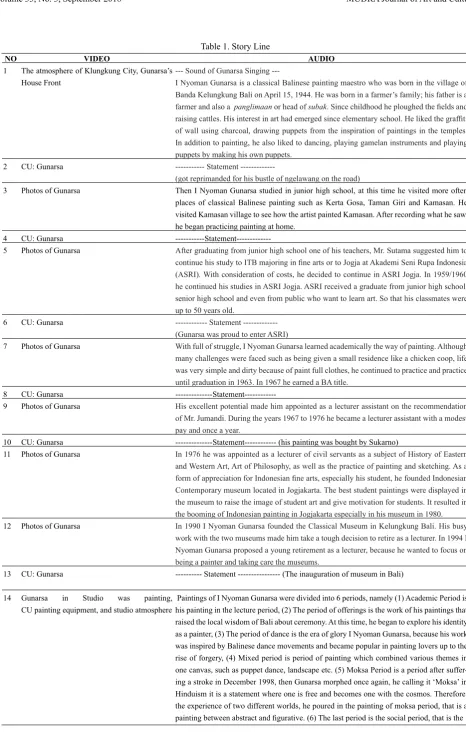
Story line in the documentary movie had been compiled in the previous year, when documentary research was con -ducted. Story line was used as a reference in the process of drawing or editing. From documentary research conducted by the method of in-depth interview and literature study, it bear narration in the story line as follows (Table 1)
The director as a leader also appeared at the production of documentary movie by directing the visuals to suit the needs of movie. When taking a visual interview, the direc -tor was also directly in duty as an interviewer. Interview materials had been prepared by the director based on the literature study by reading some books, newspapers and articles related to Gunarsa profile in the internet. Interview materials were developed and re-explored by the director based on direct interview with Gunarsa, including explor -ing the data of paint-ing entitled “Barong” which is dis -played in Lata Mahosadhi Museum of ISI Denpasar. When the production process, the director got a lot of data from the interviewee, so the director asked the two cameraper -sons to record visually the entire interview which is about 1 hour long.
At the time of post-production, director also directed and assisted the editor during the selection and arrangement of pictures from the production. The assisting of director in the editing process was done until the documentary mov -ie finished. Before the mov-ie was finished, the director re-evaluated by watching the whole movie using a mon -itor screen like the audience, so that input and evaluation were recorded for improvement. After that, the director as a leader was accountable on the work of movie in full.
Director as Artist
According to Adam (2018) an artist has a decision to de -termine the embodiment of his creation, because the artist has the inventiveness, taste and intention to express him -self in his artwork. In creating the artwork, the artist can also express his aesthetic experience with nature, social and culture into the artwork of his creation. In the mak -ing process of movie entitled “Lukisan Barong Gunarsa” then the director, as an artist was very concerned about the important point in the movie that is the visual effect. Therefore, the director as a creator was responsible on the final work of visual impressions. In order to get a good and artistic visual, director often watched similar shows or movies that are relevant to the movie work that was being created. Some choices of shots in the movie that was being watched can be a reference of shot for this visual documentary movie. By watching many reference movies and based on the director’s experience as a journalist and
producing several documentary movies, the director was expected to have a high taste of art and culture. The direc -tor had raised this sense when the movie production was held at Gunarsa Museum Kelungkung. To get the desired visuals, the director directed the cameraperson related to the needed shot in creating the movie artistically.
An artist is the first author to give meaning of his artwork that produced before the meaning developed by the appre-ciators (Saidi and Siregar, 2016). So that in editing process, a director as artist give some meaning. The director has an art sense related to color choices used for color grading. The director asked the editor to use the yellowish color to give the meaning of nostalgia in the movie. In addition, the director provided input for some images that had a time leap to be given a deep to black transition. The director chose music selection as the essence of art from the movie. So, the music was determined to give nostalgic and legend nuance that can be used in this movie. Some ambiences of obtained visual were also maintained by the director, such as Gunarsa’s song and gamelan music as part of the music illustration in the movie. This means that Gunarsa is multitalented figure. In creating, he uses his experience as dancer and musician. This is the strength of Gunarsa’s painting alive.
Director as A Technical Advisor
The role of director as a technical advisor was needed in the making process of documentary movie “Lukisan Bar -ong Gunarsa”. Some roles used by the director were as a cinematographic, audio and editing advisor.
Director as cinematographic advisor
Cinematography is art and technology and motion picture photography (FFTV-IKJ, 2008). In cinematography there are two aspects, such as the camera and lighting system. In the camera settings, the type of camera used is a DSLR camera that uses video format (digital). Two DSLR cam -eras used in this movie making were Canon DSDR 70D and 60D. Due to different types of cameras, the director directed to use image tonality (image quality and color) on both cameras using cinema mode. It was done to facilitate the editing process in coloring (color grading).
There were 4 stages in the shooting, they were visual tak -ing of interview, visual of museum review, visual of Gu -narsa when painting, visual of art object painting entitled “Barong displayed in Museum Lata Mahosadhi ISI Den -pasar” and visual of his photographs. The first visual in the interview, the director directed the cameraperson to use two cameras. One camera with close-up size and another using medium close-up size. When the visual of this in-terview, the director played a role in directing the camera person’s task to start and end the visual up taking.
NO VIDEO AUDIO
1 The atmosphere of Klungkung City, Gunarsa’s
House Front
Sound of Gunarsa Singing
---I Nyoman Gunarsa is a classical Balinese painting maestro who was born in the village of Banda Kelungkung Bali on April 15, 1944. He was born in a farmer’s family; his father is a
farmer and also a panglimaan or head of subak. Since childhood he ploughed the fields and
raising cattles. His interest in art had emerged since elementary school. He liked the graffiti of wall using charcoal, drawing puppets from the inspiration of paintings in the temples. In addition to painting, he also liked to dancing, playing gamelan instruments and playing puppets by making his own puppets.
2 CU: Gunarsa --- Statement
---(got reprimanded for his bustle of ngelawang on the road)
3 Photos of Gunarsa Then I Nyoman Gunarsa studied in junior high school, at this time he visited more often
places of classical Balinese painting such as Kerta Gosa, Taman Giri and Kamasan. He visited Kamasan village to see how the artist painted Kamasan. After recording what he saw,
he began practicing painting at home. 4 CU: Gunarsa
---Statement---5 Photos of Gunarsa After graduating from junior high school one of his teachers, Mr. Sutama suggested him to
continue his study to ITB majoring in fine arts or to Jogja at Akademi Seni Rupa Indonesia (ASRI). With consideration of costs, he decided to continue in ASRI Jogja. In 1959/1960 he continued his studies in ASRI Jogja. ASRI received a graduate from junior high school, senior high school and even from public who want to learn art. So that his classmates were
up to 50 years old.
6 CU: Gunarsa --- Statement
---(Gunarsa was proud to enter ASRI)
7 Photos of Gunarsa With full of struggle, I Nyoman Gunarsa learned academically the way of painting. Although
many challenges were faced such as being given a small residence like a chicken coop, life was very simple and dirty because of paint full clothes, he continued to practice and practice
until graduation in 1963. In 1967 he earned a BA title.
8 CU: Gunarsa ---Statement---
9 Photos of Gunarsa His excellent potential made him appointed as a lecturer assistant on the recommendation
of Mr. Jumandi. During the years 1967 to 1976 he became a lecturer assistant with a modest
pay and once a year.
10 CU: Gunarsa ---Statement--- (his painting was bought by Sukarno)
11 Photos of Gunarsa In 1976 he was appointed as a lecturer of civil servants as a subject of History of Eastern
and Western Art, Art of Philosophy, as well as the practice of painting and sketching. As a form of appreciation for Indonesian fine arts, especially his student, he founded Indonesian Contemporary museum located in Jogjakarta. The best student paintings were displayed in
the museum to raise the image of student art and give motivation for students. It resulted in
the booming of Indonesian painting in Jogjakarta especially in his museum in 1980.
12 Photos of Gunarsa In 1990 I Nyoman Gunarsa founded the Classical Museum in Kelungkung Bali. His busy
work with the two museums made him take a tough decision to retire as a lecturer. In 1994 I Nyoman Gunarsa proposed a young retirement as a lecturer, because he wanted to focus on being a painter and taking care the museums.
13 CU: Gunarsa --- Statement --- (The inauguration of museum in Bali)
14 Gunarsa in Studio was painting,
CU painting equipment, and studio atmosphere
Paintings of I Nyoman Gunarsa were divided into 6 periods, namely (1) Academic Period is his painting in the lecture period, (2) The period of offerings is the work of his paintings that raised the local wisdom of Bali about ceremony. At this time, he began to explore his identity as a painter, (3) The period of dance is the era of glory I Nyoman Gunarsa, because his work was inspired by Balinese dance movements and became popular in painting lovers up to the rise of forgery, (4) Mixed period is period of painting which combined various themes in one canvas, such as puppet dance, landscape etc. (5) Moksa Period is a period after suffer
-ing a stroke in December 1998, then Gunarsa morphed once again, he call-ing it ‘Moksa’ in Hinduism it is a statement where one is free and becomes one with the cosmos. Therefore, the experience of two different worlds, he poured in the painting of moksa period, that is a painting between abstract and figurative. (6) The last period is the social period, that is the
current period of 2016 which makes social phenomena occurs in the community as a paint
-ing. He also highlighted the social life that occurred in Indonesia by creating paint-ing. This identity makes his painting style different from the others. His works based on his ex -ploration of Balinese art, such as traditional dance, traditional music, religious ceremonial,
and environmental diversity affect many artists from Bali and Indonesia. His success is not obtained easily, he achieved it with full of struggle. After going through a period of realism, he finally chose the style of abstract expressionist painting and make Bali as the main theme of his works. During his career as a painter, Gunarsa has passed various stages in painting. His interpretation is based on the instinct and sweep of lines, dots and colors that produce image with aesthetic touch. He painted the line as he sang, put the color as he danced. Nyoman Gunarsa works based on his inspiration, he calls his painting style as space and mo
-tion. He usually paints using oil paint and watercolor. The results of his work show freedom, both in line and color, the usual objects can be overwhelming after the hands of Gunarsa. Through a stroke of color and irregular lines, he reveals that “the basic element in my paint
-ing is the rhythm”.
15 CU: Gunarsa
---Statement---16 The process of creating the flow of painting In the process of creating the paintings, I Nyoman Gunarsa usually starts with praying ac
-cording to Hinduism belief. Before painting, the concept of idea arises by making deep reflection, imagining the concept of painting to be created. Then he paints in his own style in which the preferred line or scratch should stand out, because the scratch is the breath of painting. Every scratch should be firm, should not hesitate. The second stage is the color compositions. A painter must be smart in combining color. Having a high taste for painters will bear an amazing and characterized masterpiece. His character in painting is sponta -neous, dynamic, and assertive. Each scratch is also accompanied by an inner motion to bear
a unique work. Deformation of form is created in his painting, so it lives harmoniously.
17 The works of Gunarsa paintings His work in Bali, especially in the field of fine art is also very high, he helped STSI Denpasar
which was under the leadership of Prof. Bandem to conduct pure art department by recom
-mending several names from Sanggar Dewata to become lecturers at STSI Denpasar. His dedication towards Balinese courtesy earned him the Ciwanataraja award from ISI Denpasar. I Nyoman Gunarsa has produced thousands of paintings scattered in various parts of the world. His two paintings are currently a collection of ISI Denpasar placed in Lata Mahosadhi
Museum ISI Denpasar.
18 Gunarsa’s paintings in Museum I Nyoman Gunarsa’s painting is entitled “Barong”. This painting was created specifically to be dedicated to STSI Denpasar at that time which is now ISI Denpasar. This Barong-style painting reflects how ISI Denpasar as an art education institution plays an important role in
preserving Balinese art and culture. In ISI Denpasar, there are many dances, gamelan music
which is staged during calonarang. One of the performed dance is Barong dance. Barong in his painting is a Barong in Kelungkung style seen from the barong fangs that are not long.
Through this donated Barong painting he was told to stay in love with our own art. He wants
this painting can remind and give inspiration to the younger generation to help preserving
the art of Balinese culture. For that a work must have a spirit, to seek the spirit, then a painter must work, and work, see and hear. All can be accomplished in a long time.
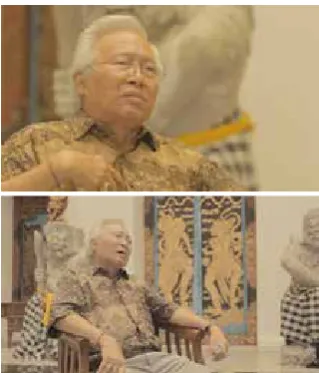
can cut some pictures from the whole space. The appeared space in the frame is called the space on screen. While the space that is not visible in the space is called off screen. In this documentary, the object was always in frame. Place -ment of objects for interview was placed on the right and left. While there were some frames for the insert image placed in the middle of the frame.
The second shot was inserted visual to complete the inter -view visual. From the inter-view result, the director added any visuals that were needed to be recorded. Then, he di -rected the two camera persons to share the task of taking insert pictures, i.e. one camera followed Gunarsa while visiting and explaining the content of museum, and anoth -er one to take the objects collected in museum with more artistic visual. In using this technique, the cameraperson used rigs aid to make the visuals more stable and flexible. In taking pictures for the visit to museum, the director used more shooting techniques by handheld camera that was di -rectly taken by cameraperson without using tripod aids. The handheld style was used to give a distinctive char -acter, in which the camera was moving dynamically and swaying to give a real (realistic) impression.
The director while shooting accompanied the first camera person and asked Gunarsa to be able to show some paint -ings he described in the interview that were the 6-period of his paintings. This image recording of camera 1 was the movement of the maestro when explaining the contents of museum and interspersed with chants of singing, dribbling and playing gamelan instrument unexpectedly. So, these moments were used by the director to record Gunarsa style in full when he explained some paintings, including art ob -jects displayed at the museum.
The third visual was Gunarsa while painting, which was also as a supporting picture of the interview. In this case, the director was asked directly by Gunarsa to be a model of his paintings. So, to get closeness with the speaker, the Figure 1. Several shots on screen that place objects on the right
or left side. Image source: Budiyana, 2017
Figure 2. Shot that used handheld camera to give a realistic impression Image source: Budiyana, 2017
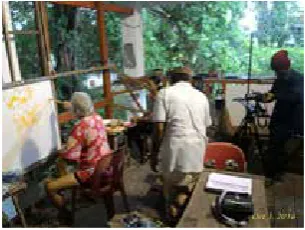
director accepted his offer as well as the director played a close observation of his painting style and conducted a light interview. In this case, the director directed the two camerapersons to record the process of his painting. Cam-era 1 took a wide picture of the painting process and style of him by using tools such as slider and tripod. Camera 2 took details on how to paint including the tools used for painting. By the use of these two cameras simultaneously it would get a lot of image variations to simplify the edit -ing process.
In making this documentary movie, the camera was pos -sibly to move freely in accordance with the aesthetic and narrative demands. So, the making of this documentary movie used several types of camera casts that functioned to follow the movement of a character or an object. The movement of this pan type (panorama) was to describe the scenery widely. The pan that is used horizontally (to the right and left or vice versa) with the camera position fixed on the axis. This technique was used to follow the charac -ters’ (objects) movement. Vertical camera movement (tilt) was also applied in the making process of this documen -tary movie, such as taking pictures of building, statue or other objects to make them looking magnificent.
The making of this movie used tracking shot assisted by a slider. The use of this tool resulted in varied camera movement such as: forward (track forward), backward (track backward), circular, side ways (track left / right). The movement of crane shot camera was also used in the making of this documentary movie. This movement was movement of floating above the ground by using crane, which generally produced high angle effects to illustrate the wide landscape situation (Pratista, 2017).
im-Figure 3. The movement of the tracking shot camera assisted by
a slider Image source: Budiyana, 2017
age and the shooting of painting detail. The cameraperson took images with still techniques and there was also cam -era movement.
Director set the objects position in the shot composition thoroughly to get certain motives. In this documentary movie shoot, the director used two types of image compo -sition that was symmetrical and dynamic. The symmetri -cal composition put the object exactly in the center of the frame; the portion of the right and left space was relative -ly balanced. Symmetrical composition in this documen-tary movie was to reveal the splendor and magnitude of objects, such as museum building, campus ISI Denpasar building, and etc.
While the dynamic composition was flexible and the object position could change in line with the frame movement. The dynamic composition didn’t have a balance compo-sition like a symmetrical compocompo-sition. This compocompo-sition used rule of thirds, imaginary line divided the image area into exactly three (Pratista, 2017). In shooting this movie, the cameraperson put a horizon line on the third line top or bottom and didn’t put the object in the middle.
To describe the painting entitled “Barong” which is dis -played at Museum Lata Mahosadhi ISI Denpasar, the di-rector directed the cameraperson to take images of activi -ties at ISI Denpasar including nameplate of ISI Denpasar, Lata Mahosadhi Museum atmosphere and also including paintings in museum display with title “Barong”. The di -rector directed the cameraperson to take visual paintings intact (wide) as well as closer or painting detail.
Other supporting visuals were in the form of Gunarsa’s photographs that were obtained from his biography book. The director directed the cameraperson to take some Gu -narsa’s photographs to be used when describing his profile. Approximately 50 photos were obtained as insert images in this documentary movie.
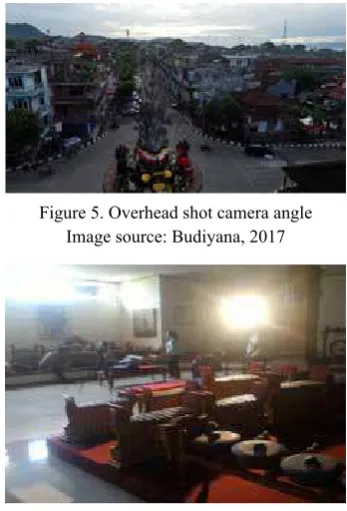
The camera angle was also a concern of the director. The camera angle is the viewing angle of the camera towards different objects in the frame. From the three camera an-gles that is high angle, straigh-on angle and low angle, in cinematography of this documentary movie used the
Figure 4. Dynamic composition Image source: Budiyana, 2017 three camera angles. Generally, the camera angle used was straight-on angle. Low angle camera was just to give the impression of a larger, dominant, confident and strong ob -ject. Conversely, low angle gave the impression that the objects look smaller, weak and intimidated. In addition, there were some images using overhead shot i.e. shot that was taken pointing perpendicularly downward, not show -ing the face or object, more display-ing image that look from above (Pratista, 2017).
Lighting can be grouped into four elements such as qual-ity, direction, source and color of light. The four elements formed the atmosphere and mood is the quality of light, direction, source, and color of light. The quality of light in this movie tends to produce bright light (hard light) to form more clearly objects and make the object looks in contrast with the environment. The direction of light re -fers to the position of the light source towards the object. The director of this movie used the direction of light that was divided into 3 (three points lighting) that is (1) frontal lighting that tends to remove the shadow and affirms the shape of an object or character face; (2) Side lighting that displays a shadow toward the side of the character body or shadow on the face; (3) Back lighting is able to display the dimension of the object background. Generally, three points lighting were used when shooting the interview ac -tivity.
In the making process of this documentary movie, the light source refers to artificial and natural lighting. Natural lighting is to use light as it is from the setting location that can be sourced from the sun. This lighting is widely used on several shots of insert images, establish shot. While ar-tificial light is to add light with lighting device such as lighting. The color of light used in this movie were 2 such as natural light source in white (sunlight) and yellow light (lamp).
Director as A Sound Advisor
Figure 5. Overhead shot camera angle
Image source: Budiyana, 2017
Figure 6. The use of lighting in interview
shooting Image source: Susanthi, 2017
Dialogue and monologue
Dialogues and monologues are one most important fac-tor in a sfac-tory movie. This movie used exposifac-tory style so the narrator as voice of God was supporting the narrative structure in the movie. The process of recording a dialogue or monologue can be done in two ways: direct and indi -rect. The advantages of recording live sound will reflect the mood of the speakers (Effendy, 2004). This movie used the sound recording of direct sources to get the atmosphere mood on shooting. Spoken language used two languages namely Indonesian and English that had been contained in the story line of documentary movie. In reading narration, the narrator used accents in accordance with the spoken language that was the Indonesian accent for Indonesian narration and the British accent for English naration.
Music
This documentary movie relies more on the natural sound obtained during shooting production, such as Gunarsa’s sound when singing Balinese song (metembang), play -ing puppets and play-ing Balinese gamelan instruments. Similarly, in the documentary movie of Ciwa Nataraja, the gamelan music accompanied the dance is heard in the movie. There was some music used in this movie, such as using gender music illustration for Gunarsa movie. This music illustration aimed to shape and strengthen the mood, story and main theme of documentary movie.
Director as Editing Advisor
The role of director as an artist also present during post-production. In this process, director had high taste in com-bining the collection of images with narrative stories. The director used the narration in form of voice over (VO) from
the narrator and the statement of the interviewee as the sto -ryline. Director, who had a background as a narrator, filled the voice first before the editing process. The results of this sound recording (VO) became a guide in the editing pro -cess. Director accompanied and occasionally determined and selected the visuals that can be used, such as the direc-tor directed the edidirec-tor to use some photographs of Gunarsa to describe his profile that tells the story of his life from elementary school until now. In the story line about Gu -narsa painting period, the director directed the editor to use visual of following Gunarsa while describing some of his paintings. Visual of painting process by Gunarsa was made with several sequences from the beginning of painting un -til the painting had finished. While the final section when describing the description of the painting entitled “Bar -ong” displayed at Lata Mahosadhi Museum ISI Denpasar, as visual insert was using images taken at the museum of ISI Denpasar, including the atmosphere of ISI Denpasar.
After the compilation of images, the director also played a role in determining the music illustration used. The direc-tor wanted the documentary movie of Gunarsa was made naturally, as well as in the illustration. The director used a realist voice from the recording, such as a sound when Gunarsa played traditional music intsrument, singing Bali -nese traditional song and played puppets. There were sev -eral sound effects, such as the sound of birds and rooster that were used only for the beginning of movie. Music il -lustrations were also featured on several movie scenes that aimed to strengthen the mood, nuance and atmosphere of a movie. The selected music illustration was gender to bring closer Balinese atmosphere and nuance.
Figure 7. Cut editing form, movement of picture A to B Image source: Budiyana, 2017
A B
A B
Figure 8. The form of fade editing, movement of image from A with the darkens intensity of the image and then it appeared to B
Simplify the editing process, two cameras were used si -multaneously that set image quality and color through the settings of contrast, brightness, color. Images can be ar-ranged dark and light, the color of the lighter and darker, it depends on the aesthetic demands. The contrast and bright-ness of the movie depends on the movie theme and genre. This documentary used contrasting and brighter aspects, different from horror fiction movie that tend to be dark. This aspect was used with cinema mode to get the clas -sic and impression of a more clas-sic and cinematic movie. The yellowish tone was chosen to match the background of this documentary story nuanced “nostalgia” (soft), that is to retell how the process of creating the “Barong” paint -ing, by Gunarsa. Yellow had a distinctive coloration with contrast and calm nuance.
Movement speed of image generally can be divided into two common techniques that are slow motion and fast motion. In this documentary movie, some part used slow motion and fast motion image speed. Slow motion tech -nique worked to give dramatic effects in the film, especial -ly some moments or events. This technique aimed to show the visual details to be conveyed to the audience. The im-portant role of cinematography in this documentary movie was the lens effect. Camera lens can provide the effect of depth, size and dimensions of an object or space.
Editing stage was done after finished shooting production. This stage assembled the shots that had been taken in ac -cordance with the needs of the script. This editing process used two types of editing that is continuous editing and discontinuous editing. Continuous editing was a direct shot shift without time jump. While discontinuous editing was a shot shift with a time jump.
Editing Forms
There are four forms of editing such as cut, fade-in / out,
dissolve and wipe. This editing process was most com -monly used in making this documentary. Of the four forms of editing, cut form was the most commonly used. Cut was used for continuous and discontinuous editing. Cut was a shot to shot transition directly. In the picture below shows that the shot of picture A immediately changed into shot B. Because the cut is flexible so that in the making of docu -mentary movie used cut for continuous editing.
In the making process of this movie did not use wipe form. Other editing forms used were dissolved and fade for dis -continuous editing. Dissolve was a shot transition where the image in shot A for a moment was stacked with shot B (as shown below). The use of this form was for significant time-shifting shot or change of room and place to avoid jump cut.
While the fade transition form was a gradual transition shot, where the image intensity gradually became darker until the entire frame was black and when it reappeared, the shot had changed to the image B. Fade was used in this movie editing at the beginning and end of the documenta-ry. Fade-in was used to open a scene while fade-out was to end the movie (editing). In addition, the fade form was used for significant time-shifting shots.
Editing Aspects
Editing technique controls the director on four basic areas such as graphic continuity, rhythmic, spatial and temporal. But in this documentary editing did not use editing tech-nique of graph continuity and spatial aspect. The rhythmic aspect was the role of the editor in controlling the dura -tion of a shot, so the editor was able to control the editing rhythm in accordance with its narrative and aesthetic de -mands. The rhythmic aspect was largely determined in the music illustration to determine the turn of the image to fit the tempo of music illustration.
The temporal aspect used in this documentary editing was closely related to continuous and discontinuous editing. In addition, this documentary used overlapping editing tech-nique that is placing atmosphere audio at the beginning of the image so that atmosphere audio acts as a common thread of some compiled shots.
Continuity Editing
This editing is an image editing to ensure continuity of a story action in a scene. Several collected shots aim to be able to tell the narrative clearly and coherently so as not to confuse the audience. Here’s a picture of arranging several shots into a scene.
The continuity editing rule used in the production of this documentary was the 180 ‘rule. This rule put the camera position not cross the line of action when the shot was done. Some 180 ‘rule were used when using multi cam -eras in interview process. The function of this rule was to Figure 9. Establish shot of Gunarsa movie
Image source: Budiyana, 2017
Figure 10. Cut-in editing, transitions of far shot (A to a closer shot (B) Image source: Budiyana, 2017
ensure the consistent position of objects in the frame.
In this movie, there are some establish shots that is a long-shot image to show the spatial relationship between the character and the background. The used establish shot was when the narrative told about Gunarsa when showing the Gunarsa Museum building. Establish shot was used at the beginning or end of the scene.
Continuity editing uses a cut-in is a transition from a far shot to a closer shot, in a single space or angle of shoot-ing. This technique was used to close as well as reinforce the figure of his character face. Instead, the cut-away was opposite to the cut-in i.e. the transition was away from the previous shot.
Montage Sequence is a series of shots that show a series of event processes over time. This technique was used in Gu -narsa documentary editing plus some transition variations such as dissolve and fade to show the action progress from time to time.
CONCLUSION
The directing of documentary movie entitled “Lukisan Barong Gunarsa” was divided into three stages: pre-pro -duction, production and postproduction. The director in the birth of this movie had a great role to bear a visual mas-terpiece. Therefore, director in directing the movie was ob -served in three roles such as director as leader, director as artists and director as technical advisor.
The role of director as a leader appeared in three stages of production. When the pre-production, the director played a major role in creating the work concept, technical concept and story line. The concept of this movie used expository style with television documentary format as its trademark by using narrator as a single speaker (voice of God). This style documentary relied on the text information logic spo -ken by the narrator. The concept was the foundation in this movie production. The director’s role as a leader was to direct the cameraperson in taking images according to the story demands. In addition, in the editing stage, director involved directly in the process of arranging the images, by cutting needed interview and image.
The director’s role was also as an artist and technical ad -visor. The resulting visual beauty also cannot be separated from the director’s firmness that helped in directing the beauty shot taking. While the director as a technical advi -sor was able to take over the role in the field of cinematog -raphy, sound and editing.
REFERENCES
Arikunto, Suharsimi. 2006. Manajemen Penelitian. Jakar -ta: Rhineka Cipta
Ayawaila, Gerzon R. 2008. Dokumenter dari Ide Sampai Produksi. Jakarta: FFTV-IKJ PRESS
Effendy, Heru. 2004. Mari Membuat Film Panduan untuk Menjadi Produser. Yogyakarta: Panduan
FFTV-IKJ. 2008. Job Description Pekerja Film. Jakarta: KKTV IKJ
Matthew, Milles. 1992. Analisis Data Kualitatif. Bandung: PT. Remaja Rosdakarya
Pratista, Himawan. 2017. Memahami Film.Yogyakarta:
Montase Press
Sarumpaet, Sam dkk. 2008. Job Description Pekerja Film. Jakarta: FFTV_IKJ dan KFT
Susanthi, Nyoman Lia dkk. 2017. Bilingual Dokumenter Sebagai Media Informasi Edukatif Guna Mendukung ISI Denpasar Menuju Centre of Excellence. Denpasar: Lapo-ran Penelitian ISI Denpasar
Internet
Adam, S. (2018). Seni Lukis Sebagai Refleksi Ketidak -berdayaan dan Keterpinggiran Cokek. Mudra Jurnal Seni Budaya, 33(1), 1-8. doi:http://dx.doi.org/10.31091/mudra. v33i1.323