Informasi Dokumen
- Penulis:
- Puty Siyamitri
- Pengajar:
- Dra. Winati Wigna, MDS
- Sekolah: Institut Pertanian Bogor
- Mata Pelajaran: Sains Komunikasi dan Pengembangan Masyarakat
- Topik: Kondisi Kerja Karyawan Perempuan Perkebunan dan Hubungannya dengan Kesejahteraan Keluarga
- Tipe: skripsi
- Tahun: 2009
- Kota: Bogor
Ringkasan Dokumen
I. PENDAHULUAN
This section provides the background, formulation of the problem, research objectives, and the significance of the study regarding the working conditions of female employees at PTPN VI Kebun Kayu Aro. The introduction emphasizes the importance of understanding the intersection of gender and work conditions in the plantation sector, which is critical for addressing gender inequalities in the workforce. It sets the stage for exploring how these conditions impact family welfare, thereby linking the research to broader educational objectives and social justice outcomes.
1.1 Latar Belakang Masalah
The agricultural sector is a significant contributor to Indonesia's economy, particularly in employment. However, the working conditions for plantation workers, especially women, are often poor and reflect gender inequality. This section outlines the historical context of labor exploitation in plantations and the persistent issues of gender discrimination, highlighting the need for research on these topics.
1.2 Perumusan Masalah
This subsection identifies key research questions regarding the working conditions of female employees, the factors influencing these conditions, and the relationship between work conditions and family welfare. These questions are crucial for understanding the broader implications of gender in the workplace and guide the research's focus.
1.3 Tujuan Penelitian
The objectives of the research are to analyze the working conditions of female employees, identify influencing factors, and examine the impact of these conditions on family welfare. These goals are aligned with educational outcomes that emphasize critical thinking and social responsibility among students.
1.4 Kegunaan Penelitian
The research aims to provide valuable insights for various stakeholders, including researchers, academics, and policymakers. It seeks to enhance understanding of gender issues in the workplace and inform strategies to improve the working conditions and welfare of female employees in the plantation sector.
II. PENDEKATAN TEOROTIS
This section discusses theoretical concepts related to gender, gender inequality, and the socio-economic context of plantations in Indonesia. It provides a framework for understanding the complexities of gender roles and their implications for working conditions and family welfare, thereby enriching the academic discourse on gender studies.
2.1 Konsep Gender
This subsection defines gender as a socially constructed concept that differentiates between the roles and expectations of men and women. Understanding gender as a social construct is essential for analyzing the power dynamics and inequalities present in the workplace, particularly in the plantation sector.
2.2 Ketidakadilan Gender
This part elaborates on gender inequalities that disproportionately affect women in the workforce. It discusses various forms of discrimination, such as subordination and marginalization, and their implications for women's rights and family welfare, which are critical for fostering gender equity.
2.3 Pembagian Kerja Gender
The discussion here focuses on the division of labor based on gender, highlighting how societal norms dictate the types of work assigned to men and women. This analysis is crucial for understanding the barriers women face in achieving equitable working conditions and the need for systemic change.
2.4 Perkebunan di Indonesia
This subsection provides an overview of the plantation sector's role in Indonesia's economy, emphasizing its significance in employment and economic development. It sets the context for analyzing the working conditions of female employees within this sector.
2.5 Kondisi Kerja Buruh Perkebunan
This part examines the working conditions of plantation workers, with a focus on gender disparities. It highlights the challenges faced by female workers, including lower wages and limited access to benefits, underscoring the need for reforms to improve their situation.
2.6 Kesejahteraan
This subsection defines welfare in terms of health, education, and living standards, linking it to the working conditions of employees. Understanding the relationship between work conditions and family welfare is essential for addressing the broader impacts of labor practices.
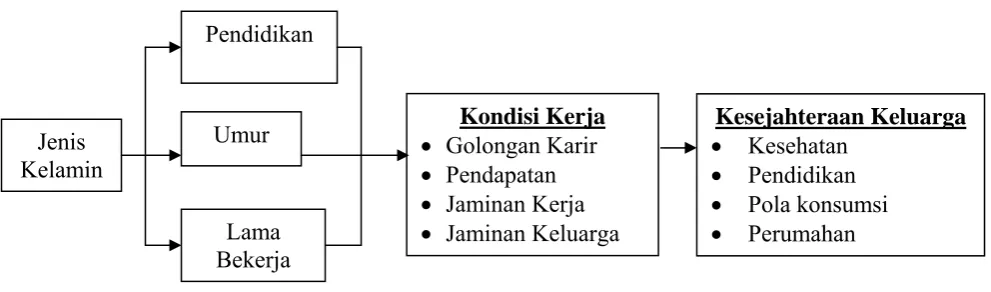
2.7 Kerangka Pemikiran
The conceptual framework outlines the interconnections between gender, work conditions, and family welfare. It serves as a guide for analyzing the data collected in the research, ensuring a comprehensive understanding of the issues at hand.
2.8 Hipotesis
This part presents the hypotheses derived from the theoretical framework, which will be tested throughout the research. The hypotheses are designed to explore the relationships between work conditions, gender, and family welfare, contributing to the academic rigor of the study.
2.9 Definisi Operasional
This subsection provides operational definitions of key terms used in the research. Clear definitions are vital for ensuring consistency and clarity in the study, facilitating better understanding among readers and stakeholders.
III. METODOLOGI PENELITIAN
This section outlines the research methodology, including the research design, location, respondent selection, data collection, and analysis methods. A robust methodology is essential for ensuring the validity and reliability of the research findings, which can inform educational practices and policies.
3.1 Metode Penelitian
This subsection describes the survey method used in the research, emphasizing its appropriateness for gathering quantitative and qualitative data on the working conditions of female employees. The choice of methodology is crucial for addressing the research questions effectively.
3.2 Penentuan Lokasi dan Waktu Penelitian
This part specifies the location and timeframe for the research, providing context for the data collection process. Understanding the setting is important for interpreting the findings in relation to the socio-economic environment of the plantation sector.
3.3 Metode Penentuan Responden dan Informan
This subsection explains the criteria for selecting respondents and informants, ensuring that the sample is representative of the population studied. Proper selection methods enhance the credibility of the research findings.
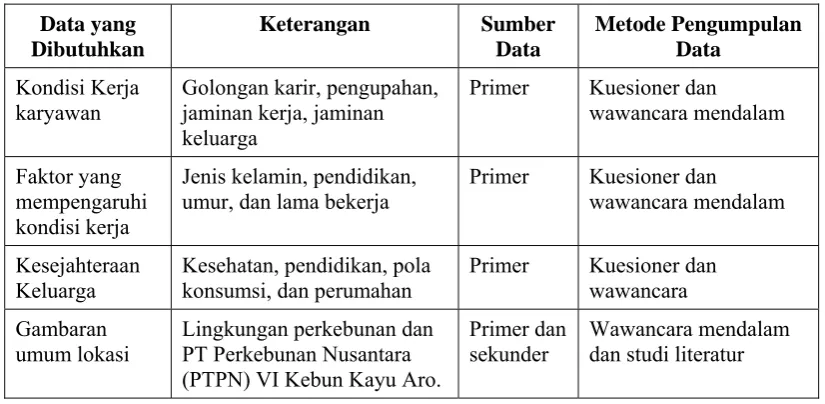
3.4 Metode Pengumpulan Data
This part details the data collection techniques employed in the study, including surveys and interviews. Effective data collection methods are vital for obtaining accurate and comprehensive information on the research topic.
3.5 Metode Pengolahan Data dan Analisis Data
This subsection outlines the data processing and analysis methods used to interpret the collected data. A systematic approach to data analysis is essential for drawing valid conclusions and making informed recommendations.
IV. PROFIL LINGKUNGAN PERUSAHAAN
This section provides an overview of the company profile, including its history, location, infrastructure, organizational structure, and human resources. Understanding the organizational context is important for analyzing the working conditions of employees and their implications for family welfare.
4.1 Sejarah Perusahaan
This subsection discusses the company's history, providing insights into its development and evolution over time. Historical context is crucial for understanding current practices and policies within the organization.
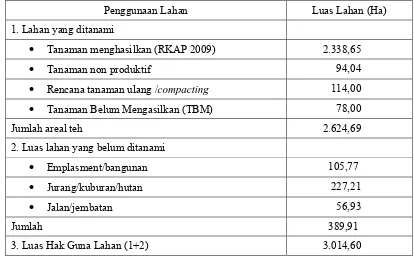
4.2 Konteks Lokasi Perusahaan
This part describes the geographical and socio-economic context of the company's location, which influences its operations and the working conditions of its employees. The local context is essential for interpreting the research findings.
4.3 Sarana dan Prasarana
This subsection outlines the facilities and infrastructure available to employees, which directly impact their working conditions and overall welfare. Adequate facilities are essential for promoting a healthy work environment.
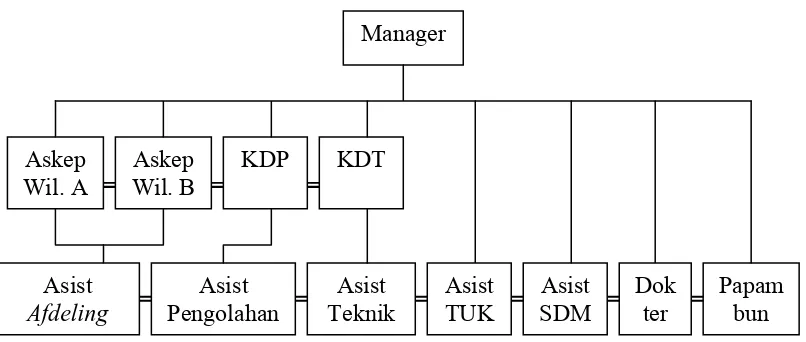
4.4 Struktur Organisasi dan Kultur Perusahaan Perkebunan
This part examines the organizational structure and culture of the plantation company, highlighting how these factors influence employee relations and working conditions. Understanding the organizational dynamics is important for addressing issues of inequality.
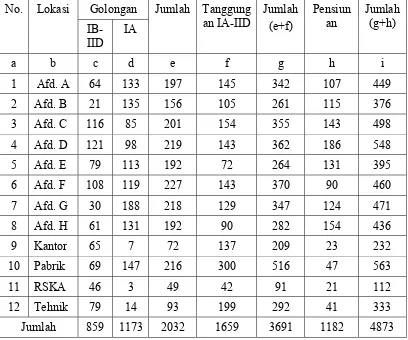
4.5 Sumber Daya Manusia (SDM) di Perusahaan
This subsection discusses the human resources policies and practices within the company, including recruitment, training, and employee support. Effective HR practices are essential for ensuring fair treatment and opportunities for all employees.
V. KONDISI KERJA KARYAWAN DI PT PERKEBUNAN NUSANTARA (PTPN) VI KEBUN KAYU ARO
This section analyzes the working conditions of employees at PTPN VI Kebun Kayu Aro, focusing on career classification, income, job security, and family benefits. Understanding these conditions is critical for assessing their impact on employee welfare and family well-being.
5.1 Golongan Karir Karyawan
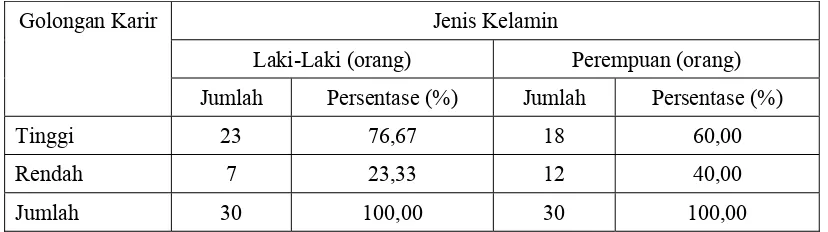
This subsection examines the career classification of employees, highlighting disparities between male and female employees in terms of career advancement opportunities. Understanding career progression is essential for addressing gender inequality in the workplace.
5.2 Pendapatan Karyawan
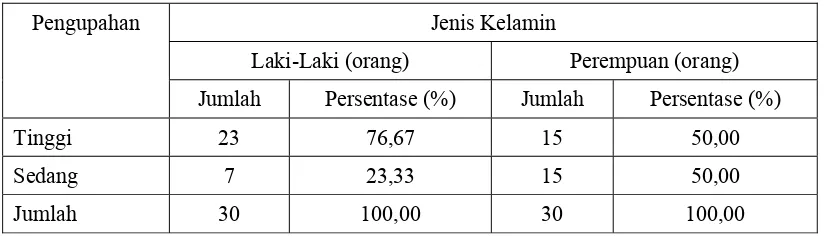
This part analyzes employee income levels, emphasizing the wage gaps between male and female workers. Income disparities are a significant factor influencing overall family welfare and highlight the need for equitable pay practices.
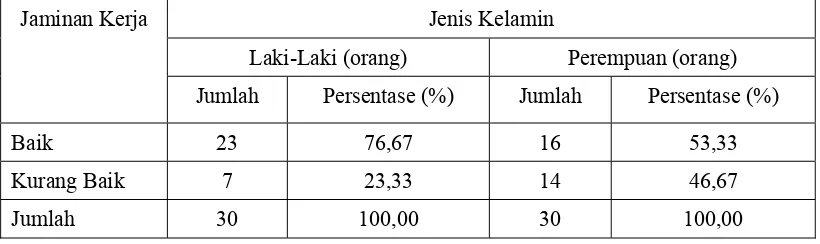
5.3 Jaminan Kerja Karyawan
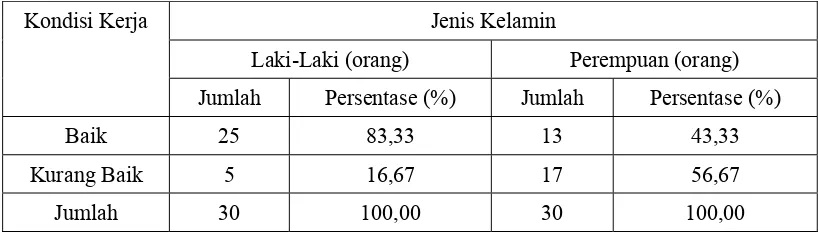
This subsection discusses job security for employees, including the benefits and protections afforded to them. Job security is crucial for ensuring employee stability and well-being, particularly for female workers who may face additional challenges.
5.4 Jaminan Keluarga Karyawan
This part examines the family benefits provided to employees, highlighting disparities in access to healthcare and social security. Adequate family benefits are essential for promoting the welfare of employees and their families.
5.5 Ikhtisar
This subsection summarizes the key findings regarding the working conditions of employees at PTPN VI Kebun Kayu Aro, emphasizing the need for improvements to enhance employee welfare and address gender disparities.
VI. FAKTOR-FAKTOR YANG BERHUBUNGAN DENGAN KONDISI KERJA KARYAWAN DI PT PERKEBUNAN NUSANTARA (PTPN) VI KEBUN KAYU ARO
This section explores the factors influencing the working conditions of employees, including education, age, and tenure. Understanding these factors is essential for developing targeted interventions to improve employee welfare.
6.1 Hubungan Pendidikan dengan Kondisi Kerja
This subsection analyzes the relationship between education levels and working conditions, highlighting how educational attainment affects career opportunities and job security for employees.
6.2 Hubungan Umur dengan Kondisi Kerja
This part examines the impact of age on working conditions, discussing how age-related factors can influence job roles and employee benefits.
6.3 Hubungan Lama Bekerja dengan Kondisi Kerja
This subsection explores the relationship between tenure and working conditions, emphasizing how longer service can lead to better job security and benefits for employees.
6.4 Ikhtisar
This part summarizes the key findings regarding the factors influencing working conditions, underscoring the need for policies that address educational and experiential disparities among employees.
VII. PENGARUH KONDISI KERJA TERHADAP KESEJAHTERAAN KARYAWAN DI PT PERKEBUNAN NUSANTARA (PTPN) VI KEBUN KAYU ARO
This section investigates the impact of working conditions on employee welfare, focusing on health, education, consumption patterns, and housing. Understanding these impacts is critical for developing strategies to enhance employee and family well-being.
7.1 Kesehatan Keluarga Karyawan
This subsection analyzes the health status of employees' families, discussing how working conditions influence access to healthcare and overall health outcomes.
7.2 Pendidikan Keluarga Karyawan
This part examines the educational attainment of employees' families and how it is affected by working conditions. Education is a key factor in determining family welfare and future opportunities.
7.3 Pola Konsumsi Keluarga Karyawan
This subsection explores the consumption patterns of employees' families, highlighting how income and working conditions influence spending on essential goods and services.
7.4 Perumahan Keluarga Karyawan
This part discusses the housing conditions of employees' families, emphasizing the importance of stable and adequate housing for family welfare.
7.5 Ikhtisar
This subsection summarizes the key findings regarding the impact of working conditions on family welfare, highlighting the need for comprehensive policies to improve employee and family well-being.
VIII. KESIMPULAN DAN SARAN
This section presents the conclusions drawn from the research findings and offers recommendations for improving working conditions and family welfare. The conclusions and recommendations are vital for informing future policies and practices aimed at promoting gender equity and employee well-being.
8.1 Kesimpulan
This subsection summarizes the main conclusions of the research, emphasizing the critical link between working conditions and family welfare, particularly for female employees.
8.2 Saran
This part offers actionable recommendations for improving working conditions and addressing gender disparities in the plantation sector. These suggestions are aimed at policymakers, company management, and other stakeholders to foster a more equitable work environment.
Referensi Dokumen
- Peranan Perkebunan Kelapa Rakyat dalam Pertumbuhan Wilayah dan Penanggulangan Kemiskinan di Kabupaten Indragiri Hilir, Propinsi Riau ( Anggraeni, Lukytawati )
- Sekali Buruh Tetap Buruh: Studi Pembentukan Generasi Buruh di Perkebunan Tembakau Deli, Kabupaten Deli Serdang, Sumatera Utara ( Daulay, Pardamean )
- Gender Bukan Tabu: Catatan Perjalanan Fasilitasi kelompok Perempuan di Jambi ( de-Vries, Dede Wiliam )
- Analisis Gender dan Transformasi Sosial ( Fakih, Mansoer )
- Memenuhi Kebutuhan Praktis Dan Kebutuhan Strategis Gender (Terjemahan) ( Moser, Caroline )