THE ROLE OF STEP-NC IN IMPROVING THE PERFORMANCE
OF SUPPLY CHAIN
Jaya Suteja
Department of Manufacturing Engineering - University of Surabaya Raya Kalirungkut, Surabaya - 60292
E-mail: [email protected]
ABSTRACT
The success of supply chain implementation in producing manufactured product heavily relies on the development of CAD system, CAM system, and CNC machine tool. However, current CAD system, CAM system, and CNC machine tool have some weaknesses in supporting supply chain implementation. This paper presents an overview of STEP-NC and its role in supply chain of manufactured product. STEP-NC is a new interface standard for CAD-CAM-CNC chain, which is developed by International Standards Organization (ISO) to extend STEP model data to define data for NC machine tools. By using STEP-NC, the link of all information in supply chain of manufactured product will be more flexible, faster, easier, safer, and more reliable.
Keywords: STEP-NC, supply chain, manufactured product.
1. INTRODUCTION
Discrete manufacturing is manufacturing of discrete or distinct products, which can be counted, touched, and seen easily. The examples of discrete product, also known as manufactured product, are paper clip, ballpoint, bicycle, and car. This type of manufacturing is characterized by individual or separate unit production, which is typically low in volume and very high in complexity. These characteristics of discrete manufacturing lead to the need for flexible manufacturing system that can improve quality and reduce time-to-market while cutting costs.
In recent years, supply chain considerations are taken into account in discrete manufacturing because the implementation of supply chain shows many benefits. Ganeshan, et al. (2005) define supply chain as a network of facilities and distribution options that performs the functions of procurement of materials; transformation of these materials into intermediate and finished products; and distribution of these finished products to customers. In broader meaning, the functions in supply chain do not only include procurement, production, and distribution but also includes design and retailing.
Supply chain must be managed to achieve an effective use of it and to reach many benefits of its implementation. Levi, et. al. (2000) define supply chain management as a discipline that focuses on the integration of suppliers, factories, warehouses, distribution centers, and retail outlets so the items are produced and distributed to the right customers, in the right time, at the right place, and at the right price. It is done in a way that minimizes costs while satisfying a certain level of service. Supported by the wide use of information and communication technology, it is obvious that supply chain management is the key factor in increasing the effectiveness and subsequently the competitiveness of a company.
Reliability, flexibility and responsiveness, cost, and assets of each function in supply chain, can be used to measure the performance of the supply chain.
In every functions of discrete manufacturing, these indicators are mostly influenced by the applied technology. For example, the reliability of the design and procurement functions in discrete manufacturing depends on the application of Computer Aided Design (CAD) system. The flexibility and responsiveness of the production function depends on the available Computer Numerical Control (CNC) machine tools. Meanwhile, the flexibility and responsiveness of process planning function depends on the available Computer Aided Manufacturing (CAM) system. Moreover, the overall performance of the supply chain in the discrete manufacturing depends on the integration of applied CAD system, CAM system, and CNC machine tools. Therefore, the performance of supply chain in producing manufactured product heavily relies on the development of CAD system, CAM system, and CNC machine tool.
However, current CAD system, CAM system, and CNC machine tool have some weaknesses in supporting supply chain implementation. This paper presents an overview of STEP-NC as a new interface standard for CAD-CAM-CNC chain and its role in supply chain of manufactured product. First, this paper presents an overview of current CAD-CAM-CNC system and their weaknesses. Then this paper describes about STEP-NC and its role in improving the performance of supply chain. As a conclusion, some advantages of STEP-NC are explained in correlation with supply chain of manufactured product.
2. CURRENT CAD-CAM-CNC SYSTEM
Recently, there are a lot of CAD systems, which may be combined by CAM systems. Each of CAD/CAM system has their own data format with its advantages and disadvantages. Because each system must be able to be utilized together with other systems, all CAD/CAM systems mostly provide a function to exchange their data format to some neutral data formats, which can be accessed by all CAD/CAM systems.
Two neutral data formats, which are widely used in exchanging data, are Initial Graphics Exchange Specification (IGES) and Standard for Exchange of Product (STEP). The IGES standard is a specification for the structure and syntax of a neutral file in ASCII, compressed ASCII, or binary format. Although IGES is the dominant standard for CAD data exchange, there has been some dissatisfaction in IGES. This fact results in emergence of various neutral data format such as STEP. STEP standard incorporate a non-formal model for the data exchange, which is described using a data modeling language called EXPRESS. STEP supports not only 3D product data but also product identification information, assembly structure, configuration controlled assemblies, and manufacturing features. After release 5.1, IGES was supposed to metamorphose into STEP 1.0 but it has not worked out that way because there are too many active IGES users and too few STEP users to shut IGES down completely. Therefore, until now both of them exist side by side.
protocols, the use of STEP neutral data format can reduce the lost of design intent or production planning especially during process planning phase.
Meanwhile on the shop floor, the today’s CNC machine tools mostly are driven by Numerically Controlled (NC) programming based on G & M codes, which describes the tool movement. There are many extensions of NC program because one extension is dedicated to one machine tool. The NC program can be programmed manually in the machine tool or by using a post processor to convert tool path data generated by CAD/CAM system as shown in Figure 1.
Figure 1. Current NC Programming Interface (Weck, et. al., 2001)
CAD-CAM-CNC systems, as described above, have widely used in producing manufactured product because their advantages especially in design and production automation. Instead of their advantages, current CAD-CAM-CNC systems have some weaknesses in supporting supply chain implementation.
The first weakness is that the standard way of data exchange among different CAD data formats is not completely reliable because many data formats are available in the market and the standard or neutral data format does not entirely fit to every CAD data format. To fix the exchanged data, the incomplete data must be subsequently processed. The effort to fix the data will take a lot of time and may cause misinterpretation. As a result, it will detain the flow of information in supply chain from design to procurement and to production.
Next, the data created in CAD/CAM systems cannot easily be transferred to CNC machine tools because the data interfaces between CAD/CAM system and CNC machine tool are poor. CAD/CAM systems can only generate a specific toolpath in form of G-codes and they cannot perform feature, process, and tool recognition. It means that the recent NC program only contain small part information available in CAD/CAM systems and is not sufficient to support more complex machine functionality. This weakness will limit the implementation of supply chain in supporting complex machine functionality and in manufacturing of complex geometry.
Therefore, the NC program can only be used for a certain machine tool therefore it has to be reprogrammed for other machine tools. This weakness will cause the information from process planning to manufacturing cannot be translated automatically and reduce the flexibility and responsiveness of supply chain.
The other weakness is that there is no bi-direction exchange of information between CAD/CAM systems and CNC machine tools. As a consequence, changes in shop floor will result in rework in planning. For example, if there is variation in clamping and should be considered in setup of CNC machine tool, it must be calculated once again in CAD/CAM system. Another example is that collision avoidance depends on the geometries of work piece, the machine tools, and the used tools in each machine tool. To avoid the collision if there is a change in machine tool, the determination of cutting speed, feed rate, and depth of cut must be performed again in CAD/CAM system for the machine tool. This weakness will reduce the flexibility, safety, and responsiveness of supply chain
3. THE ROLE OF STEP-NC IN SUPLY CHAIN
To lessen the weaknesses above, an effort has been done to change the concept of NC programming and develop a common language for CAD, CAM and CNC to integrate and translate the knowledge from design to production.
STEP-NC is a new interface standard for CAD-CAM-CNC chain, which is developed by International Standards Organization (ISO) to extend STEP model data thus it can be used to define data for Numerical Control (NC) machine tools. STEP-NC concentrates the standardization effort on information content rather than on implementation technology. Or in another word, STEP-NC standardizes how information about CNC machining can be added to parts represented in the STEP product model.
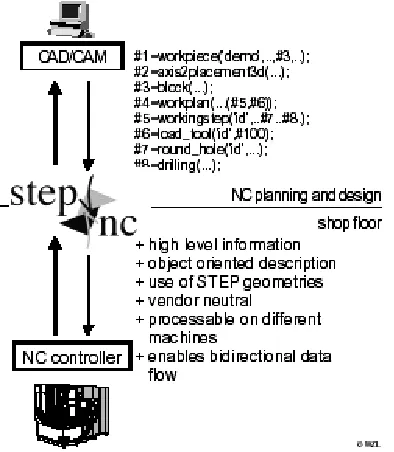
Today, STEP-NC or ISO 14649 is under development in USA, Europe, and Asia. Different from current NC programming, STEP-NC provides an object oriented data model for CNC with a detailed and structured data interface that incorporates feature based programming where there is a range of information such as the feature to be machined, type of tools used, the operations to perform, and work plan.
By using STEP-NC, data format exchange among different type of data format is not a problem anymore because it uses STEP as a standard data format. STEP supports 3D geometry data plus product information, assembly structure, configuration controlled assemblies, and manufacturing features. This data format defines features such as holes, bosses, and pockets instead of the Boolean operation using standard shapes therefore it can be easily used to exchange information in manufacturing parts. The use of standard data format will bring the flow of information in supply chain especially from design to procurement and to production faster and more reliable.
STEP-NC includes all the data required to make a part in one Application Protocol file, which is Application Protocol 238 (AP-238) file. This AP-238 file contains part geometry, geometric dimensions and tolerances of the finished part, manufacturing features, the tooling, and the materials. Therefore, AP-238 does not require the data contain machine specific tool paths and can be used for all machine tools although the machine tools in the shop floor should have STEP-NC control for reading and executing AP-238 files. By using AP-238 files, the flexibility and responsiveness of supply chain will increase.
By using this new interface, the information in form of product model created by CAD/CAM system can be linked to the information required to control the machine. The product model, which contain information about feature to be machined, type of tool used, the operation to perform, and work plan, serves as the universal NC part program. This information can be sent and received by CNC machine tool and CAD/CAM system. Therefore, the data interface provides non-specific program and allows multi-directional data exchange among different systems and among controllers of machine tool can be achieved. The multi-directional data exchange will lead the supply chain implementation to be safer, more flexible, and more responsive.
Figure 2. STEP-NC Programming Interface (Weck, et. al., 2001)
4. CONCLUSION
By using STEP-NC, the link of all information in supply chain of manufactured product will be more flexible, more responsive, faster, easier, safer, and more reliable. As a result, the time to market can be shortened, the quality of manufactured product produced using the STEP-NC will be increased, and the cost of manufactured product will be reduced because optimization of the product and the process can be done in every function in supply chain.
REFERENCES
Ganeshan, R., T.P. Harrison, 2005. An Introduction to Supply Chain Management, URL: http://lcm.csa.iisc.ernet.in/scm/supply_chain_intro.html.
Haag, E., R.W. Vroom, 1996. “The Application of STEP in the Automotive Supply Chain”,
Computers in Industry31, pp. 223 – 234.
Han, J.H., M. Kang, H. Choi, 2001. “STEP-based Feature Recognition for Manufacturing Cost Optimization”, Computer-Aided Design 33, pp. 671 – 686.
Hardwick, M., 2001. STEP into Automatic Machining: Manufacturing Moves Toward New Frontiers, URL: http://www.steptools.com.
Janowski, D., 1999. Transferring CAD/CAM Files, URL:http://www.mmsonline.com.
Krar, S., A. Gill, 2003. Exploring Advanced Manufacturing Technologies, Industrial Press.
Levi, D.S., P. Kaminsky, E.S. Levi, 2000. Designing and Managing the Supply Chain: Concepts, Strategies, and Case Studies, Mc Graw-Hill, Singapore.
Liang, M., S. Ahamed, and B. van den Berg, 1996. “A STEP Based Tool Path Generation System for Rough Machining of Planar Surfaces”, Computers in Industry 32, pp. 219 – 231
McMahon, C., J. Browne, 1993. CAD/CAM from Model to Practice, Addison-Wesley Publishing Company.
Rosso, R. S. U., R. D. Allen, S. T. Newman, 2002. “Future Issues for CAD/CAM and Intelligent CNC Manufacture”, Proceedings of the 19th International Manufacturing Conference – IMC – 19, Belfast, North Ireland.
Weck, M., J. Wolf, D. Kiritsis, 2001. “STEP-NC – the STEP Compliant NC Programming Interface”, International Intelligent Manufacturing System Forum, Ascona, Switzerland.