Retail Patronage: An Integrative Model
and a Research Agenda
M. Joseph Sirgy
VIRGINIATECHDhruv Grewal
BABSONCOLLEGETamara Mangleburg
FLORIDA ATLANTICUNIVERSITYAn integrative model of retail environment, self-congruity, and retail develop an integrative model involving the effects of the retail
patronage is described in this article. The model develops theoretical environment on self-image congruence (or “self-congruity”,
propositions for future research to further develop the research in the area for short) and the effects of self-congruity on retail patronage.
of self-image congruence in retailing. In particular, the model postulates And, because self-congruity involves a process of matching a
relationships among store environment (including store atmospherics), shopper’s self-concept to a retail patron image, the model
store patron image, shoppers’ self-concept, self-congruity, functional con- identifies factors that are likely to affect the development of
gruity, and retail patronage. The model describes the interrelationships retail patron images, such as retail atmospherics and other
among these constructs and proposes certain moderating and mediating retail environment cues. In addition, factors that are likely to
effects. Finally, the article describes past and recent efforts in measuring moderate and mediate the relationship between self-congruity self-congruity and how better measures of self-congruity can be developed and retail patronage are identified and explained. Retailing and applied in retailing. J BUSN RES 2000. 49.127–138. 2000 managers who appreciate how self-congruity works are likely
Elsevier Science Inc. All rights reserved. to be in a position to develop effective positioning strategies
that increase profitability.
T
he self-concept literature in consumer research hasAn Integrative Model
increased significantly in the past 30 years. There areConsumer research has shown that a consumer’s attitude to-many definitions of the self in consumer research,
ward a product (and product purchase) is influenced by the many studies that examined certain marketplace effects on
matching of the product user image with the consumer’s self-the formation and change of consumer self-concept, and many
concept (Sirgy, 1982a). Indeed, consumer research has had studies that examined the effects of self-concept on consumer
a long tradition of addressing how self-concept is used as a behavior (see literature reviews by Sirgy, 1982a, 1985a;
Clai-cognitive referent in evaluating symbolic cues. Product sym-borne and Sirgy, 1990). In contrast, self-concept research in
bolic cues refer to stereotypic images of users of a product or retailing has been quite limited (e.g., Dornoff and Tatham,
store (e.g. sexy, classy, fashionable, and young, to name a 1972; Bellenger, Steinberg, and Stanton, 1976; Stern, Bush,
few). The same can be said in relation to a consumer’s attitude and Hair, 1977; Sirgy and Samli, 1985, 1989b; Sirgy, Samli,
toward a store (and retail patronage). That is, shoppers per-Bahn, and Varvoglis, 1985a, 1985b, 1989).
ceive stores differently in terms of the store’s typical clientele The purpose of this article is to review research related to
or patrons. These stereotypic images of different stores are self-concept in retailing and to propose a research agenda to
referred to here as “retail patron images.” stimulate future inquiry in this area. Toward this end, we
The greater the match between the store patron image and the consumer’s self-concept, the more likely that the consumer
Address correspondence to M. Joseph Sirgy, Department of Marketing,
Pam-plin College of Business, Virginia Tech, Blacksburg, VA 24061-0236. has a favorable attitude toward that store (and the more likely
Journal of Business Research 49, 127–138 (2000)
2000 Elsevier Science Inc. All rights reserved. ISSN 0148-2963/00/$–see front matter
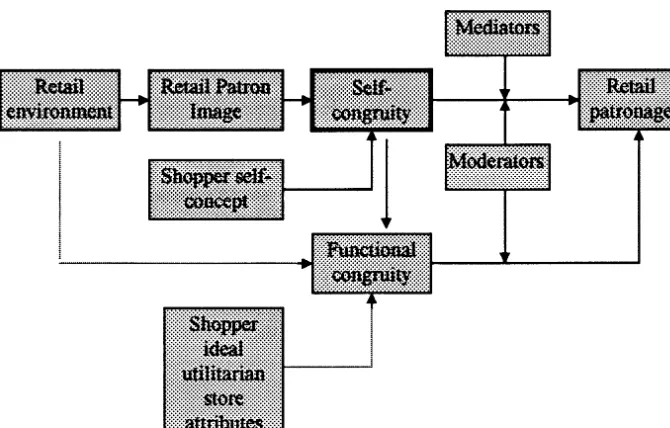
Figure 1. An integrated model involving retail environment, retail patron image, self-congruity, and retail patronage (dot-ted lines are relationships not explicitly incorporated in the integrated model).
that he would patronize that store). This matching process is establishments. In other words, various situational factors may referred to as “self-congruity.” moderate the extent to which consumers use self-congruity Because self-congruity involves the match/mismatch be- to evaluate stores. The relationship between self-congruity tween the retail patron image and a shopper’s self-image, and retail patronage, then, is likely to be contingent on a a relevant question, then, is what factors contribute to the number of situational and shopper characteristics. Factors formation of a store’s patron image and how strong and acces- such as the level of shopping experience, shopping involve-sible are these patron images in the minds of consumers? ment, time pressure, store knowledge, and the like may affect Various attributes of the store and its atmosphere (i.e., type the nature of the relationship between self-congruity and retail and quality of merchandise, prices, store ambiance, and so patronage.
on) are likely to have implications for the development and On the basis of these considerations, a conceptual model strength of retail patron images. Also, given that self-concept of self-congruity and retail patronage was developed (see Fig-is multidimensional in nature (e.g., actual vs. ideal self), at ure 1). The model posits that various aspects of the store and issue is the particular aspect of the self-concept that is used its atmosphere are related to the retail patron image. The retail when making determinations of “fit” or congruity with the patron image is then evaluated in light of specific dimensions retail patron image. For example, will consumers evaluate a of the consumer’s concept to determine the degree of self-store on the basis of how well the patron image fits with how congruity. Self-congruity is then systematically related to retail the consumer sees him/herself in reality or how the consumer patronage; the relationship between these two constructs, would like to see him/herself? Certain factors, such as consum- however, is moderated by a number of situational and shopper ers’ age and the visibility or conspicuousness of the store may characteristics. The components and posited relationships in serve to activate or accentuate specific dimensions of the self- the model are described in this article. Before turning to this concept. discussion, however, it should be noted that retail patronage In addition to evaluating stores in light of self-congruity, as used here reflects a number of related aspects, which may consumers also may evaluate stores with respect to specific include store attitude, store preference, store selection, actual store attributes. In particular, store attributes may be evaluated or intended patronage, satisfaction with a store, repeat patron-in light of consumers’ expected level of performance for a age, and store loyalty.
given attribute. For example, how does the store’s level of service relate to consumers’ expectation of store service? The
match between the store’s level of a given attribute and the
Retail Environment and Retail
consumer’s expectation of that attribute is referred to as “func-Patron Image
tional congruity”. Although the focus of this article is
self-Shoppers have stereotypic images of different stores. For ex-congruity and its potential effects on patronage, functional
ample, one department store may be perceived as typically congruity also may affect patronage and may be related to
patronized by upscale shoppers, while another may be per-self-congruity. At issue, in particular, are the conditions under
ceived as frequently patronized by working class consumers. which consumers may use self-congruity and/or functional
as color, lighting, interior decoration, or music, form the overall context within which shoppers make patronage deci-sions and are likely to have a significant impact on store image (see research by Milliman, 1982; Bellizzi, Crowley, and Hasty, 1983; Baker, Grewal, and Parasuraman, 1994; Chebat, Geli-nas-Chebat, and Vanisky, 1995; Dube, Chebat, and Morin, 1995). Retailers realize the importance of such cues and sys-tematically try and develop their prototypes to avail of
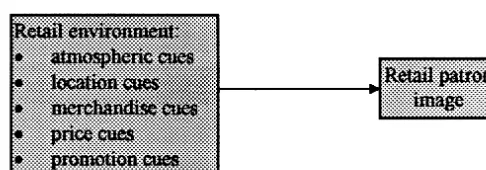
appro-Figure 2. The effect of retail environment on retail patron image. priate colors, music, and lighting that will attract their target
customers and increase their profitability. Additionally, the role of other people in a store (i.e., the social dimension) is gourmet and food connoisseurs. Other grocery stores may be
also critical—such as whether a store is crowded or not crowded seen as catering mostly to senior citizens. Some clothing stores
and the number and behavior of the retail salespeople (e.g., are perceived as being for the executive type, while others are
Bateson and Hui, 1986, 1992; Hui and Bateson, 1991; Baker, perceived as an outlet for bargain hunters (Martineau, 1958;
Grewal, and Parasuraman, 1994). Thus, understanding the role Samli, 1989; Onkvisit and Shaw, 1994, p. 142).
of store environment cues on shopper perceptions and behavior Retailers develop these store images to best position their
is critical (Bitner, 1986, 1990a, 1991b; Ward, 1992). store relative to the needs of the targeted customer. For
exam-Past research on retail environment suggests that atmo-ple, chains like Sharper Image are targeted towards trendy
spheric cues (e.g., music, lighting, decor) do affect the image upscale buyers and are perceived to attract such a clientele.
of the store and the image of the patrons of the store. That Past research has already demonstrated that store image has
is, certain types of music (e.g., classical music), lighting (soft a direct bearing on retail patronage and loyalty (Hirschman,
lights), fixtures (modern or antique-like) are likely to engender 1981; Sirgy and Samli, 1985). The question becomes: do
an image of an upscale store with affluent patrons. Take the shoppers use store cues to figure out what kind of person
simple example of floor design of an upscale department store. typically shops at the store in question? And, if so, what
Typically, an upscale store has cashiers and service personnel are these cues? The retail environment provides a myriad
in different sections of the store. Downscale stores, on the of informational cues that consumers can use to form an
other hand, have the cashiers up front, next to the entrance impression of the typical patron of the store. Some of these
and exit doors (cf. Sirgy and Samli, 1989a). Thus, one would cues include the store atmosphere, the merchandise (and
propose that: brands), and the prices of the merchandise in the store. It is
of tantamount importance for research to determine those Proposition 1: Shoppers are likely to make inferences about cues that may be used by consumers in forming impressions the patrons of a store as a direct function of store atmo-about the typical store patron, that is, retail patron image. spheric cues, such as the interior decor, the music, the
Before we describe store cues that affect the formation and lighting, and floor design. reinforcement of retail patron images, the reader should note
Furthermore, the store location serves as a cue to reflect that there may be a multitude of cues, some controllable
the typical store patrons. For example, a store located in a by retailers and some uncontrollable. “Controllable” cues are
poor neighborhood signals to shoppers that the typical store directly related to the four Ps, that is, cues related to the retail
patrons may be poor or working class. Similarly, a store located merchandise (product), cues related to the prices of the
re-in an upscale residential community may signify that its store tail merchandise (price), cues related to the location of the
patrons are upscale. A store located in a certain ethnic neigh-store and neigh-store atmospherics (place), and cues related to the
borhood may make a statement too—that it caters to that promotion of the store (promotion). There are many other
ethnic population. Thus, we propose the following: “uncontrollable” cues such as shoppers’ personal
characteris-tics. For example, a shopper who had seen the movie “Cocoon” Proposition 2: Shoppers are likely to make inferences about may react to a store with a name such as “Cocoon Electronics the patrons of a store as a direct function of the geographic Store” by conjuring up an image of the typical science-fiction location of the store.
patron who is fascinated by space-like gadgets. That shopper
is likely to believe that the typical patron of the Cocoon store
Retail Cues Related to Product
is into science fiction. We have not addressed the effects The merchandise quality and the image associated with the of uncontrollable factors because they do not have direct store brands are likely to have a significant impact on the managerial implications to retailers (see Figure 2). store image and the image of its patrons (Dodds, Monroe, and Grewal, 1991; Baker, Grewal, and Parasuraman, 1994).
Retail Environment Cues Related to Place
That is, well-known, top-of-the-line brands are likely to en-Store cues related to place can be grouped in terms of store gender an image of an upscale store with affluent patrons.Proposition 3: Shoppers are likely to make inferences about of self-concept in explaining and predicting consumer behav-the patrons of a store as a direct function of behav-the quality of ior. These are the actual self-image, the ideal self-image, the the merchandise and name brands in the store. social self-image, and the ideal social self-image (Sirgy, 1982a, 1985a). The “actual self-image” is defined as how consumers
Retail Cues Related to Price
see themselves. The “ideal self-image” is defined as how con-sumers would like to see themselves. The “social self-image” is The price levels of the merchandise also are likely to have andefined as how consumers believe they are seen by significant important role on shoppers patronage decisions (e.g., Dodds,
others. The “ideal social self-image” is defined as how consum-Monroe, and Grewal, 1991). Higher prices are likely to be
ers would like to be seen by significant others. associated with higher quality merchandise, which is
dis-Self-congruity involves a process of matching (some dimen-played and sold at upscale stores and bought by affluent or
sion of) a consumer’s self-concept with the retail patron image. status-conscious consumers. The merchandise price and the
The greater the degree of match between self-concept and the pricing policies and practices of the store (e.g., heavy
dis-retail patron image, the greater the likelihood that consumers counting, frequent promotions) are likely to have a significant
will patronize a particular store. Thus, impact on the image of the patrons of the store. Thus, one
would propose that:
Proposition 6: Retail patronage is affected by self-congruity. Proposition 4: Shoppers are likely to make inferences about That is, the greater the match between the retail patron the patrons of a store as a direct function of the price of image of a store and the shopper’s self-concept (actual, the merchandise and brands in the store. ideal, social, and/or ideal social self-image) the more likely that this shopper will be motivated to patronize that store.
Retail Cues Related to Promotion
Advertising and other forms of marketing communications
Self-Concept Motives Mediating
can be a significant source of information for shoppers.
Shop-pers may form impressions about the typical patron of a
Self-Congruity and Retail Patronage
store by observing its advertising. For example, an upscaleSince there are at least four different self-concept dimensions department store is likely to use people and artifacts in its
(actual, ideal, social, and ideal social self-image), it follows that advertising that are symbolic of economic status and class.
we should have four corresponding types of self-congruities: Thus, these promotion cues are used by shoppers to form,
actual self-congruity, ideal self-congruity, social self-congru-reinforce, or change their perceptions of the typical patron of
ity, and ideal social self-congruity (see Figure 3). that store. Hence, we propose the following:
Actual self-congruity refers to the degree of match between Proposition 5: Shoppers are likely to make inferences about a shopper’s actual self-image and a retail patron image, or the the patrons of a store as a direct function of the advertising fit between how shoppers actually see themselves in relation messages of the store. to the retail patron image. Actual self-image is part of what psychologists refer to as the private self. The private self in-volves those images that one has of oneself about which one
Retail Patron Image, Shopper
feels protective. “This is who I am,” the person may say.
Self-Concept, Self-Congruity,
Thus, the actual self-image is defined as how consumers see
and Retail Patronage
themselves, their personal identity. A discount store, for exam-ple, has a specific patron image. Shoppers tend to think of One of the problems in self-concept research in the socialthe person who patronizes a discount store as “a working and behavioral sciences is the plethora of definitions of
self-class person.” Do shoppers see themselves in this light? If so, concept stemming from the variety of ways that the self is
that is their actual self-image. viewed in the psychological literature. For example, James
Shoppers are motivated to protect their personal identities. (1890) defined the self-concept as all that we call our own
They may feel uncomfortable if they see themselves patroniz-and with whom or with which we share a bond of identity.
ing a store that is not reflective of their true selves. For example, Many other traditional definitions of the self-concept focus
a working class shopper is likely to feel uncomfortable in an on a “unitary self” (Cooley, 1902; Mead, 1934; Allport, 1943;
upscale department store. This is because this behavior is Lecky, 1945). However, the more recent psychological literature
perceived as inconsistent with her perception of who she truly in self-concept points to the possibility of “multiple selves”.
is. This motivational tendency to drive people to act in ways That is, the self is a collection of masks each tied to a particular
consistent with their personal identities (actual self-image) is set of social circumstances (Markus and Nurius, 1986). The
self-referred to in the personality and social psychology literature concept is diverse and multifaceted. Each self-concept domain
as the “self-consistency motive” (Lecky, 1945; Sirgy, 1986) represents the individual’s persistent hopes and fears and
indi-and the marketing literature too (Sirgy, 1990; Johar indi-and Sirgy, cates what can be realized in certain situations.
Figure 3. The mediating effects of self-concept motives on the relationship be-tween self-congruity and retail patronage.
The effect of actual self-congruity on consumer behavior retail outlets that are associated with them) boosts their self-esteem. That is, patronizing a store that has an image consis-has been documented through many studies conducted in the
context of both consumer goods and retail stores. In the tent with shoppers’ ideal self-image helps them feel good about themselves. Have you ever run into a working class person context of consumer goods, a handful of studies sought to
demonstrate the existence of a relationship between a product who likes to patronize upscale department stores? Perhaps this person has an ideal self-image of becoming upscale. Pa-user image and actual self-image, given a preferred product
or ownership (e.g., Sirgy, 1982a, 1985a; Claiborne and Sirgy, tronizing an upscale store serves to help the working class person approach her ideal self-image of becoming upscale 1990 for reviews of this literature). In retailing, studies by
Dornoff and Tatham (1972), Bellenger, Steinberg, and Stanton (Figure 3)
The effect of ideal self-congruity on consumer behavior (1976), and Stern, Bush, and Hair (1977) have clearly
demon-strated the existence of a relationship between a retail patron has been documented through several studies done in the context of both consumer goods and retail stores. In the image and actual self-image, given a preferred store.
context of consumer goods, several studies were able to dem-Proposition 7: Actual self-congruity affects retail patronage.
onstrate the existence of a relationship between a product That is, shoppers who experience a match between the
user image and ideal self-image, given a preferred product or patron image of a store and their actual self-image will be
ownership (e.g., Malhotra, 1981, 1988; Sirgy, 1985b; Ericksen motivated to patronize that store.
and Sirgy, 1989, 1992). In retailing, evidence for this relation-Proposition 7a: Actual self-congruity affects retail patronage ship has been provided by Dornoff and Tatham (1972) and through the mediating effects of the need for self-consis- Samli and Sirgy (1981).
tency. That is, shoppers who experience a match between
Proposition 8: Ideal self-congruity affects retail patronage. the patron image of a store and their actual self-image
That is, shoppers who experience a match between the will be motivated to patronize that store because doing so
patron image of a store and their ideal self-image will be satisfies their need for self-consistency.
motivated to patronize that store. Ideal self-congruity refers to the degree of match between
Proposition 8a: Ideal self-congruity affects retail patronage a shopper’s ideal self-image and a retail patron image or the
through the mediating effects of the need for self-esteem. fit between how shoppers like to see themselves in relation
That is, shoppers who experience a match between the to the retail patron image. Ideal self-image is also part of the
patron image of a store and their ideal self-image will be private self. A person may see himself as timid and lacking
motivated to patronize that store because doing so satisfies in confidence (actual image) yet may not like this
self-their need for self-esteem. perception. He may want to become sensitive but self-assured
(ideal self-image). As you may imagine, there is often a discrep- Social self-congruity refers to the degree of match between a shopper’s social self-image and a retail patron image or the ancy between actual and ideal self. The ideal self motivates
behavior through the need for self-esteem (Evans, 1968; fit between how shoppers believe they are seen by others in relation to the retail patron image. A person may believe others Green, Maheshwan, and Rao, 1969; Grubb and Grathwohl,
1967; Sirgy, 1986; Johar and Sirgy, 1991; Sirgy, Johar, and see him or her as introverted and plain. This social self-image may be consistent or inconsistent with the actual and ideal Claiborne, 1992). People have ideal images of themselves,
self. Social self-image influences behavior through the “social into any of her friends and neighbors because she believes that these friends and neighbors may think less of her (Figure 3). consistency motive” (Johar and Sirgy, 1991; Sirgy, Johar, and
Claiborne, 1992). People are motivated to maintain an image The effect of ideal social self-congruity on consumer behav-ior has been documented through several studies done in the others have of them. They feel uncomfortable if they act in
ways inconsistent with how they believe others see them. For context of both consumer goods and retail stores. In the context of consumer goods, several studies have demonstrated example, a person may feel very uncomfortable visiting a video
store that rents out X-rated videos. This is because he fears the existence of a relationship between a product user image and ideal social self-image, given a preferred product or own-he may run into people own-he knows. He believes that otown-hers see
him as “not the sexual type and quite reserved.” Violating ership (Sirgy, 1979, 1980, 1982b; Sirgy and Danes, 1982; Ericksen and Sirgy, 1989, 1992). In retailing, Samli and Sirgy others’ perception of him as “not being the sexual type and
being quite reserved” is likely to make him feel very uncom- (1981) and Sirgy and Samli (1985, 1989b) were able to dem-onstrate the effects of ideal social self-congruity on retail pat-fortable. He feels the need to maintain social consistency
(Fig-ure 3). ronage.
The effect of social self-congruity on consumer behavior
Proposition 10: Ideal social self-congruity affects retail pat-has been documented through several studies done in the
ronage. That is, shoppers who experience a match between context of both consumer goods and retail stores. In the
the patron image of a store and their ideal social self-image context of consumer goods, several studies have demonstrated
will be motivated to patronize that store. the existence of a relationship between a product user image
Proposition 10a: Ideal social self-congruity affects retail and social self-image, given a preferred product or ownership
patronage through the mediating effects of the need for (Sirgy, 1979, 1980, 1982b; Malhotra, 1981, 1988; Sirgy and
social approval. That is, shoppers who experience a match Danes, 1982; Ericksen and Sirgy, 1989, 1992). In retailing,
between the patron image of a store and their ideal social Samli and Sirgy (1981) and Sirgy and Samli (1985, 1989b)
self-image will be motivated to patronize that store because provided some evidence to substantiate the effects of social
doing so satisfies their need for social approval. self-congruity on retail patronage.
Proposition 9: Social self-congruity affects retail patronage.
Factors Affecting the Activation
That is, shoppers who experience a match between the
patron image of a store and their social self-image will be
of Self-Concept Dimensions
motivated to patronize that store.Because self-congruity is essentially based on the match/mis-Proposition 9a: Social self-congruity affects retail patronage
match between shoppers’ self-images and retail patron images, through the mediating effects of the need for social
consis-factors that enhance the activation of a particular dimension tency. That is, shoppers who experience a match between
of self-concept are likely to have important implications for the patron image of a store and their social self-image retail patronage. Indeed, identifying these factors may help to will be motivated to patronize that store because doing so increase the predictiveness of the various subconstructs of satisfies their need for social consistency. self-congruity, namely actual, ideal, social, and ideal social
self-congruity. With respect to the shoppers’ self-image (ac-Ideal social self-congruity refers to the degree of match
tual, ideal, social, and ideal social self-image), the question between a shopper’s ideal social self-image and a retail patron
becomes: under what conditions do private self constructs image or the fit between how shoppers would like to be seen
such as actual and ideal self-congruity predict retail patronage by others in relation to the retail patron image. The ideal
better than public self constructs—social and ideal social self-social self-image, like the self-social self-image, is part of the public
congruity? Generally speaking, those factors that serve to high-self. Patrons of upscale clothing boutiques may want to be
light or enhance a particular motive (consistency, seen by others as being classy. This is their ideal social
self-esteem, etc.) are likely to activate a particular dimension of image. The ideal social self-image affects people’s behavior
the self-concept. Four factors likely to be of particular rele-through the “social approval motive” (Johar and Sirgy, 1991;
vance here are characteristics related to store visibility (or Sirgy, Johar, and Claiborne, 1992). People are motivated to
store conspicuousness), shopping with others (or co-shop-do things that would cause others to think highly of them.
ping), and characteristics related to the individual shopper, By definition, acting in ways that realize the ideal social
self-such as age and response mode (see Figure 4). image is likely to earn approval from others. Actions that are
inconsistent with the ideal social self-image lead to social
Store Conspicuousness
disapproval. Therefore, people tend to act consistently with
Figure 4. Factors affecting the activation of self-concept dimensions.
ous brands better than for more conspicuous brands. Con- consistency. In other words, consumers who shop with signifi-cant others may actively engage in impression management versely, “public self” (social and ideal social) should predict
preference better for conspicuous rather than inconspicuous and therefore patronize stores that they believe will enhance their standing in the significant other’s eyes, or at least not brands. The results have not been highly supportive of these
hypotheses, however. violate the expectations that significant others have of them. Indeed, research suggests that consumers shop with others, Although the results have not been supportive of the
hy-pothesis in the consumers goods area (Dolich, 1969; Ross, in part, to reduce social/psychological risk (i.e., to make sure that they buy products that will make a good impression on 1971; Sirgy, 1979; Martin and Bellizi, 1982; Hong and
Zink-han, 1995), we believe that this hypothesis has logical appeal others; Kiecker and Hartman, 1993). When shopping with significant others, then, one may choose to visit only those and could easily apply to explain and predict retail patronage.
Here, we want to develop a construct we refer to as “store stores that would make a good impression on the other. Choosing stores that are reflective of the social or ideal social conspicuousness”. A store that is conspicuous is a store in
which shoppers believe that they can be readily seen and self is another means of reducing social/psychological risk when shopping with others. On the basis of these considera-judged by their significant others. Significant others are
friends, relatives, neighbors, associates, co-workers, and oth- tions, it is proposed that: ers that shoppers care to impress—or at least not disimpress
Proposition 12: Retail preference/patronage is likely to be (Johar and Sirgy, 1991). For example, many shoppers may
affected by public self-type self-congruity (social and ideal feel that stores located in shopping malls tend to be a lot
social self-congruity), more so than private self-type con-more conspicuous than stores that are buried from the visible
gruence when consumers shop with significant others. eye in a back road someplace. Therefore, consumers are more
Conversely, retail preference/patronage is likely to be af-likely to be seen and judged by relatives, neighbors, friends,
fected by private self-type self-congruity (actual and ideal etc., while shopping in stores located in a shopping mall
self-congruity), more so than public self-type congruence than in stores located less visibly. Out-shopping can be less
when consumers shop alone. conspicuous than in-shopping. Many housewives travel to
neighboring towns to hunt for brand name products at bargain
Age
prices. They don’t publicize the fact that they bought these
One may also argue that there may be many personal charac-products at bargain prices. Out-shopping helps to do this
teristics about shoppers that may help explain and predict “secretively,” that is, inconspicuously. Therefore, based on the
the extent to which consumers engage in public-self versus preceding discussion and reasoning, it is proposed that:
private-self information processing (see Figure 4). One per-Proposition 11: Shoppers’ preference/patronage of conspicu- sonal characteristic may be age. One can easily observe the fact ous stores is likely to be affected by public self-type self- that children and younger people are much more preoccupied congruity (social and ideal social self-congruity), more so with impression management than older people. This is be-than private self-type congruence. Conversely, shoppers’ cause children and young people are in the process of forming preference/patronage of inconspicuous stores is likely to be their private conceptions of themselves (private self-concept). affected by private self-type self-congruity (actual and ideal Because we are social animals, our private self-concept is self-congruity), more so than public self-type congruence. shaped mostly from social encounters. Therefore, develop-mentally speaking, children and young people in general have
Co-Shopping
a stronger sense of public self than a private self. Mature people, on the other hand, are likely to have a consolidated Shopping with significant others is another factor that is likelyto affect the predictiveness of public versus private self-type sense of private self. Using this reasoning, one may surmise that children’s decisions and actions are more likely to influ-congruence (see Figure 4). Shopping with others is likely to
adults’ decisions and actions are more likely to be influenced
The Interrelationship between
by the private self. Retail patronage is no exception. We wouldSelf-Congruity and
expect the same principle to apply here. Therefore, we put
forth the following theoretical proposition:
Functional Congruity
As described is this article so far, self-congruity is shoppers’ Proposition 13: Young shoppers’ retail
preference/patron-comparison between their retail patron image and their own age decisions are likely to be affected by public self-type
self-image. Functional congruity, on the other hand, is based self-congruity (social and ideal social self-congruity), more
on the perceived utilitarian aspects of the store in reference so than private self-type congruence. Conversely, mature
to some ideal aspects (Sirgy and Johar, 1985a, 1985b). For shoppers’ retail preference/patronage decisions are likely
example, in store selection, a shopper may consider the prox-to be affected by private self-type self-congruity (actual
imity of the store from his residence, the price range of many and ideal self-congruity), more so than public self-type
store items, the quality of the products the store carries, the congruence.
variety or assortment of merchandise, or the possible use of credit cards or other financing arrangements. These evaluative
Response Mode
criteria are utilitarian or “functional” in nature, compared Sirgy (1987) conducted two studies that supported the
hy-with symbolic criteria such as retail patron image. Functional pothesis that the activation of actual versus ideal self-images
congruity has been traditionally captured (operationally in self-congruity processing is dependent on consumers’
re-speaking) using multiattribute attitude-types of indices (e.g., sponse mode. Response mode refers to whether the decision
Sirgy and Samli, 1985). is a preference judgment type or a brand choice. It was argued
Both functional and self-congruity have been demonstrated that self-esteem is more likely to be activated in judgment type
to affect purchase motivation (Johar and Sirgy, 1989, 1991; decisions (e.g., preference decisions) than choice decisions.
Sirgy, Johar, Samli, and Claiborne, 1991) and retail patronage Conversely, self-consistency is more likely to be activated in
(Sirgy and Samli, 1985; Sirgy, Johar, Samli, and Claiborne, choice-type decisions. Since the need for self-esteem is the
1991), but the relative weights given to each may depend on underlying motivational state involved in ideal self-congruity,
a number of situational and consumer-related characteristics. one can logically infer that ideal congruity would play a
signifi-This is because functional congruity, as a psychological evalua-cant role in consumer behavior when the decision is a brand
tion process, may require greater cognitive elaboration and preference one. The same can be said for the need for
self-effort than self-congruity. For example, experienced shoppers consistency. That is, since self-consistency motivation is
in-may evaluate an electronics store on the basis of its merchan-volved in actual self-congruity, then one can expect that actual
dise assortment, service after sale, knowledgeability of sales-self-congruity is likely to be more evident in choice type
people, and the like. This is because experienced shoppers decisions (cf., Varvoglis, 1987; Hong and Zinkhan, 1995).
are likely to be more motivated and able to evaluate these For example, a working class consumer who sees an ad
utilitarian store attributes. In contrast, shoppers who have about Macy’s Department Store may judge the store as positive
little experience may evaluate electronics stores on the basis and may develop a positive attitude toward the store. This
of simple decision cues, such as self-congruity (i.e., would may be due to the notion that this consumer may feel that
people like themselves shop here?), because they may not Macy’s is an upscale store and she would like to see herself
be motivated or able to evaluate the more utilitarian store as upscale (match between the retail patron image and her
attributes. ideal self-image as being upscale). The guiding source of
moti-Consistent with this logic, a number of models in the social vation is the need for self-esteem. Imagining herself shopping
psychological and consumer behavior literature point to the at Macy’s gives her a boost in self-esteem. But then, how
contingent nature of consumers’ information processing (see, would she feel if she actually decides to visit the store? She
e.g., Sujan, 1985; Cohen and Basu, 1987). Petty and Caci-is likely to feel uncomfortable because finding herself in such
oppo’s (Petty and Cacioppo, 1986) elaboration likelihood a place would be inconsistent with her own personal identify.
model (ELM) and Chaiken’s (Chaiken, 1980) heuristic-sys-In other words, the driving force of her decision NOT to
tematic model (HSM) distinguish between persuasion that patronize the store is the self-consistency motive. Therefore,
results from careful consideration of message content (“cen-we put forth the following theoretical proposition:
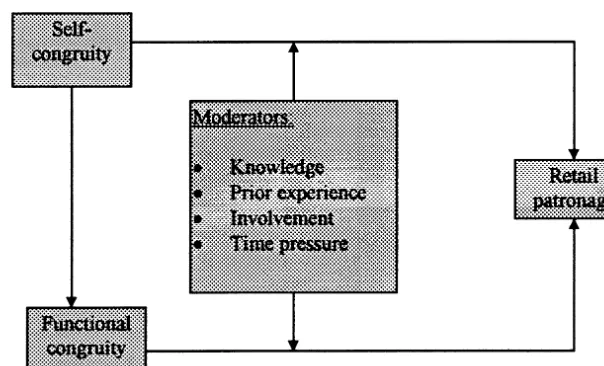
Figure 5. Moderator effects affecting the relation-ship between self-congruity (functional congruity) and retail patronage.
processed whereas symbolic cues, like retail patron image, will engage in central/systematic versus peripheral/heuristic are likely to be processed peripherally. Based on this argument, processing, or, in this case, the extent to which shoppers we propose that self-congruity influences functional congru- will engage in functional versus self-congruity processing in ity, and the predictive effects of self-congruity versus func- evaluating stores. One factor likely to affect consumers’ use tional congruity are moderated by shoppers’ knowledge, prior of functional versus self-congruity in evaluating stores is shop-experience, and involvement (see Figure 5). pers’ level of knowledge about stores and shopping. Research in consumer behavior suggests that knowledgeable or expert
Self-Congruity Bias
consumers are likely to process information differently than novice consumers (Brucks, 1985; Sujan, 1985; Alba and Sirgy, Johar, Samli, and Claiborne (1991) have shown thatHutchinson, 1987). For example, Brucks (1985) found that functional congruity is a stronger predictor of consumer
be-consumers with high prior knowledge tended to exert more havior than self-congruity. However, the evidence also
sug-gested that self-congruity “biases” functional congruity. That effort in acquiring new information. Because the information is, consumers who experience high self-congruity tend to used in this study concerned utilitarian attributes, this finding favorably process the utilitarian product attributes, and vice suggests that prior knowledge may facilitate the processing versa. Sirgy and Samli (1985) have demonstrated the same of utilitarian attributes. Similarly, Sujan (1985) suggested that phenomenon in relation to retail patronage. It stands to reason novices are likely to base evaluations on rather simplistic that shoppers who perceive a store to match their actual, criteria, whereas experts are likely to exhibit more product-ideal, social, and/or ideal social self-image may form an initial related thoughts. Because shoppers with low prior knowledge favorable attitude toward the store. This is essentially what of stores may not be able to evaluate utilitarian store attributes, social psychologists refer to as “first impression.” This first they may rely on evaluations of more “simplistic” cues, such impression biases further information processing. Thus, if as store patron image. And, because knowledge is likely to the first impression is positive, then it is likely that further facilitate processing of utilitarian attributes, shoppers with information processing may be biased in the positive direction more prior knowledge are likely to engage in functional con-(cf., Varvoglis and Sirgy, 1984). The converse is also true. gruity processing to evaluate stores (Johar and Sirgy, 1991).
Proposition 15: Self-congruity biases functional congruity.
Proposition 16: The relationship between self-congruity That is, shoppers who experience a match between the
and patronage is moderated by shoppers’ level of knowl-retail patron image and their self-concept are likely to
edge. Specifically, the effects of self-congruity on patronage process the utilitarian attributes in a favorable light, thus
are likely to be greater for shoppers with less knowledge increasing the likelihood of forming an overall favorable
than for shoppers with more knowledge. attitude toward the retail establishment. Those who
experi-ence a mismatch are likely to process the utilitarian
attri-Prior Experience
butes in an unfavorable light, thus increasing the likelihood
of forming an unfavorable attitude. With respect to prior experience, one recent study examined how prior experience moderated the relationships between
Knowledge
value-expressive and utilitarian criteria and brand attitudes. Mangleburg et al. (1998) found that user-image based cues A number of factors, such as ability and motivation to processversus more experienced consumers, but that utilitarian cues shoppers may focus on more holistic criteria, such as whether people similar to them shop in that store, and whether they generally had a greater effect on brand attitude for more
experienced versus less experienced consumers. Similarly, feel comfortable shopping there. For example, a person shop-ping for a gift at the last minute may select a store based on Wood and Kallgren (1988) reasoned that more experienced
subjects would have more attitude-relevant information acces- its image. The shopper may say to herself, “People like my friend and myself usually shop here; this is our kind of store” sible in memory than would less experienced subjects.
There-fore, less experienced subjects would be more persuaded by rather than evaluating the store’s individual utilitarian attri-butes.
nonmessage cues (e.g., source likability and expertise), and more experienced subjects would be more persuaded by
mes-Proposition 19: The relationship between self-congruity sage content. Results generally supported this line of
reason-and patronage is moderated by shoppers’ time pressure. ing. A similar process is likely to occur with respect to store
The effects of self-congruity are likely to be greater for attitude and patronage. That is, shoppers who are more
experi-shoppers who experience greater time pressure than for enced may focus on more utilitarian-based criteria in
evaluat-those who experience little time pressure. ing stores (e.g., functional congruity), whereas those shoppers
who lack experience may focus on more holistic, image-based
cues, such as self-congruity (Johar and Sirgy, 1991).
Managerial Implications
Proposition 17: The relationship between self-congruity
The managerial implications of self-congruity in consumer and patronage is moderated by consumers’ level of
shop-goods marketing have been widely recognized and discussed ping experience. Specifically, the effects of self-congruity
(e.g., Park, Jaworski, and MacInnis, 1986; Onkvisit and Shaw, on patronage are likely to be greater for shoppers with less
1987; Johar and Sirgy, 1989). In retailing the importance of experience than for shoppers with more experience.
the store image concept has been recognized since the early work of Pierre Martineau (Martineau, 1958). The managerial
Involvement
relevance of self-congruity has been discussed and debatedResearch also suggests that consumers’ level of involvement ever since (e.g., Sirgy, Samli, Bahn, and Varvoglis, 1985b, affects information processing. For example, Petty, Cacioppo, 1989; Samli and Sirgy, 1988; Samli, 1989). This article has and Schumann (1983) found that, under conditions of high sought to identify some of the potentially fruitful aspects that product involvement, argument quality had a greater effect retailing managers can use to construct desirable store patron on brand attitude. Manipulations of product endorser, how- images (i.e., price, advertising). The managerial implications ever, had a greater effect on brand attitude under conditions of self-congruity research in retailing are clear. If retailers can of low product involvement. Involvement is likely to perform position their stores to enhance the likelihood of self-congruity a similar moderating role in a retailing context. Because func- with target shoppers, they are likely to succeed in attracting tional congruity is a more cognitively taxing, piecemeal-ori- these shoppers to their stores. Doing so, of course, would ented process, it is likely to require a greater level of motiva- enhance profitability.
tion, or involvement, on the part of shoppers. Shoppers who have little involvement with shopping are likely to lack the
References
motivation to engage in this sort of processing and, therefore,
Alba, Joseph W., and Hutchinson, J. Wesley: Dimensions of Consumer
may base preferences and retail patronage decisions on
evalua-Expertise.Journal of Consumer Research13 (March 1987): 411–454.
tions of less cognitively taxing, more holistic and simplistic
Allport, G. W.: Becoming: Basic Considerations for a Psychology of
criteria, such as self-congruity (Johar and Sirgy, 1991).
Personality, Yale University Press, New Haven, CT. 1943.
Proposition 18: The relationship between self-congruity Baker, Julie, Grewal, Dhruv, and Parasuraman, A.: The Influence of and patronage is moderated by shoppers’ involvement with Store Environment on Quality Inferences and Store Image.Journal
of the Academy of Marketing Science22 (1994): 328–339.
stores and shopping. The effects of self-congruity on
pa-tronage are likely to be greater for shoppers who are not Bateson, John E. G., and Hui, Michael K. M.: Crowding in the Service Environment, inCreativity in Services Marketing, M. Venkatesan,
very involved with shopping than for those who are very
Diane Schmalensee, and C. Marshall, eds., The American
Market-involved.
ing Association, Chicago, IL. 1986.
Bateson, John E. G., and Hui, Michael K. M.: The Ecological Validity
Time Pressure
of Photographic Slides and Videotapes in Simulating the Service
Time pressure also may moderate the extent to which consum- Setting.Journal of Consumer Research19 (September 1992): 271–
281.
ers focus on utilitarian versus value-expressive criteria in
pa-tronage decisions. Shoppers who experience greater time pres- Bellenger, Danny N., Steinberg, Earle, and Stanton, Wilbur W.: The
Congruence of Store Image and Self-Image.Journal of Retailing
sure may not be able to engage in the in-depth processing
52 (Spring 1976): 17–32.
required of functional congruity, that is, to evaluate a store
Effects of Color in Store Design.Journal of Retailing59 (Spring keting, Ben M. Enis and Kenneth J. Roering, eds., American Mar-keting Association, Chicago, IL. 1981.
1983): 21–45.
Hong, Jae W., and Zinkhan, George M.: Self-Concept and Advertising Bitner, Mary Jo: Consumer Responses to the Physical Environment in
Effectiveness: The Influence of Congruency, Conspicuousness, Service Settings, inCreativity in Services Marketing, M. Venkatesan,
and Response Mode.Psychology and Marketing12 (January 1995): Diane Schhmalensee, and Claudia Marshall, eds., The American
53–77. Marketing Association, Chicago, IL. 1986, pp. 89–93.
Hui, Michael K., and Bateson, John E. G.: Perceived Control and Bitner, Mary Jo: Evaluating Service Encounters: The Effects of
Physi-the Effects of Crowding and Consumer Choice on Physi-the Service cal Surroundings and Employee Responses.Journal of Marketing
Experience. Journal of Consumer Research18 (September 1991) 54 (April 1990a): 69–82.
174–185. Bitner, Mary Jo: Servicescapes: The Impact of Physical Surroundings
James, William:The Principles of Psychology, Holt, New York. 1890. on Customers and Employees. Journal of Marketing 54 (April
1990b): 57–71. Johar, J. S., and Sirgy, M. Joseph: Positioning Models in Marketing: Toward a Normative-Integrated Model. Journal of Business and
Brucks, Merrie: The Effects of Product Class Knowledge on
Informa-Psychology3 (1989): 475–485. tion Search Behavior.Journal of Consumer Research12 (June 1985)
1–16. Johar, J. S., and Sirgy, M. Joseph: Value Expressive Versus Utilitarian Appeals: When and Why to Use Which Appeal.Journal of
Advertis-Chaiken, Shelley: Heuristic Versus Systematic Information Processing
ing20 (September 1991): 23–34. and the Use of Source Versus Message Cues in Persuasion.Journal
of Personality and Social Psychology39 (1980): 752–766. Kiecker, Pamela, and Hartman, Cathy L.: Purchase Pal Use: Why Buyers Choose to Shop with Others, in1993 AMA Winter
Educa-Chebat, Jean-Charles, Gelinas-Educa-Chebat, Claire, and Vanisky,
Alexan-tors’ Conference Proceedings, American Marketing Association, Chi-der: Impact of Waiting Attributions and Consumers Mood on
cago, IL. 1993, pp. 378–384. Perceived Quality.Journal of Business Research34 (1995): 191–196.
Lecky, P.:Self-Consistency: A Theory Personality, Island Press, New Claiborne, C. B., and Sirgy, Joseph: Self-Congruity as a Model of
York. 1945. Attitude Formation and Change: Conceptual Review and Guide
for Future Research, inDevelopments in Marketing Science, vol. Malhotra, N. K.: A Scale to Measure Self-Concepts, Person Concepts 13, B. J. Dunlap, ed., Academy of Marketing Science, Cullowhee, and Product Concepts.Journal of Marketing Research18 (Novem-NC. 1990, pp. 1–7. ber 1981): 454–464.
Cohen, Joel B., and Basu, Kunal: Alternative Models of Categoriza- Malhotra, N. K.: Self-Concept and Product Choice: An Integrated tion: Toward A Contingent Processing Framework. Journal of Perspective.Journal of Economic Psychology9 (1988): 1–28. Consumer Research13 (March 1987): 455–472.
Mangleburg, Tamara, Sirgy, M. Joseph, Grewal, Dhruv, Hatzios, Ma-Cooley, C. H.:Human Nature and the Social Order, Charles Scribner ria, Axsom, Danny, and Bogel, Trina: The Moderating Effect of and Sons, New York. 1902. Prior Experience in Consumers’ Use of User-Image Based Versus Utilarian Cues in Brand Attitude.Journal of Business and Psychology
Dodds, William B., Monroe, Kent B., and Grewal, Dhruv: The Effects
13 (Fall 1998): 101–113. of Price, Brand, and Store Information on Buyers’ Product
Evalua-tions.Journal of Marketing Research28 (August 1991): 307–319. Markus, Hazel, and Nurius, Paula: Possible Selves.American
Psycholo-gist4 (1986): 954–969. Dolich, Ira J.: Congruence Relationship between Self-Image and
Prod-uct Brands. Journal of Marketing Research 6 (February 1969): Martin, Warren S. and Joseph Bellizzi: An Analysis of Congruous 80–84. Relationships between Self-Image and Product Images.Journal of
the Academy of Marketing Science10 (Fall 1982):473–489. Dornoff, R. J., and Tatham, R. L.: Congruence Between Personal
Image and Store Image.Journal of Marketing Research Society14 Martineau, Pierre: The Personality of the Retail Store.Harvard Business
(1972): 45–52. Review36 (January-February 1958): 47–55.
Dube, Laurette, Chebat, Jean-Charles, and Morin, Sylvie: The Effects Mead, G. H.:Mind, Self, and Society, University Press, Chicago, IL. of Background Music on Consumers Desire to Affiliate in Buyer- 1934.
Seller Interactions.Psychology & Marketing12 (July 1995): 305– Milliman, Ronald E.: Using Background Music to Affect the Behavior 319. of Supermarket Shoppers.Journal of Marketing46 (Summer 1982): Ericksen, Mary Kay, and Sirgy, M. Joseph: Achievement Motivation and 86–91.
Clothing Behavior of Working Women: A Self-congruity Analysis. Onkvisit, Sak, and Shaw, John J.: Self-Concept and Image
Congru-Journal of Social Behavior and Personality4 (1989): 307–326. ence: Some Research and Managerial Implications.Journal of Con-Ericksen, Mary Kay, and Sirgy, M. Joseph: Employed Females’ Cloth- sumer Marketing4 (Winter 1987): 15–25.
ing Preference, Self-congruity, and Career Anchorage.Journal of Onkvisit, Sak, and Shaw, John J.:Consumer Behavior: Strategy and Applied Social Psychology22 (1992): 208–422. Analysis, MacMillan College Publishing, New York. 1994, pp. Evans, Franklin: Automobiles and Self-Imagery: Comment.Journal 133–164.
of Business41 (October 1968): 445–459. Park, Whan, Jaworski, Bernard J., and MacInnis, Deborah J.: Strategic Green, P. E., Maheshwan, A., and Rao, V. R.: Self-Concept and Brand Concept-Image Management.Journal of Marketing50
(Oc-Brand Preference: An Empirical Application of Multidimensional tober 1986): 135–145.
Scaling.Journal of Marketing Research Society4 (1969): 343–360. Petty, Richard, and Cacioppo, John T.:Communication and Persuasion: Grubb, E. L., and Grathwohl, Harrison L.: Consumer Self-Concept, Central and Peripheral Routes to Attitude Change, Springer-Verlag,
Symbolism, and Market Behavior: A Theoretical Approach.Journal New York. 1986.
Mar-ing Role of Involvement.Journal of Consumer Research10 (Septem- tribute Attitude Models: When to Use Which Positioning Model, in1985 AMA Educators’ Proceedings, Robert F. Lusch, et al., eds., ber 1983): 135–146.
American Marketing Association, Chicago, IL. 1985b, pp. 11–15. Ross, Ivan: Self-Concept and Brand Preference.Journal of Business of
Sirgy, M. Joseph, and Samli, A. C.: A Path Analytic Model of Store
the University of Chicago44 (1971): 38–50.
Loyalty Involving Self-Concept, Store Image, Socioeconomic Sta-Samli, A. Coskun:Retail Marketing Strategy: Planning, Implementation,
tus, and Geographic Loyalty.The Journal of the Academy of Market-and Control, Quorum Books, Westport, CT. 1989.
ing Science13 (Summer 1985): 265–291. Samli, A. Coskun, and Sirgy, M. Joseph: A Multidimensional
Ap-Sirgy, M. Joseph, and Samli, A. C.: Self-Congruity Versus Socioeco-proach to Analyzing Store Loyalty: A Predictive Model, inThe
nomic Status: Predictors of Patronage of Upscale and Downscale
Changing Marketing Environment: New Theories and Applications,
Stores, In The Cutting Edge: Proceedings of the Store Patronage
Ken Bernhardt and Bill Kehoe, eds., American Marketing
Associa-Conference, William Darden, ed., Department of Marketing, Loui-tion, Chicago, IL. 1981, pp. 113–116.
siana State University, Baton Rouge, LA. 1989a, pp. 35–45. Samli, A. Coskun, and Sirgy, M. Joseph: Evolution of Retail
Competi-Sirgy, M. Joseph, and Samli, A. C.: The Store Loyalty Concept: tion: The Strategic Marketing Perspective, inRetailing: Its Present
Dimensions and Measurement, inRetail Marketing Strategy, A. C.
and Future, Robert King, ed., Academy of Marketing Science,
Samli, ed., Greenwood Press, Westport, CT. 1989b, pp. 279–305. Charleston, SC. 1988, pp. 1–5.
Sirgy, M. Joseph, Samli, A. C., Bahn, Kenneth, and Varvoglis, Theo-Sirgy, M. Joseph: Self-Concept in Consumer Behavior, unpublished
fanis: Affective Social Congruity and Store Patronage, in
Develop-Ph.D. thesis, Department of Psychology, University of
Massachu-ments in Marketing Science, vol. 8, Naresh Malhotra, ed., Academy setts at Amherst. 1979.
of Marketing Science, Atlanta, GA. 1985a, pp. 7–11. Sirgy, M. Joseph: Self Concept in Relation to Product Preference and
Sirgy, M. Joseph, Samli, A. C., Bahn, Kenneth, and Varvoglis, Theo-Purchase Intention, inDevelopments in Marketing Science, vol. 3,
fanis: Self-Concept and Retail Strategy, inDevelopments in
Market-V. Market-V. Bellur, ed., Academy of Marketing Science, Marquett, MI.
ing Science, vol. 8, Naresh Malhotra, ed., Academy of Marketing 1980, pp. 350–354.
Science, Atlanta, GA. 1985b, pp. 2–6. Sirgy, M. Joseph: Self-Concept in Consumer Behavior: A Critical
Re-Sirgy, M. Joseph, Samli, A. C., Bahn, Kenneth, and Varvoglis, Theo-view.Journal of Consumer Research9 (December 1982a): 287–300.
fanis: Congruence Between Store Image and Self-Image, inRetail
Sirgy, M. Joseph: Self-Image/Product-Image Congruity and Purchase Marketing Strategy, A. C. Samli, ed., Greenwood Press, Westport, Motivation: A Role Playing Experiment.Proceedings of the American CT. 1989, pp. 207–219.
Psychological Association, Consumer Psychology Division (1982b): 90.
Sirgy, M. Joseph, Johar, S., Samli, A. C., and Claiborne, C. B.: Self-Sirgy, M. Joseph: Self-Image/Product Image Congruity and Consumer Congruity Versus Functional Congruity: Predictors of Consumer Decision Making.International Journal of Management2 (1985a): Behavior. Journal of the Academy of Marketing Science 19 (Fall 49–63. 1991): 363–375.
Sirgy, M. Joseph: Using Self-Congruity and Ideal Congruity to Predict Sirgy, M. Joseph, and Johar, S., and Claiborne, C. B.: Self-Concept Purchase Motivation.Journal of Business Research13 (June 1985b): Motivation as Mediator Between Self-Congruity and Attitude/In-195–206. tention, inDevelopments in Marketing Science, vol. 15, V. L. Critten, ed., Academy of Marketing Science, Chestnut Hill, MA. 1992, Sirgy, M. Joseph:Self-Congruity: Toward a Theory of Personality and
pp. 402–406.
Cybernetics, Praeger, New York. 1986.
Stern, Bruce L., Bush, Ronald F., and Hair, Joseph F.: The Self-Sirgy, M. Joseph: The Moderating Role of Response Mode in
Con-Image/Store Image Matching Process: An Empirical Test.Journal
sumer Self-Esteem/Self-Consistency Effects, in1987 AMA Winter
of Business50 (January 1977): 63–69.
Educators’ Conference, Russell Belk et al., eds., American Marketing
Association, Chicago, IL. 1987, pp. 50–55. Sujan, Mita: Consumer Knowledge: Effects on Evaluation Strategies Mediating Consumer Judgments.Journal of Consumer Research12 Sirgy, M. Joseph: Self-Cybernetics: Toward an Integrated Model of
(June 1985): 32–46. Self-Concept Processes.Systems Research7 (1990): 19–32.
Varvoglis, Theofanis:Activation of Self-Image in a Store Setting and
Sirgy, M. Joseph, and Danes, Jeffery: Self-Image/Product-Image
Con-During Television Viewing, Doctoral Dissertation, Virginia Tech, gruence Models: Testing Selected Models, inAdvances in Consumer
Blacksburg, VA. 1987.
Research, vol. 9, Andrew Mitchell, ed., Association for Consumer
Research, Ann Arbor, MI. 1982, pp. 556–561. Varvoglis, Theofanis, and Sirgy, M. Joseph: The Interrelationship Between Utilitarian and Value-Expressive Store Image Attributes, Sirgy, M. Joseph, and Johar, S.: Measures of Product
Value-Expres-inDevelopments in Marketing Sciencevol. 7, Jay D. Lindquist, ed., siveness: An Initial Test of Reliability and Validity, inProceedings
Academy of Marketing Science, Kalamazoo, MI. 1984. pp 27–31.
of the Division of Consumer Psychology, American Psychological