• Tidak ada hasil yang ditemukan

PROS Listyani Individual learner Full text

N/A
N/A
Protected

Academic year: 2017

Membagikan "PROS Listyani Individual learner Full text"

Copied!
14
0
0

Teks penuh

(1)

THE¢

_

Mセ セ@

INTERNATIONAL ':,

··{·;&.SEMINAR 2011

l . . . SATYA WACANA CHRISTIAN UNIVERSITY ,

Individual Learner Differences and

Second Language Acquisition:

A progressive study on Academic

Writing

students

Listyani

Satya Wacana Christian University

ABSTRACT

Second Language Acquisition is a part of linguistic studies which focuses on investigating how one learns a second language, that is, a foreign language learnt after the acquisition of the mother tongue. In Indonesian setting, however, the majority of the people are born bilinguals, they are exposed to both the local vernacular and the national language, Indonesian, and in Indonesia, the position of English is as a foreign language. This study focuses on how learners, with their uniqueness and special differences, grow in their personal factors, among which is self-confidence, amidst the tight competitive atmosphere of learning English as a foreign language. The participants of this study

were students of Academic Writing Class Group C, semester

1/

2011-2012. Data were mainly derived

from journals. The main conclusion of this study is that individual learner differences do affect learners' performance and active participation in the classroom setting.

(2)

THE!jit-ᄋNᄋセᄋ@

INTERNATIONAL

\ra.

SEMINAR 2011

... SAtYA WACANA CHRISTIAN UNIVEI\Sny

Individual Learner Differences and

Second Language Acquisition:

A progressive study on

Academic

Writing

students

Listyani

Satya Wacana Christian University

ABSTRACT

Second Language Acquisition is a part of linguistic studies which focuses on investigating how one learns a second language, that is, a foreign language learnt after the acquisition of the mother tongue. In Indonesian setting, however, the majority of the people are born bilinguals, they are exposed to both the local vernacular and the national language, Indonesian, and in Indonesia, the position of English is as a foreign language. This study focuses on how learners, with their uniqueness and special differences, grow in their personal factors, among which is self-confidence, amidst the tight competitive atmosphere of learning English as a foreign language. The participants of this study were students of Academic Writing Class Group C, semester 1/ 2011-2012. Data were mainly derived from journals. The main conclusion of this study is that individual learner differences do affect learners' performance and active participation in the classroom setting.

INTRODUCTION

There are various differences that we can find from second language learners. They vary

considerably in personality, age, motivation, learning style, and aptitude (Ellis, 1985: 99). All these

factors are called individual leaner differences, among which are differences in age, learning style,

aptitude, motivation, and personality (Ellis, 1985: 99). All of them contribute both to the success or failure of Second Language Acquisition (SLA). This paper focuses on one of those factors, that is, personality, and how it influences students' performance in their Academic Writing class. Self-image, which is one of the aspects of personality, will be the main theme of this research. This research,

which is qualitative in nature, is an on-going one, for this still continues throughout this semester. The participants of this study were 23 students of my Academic Writing D class, Semester

1/

2011-2012 Academic Year. The students' class years (angkatan) varied from 2005 to 2009 (fifth to

thirteenth sempster students), and Academic Writing class is the last writing class that students

should attend 6efore previously taking other writing classes, which are lower in the rank of hierarchy

and levels of difficulties. Data for this study were mainly taken from documents, that is, students' journals, which the students wrote almost every week. The findings from this study hopefully can

help other writing teachers in boosting their students' self-image, which has implications on many other factors, like motivation, self-confidence, and in turn, all these may affect their performance in

class.

(3)

PERSONALITY FACTORS AND SLA

theセ@

LセZQL@

INTERNATIONAL

::&,

SEMINAR

2011

, . SATYA WACANA CHRISTIAN UNIVERSITY

Every learner has different personalities, and every learner has their own characters and traits. In facing this diversity of learners, teachers' roles in the classroom should be more than just becoming the "messengers of knowledge", but they should be able to act as educators, "mental trainers", and "agents of changes", they should act to boost their students' confidence and spirit that the students can be better learners. All this can be done if teachers can help students have better self-image. learners can see themselves positively, appreciate themselves and grow confidence.

It is well-known that every language learner has personal and general factors which contribute to the success as well as the failure of their language learning. Ellis claims that personal factors are "highly idiosyncratic features of each individual's approach to learning a second language (1985:100)". Schumann and Schumann (1977), in Ellis (1985), mention that personal factors include nesting pattern-the need for a "secure and orderly home" before effective learning begins. Next, it also includes transition anxiety. It means stress which is caused by moving to a new place. Besides the two aspects, personal factors include the desire to maintain a personal language learning agenda. According to Schumann and Schumann (1977), all these factors influence SLA.

Personal factors are difficult to observe. There are some solutions to this problem. First, diary studies can be used. Questionnaires and interviews are other alternatives that can be used. According to Ellis (1985), personal factors include group dynamics, attitudes to the teacher and materials, and individual learning techniques.

Bailey (1983), in Ellis (1985), conducted research on anxiety and competitiveness experienced by some diarists. He got some findings. Some learners made overt comparisons between other learners and themselves. Some others think they are progressing against their expectations. These comparisons often result in emotive responses to language learning experience. In line with this, McDonough (1978) notes that although rivalries can cause confusion, they can function as a stimulus for learning. McDonough further proposes an idea that group cohesiveness,

which is based on learners' rejection of pressure and acceptance of failure, may depress performance. In other words, it can be concluded that the group dynamics affect learners' mental, this can lead to pressure and failure. Performance in the classroom is thus greatly affected by group cohesiveness.

..

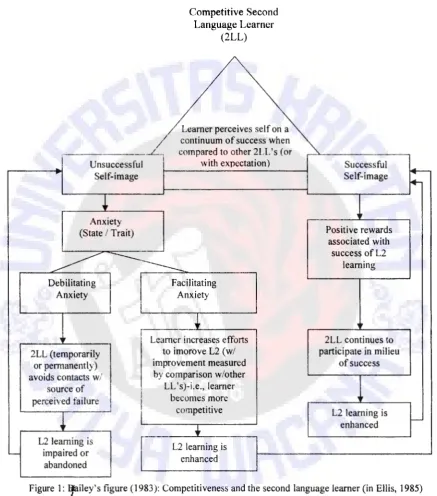
Bailey (1983), as cited by Ellis (1985) further proposes a model of how self-image of a learner compared with other learners, can either impair or enhance SLA. If the comparison results in an unsuccessful self-image, debilitating anxiety can happen. In this case, learners reduce or abandon learning effort. Another contradictory case called facilitating anxiety may emerge. In this case, learners increase their efforts to compare more favorably with others. Thus, learning is enhanced. When comparison yields successful self-image, learners experience positive rewards, and they

(4)

Below is the figure of learners' self-images and how it affects SLA.

Competitive Second Language Learner

(2LL)

/

_ _ _ _ _ _ _ _ _ _ _ _ . t _ .. ,

Leamer perceives self on a continuum of success when compared to other 2LL's (or

Anxiety (State I Trait)

with expectation)

セ@

---=----=---

_;::::,-.

_____

__,

Debilitating Anxiety

2LL (temporarily or permanently) avoids contacts w/

source of perceived failure 1

-r·--____j

L2 learning is

J

'-- impaired or

abandoned

. . _ _ _ _

Facilitating Anxiety

l

Leamer increases efforts to imorove L2 (w/ improvement measured

by comparison w/other LL's)-i.e., Ieamer I

i

becomes more competitive

L __ .-__

_____,

セMMMu@ learning is. l__enhanced

theセ@

"·"'·

INTERNATIONAL

セZZN。NN@

S EM I N A R 2011

TsATVA WACANA CHRISTIAN

· - - - , Successful Self-image

Positive rewards associated with

success of L2 learning

2LL continues to participate in milieu

of success

L2 learning is enhanced

Figure 1: IJailey' s figure ( 1983 ): Competitiveness and the second language learner (in Ellis, 1985)

Self-image itself is defined as the idea, conception, or mental image that one has of oneself

(World English Dictionary, 2011). People with low self-esteem are advised to "harness the power of

their thoughts and beliefs, and to change how they feel about themselves". The reason behind this is

because low self-esteem can bring negative impacts on every side of life, like health, relationships, as well as job. There are four steps that Mayo Clinic Staff suggest to overcome low self-esteem. First,

people are advised to identify difficult situations or conditions. Next, being aware of thoughts and

[image:4.539.56.494.127.624.2]
(5)

THE¢

"

INTERNATIONAL

Nゥセ@

S L MINAR 2011

. . . SATYA WACANA CHRISTIAN UNIVERSITY

beliefs is recommended. "Self-talk" and "interpretation of what the situation means" are included in this step. In the next step, people are advised to fight against negative thinking. The last phase is to replace negative and inaccurate thoughts with positive and constructive ones (Mayo Clinic Staff,

2011).

In this research, Academic Writing class which I taught in Semester 1/ 2011-2012, can be perceived as a group dynamic in which learners were competing with their peers. How students' self-images trnpair or enhance their performance in this class becomes the rnain focus of this study.

DISCUSSIONS ON THE FINDINGS

In this part, two central questions of this study will be answered. The first question addressed is about the difficulties that my students faced in this considered-difficult class. My question is simple, "What is/are your biggest difficulty/ties in this writing class?" The second one deals with how students saw themselves in the Academic Writing class as a group dynamic? (How do

you see ケッオイウ・セヲ@ in this class as a group dynamic? Or What do you think of your own position in this

writing class?). I then related this question with another "smaller'' question, that is, about the

learners' self-images: "In your perspective, how does your self-image influence your performance in

the classroom: does it impair or enhance your performance?" And the last question that I asked them

to write in their journal is about their efforts to survive amidst the tight competition of the class,

What are you going to do to boost up your own spirit in this writing class? In order to answer those 3

questions, the discussion section is divided into three parts as the following.

A. Academic writing Students' main difficulties in writing an argument

In this class, I have 23 students from various class years. They varied from 2005 up to 2009 class years. There was only 1 student from class year of 2005, 2 from 2006 class year, 9 students from class year of 2007. Six students came from class year of 2008, and the rest were 5 students from 2009 class year, and a Korean student from 2010 class year, the youngest generation in the class. I named the students A until X randomly.

1. Generating ideas

In the first journal, I asked them to write the answer to a question on their biggest difficulty/ties in this writing class. Dealing with that first problem (What is/are your

difficulty/ties in this Academic Writing class?), the studE!nts gave me various answers, but

most of them said that they had difficulties in finding or developing ideas and most of them were afraid of not being able to find enough sources for their essay. In this writing class, students had to write an argumentative essay with at least 15 sources, and the topic had to be related to education, teaching, linguistics, or literature. In short, all of them had to write an argument with education-related topics, with enough supports and sources for their essays.

One student mentioned that she was not interested in teaching and linguistics, so it was difficult for her to find an appropriate topic.

Extract 1: Student J's statement in her first journal

Honestly, I'm not really interested in teaching and linguistic topics .

.. ··- ·-·-·-,-..

MNLNセMᄋ@

00 . _.

セᄋ@

... 3-· ·- .

••

.

I .

(6)

THEstJ.,

セセ。N@

INTERNATIONAL

ᄋGBGᄋセseminar@

2011

Ts11.1¥A WACANA CHRISliAN UNIVERSIT1

This is strengthened by Student T's opinion who said that the nature of the class is too serious and complicated for her. Below is her statement in her first journal:

Extract 2: Student T's statement:

The title of the course itself, which is "academic", sounds very serious and complicated to write essays. I have to make an essay that is closely related to language teaching, teachers·learners, or something which is educative. Personally, I prefer to write essays that have simple topics, not those complicated ones.

This case is in line with what is stated by Podis and Podis (1984:34-5) that for successful argumentative or persuasive essays, two things are crucial: awareness of the writer's purpose and knowing the nature of the readers. Without a clear goal, the argument will not be clear. The definition of an argument is "a coherent series of reasons offered given in proof or rebuttal". This is what all the students had to write this semester. If they did not have a clear goal or purpose of their argument, they would not be able to produce a piece of good argumentative writing.

Talking about difficulty in finding ideas, Podis and Podis (1984:41), again mention that

it is a very natural event; they mention that even famous writers like Joseph Conrad admitted his lack of ideas in writing. They suggest that students should not be embarrassed to admit that they have no idea at all about what to write.

2. Grammar in the writing

Besides difficulty in finding ideas, some of the students also mentioned their worry or concern of their grammar in the writing. At least eight students mentioned this in their journals, and one of them is presented below:

Extract 3: Student A's sentences:

... in English, I fail to share them (my thoughts and opinions) in the class. I'm not sure about the reason, maybe it is because my grammar is still below average and I am always afraid to make mistakes.

On the other hand, one student, Student T, was very confident about her grammar and she wrote that her grammar was good enough: I don't think that grammar is the biggest

problem that I will get. I know that my grammar is good enough.

Good grammar, apparently, became a concern for many students in my class. Scott

and AvefY (2001:47) give advice that clearer writing is usually more "stimulating" and "interesting for the readers. They say further that good, accessible and appropriate communication is important in a piece of writing. Scott and Avery (2001:43-59) again remind

writers to always remember who their readers are, to choose suitable words or the right

diction, and avoid wordiness, passive voice, and they also remind writers not to be sexist or

discriminatory in their language.

(7)

theセ@

""'

INTERNATIONAL

, .

SEMINAR 2011

. . . . SATYA WACANA CHRISTIAN unゥvセrsitv@

3. Finding appropriate sources and paraphrasing

Out of 23 students in my class, eight of them mentioned that they were worried about finding references to support their essays. There were students who were so afraid of not being able to find adequate and appropriate references to support their arguments. This is understandable; Podis and Podis (1984:349) claim that in general, a university library can be advantageous or disadvantageous; either it has too much or too little. If students can find a lot of information, then it is beneficial for their writing, because an academic or argumentative paper must accurate and complete. Here is a student's concern (Student R) about the references she had to find for her essay: "For a paper, the students must collect 15 references and 10 of them should be included in the paper. I think it is not easy to find."

Another closely related problem is about paraphrasing. In this activity, students had to restate an author's sentences using their own words, but the idea must be the same, and the length should be about the same too (Podis and Podis, 1984: 359). This is not easy to do, since if students still use the author's words and sentences, then they fall to plagiarism. The following is a statement from Student B about this difficulty:

Extract 4: Student B's statements on paraphrasing

One of the most difficult in my writing is paraphrasing. I feel that it is the most difficult thing because I must really understand the sentences that I'm going to paraphrase. Sometimes I don't really understand a particular sentence because there are uncommon words. So I must try to guess or find it first, then I can paraphrase it. Paraphrasing sentences for me is not easy ... in a simpler way, I have difficulty in paraphrasing sentences or quotation while writing.

It is not rare that students fail this course because they fall to plagiarism, unable to re-express an author's sentences in their own words, but the meaning must be maintained.

4. Other findings

There are various answers when the students were asked to describe their difficulties

in writing. Other answers centered on lack of interest in writing and reading, nervousness in the topic selection, lack of coherence, bad handwriting, and time management. The last problem was mentioned by a student who was working on his thesis by the time he repeated the course, and another student had been working in a garment factory. In short, lack of time is a big problem for him.

B. How students deal with

identity crisis

problems

Every learner has different qualities and each of them is unique. According to Ellis (1985: 99-101), individual learner differences include personal and general factors. Personal factors are "highly idiosyncratic features of each individual's approach". Personal factors include nesting patterns (the need for a secure and organized home), transition anxiety, i.e. stress which caused when moving to a new place, and the desire to maintain a language learning agenda. In Ellis' later classification of

(8)

theセ@

QQゥZセ@

INTERNATIONAL

セseminar@

2011

SATYA WACANA CHRISTIAN UNIVEIISrry .

In this paper, I focus on two things of personal factors, that is, learner's self-confidence and how learners respond to the group dynamics in the classroom setting.

From the second question that I asked to the students (How do you see your own position in

the classroom?), I got various answers written in the second journal. I asked my students to answer

that particular question because I wanted to see how they think and feel about their position in the classroom was, in comparison with other learners. Let us see their various answers on that.

In this classroom, I see that my students vaned m their confidence or self-esteem levels. All this reflects their self-images, either successful or unsuccessful one, as what I cited from Ellis (1985) in the previous part. Three students repeated this class since they previously failed the course. Even though they were repeaters, they varied in their confidence. One repeater (Student K) from class

year of 2009 was very confident and perceived everything positively, while another one (Student A) was very unconfident, feeling that he was the dumbest student in class. This was rooted at his class year; in this class, Student A was the oldest, that is, he came from class year of 2005. The other student who repeated this class, Student 0, said that she felt that she was more prepared, and she

felt she was just an ordinary student. Being a repeater, she also claimed further that she was more experienced than others, though in fact she did not like writing. Presented below are Student K's optimistic words which I believe had inspired himself to succeed in the class:

Extract 5: Student K's second journal

I see myself in Academic Writing class as a person who has already known this subject very well. The reason is that I am repeating this class now. I have taken this class before and I know the reason well.../ won't repeat my mistake again.

Therefore, I will make the essay seriously. I want to get an A in this class.

From his assertive and positive statements, I can see clearly that this student had a very clear

goal and spirit in taking the class. Based on my observation, I could also see that he was a very serious and optimistic student; paying attention to may explanations, coming to class regularly, and

often giving critical inputs or suggestions for other friends when they were presenting their topics. In contrast to Student K, Student A, another repeater, mentioned that he got a kind of

"declining" self-confidence. First, he mentioned that he was confident; being the oldest class year in the class and having learnt many writing skills. Yet as the class progressed, he started to feel that he was the dumbest student in class, and he had to push himself. He also tried to advice himself to be

strong, though he realized that he was not as smart as others and he felt that other students often gave a cynical look at him. The following statements will clarify his promise to himself that he had to

"win" his confliqts.

Extract 6: Student A's journal

... / always think that I need to push myself as hard as I can, even when I have

reached my limit already. I do realize that I'm not as smart as some students ... I

have to /oak strong (not fragile like this, complaining and venting about nothing) in

every class ... / fee/like I deserve the title "loser of the year"

(9)

theセ@

INTERNATIONAL

.a,.

SEMINAR 2011

... SATYA WACANA CHMISTiAN UNivtliSITV

It seems that Student A had very low self-confidence, though it is still changeable. In the classroom, he also seemed to be quiet and did not answer or say something unless I asked him. In the fifth week, this student came to me for an individual consultation, and I treated him like other

students too, and I did not want to make him feel that he was "different".

Other students who had problems with self-confidence were Student V and Student 0.

Student V felt that actually she was better than her friends, but she was afraid to tell others what was in her mind; she was afraid of making mistakes. But in general, she admitted that she was an enthusiastic student. Student 0 mentioned that she was an introverted, silent, and fearful student. Yet, when she found difficulties, she would be brave to ask the teacher or her friends, and she said that she liked quiet classroom atmosphere, like this Academic Writing class.

One student, Student W, mentioned that she felt afraid to be in this class, particularly because she came from the youngest class year in this class, while others were from the older generations. She thought that older generation students got more knowledge and background, so it was difficult to compete with them, but she promised herself to do her best.

The following group of students was those who experienced increasing spirit and conf1dence, meaning that they were getting better or improving in the way they saw themselves in the classroom. They were Student

ct

Student U, and Student C. Student Q came from class year of 2008, and at first, she felt that the course was so difficult, and she got stressed. This was mainly due to the long sessions of the class, that is, 4 hours in a row per week. Another thing is that students were required to produce an 8-page academic argumentative paper, complete with the relevant references, which was not an easy task. As time went by, Student Q said that her view changed, and grew more confident and felt that she was just like others. The following will clarify my points:

Extract 7: Student Q's journal

... but then, my teacher could change my understanding about writing. I learned from her that writing is a process. I think I'm as smart as others, we are in the same class, so what my friends got, I also got it...

In line with her is Student U, from 2009 class year. Student U was a unique student because she was a leaner with very slow pace of adaptation. Her "nesting pattern" was a very important factor in her learning (Ellis, 1985). At the first time, she felt frustrated and inferior since 2009 students were a "minority" in this class. There were only 5, out of 23 students. She managed to adapt to this frustrating situation in more than 2 weeks. First, she felt that older class years reflect better

cognitive ability, "I felt they were smarter than me", that was what she stated. But approaching the middle of the semester, this student could overcome her nervousness, being the youngest class year in the class, she built up her own confidence and she felt better: '' ... /tried to talk to myself that I want to succeed and pass this class, t should be a positive thinker. As a result, now I can see myself the same as others ... in this class, we compete to be the best."

The last student who experienced growing confidence was Student C. In contrast to the previous 2 students, Student C felt Inferior because she was frorr, 2006 class year. First, she often felt

embarrassed every time she made mistakes in her pronunciation. But then as the course progressed, she grew more comfortable and confident; her friends helped her a lot. "/am thankful because my

(10)

THE¢

INTERNATIONAL

セseminar@

2011

. . . SATYA WA!.ANA CHRISTIAN UNIVEIISIT't

The last group of students could be classified as confident students, or students with high rank of self-confidence. I observed that there were 3 students with this characteristic, they were Student K, a repeater whom I have discussed above, Student T, Student R, Student X, and StudentS. Student X, as I mentioned previously, felt that he was "different" from others in terms of age, background, education level, present duties, and country of origin. He came from Korea and had been working in a garment factory as a General Manager. He was 29 and took an undergraduate degree ln order to get better セ。ャ。イケ@ and higher position in his office. That is why he had a very strong instrumental motivation, that is, motivation that occurs when the goal of learning a language is functional (Ellis, 1985: 117) and he was very optimistic.

Student R was very wise in understanding her own "position" as one of the youngest students in class. She believed that even though others were from the older generations, it did not mean that they were better. " ... /believe that they are not so much better than me ... I am a student,

so I think there is no need to feel unconfident with others who are studying too." In the classroom

activities, this student also looked confident and the various class years being in her class did not

bother her at all.

In line with her was StudentS and Student T. StudentS admitted that he was an enthusiastic

student with

ua

bunch of spirit in writing". He was a typical nice student, who always came to class regularly, never came late, and very attentive to my explanations. He was a calm and confident learner, and optimistic too. Being a student from class year of 2009 did not make him feel inferior.

Below is his statement that shows his positive attitude in learning:

Extract 8: Student S' journal

... /love to share my thoughts and one of the woys ... is through writing. I also love to read other students' thoughts or arguments ... because it can add new perspectives into my mind and ... encourage me to write as best as I can.

Student T was another student with high confidence level. She was serious in this class

mainly because she knew the academic paper that she produced would be the "embryo" of her thesis later on. In short, she was similar to Student S: a good, attentive, diligent student who never

came late and always tried to answer the teacher's questions. She had very high motivation to get a

good grade for this course.

As a conclusion, students in my class had different degrees of confidence, but after all, they

all struggled to survive in this class.

C. lndividuaklearner differences and students' performance In the classroom

I

In this part, I will share my participants' opinions on their efforts or strategies to survive

amidst the tight competition in the classroom. As 1 mentioned before, the participants of my research came from various class years/ angkatan. I believe, as Ellis (1985) mentions in his book, that individual learner differences, including self-image, self-confidence, and individual learning

techniques, do influence learners' performance in their second language learning.

In order to get answers from my students, I addressed this question" What are you going to

da to boost your self-confidence and motivation in learning?" Before assigning them to write the

(11)

THE

Sit-INTERNATIONAl

&

S E M I N

f.\

R 2011

セaイya@ wacaエセa@ CHRISliAN liNIIIERSilV

third journal, I gave the students some tips on how to boost their self-confidence (article is attached as appendix). The following part is the analysis of their answers. Due to the limitation of space and time, I will highlight interesting or intriguing things from the 3 students only in this part

The first student that I would like to describe is Student T. As mentioned earlier; she was a typical diligent student who was not afraid of the existence of older classes/ angkatan in the class. She mentioned that she did three things to boost her own c:pirit in this writing class Firc;t she prayed

the next thing she did was sharing to her close friends, family members, or teachers. And the last thing she did was she told herself that making mistakes was just normal and everybody did that. Blaming herself was one thing that she would never do. As long as I observed this particular student in the classroom, I also admit that she did not have many problems in absorbing the information I gave her in my lectures, and she also sometimes helped her friends who needed her opinions

confidently.

In contrast to Student T, Student U was still struggling with her own confidence in facing any problem dealing with any assignment given. Several times she changed her topics, while others had proceeded and were about to produce an outline. She was so unconfident of herself. In her journal, she wrote that actually she was not a learner who easily gave up with the difficult situations around her. However, she was trying hard to increase her spirit and performance in the classroom. She mentioned that she would keep practicing and praying. Next is she tried not to be afraid of making mistakes, and finally, she said to herself that she already did her best. For Student U, her friends and teacher in the classroom helped her to be a better person: "Honestly, I enjoy it (being criticized by friends and the teacher) because I can learn something that will help me to be a better person and it

is better for my study".

The last student that l would like to observe here is Student X, who felt that he was different due to his nationality, age, and status as a General Manager in a garment factory. In the classroom, he tended to be "alone", away from his younger friends. Despit1::! the fact that this student seemed not to like to mingle with others, he had a very high extrinsic motivation; that is, he wanted to get a promotion for a higher position, and of course, for better salary. That is why he kept trying to be optimistic in the classroom and always worked hard. Here are the sentences that I quoted from his third journal:

Extract 9: Student X's statements

One of the best ways to make us have more spirit in the classroom is to love learning and make learning as a fun and enjoyable activity. If we put in our mind that learning is fun and enjoyable, it will be easier for us to comprehend what we have learnt. .. One thing that is supposed to be remembered is that we do not need to be afraid of making mistake during learning; even we can learn .rnore by doing mistakes. By studying hard, learning regularly and keeping moving forward after making a mistake, our performance will be developed. In brief, we should put in mind that learning English is something fun and enjoyable, and we do not need to be afraid to make mistake,

it

will help us to have more spirit in learning and to push our progress in learning.

MMMMMMMᄋᄋセセMᄋMBセᄋᄋᄋMMMᄋセᄋᄋMMᄋᄋMMMセᄋMMセセMᄋᄋᄋM

..

セᄋᄋ\BMMMᄋMᄋᄋᄋᄋᄋ@ •••M-

I

(12)

THE!jit-<i-'

INTERNATIONAL

:A

SEMINAR 2011

TsATYA WACANA CHRISTIAN unエvセasitv@

Personally I am impressed by this student's optimism. He emphasized that no matter how difficult it was, he would keep going.

CONCLUSION

Even though this research is an on-going one, so far I have got a new horizon on how students' personal factors affected their spirit and later on, their performance in the classroom. From the analysis on the data, I could draw some conclusions as follows.

1. Every learner is unique with his/ her own idiosyncratic style.

2. Each learner has their own motivation in learning a language, be it instrumental or intrinsic motivation.

3. All learners vary in their confidence levels, in any class; there will always be learners who are confident, in between, and unconfident.

4. Personally I see that this is also the task of a teacher also to boost the students' spirit in learning.

5. Learners' confidence levels do affect their performance and in turn, their performance will affect their confidence later on. Good performance will result in higher confidence, and low

performance in lower confidence.

I hope that the findings of this study will be a contribution for other Academic Writing teachers

as well as students.

REFERENCES

Benson, Phil

&

Nunan, David. Eds. 2004. Learners' Stories: Difference and Diversity in Language

Learning. Cambridge: CUP.

Dulay, Heidi; Burt, Marina;

&

Krashen, Stephen. 1982. Language Two. Oxford: OUP. Ellis, Rod. 1985. Understanding SLA. Oxford: OUP.

Gas, Susan M. & Selinker, Larry. Second Language Acquisition: An Introductory Course. 2001. NJ: Lawrence Erlbaum Assosiates Publishers.

Holliday, Adrian. 2002. Doing and Writing Qualitative Research. London: Sage Publications. Ltd. Kern, Richard. 2000. Literacy and Language Teaching. Oxford: Oxford University Press.

Klein, Wolfgang. 1986. Second Language Acquisition. Sydney: CUP.

Mayo Clinic Staff. Self-esteem: 4 steps to feel better about yourself. Retrieved from http://www.mayoclinic.com/health/self-esteem/MH00129 on 20 September 2011.

McDonough, Jo.; and McDonough, Steven. 1997. Research Methods for English Language Teachers.

Bristol: J.W.Arrowsmith Ltd.

Podis, Leonard A., and Podis, Joanne M. 1984. Writing Invention: Form and Style. London: Scott,

fッイ・ウュセョ@ and Company.

Scott, Rebecca end Avery, Simon. 2001. Writing with Style. Harlow: Longman.

World English Dictionary. Retrieved from

http://dictionary.reference.com/browse/self+image on September 29, 2011.

(13)

APPENDIX

Self-esteem: 4 steps to feel better about yourself

(http:/l.:!:!_ww.mayoclinic.com/health/self·esteem/MH0012_<n

Step 1: Identify troubling conditinnor.; nr .:;ituations

THE¢

•k,

INTERNATIONAL

,..._ S E M I N

l\

H 2011

セatva@ WACANA CHRISTIAN UNIVERSITY

Think about the conditions or situations that seem to deflate your self-esteem. Common triggers might include:

• A business presentation • A crisis at work or home

• A challenge with a spouse, loved one, co-worker or other close contact • A change in life circumstances. such as a job loss or a child leaving home

Step 2: Become aware of thoughts and beliefs

Once you've identified troubling conditions or situations, pay attention to your thoughts about them. This includes your self-talk - what you tell yourself- and your Interpretation of what the situation means. Your thoughts and beliefs might be positive, negative or neutral. They might be rational, based on reason or facts, or irrational, based on false ideas.

Step 3: Challenge negative or Inaccurate thinking

Your initial thoughts might not be the only possible way to view a situation - so test the accuracy of your thoughts. Ask yourself whether your view is consistent with facts and logic or whether other explanations for the situation might be plausible.

Be aware that it's sometimes tough to recognize inaccuracies in thinking, though. Most people have automatic, long-standing ways of thinking about their lives and themselves. These long-held thoughts and beliefs can feel normal and factual, but many are actually just opinions or perceptions.

Also pay attention to thought patterns that tend to erode self-esteem:

• AU-or-nothing thinking. You see things as either all good or all bad. For example, "If I don't succeed in this task, I'm a total failure."

• Mental filtering. You see only negatives and dwell on them, distorting your view of a person or situation. For example, "I made a mistake on that report and now everyone will realize I'm not up to this job."

• Converting positives into negatives. You reject your achievements and other positive experiences by insisting that they don't count. For example, "I only did well on that test because it was so easy."

• Jumping to negative conclusions. You reach a negative conclusion when little or no evidence supports it. For example, "My friend hasn't replied to my email, so I must have done something to make her angry."

• Mistaking feelings for facts. You confuse feelings or be!iefs with facts. For example, "I feel like a failure, so I must be a failure,"

... a W BBMᄋMセセ@ .. セMMDyGセMセゥ^Gᄋ^MGLLBoZ^エw\nᄋG^BBGJᆱyBGGセQイMGャ^Lo\yLN@ BWGQ\セセ@ ' ' セセOBG^@ \"""''''/"'e"'."r.:' f ᄋ[セN⦅[セ[MキMBGᄋMセNgBBGエBZッOMᄋGi[BGNimGBセNNNL⦅iBGセセヲッャャャZGBZAGMMN@ - セ@ セMMMᆱJ@ •

(14)

THEstt

I

Lセ@

INTERNATIONAL

t'

·:::.. S E M I N A R 2011

TsAl'IA WACANA CHRISTIAN UNIV£RSI'rtl•

Self put-downs. You undervalue yourself, put yourself down or use self-deprecating humor . This can result from overreacting to a situation, such as making a mistake. For example, "I

don't deserve anything better."

セ@

Step 4: Adjust your thoughts and beliefs

Now replace negative or inaccurate thoughts with accurate, constructive thoughts. Try these strategies:

• Use hopeful statements. Treat yourself with kindness and encouragement. Pessimism can be a self-fulfilling prophecy. For example, if you think your presentation isn't going to go well, you might indeed stumble through it. Try telling yourself things such as, "Even though it's tough, I can handle this situation."

• Forgive yourself. Everyone makes mistakes - and mistakes aren't permanent reflections on you as a person. They're isolated moments in time. Tell yourself, "I made a mistake, but that doesn't make me a bad person."

• Avoid 'should' and 'must' statements. If you find that your thoughts are full of these words, you might be putting unreasonable demands on yourself - or on others. Removing these words from your thoughts can lead to more realistic expectations.

• Focus on the positive. Think about the good parts of your life. Remind yourself of things that have gone well recently. Consider the skills you've used to cope with challenging situations. • Relabel upsetting thoughts. You don't need to react negatively to negative thoughts.

Instead, think of negative thoughts as signals to try new, healthy patterns. Ask yourself, "What can I think and do to make this less stressful?"

• Encourage yourself. Give yourself credit for making positive changes. For example, "My presentation might not have been perfect, but my colleagues asked questions and remained engaged- which means that I accomplished my goal."

These steps might seem awkward at first, but they'll get easier with practice. As you begin to recognize the thoughts and beliefs that are contributing to your low self-esteem, you can actively counter them - which will help you accept your value as a person. As your self-esteem increases, your confidence and sense of well-being are likely to soar.

J

J

I

'

I

1

I

I

Gambar

Figure 1: IJailey' s figure ( 1983 ): Competitiveness and the second language learner (in Ellis, 1985)

Referensi

Dokumen terkait

Di dalam teori antrian, hubungan antara distribusi Poisson dengan distribusi Eksponensial ditunjukkan pada keterkaitan proses kedatangan pelanggan dengan waktu antar

Tujuan penelitian ini adalah untuk mengevaluasi pengambilan keputusan penggunaan outsourcing tenaga kerja cleaning service yang selama ini dilakukan oleh Universitas Atma

Mereka memeriksa kualitas barang dari segi fisik, mulai jumlahnya (quantity/jumlah), kemudian kualitas barang tersebut misalnya kalau kaleng tidak boleh penyok,

Agar dihadiri oleh Direktur perusahaan (tidak boleh diwakilkan) dengan membawa data- data perusahaan yang asli sesuai dengan isian kualifikasi yang Saudara sampaikan pada

Pengertian harga pokok produksi adalah metode yang biaya-biaya produksi dikumpulkan untuk periode tertentu dan harga pokok produksi persatuan produk yang dihasilkan dalam

Perkolasi adalah ekstraksi dengan pelarut yang selalu baru sampai sempurna (exhaustive extraction) yang umumnya dilakukan pada temperatur ruang.. Proses terdiri

This is to certify that the above named employee had the Wage Income Tax shown above withheld from his Gross Wages pursuant to the provisions of Section 22 of the Taxes &amp; Duties

If you do not have a payment to make you must deliver two (2) copies of the form at one of the National Directorate of Domestic Revenue (NDDR) District offices which are located