Gadjah Mada International Journal of Business September-December 2009, Vol. 11, No. 3, pp. 393–408
The function of a market maven in the information transfer processes is apparently related to one’s psychological states such as inherent knowledge and involvement level. Understanding refer-ence potential of mavens seems to be relevant to comprehend the implicit value of a maven in the communication process. This study shows that (1) apparently, maven groups can be clearly distin-guished from a non-maven group on the basis on inherent personal knowledge level and involvement level; (2) market mavens have a high reference potential which confirmed their function in WOM-information.
Keywords: attitude; knowledge; market maven; reference value; trust; word-of-mouth communication
Jofi Puspa
Justus-Liebig University-Germany
Conny Tjandra-Rahardja
YKPN School of Business (STIE YKPN)-Yogyakarta
PSYCHOLOGICAL FACTORS AND
REFERENCE POTENTIAL
Background and Hypothesis
Psychological Factors of Market
Mavens
Psychological factors operating within individuals partly determine people’s general behavior (Solomon 1996; Assael 1995: Engel et al. 1994; Sheth et al. 1999, Aaker and Day 1980). Various constructs such as cultural (e.g. cultural beliefs and value, life-style), socio-cultural (e.g. social class structure, family/group influence, opin-ion leadership) and economic/purchase situations (e.g. price, delivery, sales, time) may influence the individual psy-chological factors. Mavens’ psycho-logical set may vary (Clark and Gold-smith 2005; Wiedmann et al. 2001). Our evaluation focusing on mavens’ psychological set was intended to verify some anecdotal statements pre-sented in the previously published stud-ies. Feick and Price (1987) were the first two authors revealing the concept of market maven. Market mavens were defined as highly social consumers who engage in many discussions re-garding the market place information (Feick and Price 1987). In this case, market mavens may have two main psychological characteristics. First, they may possess variety of market (and product) information such as in-formation about product characteris-tics and places to shop. They may be aware of innovative or new products and more brands but not product spe-cifics, and of sales and marketing cam-paigns. Secondly, market mavens have
the psychological characteristic that they likely to spread word-of-mouth communications across a variety of products and to initiate discussions with other people concerning market place (Clark and Goldsmith 2005). Market mavens are motivated to a greater extent by a sense of obligation to share of information, a desire to help others, and feelings of pleasure associ-ated with informing others about prod-ucts (Walsh et al. 2004).
the end this paper tries to propose a mathematic concept to understand or calculate the economic value of a ma-ven.
Knowledge Level of Market
Mavens
Consumer knowledge is an im-portant construct in understanding con-sumer behavior (Brucks 1985; Rao and Sieben 1992; Moreau 2001). Knowledge in the primary base do-main is used to learn about and to develop a representation of the new product. Two knowledge constructs have been distinguished into twofold. (Brucks 1985; Park and Lessig 1981). The first is “objective knowledge”, which is defined as accurate informa-tion about the product class stored in long-term memory. The second is “sub-jective knowledge” or self-assessed knowledge, i.e. people’s perceptions of what or how much they know about a product class (Park et al. 1994). Stud-ies have found that consumers with a higher level of knowledge are more selective in what information they ex-amine prior to making a buying choice. Since they are more knowledgeable, they have a better understanding of the attributes, which should be examined in order to make the best choice (Brucks 1985; Alba and Hutchinson 1987). Previous authors states that due to their market place involvement mavens ac-quire market information. Market ma-vens engage in extensive information searching activities (Feick and Price
1987). They initiate discussions with consumers and respond to requests from consumers for market informa-tion (Feick and Price 1987). Market mavens are confident about their abil-ity to acquire information and to choose between alternative products (Clark 2008). All of these definitions indi-rectly stipulated that the most salient hallmark of market mavens is their possession of a wide range of market place information. This group of con-sumers may possess information re-garding places to shop. They may be aware of innovative or new products and more brands but not product spe-cifics and of sales and marketing cam-paigns (Feick and Price 1987). The reason for mavens’ information acqui-sition is apparently due to their social engagement. They may attend to in-formation, because they anticipate us-ing it in social exchanges. Expected usefulness of information for future interactions with coworkers, family, friends, and acquaintances was an im-portant predictor of information seek-ing (Atkin 1972). Principally, this theory suggests that mavens obtain marketplace information because they think it will be useful to others or because it will provide a basis for conversation. Based on those theoreti-cal considerations our first hypothesis was:
Involvement Level of Market
Mavens
A combination of aspects of the person, the products, and the situation determine the consumer’s motivation to process product-related information at a given point in time. The involve-ment level is based upon the impor-tance of the product, significant risk, emotional appeal and norm identifica-tion (Assael 1995). On the level of a product class it seems that there is general agreement as to what consti-tutes the differences between having high and low involvement. Individuals with low involvement (1) show a rela-tive lack of acrela-tive information seek-ing, (2) do little comparisons among different brands, (3) have a perception of similarity among different brands and (4) have no special preference for a particular brand (Zaichkowsky 1985). One reason for a maven’s acquisi-tion of market informaacquisi-tion may be marketplace involvement and engage-ment in extensive search of informa-tion. A maven’s involvement with the market place should also lead him or her to other market place attitudes and behaviors, such as extension of inter-est in and enjoyment of shopping, use of coupons, and interest in and atten-tion towards advertising (Feick and Price 1987). The market maven pro-cesses more brands across a wide range of products and appears to have better ‘top of mind‘ awareness of more brands across different product categories (Elliott and Warfield 1993). Our pre-diction suggests that mavens are not
only active information seekers but they also do attribute comparison, un-derstand well differences among prod-ucts and have special product prefer-ences. We assumed that mavens will display a different involvement level (higher) in some product classes, where most consumers have low involvement, such as in the food and beverage seg-ments. Food and beverage segments are perceived as a low to medium involvement area, because when buy-ing such products consumers do not have a high perception of the impor-tance of a given product. Such prod-ucts involve less perceived risk, less value attributed with symbols or signs and little hedonic appeal. Food and beverage products, such as plain yo-gurt (without marketing claim), choco-late, breads, snacks tend to be per-ceived as low involvement products (Laurent and Kapferer 1985). To sup-port our above mentioned assumption, our second hypothesis was:
(Ha2) Market mavens show relatively high involvement level towards generally low involvement prod-uct categories such as the food and beverages product classes.
Reference Potential (RP) of
Market Mavens
in-tention to buy through building up a better personal inherent knowledge and trust. Market mavens as communica-tors in a word-of-mouth system may have positive (or negative) influences on the recipients in translating recipi-ent attitude into the actual buying be-havior. The economic perspective of a maven’s role can be expressed by quan-tifying the reference potential of a maven.
Reference potential comprises the ability or potential of a communicator to provide a guide for prospected cus-tomers through the remodeling pro-cesses of inherent personal knowledge. This remodeling covers a process of motivating other people to search more on information, to do intensive learn-ing process and to improve other people’ past knowledge level. More-over, it can include providing positive, negative or neutral information to other
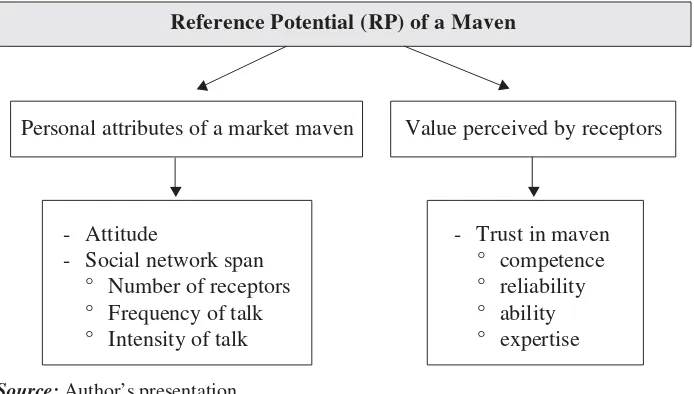
persons or exerting a direct influence on the buying process. In this study we suggested a framework relevant for measuring a reference potential of a maven (see Figure 1). In this paper, reference potential of a maven is de-fined as a combination of (a) the inher-ent personal attributes of a maven and (b) the perceived value of receivers for a market maven. The first element in-cludes (1) attitude of mavens towards a certain object; and (2) the wideness of social network span of a maven. This indirectly includes the consider-ation of whether a maven gives recom-mendation to a strong-tie or/and a weak-tie circle. The second component is taken from the side of the receivers. From this side the reference potential is estimated by including the measure-ment of trust level of receivers in a maven. The practical marketing impli-cation of the reference potential of a
Figure 1. Reference Potential of A Maven
Reference Potential (RP) of a Maven
Personal attributes of a market maven Value perceived by receptors
- Attitude - Trust in maven
- Social network span ° competence
° Number of receptors ° reliability
° Frequency of talk ° ability
° Intensity of talk ° expertise
Source: Author’s presentation T
T
maven pertains to the impact on infor-mation transfer done by a maven on building other people’s knowledge about, attitude towards and trust in certain products of a firm. It is possible that a firm obtains either a negative impact (loss) or a positive impact (profit) from a contact done by a ma-ven. The following section discusses the individual elements determining the reference potential of a maven and our proposal for measuring this.
The first inherent personal at-tribute to be discussed is attitude (A). It is necessary to include the attitude level of a communicator (maven) be-cause, apparently, attitude will guide the content of recommendation. A com-municator, who has a positive attitude towards a certain object, presumes that he/she will give a neutral to positive recommendation for the same or re-lated objects, and, to the contrary, he/ she will provide a negative recommen-dation, when their attitude towards the object is negative. The supportive lit-erature in this area is well accepted. Principally, attitude is learned in a fixed sequence (Ajzen and Fishbein 1980). It consists of the formation of belief, followed by some evaluation of that object and then some action, such as giving recommendations to others or behaving accordingly (Solomon 1996: Ajzen 1991). A firm can argue that mavens with a positive attitude reflected in her/his positive recom-mendations will improve the degree of her/his reference potential.
Based on a platform of customer valuation modeling or REVAL
(REference VAlue) the conceptual measuring model for the reference potential of a maven was formulated. This model represents a rough method to estimate the value of customer ad-vice of a certain product given to a certain receiver by using a monetary based estimation. This model uses con-sumer satisfaction as one of the vari-ables that determine the value of a reference (Cornelson 2001). Unfortu-nately for the case of market maven, satisfaction variable cannot be solely used for measuring reference potential of mavens, because the definition of market mavens does not require that these individuals be early purchasers of products or necessarily even users of products, about which they have information (Feick and Price 1987). Besides that, it is generally accepted that consumer satisfaction is a post-purchase phenomenon. Evaluation of satisfaction prior to a choice and even in the absence of a purchase or choice is being argued as inappropriate, be-cause satisfaction should only evalu-ated at the time the product evaluation occurs (Giese and Cote 2000). Based on the above mentioned arguments with regard to the different roles of attitude and satisfaction variables, this paper argues that to understand the economic value of market maven the attitude element is more relevant. Therefore, the variable attitude will be preferably used for measuring the ref-erence potential of mavens.
The social network span (SNS) deter-mines the degree of penetration of a mavens’ recommendation into their respective communities. It focuses on determining the span of recommenda-tion spreading. Higher SNS scores re-flect the depth of social coverage ex-erted by a maven. Again, from the view of the marketers, a maven will be more valuable when she/he has higher social coverage or a higher SNS score. However, SNS does not only cover the number of recipients/receivers that can be approached by a maven, but it is also concerned with the frequency of contact with an individual recipient (Q) and with the intensity of discus-sion (I). The frequency and intensity of the process of giving recommenda-tions indirectly depends upon the com-munication situation and condition. It is important, because the communica-tion situacommunica-tion is one of the key determi-nants of success of the information transfer process (Kroeber-Riel and Weinberg 1999).
The other element determining the reference potential of mavens is all the aspects taken from the side of the re-cipient. The main element relating to the recipient characteristics is level of trust. It focuses mainly on the trust-worthiness of a maven perceived by the information recipient. The level of a recipient’s trust in a maven provides an indirect understanding of the prob-ability of successful information trans-fer from a maven to other persons. Trust has become a cornerstone of relationship and successful transfer of information. The result of a
communi-cation process will depend on plausi-bility and crediplausi-bility of the communi-cator perceived by the recipients. The two most important elements of trust for assuring the success of a communi-cation are expertise and trustworthi-ness (Kroeber-Riel and Weinberg 1999). This paper proposes that the trust level induced by a strong-tie (such as relationship with friends or family members) and a weak-tie (a low level relationship) relationship is perceived differently. Mavens who have a strong-tie relationship with a recipient will be perceived as more trustworthy and more influential for the decision mak-ing process than mavens from a weak-tie relationship. However, weak-weak-tie mavens who provide a comprehensive bundle of information (expertise) will also be trustable to the same degree as strong-tie mavens. Therefore, measur-ing trust levels provides proportional clues that indirectly represent the con-sideration of social characteristics, i.e. weak- and strong-tie relationships of mavens.
frequency of talk/contact (Qn) and in-tensity of talk or contact (In), while value perceived by recipients is repre-sented by trust elements (such as com-petence, reliability, and ability scores is equal to ΣTi). This will be
summa-Since understanding the quantifi-cation of the role of mavens for the purpose of strategic marketing is im-portant, the reference potential mea-surement explained above is relevant Using this measurement we were in-terested to prove whether the refer-ence potential is different across three different maven groups. Our last hy-pothesis states:
(Ha3) A high maven group has higher reference potential than a low or a non-maven group.
Research Method
We conducted a study using a self-administered questionnaire, which was completed by a total of 134 under-graduate students from the Agricul-ture, Nutrition and Environmental Sci-ence Faculty. Most of the enrolled students were in the 2nd or 3rd year and 88% were women. The questions in the questionnaire were designed to comply with some standard
question-ing techniques developed by previous mentioned authors. To identify the presence of market mavens, the mar-ket maven scale items system devel-oped by Feick and Price (1987) was used. The answering scale was modi-fied from a 7 point Likert (strongly disagree to strongly agree scale) to a 5 point Likert rating scale in order to simplify the personal judgment. How-ever, our study used similar descrip-tive statistics as the ones utilized by previous researchers. The range of the market maven scale items was in the range of 7-35, the mean value of the maven scale was 24.2 (standard devia-tion 4.43). Using a percentiles break-down the market mavens were classi-fied into three different groups, i.e. low, medium and high mavens. Alpha for market maven scale items was 0.747. In order to provide evidence for the market maven relationship with other variables a parametric inference test was used. Due to the fact that market mavens do not focus on a spe-cific product, this study has investi-gated a relatively broad product spec-trum in the sector of food and bever-ages, including bread and cakes, milk and yoghurt, chilled products, snacks, coffee, candies and chocolates. These product classes represent the top ten product categories in the food and bev-erage market in Germany.
both express the need for consistency and clarity in the conceptualization and operationalization of consumer knowledge (Brucks 1985; Cole et al. 1991; Spreng and Olshavsky 1990; Srinivasan and Agrawal 1988). A 10-item true/false test concerning seven selected product categories and brands recalled were used to assess a subject’s objective knowledge with regard to the food and beverage market. As an objective knowledge test we have ad-ministered some questions concerning ingredients, production processes, product varieties, and market price level. Brands recalled were used as one of the indicators for objective knowledge level achieved (range of score between 0 and 10 for all respon-dents). The other indicator for objec-tive knowledge, i.e. the product knowl-edge test, ranges from 1-10 with a mean value of 6.4. These test results followed a normal distribution curve. In order to obtain a total score for objective knowledge both measure-ments were combined. For determin-ing subjective knowledge a self-report rating of familiarity and product knowl-edge using 5-point scales anchored by ‘’not at all familiar or not at all knowl-edgeable’’ to ‘’very familiar or very knowledgeable’’ was applied. Famil-iarity with product categories attained levels with a mean value of 3.7 (max. 5 and min.1). Self-assessed knowl-edge level attained a mean value of 3.4 (max. 5 and min.1). Cronbach´s alpha for the combination of those two tests
was 0.804 indicating a high degree of internal reliability and validity.
particu-lar brand (Assael 1995), some ques-tions related to those four statements were included in the questionnaire for the theoretically based construct va-lidity which verifies the PII model.
Results and Discussions
Psychological Factors of Market
Mavens
This study has identified the pres-ence of market mavens among a stu-dent group and this finding is in line with the results presented by Feick and Price in 1987. This study found quite a lot of students (47%) who fulfilled the criteria of being a market maven. The presence of three different classes of market mavens was successfully dis-tinguished i.e. low, medium and high activity mavens. In order to differenti-ate the psychological attributes and psychological influences of market mavens, all analyses were performed on the basis of these three groups.
Brands recalled were used as one of the indicators for objective knowl-edge level and achieved range of score between 0 and 10 for all respondents. The other indicator for objective knowledge, i.e. the product knowl-edge test score ranges of 1-10 with a mean value of 6.4. These test results followed a normal distribution curve. In order to obtain a total score for objective knowledge both measure-ments were combined. A subjective knowledge test was performed by ask-ing the subjects (1) to what degree they were familiar with selected product
categories; and (2) what the rating value was of the personal knowledge level for all of the product categories. Familiarity with product categories has a mean value of 3.7 (max. 5 and min.1). Self-assessed knowledge level has a mean value of 3.4 (max. 5 and min.1). The combination of both self- tests was used as a predictor of total subjec-tive knowledge level. The result of inference significance test shows that market mavens are different in term of personal inherent knowledge level re-lated to the food and beverages seg-ment (Table 1). The knowledge level correlates with the rank of maven clas-sification (low maven, medium and highly active maven). As compared to the medium and low maven groups, the highly active maven group has the highest level in terms of subjective and objective knowledge (see Table 1). It is now clearer that in the word- of-mouth communication, a communica-tor (such as a maven) will indeed be confident of giving advice to other persons only when he or she is knowl-edgeable about or has purchase expe-rience of a certain object.
Table 1. Knowledge Level- Comparisons Across Three Different Maven Groups (The Mean Values and Standard Deviation)
Knowledge
Maven Groups Objective Subjective
Low (mean) 52.788 3.260
(N) 33 31
(sd) 12.900 0.442
Medium (mean) 56.222 3.553
(N) 36 36
(sd) 10.074 0.439
High (mean) 62.562 3.709
(N) 64 63
(sd) 13.068 0.433
Asymp. Sig* 0.001 0.000
* One way ANOVA
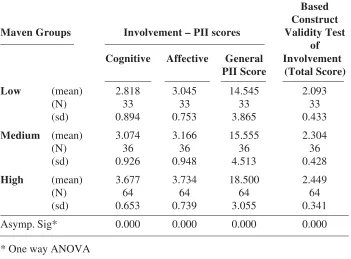
Table 2. Involvement Level Comparisons Across Three Different Maven
Groups (The Mean Values and Standard Deviation)
Based Construct Maven Groups Involvement – PII scores Validity Test
of Cognitive Affective General Involvement
PII Score (Total Score)
Low (mean) 2.818 3.045 14.545 2.093
(N) 33 33 33 33
(sd) 0.894 0.753 3.865 0.433
Medium (mean) 3.074 3.166 15.555 2.304
(N) 36 36 36 36
(sd) 0.926 0.948 4.513 0.428
High (mean) 3.677 3.734 18.500 2.449
(N) 64 64 64 64
(sd) 0.653 0.739 3.055 0.341
Asymp. Sig* 0.000 0.000 0.000 0.000
and high involvement levels, respec-tively. Minimum score was 6.00 and maximal score was 25.00. An analysis using comparison of the means across three different maven groups shows that the involvement level of three different maven groups (low-, medium-and highly active-maven) is signifi-cantly different. The low-activity ma-ven group was perceived to have the lowest involvement level (mean value of 14.545 for PII method and 2.093 for five confirmative scores of involve-ment level test). Medium-activity ma-vens have relative low involvement, but the value is higher than that of low-activity mavens. The high-low-activity maven group has the highest involve-ment level scores (see Table 2). The PII of score of high-activity mavens achieved 18.500 and the mean value for the five confirmative scores was 2.449. A one way ANOVA inference test confirmed this finding by empha-sizing that the involvement level across the three mavens groups was signifi-cantly different.
Market mavens tend to have higher involvement level towards low in-volved products such as food and bev-erage segment. Social engagement characteristic of maven and maven’s intention to spread information in the social network are some of the im-pulses to more actively seek, collect and evaluate relevant information. When we relate this finding to the previously discussed theme regarding inherent personal knowledge of a ma-ven, we can further argue that high-activity mavens tend to be
knowledge-able about respective products and of having a high interest in searching, collecting, analyzing and keeping in-formation due to their involvement level in market mavens update and improvement of their inherent current information in the memory.
Reference Potential of Mavens
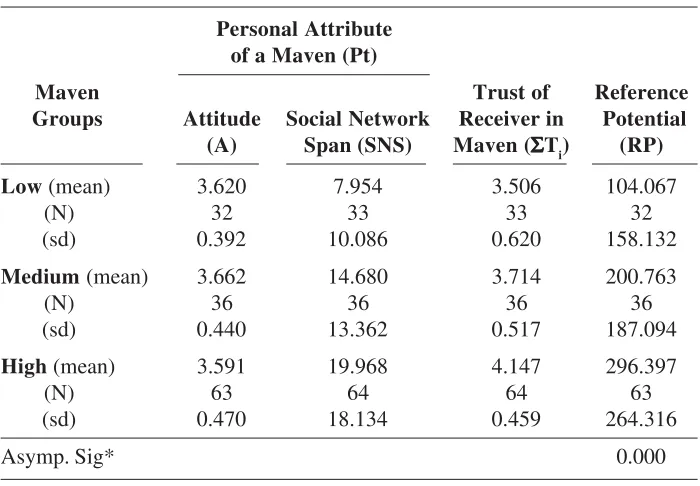
this study we did not evaluate the indi-vidual reference potential and did not determine the value of the individual representative of the high-activity maven group. However, with that find-ing we can argue that our last hypoth-esis cannot be rejected. Due to their high reference power, mavens can be considered as more potent target con-sumer for marketers. High-mavens ini-tiate more contacts and more commu-nications with more people or receiv-ers. When such maven has a strong-tie to the recipients, information from a maven can be used as valuable and trustable for making a buying deci-sion.
Conclusion
The psychological set and psy-chological influences of market ma-vens were examined in this study. With regards to the psychological set of market mavens we found that the in-herent knowledge level which includes objective and subjective knowledge was different across the three maven groups. Market mavens were perceived to have a high involvement level, even though the product classes evaluated belong to less mundane product groups purchased on an everyday basis. Most purchases of these product classes are usually low involvement buys. As a Table 03.Reference Potential Across Three Different Maven Groups (The
Mean Values and Standard Deviation) Personal Attribute
of a Maven (Pt)
Maven Trust of Reference
Groups Attitude Social Network Receiver in Potential (A) Span (SNS) Maven (ΣΣΣΣΣTi) (RP)
Low (mean) 3.620 7.954 3.506 104.067
(N) 32 33 33 32
(sd) 0.392 10.086 0.620 158.132
Medium (mean) 3.662 14.680 3.714 200.763
(N) 36 36 36 36
(sd) 0.440 13.362 0.517 187.094
High (mean) 3.591 19.968 4.147 296.397
(N) 63 64 64 63
(sd) 0.470 18.134 0.459 264.316
Asymp. Sig* 0.000
consequence of their high involvement level, market maven tends to have a higher inherent knowledge level. For the marketing, it simply can be argued that for the recruitment of market ma-vens a sufficient bundle of informa-tion is required. Informainforma-tion through TV or radio may not be sufficient, because those media are more suitable for low involvement consumers (Assael 1995). Marketers need to acti-vate media relevant for high involve-ment. In principle, from marketing point of view, it is necessary to differ-entiate the type of media used for mar-ket mavens and for other non-maven consumers. Improving knowledge level of market mavens through exten-sive marketing communication is im-portant, because knowledge is per-ceived to be relevant for building trust in certain objects.
Market mavens tend to have a high reference potential. They have a broader social network span due to their social engagement. Market
ma-vens initiate contact and communica-tion with more people in their social circle. Because of the recipients’ trust into mavens, the value of a maven as a communicator or a reference provider increases. Understanding the reference potential of a maven can provide us with a better understanding of the role and function of market mavens in per-sonal communication. It is now clear that market mavens can be used as one of the tools for strategic marketing communication, especially for word-of-mouth communication. However, there is a prerequisite for establishing a successful market maven pool for a firm. Building a loyal market maven group who is satisfied with, trusts in and has positive attitude towards the firm’s products and services, is then the challenge to be met by a firm. If and when this goal is reached, it will be beneficial because the firm will profit from the mavens’ activities in spread-ing positive information and positively influencing other people.
References
Aaker, D. A., and G. S. Day. 1980. Marketing Research. New York: John Wiley & Sons. Alba, J. W., and J. W. Hutchinson. 1987. Dimensions of consumer expertise, . Journal of
Consumer Research 13, : 411-454.
Ajzen, I. 1991. The theory of planned behaviour. Organizational Behaviour and Human Decision Processes 50: 179-211.
Ajzen, I., and M. Fishbein. 1980. Understanding Attitudes and Predicting Social Behaviour: Attitudes, Intentions, and Perceived Behavioural Control. Englewood Cliffs. NJ: Prentice Hall.
Atkin, C. 1972. Anticipated communication and mass media information seeking. Public Opinion Quarterly 36: 188-199.
Brucks, M. 1985. The effects of product class knowledge on information search behavior. Journal of Consumer Research 12: 1-6.
Cornelsen, J. 2001. Was ist der kunden wert? Kundenwertanalysen im beziehungsmarketing am beispiel von automobilkäufern. Jarhbuch der Absatz und Verbrauchsforchung 1. Clark, A. R., and E. R. Goldsmith. 2005. Market mavens: Psychological influences.
Psychology and Marketing Journal 22 (4): 289-312.
Clark, R. A., R. E. Goldsmith, and E. B. Goldsmith. 2008. Market mavenism and consumer self-confidence. Journal of Consumer Behaviour 7: 239-248.
Cole, C. A., G. Gaeth, G. Chakraborty, and I. Levin 1991. Exploring the relationship among self-reported knowledge, objective knowledge, product usage and consumer decision making. Paper presented at the Association of Consumer Research Meeting, Chicago.
Elliott, M. T., and A. E. Warfield. 1993. Do market mavens categorize brands differently?. Advance in Consumer Research 20: 202-208.
Engel, J. F., M. R. Warshaw, T. C. Kinnear. 1994. Promotional Strategy: Managing the Marketing Communication Process. Boston: Irwin- McGraw-Hill.
Feick, F. L., and L. L. Price. 1987. The market maven: A diffuser of marketplace information. Journal of Marketing 51: 83-97.
Giese, J. L., and J. A. Cote. 2000. Defining consumer satisfaction. Academy of Marketing Science Review 1.
Kroeber-Riel, W., and P. Weinberg. 1999. Konsumenten-Verhalten. München: Verlag Vahlen.
Laurent, G., and J. N. Kapferer. 1985. Measuring consumer involvement profiles. Journal of Marketing Research 22: 41-53.
Wiedmann, K. P., G. Walsh, and V. W. Mitchell. 2001. The market maven: An agent for diffusing market information. Journal of Marketing Communication 7: 195-212. Moreau, C. P., D. R. Lehmann, and A. B. Markman. 2001. Entrenched knowledge
structures and consumer response to new products. Journal of Marketing Research 38 (1): 14-29.
Park, C. W., and V. P. Lessig. 1981. Familiarity and its impact on consumer decision biases and heuristics. Journal of Consumer Research 8: 223-231.
Park, C. W., D. C. Mothersbaugh, and F. L. Feick. 1994. Consumer knowledge assessment. Journal of Consumer Research 21: 71-82.
Rao, A. R., and A. W. Sieben, A.W. 1992. The effect of prior knowledge on price acceptability and the type of information examined. Journal of Consumer Research 19: 256-270.
Spreng, R. A., and W. Olshavsky. 1990. The impact of standard of comparison and knowledge domain on the measurement of subjective knowledge. In 1990 AMA Educators’ proceeding (ed.) A. Parasuraman and William Bearden, American Marketing Association: 44-48.
Srinivasan, N. and J. Agrawal. 1988. The relationship between prior knowledge and external search. Advance in Consumer Research 15, : 27-31.
Solomon, M. R. 1996. Consumer Behavior, Buying, Having and Being. (3rd ed.). New
Jersey: Prentice Hall.
Walsh, G., K. P. Gwinner, and S. R. Swanson. 2004. What makes mavens tick? Exploring the motives of market mavens’ initiation of information diffusion. Journal of Consumer Marketing 21, : 109-122.