i
AT SMA NEGERI 1 SEPUTIH RAMAN CENTRAL LAMPUNG
By:
ASTUTI
Student Number: 1601070069
TARBIYAH AND TEACHERS TRAINING FACULTY ENGLISH EDUCATION DEPARTMENT
STATE INSTITUTE FOR ISLAMIC STUDIES OF METRO 1442 H / 2020 M
ii
AN UNDERGRADUATE THESIS
AN ANALYSIS OF INDONESIAN WORD ORDER INTERFERENCE IN EXPOSITION TEXT WRITING OF THE ELEVENTH GRADERS
AT SMA NEGERI 1 SEPUTIH RAMAN CENTRAL LAMPUNG
Presented as a Partial Fulfillment of the Requirements for the Degree of Sarjana Pendidikan (S.Pd.)
in English Education Department
By:
ASTUTI
Student Number: 1601070069
Tarbiyah and Teachers Training Faculty English Education Department
Sponsor : Ahmad Subhan Roza, M.Pd.
Co-Sponsor : Eka Yuniasih, M.Pd.
STATE INSTITUTE FOR ISLAMIC STUDIES OF METRO 1442 H / 2020 M
iii
iv
v
vi
vii
AN ANALYSIS OF INDONESIAN WORD ORDER INTERFERENCE IN EXPOSITION TEXT WRITING OF THE ELEVENTH GRADERS
AT SMA NEGERI 1 SEPUTIH RAMAN CENTRAL LAMPUNG ABSTRACT
By:
ASTUTI
The purposes of this research were to know Indonesian word order interference in exposition text writing and to find the solution to overcome Indonesian word order interference in exposition text writing of the eleventh graders at SMA N 1 Seputih Raman Central Lampung. Therefore, it is expected that this research is beneficial in informing the phenomena of Indonesian word order interference in studying the writing skill.
The method of this research was qualitative research in the form of a case study carried out at SMA Negeri 1 Seputih Raman Central Lampung. The primary source of this research is the eleventh graders students‟ at SMA Negeri 1 Seputih Raman Central Lampung that consists of 10 students. The researcher used observation, documentation and interview in collecting the data.
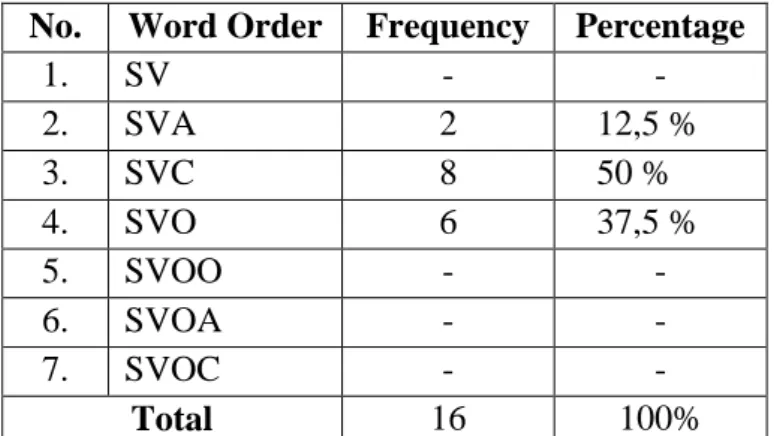
The results of this research proved that the Indonesian word order interference in exposition text writing is SVC (subject + verb + complement) 50%, SVO (subject + verb + object) 37,5%, and SVA (subject + verb + adverb) 12,5%. The most dominant type of word order is SVC. Furthermore, another research result is about the solution to overcome Indonesian word order interference in exposition text writing including of establishing a system with exercises, encouraging the students to do the exercises with verbs and tenses, encouraging the students to do the exercises where nouns change their meaning according to number and gender, and encouraging the students to do the exercises with nouns having only singular form in the foreign language to which correspond plural nouns in the mother tongue and vice versa.
Key word: Interference, Word Order, Writing
viii
ANALISIS INTERFERENSI SUSUNAN KATA BAHASA INDONESIA TERHADAP TULISAN TEKS EXPOSISI SISWA KELAS SEBELAS
SMA NEGERI 1 SEPUTIH RAMAN LAMPUNG TENGAH ABSTRAK
Oleh:
ASTUTI
Tujuan penelitian ini adalah untuk mengetahui interferensi susunan kata bahasa Indonesia dalam menulis text eksposisi dan menemukan solusinya dalam mengatasi interferensi susunan kata bahasa Indonesia dalam menulis teks eksposisi pada siswa kelas sebelas SMA N 1 Seputih Raman Lampung Tengah.
Oleh karena itu, penelitian ini diharapkan bermanfaat dalam menginformasikan fenomena interferensi susunan kata bahasa Indonesia dalam mempelajari keterampilan menulis.
Metode penelitian ini adalah penelitian kualitatif dalam bentuk studi kasus yang dilaksanakan di SMA Negeri 1 Seputih Raman Lampung Tengah. Sumber utama penelitian ini adalah siswa kelas XI SMA Negeri 1 Seputih Raman Lampung Tengah yang berjumlah 10 siswa. Peneliti menggunakan observasi, dokumentasi, dan wawancara dalam mengumpulkan data.
Hasil penelitian ini membuktikan bahwa interferensi susunan kata bahasa Indonesia dalam penulisan teks eksposisi adalah SVC (subject + verb + complement) 50%, SVO (subject + verb + object) 37,5%, dan SVA (subject + verb + adverb) 12,5%. Jenis susunan kata yang paling dominan adalah SVC.
Selanjutnya, hasil penelitian lainnya adalah tentang solusi untuk mengatasi interferensi susunan kata bahasa Indonesia dalam penulisan teks eksposisi termasuk membangun sistem dengan latihan, mendorong siswa untuk mengerjakan latihan dengan kata kerja dan tenses, mendorong siswa untuk mengerjakan soal latihan dimana kata benda berubah maknanya sesuai dengan jumlah dan gender, dan mendorong siswa untuk melakukan latihan dengan kata benda yang hanya memiliki bentuk tunggal dalam bahasa asing yang sesuai dengan kata benda jamak dalam bahasa ibu dan sebaliknya.
Kata kunci: Interferensi, Susunan Kata, Menulis
ix
x
xi MOTTO
﴿ ٌرَطَتْسُّم ٍرْيِبَكَّو ٍرْيِغَص ُّلُكَو ۳۵
﴾
“And every small and great (thing) is inscribed.” (Q.S. Al-Qamar: 53)
xii
DEDICATION PAGE
I highly dedicate this undergraduate thesis to:
1. The first is dedicated of Almighty Allah Subhanahu Wa Ta‟alla, thanks God all about the precious gifts that have been given to me.
2. My beloved parents (Mr. Warsito and Mrs. Suwarni) who have sincerely done everything for their children. Who always pray and support with endless love. Thank you so much for everything. I love you so much.
3. My beloved brothers, sister, nephew, and niece. Thanks for your support, love, help, and motivation.
4. My Sponsor (Mr. Ahmad Subhan Roza, M.Pd.) and co-sponsor (Mrs.Eka Yuniasih, M.Pd.), who have guided me patiently to complete this undergraduate thesis. Thank you for guiding.
5. All my beloved friends.
6. My beloved Almamater State Institute for Islamic Studies of Metro.
7. The big family at SMA N 1 Seputih Raman, thanks for help.
xiii
ACKNOWLEDGEMENT
Praise to Allah the Almighty and the most merciful who has given his blessings and guidance so that the writer can complete an undergraduate thesis entitled “An Analysis of Indonesian Word Order Interference in Exposition Text Writing of the Eleventh Graders at SMA Negeri 1 Seputih Raman Central Lampung”.
Considering the limitations of knowledge, got and writing ability of the writer, this undergraduate thesis is inseparable from deficiencies and is not perfect, but the writer hope that this undergraduate thesis can be useful for writer in particular and for all those who wish to use it.
The writer would like to express gratitude to the sponsor, Ahmad Subhan Roza, M.Pd. and the co-sponsor Eka Yuniasih, M.Pd. who have sincerely guide the writer to accomplish this undergraduate thesis in time.
Thanks to various parties who have helped the process of preparing this undergraduate thesis, who have provided assistance, advice and encouragement, which the writer cannot mention one by one. May the deeds of worship and encouragement and prayer given to the writer sincerely get the Grace of Allah Subhanahu Wa Ta‟alla, Aamiin.
Metro, 22 December 2020 The researcher,
Astuti 1601070069
xiv
TABLE OF CONTENTS
COVER ... i
TITLE PAGE ... ii
APPROVAL PAGE ... iii
NOTIFICATION LATTER ... iv
NOTA DINAS ... v
RATIFICATION PAGE ... vi
ABSTRACT ... vii
ABSTRAK ... viii
STATEMENT OF RESEARCH ORIGINALITY ... ix
ORISINALITAS PENELITIAN ... x
MOTTO ... xi
DEDICATION PAGE ... xii
ACKNOWLEDGEMENT ... xiii
TABLE OF CONTENTS ... xiv
CHAPTER I INTRODUCTION ... 1
A. Background of the Study ... 1
B. Research Questions ... 6
C. Objective and Benefit of the Study ... 6
D. Prior Research ... 8
CHAPTER II REVIEW OF LITERATURE ... 14
A. Concept of Writing Skill ... 14
1. Nature of Writing ... 14
2. Aspect of Writing ... 15
3. Measurement of Writing ... 16
4. The Process of Writing ... 18
B. Concept of Exposition Text ... 20
xv
1. Definition of Exposition Text ... 20
2. Generic Structure Analytical Exposition Text ... 22
3. The Example of Analytical Exposition Text ... 23
C. Concept of Interference ... 23
1. Definition of Interference ... 23
2. Types of Interference ... 25
3. The Particular Indonesian Word Order Interference in Writing 27
4. Solution to Minimize Problems in Writing Caused by Indonesian Word Order Interference ... 31
D. Indonesian Grammatical Interference in Writing ... 32
CHAPTER III RESEARCH METHOD ... 34
A. The Types and Characteristics of Research ... 34
B. Data Resources ... 34
C. Data Collection Technique ... 35
D. Data Analysis Technique ... 38
CHAPTER IV RESULT AND DISCUSSION ... 42
A. Description of Research Setting ... 42
1. Profile at SMA Negeri 1 Seputih Raman ... 42
2. Description of the Research Result ... 48
B. Discussion ... 61
1. The Indonesian word order interference in exposition text writing of the eleventh graders at SMA N 1 Seputih Raman Central Lampung ... 63
2. The solution to overcome Indonesian word order interference in exposition text writing ... 65
xvi
CHAPTER V CONCLUSION AND SUGGETION ... 65 A. Conclusion ... 65 B. Suggestions ... 66 BIBLIOGRAPHIES
APPENDICES
CURRICULUM VITAE
xvii
LIST OF TABLES
1. Table 1.1 The Data of Pre-Survey Result ... 3
2. Table 1.2 The Categorization of Pre-Survey Result Writing Skill ... 4
3. Table 2.1 The Measurement Rubric of Writing Score ... 16
4. Table 4.1 The Condition of Teachers and Official Employers ... 43
5. Table 4.2 The Total of Classroom ... 46
6. Table 4.3 The Percentage of Indonesian Word Order Interference ... 63
xviii
LIST OF FIGURES
1. Figure 3.1 Components of Data Analysis: Interactive Model ... 39 2. Figure 4.1 The Students Quantity at SMA Negeri 1 Seputih Raman in
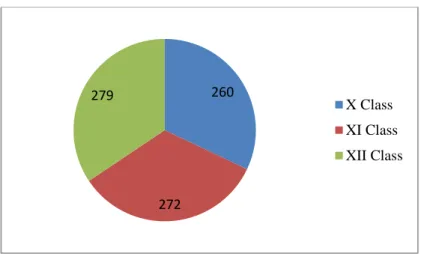
the Academic Year of 2020/2021 ... 45 3. Figure 4.2 The Location Sketch at SMA Negeri 1 Seputih Raman in the
Academic Year of 2020/2021 ... 47 4. Figure 4.3 The Percentage of Indonesian Word Order Interference ... 63
xix
LIST OF APPENDICES
1. Appendix 1. The Blue Print of Observation Sheet 2. Appendix 2. The Blue Print of Interview Sheet 3. Appendix 3. Documentation of Research 4. Appendix Silabus Pembelajaran
5. Appendix Observation Sheet 6. Appendix Interview Sheet 7. Izin Pra-Survey
8. Balasan Izin Pra-Survey
9. Kartu Konsultasi Bimbingan Proposal 10. Nota Dinas Permohnan Seminar Proposal 11. Notification Letter Seminar Proposal 12. Persetujuan Seminar Proposal 13. Ratification Page Seminar Proposal 14. Bimbingan Skripsi
15. Izin Research 16. Surat Tugas
17. Balasan Izin Research
18. Surat Keterangan Bebas Jurusan 19. Surat Keterangan Bebas Pustaka 20. Kartu Konsultasi Bimbingan APD 21. Kartu Konsultasi Bimbingan Skripsi 22. Surat Keterangan Uji Turnitin
1 A. Background of the Study
English is an international language that has an important role in various aspects of human life. English is a language used as a medium of communication and as the first international language used to interact with other people throughout the world. English mastery provides significant benefits in the communication process both through writing and oral. The benefit of English mastery is to be able to socialize with the wider community. In Indonesia, English is a foreign language, so teaching English plays an important role in both formal and informal institutions. Teaching English includes four language skills including of listening, speaking, reading, and writing.
Moreover, as one of the English language skills, writing is one of the important language skills used not only in the school or at work, but also in social life or personal life. Writing is an activity of exploring thoughts and feelings about a subject, choosing the things to be written, determining how to write them so the reader can understand them easily and clearly. Writing is also called the term composing, a whole series of activities for someone to express ideas and convey them through written language to the reading community to be understood. Therefore, writing can be said as a person's activities in expressing ideas through writing.
In addition, mastery of writing skill has tremendous benefits. By writing, people are trained to arrange our thoughts and arguments in a coherent, systematic and logical manner. In addition, writing activities can be a means to be able to find something, in the sense that it can raise ideas and information that is in our subconscious. Even by writing people can practice the ability to organize and also clarify various concepts or ideas that we have.
However, writing skill is not easy to master in a short time. There are many problems got by students in the process of writing an English text.
These writing problems are caused by the low contribution of linguistic and non linguistic aspects. Various writing problems caused by the low support of linguistic aspects include limited English vocabulary, low grammar mastery, inability to develop writing ideas into good writing, and inability to apply the concept of writing mechanism. While the forms of writing problems caused by the low contribution of non-linguistic aspects include inaccurate selection of instructional materials, incompatibility of teaching techniques, low environmental support, low motivation to write, and lack of interest in writing in English.
In line with writing problems, the researcher had also conducted a pre survey to find out the writing problems of students SMA N 1 Seputih Raman Central Lampung of the Eleventh Graders in writing. Pre survey was conducted on April 23, 2020 in SMA N 1 Seputih Raman Central Lampung.
The pre survey results are illustrated in the following table:
Table 1.1
Data of Pre-Survey Result Writing Skill of the Eleventh Graders
at SMA N 1 Seputih Raman
No Student’s Name Grade Criteria
1. AVS 50 Incomplete
2. DDS 65 Incomplete
3. IKADS 65 Incomplete
4. IPAWD 50 Incomplete
5. MS 60 Incomplete
6. NGAPRR 80 Complete
7. NKAD 65 Incomplete
8. NKLU 75 Complete
9. NKS 60 Incomplete
10. NMRA 75 Complete
11. NMWW 70 Incomplete
12. NNMA 50 Incomplete
13. NNMD 75 Complete
14. NWD 50 Incomplete
15. SY 50 Incomplete
(Source: The Students’ Grade of Writing Skill Got from the English Teacher at SMA N 1 Seputih Raman Central Lampung)
The result of pre-survey that contain writing problems for eleventh grade students at SMA N 1 Seputih Raman Central Lampung are categorized into two criteria, complete and incomplete based on Minimum Mastery Criteria (75) English subjects in the school. The results of the pre-survey data categorization are shown in the following table:
Table 1.2
The Categorization of Pre-Survey Result Writing Skill of the Eleventh Graders at SMA N 1 Seputih Raman Central Lampung No Grade Frequency Percentage Criteria
1. ≥ 75 4 students 27 % Complete
2. < 75 11 students 73 % Incomplete Total of the students (n) = 15 students
Based on pre-survey data, it is known that the percentage of students whose writing ability is more than MMC is 27%. While the percentage of students whose writing ability is less than MMC is 73%. It means that the percentage of students who achieve MMC is smaller than the percentage of students who are less than MMC. Therefore it can be concluded that the second semester students of SMA N. 1 Seputih Raman Central Lampung have limited writing skills.
In line with the writing problems above, it is proven that students of the eleventh graders at SMA N 1 Seputih Raman Central Lampung have difficulty in writing English text due to the limited English vocabulary they have. In addition, the inability to master grammar is also an obstacle that affects the quality of students writing. Student's problem in writing is also caused by student inability to apply the concept of writing mechanism.
Students also got difficulty in developing written ideas. Students‟ writing problems are also caused by low writing motivation and low writing habits.
Related to this issue, it is very important that there are efforts to examine the language components associated with writing. One of the influential
language components in writing quality is sociolinguistics. One of the sociolinguistic content that influences writing is interference. The term interference is influence of a language on another language in bilingual speech. Interference phenomenon is a result of familiarity with more than one language which is a deviation from the norms of one language that occurs in bilingual speech. The habit of pronunciations a language in another language that causes errors in grammar, vocabulary, and pronunciation is called interference.
In addition, grammatical interference is a negative structure transfer from L1 to L2. One of the cases is Indonesian interferes English which causes errors in grammar. Grammatical interference analysis helps teachers to be more aware and know of the students‟ learning process, because it can be considered as a means to improve the students‟ accuracy, especially in writing.
Based on all the description above, the efforts to examine grammatical interference in writing are very important to do. In this case, the researcher conducted qualitative research to analyze the use of word order interference in writing. Therefore, the researcher constructs an undergraduate thesis entitled: “An Analysis of Indonesian Word Order Interference in Exposition Text Writing of the Eleventh Graders at SMA Negeri 1 Seputih Raman Central Lampung.”
B. Research Questions
The writer had formulated two research questions, as follows:
1. How is the Indonesian word order interference in exposition text writing of the eleventh graders at SMA N 1 Seputih Raman Central Lampung?
2. How to overcome Indonesian word order interference in exposition text writing of the eleventh graders at SMA N 1 Seputih Raman Central Lampung?
C. Objective and Benefits of the Study 1. Objective of the study
a. To know Indonesian word order interference in exposition text writing of the eleventh graders at SMA N 1 Seputih Raman Central Lampung.
b. To find the solution to overcome Indonesian word order interference in exposition text writing of the eleventh graders at SMA N 1 Seputih Raman Central Lampung.
2. Benefits of the study
This research is expected to provide benefits for researchers, students, teachers and subsequent researchers.
a. For the students
This research is expected to be beneficial for students, especially in providing meaningful information in the factors of students‟ writing difficulties caused by Indonesian word order interference, and the solution to overcome the students‟ difficulties
caused by Indonesian word order interference. After learning about interference problems in writing, students are expected to realize and make various efforts to improve the quality of their writing.
Therefore, this research is very useful for students as an effort to diagnose their problems in writing an English text.
b. For the teacher
This research is expected to provide benefits to teachers in the form of information about the use of interference in students writing. This study provides a clear picture and proof of the evidence of the phenomenon of inaccuracy in the use of interference in student writing. By knowing this, the teacher can emphasize teaching interference in the learning process of writing.
c. For the other researchers
This research is expected to be useful for the other researchers who conduct research on the same topic, namely interference analysis in writing. This research provides clear information to the next researcher regarding the interference analysis procedure in writing related to the research objectives, research procedures and how to retrieve data. Therefore, this study can be a reference for the other researchers.
D. Prior Research
This research was conducted based on the consideration some prior researchers. The first prior research had been conducted by Yandres Answo Djedelbert Lao entitled of “First Language Interferences into English Writing Skill of the Twelfth Grade Students of SMA Negeri 1 Kupang in Academic Year 2017/2018”.1 The purposes of the first prior research are figuring aspects of first language (L1) interferences and the affecting factors of L1 interference into English writing skill. The research method used in that research is qualitative. Subject of that research is students of SMA Negeri 1 Kupang. Result of the prior research is that there are phonology, morphology, syntax and semantics at the level of L1 disorders found in students‟ English writing. In addition, the teaching and learning process of students in the classroom, mental processes, students‟ L1, and the low frequency of English use are the causes of L1 disorders.
This research has similarities and differences with the first prior research.
The similarity of both research lies in the similarity of the variables examined, namely interference research in writing. Another similarity lies in the research method equation which is the same as using qualitative research.
While the difference of both research lies in the difference in research subjects. This research examined the use of interference in writing of the eleventh graders at SMA N 1 Seputih Raman Central Lampung. While the
1 Yandres Answo Djedelbert Lao, “First Language Interferences Into English Writing Skill of the XIIth
Grade Students Of Sma Negeri 1 Kupang In Academic Year 2017/2018,” Djedelbert:
International Journal of Research – Granthaalayah 5, no.12 (2017): 33.
first prior research examined the use of interference in writing skill of the t wel ft h grade students‟ of SMA Negeri 1 Kupang in academic year 2017/2018.
In addition, the second prior research had been conducted by Maya Irmalia entitled of “Indonesian Interference in Students‟ Writing”.2 The purpose of the second prior research are to investigate the most common Indonesian grammatical interference found in English writing tasks done by students from 3 senior high schools in Sigli; and the factors that caused these senior high school students in Sigli to have Indonesian grammatical interference. The research method used in that research is qualitative.
Subjects of that research are 86 first graders and three English teachers from three senior high schools; 29 students from SMAN Unggul Sigli, 27 students from SMAN 1 Sigli, and 30 students from MAN 1 Sigli plus 1 English teacher from each school. The result of previous research is the first to use documents that showed the wrong form of the verb, that is, about 54% of students made the wrong subject-verb agreements. Furthermore, based on questionnaires and interviews, it shows that the lack of students in training to improve their English skills causes interference errors. In addition, there is a lack of a supportive environment in helping the English learning process that should be provided by the teacher.
This research also has similarities and differences with the second prior research. The similarity of both research lies in the similarity of the variables
2 Maya Irmalia, “Indonesian Interference n Students‟ Writing,” Maya Irmalia: English Education Journal (EEJ) 7, no.4 (2016): 496.
examined, namely interference research in writing. Another similarity lies in the research method which is the same as using qualitative research. While the difference of both research lies in the differences in research subjects.
This research examined the use of interference in writing the eleventh graders at SMA N 1 Seputih Raman Central Lampung. Whereas the second prior research examines the use of interference in students‟ writing to 86 first graders and three English teachers from three senior high schools in Sigli.
The third prior research has been conducted by Yosefina H. Jem, Ignasius Semana, Stanislaus Guna, Hieronimus C. and Darong entitled of Mother Tongue‟s Interference in Manggaraian Students‟ English Writing of Senior High Schools Students in Langke Rembong Subdistrict.3 The purpose of the third prior research are to see the common interferences of mother tongue in students‟ English writing, determine the factors cause those interferences and describe the quality of students‟ writing. The research method used in the second prior research is qualitative. Subject of the third prior research are students‟ of Senior High Schools in Langke Rembong Subdistrict. The result of the third prior research shows that the common interference occurs in phrase (VP) and tenses (present tense). Those interferences happen because the contribution of students‟ environment, narrative situation, cultural ties and lack of English knowledge. Furthermore, those factors of interferences give impact to the quality of students‟ writing which is unacceptable.
3 Yosefina H Jem et al., “Mother Tongue‟s Interference in Manggaraian Students‟ English Writing of Senior High Schools Students in Langke Rembong Subdistrict,” Jem: Journal Pendidikan dan Kebudayaaan Missio 10, no.1 (2018): 70.
This research has similarities and differences with the third prior research. The similarity of both research lies in the similarity of the variables examined, namely interference research in writing. Another similarity lies in the research method equation which is the same as using qualitative research.
While the difference of both research lies in the difference in research subjects. This research examined the use of interference in writing the eleventh graders of SMA N. 1 Seputih Raman Central Lampung. While the third prior research examined the use of interference in Manggaraian students‟ English writing of Senior High Schools students in Langke Rembong Subdistrict.
Moreover, the fourth prior research has been conducted by M. Ali Ghufron entitled of “Interference in Learning English: Grammatical Errors in English Essay Writing of Seventh Graders of Mts Darul Ulum, Sukosewu, Bojonegoro, East Java”.4 The purpose of the fourth prior research are to present an analysis of interference effect, a factor that plays an important role in inhibiting the acquisition of English of seventh grade students of MTs Darul Ulum, Sukosewu, Bojonegoro, East Java. The research method used in that research is qualitative. Subject of that research is all students in 7A class of Mts Darul Ulum, Sukosewu, Bojonegoro, East Java. Result of the fourth prior research shows that the use of articles, copula “be”, and subject-verb agreement was error that often occurred causes of students‟ difficulties in using good and correct English grammar.
4 M. Ali Ghufron, “Interference in Learning English: Grammatical Errors in English Essay Writing of Seventh Graders of Mts Darul Ulum, Sukosewu, Bojonegoro, East Java,” English Teaching Journal : A Journal of English Literature, Language and Education 3, no.2 (2015): 1.
This research has similarities and differences with the fourth prior research. The similarity of both research lies in the similarity of the variables examined, namely interference research in writing. Another similarity lies in the research method equation which is the same as using qualitative research.
While the difference of both research lies in the difference in research subjects. This research examined the use of interference in the students writing the eleventh graders at SMA N 1 Seputih Raman Central Lampung.
While the fourth prior research examined the use of interference in English essay writing of seventh graders of Mts Darul Ulum, Sukosewu, Bojonegoro, East Java.
In addition, the fifth prior research has been conducted by R. Agus Budiharto entitled of “Native Language Interference on Target Language Writings of Indonesian EFL Students: an Exploratory Case Study”.5 The purposes of the fifth prior research are to explore the influence of mother tongue and to investigate the most prominent and common grammatical errors that often occur in the students' English writing to determine whether their mother tongue affects the students when writing English. This research used two research methods including of quantitative and qualitative. Subjects of that research are UNIRA students. Results of the fifth prior research are that there were many mistakes of UNIRA students caused by Indonesian language interference. The students depend on their mother tongue in expressing their thoughts. In the ranking process, it was stated that the
5 R. Agus Budiharto, “Native Language Interference on Target Language Writings of Indonesian EFL Students: An Exploratory Case Study,” University of Madura, Indonesia Indonesian EFL Journal 5, no.1 (2019): 107.
students had different errors in their essays and the most serious or recurring was in their grammar and lexico-semantic.
This research also has similarities and differences with the fifth prior research. The similarity of both research lies in the similarity of the variables examined, namely interference research in writing. While the difference of both research lies in the differences in research subjects, and method. This research examined the use of interference in writing the eleventh graders at SMA N 1 Seputih Raman Central Lampung. Whereas the fifth prior research examined the use of interference on target language writing of Indonesian EFL students from UNIRA. Another differentiation lies in the research method uses qualitative research, but in the fifth prior research, researchers mixed it with quantitative methods.
Based on the information from prior research above, the researcher focuses on one of the previous research using qualitative research method namely, the first prior research conducted by Yandres Answo Djedelbert Lao.
That is because the research not only uses qualitative research but also examines students‟ writing documents at the SMA level so that the research can be a reference for researchers to conduct subsequent research.
14 A. Concept of Writing Skill
1. Nature of Writing
In English learning there are four skills that must be mastered by students. Those are listening, speaking, writing, and reading. Writing is one of language skills and productive skill. All of skills are important to learn about English directly. Students are able to express their idea and feeling by English writing.
The definitions of writing are variously stated by some experts.
According to Nazario, et al writing is an activity that is not only related to the process of thinking but also the process of expressing ideas in a concrete form.6 It means that through writing we can learn new ideas and share them with one another.
Furthermore, Javed, et al stated that, writing is an English language skill that is not easy for foreign language learners.7 In writing activities, the writer can transfer information to others by expressing ideas and thoughts into visual language in the form of symbols or images. Writing is also an activity to create a note or information on a media.
6 Luis A. Nazario, Deborah D. Borchers, and William F. Lewis, Bridges to Better Writing, Ed. 1 (Boston, MA: Wadsworth Cengage Learning, 2010), 5.
7 Muhammad Javed, Wu Xiao Juan, and Saima Nazli, “A Study of Students‟ Assessment in Writing Skills of the English Language,” Javed: International Journal of Instruction 6, no.2 (2013): 130.
Moreover, Langan argues that writing is a language skill that can be drilled through an ongoing process.8 It means that writing is the thinking result of each individual who needs skills to compile an article, because basically all skills can be learned if you have the maximum will to develop them.
Based on statement above, it can be concluded that writing is one language skills used to express, process, and productive skill by using the knowledge of structure systematically in written forms and hopes the reader understand what people mean. Writing is a productive language skill that is very important. Therefore, it is very essential for the language to language learners to be active in the process of writing continuously.
2. Aspect of Writing
Mastropieri and Scruggs in Westwood provide some useful suggestions on aspects of written work that should be appraised. These aspects include:9
a. The mechanics in writing include of spelling, punctuation, capitalization, neatness of writing, hand tidiness, and writing format.
b. Grammar in writing is an aspect related to subject-verb agreement, tense, pronouns, and others.
8 John Langan, Exploring Writing: Sentences and Paragraphs, Ed. 2 (New York: McGraw- Hill, 2010), 10.
9 Peter S Westwood, Learning and Learning Difficulties: A Handbook for Teachers (Camberwell, Vic.: ACER Press, 2014), 109.
c. Organization is an aspect of writing related to the order of contents writing in the form of paragraph.
d. Content in writing relates to the content of writing which is expected to be accurate, detailed and accordance with the purpose of writing.
e. Sophistication in writing is an aspect of writing related to vocabulary, sentence length, sentence completeness, variations, and readers' interest in writing.
3. Measurement of Writing
One of the aspects measurements of writing skill in evaluation is scoring rubrics. Jacobs, et al in Ghanbari, et al, mention that there are some criteria of each writing score to evaluate the result of writing test:
content (13-30), organization (7-20), vocabulary (7-20), language use (5- 25), mechanics (2-5).
Table 2.1
The Measurement Rubric of Writing Score
Score Level Criteria
Content
30-27 Excellent to very good: knowledgeable, substantive, through development of thesis, and relevant to assigned topic.
26-22 Good to average: some knowledge able of subject, adequate range, limited development of thesis, mostly relevant to topic, but lucks detail.
21-17 Fair to poor: limited knowledge of subject, little substance, and inadequate development of topic.
16-13 Very poor: does not show knowledge of subject, non-substantive, non pertinent, and or not enough to evaluate.
Organization
20-18 Excellent to very good: fluent expression, ideas clearly stated/supported, succinct, well-organized but main ideas stand out, limited support, logical sequencing, and cohesive.
17-14 Good to average: somewhat copy, loosely organized, and logical but incomplete sequencing.
13-10 Fair to poor: non-fluent; ideas confused or disconnected; lacks logical sequencing and development
9-7 Very poor: does not communicate; no organization; or no enough to evaluate
Vocabulary
20-18 Excellent to very good: sophisticated range; effective word/idiom choice and usage; word form mastery; appropriate register
17-14 Good to average: adequate range;
occasional errors of word/idiom form, choice, usage; but meaning not obscured 13-10 Fair to poor: limited range; frequent errors
of word/idiom form, choice, usage; meaning confused or obscured
9-7 Very poor: essentially translation; little knowledge of English vocabulary, idioms, word form; or not enough to evaluate
Language Use
25-22 Excellent to very good: effective complex constructions; few errors of agreement, tense, number, word order/function, articles, pronouns, prepositions
21-18 Good to average: effective but simple constructions; minor problems in complex constructions; several errors agreement, tense, number, word order/function, articles, pronouns, prepositions but meaning seldom obscured.
17-11 Fair to poor: major problems in simple constructions; major problems in complex constructions; frequent errors agreement, tense, number, word order/function, articles, pronouns, prepositions and/or fragments, run-ons, deletions, meaning confused or obscured
10-5 Very poor: virtually no mastery of sentence construction rules; dominated b errors; does not communicate; or not enough to evaluate
Mechanics
5 Excellent to very good: demonstrate mastery of conventions, few errors of spelling, punctuation, capitalization, paragraphing
4 Good to average: occasional errors of spelling, punctuation, capitalization, paragraphing but meaning not obscured 3 Fair to poor: frequent errors of spelling,
punctuation, capitalization, paragraphing, poor handwriting, meaning confused or obscured
2 Very poor: no mastery of conventions, deminated by errors of spelling, punctuation, capitalization, paragraphing, handwriting illegible, or no enough to evaluate.10
(Source: Ghanbari, et al. Rating Scales Revisited: EFL Writing Assessment Context of Iran under Scrutiny)
In conclusion, there are some criteria of writing skill to measure the students‟ abilities and each criterion has a writing score and level. It can help to assess students‟ writing abilities.
4. The Process of Writing
Writing is one of the four basic skills in English which in implementing needs several strategies. Jeremy explains that writing process is a series of activities conducted by writers in compiling a written text which includes four elements, including:11
10 Batoul Ghanbari, Hossein Barati, and Ahmad Moinzadeh, “Rating Scales Revisited: EFL Writing Assessment Context of Iran under Scrutiny,” Hossein Barati: Language Testing in Asia 2, no. 1 (2012): 94.
11 Jeremy Harmer, How to Teach Writing, Repr (Harlow: Longman, Pearson Education, 2011), 12.
a. Planning
Planning is the writing phase that is conducted the first time that must be done by considering the purpose of writing, the audiences who will read the writing, and the structure of the content of the writing. By considering these three things in the planning process, the writing result will answer the objectives of the writing, adjust to audience conditions, and have good quality writing.
b. Drafting
Drafting is a writing process that is conducted after planning which requires the writer to arrange words in the form of text on a piece of writing based on basic concepts.
c. Editing
Editing is a stage in writing process where the writer makes intensive corrections and improvements from what has been written previously. The editing process focuses not only on the content but also on the vocabulary and grammar accuracy used by the author in the writing process.
d. Final Version
Final version is the final stage in the writing process, the results of which the audience must readily read.12
Writing can be considered as a process or an outcome. Through the process, the writer can apply the stages that usually occur in the writing
12 Ibid., 4-5.
process. In the writing process usually lies in what is thought, done, and experienced by the writer when doing the writing process. Many people fail to write because they do not complete the process.
B. The Concept of Exposition Text 1. Definition of Exposition Text
According to Gordon, exposition text is a type of text that provides a specific and complete explanation of a writing topic supported by the main ideas and supporting ideas in the writing.13 Exposition text is a series of sentences that aim to explain one idea from one point of view to the reader.
In addition, Lester sated that exposition writing is a process of explaining a new topic direction to provide comparisons of several topics.14 Exposition writing is an argument about opinion that is used to convince other people or readers accompanied by analysis and explanation.
The term exposition is that part of the plot which gives us the background information about the characters, contains issues on certain topics to convince readers, accompanied by analysis and explanation.
Exposition expresses what to think and build logically.
13 Christine J Gordon, “Modeling an Expository Text Structure Strategy in Think Alouds,”
Reading Horizons: A Journal Literacy and Language Arts 31, no.2, (2012): 150.
14 Mark Lester and Glencoe/McGraw-Hill, Glencoe Writer’s Choice: Grammar and Composition (New York, NY: Glencoe/McGraw-Hill, 2015), 220.
Text exposition consists of two types, namely hortatory exposition and analytical exposition text. There are differences between hortatory and analytical exposition text. Hortatory exposition has a generic text structure, namely thesis, argument, and recommendation. In other hand, the analytical exposition text has a generic structure in different to hortatory exposition. The generic structure of analytical exposition is a thesis, argument, reiteration or conclusion. In short, between hortatory and analytical are almost similar, the differences are in the last paragraph.
In hortatory exposition, the last paragraph contains recommendations for students, while analytical exposition contains reiteration.
Hortatory exposition text is to argue a case for or against a particular position or point of view and it proposes a suggestion at the end of the argumentation.15 Hortatory exposition text is a type of text exposition which aims to give influence to the readers so that this text provides strong arguments to support the main topic of writing.
Meanwhile, analytical exposition proposes or suggests a certain topic which may only be pro or contra, not both.16 Analytical exposition text is a text that has the aim of convincing readers regarding the topic that is described as an important issue that must be presented.
15 Joko Priyana and Mumpuni, English for Senior High School Students XI Science and Social Study Programme (Jakarta: Pusat Perbukuan, Departemen Pendidikan Nasional, 2008), 132.
16 Ibid., 58.
Analytical exposition is a type of text that has three sections, namely the author‟s point of view, series of arguments, and a conclusion.17 It has aims to inform the readers about the urgent topic. In this case the researcher wants to limit the exposition text based on the syllabus in this odd semester, namely in the form of analytical exposition text.
2. Generic Structure Analytical Exposition Text
Analytical exposition text covers three generic structures, as follow:18
a. Thesis
Thesis is the first generic structure of analytical exposition text that introduces the writing topic that sentences the writers‟ point of view in order to inform the basic outline of writing.
b. Argument
Argument is the second part of analytical exposition text that explains the writers‟ argument about the writing topic that include of elaboration, development, and supporting point of view.
c. Reiteration
Reiteration is the third part of analytical exposition text that restate the writers‟ point of view and summarize the whole content of the text.
17 Mark Anderson and Kathy Anderson, Text Types in English 3 (South Yarra, Vic.:
Macmillan, 2013), 22.
18 Linda Gerot and Peter Wignell, Making Sense of Functional Grammar: An Introductory Workbook, (Cammeray: Antipodean Educational Enterprises, 2005), 197.
3. The Example of Analytical Exposition Text
The example of analytical exposition text is as follow:19
C. Concept of Interference 1. Definition of Interference
Interference is a phenomenon that occurs in the communication process when there is interference from one language system to another which is used at the same time. Lekova states that interference is a negative involvement from the mother tongue to the foreign language, so
19 Joko Priyana and Mumpuni, English for Senior High School Students XI Science and Social Study Programme (Jakarta: Pusat Perbukuan, Departemen Pendidikan Nasional, 2008)
Before you smoke, it is better to see the reality.
Around 50 thousand people die every year in the world.
Almost a quarter of smokers die from diseases causing by smoking.
Thesis
Ninety percent of lung cancer is caused by smoking. If we smoke five cigarettes a day, we die will easier from lung cancer than nonsmokers. Ninety-five percent of people who suffer from bronchitis are the people who smoke. Smokers die easier from heart disease than nonsmokers.
In addition, children who smoke develop bronchitis and pneumonia. In one hour in a room full of cigarette smog, non-smokers breath with the cancer-causing substances as much as if they had smoked fifteen cigarettes.
Argument
Smoking is really good for the tobacco companies because they got a lot of money from cigarette, but smoking is not good for anybody.
Reiteratio n
that it gives a negative effect on the structures and elements of the foreign language.20 Interference can occur in written or spoken activities in the form of deviating changes to the linguistic rules of a language.
When negative transfer is more dominant, it affects the structure and element of the second language. Mother tongue dominates and influences the second language which leads to disorder causes the second language not to be mastered to the level of the first language.
In the other hand, interference occurs when one language affects other languages negatively. According to Harding-Esch et al, interference can occur at any level of language structure or function.21 Interference is one indication of language dominance. In those cases where the bilingual is not absolutely balanced, one language is said to be dominant.
Moreover, Nayak, et al stated that interference often occurs in two languages in the form of the influence of one language on other languages in a conversation.22 Interference of a language occurs in the form of a negative influence on changes in grammar principles caused by environmental, social and personality influences including age, life span in a city, educational background, and social networking.
20 B Lekova, “Language Interference and Methods of its Overcoming in Foreign Language Teaching,” Bulgaria: Trakia Journal of Sciences 8, no.3 (2010): 320.
21 Edith Esch and Philip Riley, Bilingual Family: A Handbook for Parents (Cambridge; New York: Cambridge University Press, 2013), 35.
22 Deepa Nayak. et al, “Phonological, Grammatical and Lexical Interference in Adult Multilingual Speakers,” Avanthi Paplikar: Language in India 9, no.6 (2009): 12.
Therefore, it can be concluded from some definitions above that interference is the negative pressure from one language to another which causes inappropriate changes in linguistics.
2. Types of Interference
Interference can happen in all language levels. Language interference can be classified into several types. Those are phonological, morphological, and grammatical interference. Lekova mentions that interference includes of phonetic, lexical, and grammatical.23 Interference in L2 usually occurs because of the influence from L1. Mother tongue differences cause the learner misunderstanding in hearing, pronunciation, and word order in delivering the second language. Types of interference according to Lekova are as follows:
a. Phonetic interference
Phonetic interference is a form of interference from one language to another in the form of phonetic influence from a mother tongue to a foreign language where the phonetic of the foreign language is predominantly influenced by the mother tongue. An example of that, the word “whether” in English pronounced /„wɛðə/, but Indonesian wrote the word with “wheather” because of mispronunciation and hearing errors.
23 Lekova, “Language Interference and Methods of its Overcoming in Foreign Language Teaching,” Bulgaria: Trakia Journal of Sciences 8, no.3 (2010): 321–322.
b. Lexical interference
Lexical interference is a form of interference from one language to another in the form of a vocabulary arrangement that interferes negatively to another language. Lexical interference occurs when narrowing or using the wrong word. For example, “Becoming a teacher needs extra patient” instead of “Become a teacher need extra patient”.
c. Grammatical interference
Grammatical interference is a form of interference from one language to another in the form of a negative change in terms of the structure of the language. Grammatical interference occurs when the language structure changes. For example, it should be “four cats”
instead of that “four cat”. This type of interference phenomenon sometimes makes a negative impact on the occurrence in English word.
Based on the explanation above, interference arises when a bilingual identifies a second language with one in the L1. In the teaching process grammatical interference often occurs, especially in the forms of phonetic, lexical, and grammatical because the pronunciation and writing symbols are completely different. It means that differences in the systems of the two languages one of which interferes with the other will cause misunderstandings.
3. The Particular Indonesian Word Order Interference in Writing According to Swan, one of the problems in writing caused by Indonesian interference is word order. Word order in English has similarities with Indonesian, especially in the verb subject object.24 In other hand, according to Eastwood word order is very important in the English system because it will clarify the position of the subject and object in a sentence.25 As known, in compiling a good and correct sentence the following sequence is needed: Subject, Predicate (verb) and Object, then add the adverb of place and time if any.
Subject Verb Object
Rina loved Doni. (She loved him.) Doni loved Rina. (He loved her.)
The subject-verb order is fixed and can be changed it only if there is a specific reason.
Moreover, Agleo states that word order is a grammar marker in most languages including English. For the example, “the girl picked the flower” and “the flower picked the girl” are sharply different in meaning.26 Word Order is the arrangement or sequence of words in composing a sentence. In the Indonesian language rules, we know SPOK,
24 Michael Swan and Bernard Smith, eds., Learner English: A Teacher’s Guide to Interference and Other Problems, Ed. 2 (Cambridge; New York: Cambridge University Press, 2011), 283.
25 John Eastwood, Oxford Guide to English Grammar (Oxford: Oxford Univ. Press, 2015), 5.
26 John Algeo and Thomas Pyles, The Origins and Development of the English Language, Ed. 6 (Boston, MA: Wadsworth Cengage Learning, 2010), 4.
so it is a word order in English. With word order can distinguish one sentence from another in the arrangement or order of grammar.
In addition, there are seven elements enter into word orders structure, as follow:
a. SV (subject + (intransitive) verb)
Word order of the subject verb occurs in intransitive sentences, namely sentences that do not need an object.27
1) I (s) understand (v) 2) No cure (s) exists (v) 3) They (s) are lying (v)
4) The protestors (s) were demonstrating (v) b. SVA (subject + verb + adverbial (complement))
Adverbials (A) convey various of information about the situation depicted in the basic structure. However, some elements convey the same information as adverbials are obligatory, because the main verb is not complete without them. Such obligatory element is adverbial complement (aC).28
1) The protestors were demonstrating outside the white house (A).
2) The protestors were outside the white house (aC).
In (1) the sentence is complete without the adverbial, but in (2) the sentence is not complete without the adverbial complement.
27 Sidney Greenbaum and Gerald Nelson, An Introduction to English Grammar, Ed. 2 (London: Longman, 2002), 28.
28 Ibid., 29.
c. SVC (subject + (linking) verb + (subject) complement)
If a verb requires a subject complement (sC) to complete the sentence, the verb is a linking verb. The subject complement (underlined in the examples that follow) typically identify or characterize the person or thing denoted by the subject:29
1) Kevin is my father‟s name.
2) Your house must be the one next to mine.
3) The receptionist seemed very tired.
4) You should be more careful.
d. SVO (subject + (transitive) verb + (direct) object)
If a main verb requires a direct object to complete the sentence, it is a transitive verb. The term „transitive‟ comes from the notion that a person (represented by the subject of the sentence) performs an action that affects some person or thing: there is a „transition‟ of the action from the one to the other. Indeed, the direct object (dO) typically refers to a person or thing directly affected by the action described in the sentence:30
1) Helen received my email (dO).
2) They ate all the strawberries (dO).
3) I dusted the bookshelves in my bedroom (dO).
4) Anthony stroked his beard (dO).
29 Ibid., 27–28.
30 Ibid., 26.
e. SVOO (subject + (transitive) verb + (indirect) object + (direct) object)
Some transitive verbs can have two objects: an indirect object followed by a direct object. The indirect object (iO) refers to a person indirectly affected by the action described in the sentence.
The person generally receives something or benefits from something:31
1) Ruth gave my son (iO) a birthday present (dO).
2) I can show you (iO) my diploma (dO).
f. SVOA (subject + (transitive) verb + (direct) object + adverbial (complement))
The direct object may be followed by an adverbial complement (aC) 1) You should put (V) the chicken (dO) in the microwave (aC).
2) I keep (V) my car (dO) outside the house (aC).
g. SVOC (subject + (transitive) verb + (direct) object + (object) complement)
This SVOC structure parallels the SVC structure, but in the first structure the complement is related to the direct object and in the second it is related to the object complement:32
1) His jokes made the audience (dO) uneasy (oC).
2) I declared the meeting (dO) open (oC).
31 Ibid., 30.
32 Ibid., 32.
4. Solution to Minimize Problems in Writing Caused by Indonesian Word Order Interference
In learning a foreign language, there are surely many difficulties. It cannot be denied that the influence of mother tongue is one of the factors causing of interference a second language acquisition. However, there are several ways to minimize of interference. As mentioned by Lekova below:
a. Establishing a system with exercises for overcoming Indonesian word order interference mistakes;
b. Encouraging the students to do the exercises with verbs and tenses;
c. Encouraging the students to do the exercises where nouns change their meaning according to number and gender;
d. Encouraging the students to do the exercises with nouns having only singular form in the foreign language to which correspond plural nouns in the mother tongue and vice versa.33
In order to avoid demonstrated difficulties in learning the second language, it is more expedient to create an environment of pure bilingualism in which the reciprocal distortion of languages is reduced.
However, it does not suggest that a foreign language should be taught in the mother tongue.
33 Lekova, “Language Interference and Methods of its Overcoming in Foreign Language Teaching,” Bulgaria: Trakia Journal of Sciences 8, no.3 (2010): 324.
D. Indonesian Grammatical Interference in Writing
Language interference is one of the latest trends in the teaching of foreign languages.34 There are three types of interference that are, phonetic interference, lexical interference, and grammatical interference. Grammatical interference is a kind of interference that concerns of changes in the structural elements in the foreign language.35 It means that grammatical interference is a language disorder caused by influence of the grammatical mother tongue on the target of foreign language. An example is the effect of Indonesian grammar on English writing which affects the accuracy of the English language.
Indonesian grammatical interference influences negatively the quality of writing. Writing a foreign language is affected by someone mother tongue grammatical structure. The language learners do not consider the differences between the system of their mother tongue and the foreign language.36 There are many forms of Indonesian grammatical interference such as word order, number, countability, gender, personal pronouns, relative pronouns, reflexive pronouns, topicalisation structures, it and there, articles/determiners, verb, time, tense and aspect, non-finite forms, modal auxiliary verbs, active and passive, question forms and question tags, negatives, complex sentence, prepositions, adjectives and adverbs.
34 Ibid., 320.
35 Ibid., 322.
36 Bader S Dweik and Zainab A Othman, “Lexical and Grammatical Interference in the Translation of Written Texts From Arabic into English,” Bader Dweik: Academic Research International 8, no.3 (2017): 68.
In this case the researcher would like to know Indonesian word order interference in exposition text writing of the eleventh graders at SMA N 1 Seputih Raman Central Lampung, and to find the solution to overcome Indonesian word order interference in exposition text writing of the eleventh graders at SMA N 1 Seputih Raman Central Lampung.
34
A. The Types and Characteristics of Research
According to Yin‟s, qualitative research is a research procedure that allows the researcher to carry out and in analyses of a wide variety of subject, including their favourites, in both plain and everyday words.37 In this case, the researcher considers the phenomenon of Indonesian word order interference in the students‟ writing to be explored. The researcher decides to use qualitative research to know Indonesian word order interference in exposition text writing of the eleventh graders at SMA N 1 Seputih Raman Central Lampung and to find out how to overcome Indonesian word order interference in exposition text writing of the eleventh graders at SMA N 1 Seputih Raman Central Lampung.
B. Data Resources
In this research the researcher divides the sources into two items. They are primary and secondary resources.
1. Primary source
According to Gibson, et al the term primary source of data is usually used in reference to data produced by either a researcher, a research
37 Robert K. Yin, Qualitative Research from Start to Finish (New York: Guilford Press, 2011), 6.
subject or someone specific to the research questions.38 The primary sources of this research are the students‟ written document got from students‟ at SMA N 1 Seputih Raman Central Lampung. The total numbers of the students are 10 students.
2. Secondary source
Gibson, et al mention that, secondary source of data refers specifically to remarks or statements made on certain data by the other researcher, writers or analysts.39 The secondary source in this research is from interview, documentation, the books both in the printed form and in electronic book, journals, e-books and articles that are related to the research in the topic of Indonesian word order interference in students‟
writing.
C. Data Collection Technique
Creswell said that collection of qualitative data consists of large cycles of information collecting specifically affecting individuals and of capturing comprehensive personal views of individuals.40 In the process of collecting the data, the researcher collects the results of students‟ writing to analyze and to identify of Indonesian word order interference in students writing. In this research the researcher used three techniques to collect the data, there are observation, documentation and interview.
38 William Gibson and Andrew Brown, Working with Qualitative Data (1 Oliver‟s Yard, 55 City Road, London England EC1Y 1SP United Kingdom: SAGE Publications, Ltd, 2009), 66.
39 Ibid., 66.
40 John W. Creswell, Educational Research: Planning, Conducting, and Evaluating Quantitative and Qualitative Research, Ed. 4 (Boston: Pearson, 2012), 210.