IMMOBILIZATION OF Cr(VI) IN RICE HUSK ASH BASED
GEOPOLYMER
Kun Sri Budiasih*, A.K. Prodjosantosa, Pranjoto Utomo
Department of Chemistry Education, Yogyakarta State University , Indonesia *)
Email; [email protected]
Abstract:
Geopolymer based on rice husk ash has been studied as an alternative eco-friendly cementitous material. Immobilization of Cr(VI) in its material was done for preventing toxicity effect of this species into human body. The rise husk ash based geopolimer was prepared using metakaolinite as alumina source and NaOH as the activator.
The mixture of rice husk ask, kaolin and NaOH were autoclaving at temperature 115oC and pressure 10 Psi for 5 hours. The NaOH concentration was varied of 8, 10 and 12 M. The Cr(VI) of K2CrO4 salt was introduced in resulting geopolymer material with concentration of 15 to 25 ppm. The final resulting material was characterized by X-Ray Diffraction, Fourier Transform Infra Red (FTIR) Spectrophotometer and Porosity Analyzer.
X ray diffraction pattern of the geopolymer indicates that the material is amorphous. The FTIR spectra show several peaks at certain wavenumbers, indicating the vibration band of Si-O-Al at 1016-1006 cm-1, Al-O at 875 cm-1 and Si-O at 440-450cm-1, respectively. After introduction of Cr in the system, the vibration stretching band of Si-O-Si shifted from 1004.20-1006.12cm-1 to 1010.70cm-1. Porosity analysis shows the highest porosity was 16.57 % reached by sample prepared at 10M NaOH. TCLP (Toxicity Characteristic Leaching Procedure) tests showed that Cr(VI) was stable in the geopolymer material during at least 10 days.
Keywords: geopolymer, rice husk ash, immobilization, Cr(VI), TCLP
Introduction
Geopolymer, or Aluminosilicate Inorganic Polymers (AIPs) is a term of inorganic polymers group of aluminosilicates. Geopolymer shows the cement characters. It was designed to replace Portland cements in some applications. Development of geopolymer will also decrease the negative effect of cement production:
emission of CO2 which contributes to global warming
1
.
Previous reports used the term of polysialate for describing the polymer structure of geopolymer.
The sialate monomer represents SiO4 and AlO4
tetrahedra which connected by oxygen bridge 2,3.
Polisialate could be empirical formulated:
M n {-(SiO2)z-(AlO2)-}n
The structure of geopolymer was also
reported as SiO4 and AlO4 tetrahedra connected by
oxygen bridge with hydrated Na+ present in
framework cavities. The structure is showed in Figure
1. 4,5
Fig.1. Proposed structure of a Na-polysialate polymer
Geopolymer will have advantages to replace Portland cement in ability of immobilization of toxic species from industrial waste water. Previous study of metakalonite based Geopolymer showed a high stability when exposed by aquadest, sea water, sodium
sulphate and sulphuric acid 6.
been prepared at the preliminary research. 8
Materials and Methods
In the synthesis of geopolymers, there are two essentially types of raw materials, aluminosilicate-containing solids and alkali-silicate solutions. In this paper, rice husk ash were used as silica source and metakaolinite as alumina source.
The alkali-silicate solutions were prepared by diluting alkali-hydroxide solids in water, then added by rice husk ash to obtain certain silicate and alkali
concentrations, expressed as SiO2/M2O and H2O/M2O
ratios (where M = Na).9
Rice husk ash was made by calcinating dried rice
husk at 800oC. Rice husk consist of 85-98 % of SiO2.
according to get the best result in order to apply in immobilization.
Geopolymer Synthesis and Characterization
Geopolymer materials were made by mixing of alumina source material (metakaolinite) with alkali-silicate solution. Alkali alkali-silicates were first prepared by mixing of rice husk ash (silica source) with alkali solution (NaOH 8,10 and 12M).
The geopolymer binders were synthesized in a plastic container by hand mixing of geopolymer slurries for 5 minutes or longer and then poured into 3x3x3 cm cubic plastic moulds. The samples were then sealed and placed immediately in an air-circulated
oven or autoclaveat 115oC and 10 Psi for 5 hours.
The products (Na-geopolymer) were
characterized by X-Ray Diffraction, Infrared
Spectrophotometer and porosity test.
Immobilization of Cr (VI) in the Geopolymer
Immobilization of Cr(VI) was carried out similar to the preparation of the geopolymer. A portion of water used was replaced by simulation solution of
15,20 1nd 25 ppm Cr(VI) from K2CrO4. The resulting
Cr-geopolymer were characterized by Infrared Spectrophotometer and TCLP test.
Results and Discussion
a.Geopolymer
Fig 2. Rice Husk Ash Based Geopolymer
Figure 2 showed the physical appearance of resulted Na-geopolymer in this research. It looks like a piece of chalk. The color of the material depends on the raw materials. Both rice husk ash and metakaolinite were resulting grayish white material. The shape of the geopolymer product came from the mould shape.
b.1.Characterization by X-Ray Diffraction (XRD)
Figure 3. The XRD pattern of Na-geopolymer, made by NaOH 10M.
The XRD pattern showed that
Na-Geopolymer is an amorphous material. There is no characteristic peaks correspond to the planes of crystalline solid.
b.2. Characterization by Infrared Spectrophotometer
4
Fig.4. Infrared spectra of Na-Geopolymer made by
8,10,12 M NaOH.
Table 1. Assignment of wavenumbers (or frequencies) for molecular vibrations in absorption spectra of geopolymers.
b.3. Porosity Test
This test is based on the weight differences of the geopolymer before and after absorbtion of water. Porosity (P) was expressed by percentage as following equation:
The highest porosity of geopolymer material was 16.57 %, reached by Na-geopolimer with 10M NaOH. This product was applied in immobilization of Chromium (VI). The result was listed at Table 2.
Table 2. The result of the porosity test
Code Dry
c. Immobilization of Cr(VI) in Geopolymer
The concentration of introduced Cr (VI) in the geopolymer matrix was varied by 15, 20 and 25 ppm. The resulting Cr-Geopolymers were characterized using Infrared spectrophotometer, giving 3 spectra as expressed at Fig.5a-5c:
Fig 5.a. Infrared Spectra of of Na-Geopolymer-Cr infrared pattern of Na-Geopolymer-Cr compared to the original geopolymer, except a shifting of several peaks. For example,The strectching vibration peak of
Si-O-Si was shifted from 1004,20- 1006.12cm-1 to
1010.70cm-1.
There were two interpreted facts: First, there isn’t
a bond produced between Cr and geopolymer only physical interaction. The second, the Cr-O bonding
was not detected until the wavenumber 500cm-1. It
coresponds to vibration of ionic bond which absorb higher energy and lower wavelength.
TCLP (Toxicity Characteristic Leaching
Procedure) was done for determining the concentration of Cr (VI) diluted from the geopolymer matrix in a certain time. The procedure was adopted from Japan
Environmental Agency 10.
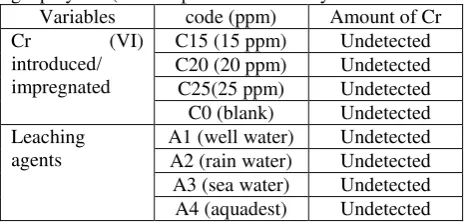
no Cr (VI) detected in the leachate water. The result was listed at the Table 3.
Table 3. TCLP test of Cr (VI) in rice husk ash geopolymer (Na-Geopolimer for 10 days
Variables code (ppm) Amount of Cr
Cr (VI)
introduced/ impregnated
C15 (15 ppm) Undetected
C20 (20 ppm) Undetected
C25(25 ppm) Undetected
C0 (blank) Undetected
Leaching agents
A1 (well water) Undetected
A2 (rain water) Undetected
A3 (sea water) Undetected
A4 (aquadest) Undetected
Conclusions
Immobilization of Cr(VI) in NaOH–rice husk ash
geopolymer obtain a good result up to 25 ppm of Cr(VI). TCLP in 10 days showed that there is no C r ( V I ) d e t e c t e d i n t h e l e a c h a t e w a t e r .
References
1)Davidovits,J., Geopolymers and Geopolymeric
Materials, Journal of Thermal Analysis, vol. 35,
no.2, 1989,p. 429-441.
2)Davidovits, J., Geopolymer : Inorganic Polymeric
New Materials, Journal of Thermal Analysis, ,vol.
37, 1991 p. 1633-1656.
3)Rowles, M.R., The Structural Nature of Aluminosilicate Inorganic Polymers: A Macro to Nanoscale Study, thesis, Curtin University, , 2004
4)Sindhunata, A Conceptual Model of Geopolymerisation, Thesis, Department of Chemical and Biomolecular Engineering The
University of Melbourne Australia,2006.
5)Barbosa, V.F.F, Mac Kenzie, K.J.D., & Thaumaturgo, C.,, Synthesis And Characterisation of materials Based on Inorganic Polymer of Alumina and Silica, Sodium Polysialate Polymers,
International Journal of Inorganic Material), vol 2, no 4, 2000, pp.309-317.
6)Palomo A & M. Palacios , Alkali-Activated Cementitious Materials: Alternative Matrices For The Immobilisation Of Hazardous Wastes Part II.
Stabilisation Of Chromium And Lead, Cement And
Concrete Research , Vol.33, iss 2, Feb 2003, 289-295.
7)Moore, JW: Inorganic Contaminant of Surface Water, Springer Verlag, New York, 1991.
8)Budiasih, KS., Prodjosantosa, A.K., Preparation And Characterization Of Rice Husk Ash Based Geopolymer, ,XIX International Chemistry Seminar
, Gadjah Mada University, Yogyakarta, May 20, 2009.
9)Kriven WM., & Jonathan L.Bell, Master Thesis,
Effect of alkali choice on Geopolymer Properties, University of Illinois at Urbana Champaign Material Science and Engineering Bldg, 2004.
10) Japan Environmental Agency , TCLP for Toxic