p-ISSN: 2085-5893 / e-ISSN: 2541-0458 http://jurnalbeta.ac.id
STUDENTS’ PRIOR UNDERSTANDING OF AREA
Susilahudin Putrawangsa1, Uswatun Hasanah2
Abstrak: Penelitian ini bertujuan untuk menjelaskan pemikiran dan pemahaman awal siswa mengenai konsep luas dan pengukuran luas sebelum mereka diajarkan mengenai luas secara formal dalam kelas matematika. Dalam bahasa lain, penelitian ini bertujuan unuk menyelidiki hakikat pemahaman dan pandangan siswa mengenai konsep luas dimana pemahaman dan pandangan tersebut bukan merupakan pengaruh dari pembelajaran matematika di dalam kelas pada topik tersebut. Temuan dari penelitian ini diharapakan dapat berguna untuk guru atau pihak lainnya yang terkait sebagai pertimbangan dalam mengajar dan merancang perangkat pembelajaran, tugas belajar, atau kegiatan pembelajaran pada konsep pengukuran luas. Dalam penelitian ini, kami melibatkan 6 orang siswa sekolah dasar kelas tiga yang berumur sekitar 9 atau 10 tahun. Kami meminta mereka untuk menyelesaikan lima masalah matematika pada konsep luas. Mereka kemudian diwawancarai secara mendalam mengenai solusi yang mereka berikan untuk kelima masalah yang telah diberikan. Jawaban tertulis beserta penjelasan mereka mengenai jawaban tersebut dianalisis secara mendalam dan digunakan sebagai dasar dalam pengambilan kesimpulan. Penelitian ini menemukan tiga hal penting terkait dengan pemahaman awal siswa mengenai luas dan pengukuran luas, yaitu (1) siswa memandang luas sebagai wilayah dari suatu permukaan (tidak melihat luas sebagai garis); akan tetapi (2) sebagian besar dari mereka belum memiliki pemahaman mengenai satuan pengukuran luas dalam menentukan luas suatu permukaan; oleh karena itu (3) mereka tidak dapat melakukan kegiatan pengukuran luas dengan benar. Malahan mereka mengukur panjang atau lebar dari suatu bidang dari pada mengukur luas ketika mereka diminta untuk menentukan luas suatu bidang. Dalam hal ini, mereka hanya memperhatikan dimensi tertentu dari bidang yang diukur, seperti
panjang atau lebar, ketika berhadapan dengan masalah
membandingkan luas. Memperhatikan ketiga temuan tersebut dan mengacu pada literature yang terkait dengan proses pengajaran yang efektif pada konsep luas, maka untuk meningkatkan pemahaman
konseptual siswa mengenai luas, dianggap penting untuk
memperkenalkan siswa mengenai konsep satuan pengukuran luas. Pemahaman mengenai satuan tersebut kemudian dapat dijadikan sebagai dasar untuk memperkenalkan konsep mengenai pengukuran luas sebagai perhitungan banykanya satuan pengukuran luas. Pada
βeta: Vol. 8 No. 2 (November) 2015
|
101 akhirnya, pemahaman mengenai cara pengukuran luas seperti itu dapat dijadikan sebagai landasan bagi siswa untuk memahami dan memaknai konsep mengenai pengukuran luas dengan menggunakan rumus pengukuran luas.Kata Kunci: Luas, Pengukuran Luas, Pemahaman Awal
Abstract: The recent study intends to clarify students’ prior thinking and understanding toward area and area measurement before they are taught about area formally in classroom. In other words, this study intends to investigate students’ ‘natural’ understanding and view toward area in which such understanding and view are not affected yet by the classroom instructions in that topic. The findings are intended to inform teachers or any related parties as the consideration in teaching and designing learning materials, tasks, or classroom activities for teaching area measurement. We involved six primary students of the third grade, around 9 or 10 years old. We asked them to solve five basic problems of area. They then are interviewed in depth on their solutions of the given problems. Their written works and their explanations were analysed intensively and are used as the basis to draw conclusion. The recent study found three remarks regarding students’ prior understanding of area and area measurement. The three remarks are: (1) students could view area as region of a surface (not seeing area as line); but (2) most of them have no idea about the measurement unit of area to determine area; therefore (3) they are not able to measure area properly yet. They measure the length, width or perimeter of a figure instead of measuring area when they are asked to determine area of plane figures. Here, they just consider a certain dimension of figures, such as their height or width, when they are working with area comparison problems. Considering the remarks above and consulting to relevant literature about effective learning for area, to develop students’ conceptual understanding of area, it is necessary to introduce the idea of measurement units of area to students. Understanding such units then can be used as the basis to introduce the idea of measuring area as counting the units. Finally, understanding such a way of measuring area can be used as the basis for students to grasp meaningfully the idea of area formula in measuring area.
Keywords: Area, Area Measurement, Prior Understanding.
A. INTRODUCTION
102 |βeta Vol. 8 No. 2 (November) 2015
many studies reveal students’ poor understanding on the concept
(Fauzan, 2002; Bonotto, 2003; Zacharos, 2006). Zacharos (2006) asserts that the way the concept being taught to students significantly impact
students’ conceptions and strategy regarding area measurement.
The study on mathematics textbook and classroom practice, Fauzan (2002) and Putrawangsa (2012) report that area is usually taught abstractly and directly to the formal form of mathematics which is put a big gap between students’ prior understanding and experience of area (the existing knowledge) and the new knowledge, whereas many studies gives strong stress on the role of prior knowledge in building new knowledge (Bruner, 1961; Strangman, 2003; Roschelle, 2014; DiGiacomo, 2000; Christen & Murphy, 1991; Lewin, 2003). Bruner (1961), for example, suggests that students should be involved in using their prior experiences and structures of understanding to learn new knowledge.
Many studies report the significant role of students’ prior knowledge and understanding of a subject matter in helping students gaining a better understanding of the matter during learning process (Strangman, 2003; Susan, 2000; Christen & Murphy, 1991; Lewin, 2003; Roschelle, 2014). Study by Strangman (2003), for example, found that in order to be successful in learning students need to develop appropriate background knowledge and the ability to use it. Meanwhile, Bruner (1961) asserts that learners use prior experience to fit new information into the pre-existing structure. Moreover, Falk and Adelman (2003) claim that the creation of new understandings and attitudes depends on the successful integration
of the learner’s prior experiences with new experiences.
βeta: Vol. 8 No. 2 (November) 2015
|
103 Thus, the learning activities or tasks that are fit or allow students to create relationships between their prior understanding and the new knowledge will promote effective learning. Consequently, the study on what students have known of a subject matter is necessary to be conducted before designing learning activity or task on the matter.Therefore, in order to designing effective learning activities/tasks in
developing students’ understanding of area and area measurement, it is necessary to investigate students’ prior understanding of area and area
measurement. The current research is intended for such a purpose. The research question being investigated in the recent study is “What is the
understanding of primary students (9 to 10 years old) toward area and area measurement if they are not taught yet formally in school about the
topic?”
B. THEORETICAL BACKGROUND
1.
Prior understandingAccording to Skemp (1982), to understand something means to assimilate it into an appropriate schema. The schema is a cognitive map or an intellectual structure or a mental model that represent the relationships between concepts and processes, at one level, and between selected schemas, themselves, at another. The schema can also be viewed as the representation of the existing knowledge structure. Once a student can assimilate something (such as experiences, ideas, facts, etc.) in an appropriate schema, the student will be able to use the thing flexibly to other situation or to relate it to other things. For example, when students are asked to mention the following sequence of number “1, 4, 7, 10, 13,
16, 19, 22” after being presented to them for a couple minutes, the
104 |βeta Vol. 8 No. 2 (November) 2015
recognize the pattern. Therefore, Skemp (1982) categorized two types of understanding: instrumental and relational understanding in mathematics. Instrumental understanding is the ability to apply an appropriate remembered rule to the solution of a problem without knowing why the rule works. If a student has an instrumental understanding, he/she only can take an appropriate procedure in solving a problem but he/she does not know why he/she has to take the procedure. Relational understanding, on the other hand, is the ability to deduce specific rules or procedures from more general mathematical relationship. A student who has this type of understanding can explain what procedure and why he/she has to use the procedure in solving a problem.
Meanwhile, the term prior understanding or prior knowledge in many literatures refers to background knowledge or another way around (Dochy et al., 1995; Schallert, 1982; Stevens, 1980; Biemans & Simons, 1996). The terms background knowledge and prior knowledge are generally used interchangeably. Dochy et al. (1995), for example, use the term prior knowledge to describe as the whole of a person's knowledge, including explicit and tacit knowledge, metacognitive and conceptual knowledge. This definition is quite similar to Schallert's definition (Schallert, 1982). Meanwhile, Stevens (1980) use the terms background knowledge to describe the idea about what one already knows about a subject. Biemans & Simons (1996) also use the term background knowledge referring to all knowledge learners have when entering a learning environment which is potentially relevant for acquiring new knowledge. Thus, while scholars' definitions of these two terms are often worded differently, they typically describe the same basic concept.
According to Strangman et. al. (2003), prior knowledge and background knowledge are themselves parent terms for many more specific knowledge dimensions such as conceptual knowledge and metacognitive knowledge. Moreover, Strangman et. al. (2003) asserts subject matter knowledge, strategy knowledge, personal knowledge, and self-knowledge are all specialized forms of prior knowledge/background knowledge.
2.
Area and area measurementβeta: Vol. 8 No. 2 (November) 2015
|
105 units needed to cover a plane figure. Meanwhile, Baturo and Nason (1996) equate area with the quantified amount of plane figure that is enclosed within a boundary. This implies that area is the region inside boundaries. Meanwhile, measuring area is the process of findings the number of those measurement units (Fauzan, 2002) or those quantified amount of plane figures (Baturo and Nason, 1996).Measuring area process takes place when there is a need to determine the size of a plane figure. This need often arises when direct perceptual comparison is prevented to obtain the size of the plane figure or expected to be ineffective (Nunes, Light & Mason in Baturo & Nason, 1996). According to Baturo and Nason (1996), measuring area becomes the matter of portioning a plane figure being measured into discrete units of the same size and then counting those units. This quantification of the units gives rise to the process of area measurement. The number of such units indicates the area of the plane figure and those units are then called as the measurement units. Those measurement units of area can be utilized iteratively in two different ways to generate area. The first is selecting a unit by taking one element out of a whole and then transposing this unit by continuously changing its position, without overlapping or leaving gaps, on the remainder of the whole (figure 1a). The second is determining a suitable measurement units and using as many of these units as are required to cover the whole (figure 1b) (Baturo & Nason, 1996).
a
a b
Figure1. (a) transposing a unit to generate area,
(b) using adequate number of units to cover the surface to generate area.
106 |βeta Vol. 8 No. 2 (November) 2015
covering plane figures with units of measure. They should realize that there are to be no gaps or overlapping and that the entire plane figure should be covered. Second, they should learn how to structure arrays. Figuring out how many squares in pictures of arrays, with less and less graphic information of clues, is an excellent task. Third, students should learn that the length of the sides of a rectangle can determine the number of area units in each row and consecutively tell the number of rows in the array. This will help students to understand the role of dimensions as the representation of the array structure. Fourth, students who can structure an array can meaningfully learn to multiply the length and the width of the plane figure as a shortcut for determining the total number of the area units covering the plane figure.
Meanwhile, Outhred and Mitchelmore (2000) propose four basic
principles that constitute children’s intuitive understanding of area
measurement. These principles are complete covering (covering surface being measure using measurement units), spatial structure (the measurement units can be arrange in many different ways), size relation (the bigger the units the smaller the number of units needed), and multiplicative structure (the structure of units in rectangular figure that allow the multiplication strategy in counting the units). The four principles
successively show the children’s acquisition in learning area
measurement.
C. RESEARCH METHOD
Since the intentions of the recent study is to clarify students’ prior
thinking and understanding toward area and area measurement, descriptive method of research is appropriate for this purpose.
The data were collected from test, observation on students’
performance during the test, and interview. Six Indonesian primary students of the third grade, around 9 or 10 years old, were involved in this study. The third grade students were taken since they have not learnt area yet in mathematics classroom. They were from various levels of students, such as high achievement, average, and low achievement and were distributed according to normal curve.
βeta: Vol. 8 No. 2 (November) 2015
|
107measurement. The first type acquires students’ conception of area.
Meanwhile the second and the third type investigate students’
understanding of measurement units of area and area measurement respectively. Second, during solving the problem, the participants were observed to see their strategies in solving the problems. Third, some potential participants were interviewed relating to their strategies in solving problem. The purpose of interview was not to teach the participants but to clarify their strategies and to investigate further and deeper about their thinking toward the problems.
Data analysis was conducted according to the following phases.
First, participants’ responses toward the problem were categorized
according to their similarity in terms of idea or strategy. In this phase,
the tendencies of participants’ responses are expected to identify.
Second, explanations on participants’ responses were then
elaborated by consulting to relevant theories. Some implications to teaching and learning were also noted in this phase since the findings of the recent study were intended to inform teachers or any related parties as the considerations in designing learning materials, tasks or activities for teaching area and area measurement.
D. FINDINGS AND DISCUSSION
As it is stated before, this study intends to clarify students’ prior thinking and understanding regarding area and area measurement to inform teachers as the consideration in designing learning materials, tasks or activities for instructions. The recent study found three remarks
regarding students’ prior conception of area: (1) students have a prior understanding of area as region of a surface; but (2) most of them have no idea yet about the measurement unit of area; therefore (2) they have no idea yet about how to measure area. Those three remarks are discussed intensively in the following paragraphs
1. Students view area as region of a surface
108 |βeta Vol. 8 No. 2 (November) 2015
The conclusion above is based on the investigation on students’
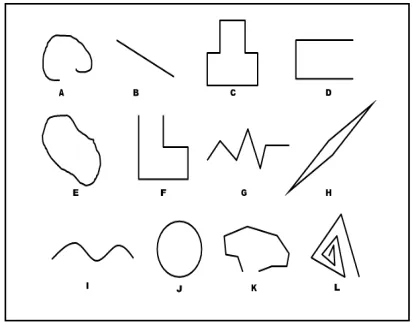
response on the first problem. The students were given a number of figures (Figure 2) and were asked to select the figures that they think have area. The findings show that most of the students (five out of six students) argued that the area of the figures is the region inside the figures.
Nevertheless, although they could see area as a region, they failed in selecting the relevant figures that have area. Five of them mixed their selections from some figures of both close-curve figures (C, E, H, or J) and open-curve figures (A, B, D, F, G, I, K, or L). For example, student 1 selected the following figures: A, C, E, F, J, K, but stated that the area of those figures are the region inside the figures. Theoretically, only a close-curve figure can be defined its area (the region inside the boundaries which can be measured its extent, its size). Here, he could see area as a region but had no understanding yet of the requirement of figure that has area.
Figure 2. Identifying figures that has area
2. Most of Students have no idea yet about the measurement unit of
area and area as the number those units
βeta: Vol. 8 No. 2 (November) 2015
|
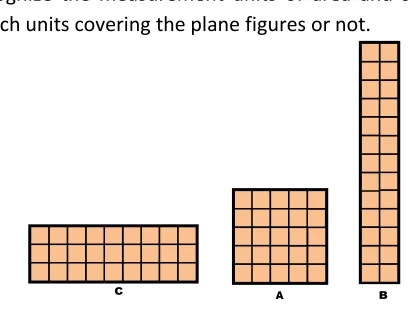
109 students recognize the measurement units of area and see area as the number of such units covering the plane figures or not.Figure 3. Comparing the area of three plane figures
In another problem, the students were asked to compare the area of two incomplete-tiled floors (see Figure 5.3). The purpose of this problem
is to check students’ consistency between their answer in the previous
problem and in the second problem. Moreover, this problem is intended
to see students’ prior understanding of the array structure of units of area
(the squares units).
Figure 4. Two plane figures covering by square tiles
110 |βeta Vol. 8 No. 2 (November) 2015
The findings from the first problem show that most of them (four out of six students) sorted the plane figures based on the length or the width of the plane figures. When they considered the length, they stated that b is the larger and then c and a. Meanwhile, the sort would be a, c, and b when they considered the width. Other two students sorted the plane figures based on the number of the squares (units) covering the plane figures. These students counted the squares constituting the plane figures and then compared the numbers they obtain. Therefore, they stated that the larger is c since it contains 27 squares, and then b and a that have 26 and 25 squares respectively. It seems that these students have a prior understanding of area as the number of square units covering the plane figures.
In the second problem most of the students (five out of six students) compared the length or the width the plane figures when comparing the area of the figures although in the first problem there are some of them who could compare the area of plane figures by considering the square
units. So, there is an inconsistency on students’ response comparing to
their solution on the first problem. Only one student compared the area of the plane figure by considering the square units on the plane figures. But, he only compared the visible squares, not compare the whole possible squares covering the plane figures. It seems that this student has a prior understanding of area as counting the square units, but he did not understand yet about area as the number of area units covering the whole surface completely. This finding also implies that the students have no idea yet about the array structure of the square units.
3. Students have no idea yet about how to measure area
βeta: Vol. 8 No. 2 (November) 2015
|
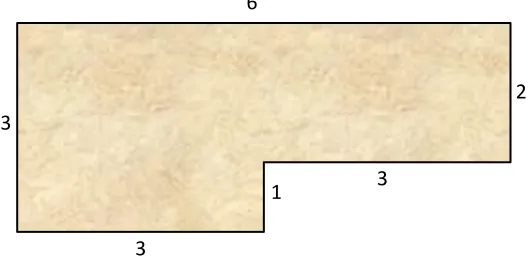
111Lets’ consider students’ strategy in solving the first problem. They
were given a right-angle plane figure with its dimensions in each side (see figure 5) and were asked to determine the area of the figure. The purpose
of the problem is to investigate students’ strategy when dealing with
measuring area of a right-angle plane figure and how they will interpret the dimensions.
The findings show that two out of the six students measured the perimeter instead of area when they were asked to measure the area of the plane figure. They measured the length of each edge of the figure. They summed the result of their measurement to obtain the area. Here, they saw area as perimeter. Meanwhile, two other students stated the area as the width of the plane figure. They looked at the width (height) of the plane figure and then claimed the length of the width is the area of the figure. It is also found that some students had no idea yet about finding the area of the plane figure.
Grounding to the findings above, it can be inferred that the students have no idea yet how to measure area. Most of them thought of measuring area as measuring the perimeter of a plane figure and some others considered measuring area as finding the width or the length of a plane figure. The role of the dimensions as the representation of the array structure of the area units was not understood by the students.
Figure 5. a right-angle plane figure
Let’s consider students’ strategy in facing the second problem. The students were given a rectangle plane figure (see figure 6) and were asked to determine the area of the figure. The purpose of the problems is to find
3
2
3 1
3
112 |βeta Vol. 8 No. 2 (November) 2015
out students’ strategies in determining the area of rectangular plane figures which is considered to be easier rather than the previous problem.
Figure 6. a rectangle plane figure
The findings show that three out of the six students measured the area of the plane figure by measuring the length and as well as and the height of the figure. Here, they claimed the area of the figure is both the height and width of the figure. For example, they said that the area of the figure is 8 cm and 4 cm. Meanwhile, the other two remaining students stated that the area of the plane figure is the length of the figure which is 8 cm. The last another remaining student measured the area of the plane figure by measuring all of the dimensions of the plane figure. He defined every side of the plane figure by letter, such as a, b, c, and d. He then said that the area of the plane figure is a=4 cm, b=8 cm, c=4 cm, and d=8 cm.
E.
CONCLUSIONThe recent study found three remarks regarding students’ prior
understanding of area and area measurement. The three remarks are: (1) students could view area as region of a surface; but (2) most of them have no idea about the measurement unit of area to determine area; therefore (3) they are not able to measure area properly yet. They measure the length, width or perimeter of a figure instead of measuring area when they are asked to determine area of plane figures. They just consider a certain dimension of figures, such as their height or width, when they are working with area comparison problems.
8
βeta: Vol. 8 No. 2 (November) 2015
|
113 Considering the remarks above and consulting to relevant literature about effective learning for area (see Clements & Stephen, 2004; Outhred& Mitchelmore, 2000), to develop students’ conceptual understanding of
area, it is necessary to introduce the idea of measurement units of area to students. Understanding such units then can be used as the basis to introduce the idea of measuring area as counting the units. Finally, understanding such a way of measuring area can be used as the basis for students to grasp meaningfully the idea of area formula in measuring area.
REFERENCES
Baturo, A., & Nason, R. (1996). Student teachers’ subject matter knowledge
within the domain of area measurement. Educational Studies in
Mathematics, 31(3), 235–268.
Biemans, H. J. A., Deel, O. R. & Simons, P. R. (1996). Differences between successful and less successful students while working with the
CONTACT-2 strategy. Learning and Instruction, 11, 265-282.
Bonotto, C. (2003). About students’ understanding and learning of the concept of surface area. In D. H. Clements, & G. Bright (Eds), Learning and teaching measurement, 2003 NCTM Yearbook (pp. 157-167), Reston, Va.: National Council of Teachers of Mathematics.
Bruner, J. S. (196 1). The Act of Discovery. Harvard Educational Review 31:
21-32.
Christen, William. L. & Murphy, Thomas. J. (1991). Increasing Comprehension by
Activating Prior Knowledge. ERIC Clearinghouse on Reading, English, and
Communication. At http://www.ericdigests.org/pre-9219/prior.htm Clements, D. H., & Stephan, M. (2004). Measurement in pre-K to grade 2
mathematics. In D. H. Clements, & J. Samara (Eds.), Engaging young
children in mathematics. Standards for early childhood mathematics
education (pp. 299–317). Mahwah, NJ: Lawrence Erlbaum Associates, Publishers.
DiGiacomo, S. (2000). Reading Instruction Handbook: Activating Personal
Knowledge. At http://curry.edschool.virginia.edu/go/edis771/
webquest2000/student/ssusandigiac/priorknowldge
Dochy, F. J. R. C. & Alexander, P. A. (1995). Mapping prior knowledge: A framework for discussion among researchers. E 242.
Fauzan, A. (2002). Applying Realistic Mathematics Education (RME) in
Teaching Geometry in Indonesian Primary Schools. Doctoral Dissertation,
114 |βeta Vol. 8 No. 2 (November) 2015
Falk, J.H. and Adelman, L.M. (2003). Investigating the Impact of Prior
Knowledge and Interest on Aquarium Visitor Learning. Journal of
Research in Science Teaching Vol. 40, No. 2, Pp. 163–176.
Hirstein, J., Lamb, C., & Osborne, A. (1978). Student misconcepts about area
measure. Arithmetic Teacher, 25,10e16.
Lewin, L. (2003). Practical Ideas for Improving Instruction: Connecting to Prior
Knowledge. At http://www.larrylewin.com/
Outhred, L. N., & Mitchelmore, M. C. (2000). Young children’s intuitive
understanding of rectangular area measurement. Journal for
Research in Mathematics Education, 31 (2), 144 – 167.
Putrawangsa, S (2013). Educational Design Research: Developing students’ understanding of the multiplication strategy in area measurement.
Master thesis. Surabaya: Post graduate program on mathematics education Surabaya State University.
Roschelle, J. (2014). Learning in Interactive Environments: Prior Knowledge
and New Experience. At http://www.exploratorium.edu/ifi/resources
/museumeducation/priorknowledge.html
Schallert, D. L. (1982). The significance of knowledge: A synthesis of research
related to schema theory. In W. Otto & S. White (Eds.), Reading
expository prose (pp. 13-48). New York: Academic.
Skemp, R. (1982). The Physiology of Learning Mathematics. Great Britain,
Hazell Watson & Viney Ltd. Aylesbury, Buck
Stevens, K. C. (1980). The effect of background knowledge on the reading
comprehension of ninth graders. Journal of Reading Behaviour, 12(2),
151-154.
Strangman, N., Hall, T., and Meyer, A. (2003). Background Knowledge
Instruction and the Implications for UDL Implementation. USA: National Center on Accessing the General Curriculum.