
Prometna politika Skopja
Bebas
70
0
0
Teks penuh
(2) Kandidat:. BOBAN ATANASOSKI. PROMETNA POLITIKA SKOPJA. TRAFFIC POLICY IN SKOPJE. Mentor: doc. dr. Peter Lipar. Predsednik komisije:. Somentor: doc. dr. Zlatko Zafirovski Član komisije:. 2017.
(3) I Atanasoski, B. 2017. Traffic policy in Skopje. BSc Th. Ljubljana, UL FGG, First cycle academic study programme Civil Engineering.. Page for improvements Eror page. Line failure. instead. let it be.
(4) II Atanasoski, B. 2017. Traffic policy in Skopje. BSc Th. Ljubljana, UL FGG, First cycle academic study programme Civil Engineering. STATEMENTS. I, the undersigned Boban Atanasoski, exchange student at the Faculty of Civil and Geodetic Engineering, the University of Ljubljana, with registration number 70074215, author of the written final work of studies, entitled: Traffic Policy in Skopje, DECLARE that 1.* a) The written final work of studies is a result of my independent work; b) The written final work of studies is a result of own work of several candidates and fulfils the conditions determined by the UL Statute for joint final works of studies and is a result of my independent work in the required share; 2. The printed form of the written final work of studies is identical to the electronic form of the written final work of studies; 3. I acquired all the necessary permissions for the use of data and copyrighted works in the written final work of studies and clearly marked them in the written final work of studies; 4. During the preparation of the written final work of studies I acted in accordance with ethical principles and obtained, where necessary, agreement of the ethics commission; 5. I give my consent to the use of the electronic form of the written final work of studies for the detection of content similarity with other works, using similarity detection software that is connected with the study information system of the university member; 6. I transfer to the UL – free of charge, non-exclusively, geographically and time-wise unlimited – the right of saving the work in the electronic form, the right of reproduction, as well as the right of making the written final work of studies available to the public on the World Wide Web via the Repository of the UL; 7. I give my consent to the publication of my personal data included in the written final work of studies and in this declaration, together with the publication of the written final work of studies; 8. I give my consent to the use of my birth date in COBISS record.. In Ljubljana: 31.05.2017. Student's signature: Boban Atanasoski.
(5) III Atanasoski, B. 2017. Traffic policy in Skopje. BSc Th. Ljubljana, UL FGG, First cycle academic study programme Civil Engineering. BIBLIOGRAPHIC – DOCUMENTALISTIC INFORMATION AND ABSTRACT. UDC:. 656.1:711(497.711)(043.3). Author:. Boban Atanasoski. Supervisor:. Assist. Prof. Peter Lipar, Ph. D.. Cosupervisor:. Assist. Prof. Zlatko Zafirovski, Ph. D.. Title:. Traffic policy in Skopje. Document type:. Bachelor Science Thesis. Scope and tools:. 52 p., 4 tab., 40 fig.. Key Words:. traffic policy, Skopje, sustainable urban developement.. Abstract In Skopje, as well as in the other Macedonian municipalities, there is no practice or experience with strategic transport planning. Traffic policy implementation strategies are meant to help municipalities overcome such problems. It means making decisions in collaboration with stakeholders and residents, improving the public image of the municipality, creating a higher quality of life, improving mobility and availability as well as bringing positive effects on the environment and population health. It also means using modes of transport that are eco-friendly, modes that will improve and enhance the public transport service, improve bicycle traffic, close the city center, implement pedestrian walks, electric vehicles and of placement transport terminal. The following measures will help to solve the traffic problems in Skopje and improve the quality of life of the inhabitants of Skopje..
(6) IV Atanasoski, B. 2017. Traffic policy in Skopje. BSc Th. Ljubljana, UL FGG, First cycle academic study programme Civil Engineering. BIBLIOGRAFSKO-DOKUMENTACIJSKA STRAN IN IZVLEČEK. UDK:. 656.1:711(497.711)(043.3). Avtor:. Boban Atanasoski. Mentor:. doc. dr. Peter Lipar. Somentor:. doc. dr. Zlatko Zafirovski. Naslov:. Prometna politika Skopja. Tip dokumenta:. Diplomsko delo. Obseg in oprema:. 52 str., 4 pregl., 40 sl.. Ključne besede:. prometna politika, Skopje, trajnostni urbani razvoj omrežja.. Izvleček. Tako kot v drugih makedonskih mestih tudi v Skopju nimajo izkušenj s strateškim prometnim planiranjem. Prometna politika naj bi s svojimi ukrepi pomagala posameznim mestom, da bi lahko izboljšali prometne razmere in prešli slabe obstoječe prakse. To pomeni, da bi se vse odločitve glede prometne ureditve uskladile z deležniki in prebivalci mesta. Tako bi bilo mogoče vzpostaviti višji nivo življenja, izboljšati mobilnost in zmanjšati negativne posledice na okolje in na zdravje ljudi. To bi lahko dosegli z uporabo različnih prometnih modulov, z boljšim javnim prevozom, z izboljšanjem kolesarske infrastrukture, z zaporo mestnega središča za motorni promet, z vzpostavitvijo peš con in z uveljavljanjem električnih vozil. Takšni ukrepi bi lahko pripomogli k reševanju prometne problematike in izboljšanju kvaliteto življenja prebivalcem Skopja..
(7) V Atanasoski, B. 2017. Traffic policy in Skopje. BSc Th. Ljubljana, UL FGG, First cycle academic study programme Civil Engineering. ACKNOWLEDGMENT I would like to express my great appreciation and thankfulness to my parents (Zvonko and Karolina) for all of their support throughout my life, especially during my studies, for motivating me in the hardest moments and for showing me that all of my efforts are worth it. With this words, I would like to sincerely thank my mentor Assoc. Prof. Dr. Peter Lipar, for all of his advice regarding the development of this Bachelor Thesis and his positive approach towards my work throughout the overall course of study. Furthermore, I would like to thank Assist. Dr. Zlatko Zafirovski for his useful suggestions and cooperation. And last but not least, a great appreciation to Assoc. prof. Dr. Todorka Samardzioska for her advice and support during my studies..
(8) VI Atanasoski, B. 2017. Traffic policy in Skopje. BSc Th. Ljubljana, UL FGG, First cycle academic study programme Civil Engineering. TABLE OF CONTENT. STATEMENTS ..................................................................................................................................... II BIBLIOGRAPHIC – DOCUMENTALISTIC INFORMATION AND ABSTRACT ...................III BIBLIOGRAFSKO-DOKUMENTACIJSKA STRAN IN IZVLEČEK ........................................ IV TABLE OF CONTENT ...................................................................................................................... VI LIST OF TABLES............................................................................................................................ VIII SEZNAM PREGLEDNIC .................................................................................................................. IX LIST OF FIGURES .............................................................................................................................. X SEZNAM SLIK ................................................................................................................................ XIII 1. INTRODUCTION ......................................................................................................................... 1 1.2 Sustainable urban development ..................................................................................................... 3. 2. CHARACTERISTICS OF SKOPJE'S PROBLEMS................................................................. 5 2.1 Challenges and opportunities from traffic policy implementation in Skopje ................................ 7 2.1.2 Five challenges of the municipality ....................................................................................... 7. 3. FIVE OPPORTUNITIES FROM TRAFFIC POLICY IMPLEMENTATION IN SKOPJE 8 3.1 Five aims ....................................................................................................................................... 9. 4. STRATEGY AND CURRENT SITUATION ........................................................................... 10 4.1 Improving theservis quality of the public transport in Skopje .................................................... 10 4.1.1 Bus line network of Skopje JSP ( Urban Public Transport ) ............................................... 10 4.1.2 Separeted bus lines ............................................................................................................... 12 4.1.3 Systems for location of public transport vehicles ................................................................. 13 4.1.4 Fire collection systems ......................................................................................................... 14 4.2 Recommendations for improving the bicycle traffic in Skopje ................................................... 17 4.2.1 Few recommendations for improvement of the bicycle traffic: ........................................... 17 4.2.2 How does it work? ................................................................................................................ 21 4.2.3 Bike boxes ............................................................................................................................ 22 4.2.4 Bicycle parks, service stations and an information point. ................................................... 23 4.3. To develop an economical, eco-sensitive and efficient way of distribution in Skopje, we must turn to e-ways of transport ........................................................................................................ 24 4.3.1 Low emission zone ............................................................................................................... 25 4.3.2 Electrical buses ..................................................................................................................... 26 4.3.3 Electric cars-sharing model .................................................................................................. 28 4.4 Tram ............................................................................................................................................ 30 4.4.1 Metro (Subway) .................................................................................................................... 30 4.4.2 Fast tram in Skopje ............................................................................................................... 30.
(9) VII Atanasoski, B. 2017. Traffic policy in Skopje. BSc Th. Ljubljana, UL FGG, First cycle academic study programme Civil Engineering. 4.4.3 Hanging tram ........................................................................................................................ 32 4.4.4 Healt impact of tram systems ............................................................................................... 35 4.4.5 Why trams? .......................................................................................................................... 35 4.5 Transport terminals ..................................................................................................................... 36 4.5.1 Park and ride......................................................................................................................... 37 4.5.2 Real time traffic reports........................................................................................................ 40 4.5.3 City ring ............................................................................................................................... 42 5. CONCLUSION ............................................................................................................................ 43. 6. SUMMARY ................................................................................................................................. 44. 7. RAZŠIRJEN POVZETEK V SLOVENŠČINI......................................................................... 47. REFERENCES .................................................................................................................................... 50.
(10) VIII Atanasoski, B. 2017. Traffic policy in Skopje. BSc Th. Ljubljana, UL FGG, First cycle academic study programme Civil Engineering. LIST OF TABLES. Table 1:. Modal splıt comparıson for dıfferent European cıtıes………………………………2. Table 2:. Differences between traditional transport planing and sustainable urban mobility planning(Guidelines. Developing and Implementing a Sustainable Urban Mobility Plan, Frank Wefering) ............................................................................................... 3. Table 3:. Total number of accidents in whch public transport vehicles have been involved over the period od 2007 to 2014 (ВТОРА НАЦИОНАЛНА СТРАТЕГИЈА НА РЕПУБЛИКА МАКЕДОНИЈА ЗА УНАПРЕДУВАЊЕ НА БЕЗБЕДНОСТА НА СООБРАЌАЈОТ НА ПАТИШТАТА 2015 – 2020)………………………………………………………6. Table 4:. Plan with 8 proposes measures for the constroctions of the sustainable transport system in Skopje ........................................................................................................ 9.
(11) IX Atanasoski, B. 2017. Traffic policy in Skopje. BSc Th. Ljubljana, UL FGG, First cycle academic study programme Civil Engineering. SEZNAM PREGLEDNIC. Preglednica 1:. Modal split Primerjava za različnih evropskih mestih………………………….2. Preglednica 2:. Razlike med tradicionalnim načrtovanjem prometa in trajnostnim načrtovanjem mobilnosti v mestih (Guidelines. Developing and Implementing a Sustainable Urban Mobility Plan, Frank Wefering)…………………………………………3. Preglednica 3:. Skupno število nesreč, v katerih so bila vozila za javni prevoz, ki sodelujejo v obdobju od 2007 do 2014(ВТОРА НАЦИОНАЛНА СТРАТЕГИЈА НА РЕПУБЛИКА МАКЕДОНИЈА ЗА УНАПРЕДУВАЊЕ НА БЕЗБЕДНОСТА НА СООБРАЌАЈОТ НА ПАТИШТАТА 2015 – 2020……………………….6. Preglednica 4:. Načrt z 8 predlaga ukrepe za objekte v trajnostni prometni sistem v Skopje ...... 9.
(12) X Atanasoski, B. 2017. Traffic policy in Skopje. BSc Th. Ljubljana, UL FGG, First cycle academic study programme Civil Engineering. LIST OF FIGURES. Figure 1: Urbanistic plan of Skopje (http://www.skopje.gov.mk/DesktopDefault.aspx?tabindex=0&tabid=594)...........................................1 Figure 2: Zones in Skopje (http://www.skopje.gov.mk/DesktopDefault.aspx?tabindex=0&tabid=594) .......................................... 2 Figure 3: Double-decker buses in Skopje (http://macedoniaonline.eu/content/view/31199/45/).............................................................................11 Figure 4: Bus is stopping on a bus station in the separete bus line (http://www.infrastructureontario.ca/York-Viva-Bus-Rapid-Transit-Expansion/)................................12 Figure 5: Bus Rapid Transfer station in Curitiba's Linha Verde, Brazil (http://citiscope.org/citisignals/2014/bus-rapid-transit-expands-180-cities) ......................................... 13 Figure 6: LED information display at Düsseldorf Hauptbahnhof ......................................................... 14 Figure 7: AFC barrier gates at Southern Cross Station in the Melbourne Metcard AFC System (https://en.wikipedia.org/wiki/Automated_fare_collection)...................................................................15 Figure 8: Ticket validator and inteligent card in LPP-Ljubljanski Potniški Promet (https://www.had.si/blog/2009/09/02/urbana-ljubljana-enotna-mestna-kartica/#jp-carousel-13395)....15 Figure 9: Charging of the Inteligent Cards at Urbanomat at Konzorcij-Ljubljana…………………….16 Figure 10: Separate bycicle truck in Milano…………………………………………………………...17 Figure 11: The look of the bicycle path and pedestrian walk in Amsterdam………………………….18 Figure 12: Old bicycle rent point-Skopje (https://www.visitskopje.mk/museums/57-rent-a-bike-to-fully-enjoy-skopje)......................................19 Figure 13: Plan for bicycle utilization in Skopje……………………………………………………...20 Figure 14: BicikeLJ rent a bike-Ljubljana (http://www.inljubljana.com/ljubljana-bike-rental/)...............................................................................20 Figure 15: Urbanomat (rent a bike automat in Ljubljana) (http://www.inljubljana.com/ljubljana-bike-rental/)...............................................................................21 Figure 16: Bike boxes at Zoisova Cesta in Ljubljana (http://www.copenhagenize.com/2011/09/ljubljana.html )....................................................................22 Figure 17: Bike station in Ljubljana…………………………………………………………………...23 Figure 18: Air pollution in Skopje November 2016 (http://www.independent.mk/articles/7187/Skopje+is+Second+Most+Polluted+City+in+Europe)......24 Figure 19: Signage at entrance to low emission zone (https://tfl.gov.uk)...................................................................................................................................25 Figure 20: Area C gate in Porta Ticinese with monitoring cameras (https://en.wikipedia.org/wiki/Milan_Area_C)......................................................................................26.
(13) XI Atanasoski, B. 2017. Traffic policy in Skopje. BSc Th. Ljubljana, UL FGG, First cycle academic study programme Civil Engineering. Figure 21: City Electric buses are charging at the bus station, Terschelling, NL (https://en.wikipedia.org/wiki/Electric_bus#/media/File:VDL_Citea_Electric_charging_at_WestTerschelling_bus_station.jpg).................................................................................................................27 Figure 22: Electical bus in Japan (https://en.wikipedia.org/wiki/Online_Electric_Vehicle#/media/File:SJT_OLEV_bus.jpg).................27 Figure 23: Charging of an electical car in BTC središče, Ljubljana (http://www.btc.si/eng/press-center/sporocilo/1316/new-avant2go-electric-car-sharing-stop-in-btccity-murska-sobota)................................................................................................................................28 Figure 24: Tesla Superchargers in front of Sheraton hotel Ljubljana (http://aff.bstatic.com/images/hotel/max500/841/84137032.jpg)...........................................................29 Figure 25: My suggestion for the future plan about fast tram lines in Skopje………………………...31 Figure 26: Manchester's Fast tram separeted layout (http://schwandl.blogspot.si/2015/07/manchester-metrolink.html)........................................................31 Figure 27: Hanging Railway in campus at University of Dortmund (http://www.h-bahn.info/en/gallery.php )...............................................................................................32 Figure 28: Düsseldorf Skytrain leaving the station (http://www.bahnbilder.de/name/galerie/kategorie/deutschland~magnetschwebe--schwebe--hbahnen~dusseldorf-skytrain.html)..........................................................................................................33 Figure 29: A Shonan Monorail train at Shōnan-Fukusawa station with track switch at upper left (http://www.wikiwand.com/en/Shonan_Monorail )...............................................................................34 Figure 30: A 5000 series train in August 2008 (http://www.wikiwand.com/en/Shonan_Monorail)................................................................................34 Figure 31: Ideas for a terminal transport points in Skopje…………………………………………….37 Figure 32: Park and Rıde Dolgi Most –Ljubljana Slovenia (http://www.delo.si/novice/ljubljana/gradbinci-so-precej-znizali-ponudbe.html).................................38 Figure 33: Bicycle Station and Chargers for the electic cars in the Terminal Transport station Dolgi most in Ljubljana (http://ljubljanski.projekti.si/p-r-barje.aspx)..............................................................39 Figure 34: Park and Ride Traffyc Sign (https://en.wikipedia.org/wiki/Park_and_ride#/media/File:ParkAndRideSignOxford20050910.JPG )39 Figure 35: Electric traffic sıgns / Variable message signs (http://www.roadtraffic-technology.com/projects/adelaide-crafers-highway/adelaide-crafershighway1.html).......................................................................................................................................40 Figure 36: Website of TRAFFIC INFORMATION CENTRE in Slovenia (https://www.promet.si/portal/en/1traffic-conditions.aspx)...................................................................40.
(14) XII Atanasoski, B. 2017. Traffic policy in Skopje. BSc Th. Ljubljana, UL FGG, First cycle academic study programme Civil Engineering. Figure 37: Traffic Camera instaled on a traffic light…………………………………………………..40 Figure 38: Traffic monitoring center (https://transportation.arlingtonva.us/streets/traffic-signals/).................................................................41 Figure 39: City ring in Skopje…………………………………………………………………………42 Figure 40: Electrical vehicles in the center ring in Ljubljana (https://www.visitljubljana.com/sl/obiskovalci/ljubljana-in-regija/promet-in-transport/kavalir/ )……42.
(15) XIII Atanasoski, B. 2017. Traffic policy in Skopje. BSc Th. Ljubljana, UL FGG, First cycle academic study programme Civil Engineering. SEZNAM SLIK. Slika 1: Urbanistični načrt Skopje (http://www.skopje.gov.mk/DesktopDefault.aspx?tabindex=0&tabid=594)...........................................1 Slika 2: Cone v Skopju (http://www.skopje.gov.mk/DesktopDefault.aspx?tabindex=0&tabid=594) .......................................... 2 Slika 3: Dvonadstropni avtobusi v Skopju (http://macedoniaonline.eu/content/view/31199/45/)............................................................................ 11 Slika 4: Avtobus se ustavi na avtobusni postaji v ločeni avtobusni liniji (http://www.infrastructureontario.ca/York-Viva-Bus-Rapid-Transit-Expansion/) ............................... 12 Slika 5: Bus Rapid Transfer-postaja v Curitiba's Linha Verde, Brazil (http://citiscope.org/citisignals/2014/bus-rapid-transit-expands-180-cities) ......................................... 13 Slika 6: LED informaciskij prikaz v Düsseldorf Hauptbahnhof ........................................................... 14 Slika 7: AFC pregradna vrata na južni Cross Station v sistemu Melbourne Metcard AFC (https://en.wikipedia.org/wiki/Automated_fare_collection) ................................................................. 15 Slika 8: Validator vstopnic in pametna kartica v LPP-Ljubljanski Potniški Promet (https://www.had.si/blog/2009/09/02/urbana-ljubljana-enotna-mestna-kartica/#jp-carousel-13395) .. 15 Slika 9: Polnjenje inteligentne kartice na Urbanomatu Konzorcij-Ljubljana....................................... 16 Slika 10: Ločena kolesarska pot v Milano ............................................................................................ 17 Slika 11: Videž kolesarske poti in sprehod za pešce v Amsterdamu ................................................... 18 Slika 12: Stara postaja izposoja koles v Skopju (https://www.visitskopje.mk/museums/57-rent-a-bike-to-fully-enjoy-skopje) ..................................... 19 Slika 13: Načrt uporabe koles v Skopju ............................................................................................... 20 Slika 14: BicikeLJ najem koles-Ljubljana (http://www.inljubljana.com/ljubljana-bike-rental/) ............................................................................. 20 Slika 15: Urbanomat (avtomat za najem kolesa v Ljubljani) (http://www.inljubljana.com/ljubljana-bike-rental/) ............................................................................. 21 Slika 16: Kolesarske škatle Zoisove Ceste v Ljubljani (http://www.copenhagenize.com/2011/09/ljubljana.html ) ................................................................... 22 Slika 17: Kolesarska postaja v Ljubljani (https://www.ljubljana.si/en/news/new-bicikelj-stations/) .................................................................... 23 Slika 18: Onesnaženost zraka v Skopju November 2016 (http://www.independent.mk/articles/7187/Skopje+is+Second+Most+Polluted+City+in+Europe) .... 24 Slika 19: Prometni znak za vhod v niskem območjo emisij (https://tfl.gov.uk) ................................................................................................................................. 25 Slika 20: Area C vhod v Porta Ticinese z video nadzorom (https://en.wikipedia.org/wiki/Milan_Area_C) ..................................................................................... 26.
(16) XIV Atanasoski, B. 2017. Traffic policy in Skopje. BSc Th. Ljubljana, UL FGG, First cycle academic study programme Civil Engineering. Slika 21: Polnenje Mestnega elektronskega avtobusa na avtobusni postaji, Terschelling, NL (https://en.wikipedia.org/wiki/Electric_bus#/media/File:VDL_Citea_Electric_charging_at_WestTerschelling_bus_station.jpg)................................................................................................................ 27 Slika 22: Električni avtobusi na Japonskem (https://en.wikipedia.org/wiki/Online_Electric_Vehicle#/media/File:SJT_OLEV_bus.jpg) ................ 27 Slika 23: Polnenje elektronskega avta v BTC centar, Ljubljana (http://www.btc.si/eng/press-center/sporocilo/1316/new-avant2go-electric-car-sharing-stop-in-btccity-murska-sobota) ............................................................................................................................... 28 Slika 24: Tesla Superchargers pred Sheraton hotel Ljubljana (http://aff.bstatic.com/images/hotel/max500/841/84137032.jpg) ......................................................... 29 Slika 25: Moj predlog za prihodnji načrt o hitrih tramvajskih progah v Skopju ................................... 31 Slika 26: Ločena postavitev hitre železnice Manćisterja (http://schwandl.blogspot.si/2015/07/manchester-metrolink.html) ....................................................... 31 Slika 27: Viseča železnica v kampusu na univerzi v Dortmundu (http://www.h-bahn.info/en/gallery.php ) .............................................................................................. 32 Slika 28: Düsseldorf Skytrain zapusti postajo (http://www.bahnbilder.de/name/galerie/kategorie/deutschland~magnetschwebe--schwebe--hbahnen~dusseldorf-skytrain.html) ......................................................................................................... 33 Slika 29: Shonan Monorail vlak na Shonan-Fukusawa postaja s stikalom proge na zgornjem levem (http://www.wikiwand.com/en/Shonan_Monorail ) .............................................................................. 34 Slika 30: A 5000 series vlak v Augustu 2008 (http://www.wikiwand.com/en/Shonan_Monorail) ............................................................................... 34 Slika 31: Ideje za terminalne prometnih točk v Skopju......................................................................... 37 Slika 32: Park and Rıde Dolgi Most –Ljubljana Slovenia (http://www.delo.si/novice/ljubljana/gradbinci-so-precej-znizali-ponudbe.html) ................................ 38 Slika 33: Kolesarska postaja in polnilci za električne avtomobile na prometni Terminal Dolgi most v Ljubljani (http://ljubljanski.projekti.si/p-r-barje.aspx) .......................................................................... 39 Slika 34: Park and Ride Prometni znak (https://en.wikipedia.org/wiki/Park_and_ride#/media/File:ParkAndRideSignOxford20050910.JPG ) 39 Slika 35: Električni prometni znak (http://www.roadtraffic-technology.com/projects/adelaide-crafers-highway/adelaide-crafershighway1.html) ...................................................................................................................................... 40 Slika 36: Spletna stran Prometno-informacijski center v Sloveniji (https://www.promet.si/portal/en/1traffic-conditions.aspx) .................................................................. 40 Slika 37: Prometne kamere nameščene na semaforju............................................................................ 41 Slika 38: Center za spremljanje prometa (https://transportation.arlingtonva.us/streets/traffic-signals/) ................................................................ 41.
(17) XV Atanasoski, B. 2017. Traffic policy in Skopje. BSc Th. Ljubljana, UL FGG, First cycle academic study programme Civil Engineering. Slika 39: Mestni krog Skopja ................................................................................................................ 42 Slika 40: Električna vozila v centru obroča v Ljubljani (https://www.visitljubljana.com/sl/obiskovalci/ljubljana-in-regija/promet-in-transport/kavalir/ ) ....... 42.
(18) XVI Atanasoski, B. 2017. Traffic policy in Skopje. BSc Th. Ljubljana, UL FGG, First cycle academic study programme Civil Engineering. ABBREVIATIONS. SUMP. Sustainable Urban Mobility Planning. KM. Kilometers. EU. Europe Union. IPH. Institute for Public Health (IPH),. JSP. Javno Soobrakajno Pretprijatie Skopje ( Urban Public Transport Skopje ). BRT. Bus rapid transit. GPS. Global Positioning System. LED. Light-Emitting Diode. AFC. Automated Fare Collection. TMV. Ticket vending machines. PT. Public Transport. LEZ. Low Emission Zone. SIPEM. SIemens PEople Mov.
(19) 1. Atanasoski, B. 2017. Traffic policy in Skopje BSc Thesis Ljubljana, UL FGG, First cycle academic study programme Civil Engineering.. 1. INTRODUCTION. Skopje is the capital city od Macedonia and it's its political, economical, educational and cultural center. With a population of almost one million, it continues to be a focus for new residents, economic development, construction, and refurbishment. Skopje is steadily becoming a vital regional route for international flight operators. It also has major foreign investors. The city's growth can add up to its long and illustrious history of culture and commerce. It is a vibrant center that is dedicated to becoming a sustainable capital on the Western Balkans. Since the 1990s, the level of Skopje standing as a major Southeast European transport hub has increased. The city is an intersection of two main European transport corridors - Corridor VIII (eastwest) and Corridor X (north-south). The E75 highway runs east of Skopje, and R65 runs through the northern and western edges of the city. It is also accessible with a railway and it is the hub of the north-south SEE line. Skopje central railway station is approximately 2 kilometers east of the city center. It is a part of the ''Transportation Center'' complex. The main Skopje bus station is in the same complex as well. City buses run through the entire city, connecting different neighborhoods as well as the smaller surrounding towns. The Transportation Center station is also a hub for intercity and international bus routes. Buses are frequent and offer relatively inexpensive fares. On 17 January 1948, the Public transport company is constituted. The public transport is realized by Public transport enterprise, together with two other private firms. The public transport is the most popular transport mode. Supported by the City of Skopje subsidies, there is free transport available for persons over 62/64 age, as well as for children that are up to six years. The inner city is Zone 1, with ticket price 35 denars in public transport buses (JSP) and 25 denars in private buses. The tickets can be one way, weekly or monthly. [1]. Figure 1: Urbanistic plan of Skopje (http://www.skopje.gov.mk/DesktopDefault.aspx?tabindex=0&tabid=594) Slika 1: Urbanistični načrt Skopje (http://www.skopje.gov.mk/DesktopDefault.aspx?tabindex=0&tabid=594).
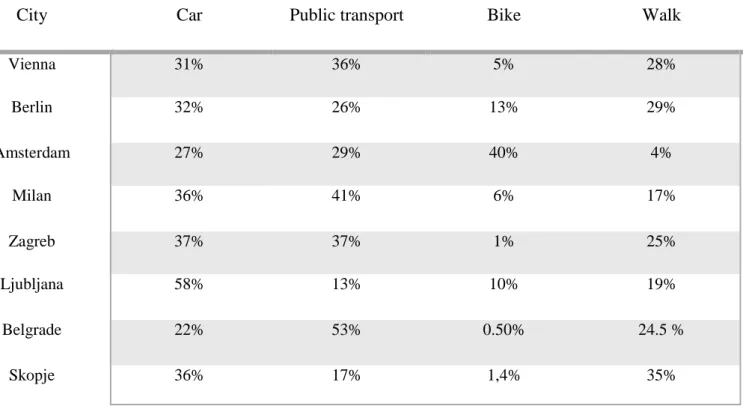
(20) 2. Atanasoski, B. 2017. Traffic policy in Skopje BSc Thesis Ljubljana, UL FGG, First cycle academic study programme Civil Engineering.. Figure 2: Zones in Skopje (http://www.skopje.gov.mk/DesktopDefault.aspx?tabindex=0&tabid=594) Slika 2: Cone v Skopju (http://www.skopje.gov.mk/DesktopDefault.aspx?tabindex=0&tabid=594). City. Car. Public transport. Bike. Walk. Vienna. 31%. 36%. 5%. 28%. Berlin. 32%. 26%. 13%. 29%. Amsterdam. 27%. 29%. 40%. 4%. Milan. 36%. 41%. 6%. 17%. Zagreb. 37%. 37%. 1%. 25%. Ljubljana. 58%. 13%. 10%. 19%. Belgrade. 22%. 53%. 0.50%. 24.5 %. Skopje. 36%. 17%. 1,4%. 35%. Table 1: Modal splıt comparıson for dıfferent European cıtıes Preglednica 1: Modal split Primerjava za različnih evropskih mestih.
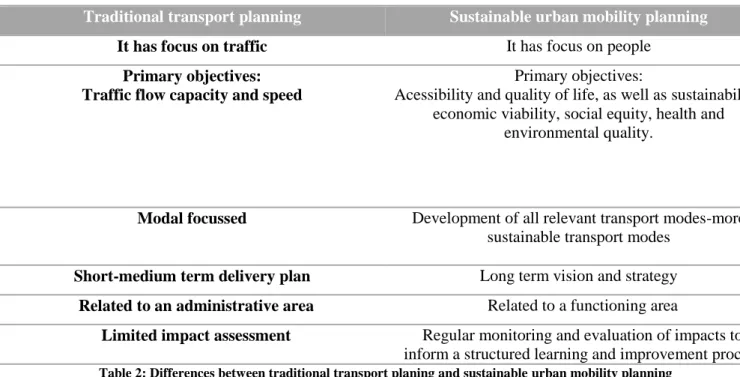
(21) 3. Atanasoski, B. 2017. Traffic policy in Skopje BSc Thesis Ljubljana, UL FGG, First cycle academic study programme Civil Engineering. 1.2 Sustainable urban development. When trying to imagine the perfect city to live in, how does it look like? In order to capture that picture, we would have to answer more than one question. Will that be a city where children can play safely? Is that a city where the air is clean, and you can go for a walk and bike without any obstacles? With a lot of green space and parks? And all of this in urban and business prospering city. Planning this is a very complex task because of contradictory demands like maintaining a high quality of life while also creating an attractive environment for businesses. So, a strategic plan designed to satisfy the mobility needs of people and businesses in cities, called a sustainable urban mobility plan, makes it easier for a better quality of life. What turns a plan into a sustainable mobility plan? A sustainable urban mobility plan aims to create an urban transport system by: • Ensuring all citizens are offered with transport options that enable access to key destinations and services; • Improve the safety and security; • Reduce the air and noise pollution, greenhouse gas emissions and energy consumption; • Improve the efficiency and cost-effectiveness of the transportation of persons and goods; • Contribute to enhancing the attractiveness and quality of the urban environment and urban design for benefits of citizens, the economy, and society as a whole. The plan covers all modes and forms of transport in the entire urban agglomeration-public and private transport, passengers and freight, motorized and non-motorised, moving and parking.. Traditional transport planning. Sustainable urban mobility planning. It has focus on traffic. It has focus on people. Primary objectives: Traffic flow capacity and speed. Primary objectives: Acessibility and quality of life, as well as sustainability, economic viability, social equity, health and environmental quality.. Modal focussed. Development of all relevant transport modes-more sustainable transport modes. Short-medium term delivery plan. Long term vision and strategy. Related to an administrative area. Related to a functioning area. Limited impact assessment. Regular monitoring and evaluation of impacts to inform a structured learning and improvement process. Table 2: Differences between traditional transport planing and sustainable urban mobility planning (Guidelines. Developing and Implementing a Sustainable Urban Mobility Plan, Frank Wefering) Preglednica 2: Razlike med tradicionalnim načrtovanjem prometa in trajnostnim načrtovanjem mobilnosti v mestih (Guidelines. Developing and Implementing a Sustainable Urban Mobility Plan, Frank Wefering).
(22) 4. Atanasoski, B. 2017. Traffic policy in Skopje BSc Thesis Ljubljana, UL FGG, First cycle academic study programme Civil Engineering. The benefits of Sustainable urban mobility planning are: 1. Improving the quality of a wide-life range of benefits such as more attractive public spaces, improved road safety, better health-less air and noise pollution. 2. Contributing to better health, air quality and reduction of noise. Walking and cycling at a higher rate is good for citizens' health. It pays off for a city to invest in less noise and better air quality, all while reducing emission gasses in the transport sector. 3. Saving costs create economic benefits. Also, well-organized and sustainable city is a more attractive city for investors. 4. Making more effective use of limited resources at a time when financial resources are limited. It's more important to ensure that the solutions make the most cost-effective use of the funds available. 5.. Winning public support - A city government that shows its care about its citizens is in a much better position to obtain a high level of public legitimacy.. 6. Fulfilling legal obligations effectively - the legal obligations for air quality improvement and noise abatement are only two examples of a range of national and European regulations. The sustainable urban mobility plan offers an effective way to respond through one comprehensive strategy. 7. Moving towards a new mobility culture - the outcome of this mobility planning in many cities shows a new mobility culture, a vision that is agreed by the major political groups and shared by the institutions and citizens of an urban society. [2].
(23) 5. Atanasoski, B. 2017. Traffic policy in Skopje BSc Thesis Ljubljana, UL FGG, First cycle academic study programme Civil Engineering. 2. CHARACTERISTICS OF SKOPJE'S PROBLEMS. The territory of Skopje covers 1818 square kilometers: 23 km in length, 9 km in width and is located at an average altitude of 245 meters. The city is situated in the east-west oriented Skopje Valley and is surrounded mostly by mountains. According to the last population census in 2002, Skopje has a population of 578,144 citizens (accounting for 28,6% of the total national population). This is the largest region by population in Macedonia (326 residents in km2). Whereas the fact that there hasn't been a population census in the last 15 years, meantime there is fast demographic expansion and rapid demographic growth of Skopje. This demographic growth brought the most of the city's traffic problems. 1. Public transport - Leaning only on bus transport and ''freezing'' the level of quality of some services causes descending of citizen's interest in using the public transport system (the number of passengers falls from 150M per year in 1989 to only 45M in 2010!). The public transport sector has one public and two private companies. The buses that are used on daily bases are mainly old and pollute the air in large quantities. Studies show that 60% of total air pollution in Skopje comes from buses. 2. Cycling traffic - Skopje has conditions, but not results regarding cycling. 80% of Skopje's territory is flat, plus it has a solid climate and an average temperature od 13,5 degrees Celsius. Nevertheless, it has not grown into a functional bicycle city. Skopje cyclists seek strategic solutions and equal treatment as the motorized transport. Widened streets are no good if cyclists are marginalized, without an organized road network that is repaired from campaign to campaign. Skopje has 60 km of cycling paths by the sides of the streets, and 21 km path by the river Vardar, but most of this is not suitable for use. And there are many obstacles on these paths, such as traffic signs, containers, billboards, no parking spots for bicycles, etc. 3. Pedestrian zones problems - Not having enough pedestrian zones; narrow footpaths; poor signage and barriers to pedestrian movement; an unwelcoming environment for the elderly and physically disabled; safety problems in relation to traffic and in areas that are poorly lit or badly maintained; noise and air pollution from traffic; unattractive streets and pedestrian links which lack character, identity and comfort (shade, seating, plants etc). 4. Increased traffic accidents in the last few years - According to the latest analysis by the National Council for Safety and Traffic on the roads, the number of pedestrians killed in Skopje has increased. Most of the people killed in traffic accidents were pedestrians. On average, in Macedonia, 160-170 people are killed a year on the roads, out of which more than 40% of traffic accidents happen in the capital, Skopje..
(24) 6. Atanasoski, B. 2017. Traffic policy in Skopje BSc Thesis Ljubljana, UL FGG, First cycle academic study programme Civil Engineering.. Table 3: Total number of accidents in whch public transport vehicles have been involved over the period od 2007 to 2014 (source: ВТОРА НАЦИОНАЛНА СТРАТЕГИЈА НА РЕПУБЛИКА МАКЕДОНИЈА ЗА УНАПРЕДУВАЊЕ НА БЕЗБЕДНОСТА НА СООБРАЌАЈОТ НА ПАТИШТАТА 2015 – 2020) Preglednica 3: Skupno število nesreč, v katerih so bila vozila za javni prevoz, ki sodelujejo v obdobju od 2007 do 2014 (source: ВТОРА НАЦИОНАЛНА СТРАТЕГИЈА НА РЕПУБЛИКА МАКЕДОНИЈА ЗА УНАПРЕДУВАЊЕ НА БЕЗБЕДНОСТА НА СООБРАЌАЈОТ НА ПАТИШТАТА 2015 – 2020).
(25) 7. Atanasoski, B. 2017. Traffic policy in Skopje BSc Thesis Ljubljana, UL FGG, First cycle academic study programme Civil Engineering. 2.1 Challenges and opportunities from traffic policy implementation in Skopje Traffic policy implementation strategies are meant to help municipalities overcome such problems and bad practices. It means making decisions in collaboration with stakeholders and residents, improve the public image of the municipality, create a higher quality of life, improve mobility and availability and bring positive effects on the environment and population health. 2.1.2 Five challenges of the municipality Non experienced planning - In Skopje, as well as in the other Macedonian municipalities, there is no practice or experience with strategic transport planning. Without strategic frameworks, we also do not have mechanisms for prioritizing and assessing the contribution of a transport action towards achieving the objectives we have set for ourselves. Transport planning is still too focused on increasing capacity and fluidity of road infrastructure. The result is a lower quality of life and big spending of public money for the construction of road infrastructure, which does not significantly improve the situation. People travel more, spend more money for mobility, and as a result of their mobility, there is a frequent use of a personal car. In addition, Skopje should have a comprehensive transport strategy - such as strategy cycling, parking policy, mobility management and so on. Among them, managed mobility also has a great potential because it affects travel behavior by using "soft" measures, such as the information and communications that do not require large cash contributions and often have a very positive relationship between the effects and costs. Unhealthy travel (mobility) habits - The data shows that the inhabitants of Skopje follow the trend of the travel (mobility) habits of the country - growing proportion of journeys are carried out by car, resulting in less walk, cycle or use of public transport. Personal car is being used in cases where the traveling distance is short and could easily be done by foot or by bike. Such travel behavior has an impact on the health of the population, as further reducing their physical activity – which is already low due to the prevailing sedentary lifestyle. Particularly worrying are the trends among young people, who increasingly suffer due to over-nutrition and obesity. The decline of the public passenger transport - Since the bus services' offers in the municipality are constantly declining, there is consequently a decline in the number of passengers. During weekdays, the number of connections with a number of centers in the region is cut in half. The bus connections on Saturdays, Sundays and holidays, in large part, are abolished. Also, with the aging of the population, the public transport is becoming worse since is being overused by the older population, growing into a social problem. Due to the overcrowded buses, youngsters often decide to use a personal car over public transport. Poor conditions for walking and cycling - Skopje is a flat city, which allows the population to take their journey on foot or by bike. This potential is not sufficiently exploited - the deployment of some new activities (mainly trade) extended the routes and encouraged residents to make greater use of cars. Similarly, the restrictions on residents created by the bad conditions for walking and cycling - a bad network of sidewalks or bike paths that are discontinuous, overcrowded sidewalks by cars etc. add up. Although recent road projects include sidewalks and bicycle lanes, their implementation is lagging behind. Lowering the quality of life due to motorized transport - People significantly contribute to these problems through the usage of their cars even when there is no real reason to do so. Problems are concentrated in the municipal district and are reflected in the deterioration of traffic, safety, and environmental conditions. As a result, the quality of life of the residents nearby is affected by the noise and poor air quality.[3].
(26) 8. Atanasoski, B. 2017. Traffic policy in Skopje BSc Thesis Ljubljana, UL FGG, First cycle academic study programme Civil Engineering. 3. FIVE OPPORTUNITIES FROM TRAFFIC POLICY IMPLEMENTATION IN SKOPJE. 1. The potential for walking and cycling - Skopje's geographical features allow a much larger proportion of car-free paths. The city in greater part is very suitable for walking and cycling. Distances are particularly conducive to cycling, which is the fastest transport mode. The list of presumed or proven advantages to be gained from cycling and walking has never been established exhaustively.They are of various kinds, including economic benefits (such as a drop in the household budget devoted to cars, reduction of working hours lost in traffic jams, reduction of health costs thanks to the effects of regular exercise); political advantages (such as reduction in dependence on energy, saving non-renewable resources); ecological impacts (with a distinction between local, short-term effects notion of environment and not localised long-term effects notion of ecological balance). 2. New parking arrangements - For the inhabitants of Skopje, parking spaces is the main problem. Due to the actuality of this problem, a few years ago there was an introduction of a blue zone and parking payment. The first attempt to charge for parking was not effective, so as of June 2011, a new decree defined the area of short-term parking and reserved parking area. Actively dealing with this issue in the past, this step provided a good basis for active parking policy, which will be an important part of the transport strategy. 3. The reform of the public transport supply - Social problems due to declining supply of public services and an aging population require special attention to the transport strategy. Reforms must take advantage of the offer or connect an existing range of public and school transport, as well as the taxi services, all in order to rationally utilize the substantial funds granted by the state and municipality. The solution should also offer public transport on demand. 4. Bigger availability and faster arrival to the desired location - Skopje is already a city of above half a million residents, which means there should be implemented a faster and better-capacitated form of public transport. An excellent solution would be a fast tram system, especially at the basic transport corridors where the densest passenger flow occurs. Together with the fast tram, the bus lines timetables need to be rearranged, so that the public transport can function as a coordinated and integrated system. 5. Reducing air pollution and improving the quality of life - According to the latest study by the Finnish Meteorological Institute and the Macedonian Institute for Public Health (IPH), Skopje has the highest concentration of fine particles in the air (PM 2.5) of all European cities. According to the dispersion modeling calculations, traffic in Skopje is the biggest contributor to the NO2 concentrations with the highest concentrations occurring along the major roads and crossroads. Therefore, it is more than crucial to reduce the air pollution by a promotion of healthy life habits and reduction of car use. Walking is the most natural, democratic, healthy and socially equitable way of moving. It doesn't cause emissions or other impacts on the environment, compared to other transport modes. These are the key motives why it should be a priority to ensure good conditions for walking. Citizens should be able to live a quality life without the car's presence. If the traffic culture is changed, people will feel safe, no matter if they live in the center or in other areas. There will be fewer accidents and injuries, and streets and markets will once again gain more space, encouraging more encounters and socializing. The quality of life in the municipality will be improved. The modern way of thinking and planning will bring a healthy environment and a well-developed transport supply. And as a result of the low energy consumption, Skopje will have clean air and minimal noise.[3].
(27) 9. Atanasoski, B. 2017. Traffic policy in Skopje BSc Thesis Ljubljana, UL FGG, First cycle academic study programme Civil Engineering. 3.1 Five aims As previously mentioned, sustainable mobility is, in fact, a policy where the transport of people and products, along with traffic and parking, is organized in such a manner that provide a sustainable balance between mobility and accessibility demands on the one hand, and preservation of the environment on the other. In order to achieve this (minimization of environmental impact, equal accessibility, increased traffic safety, economic growth without traffic growth), there should be a plan for sustainable urban mobility. In accordance with the EU policy on the development of sustainable urban transport systems, and the experience of other EU and world cities in its process of implementation, the following aims have been defined: • Using modes of transport that are more eco-friendly (improvement and enhancement of the public transport service, improvement of bicycle traffic); • Achieving sustainable levels of energy consumption during transport and low emission of greenhouse gases (increased resorting to energy-efficient transport modes, rationalization of the urban freight logistics); • Reduction in emission of transport polluters to levels that will minimize the effects on human health; • Reduction of traffic noise both at the source and via measures for reduction of influences outside the source, in order to provide levels of noise subjection that will have minimal impact on human health (lowering the intensity of individual traffic, coordinated land use and transportation planning); • Reduction of fatal traffic accidents (measures to pacify traffic in residential areas).. 1.COORDINATED LAND USE AND TRANSPORTATION PLANNING. 5.PARKING MENAGEMENT. 2.PROMOTION OF PUBLIC TRANSPORTATION. 6.CONCEPT OF SUSTAINABLE TRANSPORT. 3.MEASURES TO PACIFY TRAFFIC. 7.FREIGHT TRAFFIC MANAGEMENT. 4.PROMOTION OF CYCLING AND PEDESTRIAN TRAFFIC MODE. 8.MEASURES DIRECTED TOWARDS PEOPLE'S CONDUCT AND MENTALITY AND THEIR DECISIONS ON A PREFERED METHOD FOR THEIR TRIP. Table 4: Plan with 8 proposes measures for the constroctions of the sustainable transport system in Skopje Preglednica 4: Načrt z 8 predlaga ukrepe za objekte v trajnostni prometni sistem v Skopje.
(28) 10. Atanasoski, B. 2017. Traffic policy in Skopje BSc Thesis Ljubljana, UL FGG, First cycle academic study programme Civil Engineering. 4. STRATEGY AND CURRENT SITUATION. 4.1 Improving theservis quality of the public transport in Skopje Public transport in world cities today undergoes true revolutionary changes. Modern achievements in information technology, contemporary designs of public transport system elements, as well as highlyexpert planning and managements solutions through the creation of new, innovative types of services have completely transformed public transportation, marking it an integral part of the modern quality way of life in those cities. What are necessary changes – directions of action that need to be followed in the public transport of Skopje in order to alleviate the conceived problems? Which novelties in the approach to planning and what new technologies would be of interest to the Skopje public transport?. 4.1.1 Bus line network of Skopje JSP ( Urban Public Transport ) One of the essential things for a better service in the public transport is the design of an optimal bus line network. The routes of the individual lines within this network should be carefully planned to satisfy some of the preconditions: • Bus line network needs to match with the travel frame of the public transport users. This means that the lines need to fit with the source and destination of the trip i.e. majority of the trips must be direct, without a need to transfer to one or more lines; • The density of the network needs to cover all of the urban and closest suburban areas through usage of the JSP service; • The network needs to correspond to the currently used modes of public passengers transport (bus and in the future tram); It is of crucial importance that while designing an optimal JSP bus line network a corresponding public transport network is chosen. The JSP lines should be divided in several categories, according to the degree of separation from the rest of the traffic:. A route category is a completely separate and independent route from the rest of the traffic. The route could be in a tunnel or elevated construction or on a field level but physically separated from the surroundings. With this type of route, it is very important to notice there is no same level intersecting with the other types of traffic. Because of this separation vehicles in A route category can move at higher speeds. B route category is lengthwise separated route from the rest of the traffic with fence curbs or other similar material. The intersections are on the same level but these crossroads are usually managed with traffic lights that regulate the right of way. C route category is a route where vehicles of the JSP move on the same road as the rest of the traffic which means there is no separation from the rest of the traffic. Bus lanes also belong to this route category as with them there is no physical separation from the rest of the traffic. Here the separation is limited by the road marking..
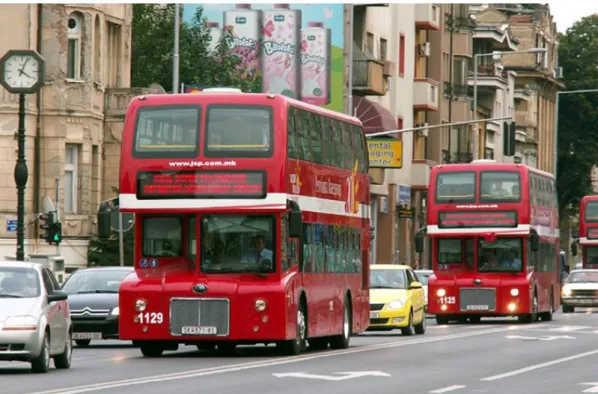
(29) 11. Atanasoski, B. 2017. Traffic policy in Skopje BSc Thesis Ljubljana, UL FGG, First cycle academic study programme Civil Engineering.. Figure 3: Double-decker buses in Skopje (http://macedoniaonline.eu/content/view/31199/45/) Slika 3: Dvonadstropni avtobusi v Skopju (http://macedoniaonline.eu/content/view/31199/45/). The theory in the field of public transport, as well as the practice from the past, shows that the route category used by vehicles of the public transport is of crucial importance to the quality of transport service. The greater the degree of separation between the public transport from the rest of the traffic, the more positive effects on the elements of service quality such as speed and time of travel, waiting time at standpoints, comfort traffic, safety, and regularity of the vehicles is experienced. This allows the passengers to travel and transfer safely, without delay. Still, the existing JSP line in Skopje has not been changed from the last three decades ago. While the transport infrastructure in Skopje has not changed, the capital is experiencing a big transformation on other fields. Upgrade of existing neighborhoods, construction of new ones, construction of new industrial zones and destroying of the old ones are just a few of the latest changes in Skopje. All of this resulted in changing of the passenger travel network and a creation of a need to change the existing lines network. Analyzes says that certain parts of Skopje are not connected with direct lines. Such is the case with the connection of neighborhoods of Kisela Voda with Aerodrom, Gjorche Petrov with Butel etc. Skopje has considered the situation and has already taken steps to introduce a higher transport capacity, regularity and well timing of buses (following the timelines). If Skopje wants to ensure a quality in the public transport system in the future it must provide a B route category (fast tram). The provision of the fast tram will require a reorganization of the public transport in Skopje. The fast tram will connect the main transport corridors of the Skopje ( Butel – Kapishtec ) and ( Gjorce Petrov Lisiche) while buses will servicing the parts of Skopje not covered by tram..
(30) 12. Atanasoski, B. 2017. Traffic policy in Skopje BSc Thesis Ljubljana, UL FGG, First cycle academic study programme Civil Engineering. 4.1.2 Separeted bus lines A bus lane or bus-only lane is a lane restricted to buses and generally used to speed up public transport. Bus lanes are a key component of a high-quality bus rapid transit (BRT) network, improving bus travel speeds and reliability by reducing delay caused by other traffic. A dedicated bus lane may occupy only part of a road which also has lanes serving general automotive traffic. Busway describes a road completely dedicated for use by buses.. Figure 4: Bus is stopping on a bus station in the separete bus line (http://www.infrastructureontario.ca/York-Viva-Bus-Rapid-Transit-Expansion/) Slika 4: Avtobus se ustavi na avtobusni postaji v ločeni avtobusni liniji (http://www.infrastructureontario.ca/York-Viva-Bus-Rapid-Transit-Expansion/. Bus rapid transit (BRT, BRTS, busway, transitway) is a bus-based public transport system designed to improve capacity and reliability relative to a conventional bus system. Typically, a BRT system includes roadway that is dedicated to buses and gives priority to buses at intersections where buses may interact with other traffic. BRT aims to combine the capacity and speed of a metro with the flexibility, lower cost, and simplicity of a bus system. The first BRT system was the Rede Integrada de Transporte ('Integrated Transportation Network') in Curitiba, Brazil in 1974. This inspired many similar systems in Brazil and around the world, so according to this maybe it will be a great idea if this BRT system is applied in Skopje like one of the ways of improving the traffic policy..
(31) 13. Atanasoski, B. 2017. Traffic policy in Skopje BSc Thesis Ljubljana, UL FGG, First cycle academic study programme Civil Engineering.. Figure 5 Bus Rapid Transfer station in Curitiba's Linha Verde, Brazil (http://citiscope.org/citisignals/2014/bus-rapid-transit-expands-180-cities) Slika 5: Bus Rapid Transfer-postaja v Curitiba's Linha Verde, Brazil (http://citiscope.org/citisignals/2014/bus-rapid-transit-expands-180-cities). To allow transit intersections, bus lines may have separate sets of dedicated traffic signals. Peak-only bus lanes are enforced only at certain times of the day, usually during rush hour, reverting to parking a general purpose or parking lane at other times. Peak-only bus lanes may be in effect only in the main direction of travel, such as towards a downtown during morning rush hour traffic, with the buses using general purpose lanes in the other direction. Bus lines are giving priority to buses, by cutting down the journey times on roads that are congested with other traffic and so are increasing the certainty of buses. Also, an introduction of bus lines can importantly help in the reduction of air pollution. By marking bus lines with colored pavement, there is reducing intrusions into bus lines, speeding travel time and increasing of bus reliability.[4] 4.1.3 Systems for location of public transport vehicles Today's GPS systems enable tracking in real time of every vehicle of the public transport. This makes a lot of advantages for the passengers and transporters. Transporters can follow the realization of timetables, can quickly intervene in the case of some irregularities and can increase their driving personnel's discipline. And for the passengers is more useful because they get real time information for the next vehicle arriving. This system of an automatic location of public transport vehicles can increase the quality of the public transport in Skopje. A passenger information system is an electronic system which shares real-time information. It may include both information about arrival and departure times, as well as information about the nature and.
(32) 14. Atanasoski, B. 2017. Traffic policy in Skopje BSc Thesis Ljubljana, UL FGG, First cycle academic study programme Civil Engineering. causes of disruptions. Information could be delivered from the touch screen kiosk for self-service, LED displays and screens inside the stations. This information can be delivered not only to standpoints through digital informational panels, but also through the Internet, mobile applications, public television etc. This means that all information for the current timetable of all public transport lines can be available not only on the standpoints but also at home, work or anywhere the interested user is located currently. [5]. Figure 6: LED information display at Düsseldorf Hauptbahnhof Slika 6: LED informaciskij prikaz v Düsseldorf Hauptbahnhof. 4.1.4 Fire collection systems An automated fare collection (AFC) system is the collection of components that automate the ticketing system of a public transportation network - an automated version of manual fare collection. An AFC system is usually the basis for integrated ticketing. It may be used as intelligent cards that can memorize data and can be recharged with monetary value. Those cards are becoming more and more widespread. Passengers could collect fares only in two ways - before they get into the vehicle or once they are on the vehicle. It must be remembered that if there is a way for fares not to be paid, they will not be paid. The method often adopted is to collect fares on trains but this may not be effective for high capacity trains with short distances between stations. In this case, the simplest and most effective method is to collect fares before trains are boarded on the barrier gates. This is best realized by automatic fare collection (AFC)..
(33) 15. Atanasoski, B. 2017. Traffic policy in Skopje BSc Thesis Ljubljana, UL FGG, First cycle academic study programme Civil Engineering.. Figure 7: AFC barrier gates at Southern Cross Station in the Melbourne Metcard AFC System (https://en.wikipedia.org/wiki/Automated_fare_collection) Slika 7: AFC pregradna vrata na južni Cross Station v sistemu Melbourne Metcard AFC (https://en.wikipedia.org/wiki/Automated_fare_collection. Tickets are sold from manned ticket offices or Ticket vending machines (TMV) strategically positioned around the station entrances. The location of TVMs is important so that they could be easily seen. TVMs should not be placed close to escalators, stairs or doorways but they should be within sight of the ticket office staff so that any occurring problems can be dealt with quickly and easily. With the intelligent cards, after paying once, the passengers will not have to pay for the next two hours regardless of the number of transport changes in those two hours. [6]. Figure 8: Ticket validator and inteligent card in LPP-Ljubljanski Potniški Promet (https://www.had.si/blog/2009/09/02/urbana-ljubljana-enotna-mestna-kartica/#jp-carousel-13395) Slika 8: Validator vstopnic in pametna kartica v LPP-Ljubljanski Potniški Promet (https://www.had.si/blog/2009/09/02/urbana-ljubljana-enotna-mestna-kartica/#jp-carousel-13395).
(34) 16. Atanasoski, B. 2017. Traffic policy in Skopje BSc Thesis Ljubljana, UL FGG, First cycle academic study programme Civil Engineering.. Figure 9. Charging of the Inteligent Cards at Urbanomat at Konzorcij-Ljubljana Slika 9: Polnjenje inteligentne kartice na Urbanomatu Konzorcij-Ljubljana. 4.1.5 Effective promotion campaign of public transport in Skopje Parallel with the rise of the living standard in Skopje, the number of passengers-car traffic increases as well. This results with insufficient capacity of the road network, relating it to environmental issues occurring in the city. To improve this situation, few steps can be made and one of them is to increase the number of public transport users. To provide a sustainable development in the city, it's essential to show and present the benefits of public transport effectively and promote its services to influence the modal split in favor of public transportation. The proper functioning of the public transport, with appropriately promotion and improvement of it, is of huge interest for all state institutions. Public Transport promotion has aims that include strengthening its image, supporting the good image of PT and attracting passengers. The necessary precondition for effective promotion campaign is cooperation of the city institutions with the public transport operator. Public transport promotions include several basic aims: • • • • • •. Attracting new passengers and keeping the existing ones; Bring out the advantages of Public Transport in comparison to individual motor transport; Improvement of provision of information about transport services; Improving the approach of the services, by enabling information to passengers; Supplying favorable services, such as time coupons and SMS tickets; Increasing the awareness in the city about the Public Transport.. For more attractive Public Transport, basic improvements can be also made by information brochures and other sources of comprehensive data about the services of PT, free Wi-Fi connection in vehicles for users of PT, etc. [7].
(35) 17. Atanasoski, B. 2017. Traffic policy in Skopje BSc Thesis Ljubljana, UL FGG, First cycle academic study programme Civil Engineering. 4.2 Recommendations for improving the bicycle traffic in Skopje If there is a well-designed and well-constructed bicycle infrastructure, with the implementation of campaigns for the advantages of using a bicycle as a means of urban transport, the bicycle traffic can play a very significant role in the construction of a sustainable urban transport system. Skopje, as a flatland city with favorable climate conditions, could and should exploit the immense advantages of the bicycle as a means of transport. By giving more attention to the bicycle traffic in Skopje and greater construction in the bicycle infrastructure, significant results can be noticed. Recommendations of this kind apply to the future superstructure of the bicycle infrastructure with specific measures that will help and inspire the increased bicycle utilization. These measures need to be applied continuously. 4.2.1 Few recommendations for improvement of the bicycle traffic: 1.. Recommendations for institutional and legal support:. • Amendment of the legal regulation with defining the minimum number of parking spots for bicycles depending on the type of the object, with the goal of the compulsory planning of parking spots for bicycles. • Strengthening the institutional framework for bicycle traffic through the creation of a team for bicycle traffic within the traffic department. 2. Recommendations for superstructure of the bicycle infrastructure (lines, pathways, parking spots, signalization) •. Planning of bicycle traffic separated from the rest of the traffic.. • Planning of bicycle lanes along the streets of the primary and secondary traffic networks in the urban plans. • Securing a good access to all urban areas by bicycle-superstructure on the bicycle lane/pathway network. Connecting the northern with the eastern part of the city with a bicycle lane, a superstructure of the recreational path on the left side of the Vardar River, providing continuity of the bicycle lanes. •. Increasing the number of bicycle parking spots.. •. The introduction of Bike Stop & Go points.. Figure 10: Separate bycicle truck in Milano Slika 10: Ločena kolesarska pot v Milano.
(36) 18. Atanasoski, B. 2017. Traffic policy in Skopje BSc Thesis Ljubljana, UL FGG, First cycle academic study programme Civil Engineering.. Figure 11: The look of the bicycle path and pedestrian walk in Amsterdam Slika 11: Videž kolesarske poti in sprehod za pešce v Amsterdamu. 3.. Recommendations for integrating the bicycle traffic with the other types of traffic:. • Implementation of a bicycle station within the transport center equipped with a system for renting bicycles and urban equipment for parking bicycles. • Setting up urban equipment for parking bicycles on terminals and standpoints of the public passenger transport. • Protection of bicycle lines. 4.. Extension of the system for renting bicycles. •. Implementation of a system for intelligent collection and for automatic bicycle rent.. •. Increasing the number of bicycle rent points.. •. Increasing the number of bicycles for rent..
(37) 19. Atanasoski, B. 2017. Traffic policy in Skopje BSc Thesis Ljubljana, UL FGG, First cycle academic study programme Civil Engineering.. Figure 12: Old bicycle rent point-Skopje (https://www.visitskopje.mk/museums/57-rent-a-bike-to-fully-enjoy-skopje) Slika 12: Stara postaja izposoja koles v Skopju (https://www.visitskopje.mk/museums/57-rent-a-bike-to-fully-enjoy-skopje). 5.. Protection and maintenance of bicycle surfaces. •. Protection of bicycle surfaces from their usurpation by motorized vehicles.. •. Reconstruction and regular maintenance of bicycle surfaces.. •. Marking the bicycle surfaces with horizontal and vertical signalization.. • Substituting the pedestrian lanterns with combined (pedestrian-bicycle) lanterns on places of both pedestrian and bicycle passages.. 6.. Public campaigns for promoting the bicycle traffic. •. Preparing campaigns for using bicycles as a means of transport.. •. Organizing events (workshops, festivals etc.) for bicycle traffic.. •. The introduction of a tourist sightseeing route in Skopje tourist points.. •. Preparation of a tourist map with bicycle lanes and information of tourist points.. • Setting up of information panels with maps of bicycle lanes and information for the tourist points.[8].
(38) 20. Atanasoski, B. 2017. Traffic policy in Skopje BSc Thesis Ljubljana, UL FGG, First cycle academic study programme Civil Engineering.. Figure 13: Plan for bicycle utilization in Skopje Slika 13: Načrt uporabe koles v Skopju. A good example to follow is the one in Ljubljana. It is near us, and it’s also in the European Union. Bicycle rental system BicikeLJ with numerous infrastructural improvements and other measures has greatly contributed to the rise of cycling in the city. Due to improvements made in the area of cycling, it is the first time that Ljubljana made it onto the list of 20 Most Bike-Friendly Cities on the Planet, ranking at the high 13th place. In May 2011, in a public-private partnership with the company Europlakat, Ljubljana introduced the city bike in the self-service rental system BicikeLJ with 31 stations and 300 bicycles. By the end of 2016, the system included 38 stations and 380 bicycles and it recorded 3.8 million rides by its users. The first half-hour of use is free which contributed to the rising popularity of the system and with it the increase in the cycling share. At the beginning of 2017 the network expanded to include additional 13 stations, and by the end of the year, 6 more stations are to be set up. The bicycles in the system can be rented upon prior registration using the uniform city card Urbana.. Figure 142: BicikeLJ rent a bike-Ljubljana (http://www.inljubljana.com/ljubljana-bike-rental/) Slika 14: BicikeLJ najem koles-Ljubljana (http://www.inljubljana.com/ljubljana-bike-rental/).
(39) 21. Atanasoski, B. 2017. Traffic policy in Skopje BSc Thesis Ljubljana, UL FGG, First cycle academic study programme Civil Engineering. 4.2.2 How does it work? The BicikeLJ system consists of 380 bikes and 38 stations, 300 to 500m away from each other. The stations are equipped with an automatic rental terminal for locking and unlocking approximately 20 bicycles each. The first 60 minutes of bike rental is free. After the first 60 minutes, the hour rental rate for total hours beyond the first 60 minutes is debited from the user’s bank account. However, bikes can be rented for free longer than one-hour “serially” during a day if a minimum of five minutes has passed between the two free rides. The total number of free rides over the period of users subscription is unlimited. Short-term subscribers, such as tourists, pay only €1 for a one-line registration that is valid for one week. If the bike is not returned within 24 hours, the €350 deposit will be debited. Annual subscribers can rent the bikes over a one-year period for just €3 and are able to use the system with their Urbana public transit smart card and personal identification number. [9]. Figure 15: Urbanomat (rent a bike automat in Ljubljana) (http://www.inljubljana.com/ljubljana-bike-rental/) Slika 15: Urbanomat (avtomat za najem kolesa v Ljubljani) (http://www.inljubljana.com/ljubljana-bike-rental/). The thematic cycling paths were designed in cooperation with the City of Ljubljana, by the association For a City on Two. This was done within the framework of the Do the Right Mix campaign, where Ljubljana Tourism also made its contribution by providing path markings. The aim of the thematic cycling paths is to set up attractive cycling paths between different parts of Ljubljana on less congested streets for daily journeys made by bicycles. At the same time, these paths represent an extension of what Ljubljana has to offer to its visitors who can go on a bike ride to experience Plečnik’s architecture, the beauty of the Ljubljanica River or the green wedges of the city. In 2014 the Waterside Path was marked, first of the four thematic cycling paths. It winds alongside Ljubljanica and intertwines urban environment with nature. It runs from the Fužine Castle on the embankments of Ljubljanica through Štepanjsko naselje and Kodeljevo district, through the city center (Petkovšek Embankment, Prešern Square, Congress Square and New Square) and ends at the Špica embankment. In 2015 the idea expanded to include the Plečnik Path, which connects Plečnik’s heritage in Trnovo, Žale and Tivoli, and the Forest Path around the foot of Rožnik Hill connecting Tivoli Park with Mostec Park. The fourth path, which has been popular among cyclist for a long time, is the gravel path around Ljubljana, lined with trees, namely, the Path of Remembrance and Comradeship..
Gambar

+7


Dokumen terkait
siswa sebagai akibat dari proses belajar pada fase ini guru dapat mengajukan. pertanyaan terbuka yang dapat dijawab dengan menggunakan lembar
2 Walgito, Bimo, Pengantar Psikologi Umum, (Yogyakarta: ANDI.. diidentikkan perubahan dalam diri seseorang. Kalau tangan seorang anak menjadi bengkok karena keadaan
Menghubungkan antara masalah apa saja yang mungkin terjadi dengan kemajemukan bangsa Indonesia, wilayah Indonesia yang berupa kepulauan yang 2/3 luas wilayahnya
Meningkatnya nilai tukar rupiah dari suatu mata uang asing, dalam hal ini Dollar AS terhadap Rupiah, dapat mengakibatkan masyarakat lebih ingin untuk
Sukses Sablon adalah sebuah percetakan atau advertising dengan banyak customer dan berbagai macam produksi, untuk pengembangan pelayanan customer yang lebih baik, terintegrasi,
of the textbooks used by English teachers for the tenth grade of MAN Model of Palangka Raya based on Education National Standard Council (BSNP).
Apalagi banyak penelitian yang menunjukkan adanya hubungan yang positif antara etika bisnis dengan kinerja perusahaan. Dengan demikian, penting bagi dunia bisnis
The main signs are that the colony is more irritable than usual, the bees seem to be less well-organized on the combs, very few brood cells will be polished up ready for the queen
