Hybrid Rule Threshold Adjustment System for
Abstract—Generally, multiple IDSs generates huge volume of alerts every minute and to manage these alerts, rule-based alert management systems are very important. It is critical to keep the rules inside these systems updated, based on the ever changing network environment. Rule Threshold Adjustment is the solution to this problem and it is able to keep the rules updated. Rule Threshold Adjustment tunes the internal thresholds and keeps the structure unchanged. In this paper, we propose a hybrid threshold Adjustment framework by combining both the online and offline adjustment module together. This hybrid adjustment will be more robust and efficient in adjustment the threshold in real time and to keep the threshold fine-adjusted. The online module should work in real time to adjust the thresholds, whereas the offline module will be using some parts of the recent alerts to adjust the thresholds. We have implemented this method and evaluated it using real-world datasets. Our approach was successfully able to adjust the rules in all the cases with marginal error.
Keywords- Hybrid Rule Threshold Adjustment, Intrusion Detection, Rule-based System
I. INTRODUCTION
Continuously increasing volume of security data generated by different security tools such as Intrusion Detection Systems, Firewalls, Antivirus utilities and File Integrity Checkers makes the manual security status analysis a time consuming and error prone task for the administrator. Thus, an automatic higher level analysis of low-level security alerts is required in order to provide a big picture of the security status of the network. This analysis can be done by a set of custom rules that can correlate the low-level alerts and generate reports for the security administrator [1], [2].
Furthermore, computer networks gradually change over time. A very small change in the network can affect the behavior of the security devices that are deployed in that network. For example, introducing a new server to the network may cause some of the security devices to generate a large number of alerts. This immoderate number of new alerts may cause the existing rules of the current rule-set to become out of tune. To cope up with this problem, the rule-based alert management system needs to be adapted. This adaptation can be done by adjusting the current existing rules. Generally, two types of automatic adjusting of the rules can be identified. One type can be, adjusting the structure of the rule by modifying the logical conditions inside the rule and/or removing or adding a
part of the rule structure. The other type of adjustment can be done by adjusting the numerical thresholds inside the rule. The first type of adjustment is usually referred as Rule Structure Refinement and the other one can be called Rule Threshold Adjustment.
As discussed in [3] Rule Adjustment in the intrusion detection case, confined to rule threshold adjustment. Rule threshold adjustment attempts to change only the thresholds inside the rule to accommodate network changes and can be breakdown into Online Threshold Adjustment Module and Offline Threshold Adjustment Module.
Online Threshold Adjustment Module detects the network changes and modifies the thresholds of the rule, whereas, Offline Threshold Adjustment Module runs in a repeating manner and looks at the network history of the previous periods to adjust the thresholds. They both have advantages and disadvantages and they complement each other.
The aim of this paper is to develop Hybrid Rule Threshold Adjustment (HRTA) system combining both the online and offline adjustment module. In [3] we proposed a new framework for Online Rule Threshold Adjustment. In this paper we use this framework for Online-part of HRTA. For Offline-Part of HRTA we propose a new framework in section III.
The reminder of this paper is organized as follows: first, we review some related works in automatic rule adjustment and also provide an explanation for rule based system. Next, we propose a framework for offline rule threshold adjustment for offline-part of HRTA. We also develop a new algorithm for the offline-part. Later, we use online and offline framework for development of HRTA and finally, we evaluate the proposed frameworks and the algorithms using different real-world datasets.
II. BACKGROUND
Handling raw alerts generated by different sensors are becoming more important to intrusion detection systems because more sensors with different capabilities are distributed in the network. Higher level management is required for analyzing low-level alerts produced by these devices. Firstly, it is not easy to locate the source or target of the intrusion or fault in the network by looking into the low-level alerts. Secondly, the low-level sensors consider raw alerts in solitude and raise alarms for each of them, without considering logical
connections between alerts. Thirdly, any automatic response would be inefficient with these raw alerts as input. In a typical environment there are a large number of false-positive alerts reported by traditional IDS. Therefore, it appears that there are various problems in managing the raw alerts.
To address the above-mentioned problems, some efforts have been made, in both academic and industrial communities that are referred to as Alert Correlation. The primary goal of alert correlation is to provide system support for a global and condensed view of network attacks by analyzing raw alerts. Alert correlation results in producing rules for the rule-based high level alert management systems. Once these rules are generated by the alert correlation system and deployed in a real network, they stay fixed until the administrator decides that they need to be adjusted to accommodate the changes in the network. But adjusting a large set of rules manually is a difficult and error-prone task. Automatic Rule adjustment intends to do this task.
A. The Rule Set
In a general manner, a rule can be viewed as a logical combination of conditions which if satisfied leads to triggering of actions specified by that rule. Every rule consists of two main parts:
1. The Condition part specifies the condition(s) to be met for the rule to be triggered.
2. The Action part specifies the action(s) to be taken in case the rule is triggered.
The condition part of a rule consists of logical combination of tests that represent the conditions that should be satisfied for the action part of the rule to be triggered. Along with the tests, the conditional part of the rule can include other rules, or rather a conditional part of other rules. Such a rule can be considered as a hierarchy of the conditions to be met that are represented in a form of tests or a conditional part of other rules (Figure 1). A rule test is a Boolean function defined on an input parameter represented in numerical form (e.g. IP address, time period, number of attempts, etc.) or descriptive form (attack type, existence of open/closed port, etc.) with a return value of True or False.
Figure1- Typical Rule Structure
B. Rule Adjustment
1) Rule structure Refinement: One of the first systems for automatic rule refinement is called SEEK was proposed by[4, 5], followed by its extended version, SEEK2 [6]. Both SEEK
and SEEK2 are automatic knowledge-base refinement system and they perform the refinement by adding,deleting, or altering the rule-components in a knowledge base system. Other systems that incorporate rule refinement mechanisms include the systems based on the inductive logicare FOIL [7], GOLEM [8], and SILT [9]. A model based on the neural networks was proposed as TopGen [10], which is an extension of Knowledge-based artificial neural networks (KBANN) [11]. Several models based on case-based reasoning (CBR) logicare proposed by [12], KREFS [13], HTR [14], and EITHER [15]. Another system based on rough set theory is ROSETTA [16]. Several techniques are proposed as general methods for rule optimization and update [17].
2) Rule Threshold Adjustment: The idea of Rule Threshold adjustment is simpler than Rule Structure refinement. The target of threshold adjustment is to find a new set of numerical threshold values for the rules and tests inside a rule-set based While calculating, exceptional cases known as outliers are needed to be handled. In addition, the correlation among the internal rules is also required to be considered.
C. Time Series Analysis
Monitoring the behavior of the generated alerts in a network and detecting the changes can be done using time-series analysis methods. Several time time-series analysis methods evolved since Holt described the exponential moving average [18]. The exponential moving average based methods originated in 1950s and 1960s with the work of Brown[19], Holt [18], and Winters [20]. The methods that are related to this paper and have been studied are the Simple exponential smoothing also known as exponentially weighted moving average (EWMA) [18, 21], Holt-Winters method, and Cumulative Sum (CUSUM) [22] algorithm.
There are many time-series analysis methods which are very efficient in detecting changes of behavior in time-series models. However, a good time-series analysis method adapts itself with the changed behavior of the model. For the same reason, a good time-series analysis method can detect a sharp/sudden change in the model more effectively than a slow/gradual change. As one of the requirements of this paper is to detect both sharp and slow changes in the model, we have developed a new algorithm based on the existing time-series analysis methods.
1) EWMA: The simplest application of an exponentially
time-series curve, which is also known as simple exponential smoothing.
2) CumulativeSum:A cusum control chart is a data
analysis technique for determining if a measurementprocess has gone out of statistical control. Similar to the EWMA control chart, it is better than the standard xbar control chart for detecting smallshifts in the process mean.[22]
D. Concluding Remarks
All the methods that we have discussed in this section have one common problem that is they all are very general solutions to rule Adjustment. To be more specific, these methods try to adjust the rule by means of altering the rule structure and the numeric thresholds inside the rules. But in our case, we need a very specific solution which will be able to adjust only the thresholds, because the rules that we have are generated based on the expert knowledge. These rules are very specific to each certain attacks or misconfigurations in the network. The thresholds inside the rules are the only part that might vary in different networks. So far, none of the methods address this issue. To address the above mentioned problem, we need to design a new system which will be able to adjust the thresholds inside the rules based on the current environment of the network. The following section is used to develop a new system to address the problem of rule threshold adjustment based on the network environments.
III. PROPOSED FRAMEWORK
A. Offline Rule Threshold Adjustment
Generally, the initial values of the test thresholds are determined by the administrator based on the initial system configuration, security policy, usual network traffic characteristics, and administrator‘s past experience. As this process is tedious, error-prone, and time-consuming, the administrator often relies on the default values setup for the whole set of rules. Although the default rule-set simplify the system configuration process, it presents a generalized case, which often leads to a situation when a significant number of events satisfy the default rules. To avoid administrator overloading, the default values of the test thresholds require additional adjustment which traditionally is done manually.
In this work, we propose an approach to automatic adjustment of the test thresholds of the default rule-set according to the behavior of the network environment. The primary goal of this adjustment is to adjust test‘s thresholds in a way that would allow achieving an optimal number of the events satisfying the rules and as a result an optimal number of rule firing is triggered on the basis of these events. This process will work offline on historic data. In addition to initial threshold setup, it can be used periodically to refine the thresholds adjusted by the online rule adjustment.
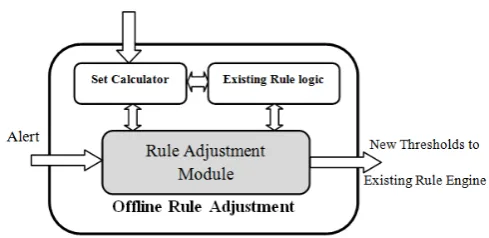
Our proposed framework for offline rule Adjustment is shown in figure 2. It consists of three main components. Firstly, set calculator calculates the event sets for each rule and test from the rule hierarchy and event database. Secondly, the existing rule logic holds the rule hierarchy that we are going to
adjust. Thirdly, the rule adjustment module holds our algorithm for offline rule adjustment which uses the set calculator to calculate the event sets after each threshold adjustments.
1) The Set Calculator: The rule hierarchy consists of the
intermediate nodes that represent the rules and the leaf nodes that represent individual tests. Here, the root node of the hierarchy denotes the higher level rule that aggregates data satisfying the lower level rules and tests. As a result of aggregation new alerts are generated. Now, each node in the hierarchy is annotated with a logical AND or OR condition that specifies the relations between node‘s children. Rules are organized in a hierarchical fashion. The example of such hierarchical structure is shown in Figure 1.
Generally, an OR condition between the nodes indicate that the parent node inherits the number of events resulting from all children nodes, i.e., the union of the children‘s sets (Figure 3). An AND condition gives the parent node at most the smallest event set of any of the children, or in other words, the set that represents an intersection among children‘s sets (Figure 3). Thus, relying on the logical condition between nodes in the hierarchy allows inferring an approximate number of firing at the root node. The conditions of the rule hierarchy traversal are described in Figure 4.
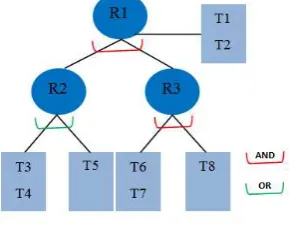
Figure 5, gives a clear view of the rule structure. Here, R1 is the root that has two children and two thresholds T1 and T2. When we are going to adjust this rule structure based on a target optimal firing of the root (R1), we will start adjustment from the leaf nodes of the tree. Since, R2 and R3 are as ‗AND‘ under R1, we will look for the rule which has the smallest number of firings for the alert-set because if we adjust the smaller set, it will affect the number of firing in the parent node with more probability.
Figure 2. Offline Rule Threshold Adjustment Framework
For each branch of the node we choose a sub-tree to adjust based on the number of events at each node according to the following conditions:
If a branch has OR condirion:
adjust the node with the largest set until:
the sub-tree rooted at this node is no longer the largest OR
the final result is smaller or equal to an optimal number of firing at the root
if a branch has AND condition:
adjust the node with the smallest set until: the sub-tree rooted at this node is no longer the smallest OR
the final result is smaller or equal to an optimal number of firing at the root
Figure 4.Algorithm for Offline Rule Adjustment.
If we find R2 has the smaller set of firing, we will look for the largest number of firing between its children nodes because it‘s children are as ‗OR‘ under R2. We will choose the largest set for the adjustment because it is more probable that adjustment the largest set will affect the set at the parent node.
Figure 5. Example of Rule Structure
2) Offline Threshold Adjustment Algorithm:The formal
algorithms for traversal of the hierarchies based on the depth-first-search(DFS) algorithm are presented in Figure 6. Procedure traversal describes the first traversal of the rule hierarchy to compute the initial number of events satisfying the rule hierarchy. This procedure takes as input, a root node x of the hierarchy and returns the set of events (setOfEvents) satisfying the rule hierarchy. Again, the procedure traverses a rule hierarchy in a manner of DFS algorithm by exploring the full depth of a first found child before proceeding to the next sub-tree. Once a leaf node is reached, the procedure invokes computeSet method that processes the data to retrieve the events mySet satisfying the conditions of the current node x (Lines 12- 13).
The traversal procedure aggregates the final set of events at the root node by computing the initial event sets for all nodes in the rule hierarchy in a bottom-up fashion.At this point, if the final set of root node exceeds the predetermined threshold for optimal number of events for the rule hierarchy, the adjustment procedure is invoked to find the test that should be adjusted. This is done to adjust that test thresholds and to re-compute the event-sets for nodes in the path from the adjusted
test to the root. Here, the adjustment procedure is invoked repeatedly until the set of root node satisfies the pre determined threshold for the optimal number of events for this hierarchy.
The Adjustment procedure is based on the conditions of the rule hierarchy traversal defined above. At each level the procedure selects the node that is likely to cause the overflow of events at the root node, and therefore, should be adjusted. Thus, if thenode has an AND condition, then the sub-tree rooted in the child with the smallest event set is selected for the adjustment. If the node has an OR condition, then the sub-tree rooted in the child with the largest event set is selected (Lines 5-9).
Lines 10-12 recursively invoke the adjustment procedure on the child node selected forthe adjustment. Once the leaf node is reached the sub-procedure adjustTestThresholds is called to adjust the test thresholds (Lines 14-16). After that the algorithm follows its path back to the root node while recomputing the event sets for all nodes with adjustable conditionsin the path from the adjusted test to the root (Lines 16-19).
1: setOfEvents traversal (Node x) { 2: serOfEvents mySet, set, staticSet;
B. Online Rule Threshold Adjustment
One of the possible pitfalls in automatic rule adjustment is the nature of the occurring change that can be permanent or reflect a temporal fluctuation of the network traffic. Therefore, it is also necessary to ensure that the occurring change is stable. Once these conditions are satisfied, the test threshold should be adjusted to reflect the amount of occurred change in the network behavior.
The online adjustment receives a stream of alerts, monitors them for detecting changes in the network, and based on the detected changes it adjusts the thresholds inside the corresponding rules keeping the structure intact.
We use Online Rule Threshold Adjustment Framework that proposed in [3] for online-part of HRTA. In this proposed framework test threshold adjustment process is comprised of three steps:
1. Monitor test‘s behavior to detect network changes. 2. Determine whether the change is stable or not. 3. Compute the new threshold.
Figure 7 shows this framework which consists of four separate modules. The outlier detector detects any outlier in the input data. Outliers defined as some alerts which are actually acceptable for the current network and should not be considered for adjusting the rule thresholds; instead, an exception should be added to the current rule-set. The test monitor sub-module monitors all the individual tests of a rule for a change of behavior.
When the test monitor detects some stable change of behavior of one test, the test correlator module calculates the correlations between that test and all other test(s) in that rule. And finally, the rule adjustment sub-module calculates a new set of thresholds for all the tests of that rule.
Figure 7. Online Rule Threshold Adjustment Framework
C. Hybrid Rule Threshold Adjustment (HRTA) Framework Now, we can use Proposed Frameworks for Online and Offline Rule Threshold Adjustment to design a Hybrid Rule Threshold Adjustment System by combining them. This hybrid adjustment system will be more robust and efficient in adjusting the threshold in real time and to keep the threshold fine-adjusted. The online adjustment module part should work in real-time to adjust the thresholds, whereas the offline part will keep the number of threshold firings in a manageable amount for the administrator. The offline part will be using some parts of the recent alerts to adjust the thresholds.
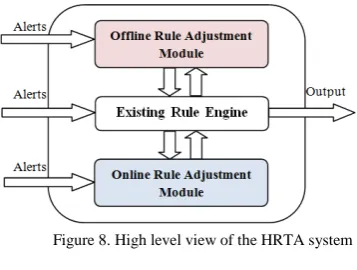
Figure 8 shows our proposed framework for HRTA system. The online and offline rule adjustment modules work
in parallel with the existing rule engine and continuously receive alerts. They also interact with the rule engine and can make changes to the existing thresholds. The online rule adjustment module monitors all the actual values for the current thresholds and adjusts any thresholds that are needed to be adjusted whereas; the offline adjustment module performs analysis of the generated alerts and does the adjustment periodically.
Online adjustment is more memory efficient and fast but prone to small error. On the other hand, offline adjustment is more memory and CPU intensive but more accurate. We propose that both online and offline adjustment module should be used in parallel. The online adjustment module will make sure that the rules are always up-to-date with the network changes and the offline adjustment module will run periodically to fine-adjust the thresholds tuned by the adjustment module and keep the number of alerts generated by the rule-based systems in check.
Figure 8. High level view of the HRTA system
IV. TESTING AND EVALUATION
Testing and Evaluation process for online-part of HRTA has been done in our previous work [3]. But for offline-part we have prepared seven datasets. All of these datasets are composed from real-world network events collected from the internal network security lab of IUT (IUTNET) Using a Well-Known IDS called Snort. Unlike the online rule adjustment module that requires a training period, the offline rule adjustment module does not need any training. Six of the datasets are four hours long and one of the datasets is twenty-four hours long.
As the offline adjustment module does not need any training, we could pick datasets from any parts of our source data. So we randomly picked six chunks of four hours long and a twenty-four hours long dataset for evaluation of the offline – part of HRTA.
A. Testing Process
checked the new set of thresholds and the final number of rule firings on the test dataset, which is twenty-four hours long.
B. Testing Results
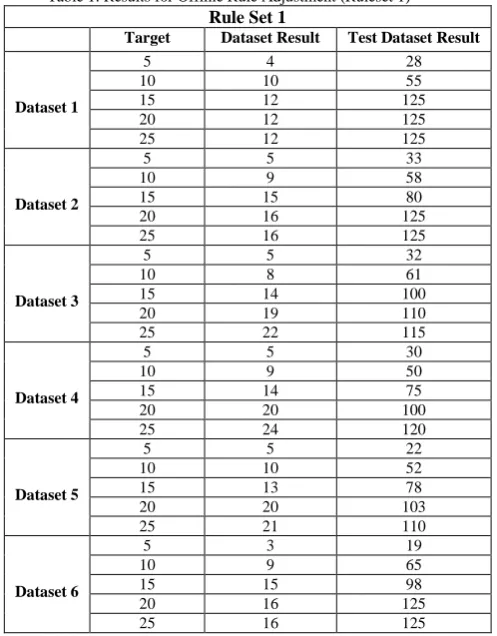
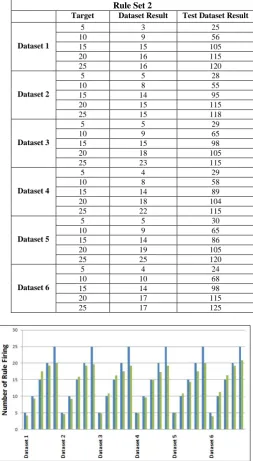
Results for the proposed framework are presented in Table 1 and Table 2 for Rule-set 1 and Rule-set 2 respectively. A chart for each of the rule-set is also presented to show the comparisons between the targets and the test results. Since the test dataset is six times longer than the training datasets, we have divided the test results by six to make the values comparable. Each of the consecutive five bars represent one dataset i.e. the first five bars are for Dataset 1, second five bars are for Dataset 2, and so on.
It is very difficult to make a conclusion by looking at a table in comparison to looking at a chart. If we look at figure 9, which shows the test results in comparison to the target set for the rule adjustment module. In almost every case, the test result closely follows the target except for the 5th target. It can be easily explained why this is the case for the 5th target. This happens because the target was set too high and the dataset does not have enough alerts to make that rule-set fire close to the target even with the lowest thresholds possible.
Table 1. Results for Offline Rule Adjustment (Ruleset 1) Rule Set 1
Target Dataset Result Test Dataset Result
Dataset 1
The results for rule-set 2 are no exception than the results for rule-set 1. Figure 10 clearly shows that the test results closely follow the targets in almost every case. It also has the similar behavior for the 5th target as well.
C. Results Analysis
From the offline adjustment results that we have presented, we can say that offline rule adjustment module works well but the accuracy of the adjustment mostly depends on the dataset. If a dataset lacks a certain type of event, the rule adjustment module will not be able to adjust the threshold that is related to that event.
V. CONCLUSION
Rule threshold adjustment is a new research in the field of Intrusion Detection. A large number of IDSs generates a large volume of alerts every minute and to manage these alerts, rule-based alert management systems are very important. It is also crucial to keep the rules inside these systems updated, based on the ever changing network environment. Rule adjustment is the solution to this problem and it is able to keep the rules updated.
This paper presents a framework for offline rule threshold adjustment and combining it with online framework [3] proposes Hybrid Rule Threshold Adjustment (HRTA) System. The online adjustment module receives a stream of alerts, monitors them for detecting changes in the network, and based on the detected changes it adjusts the thresholds inside the corresponding rules keeping the structure intact. On the other hand, the offline rule adjustment module receives a set of alerts which is used by the offline adjustment module repeatedly, to adjust the thresholds of the rules and to reach an optimal number of rule firing.
Online rule adjustment module will make the tasks of the administrator easier. It is almost impossible for a human being to do the threshold adjustment based on every change in the environment. Since it automatically ignores the outliers, the administrator does not need to specifically adjust the rules to targeted number of firing for a rule-set. Administrators can set a manageable number of targets for different rule-sets and run offline rule adjustment module that will make sure that the number of generated alarms from the rule based system is
manageable for the administrators. Offline rule adjustment module can also be used to fine adjust the thresholds tuned by the online adjustment module. The proposed framework for offline-part of HRTA was implemented and evaluated in several aspects.
Offline threshold adjustment module was successful in adjustment the thresholds. In the experiments it adjusted the thresholds successfully to stay very close to the target number we set.
Table 1. Results for Offline Rule adjustment module (Ruleset 2) Rule Set 2
Target Dataset Result Test Dataset Result
Dataset 1
Figure 10.Results for Offline Rule Adjustment (Ruleset 2- blue:Target, green: Test Dataset result) pattern discovering,‖ International Journal of Network Security, Vol.10, No.2, PP.142-152, Mar. 2010.
[2] Shah Arif Iqbal, Mahbobeh Soleimani and Natalia Stakhanova, ―Automated rule structure refinement‖, Technical Report NSL-TR01-2008, University of NewBrunswick, March 2008.
[3] M.M. Moghimi and M. Saraee, ― A new framework for online rule threshold adjustment in intrusion detection‖, 15th CSI International
symposium on Computer Science and Software Engineering(CSSE2011), Tehran, Iran, 2011.
[4] A. Ginsberg, S. M. Weiss and P. Politakis, "Automatic knowledge base refinement for classification systems," Artif. Intell., vol. 35, pp. 197-226, June. 1988. International Joint Conference on AI, pp. 367-374, 1985.
[7] J. R. Quinlan and R. M. CameronJones, "Induction of Logic Programs: FOIL and Related Systems," New Generation Computing, vol. 13, pp. 287-312, 1995.
[8] S. Muggleton and C. Feng, "Efficient induction of logic programs," in 1st Conference on Algorithmic Learning Theory, pp. 368-381, 1990. [9] D. Opitz and J. Shavlik, "Dynamically Adding Symbolically Meaningful
Nodes to Knowledge-Based Neural Networks," Knowledge-Based Systems, vol. 8, pp. 301-311, 1995.
[10] R. J. Kate, Y. W. Wong, R. Ge and R. J. Mooney, "Learning transformation rules for semantic parsing," University of Texas, Texas, USA, Tech. Rep. 1, April, 2004.
[11] G. G. Towell and J. W. Shavlik, "Knowledge-Based Artificial Neural Networks," Artificial Intelligence, vol. 70, pp. 119-165, 1994. [12] H. Kelbassa, "Optimal case-based refinement of adaptation rule bases
for engineering design," in 5th International Conference on Case-Based Reasoning,pp. 1064-1079, 2003.
[13] S. C. Park, S. Piramuthu and M. J. Shaw, "Dynamic rule refinement in knowledge-based data mining systems," Decision Support Systems, vol. 31, pp. 205-222, June. 2001. Analytical and Empirical Methods," Artificial Intelligence, vol. 66, pp. 273-309, April. 1994.
[17] E. Makosa, "Rule Tuning," Uppsala University, Sweden, pp. 1-51, June. 2005.
[18] C. C. Holt, "Forecasting seasonal and trends by exponentially weighted averages,"International Journal of Forecasting, vol. 20, pp. 5-10, January. 2004.
[19] R. G. Brown, Smoothing, Forecasting and Prediction of Discrete Time Series. , vol.1, Englewood Cliffs, NJ: Printice-Hall, 1963, pp. 468. [20] J. M. Lucas and M. S. Saccucci, "Exponentially weighted moving
average control schemes: properties and enhancements," Technometrics,
vol. 32, pp. 1-12, February.1990.
[21] H. B. Wong, F. F. Gan and T. C. Chang, "Designs of moving average control chart," Journal of Statistical Computation & Simulation, vol. 74, pp. 47-62, January. 2004.
[22] NIST/SEMATECH. (2006, 7/18/2006). NIST/SEMATECH e-handbook of statisticalmethod. 2007(May), pp. 1. Available:http://www.itl.nist.gov/div898/handbook/pmc/section3/pmc32 3.htm