DEWAN REDAKSI
Pengarah : Prof. Dr. Ir. Muhammad Basir, SE., MS. (Rektor UNTAD)
Penanggung Jawab : Drs. Abdullah, MT. (Dekan FMIPA UNTAD)
Editor Utama : I Wayan Sudarsana, Dr. (UNTAD, Matematika)
Editor : Edy Soewanto, Prof., Dr. (ITB, Matematika) Saladin Uttugadewa, Dr. (ITB, Mayematika) Rieske Hadiyanti, Dr. (ITB, Matematika) Wuryansari M.K, Dr. (UB, Matematika) Halmar Halide, Prof., Dr. (UNHAS, Fisika)
Agung Bambang Setyo Utama, Prof., Ph.D. (UGM,Fisika) Rusyidi, Dr. (Untad, Fisika)
Abdul Rauf Patong, Prof., Dr. (UNHAS, Kimia) Mappiratu, Prof., Dr. (UNTAD, Kimia)
Rahman Razak, Dr. (UNTAD, Kimia) Ramadhanil, Prof., Dr. (UNTAD, Biologi) Medi Hendra, Dr. (UNMUL, Biologi) Salni Basir, Dr. (UNSRI, Biologi)
Ibnu Gholib Gandjar, Prof., Dr. (UGM, Farmasi)
Elly Wahyudin, Prof., Dr., Dea, Apt. (UNHAS, Farmasi) Gemini Alam, Prof., Dr., M.Si., Apt. (UNHAS, Farmasi) M. Natsir Djide, Prof., Dr., M.S, Apt. (UNHAS,Farmasi)
Penyunting Naskah : Rina Ratianingsih, M.Si., Dra. Agusman Sahari, S.Si., M.Si. Yuthdam Mudin, M.Si., S.Si. Rais, S.Si., M.Si.
Abd. Rahman Razak, Dr., M.Si. Nurlina Ibrahim, Hj., M.Si., Dra., Apt. Umrah, Dr., M.Si.
Prosiding Seminar Nasional Sains I, 3 – 4 Desember 2012 ISSN: 2338 - 817X
Daftar Isi
ii
DAFTAR ISI
MATEMATIKA
Hasil Kali Silang dari Ruang Peluang Loeb ... 1 Selvy Musdalifah
Senter Manifold dari Sistem Autoparametrik dengan Gaya Luar ... 14 Rina Ratianingsih
Model Dinamik Tingkat Pertumbuhan Biogas Dari Limbah Cair Tempe ... 20 Rina Tratianingsi dan Ririn Nirmala Sari
Perancangan Sistem Pakar Fuzzy Untuk Menentukan Kinerja Dosen Di Perguruan Tinggi ... 26 Mohamad Yazdi
Mengkaji Interaksi Antara Trigliserida dan Metanol pada Proses Pembuatan Biodiesel
Melalui Sistem Dinamik ... 41 Nasria Nacong, Rina Ratianingsi dan Agus Indra Jaya
Usaha Preventif Pembentukan Gosong Pasir di Dasar Sungai Melalui Desain Topografi
Ideal ... 47 Hajar, Rina Ratianingsi, dan Agus Indra Jaya
Mengkaji Alternatif Pengolahan Limbah Padat Kota Palu Berdasarkan Biaya Pengolaan
Optimal ... 54 Dede Arseyani, Rina ratianingsih, dan Agus Indra Jaya
Analisis Tindak Kejahatan Terlapor Di kepolisian Resort Kota Palu dengan
Menggunakan Rancangan Bujur Sangkar Latin (RBSL) ... 63 Annisa Ristiana, Fadjryani, dan Nur’eni
Himpunan Resolving dari Blok Lingkaran pada Graf Kaktus ... 76 Hazrul Iswadi
Kajian Evolusi Topografi Dasar Sungai Melalui Masalah Nilai Awal ... 81 Agus Indra Jaya
Pemodelan Numerik Sirkulasi Arus di Perairan Teluk Palu ... 86 Agusman Sahari
Aproksimasi Perhitungan Integral Dengan Menggunakan Metode Monte Carlo Integration ... 99 Nur’eni
FISIKA
Numerical Analysis of Possibility to Utilize an Asymmetrical Structure in Oscillatroy
Flow for Controling Sediment Transport and Water Quality in Coastal Water Area ... 108 Andi Rusdin, Oshikawa
Hideo
, Hashimoto Akihiro, and Komatsu ToshimitsuIntegrasi Data Triangulated Irregular Network (TIN) dan Model Hidrodinamik Hec-Ras
untuk Penelusuran Banjir di Sungai ... 117 I Gede Tunas, Arody Tanga
The Effect of Power discharge to The Structural Properties of Silicon Thin Film Prepared
By VHF-PECVD Technique ... 128 Ida Usman, Muh. Zamrun F, Toto Winata
Model Hidrodinamika 2 Dimensi Pola Pergerakan Massa air Kepulauan Seribu pada
Musim Barat ... 136 Sabhan
NUMERICAL ANALYSIS OF POSSIBILITY TO UTILIZE AN ASYMMETRICAL STRUCTURE IN OSCILLATROY FLOW FOR CONTROLING SEDIMENT
TRANSPORT AND WATER QUALITY IN COASTAL WATER AREA
Rusdin Andi1, Hideo Oshikawa2, Akihiro Hashimoto2, And Toshimitsu Komatsu2
1
Department of Civil Engineering, Tadulako University, Indonesia, [email protected]
2
Department of Urban and Environmental Engineering, Faculty of Engineering, Kyushu University, Fukuoka, Japan, [email protected]
Abstract
The applicable of asymmetrical structure in oscillatory flow field for sediment transport and water quality controls was examined by analysing the magnitude and direction of periodical average of flow velocity around the structure. The one direction of periodical average of flow velocity can be generated by asymmetrical structure because of the difference resistance between two structure edges. In this study, the periodical average velocity is referred as residual currents and it will be calculated by using numerical method. Vertical two-dimensional numerical simulations based on Reynolds-averaged Navier-Stokes equations (:RANS) and the k-ε turbulent model were performed to examine oscillatory flows around an asymmetrical structure. A quarter cylinder was used as an asymmetrical structure and a half cylindroid was taken as symmetrical structure. The residual currents generated by both structures were compared to know the water circulation pattern that can evoke substance tranport. Various values of Keulegan-Carpenter number (KC) were consider to probe their effect to hydrodynamic forces. It is found that the asymmetrical structure can generate residual currents that flow from the area behind the structure to the other side and cover a large area of the computation domain. In contrast, the symmetrical structure generate two separate residual currents circulation behind and in the front the structure. This study aslo reveals that the increasing of KC number let the hydrodynamic force to decrease. According to this research It seems that the asymmetrical structure shows the potential to transport substances in a relatively longer space.
Prosiding Seminar Nasional Sains I, 3 - 4 Desember 2012 ISSN: 2338 – 817X
Numerical Analysis of Possibility to Utilize an Asymmetrical Structure in Oscillatroy Flow for Controling Sediment Transport and Water Quality in Coastal Water Area
(Andi Rusdin, et al.)
109
INTRODUCTION
Sedimentation and erosion problems which are prevalent require proper and inexpensive prevention methods. In general, coastal protection structures function is to dissipate energy that travel to the shore, therefore the structures was constructed massively and require an expensive budget. The movement of sediment on the beach is affected by ocean currents caused by tides and waves. Hence, by adjusting the current direction, the sediment drift can be can be used to direct the movement of sediment. In addition, water pollution in stagnant sea areas especially in the semi enclosed bay is the main cause of water deterioration because of the lack of water exchange with the open sea. In order to improve bay water quality, it is needed to evoke larger circulation that can trigger water exchange with open sea.
Both problems indicate that substance transport such us sediment and pollutant can be controlled by adjusting the water flow magnitude and direction. In the resent years, several methods have been proposed in order to overcome this problem. Some of them are based on the generation of the water circulation in the wide area by using natural energy such as tides (Komatsu et al., 1997) and waves (Komatsu et al., 2001; Oshikawa et al., 2005; Kawano et al., 2006). Hence, they make it possible to move the water of a stagnant sea area to the open sea. Such methods use structures that have an asymmetrical shape to generate a net flow in one direction under periodical flows.
According to the research conducted by Komatsu et al. (2001), the asymmetrical structures placed under surface gravity waves or inside oscillatory flows can produce a net resistance in a particular direction, resulting in a net flow in the direction which is referred to as the wave-induced residual current. Furthermore, Oshikawa et al. (2003) performed laboratory experiments with a U-tube oscillatory flow to examine the resistance properties of the asymmetrical structures. They used a quarter sphere and a hemisphere to conduct their experiments with different values of the Keulegan-Carpenter number (Keulegan and Carpenter, 1950) for the same value of Reynolds number (Re). Findings of these experiments indicated that a residual hydrodynamic force, which is defined as time averaged hydrodynamic force for one period of an oscillatory flow, can be generated by the quarter sphere. Moreover, Oshikawa and Komatsu (2007) carried out numerical simulations by means of three-dimensional DNS (: Direct Numerical Simulation) to investigate the hydrodynamic forces and the velocity distributions influenced by an asymmetrical structure and a symmetrical structure. From the results of the experiments and the simulations, they found that the residual hydrodynamic forces decrease with the increasing of KC, however, only three values of KC that were used seem to be insufficient to clearly understand the effects of KC on the residual hydrodynamics forces. In the simulations, they also applied different values of Re for the same values of KC and found that there was no significant change in the hydrodynamic force regarding the increase of Re. Their simulation
results also showed that the asymmetrical structures were able to generate the residual currents. However, they could not determine the effects of KC number on the magnitude of the residual currents.
The aim of the present work is to examine the effects of an asymmetrical structure in oscillatory flows on the generation of the residual currents based on numerical simulations. The hydrodynamic forces acting on an asymmetrical structure and a symmetrical structure are investigated. The simulations are performed for various KC to determine the effect of the KC on residual currents around the asymmetrical structure. In addition, the flow patterns around the asymmetrical structure are compared with the symmetrical structure in order to ascertain the substance transport potential by the residual currents.
MATHEMATICAL FORMULATION
The oscillatory flow around a structure is resolved based on the vertical two-dimensional Reynolds-averaged Navier-Stokes (:RANS) equations with a turbulent closure model. The equations for an incompressible flow can be expressed as follows (i and j = 1, 2):
0 = ∂ ∂ i i x u (1) ∂ ∂ ∂ ∂ + ∂ ∂ − = ∂ ∂ + ∂ ∂ j i e j i j i j i x u x x p x u u t u ν ρ 1 (2) t e ν ν ν = + (3)
where ui is the velocity, p is the pressure, ρ is the density of fluid, υ is the coefficient of kinematic viscosity, and υt is the coefficient of kinematic eddy viscosity. The eddy viscosity is calculated by applying k-ε turbulent model. The turbulent kinematic energy k and the dissipation of turbulent kinematic energy ε are determined from the following equations:
ε σ ν ν + − ∂ ∂ + ∂ ∂ = ∂ ∂ + ∂ ∂ k i k t i i i P x k x x k u t k (5) k C k P C x x x u t k t i i i 2 2 1 ε ε ε σ ν ν ε ε ε ε ε − + ∂ ∂ + ∂ ∂ = ∂ ∂ + ∂ ∂ (6)
Prosiding Seminar Nasional Sains I, 3 - 4 Desember 2012 ISSN: 2338 – 817X
Numerical Analysis of Possibility to Utilize an Asymmetrical Structure in Oscillatroy Flow for Controling Sediment Transport and Water Quality in Coastal Water Area
(Andi Rusdin, et al.)
111 2 2 1 ∂ ∂ + ∂ ∂ = i j j i t k x u x u P υ (7)
where the values of empirical constants used are Cµ = 0.09, Cε1 = 1.44, Cε2 = 1.92, σk = 1.0, σε = 1.3.
The governing equations are discretized by means of the finite-difference method and written in the Cartesian-staggered grid based on a code developed by Isobe at al. (1999). In addition, the donor scheme is adopted to calculate the advection terms; the second-order central difference scheme is applied for the diffusion terms; and the forward scheme is used for the pressure term. Time integration of these equations is resolved by using the Euler method.
COMPUTATIONAL CONDITIONS
The numerical simulations were performed under the same conditions of the laboratory tests by Oshikawa et al. (2003). They were conducted in oscillatory flow fields in a closed water tank with a structure placed on the bottom at the middle of the tank. In these experiments, the structures used were a quarter sphere as an asymmetrical structure and a hemisphere as a symmetrical one. Even though both of the shapes had 5.0cm of the radius, the longitudinal lengths of the structures were different. In other words, the x-directional representative length of the quarter sphere was D=5.0cm and the hemisphere was 2D=10.0cm.
In the present work, the simulations are carried out for a Reynolds number Re (=UoL/υ) which is equal to 27000 with various kinds of KC (=UoT/L). Uo donates the amplitude of the x-directional velocity at the water surface of the oscillatory flow, T is an oscillatory period, and L indicates a representative length scale.
COMPUTATIONAL DOMAIN AND BOUNDARY CONDITIONS
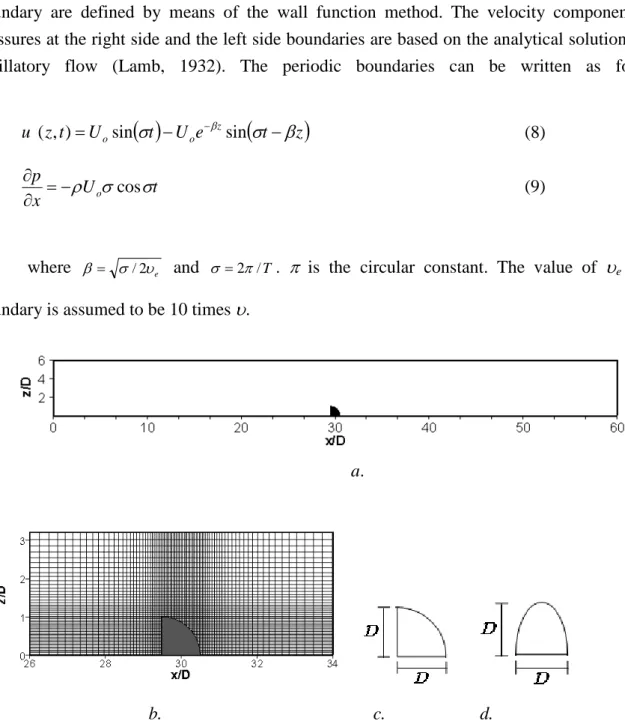
The computational domain is 300.0cm long and 30.0cm high, namely 60D × 6D (see Fig. 1a). The numerical grid used in our calculations is a stretched rectangular grid. The grid size within the structure and at the first grid near the wall boundaries is D/25 (2.0mm). The criteria of grid stretching is restricted to 0.9 ≤ ∆xi/∆xi-1, ∆zi/∆zi-1≤ 1.1 in order to suppress the influence of grid stretching. In the x-direction the maximum stretching is bounded to the maximum value of 2.5cm. Fig. 1b shows a part of the computational grid for the case of the quarter cylinder.
At the top of the computational domain, the free slip boundary is set for the flow velocity, and the condition in which the normal gradient equals zero is used for the pressure, k and ε. For the fixed boundary, the standard logarithmic law is applied for velocities and a zero normal
gradient is used to determine the pressure. The boundary conditions of k and ε at the fixed boundary are defined by means of the wall function method. The velocity components and pressures at the right side and the left side boundaries are based on the analytical solution for an oscillatory flow (Lamb, 1932). The periodic boundaries can be written as follows:
( )
t U e(
t z)
U t z u ( , )= osinσ − o −βzsinσ −β (8) t U x p oσ σ ρ cos − = ∂ ∂ (9)where β = σ/2υe and σ =2π/T. π is the circular constant. The value of υe at the boundary is assumed to be 10 times υ.
a.
b. c. d.
Fig. 1. Computational domain and structure shapes; a. the condition of
computational domain; b. A section of the computational grid for the quarter cylinder; c. Quarter cylinder; d. Half cylindroid.
Prosiding Seminar Nasional Sains I, 3 - 4 Desember 2012 ISSN: 2338 – 817X
Numerical Analysis of Possibility to Utilize an Asymmetrical Structure in Oscillatroy Flow for Controling Sediment Transport and Water Quality in Coastal Water Area
(Andi Rusdin, et al.)
113
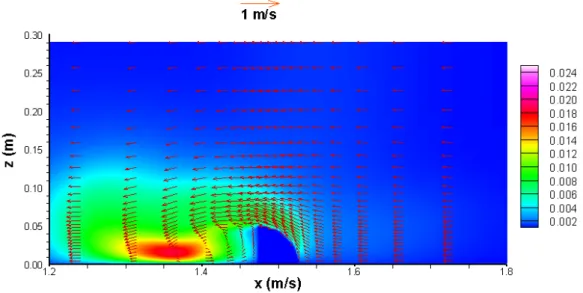
Fig. 2. Velocity and turbulence kenetic energy around asymmetrical structure.
RESULTS AND DISCUSSION
The simulations of the oscillatory flow around the asymmetrical and symmetrical structures were performed in order to show their effects on the generation of the residual currents. Our research examines the quantity of the differences of the calculations among the various shapes of the structures and the various values of KC-number. Fig. 2 indicates the velocity and turbulence kenetic energy distributions. The values of turbulence kenetc energy around the structure are larger and the velocity magnitudes become larger as the flow approaching the structure.
Hydrodynamic Force
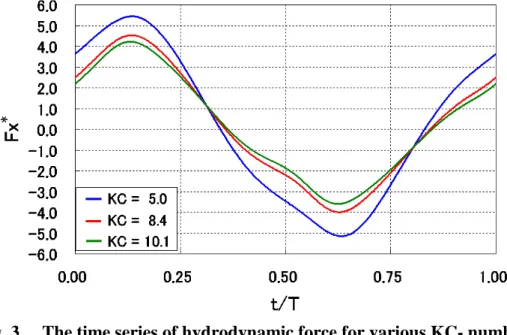
The effect of the KC value on the hydrodynamic force is shown in Fig. 3. This figure shows Fx* of the computational results for three kinds of KC number, i.e. 5.0, 8.4, and 10.1. The simulations reveal that the variation of KC does not change the phases of Fx*. It also shows that the smaller value of KC creates larger Fx. The hydrodynamic force consists of the inertia force and the drag force, which are the function of KC and Re (Summer and Fredsøe, 1999). Therefore, the variation of Fx* depends on the combination of the KC and Re magnitudes. Generally, waves generated by winds are short-period waves, namely short waves. In the situation where the short waves pass a structure, KC number is small. For the small value of KC (0 < KC ≤ 20 – 30), the inertia component is relatively larger than the drag component (Summer and Fredsøe, 1999). As for this phenomenon, the increasing of Fx* with the decreasing of KC corresponds to the rising of inertia force.
Residual Current
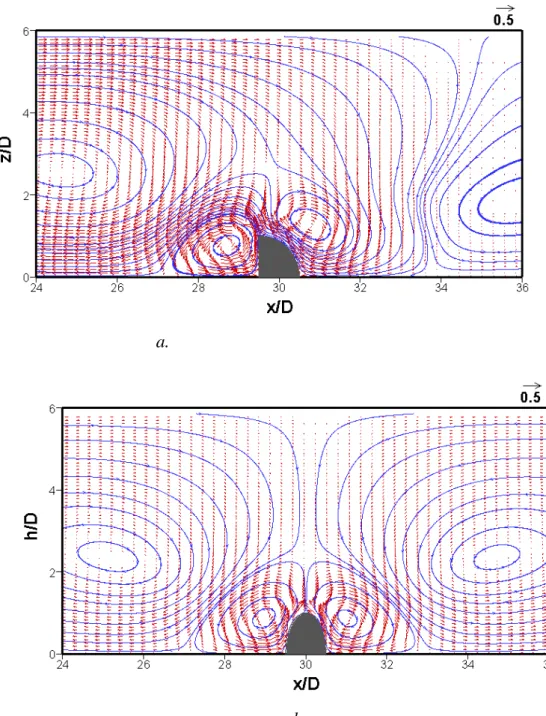
The substance transport such as pollutants and sediments transport is affected greatly by the water movement. The distance and the movement direction of the substance transported in the water are strongly affected by the magnitude and the direction of the flow. Therefore, it is important to understand clearly the flow pattern of the residual currents around the asymmetrical structure. Fig. 4 illustrates the dimensionless velocity vector of the residual currents around a quarter cylinder and a half cylindroid for KC=5. The residual currents were determined by averaging the velocity for one period of the oscillation time, and these currents were normalized by Uo.
In Fig. 4a, the asymmetrical structure shows the potential to transport substances in a relatively longer space. The residual currents are generated by the asymmetrical structure near the bottom (0 < z/D ≤ 2) and flow in a relatively large area (x/D≤34). In the area near to the top boundary, the positive x-directional currents are created as compensated flows of the bottom residual currents. In contrast, the symmetrical structure is not able to encourage substance transport (see Fig. 4b). The residual currents are symmetrical and only flow in two small separate areas at the right and the left side of the structure.
Prosiding Seminar Nasional Sains I, 3 - 4 Desember 2012 ISSN: 2338 – 817X
Numerical Analysis of Possibility to Utilize an Asymmetrical Structure in Oscillatroy Flow for Controling Sediment Transport and Water Quality in Coastal Water Area
(Andi Rusdin, et al.)
115 a.
b.
Fig. 4. The non-dimensional velocity vectors and streamlines of the residual currents for KC=5; a. Quarter cylinder; b. Half cylindroid.
CONCLUSIONS
The findings reveal that the asymmetrical structures in oscillatory flow field can produce the residual hydrodynamic forces and the residual currents around the structures. The hydrodynamic force generated by the asymmetrical structure seems to increase with the decreasing of KC. The rise of this force is manly due to the increase of the inertia force which is
greater than the drag force in the low KC number. The circulation of residual currents around the asymmetrical structure covers the domain area. In other hand, the symmetrical structure provokes two separate residual current circulations at the left and right side of the computational domain. The wave orbital velocity in the sea can be categorized as an oscillatory flow. The findings indicate that asymmetrical structures below waves can be used for controling sediment transport and water quality at the coastal water by generating residual currents that flow in certaian direction. However, further research is necessary to study the effect of the Reynolds number (Re) on the generation of residual currents.
REFERENCES
[1] Isobe M., Takahashi S., Yu S. P., Sakakiyama T., Fujima K., Kawasaki K., Jiang Q., Akiyama M., and Oyama H., Interim Report on Deveopment of Numerical Wave Flume for Maritime Structure Design, Proc. Civil Eng. in the Ocean, JSCE, Vol.15, pp321-326, (1999), (in Japanese).
[2] Kawano T., Hatta M. P., Fujita K., Matsuda J., Oshikawa H., and Komatsu T., Characteristic of Wave-Induced Residual Currents in the One-Way Pipe, Annual Journal of Hydraulics Engineering , JSCE, Vol.50, (2006), (in Japanese).
[3] Keulegan G. M., and Carpenter L. H., Forces on Cylinders and Plates in an Oscillating Fluid, J. of Research of National Bureau of Standards, Vol. 60, No.5, pp423-440, (1958) [4] Komatsu T., Yano S., and Kohasgi N., Control and Creation of Tidal Residual Current in
a Semi-Enclosed Bay by Bottom Roughness with Directional Resistance Characteristic, Proc. of the 27th Congress of IAHR, B, pp. 653-658 (1997).
[5] Komatsu T., Saita T., Kohashi N., Adachi T., and Shibata T., Control of Sediment Transport by BaNK Blocks with Directional Resistance Properties, Proc. 29th IAHR, Theme E, pp. 340-346, (2001).
[6] Lamb S.H., Hydrodynamics, 6th Edition, CAMBRIDGE, pp.622-623, (1932).
[7] Oshikawa H., Komatsu T., and Shibata T., An Experimental Study on Resistance Properties of an Asymmetrical Bottom Roughness in Oscillatory Flow, Proc. of the 30th Congress of IAHR, A, pp. 611-618, (2003).
[8] Oshikawa H., Komatsu T., and Hashida M., Control of substance transport due to plural submerged asymmetrical roughness in wave fields, Environmental Hydraulics and Sustainable Water Management, Vol. 1, pp.1017-1022, (2005).
[9] Oshikawa H., and Komatsu T., Characteristics of Oscillatory Flows around a Submerged Asymmetrical Structure, Proc. 32nd IAHR, CD-ROM, 10p, (2007).