II.1 Related Work in User Activity
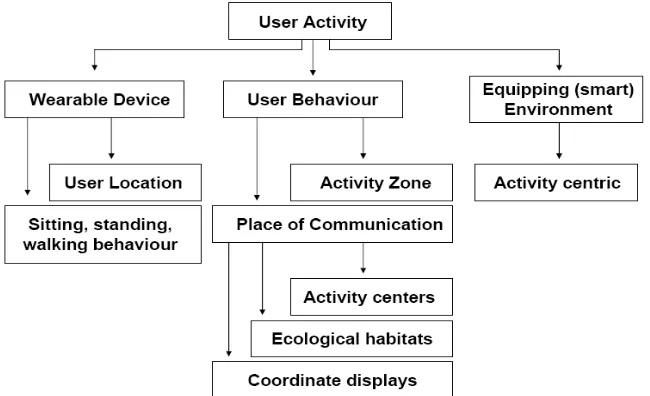
In the current literature, researchers who work in the area of user activity fall into three categories, they: 1. develop equipment using wearable devices to be worn by the user to sense user activity and recognise user location, 2. study user behaviour in the workplace area and home, and 3. develop a system/device to equip the environment. The tree structure of research categories in the area of user activity is described in Figure 2.3.
Firstly, in the area of wearable devices, it is possible to determine the user’s location using a dead-reckoning method to detect the transition between preselected locations and recognise and classify sitting, standing and walking behaviours (Lee and Mase 2002).
Secondly, in the study of user behaviour, user activity changes in work and society are impinging on the place where the user works and how the work gets done. For example, the increasingly international nature of work has led to a growing amount of travel despite the use of advanced collaboration technologies (Churchill and Munro 2001). It has been argued that many more people are experiencing a blurring of the division between ‘home’ and ‘work’ domains as different forms of work become possible within the physical space of the home.
While Koile proposes activity zones to construct an activity area, Crabtree introduces communication places. Activity zones have a physical form – e.g. wall, furniture – which partition places into zones of human activity and places of communication that are familiar in the home as areas of production, management and consumption of communication. Activity zones were constructed by tracking systems to observe people’s activities over time. Crabtree considers three different properties: ecological habitats, activity centers and coordinate displays, where Activity centers are places where media are actively produced and consumed and where information is transformed (Crabtree, Rodden et al. 2003; Koile, Toolman et al. 2003).
Figure 2.3 Research Categories in the Area of User Activity
(Mantoro and Johnson 2003). Currently there are a number of smart environments already in use in research organisations, for example, MIT’s Intelligent Room (Benerecetti, Bouquet et al. 2000), Stanford iRoom Project (Brown, Bovey et al. 1997), NIST’s Smart Space Lab (Budzik and Hammod 2000), Georgia Tech’s Aware Home project (Kidd, Orr et al. 1999) and ANU’s Active Office (Mantoro 2003; Mantoro and Johnson 2003; Mantoro and Johnson 2003; Mantoro and Johnson 2004).
To provide a dynamic environment of located-objects, Schilit proposed Active Map Geographic Information to manage information about the relationship that exists between locations (Schilit 1995). In people’s daily lives two kinds of spatial relationships are commonly used: containment and travel distance. Schilit mentioned that Euclidian distance between positions within a coordinate system are not suitable for human activity (Schilit 1995).
Related study in user activity also considers the social aspect of the user. This research is mostly study in user dimensions, instead of environment dimensions or technological aspects, such as the study of the use of time (Szalai 1972). Time use studies typically have a single focus: to study the frequency and duration of human activities (Stinson 1999).