AN UNDERGRADUATE THESIS
THE INFLUENCE OF USING PQRST (PREVIEW, QUESTION, READ, SUMMARIZE, AND TEST) STRATEGY ON THE STUDENTS
READING COMPREHESION AT THE EIGHTH GRADE OF JUNIOR HIGH SCHOOL 4 METRO
By:
METTY KURNIA DEWI Student Number: 13107687
Tarbiyah and Teacher Training Faculty English Education Department
STATE INSTITUTE FOR ISLAMIC STUDIES OF METRO
1440 H / 2019 M
THE INFLUENCE OF USING PQRST (PREVIEW, QUESTION, READ, SUMMARIZE, AND TEST) STRATEGY ON THE STUDENTS
READING COMPREHESION AT THE EIGHTH GRADE OF JUNIOR HIGH SCHOOL 4 METRO
Presented as a Partial Fulfilment of the Requirements for the Degree of Sarjana Pendidikan (S.Pd)
in English Education Department By:
METTY KURNIA DEWI Student Number: 13107687
Tarbiyah and Teacher Training Faculty English Education Department
Sponsor : Dr. Widhiya Ninsiana, M.Hum Co-Sponsor : Ahmad Subhan Roza, M.Pd
STATE INSTITUTE FOR ISLAMIC STUDIES OF METRO
1440 H / 2019 M
THE INFLUENCE OF USING PQRST (PREVIEW, QUESTION, READ, SUMMARIZE, AND TEST) STRATEGY ON THE STUDENTS
READING COMPREHESION AT THE EIGHTH GRADE OF JUNIOR HIGH SCHOOL 4 METRO
ABSTRACT By:
METTY KURNIA DEWI
The purpose of this research was to determine whether there is any positive and significant influence of using PQRST (Preview, Question, Read, Summarize, and Test) Strategy on the students reading comprehension. The problem that faced by the students is the students are low in reading comprehension. This research is carried to discuss PQRST (Preview, Question, Read, Summarize, and Test) Strategy on the students reading comprehension.
This research is quantitative research. Technique sampling used to determine the amount of sample is cluster purposive sampling. In data collecting of the researcher applied method of test, observation, and documentation. The subject of study is the eighth grade of Junior High School 4 Metro in VIII H consists of 32 students. To get the data, the writer has given multiple choice tests to students that is pre-test and post-test. After getting the data, the researcher analyzed the data by using ttest formula.
The result of this study shows that on the standard of significant 1% or 5%. The ttable shows 2,021 in 5% and 2,704 in 1%, while tobserved is 11,18. The result of data interpretation shows tobserved is higher than ttable, so, 2,021 < 11,18 >
2,704. It means that there is influence of using PQRST Strategy on the students reading comprehension at the eighth grade of Junior High School 4 Metro.
Key words : PQRST (preview, question, read, summarize, and test) strategy, Reading Comprehension.
PENGARUH PENGGUNAAN STRATEGI PQRST (PREVIEW, QUESTION, READ, SUMMARIZE, AND TEST) TERHADAP KEMAMPUAN SISWA DALAM PEMAHAMAN MEMBACA
DI KELAS DELAPAN SMP N 4 METRO ABSTRAK
Oleh:
METTY KURNIA DEWI
Tujuan dari penelitian ini adalah untuk mengetahui apakah ada pengaruh positif dan signifikan menggunakan Strategi PQRST (Preview, Question, Read, Summarize, dan Test) terhadap pemahaman membaca siswa. Masalah yang dihadapi siswa yaitu siswa memiliki pemahaman membaca yang rendah.
Penelitian ini diadakan untuk mendiskusikan bagaimana Strategi PQRST (Preview, Question, Read, Summarize, dan Test) terhadap pemahaman membaca siswa.
Penelitian ini merupakan penelitian kuantitatif. Tekhnik sampling yang digunakan untuk menentukan jumlah sampel adalah cluster purposive sampling.
Dalam pengumpulan data peneliti menggunakan metode tes, observasi, dan dokumentasi. Subyek penelitian adalah siswa kelas VIII H di SMP N 4 METRO yang terdiri dari 32 siswa. Untuk mendapatkan data, peneliti memberikan tes pilihan ganda kepada siswa yang terdiri dari pre-test dan post-test. Setelah mendapatkan data, peneliti menghitung dengan menggunakan rumus T-test.
Hasil penelitian ini menunjukkan bahwa pada standar signifikan 1% atau 5%. Ttabel menunjukkan 2.021 dalam 5% dan 2.704 dalam 1%, sedangkan thitung adalah 11.18. Hasil interpretasi data menunjukkan thitung lebih besar dari ttabel yaitu 2,021 <11,18> 2,704. Ini berarti bahwa ada pengaruh dalam penggunaan Strategi PQRST terhadap kemampuan siswa dalam pemahaman membaca di kelas delapan SMP N 4 METRO.
Kata kunci: strategi PQRST (preview, question, read, summarize, and test), Pemahaman membaca.
MOTTO
“Everything Is Gonne Be Ok”
( Dea Oct )
ْمِهِسُفْنَأِب اَم او ُرِِّيَغُي ىَّتَح ٍم ْوَقِب اَم ُرِِّيَغُي لا َ َّاللَّ َّنِإ...
Allah does not change a people’s not unless they change what is in their hearts.
(Q.S Ar-Ra’d: 13:10)
DEDICATION PAGE
I highly dedicate this undergraduate thesis to:
My beloved parents and my husband who always support me in their endless love.
Then, to all my friend, thanks for your
inspiration, motivation, loving, praying,
and always give support for me until
finished this thesis, and my beloved
almamater IAIN Metro.
TABLE OF CONTENTS
OVER ... i
TITLE ... ii
ABSTRACT ... iii
APPROVAL PAGE ... v
NOTIFICATION LETTER ... vi
STATEMENT OF RESEARCH ORIGINALITY ... vii
ORISINILITAS PENELITIAN ... viii
MOTTO ... ix
DEDICATION PAGE ... x
ACKNOWLEDGMENT . ... xi
TABLE OF CONTENTS ... xii
LIST OF TABLE ... xv
LIST OF DIAGRAMS ... xvii
LIST OF FIGURE ... xviii
LIST OF APPENDIXES ... xix
CHAPTER I INTRODUCTION ... 1
A. Background of the Study ... 1
B. Problem Identification ... 5
C. Problem Limitation ... 5
D. Problem Formulation ... 6
E. Research Objective... 6
F. Benefits of the Study ... 6
CHAPTER II REVIEW OF THE RELATED THEORIES ... 7
A. The Concept of Reading Comprehension ... 7
1. The Concept of Reading... 7
a. The Definition of Reading ... 7
b. Model of reading ... 12
c. Types of Reading ... 14
d. The Purpose of Reading ... 16
2. The Concept of Reading Comprehension ... 18
a. The Definition of Reading Comprehension ... 18
b. Teaching Reading Comprehension ... 19
c. Reading Comprehension Strategy ... 21
d. Measurement of Reading Comprehension ... 22
3. The Concept of Descriptive Text ... 27
a. The Definition of Descriptive text ... 27
b. The Schematic Structures of Description ... 28
B. The Concept PQRST Strategy ... 29
1. The Definition of PQRST Strategy ... 29
2. Advantages and Disadvantages of PQRST Strategy ... 34
3. The Steps of PQRST Strategy ... 37
C. Theoretical Framework and Paradigm ... 40
1. Theoretical Framework ... 40
2. Paradigm ... 41
D. Hypothesis ... 42
1.Hypothesis Formulation ... 42
2. Statistical Hypothesis ... 43
CHAPTER III RESEARCH METHOD ... 44
A. Research Design ... 44
B. Population, Sample, and Sampling Technique ... 46
C. Operational Definitions of Variable ... 48
D. Data Collection Technique ... 50
E. Research Instrument ... 51
F. Data Analysis Technique ... 55
CHAPTER IV RESULT OF THE RESEARCH ... 57
A. Research of the Data ... 57
1. Research Setting ... 57
2. The Data of Research ... 63
B. Hypothesis Testing ... 70
1. Preparing the Table ... 70
2. Putting the data by using of Chi-Square ( χ2 ) ... 72
3. Putting the data into formula t-test ... 75
C. Interpretation ... 77
D. Discussion ... 78
E. Limitation ... 80
CHAPTER V CONCLUSION AND SUGGESTION ... 81
A. Conclusion ... 81
B. Suggestion ... 82 BIBLIOGRAPHY
APPENDIXES
CURRICULUM VITAE
LIST OF TABLES
Table 1 Data Pre-survey of Reading Comprehension Test ... 3
Table 2 Data Pre-survey of Reading Comprehension Test ... 4
Table 3 Specification of Reading Comprehension ... 23
Table 4 The Population of the Eighth Grade in Junior High School 4 Metro ... 46
Table 5 The Instrument Test for Reading Comprehension by using PQRST Strategy ... 53
Table 6 Teachers Educational Background in Junior High School 4 Metro in the Academic Year of 2018/2019 ... 58
Table 7 The Students Quantity of Junior High School 4 Metro in the Academic Year of 2018/2019 ... 59
Table 8 The Result of the Students’ reading comprehension in Pre-Test at the Eighth of Junior High School 4 Metro the Academic Year of 2018/2019 ... 63
Table 9 Frequency Distribution of the Students’ reading comprehension in Pre-Test at the Eighth Grade of Junior High School 4 Metro the Academic Year of 2018/2019 ... 65
Table 10 The Result of the Students’ reading comprehension in Post-Test at the Eighth of Junior High School 4 Metro the Academic Year of 2018/2019 ... 67
Table 11 Frequency Distribution of the Students’ reading comprehension in Post-Test at the Eighth Grade of Junior High School 4 Metro the
Academic Year of 2018/2019 ... 69
Table 12 The Score Pre-test and Post-test result of the Students Reading Comprehension ... 70
Table 13 The Contingency Table of the Expected Frequency at the Result of the Students Reading Comprehension in Pre Test and Post Test ... 72
Table 14 The Testing of Data ... 73
Table 15 The Table of Critical Value of Chi-square ... 74
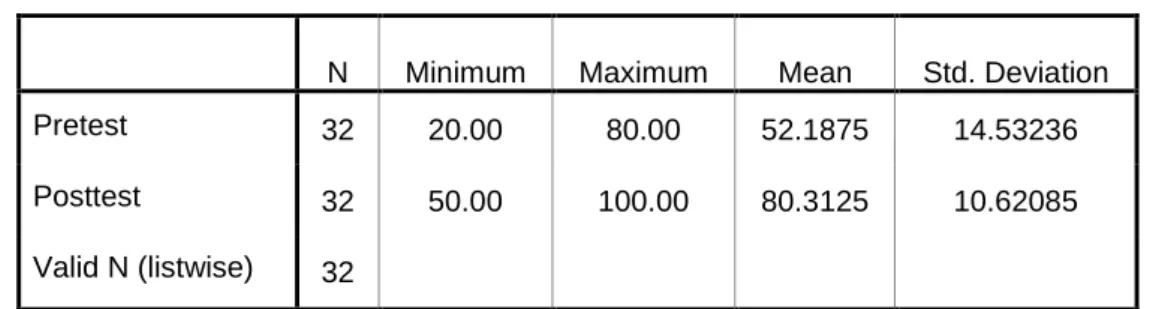
Table 16 Descriptive Statistic ... 76
Table 17 Critical Value of t_table ... 77
LIST OF DIAGRAMS
Diagram 1 The Chart of Frequency Distribution of the Students’ reading comprehension in Pre Test at the Eighth Grade of Junior High School 4 Metro the Academic Year of 2018/2019 ... 66 Diagram 2 The Chart of Frequency Distribution of the Students’ reading
comprehension in Post Test at the Eighth Grade of Junior High School 4 Metro the Academic Year of 2018/2019 ... 69
LIST OF FIGURES
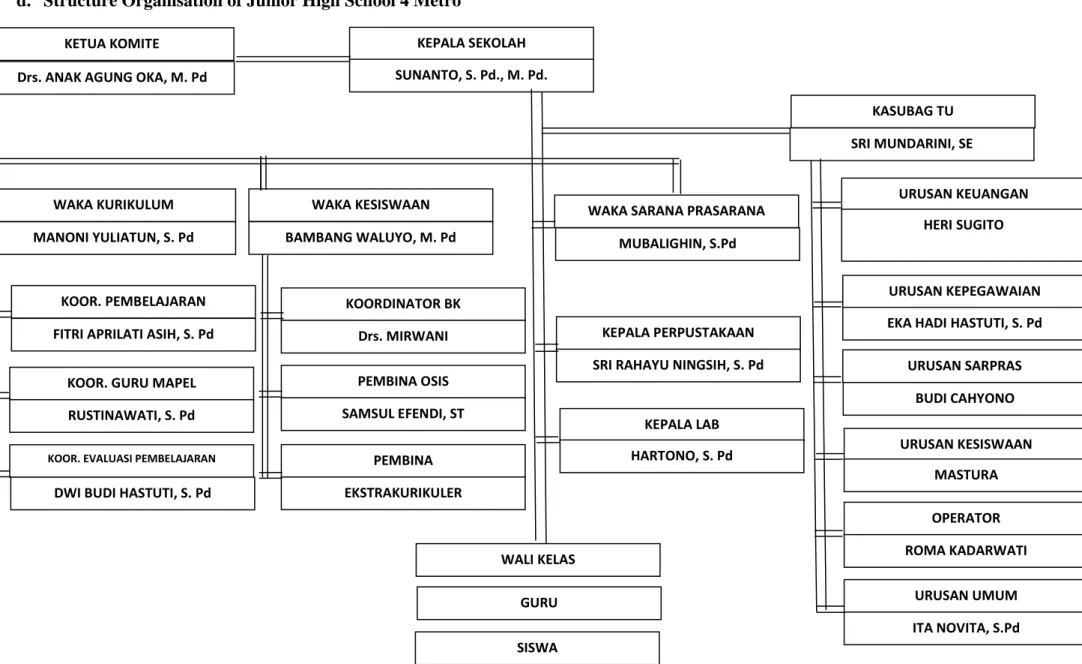
Figure 1 Paradigm of the influence of using PQRST Strategy on the students reading comprehension ... 41 Figure 2 Structure Organization of Junior High School 4 Metro in the
Academic Year of 2018/2019 ... 60
LIST OF APPENDIXES Appendix I
Attendence list ... 83
Sylabus ... 87
Lesson Plan ... 93
Instrument Pre Test ... 102
Instrument Post Test ... 104
Key Answer of Pre Test And Post Test ... 107
Table t Values ... 108
Documentation list ... 109
The Result of Pre Test ... 114
The Result of Post Test ... 115
Documentation ... 116
Appendix II The Pra Survey License Letter ... 120
The Assignment Letter from the Chief of IAIN Metro ... 121
The Research License Letter ... 122
The Assignment from Junior High School 4 Metro ... 123
The Thesis Guide Letter ... 124
The Thesis Consultation ... 125
CHAPTER I INTRODUCTION
A. Background of Research
English takes a place as international language that is widely used by a lot of nations all over the world. The use of English is not only to connect people in different country, but also to support state’s growth in many sectors. Many aspects are influenced by English; they are economics, science, technology, education, culture, politics, and other sectors. It makes a lot of nations put English into the curriculum of education as compulsory subject, including Indonesia.
Meanwhile in Indonesia, English is one of primarily subjects which are taught every formal school, such as in junior high school until university. It becomes one of the primary subjects to be final examination. Consequently, English has been highly implemented in Indonesia for the need of education.
Moreover, school-based curriculum has been conducted in most of schools. The curriculum introduces the concept of some types of English texts where the students are expected to be able to understand and to comprehend a reading text in the form of narrative text, recount text, descriptive text, report text, explanation text, analytical exposition, hortatory exposition and so on.
The curriculum states that Junior High School students should be able to use the language in informational level. It means that the students are expected to
be able to access knowledge and information from the target language (English) by their language skill.
Nevertheless, there are four skills in English should be mastered are listening, reading, writing and speaking. Among the four skills, reading is one of the important ways to improve general language comprehension in English. It takes on a very significant role teaching English as a foreign language. By reading students can get information and expand the knowledge.
Therefore, there are some common-sense strategies that can be applied in teaching reading. One of them is the PQRST (Preview, Question, Read, Summarize, and Test) strategies. PQRST (Preview, Question, Read, Summarize, and Test) strategy is a strategy that intended to improve students’
abilities to study and remember material presented in textbooks. In using this strategy, previews the chapter at hand to get an idea of its topics and sections, reading the chapter outlines, the section headings, the summary, then stages apply to each section and trying to answer questions.
Then, the purpose of the PQRST strategy is to improve reading comprehension and foster curiosity of students associated with the topic that will be read. However, in implementing this strategy, text provided should be text-rich information so that students can later find the answers to the questions they have. This strategy consists of several stages: Preview, Question, Read, Summarize, and Test. Inversely proportional to the reality at the site, many students have gotten low and unsatisfying value in reading
especially in narrative text. It can be seen from their daily score in reading.
Furthermore, from the data pre-survey at the eighth grade of Junior High School 4 Metro. The pre survey has been done on 23st March, 2018. The data shown as follows:
Table 1
Data Pre-survey of Reading Comprehension Test at the eighth grade of Junior High School 4 Metro
NO NAME SCORE CATEGORY
1 AFM 83 Very Good
2 AMN 80 Good
3 ABF 70 Fair
4 ASS 72 Fair
5 AS 71 Fair
6 BSSP 74 Good
7 BPR 88 Very Good
8 BKS 78 Good
9 CPK 70 Fair
10 DD 77 Good
11 DGFS 72 Fair
12 DSN 89 Very Good
13 EYA 69 Fair
14 LZD 85 Very Good
15 MFZ 79 Good
16 MAS 69 Fair
17 MFFR 76 Good
18 MRMA 70 Fair
19 NS 80 Very Good
20 PRN 72 Fair
21 RMP 75 Good
22 SVN 71 Fair
23 SAE 86 Very Good
24 STR 68 Fair
25 SAN 77 Good
26 SL 70 Fair
27 SK 68 Fair
28 SJAM 70 Fair
29 W 75 Good
30 WA 70 Fair
31 ZN 77 Good
32 ZZK 72 Fair
Source: Teacher’s Document of Reading test result of the eighth grade of Junior High School 4 Metro.Taken on March 23st, 2018
The researcher got the data from the students score on pre survey in reading comprehension task at the Junior High School 4 Metro. The pre survey has done on 23st March, 2018.
Table 2
Data Pre-survey of Reading Comprehension Test at the eighth grade of Junior High School 4 Metro
No Score Category Frequencies Percentage
1 50-72 Fair 16 50%
2 73-79 Good 10 31%
3 80-100 Very Good 6 19%
Total 32 100 %
Source: Teacher’s Document of Reading test result of the eighth grade of Junior High School 4 Metro.Taken on March 23st, 2018
Based on the students reading comprehension result at class VIII H above, the criteria of students who are successful in mastering of material who get minimum standard score (MSS) that is 73. They have 32 students, it shows that 19% from 6 students got high score in the scale of 83-100 or 31% from 10 students got fair score in the scale 73-82, and 53-72 scale or 50% from 16 students got low score.
From the data above, it can be assumed there are students who got high, fair and also low level. The data had been showed that the 50% of students’ achievement in reading comprehension is low and it must be increased.
Based on explanation above, researcher interested to conduct this research that is the influece of using PQRST strategy on the students skill in reading comprehension.
B. Problem Identification
Based on the background above, the researcher identifies the problems as follows:
1. The students are low ability in reading comprehension.
2. The students have low understanding in reading a narrative text.
3. The students are not interested in the reading subject.
4. The students have lack vocabularies.
5. Teaching learning is still conventional.
C. Problem Limitation
Limitation of the problem is very useful for the researcher to determine the problem that will be analyzed. In this case, the researcher focuses on the first problem that the students are low ability in reading comprehension. So, the researcher will use PQRST (Preview, Question, Read, Summarize, and
Test) Strategy on the students reading comprehension at the Eighth Grade of Junior High School 4 METRO.
D. Problem Formulation
Concerning the background of the research and problem identifications above, the researcher formulates the question in this research as follows “Is there any positive and significant influence of using PQRST (Preview, Question, Read, Summarize, and Test) Strategy on the students reading comprehension at the Eighth Grade of Junior High School 4 METRO?”
E. Research Objective
Based on the problem, the researcher formulates the objective is to know whether there is a prectice an significant influence of using PQRST (Preview, Question, Read, Summarize, and Test) Strategy on the students reading comprehension at the eighth grade of Junior High School 4 METRO.
F. Benefit of The Research
Overall, this research is aimed to be information in developing the quality of reading comprehension in Junior High School 4 METRO.
Specifically, it is exceedingly expected to have the benefits as follows:
1. For the students
To motivate the students to master about reading strategy, enrich their knowledge and improve their reading comprehension.
2. For the teachers
To give more information about PQRST strategy for the English teacher, especially at the eighth grade of junior high school.
3. For the next researcher
Theoretically, this research can give additional reading knowledge for next researchers in gaining the narrative reading text.
CHAPTER II
REVIEW OF THE RELATED THEORIES
A. The Concept of Reading Comprehension 1. The Concept of Reading
a. The Definition of Reading
There are four skills in English should be mastered, like listening, speaking, writing and reading. Reading is one of the main skills that are needed by the students from elementary school up to university. By reading, the students are able to get a lot of knowledge and information based on what they read. So, without reading the students surely never know about all of the anything which happened either change in situation of education, economic, or necessary information that occurs.
There are some experts that have opinion about the meaning of reading. Jeremy Hamer mentions that reading is useful for language acquisition. Available the students more what they read, the better they get at it. Reading also has a good influence on students’
vocabulary knowledge, on their spelling and on their writing.1 Because through reading students may find a new vocabulary and spelling practice reading students to become better.
1 Jeremy Harmer, How to Teach English, (England: Ocelot Publishing, 2007), P. 99
Moreover, Caroline T. Line mentions that reading is a set of skills that involves making sense deriving meaning from the printed word. In order to read we must be able to decode the printed words and also comprehend what we read.2 It means reading is a process to get to know a few words and integrate into the meaning of words into sentences and reading structures.
Therefore, after reading can make the meaning of the context it self.
Whereas, According to gerald, the main thing in reading is to develop students who do read. That means motivating them to read.
But how do we do that? We are helped to do it if we keep in mind an enduring teaching principle that says: “What they do is what they think it is.” That is, what students do during “reading” time is what they think is the main thing about reading.3
In studies of children and adults with lower levels of comprehension whose word reading is intact, vocabulary difficulties extend beyond simply not knowing the meanings of words. Even when these readers know something about word meanings, they may still have difficulties rapidly and effortlessly accessing a broad range of semantic connections about and
2 Caroline T. Linse, Practical English Language Teaching: Young Learners, (New York:
McGraw-Hill Companies, 2005), P.69
3 Gerald G. Duffy, Explaining Reading : A Resource for Teaching Concepts, Skills, and Strategies, Second Edition , (New York: The Guilford, 2009), P. 3
between words.4 Reading is an essential skill for learners of English as a second language. For most of these learners it is the most important skill to master in order to ensure success not only in learning English, but also in learning in any content class where reading in English is required. With strengthened reading skills, learners will make greater progress and development in all other areas of learning. Teaching reading usually has at least two aspects.
First, it can refer to teaching learners who are learning to read for the very first time.
A second aspect of teaching reading refers to teaching learners who already have reading skills in their first language. You only learn to read once. Once you have learned how to read in one language, you do not learn how to read again in second or foreign language, but rather you learn how to transfer skills that you have already learned to the new reading context in a new language.5
Reading has been described as what happens when people look at a text and assign meaning to the written symbols in that text. The goal of most second or foreign language reading programs is to turn "learning to read" into "reading to learn".6
4 Kristi L. Santi, & Deborah K. Reed, Improving Reading Comprehension of Middle and High School Students, (New York : Springer Cham, 2015), P. 8
5 David Nunan, Practical English Language Teaching, (New York: McGraw-Hill , 2003), P. 68
6 Thomas S. C. Farrell, A Strategic Approach To Teaching Reading, (Singapore: National Institute of Education, 2002) P. 133
Reading is a process very much determined by what the reader’s brain and emotions and beliefs bring to the reading:
the knowledge or information (or misinformation, absence of information), strategies for processing text, moods, fears and joys all of it. Elizabeth said that Reading is a skill that will empower everyone who learns it.
In sum up, reading is both a psycholinguistic process (involving the mind actively processing the text) and a sociolinguistic one (with multiple social factors that can affect how one reads, how much one leans from the reading, and more). Even word identification itself can be affected by these factors, because reading is as much or more a brain to text process as a text to brain process.7
They will be able to benefit from the store of knowledge in printed materials and ultimately, to contribute to that knowledge.
Good teaching enables students to learn to read and read to learn.
Reading is about understanding written texts. It is a complex activity that involves both perception and thought.
Reading consists of two related processes: word recognition and comprehension. Word recognition refers to the process of
7 Heinemann, Reading Process: Brief Edition of Reading Process and Practice, Third Edition, (Constance Weaver: Portsmouth, NH, 2009) P. XIII
perceiving how written symbols correspond to one’s spoken language.8
Remember that the reading process is the same whether the text is long or short, complex or simple, and the way to respond to the questions correctly is to read closely and carefully.
Based on the explanation above, the writer can draw a conclusion that reading is the process of people in order to gain the ideas and information which shared by the writer in reading device such as books, advertisements, contracts, newspapers, letters, manuals, and a host of other materials. We can see that reading is not a simple thing by reading people get something. And the writer agrees that someone has purpose when he is reading. The purpose of reading commonly is to find idea from reading passage.
However, reading in foreign language needs reading skill in order to find idea. So the reader should comprehend the passage when he is reading.
b. Models of reading
There are several type model of reading such as:
1) Top-down model
Argues that readers bring prior knowledge and experiences to the text and that they continue to read as long as the text confirms their expectations. This top-down process can be
8 Elizabeth S. Pang, Angaluki Muaka, Elizabeth B. Bernhardt, & Michael L. Kamil, Teaching Reading , (UNESCO: International Bureau of Education, 2003), P. 6
explained as follows: the reader first looks at a passage or a text.
Then he or she guesses about or predicts what the text will be about (based on their prior knowledge and experience of the topic) after reading the title, the headings and sub headings.
The reader then continue to read the text seeking confirmation about the topic based on their prior knowledge of that topic. So readers fit the text into knowledge an experiences they already hold.
2) Bottom-up model
Suggests that a reader reads the words and sentences and looks at the organization of the text (without relating it to experience or prior knowledge) in order to construct meaning from what was written in the text-meaning depends both on knowledge of vocabulary plus syntax. The bottom-up process can be explained as follows: when we read, one thing we do is extract the propositions from the text. How? By chunking the sentences into constituents and constructing the propositions from there. Comprehension then depends on the propositions we have extracted which serve as the basis of what we understand and recall (Richards, J. C., personal communication). This is the opposite of the top-down approach; instead of working from meaning to text (top-down),
this model has a reader working from text to meaning (with a focus at word and sentence level).
3) Interactive model
Argues that both top-down and bottom-up processes occur when a person reads a text.9
c. Types of Reading 1) Choral reading
Even though Choral reading is relatively incredible in modern language classes. This type of reading is still important in increasing pronunciation students. Working in groups will make students feel faithful to pronounce a word and to practice is really recommended in this method.10 It means that Choral reading helps build students' fluency, self-confidence, and motivation. Because students are reading aloud together, students who may ordinarily feel self-conscious or nervous about reading aloud have built in support.
2) Silent Reading
Silent reading is reading in the silent way that is done by the students. After the students learn the words and know how to pronounce it, the real reading can begin. It means that through silent reading. Reading silently improves students’
9 Thomas S. C. Farrell, A Strategic Approach To Teaching Reading, (Singapore: National Institute of Education, 2002) P. 134
10 Ag. Bambang setiyadi, Teaching English As a Foreign Language, (Jakarta; Graha Ilmu, 2012), P. 67
understanding because it helps them concentrate on what they are reading, rather than the pronunciation of individual words.
The teacher also can be able to check whether the students understand what they have read, and make a test them by giving exercise based on the text, by summarizing the text.
3) Intensive Reading
Intensive reading involves learners reading in detail with specific learning aims and tasks.11 It means that intensive reading can be compared with extensive reading, which involves learners reading texts for enjoyment and to develop general reading skills.
4) Extensive Reading
Extensive reading is silent reading however done there out classroom. It means that extensive reading is to read widely. The object covering as much as possible in the shortest time. The object covering as much as possible. And the material for extensive reading will be selected at a lower level of difficulty than that for intensive reading. The purpose of extensive reading will be to train the student to read directly and fluently in the target language for enjoyment, with the aid of the teacher.
11 Ag. Bambang setiyadi., P. 68.
5) Supplementary Reading
Supplementary Reading is also done there out class.
The students are free to choose reading materials.12 It is consist of magazine, bulletin, or newspapers in target language. It means that when the students study in outside class, they can select reading book based on their want.
d. The Purpose of Reading
1) Reading to search for simple information
Reading to search for simple information is a common reading ability. It is used so often in reading that it is probably best seen as a type of reading ability.
In reading to search, we typically scan the text for a specific word, or a specific piece of information, or a few representative phrases.13 So when we read some information we read based on our ability to facilitate us in finding simple information.
2) Reading to skim quickly
Reading to skim quickly is a combination of strategies for guessing where important information might be located in the text.14 In the search for information in the form of a list, reading skimming techniques can facilitate searching some
12 Ibid, P.69.
13 William Grabe, Reading in Second Language, (New York; Cambridge University Press, 2009), P. 27
14 Ibid., P. 28.
information in the text through technique of reading scan.
Examples such as the search for a list of phone numbers or read the list of names of absent students.
3) Reading to learn from texts
Reading to learn from texts requires abilities to:
a) remember main ideas as well as a number of details that elaborate the main and supporting ideas in the text
b) recognize the information in the text c) ink the text to the reader’s knowledge base
So through reading, we can get information from a text or paragraphs that can facilitate us in learning.
4) Reading for general comprehension
When accomplished by a skilled fluent reader, requires very rapid and automatic processing of words, strong skills in forming a general meaning representation of main ideas, and efficient coordination of many processes under very limited time constraints15. So comprehension requires the reader to be an active constructor of meaning. Reading research has demonstrated that readers do not simply "perceive" the meaning that is the text.
15 William Grabe,. P. 29.
2. The Concept of Reading Comprehension a. The Definition of Reading Comprehension
According to Anderson, The aim of reading is comprehension. Some individuals equate decoding with reading.
Just because a learner knows how to pronounce written word correctly, does not mean that he can read.16 It means that if reading comprehension refers to reading information, understanding and entertainment. It involves higher order thinking skills and is much more complex than decoding specific words.
Reading comprehension consists of the processes of constructing conceptual knowledge from a text through cognitive interaction and motivational involvement with the text.17 It means that a motivation also helps in the understanding of a person in determining the meaning or content of a text in the reading process.
Reading comprehension is the process of making meaning from text. The purpose is to gain an overall understanding of what is described in the text rather than to get the meaning from words or sentences.18 It means that when students read some text, the students have to understand the contents of text or paragraphs
16 Caroline T. Linse, Practical English Language Teaching: Young Learners, (New York:
McGraw-Hill Companies, 2005), P. 71
17 John T. Guthrie, Allan Wigfield, & Kathleen C. Perencevich, Motivating Reading Comprehension: Concept-Oriented Reading Instruction, (United State of America: Lawrence Erlbaum Associated, 2004) P. 227
18 Maryam Rohani, “The Effect of Retellinng Technique on reading Comprehension”, in International Journal of Basic Sciences & Applied Research, (Iran: University of Isyahan) Vol., 3/
2014, P. 74
itself, without any understanding the meaning of a text it will not understand what we read.
From description above, we can conclude that a comprehension is the most important thing in reading textbooks or written materials. In other word, there are some aspects in reading comprehension that should be considered by the reader. They include the knowledge of the reader that is related to the content of the message and the knowledge of the reader on language terms.
So the reader’s background knowledge is absolutely needed.
b. Teaching Reading Comprehension
The good rubric to keep in mind for teaching reading is the following three-part19:
1) Before Reading (pre-activities)
Spend some time introducing a topic, encouraging skimming, scanning. Students can bring the best of their knowledge and skills to a text when they have been given a chance to “ease into” the passage. During pre-reading, the teacher should:
a) Assess the students’ background knowledge the topic and linguistic content of the text.
19 Douglas brown, Teaching by Principles: An Interactive Approach to Language Pedagogy, (Longman: Second Edition, 2012), P. 315
b) Give the students the background knowledge necessary for comprehension of the text, or activate the existing knowledge that the students possess.
c) Clarify any cultural information that may be necessary to comprehend the passage.
d) Make the students aware the type of the text they will be reading and the purposes for reading.
2) While Reading (while-activities)
Not all reading is simply extensive or global reading. There may be certain facts or theoretical devises that students should take note of while they read. In while-reading activities, students check their comprehension as they read.
In while-activities, the teacher should:
a) Remind the students, do they obtain the information they are looking for when they are reading for the specific information?
b) Ask the students whether they understand the story-line/
sequence of ideas well enough to enjoy reading the text?
c) When they read for through understanding (intensive reading), ask them, do they understand each main idea and how the author supports it?
To check comprehension in this situation, students may:
a) Stop at the end of each section to review and check their predictions, restate the main idea and summarize the section.
b) Use the comprehension questions as guides to the text, stopping to answer them as they read.
3) After Reading (post-activities)
Comprehension questions are just one form of activity appropriate for post reading. In post-activities, the students are:
Consider vocabulary study, identifying the author’s purpose, discussion the author’s line of reasoning, examining grammatical structures, then follow up writing exercise.20
c. Reading Comprehension Strategies 1) Identify the purpose in reading
Efficient reading consists of clearly identify the aim in reading something.21 By doing it, you know what you are looking for and can weed out potential distracting information. Whenever you are teaching a reading technique, make sure students know their purpose in reading something. From explanation above, we can easily to get comprehension when reading something.
2) Skim the text for main ideas
Actually there are two kind of reading strategies for learners are skimming and scanning. Skimming consist of quickly running
20 H Douglas brown, Teaching by Principles An Interactive Approach to Language Pedagogy, (Longman: Second Edition, 2012), P. 315
21 Ibid, P. 306
one’s eyes across a whole text.22 Skimming gives the students benefit of being able to predict the purpose of the passage, the main topic, or message, and something that becomes supporting ideas.
These strategies can make the students more focused when reading.
3) Scan the text for specific information
The second in the most important category is scanning, or quickly searching for some piece or pieces on information in content. The goal of scanning is to summary specific information without reading the whole a text. For academic English, scanning is absolutely essential. In vocational or general English, scanning is main in dealing with genres like schedules, and form, etc.
4) Analyze vocabulary
One method for learners to make guessing pay off when they do not immediately recognize a word is to analyze it in terms of what they know about it. For example like look for prefixes, suffixes, etc. It means that if we have analyzed a vocabulary which wants to read, our comprehension reading is easily to understanding.
d. Measurement of Reading Comprehension
The writer Actually used to measure reading comprehension can be interpreted as degrees of imperfection in how well different indicators identify one or more latent variables that make up reading comprehension.
22 Ibid,. P. 308
The assessment of reading comprehension need to incorporate multiple indicators to enhance the precision in which the underlying latent variables are measured.
Table 3
Specification of Reading Comprehension
Number Letter Categories Description of Criteria 80-100 A Very Good 1. A good reader does not
only have a good understanding. They also will be able to put him/her selves into the text and will try to live the history.
2. A good reader will let the concentration mingle with the book, and not only understand the deeper meanings of the text.
3. A good reader will not only be fluent in reading, but he or she would show certain personal qualities in
reading.
4. A good reader would love to share what he or she has read, always confident, dedicated and carefully, and be willing to read back when needed.
73-79 B Good 1. A good reader does not only
have a good understanding.
They also will be able to put him/her selves into the test and will try to live the story (an error)
2. A good reader will let the book, and not only understand the deeper meanings of the test (an error)
3. A good reader will not only be fluent in reading, but he/she would show certain personal qualities in
reading.
4. A good reader would love to share what he or she has read, always confident, dedicated and carefully, and be willing to read back when needed.
50-72 C Fair
1. A good reader does not only have a good understanding.
They also will be able to put him/her selves into the test and will try to live the story.
2. A good reader will let the concentration mingle with the book, and not only understand the deeper meanings of the text.
3. A good reader will not only be fluent in reading, but he or she would show certain personal qualities in reading (an error).
4. A good reader would love
to share what he or she has read, always confident, dedicated and carefully, and be willing to read back when needed.
10-49 D Poor
1. A good reader does not only have a good understanding.
They also will be able to put him/her selves into the test and will try to live the story.
2. A good reader will let the concentration mingle with the book, and not only understand the deeper meanings of the text.
3. A good reader would love to share what he or she has read, always confident, dedicated and carefully, and be willing to read back when needed.23
23 William Grabe, Reading in Second Language, (New York: Cambridge University Press, 2009), P. 29
3. The Concept of Descriptive Text a. The definition of Descriptive text
A According to Anderson and Anderson that descriptive or description describes a particular person, place, or thing. Its purpose is to tell about the subject by describing its features without including personal opinions.24 Besides, the word descriptions from two words: Scriber, meaning “to write” and de, meaning “down” or “about”. There is a hint in the describing you will follow the outline of an object visually and then write it down or “draw” it in word.25
Related to Anderson statement about the definition of description, Karim and Rachmadie point out that a description is verbal picture of a person, place, or object. Thus, a description essay is the one describes a person, place, or object.
Another expert, Plooger proposed that a descriptive is used to add details about something physical: a person, place, or thing.
This method uses sensory language, that is, words that appeal to the five senses,26 such as sight, hearing, smell, taste, and touch.
From some definition above, the experts have same concepts or similar concept about descriptive itself, they said that a
24 Mark Anderson and Kathy Anderson, Text Types in English 3, (Australia:Macmillan Education Australia Pty Ltd, 1998), p. 26.
25 Frank J. D’Angelo, Process and thought in Composition, (Massachusetts: Winthroup Publishers, Inc, 1977), p. 123.
26 Katherine Ploeger, Simplified Paragraph Skills, (USA: NTC Publishing Group, 2000), p. 239.
descriptive is to describe something like a person, place, or object.
There are some features in a descriptive that we must give a serious attention, they are: the feature in construction a description. A typical description has an opening paragraph introduction the subject of the description, followed by a series of paragraph each describing one feature of the subject. There can also be a final concluding section that signal the end or the description or in another hand there are an identification and description in a descriptive text. The identification of the descriptive text is usually as a main idea of the paragraph or called as a general statement, and the description of the descriptive text is about the explanation of the general statement or main idea or supporting details to the general statement.
b. The Schematic Structures of Description
The schematic structure of descriptive paragraph consists of identification and description. Identification mention phenomenon to be described, while the description describes the parts, the qualities, and the characteristics of what has been described.27
Moreover, Anderson and Anderson stated that to construct a description usually uses an opening paragraph introducing a subject of the description, followed by a series of paragraph each
27Pardiyono, Teaching Genre-Based Writing, Metode Mengajar Writing Berbaris Genre Secara Efectif, (Yogyakarta: CV AndiOffeset, 2007), p. 34.
describing one feature of the subject. There can also be a final concluding section that signals the end of the description.28
B. The Concept of PQRST (Preview, Question, Read, Summarize, and Test)
1. The Definition of PQRST (Preview, Question, Read, Summarize, and Test)
In relation to the teaching reading comprehension, technique is useful to use. The use of PQRST strategy may support the process of teaching reading comprehension. Moreover, conceptually the PQRST strategy is one the teaching strategies which comprise of five stages: Review, Question, Read, Summarize, and Test. It provides a step-by step guidance to students before, during, and after their reading process which is essential for their comprehension. Each stage gives benefits to students in facilitating their learning. The stages in the PQRST strategy underline the constructivist nature of learning noting that reading is an active, often necessarily selective, effortful and iterative process.
One of the best-known techniques for improving memory from reading is called the PQRST strategy (Preview, Question, Read, Summarize, and Test). The strategy is intended to improve
28Anderson, op. cit., P. 26-27.
students’ abilities to study and remember material presented in textbooks. In the first step, the reader previews the chapter at hand to get an idea of its topics and sections, reading the chapter outlines, the section headings, and the summary. The second, third, and fourth stages apply to each section. Trying to answer questions like what?, who?, when?, where?, how?, and why? improve our learning. An active reader adds structure to the text and summarizes the text with keywords. The fifth step, the test, takes place after finishing the work with the chapter.29
It is means in this step, the reader previews the chapter at hand to get an idea of its topics and sections, reading the chapter outlines, the section headings, and the summary. One of the best- known strategy for improving memory from reading is called the PQRST (Preview, Question, Read, Summarize, and Test).
In teaching reading comprehension, PQRST strategy can lead the students to find the ideas and help them in the vocabularies problem. In this case, the use of PQRST strategy is very helpful for the students as many of students are weak in finding details information.
One of the widely used study strategies to gain students‟
comprehension especially in content area reading is PQRST, which
29 Rune Pettersson, Information Design: An introduction, (Amsterdam/Philadelphia: John Benjamins Publishing Company, 2002), P. 242
stands for Preview, Question, Read, Summarize, and Test.30 PQRST is a memory trick itself it’s an acronym that stands for:
Preview, Question, Review, State, Test. Here is how the method would work if you were preparing for a major test.31
That means one of the generally utilized investigation methodologies to pick up students‟ appreciation particularly in content region perusing is PQRST, which remains for Preview, Question, Review, Summarize, and Test.
PQRST strategy during a training session offered by my school district several years ago. The basic format that students should follow when reading a chapter is: a) P Preview to identify the main parts; b) Q Develop questions to which you want to find answers; c) R Read the material; d) S Summarize the central idea or theme; e) T Test yourself by answering questions, or teach it to a classmate.
The PQRST strategy relies on three basic principles for improving memory: (1) organizing the material, (2) elaborating the material, and (3) practising retrieval.32
30 Alfi Hidayatu Miqawati, & Gunadi Harry Sulistyo ,“The Pqrst Strategy, Reading Comprehension, and Learning Styles” in Indonesian Journal of Applied Linguistic, (East Java:
University of Bondowoso & State University of Malang), Vol. 4 No. 1/ July 2014, P.126
31 Carol Turkington, Memory: A Self-Teaching Guide, (United States of America: John Wiley & Sons, Inc., 2003), P.62
32 Rune Pettersson, Information Design: An introduction, (Amsterdam/Philadelphia: John Benjamins Publishing Company, 2002), P. 242
The main goal of PQRST strategy is to help students to advance their reading comprehension. PQRST strategy consists of these 5 steps below:33
1. P ( Preview )
In this first step, the reader determine what the entire text is about by skimming through it all so they know they‟re going to be covering. One way to do this is to read the litle, and then notice the graphs, pictures, diagrams in the text. Next, read the introduction and summary or the first paragraph, also notice the organizational structure text. The point is to get an idea of the main topic and sections of the text.
One of the best things about previewing is that it takes very little time to do. Once they‟ve had some practice, they‟ ll usually be able to preview a text quickly. If they have a general idea about what a reading assignment covers, they will be able to determine how it relates to the course for which they‟re reading, and what they want to learn from it.
2. Q ( Question )
After preview the text, the students as the readers determine what they are exactly looking for while reading. The students should make question based on what they have read before. The questions can lead them to find further information of text.
33 Carol Turkington, Memory: A Self-Teaching Guide, (United States of America: John Wiley & Sons, Inc., 2003), P. 64
They should avoid adding questions that might distract or change the subject.
With specific questions in mind about a reading assigmnment, they will know exactly what information to look for, and they will be motivated to find it. This will help them to learn as much as they can from reading. The questions are maybe a. Who is/are the major character/s? b. What do/does the major character/s look like? c. Where did the story take place?
3. R ( Read )
The third step is R or Read. In this step, the readers read the whole text. And while reading it, they also try to find the answers of the questions they made before. Here, they should remember the features that they notice during the last wo steeps: heading, special term, pictures, and summaries. Those can be used to guide them toward the main ideas.
4. S ( Summary )
After reading the text, the readers should know how much they can recall the information they get from the text and state it by their own words. Highlight, only the most important words. Without looking at the book, ask the students to recite the main idea of the text generally and the main idea of each paragraph. Then tell themselves in a sentence or two what
they‟ve read. Finally, scan over the section quickly to pick up any essential points they may have missed.
5. T ( Test )
The last step is T or Test. At the end of the reading activity, the reader checks their knowledge by testing themselves to know how far their understanding of the text they read is. It can be doneby reviewing all the material and storing it into their long term memory
From description above, the researcher was supposed to do teaching reading by using PQRST strategy. The researcher assumed that using such thisnstrategy is necessary to help the students in reading comprehension. The PQRST strategy helps not only the teacher in teaching process, but also helps the students to read the text and find the details easily.
2. Advantages and Disadvantages of PQRST (Preview, Question, Read, Summarize, and Test) Strategy in Teaching Reading
There some advantages and disadvantages of using PQRST strategy in teaching reading comprehension:
a. The Advantages of PQRST Strategy
The following are the advantages of PQRST strategy:
1) The PQRST strategy has been empirically shown to be able to improve students‟ reading comprehension.34
2) The PQRST is a time-honored way of learning effectively.
But there are other things to keep in mind that can help you record, retain, and retrieve information very effectively.35 3) The PQRST is another useful internal technique to be applied
for retaining lists of information.
4) Use the PQRST method and similar devices for making sense of reading assignments, for instance, from textbooks.36
5) This strategy made the students well-planed in reading the text. It made the reading process more effective in order to reach the goals. By knowing this ahead of time, the students able to look for and recognize the most important points when they do read for details. They did not waste time stumbling through the book and finding a starting point (Staton: 1982).
6) PQRST is an instructional strategy that has been shown to be effective to improve a readers understanding, and his/her
34 Alfi Hidayatu Miqawati, & Gunadi Harry Sulistyo ,“The Pqrst Strategy, Reading Comprehension, and Learning Styles” in Indonesian Journal of Applied Linguistic, (East Java:
University of Bondowoso & State University of Malang), Vol. 4 No. 1/ July 2014, P. 126
35 Carol Turkington, Memory: A Self-Teaching Guide, (United States of America: John Wiley & Sons, Inc., 2003), P. 64
36 Rick Wormeli, Meet Me in the Middle: Becoming an Accomplished Middle-Level Teacher, (Portland: Stenhouse Publishers, 2001), P. 16
ability to recall information. In other words, the reader is more likely to learn, and to learn more, of the material he/she is reading.
7) Steps in PQRST are also beneficial for aiding the students in comprehending a text.
8) It is simple to remember, and it uses sound practices for reading comprehension.37
b. The Disadvantages of PQRST
The following are the disadvantages of PQRST:
1) This strategy was time consuming, because it had several stages that should be done by the students in reading. So, it would rather difficult for the students who have difficulties in reading. To solve the problem, the teacher used the simple or short text in order to make the effective time. The students also did the group work to discuss the text in some part of learning process.
2) In some stages, the students may get difficulties in doing the step of PQRST strategy. For example, there are some students with low capability in summarizing, because they are weak to recognize the most important points to find the details. Only the students who have upper knowledge level are able to recall the important points. So, it was dominated
37 Rick Wormeli, Summarization in any subject : 50 techniques to improve student learning, (Alexandria, Virginia USA: Association for Supervision and Curriculum Development, 2005) P. 131
by some students who can do this stage. To solve this problem, the teacher divided the class in some groups or pairing works to discuss the difficult terms. The teacher also asked the students to consult their dictionary.38
3. The Steps of Teaching Reading Comprehension through PQRST (Preview, Question, Read, Summarize, and Test) Strategy
There are some processes in teaching reading through PQRST strategy that consist of six stages (Westwood, 2001). It could be done well if the teacher gave the appropriate ways in teaching process as follows:39
a. Step 1
In the first step, the teacher introduced the concept of PQRST strategy and the effectiveness in learning process. The teacher could also tell them main purpose using this strategy.
So, the students had motivation to use this strategy.
b. Step 2
The students were given the text of reading by the teacher.
As the first step of PQRST strategy; previewing. The students can immediately preview the entire chapter by skimming through it to get an idea of the major topics. This is done by
38 Nikmatul Khoiriah, “The Implementation of P-Q-R-S-T Strategy To Improve Students’
Reading Comprehension Ability At Smki Assya’roniyyah Mataram Baru”, (Lampung, University of Lampung, 2017) P. 25
39 Ibid., P. 21-23
reading the chapter outline, and then skimming the chapter, paying special attention to headings of main sections and sub- sections, the kind of the text, the orientation of the text, the verb that is used in the text, and glancing at picture, figure, number, italic words in the text, also noticing the organizational structure text. If there is a summary, take time to consider each point in the summary, questions will come to mind that should be answered later as the students read the full text. The preview stage will give the students an overview of the topics covered in the chapter and how they are organized. The point is to get an idea of the main topics and sections of the text.
c. Step 3
The next step is questioning. In this step, the students tried to ask specific questions in their mind about reading assignment.
The students could start this stage by turning the chapter headings and sub headings into questions. The teacher guided the students to generate questions to help focus reader’s reading and find the key points in each section. They could use the standard questions such as who, what, why, which, when, where or how. The questions can lead them to find further information of text.
d. Step 4
Next, the students read the material in detail. As the students read, they tried to answer the question which asked in the step Question. Besides, they could give underline the difficult word and pay attention the main idea. If the students get difficulties in comprehending the text, they may read the text twice.
e. Step 5
After the students finished reading the section, the students tried to recall the main ideas and recite the information.
Summarizing is a powerful means of fixing the material on the students’ memory. The students try to recite the information and they should know how much they can recall the information they get from the text and state it by their own words.
Summarizing will reveal blanks in the students’ knowledge and help them organize the information in their mind. The students could take notes from the passage they have read.
f. Step 6
In this final step of PQRST strategy, to know and remember what the students have read. It can be started by recalling as much as they can without looking at the book or their recitation notes. It helps them to think about the relevance of what they learned and how it all fits together. The reader checks their knowledge by testing themselves to know how far
their understanding of the text they read is. It can be done by reviewing all the material and storing it into their long-term memory.
Based on the explanation above, the procedure in teaching reading through PQRST strategy has six steps. These steps can be applied well if there is the good interaction between the teacher and the students.
A. Theoretical Framework and Paradigm 1. Theoretical Framework
This research is composed of two variables. They are independent variable (X) and dependent variable (Y). The independent variable (X) is PQRST strategy. Then the dependent variable (Y) is the students reading comprehension.
Essentially, children level ability is divided into two layers namely actual ability (owned by children) and potential capability (possible to be mastered). Zona between both the actual ability and potential capability is zona proximal development. The children need the PQRST strategy to achieve their potential capability.
PQRST Strategy is a learning process that requires direct teaching or companion can be done by teachers or people who are more expert in order to help students to understand what was learned.
Therefore almost identical to guided reading. The importance of