TTHncB NgattfidDnnaill
here's the newest fancy trim in a pickup
The new 1966
international^pickups
offer interi- orsas plushand comfortable
asan
automobile's.You can
get extraslikecolorfulnew
upholsteryover
wide,softcushions.Nylon
carpeton
thefloor.Simulated wood
graininstrument
panel.Padded dash and door
panels.Padded
dualsun
visorsand
acoustical headliner.The outside
isjustas
sharp.Be sure
tosee
thesleek
lines,new choice
of brightbody
col- ors,and shiny new
grilleon
these brand new international
pickups.Under
theinternational hood
there'snew
insula- tion,new engine
quietness.A balanced
drive linereduces
vibration.Improved
clutchlinkagelessenspedal
effort.Go
toyour international Dealer
orBranch-
listed in the
Yellow Pages —
to findoutabout
allour
other greatpickup features. They
offersome
prettyfancy savings
too.international HARVESTER
CO.CHICAGO.ILLINOIS
and here's where you can see it.
Mtuyinf/ a used sports ear?
Want to know what the pros Zoo/, fin*?
Buying a sports car
isvery different from buying a family sedan. Here are a few tips to help you get the pleasure and performance you're paying for.
Take
a casualwalk around
thecar. Taj) therocker panelstomake
surethey'resound.Any
evidence of patching?Do
wrinkles in thebody
skin suggest extensivebody
repair'/Get
squarely infrontof the carand
squatdown. Does
the car standup
niceand
straight? If the car can't passmuster on
all these counts, beon
yourguard and
get an explanation.How
big areyou?
Ifyou'resix-sixdon'tsettleforthetinier models.
A
long trip withyour
kneesunder
your chin willmake you
hate the littlemonsler
insteadofenjoyingthe tripofyourlife.Give
the lires agood
goingover. Isthe tread stillgood and
squareorisit holloworrounded? Hollow means
they'vebeen
over-inflated.Hounded means
under-inflated.They
bothmean
poor careofthecar.Ifthe carhas spoke wheels, play the spokeslike a guitar.
Thcv
shouldgive a clear crisptone...shouldallgiveabout the
same
note.Untuned
spokesmean warped
wheels at worst, poor care at best.Don't pay
top dollar for apoorlymaintained
car.Make
sure parlsand
service are available nearbv.^ourpride
and
joywillturnintoan objectofabom-
ination towards theend
of the thirdweek
you're wailingloradistributor cap.(Iheck theyellow pages to seewhat makes
are soldand
servicedinyourarea.a
8
SE\N\Gt
\0Z MU_£S
T
What do you
intend touse the- driving bv\ourself<>rwith one just the ticket. IIyou
like to around, bettermake
sureDae
familybuggv
offlimits.ar for?If
you
enjoy riend. a sportsears
haul several friends isn't declaring theLast but not least,
have
amechanic
friend givethe caragood
goingover.Itmay
costyou
afewdollars, but ifit savesyou from buving
a lemon, it could be the smartestmoney vou
everspent.\\hat tire is first choice for original
equipment on new
ears?Firestone—
withgood
reason.YOUR
SYMBOL OF QUALITYAND
SERVICEASponsorofNationalStudentTrafficSafetyProgram,National4-H Automotive Program andFFA
The National
Future Farmer
OwiiimIamiPublished by theFu
JUNE-JULY,
1966THE MAGAZINE FOR YOUNG MEN
IN AGRICULTURE
VOLUME
14NUMBER
5In This Issue FEATURES
24
IfYour Tractor Won't Start
CHANCES ARE IF YOU HAVE A TRACTOR IT WILL BE A LOT EASIER TO START THAN THIS OLD MODEL. BUT EVEN A BIG NEW TRACTOR WILL SOMETIMES REFUSE TO START.
MOST SUCH DIFFICULTIES ARE USUALLY CAUSED BY SOME MINOR CONDITION WHICH CAN BE EASILY REPAIRED. AN ARTICLE THAT WILL HELP YOU PINPOINT THE DIFFICULTY.
26 FFA's National Vice Presidents
JOURNEY WITH US TO FOUR DIFFERENT REGIONS OF THE UNITED STATESTO VISITWITH FOUR OF THEOUTSTANDING FFA MEMBERS IN AMERICA. EACH VISIT WILL GIVE YOU AN INSIGHT INTO THE QUALITIES THAT HAVE LED THESE YOUNG MENTOTHEVERY TOPINFFAACHIEVEMENT.YOU'LL ALSO LEARN ABOUT THEIR FARM HOMES AND HOBBIES.
46 Bass Fishing
IT'S THAT TIME OF YEAR, "LET'S GO FISHING." AND MOST DIE-HARD FISHERMEN WILL AGREE THERE IS ABSO- LUTELY NOTHING TO MATCH THE THRILL OF BASS FISHING WITH A TOP-WATER LURE. OUR CONTRIBUTING WRITER ON OUTDOOR SPORTS GIVES YOU SOME "EXPERT" ADVICE ON USING THESE LURES FOR EXCITEMENT THIS SUMMER.
20 Star Dairy Farmer 22 Natural Beauty
25 Touch-Tone Record Keeping 29 Pasture Ideas
30 Outstanding Young Men
35
TellItWith TV 36 Special Crops
40 You,
Inc.42
FirePrevention 44 Rabies
48 Farm Shop Feature 52 Sounds Of Speed 54 Tractor Safety Frame 58 The FFA
InAction
DEPARTMENTS The
Editors'Corner 6
Looking Ahead
8From The Mailbag
IIPhoto Roundup 38
Free For You 53
Something New 56
Sportrait 60
Joke Page 62
Our Cover A former chapter
sweet- heart,Sandra Tibeau, who
be-came Dairy Princess
in1962, poses
ivithRay W
oodside,Issaqnah Chapter,
aformer Washington
StarDairy Farm-
er.
Since June
isDairy Month, we
salutethe industrywith
thiscover and
a storyon
the StarDairy Farmer
inside.PHOTOBY F.L. BARBEE
THE NATIONAL FUTURE FARMER
is mailedeverytwomonths onthefollowing dates:January 20
FEBRUARY-MARCH
IssueAPRIL-MAYIssue
JUNE-JULYIssue
AUGUST-SEPTEMBER
IssueOCTOBER-NOVEMBER
IssueDECEMBER-JANUARY
Issue March 20May 20 Septembe
ADDRESS
ALLCORRESPONDENCE
TO: The NationalFUTURE
FARMER, Alexandria.Virginia22306. Offices arelocatedinthe Future FarmersBuilding onU. S. RouteOne, eight milessouth ofAlexandria.The National
FUTURE FARMER
ispublishedbimonthly bytheFuture FarmersofAmericaatAlexandria.Virginia 22306.Second classpostage paid atWashington. D. C. Copyright 1966 bv the Future Farmers of America. Thisissuepublishedinnationalandregional editions.Additionalpages ofregional editions numbered or allowed for as follows:
Single subscriptionis75c1per year inU. S.and possessions. Foreii subscription,51.00per year.Singlecopies,20c1in U.S.
CHANGE
OF ADDRESS:dilation Department, The ? Virginia22306.
Magazine Staff
EDITOR, Wilson W.CarnesBUSINESS
MANAGER,
V.Stanley Allen EDITORIALLen Richardson and John Pitzer, Associate Editors.
Zelma McShane,EditorialAssistant.
Circulation Assistants: Norma Salvatore, Frances Hall, Adrians Stagg, Ramona F. Hayhurst.
Promotion Assistant, Jim Hayhurst.
ADVERTISING
Lennie Gamage, Advertising Manager
Regional Ad Managers: Victor Cappucci,Tom Davidson.
Advertising Assistant, Linda Reinders.
4 S
NC W
National Organization
ofFuture Farmers
ofAmerica board of
directorsnational
officers Chairman, H. N. Hunsicker D ., ,President
Members: Neal D.Andrew, T. L. Howard Williams, North Carolina Faulkner, C. C. Eustace, Percy
Kirk, M.C. Gaar, Jesse A. Taft, H. E. Edwards.
FFA EXECUTIVE SECRETARY William Paul Gray
Vice Presidents James Stitzlein, Ohio William Kelly, New Hampshire LarryCraig, Idaho PUBLICRELATIONSDIRECTOR NormanGay, Georgia John Farrar
INFORMATION
SPECIALIST John C. FoltzStudent Secretary Joseph Detrixhe, Kansas
TheNational
FUTURE FARMER
CAN HOGS PAY FOR
ALL THIS?
Foggers
tokeep them
comfortableinhot weather.Insu- latedwallsand
controlledventilation tokeep them com-
fortableincoldweather.Slat floors to
keep them
clean.A lagoon underneath
todisposeofthemanure.
Specially constructed metalpens
thatcome
aparteasily.Can hogs
reallypay
forallof this"luxury,"orshouldwe
put
them back on
pastureand
cutoutthisexpense?
We're
givingthismanagement system
athorough
testing atthe PurinaResearch Farm and
will letthenetprofit figures give us the answer.As soon
aswe
get the answer, every Purina dealer across the country willhave
it so he'llknow how
to advise his customers.And
that'show
thebenefits of practicalPurinaResearch getout to livestockand
poultry feeders everywhere.I
i
Ralston Purina
Company
•Checkerboard Square
• St.Louis,Mo
H«MM«WB»WK
June-Jlily, 1966
IF YOU HAVE A NEIGHBOR
WHO OWNS AN...
MCI ROTARY
SCYTHE
He'll tell you:
1.
2.
3.
He's nevermadebetterhay He'snevermadeitfaster or easier Howitpicksup rain-soakedhay,fluffs and reconditions it without damage, reducing drying time from days to hours
4. HisM-C Rotary Scytheisthetoughest, strongesthaymaking machine onthe market
0. He wouldn'tsellitfortwice what he paid foritifhecouldn'treplaceit.
The
best advertisement forM-C
Rotary Scythesisthemachineitself.
Thissimple, ruggedlybuilt machine mows, conditions and windrows in 1operationanditwalksthroughthe toughest stands of hybrid forage crops, leaving a perfectly conditioned windrow, fluffy and light for quick field drying.
Made
in 6', 7' and 10' widths.IF
YOUR NEIGHBOR ISN'T
LUCKY ENOUGH TO OWN AN M-C ROTARY SCYTHE
...
why
notwrite forthisFREE
Catalog
and
get completedetailstoday?
M-C FARM £"
EQUIPMENT ^
THE MATHEWS COMPANY
DEPT.S66FF* CRYSTALLAKE,ILLINOIS60014
1 HI WJSS ilfe
,V,
T^NROLLMENT
in high school agricultural classes is rising,and
-*-^ enrollment has increased
50
percent at the college level since 1955, according toJoe P. Bail, professorof ruraleducation at Cor- nell University's College of Agriculture.This
upward
trendis nationwideand shows
6.6 percent increase of high school students,young
farmers,and
adult farmers enrolled in agricultural classes. College agricultural enrollment, too,shows
a50
percent increase.During
the period 1955-64, enrollment ofyoung
out-of-school farmers in agricultural courses has doubled.Bail says agricultural students havelittle trouble finding jobs
on
graduationfrom
eitherhighschool orcollege.He
notesthatlessthan1 percent of high school agricultural graduates
were
without jobs threemonths
after graduation.More
than aquarterofthem
entered farming, another27 percent continued their education,and
31 percentwere employed
in non-farm
agricultural jobs orotherjobs not related to their agricultural training.College graduates
were
even better off, he says.The New York
State College of Agriculture estimates there
were more
thantwo
jobs available for each of its graduates. Perhaps thesame
is true in yourstate.Your
study of vocational agricultureand your FFA
experience giveyou
agood
start for a challenging career in agriculture—
eitheron
thefarm
orin arelated agricultural occupation.The week
of July24-30
hasbeen
proclaimed NationalFarm
Safety
Week by
President Johnson.The theme
selected for this twenty-third annual nationwide rural safetycampaign
is, "Safety Is VictorOver
Accidents."The
National Safety Council tells usthat during 1965, over 8,000 accidental deathsand 750,000
disabling injuries occurred tofarm
residents.Farming
is the thirdmost
dangerous industry, basedon
deaths per100,000
workers.FFA
chapters havebeenworking
foryearsto reduce thenumber
of accidents
on
the farm.The
figures for1965
is proofenough
that our jobis notcompleted
yet.How
can your chapter help in this important task?Get
safety messages tofarm
families by all routeswhich
get towhere farm
people are.Suggestthatsafetybeatopic forfarm meetings, class ses- sions,and
church functions. Safety slides, movies, demonstrations, exhibits,and
othervisuals will prove effective. Invite persons withknowledge
ofgood
safety practices to speak at meetings.Help
or- ganize acommunity farm
safetyget-together.Use Farm
SafetyWeek
posters, letter enclosures,
and
stickers. Quantities are available free to chaptersfrom
the National SafetyCouncil. Their address is425 North Michigan Avenue,
Chicago, Illinois, 60611.With
everyone doingtheir part, the statistics for1966
should beimproved
overthose oflastyear.Editor
The National
FUTURE FARMER
Iwork equipment
hard. I rely on
oil with muscle
to work it longer."
FarmerRobertW. Kreneksaidthat.
He
producescottonandcorn—withthe helpofsonBob,Jr.—on112acresinWharton, Texas.
Has farmedthislandfor
some
20-oddyears.Owns
andoperates 2tractors, acottonpicker,anda pickuptruck. UsesTexaco's HavolineMotorOil."EveryextrayearIgetfrom
my
equipmentispureprofit,"says Mr. Krenek."Andthat'sO.K. withme.Iwantmy
enginestolast a long time."My problemsusedtobeafuel-guzzlingengineandacouple of repairjobsthat set
me
backsome. SoIwasreadyforhelpwhen my
TexacoFarmServiceDistributorbroughtme
Havoline."Havolinehelpedall right.Stilldoes.It'sgotthestaminafor theheavyworkI do.Doesn'tthinoutafterhoursandhours of operationunderhigh engineheat.
"Andthose engine depositsthatusedto buildup andwaste so
much
fuelandwearoutparts?No moreofthat forme.Havoline keepsmy
engines clean by preventing depositsfromformingin thefirstplace."Helpingfarmer-customersfindsolutionstotheirproblemsisa habitwithyourTexacoFarmServiceDistributor.He's got thetop- qualityproducts—he providestop-quality service.Andhisdeliver- iesareprompt anddependable. Givehimacall.He'll lendahand.
Trust Texaco
Farm Service
Hereare
some
ofTexaco's top-qualitypetroleum productsforthe farm:1.MarfakMulti-Purposelubricant. 2.Havolineand Ursa MotorOils.3.Multigear Lubricant EP.4.RegalOilsfor hydraulics. 5.Famous
FireChief gasolineand TexacoDieselfuel.Looking Ahead
Livestock Crops
HOGS — Meat
production under Federal inspection for theweek
ended April 23 was estimated at 511 million pounds. That'sup3 percentfromaweek
earlierand7 per- cent above a year ago.The
feature of the increase:Hog
slaughter, at 1,310,000 head, was up slightly from a year earlier. This
marked
the firstweek
since early September, 1965, thathog slaughter has exceeded year-ago totals.Hog
raisershave been raisingquestions regardingmethods of feeding gestating sows. Wisconsin researchers have found that sows fed a bulky free-choice rationconsumed
60percentmore
feedthan those fed a concentratedration in a self-operateddump
tube-auger feeder.Most
important,it
was
cheaper to maintain the sowswhen
they were fed theconcentrated ration inlimited amounts.BEEF—
Since 1880, thenumber
ofcattle on U.S. farms hasmoved
through six complete cycles, each lasting from 10 to 16 years.On
January 1, cattleon farms weredown
627,000 from the record total a year earlier, indicating the end of the current buildup which began seven years earlier. If the January-February slaughter rate continues atthesame
level, thecattle inventorywillbedown
another three million head by January, 1967. However, it probably won't remainthat high butwill belarge enough to reduce the cattle inventory again next January.Flaked oyster shells in high-grain beef finishing rations has attracted considerable attention.However,there islittle data available, and Iowa and Nebraska studies
show
little or no benefit from feeding oyster shells. Rations with high levels ofgrain are generally deficient in calcium, sooyster shells (38 percent calcium)may
reduce this problem.The
coarse shellsmay
also improve thecondition of therumen
lining.
POULTRY — Lower
production and the highest prices since 1960hasbeen the storyfor dairying and pork during the past few months.Now,
it's the story for eggs. Unlike thedairy-pork picture, however,the egg production picture will change. Egg-type chicks hatched are running 10-16 percent above last year, and milder weather will help in- crease the rateof laying by the national flock.The
result:Egg
production will be up substantially by the timeyou
receive this issue.The
first quarter of 1967 will be over- burdened with supplies, and prices will drop.DAIRY —
Milk used forfluidpurposes during early April averaged $5.06 per hundred weight in 165 U. S. markets.That's the same as a
month
earlier, but up 42 cents from a year earlier and 39 cents above the April, 1960-1964, average.PLANTINGS DOWN—
Planting intentions indicate 1966 willhave thesecond smallestplanted acreage since records began in 1929. Farmers plan a total of 305 million acres in crops—
two million less than last year.The
biggest decrease is cotton acreage which isdown
23 percent.WEED PEST— Even
though Multiflora Rose has beenrecommended
in past years as a wildlife cover, it isnow
recognized as a
weed
pest, cautions A. O. Rasmussen, extension ornamental specialist at Pennsylvania State Uni- versity. Ifmowed
over, the plant springs up two ormore
times as thick as it originally grew.Some
studiesshow
that 2,4-Dor 2,4,5-T are effectivecontrols providing these herbicides can be used without damaging desirable plants.
ALCOHOL STIMULATES PINE GROWTH— Some
pine seedlingsmay
grow better under the influence of alcohol.This startling fact is the discovery of S. A. Wilde at the University of Wisconsin.
Working
withMonterey
pine seedlings in a tree nursery, he found that under certain conditions,treatment of thesoilwithallylalcoholwillmake
seedlings grow faster. With the abnormal stimulation of the crowns, however, root developmentwas inhibited.CEREAL LEAF BEETLE— The
cereal leaf beetle is liable to find its favorite food difficult to eat in the years ahead.The
reason: Scientistshave found that wheat leaves withbristlysurfaces are souncomfortablefor the beetlethat it repels egg laying. Furthermore, these tiny bristles are sodenselarvaecan't get theirheadstothe leavesto eat.NEW SEED TEST—A new
seed vigortest being devel- oped bytheAgriculture ResearchServicemay
assurefarm- ers that the seed will not only germinate, but develop into a strong, healthy plant. Limited so far to corn and lima beans, the test has screened out seeds injured by heat, freezing, and long-term storage.Machinery and Buildings
WONDER WAGON—
Agricultural Machinery Design students atIowa
State University have developed a self- loading spreader theycalla "wonder wagon." Althoughthe self-loader willwork
ondirt and concrete, it's not as effi- cienton dirt.The
device works like an elevating scraper.CONCRETE — A
linseedoilemulsionshows promiseas a safe, low cost ingredient for protecting concrete from freezing and thawing damage.Work
in Kansas shows the water and linseed oil combination is noninflammable, can be prepared atthe construction site, andis safe.TheNational
FUTURE
FARHfER'•$$>
r •'••. *
*•* '•*
fr '-H
C=>
—
CO
FIGHT THE HIGH COST
OF HEALTHY GAINS
with the Milk-Bank nutrition of Kraft Feed Boosters
Here's
theirbank of milk nutrients: dried whey, delactosed whey, hydrolyzed whey, cultured whey, cheese.
Sure, if
money were no
object,you
could getfast, healthygainseasily.The
trickistodo
itwithoutadding
toyour
feed cost,and
if possible, cutyour
cost perpound
of gain.Itispossible withKraft
Feed Boosters— Pex products
for poultry, Kraylets pelletsand
Kraft Pig Pre-Starter for swine, Kaff-Aproducts
for dairyand
beefcattle,and
Nutri-PlusBoosters
forsheep. And,
togivehorses
extrabloom,
gloss,and
vigor,you can use Pace
Pellets.These
feedboosters
giveanimals
nutrients that ordinary rations don't usually provide: milk nutrientsrounded
out with other important ingredients.With
the lactose, protein, mineralsand
vitamins thatthe milk nutrientssupply,any
rationwillproduce more
healthy gainsmore
efficiently. Here'swhy:
LACTOSE-HARDWORKING CARBOHYDRATE
The Milk-Bank Boosters
provide lactose,ahardwork- ing carbohydrate, especially importantforyoung and growing
animals. Itoutperforms
allothersugars, giv- ingyou
abetter rate ofgain withfewer
digestive upsets.Inaddition,lactose
promotes
acidityinthe digestive tract, keeping it cleanand
healthy.And
with lactose in the ration,animals absorb and use more
calcium,phosphorus, and magnesium.
PROTEIN RICH
INAMINO ACIDS
Protein is
another
keyelement
in the Milk-Bank. Lac- talbuminand
casein areamong
the richest inessen-
tial
amino
acids, idealcomplements
to grain protein.They promote
animal healthand
growth, help build softtissuesand
disease-fighting antibodies.BONUS
INMINERALS AND VITAMINS Milk-Bank Feed boosters
offeragood
supply ofmin-
erals,too: calcium,phosphorus, potassium,
sulphur,and magnesium
plus traceelements such
asmanga-
nese, iodine,copper, iron,and
cobalt.The vitamins— members
oftheB complex—
in these feedboosters
supplyadded
nutritionand reduce
theneed
for vitaminsupplements.
Finally,Milk-Bank
feedboosters
provide unidentifiedgrowth
factorswhich
stimulategrowth and improve
over-allfeed efficiency.Feed
rationsthatwork
harderand
bringout the best inyour stock—
rations thatinclude
theMilk-Bank Boosters
by Kraft.Ask your
dealer or writefor KraftResearch Proved-Farm Tested
feedformulas now.
Kraft
Foods Agricultural
Division,Dept.
19,500 Peshtigo
Court,Chicago,
III.60690.where
better nutrition starts withmilk
New set of wheels?
I hit the jackpot!"
'Ever sinceIcan
remember
I'vebeenhung up on
anything thatrolls.From
skates to scooters tomy own home-made custom
job.And
I'vealwayswanted more
wheels."So
I joined theArmy.
Jackpot! Ifound
more
wheels,more
different kinds ofwheels than I ever thought existed. Wheels. Treads. Science- fiction rigs runningon
rubber pillows. Evena mechanical mule."And
I get a chancetowork
on ofthem.
That'spart ofbeingan Army
mechanic."Next
month
I'moffto seethe world.And some
ofthewildest jobsthatever rolled."An Army
enlistment hasbeen the turning point formany men. And
itcan beforyou.It cangive you the chance to learn
any
oneofover 300 skills.Skills you can build your lifeon.You
cantravel to countriesand
placesyoumight
never see otherwise.And
you'llbeproudofwhat
you'redoing.Look
intowhat
theArmy
has to offer. You'll find there'smore
foryou in today'sactionArmy
^A.
Edgar, Wisconsin
Enclosed is a coupon for the free material offered in the April-May, 1966, issue.
I would liketo tell you thatyou pub- lish a very valuablemagazine. All ofthe articles are well-written, educational, in- teresting,andprofitable to read.
You
have printedmany
articleswith good ideas that help us understand and appreciate our wonderful farming industryand our great country.Ihave been receivingyourmagazinefor twoyears andhope tocontinue getting it.
I
am
presently Edgar Chapter President.Tom
Napierala Ocala, FloridaIwasimpressed bythewell-roundedline of subjectsinyour magazine.Ihave found some helpful hints, but could you please tryto add more onswine productionand automatic feeding equipment.
I have noticed in your article "The American Lacombe"thebadpicture repre- sentingthe breed.I feel youcould find a betterpicture thanthis. The hogpictured has a long neck,apoorunderline,and an extremely poorham.I
am
sorry tobethe onetopointthisout; yetIstillthinkyou put out the best all-around magazine on the market. Keep up the goodwork.Elbert Thompson Elbert,
we
appreciate your comments about theAmerican Lacombefeatured in the "Historyof the Breed"column inour April-May, 1966, issue. This picture was furnished tothe Magazine by the Ameri- canLacombe SwineAssociation.However,itshould be pointed out that you cannot always accurately judgelivestockby photos because of distortions in some pictures.
Also, most marketstoday prefer a long, lean typehog.
—
Ed.Gooding, Idaho
The followingstory isan editorial that appearedinthe "Boise,Idaho,Statesman,"
pertaining to theconduct of
FFA
members atthe stateFFA
convention:"They Were
Gentlemen,AH"
"Just in caseyoubelieve thatallislost
—
thatallkidsaredelinquentsbecause they fallinto thecategoryof 'teen-agers'—
takeheart.Allisnotlost.
And
wecan proveit."Between 600 and 700 teen-agers in- vaded Meridian High School last week.
The invasion was bloodless . . . void of vandalism . . . and quiet. Classes con- tinuedas usual.Theinvasionwasby
mem-
bersofFutureFarmersofAmericaorgani- zations from 70 high schools throughout the state.
June-July,1966
"Meridian School Superintendent Lowell Scott, in his address of welcome to the delegates to the leadership conference,
made
special noteof the fact that such a numberof 'outsiders'could take overthe facilityandnotdisturb the regularschool routine."Following Scott's address of welcome, the response was
made
by the stateFFA
president,JackTorreyof the
Kuna
Chap-ter. Recognizing the compliment paid the youths bytheeducator,heremindedthem their code of ethics required a Future Farmer to 'alwaysbe a gentleman.'
"Theycertainlywere gentlemenatMeri- dian.
We
are sure they are gentlemen at home. Theirparents, advisors and respec- tive communitiesmay
well be proud of the blue-jacketed, clean-cut youngmen who
will carry the responsibility of pro- viding food for the future to a hungrier and hungrier world."Ithought itwasworthwhiletopass on toyouasitexpressesthehigh regardthat
many
peoplehave fortheFFA.
D. R. Schnitker
FFA
Advisor Maysville, MissouriI would like to have six copies of the April-May, 1966. issue. I
am
the personwho
isfeaturedonthecover ofthisissue.Iwant toexpress
my
deep appreciation for thishonor. Icannot thinkof a better climax tomy FFA
career. Ireceivedmy
American Farmer Degree in1963 andfelt this would bethe end ofmy
recognition inFFA,
butInow
see that themostgrati- fying honor I was to receive was yet to come.I
am now
pursuing an active career in farminginpartnership withmy
parentsin- volving an operation of 1600 acres of generalfarming.Ifeel a largepart ofmy
success came from
my FFA
training.M.
L. McCrea,Jr.Foxworth, Mississippi
This pastschool year, Iwasa
member
of a new organization as far as I was concerned—
the FFA. (I was previously anNFA
member.) I found the organiza- tion challengingtotheAmerican youth.Another thing that makes the
FFA
as great as itreally is, isour superb maga- zine. The members here atmy
school, Marion Central High, enjoyed reading ittremendously. Ifound itvery informative with very competentcontents. I look for- ward toreading andreceiving
many
more issues ofTheNationalFUTURE FARM-
ER.Billie
McGowan
(Continued on page12)Here's how
to find out what the Army can do for you
The
quickestway
istogo
see your localArmy
Recruiter. He'llanswerany
questionsyou have about your opportunities intheArmy.
If he doesn'thavean
answerright there, he'llgetitforyou.And
it'llbea straightanswer.After all,it'shisjobtobe sure theArmy's
theright place foryou.He knows where
the opportunitiesare...and
cantellyouwhere
you'llfitin.You
caneasilyfindyourlocalArmy
Recruiterlistedin your telephone book.Callhim
today.And,inthemeantime,
filloutthiscoupon and
you'll receive acopyofthehelpfuland
informative 40-page booklet,The
Secret of GettingAhead
.No
obligation
on
yourpart, of course.Army
— — —
^
NFF 6/66 I
Mt.Pleosont, Iowa52641 Pleaserushmeyour 40-pagebooklet.
"TheSecretofGettingAhead.' NAME.
AGE ADDRESS.
CITY ZIPCODE.
PHONE
Do-Si-Do Au-Go-Go
in Lee Westerners
When
Lee Westerners gotoasquaredance
...itstops beingasquare dance. Anything canhappen when
a guy'sin Lee Westernerpants. Likehearingasweetrefrain of"Home
ontheRange"
...and breakingintoamean
frug.Maybe
it'sthat long, leantailoring.
Maybe
it'sthatgo-golook.Or
maybe
it'sjustthe greatway
youlookin Lee Westerners.Mailbag
(Continued
from
page11) Parkersburg, IllinoisIhavefoundseveralinterestingand in- formative articles on farm management, American history, and even sociology in
The National
FUTURE FARMER
Mag- azine.Although I graduated fromhigh school in 1964. I
am
still an activemember
ofmy
localFFA
chapter. By June 1, I will have completed one year of college agri- culture in an agri-business curriculum at an area junior college. Ilike farmingand wouldrather farm than do anything else, but because I lack land, I will probably have to work for an agriculture related business, or for the State Department of Conservation, or forestry and farm part time until I can acquire more land and other resources.I expectthatthere are
many
boys with this same problemwho
would appreciate reading articles on it in The NationalFUTURE FARMER.
JamesL. Nicholas
Lee wesTerners Lee
the authentic western pants Mj"f.M
YOU CAN WIN $10.00!
YOU CAN
winacrisp$10.00billby submitting the top entryin
The
NationalFUTURE FARMER'S FFA
Experience Contest.The
two entriesjudgedsecondbestwilleach earn $5.00fortheirauthors.Just tellus in200 words orless your
"Most
Unforgettable Experi- ence in theFFA."
There'sno restriction on subject matter!
Your
entry can deal with farmprojects,home
life,socials,or schoolactivities.Tellusabout any- thing, just as long as theFFA
had something to do with the ex- perience or helpedto
make
it "un- forgettable."Remember,
writing abilityisnot a basis forjudging.Your
entrywill bejudged entirely on interest and sincerity. It can be typed or in yourown
handwriting.Any
FutureFarmer
can enter.Entriescannotbe acknowledgedor returnedandwill
become
theprop- erty of The NationalFUTURE FARMER.
Winnerswillbenotified by mail, and their entries will be carried in the next issue of the Magazine. Entries must be in the Magazineoffice byJune 23. 1966, in orderto be considered. Judges' decisionswillbefinal.Send entries to
The
NationalFUTURE FARMER,
c/oFFA
Ex- perience Contest, Alexandria, Vir- ginia 22306.It'syourcontest!
Why
not enter?Do
ittodav!/
FUTURE FARMER
" You'll see why we favor Dodges when
Itell you what our oldest has done.
It's a 1949 six-cylinder two-tonner with 180,000 miles on
it.Maintenance — almost nothing. Tune-up — now and then. Overhaul — at 100,000 miles.
Another Dodge is our 1964 C500 [below]
with a V8 engine and an 18-foot stake body/' W. J. Burns, St. Francisville, Illinois
Dodge toughness doesn't cost any more.
Why settle for less?
*
Bodge Builds Tough Trucks DODGE
DIVISION^^ CHRYSLER
YJ^I MOTORS
CORPORATIONJune-July.1966
and save up to
$300 on your next swather
With
a savinglikethis,why
even con- sidera water-cooled engine?Why pay
for the radiator,water pump and
jackets, air-intake stack,
and other hardware? They
justadd
weightand
cost toyour
swather—
eatup power and
fueltolugthem around — and
complicatefield servicing.The V-461D
ismuch
lighterand
smaller butasrugged
asany
water- cooled equal.You
can cut a 16-ft.swath
in dog-hairpastures
to 7-ft.sorghum-sudans — and
handleup
to 80 acres per day.The V-461D
isdependable!
Air- cooling is the bestdefense against
extreme heatand
dust.Iteliminates theneed
forwaterand
worriesaboutpower
failuresdue
to boil-outs, freeze-ups and
fouledorneglected water-
coolingsystem
parts.And
itrequires the leastcareinthefield.The
initialsavingand
our one-yearwarranty
saythatV-461D
isthebest swather engine going.Get
Bulletins S-317and
S-337.Write
toDept.F-156.WISCONSIN
MOTOR CORPORATION
MILWAUKEE, WISCONSIN 53246
World's Largest Builderof Heavy-DutyAir-Cooled Engines
—
3to60.5hpFarmer- Ambassadors
Exchange program representatives are selected.
TWO FFA MEMBERS
and twoYoung
Farmers Clubmembers
of Great Britain will exchange visits thissummer
as part of a farm youth ex- changeprogram
betweenthetwoorgan- izations.The
Future Farmers will sail fromNew York
on June 7 and returnon
August 29, and theYoung
Farmers Clubmembers
willcome
to the United States later in thesummer.
All four will conclude their trips at theNa-
tional
FFA
ConventioninOctober.The
farmer-ambassadorsfor theFFA
rate high in their ability to handle this assignment. Gayle Faust hails from a 279-acre farm in Scott County. Ken- tucky.
He
raises burley tobacco and AberdeenAngus
cattle.He
earned hisAmerican Farmer
Degree and served as a state officer for the Kentucky Association. Currently, he is studying agriculture at University of Kentucky.Wayne
Rasmussen operates 500 acres in partnership with his father in Pierce County, Nebraska.They
have a farrow-to-finish operation and market 1,000 hogs a year.Wayne
was stateFFA
association vice president andhas earned all four degrees ofFFA mem-
bership.
He now
serves aspresident ofFrom Great Britain
From the United States
i
the
Young
Farmersorganizationinthe local vo-ag department.The
FutureFarmers wereselectedby theGoverningCommittee
fromthecan- didates for national office,according toWm.
PaulGray,nationalexecutivesec- retary.The
visitorsto thiscountryare equal- ly well qualified for the job of farmer- ambassador. MichaelDunlop
farms in partnership with his father on 630 acres in Scotland.They
have 70 Ayrshire cows, cross ewes, beef cows, and 100 acres ofbarley.He
hasvisited the Republicof Ireland, Jordan, Israel, and Lebanon.Roy
Hairsine is em- ployed ina partnership with his father on 950 acres and has special respon- sibilityfor200acres.He
wasthe main speaker on "Contract Farming" at the 1964 OxfordPower Farming
Confer- ence.Roy
also visited Russia in 1964 sponsoredbythe VoluntaryYouth
Or- ganization.While in the United States, Michael and
Roy
will tour several other states aswellasKentucky
and Nebraska.In 1947 the
FFA
initiated its first international exchange program with Great Britain followingWorld War
II.Dunlop
TheNation,:!
FUTURE FARMER
The
firing tip ofthe center electrode
inAC Farm Tractor Heavy-Duty Spark Plu give greater "sparkability" and promote faster
starts,more tractor power. AC's process results
inasmooth
firingsurface that adds to electrode
lifebecause
itespots" that tend to wear away faster and speed gap growth. AC's knurled desig
ofsharp edges around the circumference
ofthe
firing tip— and because each encourages sparking, you get more positive sparking action than
from conventional center electrodes. The
result:AC knurled center electrodes promote faster starts and more powerful, more responsive engine performance. Get
thisadded assurance
ofbetter perform- ance from your farm tractor. Ask for AC Farm Tractor Heavy-Duty Spark Plugs
inthe convenient AC 4-Pac next time you change
gs
isknurled to manufacturing iminates "high
nputs
aseries
ofthese edges
VisittheACDisplayattheM.I.N.K.Agri-Tech ShowsandCollinsNationalTractoRodeo—August
31,September 1-4,1966, atSidney,Iowa,
AC SPARK PLUG
DIVISIONJune-July,1966
SPRAY BEEF ONCE-
Keep Hornf ly-free 3 weeks
DuPont
Marlate®Methoxychlor doesthejob rightup
toslaughter time.Simply mix with water and
spray. Also use"Marlate"
to control flies infarm
buildingsand around
premises.Spray
eitherformulation:"Marlate"2-MR, an
emulsifiable liquid, or"Marlate"
50,a wettable powder.If
you have
alfalfaacreage, get the weevil beforeitgetsyour
crop.And
doitwithout the fearofresiduesin milk.
Spray "Marlate" 2-MR
alone, or incombinationwith
malathion,asrecommended by your
state college.Also controlsotherforage cropinsects.With anychemical,follow labelinginstructionsand warningscarefully.
t P MARLATE'METHOXYCHLOR
BetterThingsforBetterLiving..
.
throughChemistry
IroGloverhasbeen
named
director of the reactivated NationalFFA
Chorus.Glover to Direct
FFA Chorus MR. IRO
S.GLOVER
has beennamed
director of the 80-voice NationalFFA
Chorus whichwillappear at the 1966 NationalFFA
Convention inOctober.Mr. Gloverhas taught voca- tional agriculture for 31 years and is presently a teacher at Sylvester. Geor- gia.He
was director of the NationalNFA
Chorus from 1951 to 1965 and wasamember
of theHampton
Institute Choir and Glee Club.He
also directed a vo-agteacherschorusand was active inquartet singingin school.He
was borninAiken County, South Carolina, rearedona farm and earned a B.S. in agricultural education atHampton
Institute. Virginia.He
ismarried and has four children.
The
NationalFFA
Chorushasplayed an important part in 12National Con- ventions. However, theFFA
has not had a chorus in recent years. At the lanuary meeting of the NationalFFA
Board of Student Officers and Direc- tors, it was unanimously agreed to re- activate the chorus for 1966, and Mr.
Gloverwas
named
director.The
80-voicechoruswillbemade up
of Future Farmers representing every state. Chorusmembers
willbeselected by mailfrom
nominations submitted by state associations on the basis of musical recommendations, voice range,FFA
activities, andschool grade stand- ing.FutureFarmers selected will besent music sothey can learn their partand
memorize
the words and music beforecoming
totheconvention.Chorusmem-
berswill arrive in Kansas City the day before the convention prepared to be- gingrouprehearsals.
Mr. Glover will then, for the first time, have all 80 of the
FFA
singers togethertoweldthemintoanotherout- standing NationalFFA
Chorusfor the 1966NationalFFA
Convention.TheNational
FUTURE FARMER
"The Trail 90 is making hiking obsolete," says Tony Rogers.
Actor Tony Rogers gets away from the tensions of his profession by camping and hunting. He finds the Honda Trail 90 invaluable. "My Trail 90 will go anywhere," says Tony. When the going gets the roughest, the famous Honda
dependability really comes through for you. And you can go anywhere with your Honda Trail 90, because
ithas a USDA-approved spark arrestor. Why not
add a Trail 90 to your camping equipment — soon? U-J^^|^J ^j/V
Free booklet!"TheSafety
&
FunofTwo-Wheel Motoring."Write Dept.LL AmericanHondaMotorCo.,Box50,Gardena,Calif.©
1966AHM
June-July,1966 17
That's a rugged Myers Submersible Pump
!Always
ready, always on the
job.The
realworkhorse on
today'sfarm. The most-used
pieceof
equipment around.
On duty 24 hours
aday, 365 days a
year.Quiet,
powerful,
efficientMyers submersibles are
built tomeet the water needs
of
the future
as well asthose
oftoday.When you
want
reallydependable
pump performance,
look for aMyers Submersible. For
more information on water systems,
seeyour
Myers
Dealer.Myers
...the finest name in pumps
THE
F.E.MYERS &
BRO.CClIB McNEIL
"'"TfT""'""'""'
Parliamentary Procedure
By Dr.
JarrellGray
DO The YOU
obviousLIKE
answerto win contests?for most
FFA members
is. "Certainly."Regardless of whether the contest
is livestock judging, public speaking or parliamentary procedure, winning denotes a certain
amount
ofskilland proficiency.Winning
a parliamentary contest denotes these—
and a littlemore. Since parliamentary contests usually involve
more FFA
chaptermembers
than other contests,more teamwork
is frequently involved.What
traitsor characteristicsshould one possess to be amember
of a winning team?The
following might well be considered in selecting such ateam:1. Willingness to work.
Each
teammember
must assume and discharge hisown
responsibilities. If hedoesn't, this weakness will affect the entire team, and thiscould be the difference between winning or losing the con- test. If amember
is not willing towork
and learn parliamentary proce- dure, he should not be selected as a teammember.
2.
Team
spirit.A
successful team, whether in the academic field or in sports, must have team spirit.Some
individuals have a "knack" for show- ing the type of leadership which creates good team spirit.This type of individual is usually the onewho
places the welfare of the team first
andhimself second.
3. Ability to learn parliamentary procedure.
Some
ability to learn parliamentary procedure is essential tobecome
a good teammember.
Inmany
instances, however, anFFA member who
iswilling towork
hardmay
achievemore
than anothermem-
ber
who
hasmore
ability but is not willingtoput forthasmuch
effort.4. Well-developed voice. Since a certain
amount
of public speaking talent is involved, it is important for the teammembers
to have well- developedvoices.5. Calmness and self-confidence.
FFA members
are under a tremen- dousamount
of pressure in acontest.Just one
member
"going to pieces"can cause the team to lose the con- test.
Not
only is it essential for one toknow
hisparliamentary procedure.but he must remain calm and con- fident under pressure so he can
dem-
onstratehisknowledge.Future Farmers have long taken pride in their personal appearance.
This has been most impressive to the adult public.
A
neat appearance iscertainlyimportanttoaparliamentary team.
And
whatmakes
for a neater team appearance thanmembers
withFFA
jackets, ties, white shirts, and dark trousers—
the dressworn
bymany
parliamentaryteams?Yes, winningis fun and an honor.
Buttowinateamcontest,each
mem-
ber must do his part. If each
mem-
ber possesses the above-mentioned characteristics, the
FFA
chapter, the school, and thecommunity
will have ateamofwhichtheycanbeproud.Lakeland, Georgia
Q.
How
do you bring a question under discussion toa vote?Harvey Weldon
A.A
question under discussionmay
be brought to a vote bymoving
the previous question.A
two-thirds vote is requiredfor passage of the previous question. It isundebatable and unamendable. Passage of the previous question terminates discussion on the pending
mo-
tion, thereby bringing it to a vote immediately.
Do
youliavc a questionon parlia- mentary procedure? If so, you can getadirectreplyfromDr.Gray,and your questionmay
he selected for this column in the next issue.Answers are hased upon "Parlia- mentary Guidefor
FFA"
by Dr.J ar- ret! D. Gray.Fordirect replies, send your question to Parliamentary Pro- cedure, TheNational Future Farmer, Alexandria, Virginia22306.Enclosea self-addressed, stamped envelope.ul
FUTURE FARMER
Good
driving tips forteensLeave yourself an "out" when you drive
One
sign ofgood, safe driving isfoavoidgettingboxed
in. Leave yourselfan "out" by
making
sure you have a space cushiontothefront,rearand
sidesofyourcar.In traffic, adjustyour
speed
toget thesaferspacing you need. Pick the legal lane withthe best view ahead, the lanewith theleastriskoftroublefromany
direction.Don't getyourselfcrowded
intoaspotwhere
there'snoroom
tomove
outofdanger.And when
theroad is slippery or rough,when
youcan'tseeclearlyahead,when
the fellow following you isso close he's"drivingblind"—
that'sthe timetoallowextraspace.Leaving a
space
cushionaround
your car is the extramargin
ofsafety thatcanmake
you an expertdriver.Take
the advice of Harold Smith, originator of the"Smith System
ofNo-Accident
Driving,"and
leave yourselfan"out." You'llbe abetter,safer driver.
&<yr<l
FOR A SAFER AMERICAN ROAD
June-July, 1966
David isshown workingwith hismother and Mr. Bruce
W.
Emanuel, his
FFA
advisor. David keeps extensive records.David Mosher
Star Dairy Farmer
By Len Richardson
THE
Waterloo.FFA PARADE
Iowa's Nationalof starsDairyatCattle Congress had just
come
to an end. Before
more
than 21,000 visitors,DavidJ. Mosher,17,ofGreen- wich,New
York, hadwon
the title of StarDairyFarmer
ofAmerica.At this pinnacle in his
FFA
career,we
asked David,'As
you look back, whatFFA
events seem to stand out most?""Oh, I'm always getting the secre- tary'sjob,"he replied with a chuckle.
This statement,
more
thananyother tells thestory of DavidJ. Mosher. It'ssimply this: He's a whiz at keeping records.
"I keep extensive cash account and farm inventory records," David points out. "I strongly feel these records are the most important part of operating thefarm.
They
provide afinancialpic- ture of the entire farm business from which I can pinpoint the strong andweak
areas of ourprogram. Icompare my
labor income to other dairies to seehow we
are doing. I have recentlymade
a major study of thework
con- ducted by ProfessorCunningham
at CornellonCommercial
DairyFarming
in the
Hudson
Valley. This includesmy own
county, and Iknow
exactlyhow my
farm-business factors and herd sizecompareswithallotherfarmsin our region.
As
a result, Iam
able to plan for the future with confidence, drawing specific objectives sowe
can continue to have a strong farm busi- ness."Davidhas recordsthat give
him
pre- cise knowledge about his 218-acre farm and 55 head of Holsteins. Last year's production average was 15.720 poundsofmilk and 578 poundsoffat.Presently, a three-waypartnership is in operation with David, a sister, and his mother sharing equally except for the animals.Seventy-onepercent of theani- mals are
owned
by David; however, themilkcheckisdivided equally.Three
Cows
anda LotMore The
recordsshow
thatDavidMosher
entered high school in 1962 with a farming program of three cows.What
they do not say, however, is that he faced the biggest test of his life in 1962. His climb to the top is a story ofcourageanddetermination.
Davidwas a poliovictim at the age of 19 months.
From
all indications, ithad not impaired his growth and de-
velopment.
By
1961, however, he had developed anoticeable limp.An
ortho- pedic surgeon advised an operation.He
entered Ellis Hospital in Schenec- tady,New
York, inNovember,
1962, and hadpinsplacedinbothhips.Shortly thereafter his father died, and the farm's milking herd was sold.
Meanwhile, David entered Sunnyview Hospital in Schenectady for special therapy.
He
also thought a lot about the farm.He
says,"My
father was a leader inagriculture andthecommuni-
ty and was considered one of the out- standing dairy farmers of the area. I
wantedtofollowinhisfootsteps."
David remained in Sunnyview until March, 1963, andwas on crutchesun-
til June.
By
then hehadmade
acom-
plete recovery. During this time, he had also set
down
the blueprint for a farm breeding program. Basic to the plan was the use of CurtissCandy
siresforhigh milkproduction.
He
also used twospecific bulls (LakefieldFond Hope
andCochran
General) to give the herdmore
"dairy character and upstandingness." Gradually David built the herd up to the 55 head he has today.Young Mosher
also uses the most The NationalFUTURE FARMER
advanced feeding and herd health methods.
"We
keep a close watch on ourDHIA
records to determine cor- rect amounts of concentrates to feed.One
ofmy
recent innovationshas been adapting lead feeding; that is, increas- ing concentrates from two to three weeksbefore freshening."The
close attention he gives herd health is best told in the story ofonecow
. . . Maplenix Birch Hollow Gert.A
good type heifer, herdam
had pro- duced nearly 18,000 pounds of milk as a first-calf heifer, and her sirewas
provenforbothtypeandproduction.About
fourmonths
before freshen- ing, Davidnoticedherrightfront quar- terwas
badly swollen.He
explains, "I noticed it while salting the heifers at the usualweekly interval. I immediate- ly called the vet. Diagnosis: mastitis.With
antibiotics, pine oil, and con- stantwashing,thissituationwascleared up."After freshening, however, an abcess developed on her left rear quarter.
Again David provided constant wash- ing and application of medication un-
til the abcess was drained. Today, thanks to David's constant attention, the
cow
is classifiedGood
Plus and produced 12,000 pounds of milk her firstyear oflactation.While the interview ended with this
happy
story, there is one footnote: Atthe first Regional
FFA
LeadershipConference held in conjunction with theNational DairyCattle Congress the next day, David
Mosher
was elected secretary.Surprised?Top
right: Experienced at clipping,Dave
oftenteachesgrooming
methods.Center right: Close attention to herd health saved this top producer.
Bottom
right:Home-grown
grains are usedin David'sfarm feeding program.Below: Records arealso kept on each field.
Here
a soil sample is taken.Photo by Paul Smith TheseFlorida FutureFarmersstudy forest resources.
FFA at Work for
Natural Beauty and Conservation
By Len Richardson
THE
tanceFIRST
uponinfluenceman's mindof impor-is na- ture. This one fact stands out above all others as the reason natural beauty is receiving
more
andmore
public attention these days.FFA
chapters have been promoting conservation and beauty projects for years, but as President Johnson's re- centmessage onnaturalbeautywarned."The stormof
modern
ehanucisthreat-eningto blight and diminish in a few decades what has been cherished and protected for generations." It hasbeen accurately stated that "Each newly born babyhas one-quarter acre lessof such land toenjoy than thebaby born a
moment
before."FFA
AcceptstheChallengeOn
July 29, 1965. NationalFFA
President
Ken Kennedy
and hisfellowofficers called on President
Lyndon
B.Johnson at the White
House
to per- sonally endorse his nationwide beau- tification program.They
presented a resolution pledging support of the na- tional organization of students of vo- cational agriculture to "embrace in itsprogram of activities greatly expanded
work
in the area of beautification."More
recently George Fox, state president of the IndianaFFA
Associa-te
NationalFUTURE FARMER
An FFA member
releases a pheasant raised in conjunction with the local conservation club by hisFFA
chapter.With
the help of theirFFA
chapter sweetheart, these FutureFarmersplant their one-millionthNorway Red
Pine.These Future Farmers got together with the school board and decided on placing trash barrels in their town.
tion, was elected chairman of a
Na-
tional
Youth
Conference on Natural Beauty and Conservation to be held inWashington, D.C.
June 26-29.Fox
and Harrell Day. president of theAlabama
Association, aremembers
of a steering group of 20 teen-age boys andgirlsrepresenting ten nationalyouth organizationswho
planned the confer- ence.Thesetennationalyouthorganiza- tions are Boys' Clubs ofAmerica.Boy
Scouts of America,Camp
Fire Girls,4-H
Clubs. Future Farmers of Ameri- ca, FutureHomemakers
of America, GirlScouts of the U.S.A.. Girls' Clubs ofAmerica,YMCA,
andYWCA.
FFA members
do care about their surroundings.The
following examples ofFFA
efforts inmany
states illus- trate the varietyofways FutureFarm-
ersare working torestoreand preserve natural beauty. These examples were selected from reports submitted to
Wm.
Paul Gray, nationalFFA
execu- tivesecretary.Safeguarding
Our
National Heritage H. "Nat" Johnson, writing in a re- cent issue of the Conservation Volun- teer,says,"The
'MinnesotaFFA Wings
forTomorrow'
programisrepresentative of the greatand growingpositivemilitant safeguarding of our natural heritage."Briefly, the
"FFA Wings
forTomor- row
Mallard"program involves the re- ceiving, raising, andrelease of mallard ducklings crossed with a positive wild strain so that theywill retain their na- tive capacity for survival in the wild.Accomplishments of the mallard pro-
gram
in 1965 are impressive. Over 360members
participated inraisingand re- leasing 9,000 mallards.The
program was developed by the MinnesotaCon-
servationDepartment,theUnitedStates Fish and Wildlife Service, the Min- nesota Department of Education, andJune-July,1966
officersof the
FFA
organization.On
a nationalbasistheFFA
has four programs that fall in the area of con- servationand naturalbeauty.They
are theFFA
Foundationproficiencyawards for soil and watermanagement
and farm forestry.The
twonew
awardsare ornamental horticulture andhome
improvement. This year's national win- ner in farm forestry, Bernard Meyer, plantedmore
than 9.000seedlings and has brought the timber stand on his farm to "financial maturity."He
is a studentatPerryville,Missouri.It should be noted, however, that
many FFA
chapters carry on conser- vation and beautification projects in addition to state and nationalFFA
campaigns. For example, ifthe citizens of Collinsville.
Oklahoma,
follow the advice of the CollinsvilleFFA
Chap-ter,thousandsof dollars couldbeadded to the city's future, and the
summer
sun would be less of a problem. ThisFFA
chapter has launched a project called "Beauty With a Bonus."The
"beauty" is the pecan tree, and the
"bonus" isthe added revenue thatcan be gained from Oklahoma's top horti- culture crop.
As
a part of the program, thechap- ter recentlyheld its annual PecanNut
Show. This popularshow
draws hun- dreds of people from the area and has local businesses and citizens as sponsors. Inthe foodshow, girls from the area competed for prizes showing pecan candies, cookies, pies, cakes, and breads.Here is a
roundup
of state associa- tions reporting conservation and natu- ralbeauty projects.Alabama — Growing
of crape myrtle as a statewide roadside beautification project.Members
also participate in a statewidehome
improvementproject.Arkansas
—
In additionto astatewide"Paint-UpClean-Up" project, the
FFA
association has developed an awards program based on (1) improvement of outside appearance of vo-ag buildings by clean-up and landscaping, (2) im- provement of school
campus
by land- scaping and planting annual flowers, and (3) improvement in appearance of individuals'homes
by landscaping and plantingannualflowers.Colorado
— The
stateFFA
associationis cooperating with four other youth organizations in a campaign to
"Keep
Colorado Colorful."The
young people will offer assistance incommunity
ef- forts to plan, establish, and maintain parks, recreation, landscaping,litter-free streams, lakes, highways, and other beautification activities.Hawaii
— The
stateassociation isen- gaged in thepropagation ofornamental plants and trees for localcampus
use as well as for distribution to other schools for their landscaping.Illinois
—
161 chapters participating instatewide beautificationprogram.Louisiana
—
StateFFA
horticulture contest.Minnesota
—
State association par- ticipates in the following programs:(1) "Operation Cover
Up"
in which theFFA
helped to screen 15 to 20dump
groundsand junkyardsbyplant- ing trees. (2)"Keep
Minnesota Clean and Scenic." (31 "Trash Burner Pro-gram"
whereFFA members
construct rubbish burners in their farm shops andmake
themavailableto localcom-
munities. (4) Raising of ducks and pheasants aswell as distribution of the birds. (5)FFA
is cooperating with the FarmersUnion
in their "greenthumb"
and debris depository program. Oil
drums
paintedFFA
colors are dis- tributed. (6) Nearly half of the 40(Continued on Pa^e 55)
FIGURE
I.First, be sure there'sfuel inthe tank. Even ifthe
gauge
indicates there is, it pays tomake
a directmeasurement —
thegauge may
be out-of-order. Be sure the measuring stick is clean and smooth.Check
to seeifthe fuelshut-offvalve isopen. Here's anotheritem that's easily overlooked.Inspect thefuelfilterto
make
surethatfuel flowisnot blocked. Water, dirt, or air in the fuel lines can also prevent fuel from reaching the engine. In gasoline en- gines,the fuel line can be disconnected where it enters the carburetortomake
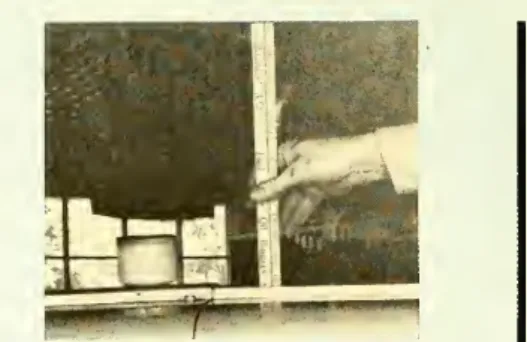
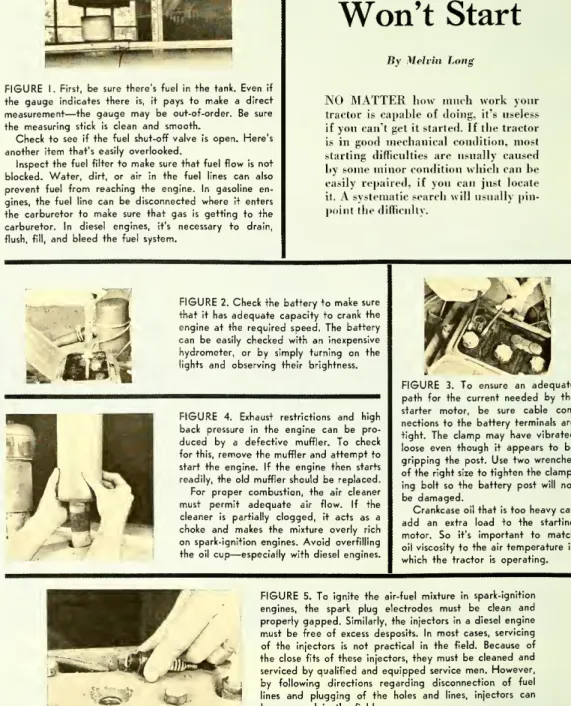
sure that gas is getting to the carburetor. In diesel engines, it's necessary to drain, flush, fill, and bleed thefuel system.If Your Tractor
Won't Start
By Melvin Long
NO MATTER how much work your
tractor iscapable
of doing,it's useless ifyou cant
getitstarted. Ifthe
tractor is ingood mechanical
condition,most
starting difficultiesare usually caused by some minor condition which can be
easilyrepaired,
ifyou can
just locateit.
A systematic search
willusually
pin-point the
difficulty.FIGURE
2.Check
thebattery tomake
sure thatithas adequate ca