Management at Administration
(MA)
Universitas Bina Darma
Purposes
• Mengetahui lingkup mata kuliah “Management at Administration” (MA)
• Memperkenalkan sistem pembelajaran MA
– Mode Pembelajaran – Komponen Penilaian – Score Penilaian
– Sumber Materi Ajar
– Dll.
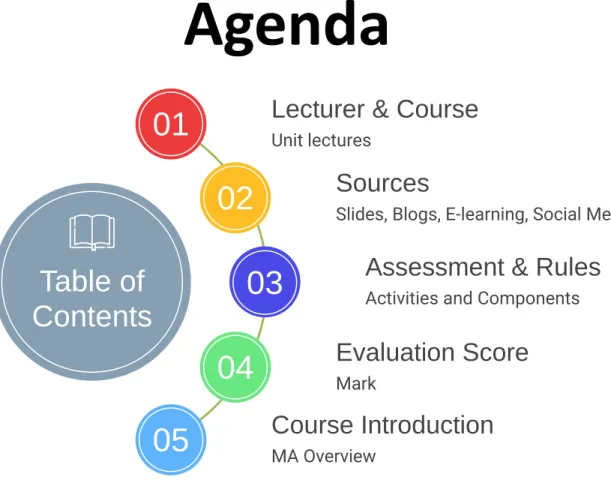
Agenda
Table of Contents
Unit lectures
Lecturer & Course
01
Mark
Evaluation Score
04
Slides, Blogs, E-learning, Social Meida
Sources
02
Activities and Components
Assessment & Rules
03
Lecturer Information
Computer Science & IS
Associate Professor
01
Enterprise Systems Group
Coordinator
06
Academic, Research, Community
Consultant
05
Publons, New Zealand
Mentor
04
HCI, KMS, CRM
Courses Coordinator
03
Journals & Conferences
Editor & Reviewer
02
Leon A. Abdillah
List of Courses Taught
07
Algorithms, Programming,
04
Human- Computer Interaction
01
Systems Analysis &
Design
09 Business
06 Human Capital Management
03 Research Methods
08 Supply Chain
05
Knowledge Management Systems
02 Enterprise
Systems
Unit Lectures
No Content No Content
1 Introduction to Office orientation 9 Travel arrangements
2 Communication 10 Human resources management
3 Recruitment and orientation 11 Accounts and financial services
4 Daily Exam 12 Procurement and inventory management
5 Records and information management
13 Sales, marketing and customer service
6 Reception and hospitality 14 Operations, Despatch and Transport Offices
7 Meetings 15 Presentations
8 Mid Exam 16 Final Exam
Learning Media & Sources
WhatsApp Group of MA
Moodle
Moodle elearning.binadarma.ac.id
Blogs
• blog.binadarma.ac.id/mleonaa
Teaching | Management Administation
• leonabdillah.wordpress.com | Teaching | Management Administration
MA 2020-2021 Genap
Assessment Component
15%
Quiz & Presence
01
Class Activities
40%
Final Test
04
Final Exam
20%
Mid Test
02
Middle Exam
25%
Tasks & Presentation
03
Reports
Course Rules
Discipline < 15 min late
03
Academic Rules
05
Schedule
06
Attendance >= 80%
02
Registered in KRS
01 04
HonestEvaluation Score
5 10 15 20 25 30 35 40 45 50 55 60 65 70 75 80 85 90 95 100
A A A A
B B B C C C
D D D
E E E E E E E
MA Overview
• Definition?
• What does the discipline of MA cover?
• Why study MA?
Core Concepts Preview
• Data
– Raw facts (fakta-fakta mentah) such as an employee’s name and number of hours worked in a week, inventory part numbers or sales orders.
• Information
– A collection of facts organized in such a way that they have additional value beyond the value of the facts themselves.
• Information Systems
– The collections of elements that processing data info information for specific
purposes
Data Processing
•
Data Information
$35,000 12 Units $12,000 J. Jones Western Region
$100,000 100 Units 35 Units
Data Processing
Salesperson: J. Jones Sales Territory: Western Region Current Sales: 147 Units =
$147,000
Data Processes
• The types of basic process are (Curtis and Cobham, 2004):
– classification of data;
– rearranging/sorting data;
– summarizing/aggregating data;
– performing calculations on data;
– selection of data.
Information Systems [1/3]
• The main area most associated with IT is Information Systems (IS). Both IT and IS rely on the central terminology, namely information (Abdillah,
2020).
• Information systems (IS) in organizations capture and manage data to produce useful information that supports an organization and its
employees, customers, suppliers, and partners (Whitten & Bentley, 2007).
• An information system (IS) can be any organized combination of people, hardware, software, communications networks, data resources, and
policies and procedures that stores, retrieves, transforms, and
disseminates information in an organization (O'Brien & Marakas, 2011).
Information Systems [2/3]
• An information system combines information technology, people, and data to support business requirements (Shelly
& Rosenblatt, 2012).
• Information system, an integrated set of components for collecting, storing, and processing data and for providing information, knowledge, and digital products (Zwass, 2016).
• An information system is a set of interrelated components that collect, process, store, and provide as output the
information needed to complete business tasks (Satzinger,
Jackson & Burd, 2016).
Information Systems [3/3]
• An information system combines technology, people, and data to provide support for
business functions such as order processing, inventory control, human resources,
accounting, and many more (Tilley, 2020).
Information Systems [4/4]
• IS
Information Technology
• Information technology (IT) refers to the combination of
hardware, software, and services that people use to manage, communicate, and share information.
• More than ever, business success depends on information technology.
• IT is driving a new digital economy, where advances in
hardware, software, and connectivity can provide enormous
Information Systems Types
• At least 3 (three) layers of IS (Zwass, 2016):
– Management Support – Support of Knowledge
Work
– Operational Support
Business IS
• The relationship between different parts of an
organisation and how they are related according to systems theory.
• The control mechanism is
indicated by the arrowed
line from the output back
to the input.
Office [1/2]
• The office is considered as the centre of any business, whether large or small (Trenfield-newsome & Walker, 2011).
• The functions of the office include:
– production;
– distribution and exchange of goods and services;
– collection, processing and preservation of information;
– dissemination of information;
– organizational and legal control.
Office [2/2]
• To some it is where the management is and where the paperwork is done: to others it is where the clerks do their work, where the
correspondence is done and where the filing is
kept (Eyre, 1989).
Management [1/2]
• The work of the office is now inextricably bound up with all levels of general
management (Eyre, 1989).
Management [2/2]
• A hierarchical structure of
management would
look like this:
Administration [1/2]
• Administrative activities and processes exist at all levels of management.
• Media information that is most in demand today can be accessed via the internet
(Manulang, Abdillah, & Kurniawan, 2017).
Administration [1/2]
• Attendance administration during the COVID-19 pandemic (Abdillah, 2020c) can be carried out using a number of applications:
– Cloud Zoom Meetings (Abdillah, 2020a)
– Employee Attendance Monitoring System (Munshi et al., 2019)
– Attendance using QR-Code (Al Satrio, Abdillah, &
You Know Now
• The MA discipline includes the study of:
– Data, Information
– Information Technology & Information Systems – Administration
– Management – Office
• MA is worth studying because it aligns both technolgy with administration and management aspects
17/02/2021 MA2021 - 01 Introduction 28
Homework
1. Prepare your SocialMedia ID (FaceBook)
2. Set a group discussion consist of 2-4 students for small class (<=20), 5-6 students for medium class (21-35), or 7-8 students for large class (>36) 3. Create an account in CloudPrepare your blog using WordPress
[yourname], create a PAGE/laman of “MA” or “Management Administration”.
4. Create a cloud repository (DropBox)
5. Develop your team project theme based on the information given from
several sources (journals, conference proceedings, books, or master
theses). You may use one of these sources: a) GOOGLE SCHOLAR
(http://scholar.google.com/) or b) MICROSOFT ACADEMIC SEARCH
Assignment
• Assignment 01
– Browse at least 5 (five) definitions of Administration, Management, Office (from Books, Journal Articles, etc.).
– Save your assignment in word as “MA2021-Class-01- Group/Name”
– Store it in DropBox, paste the URL from DropBox into
the submitted URL!
References
Abdillah, L. A. (2020a). Online Learning Menggunakan Zoom Teleconference: Work Form Home During COVID-19 Global Pandemic.
Retrieved from Computer Science and Information Systems website: http://eprints.binadarma.ac.id/4162/2/Abdillah2020
%5BOnline Learning Menggunakan Zoom Teleconference%5D 2020415.pdf
Abdillah, L. A. (2020b). Sistem Informasi (Information Systems). In Pengenalan Teknologi Informasi (Introduction to Information Technology). Medan: Yayasan Kita Menulis.
Abdillah, L. A. (2020c). Stigma Terhadap Orang Positif COVID-19. In Pandemik COVID-19: Antara Persoalan dan Refleksi di Indonesia. Medan: Yayasan Kita Menulis.
Al Satrio, M., Abdillah, L. A., & Syazili, A. (2017). Aplikasi Presensi Mahasiswa dengan Menggunakan QR Code Berbasis Android pada Universitas Bina Darma. Seminar Hasil Penelitian Ilmu Komputer Ke-2 (SENTIKOM2017).
https://doi.org/10.17605/OSF.IO/NMHRX
Bocij, P., Greasley, A., & Hickie, S. (2015). Business Information Systems: Technology, Development and Management for the E- Business (5th ed.). Harlow, UK: Pearson Education Limited.
Curtis, G., & Cobham, D. (2004). Business Information Systems: Analysis, Design and Practice (5th ed.). Essex, England: Pearson Education Limited.
Munshi, A. … Babteen, B. (2019). Employee Attendance Monitoring System by Applying the Concept of Enterprise Resource Planning (ERP). International Journal of Education and Management Engineering, 9(5), 1–9.
https://doi.org/10.5815/ijeme.2019.05.01
O’Brien, J. A., & Marakas, G. M. (2011). Management Information Systems (10th ed.). New York, USA: McGraw-Hill Companies, Inc.
Satzinger, J. W., Jackson, R. B., & Burd, S. D. (2016). Systems Analysis and Design in a Changing World (7 ed.). Boston, MA, USA:
Cengage Learning.
Shelly, G. B., & Rosenblatt, H. J. (2012). Systems Analysis and Design (9th ed.). Boston, MA, USA: Course Technology, Cengage Learning.
Tilley, S. (2020). Systems Analysis and Design (12th ed.). Boston, MA, USA: Cengage Learning, Inc.
Trenfield-newsome, A., & Walker, C. (2011). Office Administration for CSEC Examinations. In Capacity building for local NGOs: A guidance manual for good practice. Oxford, UK: Macmillan Publishers Limited.
Whitten, J. L., & Bentley, L. D. (2007). Systems Analysis and Design Methods (7th ed.). New York, USA: The McGraw-Hill Companies, Inc.
Zwass, V. (2016). Information system. Encyclopædia Britannica, from https://www.britannica.com/topic/information-system