THE USE OF POLITENESS BY STUDENTS DURING DISCUSSION SESSION IN EFL CLASS
(A Descriptive Qualitative Study in Fifth Semester of English Department of IAIN Bengkulu, Academic Year 2018/2019)
THESIS
Submitted as A Partial Requirements for the degree of Sarjana in English Education Program
By :
AULIA ARIFANI MILADESIA 1416232930
ENGLISH EDUCATION STUDY PROGRAM ISLAMIC EDUCATION AND TADRIS FACULTY
THE STATE INSTITUTE OF ISLAMIC STUDIES OF BENGKULU 2019
MOTTOS (ا َع ِشر )
اَنَعَم َ َالَل َّنإ نَزحَت َلَ
“Don‟t be sad, Allah is with us” (QS.At-Taubah:40)
“A good head and good heart are always a formidable combination. But when you add to that a literate tongue or pen, then you have something very special.”
-Nelson Mandela-
If you want to reach your dreams, work hard and prays. Without that, your dream means nothing.
DEDICATION AND SPECIAL THANKS The writer would like to thank to :
1. Allah SWT that gave me power to finish this and help me always 2. My beloved parents, Drs. Milsef Hubran and Dra. Desma Heryani, that
always support no matter what, gave motivation, pray, and my beloved brother, Arsyi Arif Agami, thank you so much boy
3. My big family, aunts, uncles, my cousins, grandparents. Thank you for always supporting me
4. My beloved friends, Farida, Monica Meliyani Putri, Afif Pratiwi, Ghea Aristy, Ninda Agusti Aulya, Berti Ayu Mahadiyanti, Dian Fernanda, Alna Wijiana, Ratih Edvika Dewi. Thank you girls for your support, let‟s be friends till forever, love you guys
5. My unique friends in Class D 2014, you are the best guys, let‟s be success together
6. My partner in crime, Rizky Devi Ayustina. Thank you for being my back during this journey. Thank you so much.
7. My almamater, IAIN Bengkulu.
8. My friends TBI 2014, thank you so much for your help, and all my friends for being such as big inspiration for me, made me dare to dream big and being a motivation during this critical journey.
9. All people that could not written one by one that help writer to finish this thesis
ABSTRACT
Aulia Arifani Miladesia 2019 “The Use of Politeness by Students during Discussion Session in EFL Class (A Descriptive Qualitative Study in Fifth Semester of English Department of IAIN Bengkulu, Academic Year 2018/2019)”.
Thesis : English Letters Study Program, Islamic Education and Tadris Faculty, IAIN Bengkulu.
Advisor : 1. Riswanto, Ph.D. 2. Detti Lismayanti, M.Hum.
Keyword : Politeness, students, discussion, attitude, EFL Class.
The aim of this study was to find out about the use of politeness by students during discussion session in the class. The problem that mostly missed from teaching-learning process is politeness during discussion. The design of this research is descriptive-qualitative with population of the students on fifth semester of English Department IAIN Bengkulu in EFL Class (TEFL). The sample of this research was class 5A, 5B, 5C, and 5D with about 30 students each class. EFL Class is a class that use most English as majoring medium of instruction. In EFL Class, students are taught about what learning in English look like, such as manners, language, and action, including politeness. The instrument used was field notes, video recording, observation checklist, and documentation. This research focused on student discussion in the class. Researcher observed class activity and what happen during discussion, such as student‟s activity, group‟s attention, concentration, and attitude. Researcher matched what happen in the class with table of student utterances, observation checklist, made field notes, and give a brief question for complete the data. The result of this research showed that students in this semester did not realize that they use politeness during discussion session. There are some category for politeness, like exploratory, evaluation, desultory, disputational, and question. For example, Ok, we are from group two, and today we were going to explain about our material is exploratory, Have you opened the page? Is question, That is our presentation today, thanks for your attention. Let’s close this presentation by reciting hamdalah is evaluation. Student did not realize these sentences is kind of politeness. They just want to deliver the material to audience in the class. Besides that, they did not use politeness because they did not know what is it and how to do it. They just use English straightforwardly and focus on ability to speak more than care about advance manner such as politeness.
From explanation above, it can be conclude that student of Fifth semester of English Department IAIN Bengkulu did not realize that they use politeness, but did not use these as full as possible.
ABSTRAK
Aulia Arifani Miladesia 2019 “The Use of Politeness by Students during Discussion Session in EFL Class (A Descriptive Qualitative Study in Fifth Semester of English Department of IAIN Bengkulu, Academic Year 2018/2019)”.
Skripsi : Program Studi Pendidikan Bahasa dan Sastra Inggris, Fakultas Tarbiyah dan Tadris, IAIN Bengkulu.
Pembimbing : 1. Riswanto, Ph.D. 2. Detti Lismayanti, M.Hum.
Kata kunci : Sikap formal, siswa, diskusi, sikap, EFL Class
Tujuan dari penelitian ini adalah untuk melihat penggunaan sikap formal oleh siswa dalam kegiatan diskusi di dalam kelas. Masalah yang sering timbul dalam proses belajar-mengajar adalah sikap formal dalam melakukan diskusi.
Desain penelitian dari studi ini adalah deskriptif-kualitatif dengan populasi nya adalah para siswa semester 5 Prodi Tadris Bahasa Inggris IAIN Bengkulu dalam kelas EFL (TEFL). Sampel untuk penelitian ini adalah kelas 5A, 5B, 5C dan 5D dengan jumlah siswa tiap kelas adalah 30 orang siswa. EFL Class adalah kelas yang menggunakan bahasa inggris sebagai media pengantar di Negara yang bahasa inggris bukan sebagai bahasa utama nya. Dalam EFL Class, siswa diajarkan tentang bagaimana cara belajar dalam bahasa inggris itu, seperti sikapnya, bahasa, tingkah laku, dan kesopanan itu sendiri. Instrumen yang digunakan adalah tabel ujaran siswa, catatan lapangan, rekaman video, daftar observasi, dan dokumentasi. Penelitian ini berfokus pada kegiatan diskusi siswa di kelas. Peneliti memperhatikan kegiatan kelas, dan apa yang terjadi selama kegiatan diskusi itu berlangsung di dalam kelas, seperti kegiatan siswa, perhatian kelompok, konsentrasi kelas, dan sikap mereka. Peneliti mencocokkan apa yang terjadi di dalam kelas dengan daftar observasi, membuat catatan lapangan, dan memberikan pertanyaan singkatkepada siswa untk melengkapi data yang ada.
Hasil diskusi ini menunjukkan bahwa siswa di semester ini tidak menyadari penggunaan sikap formal selama diskusi dilaksanakan. Terdapat banyak jenis dari sikap formal ini, seperti exploratory, evaluation, desultory, and question.
Contohnya, Ok, we are from group two, and today we were going to explain about our material adalah exploratory, Have you opened the page? adalah question, That is our presentation today, thanks for your attention. Let’s close this presentation by reciting hamdalah adalah evaluation. Para siswa tidak menyadari bahwa kalimat-kalimat ini adalah politeness. Mereka hanya ingin menyampaikan materi kepada audien di kelas. Mereka memilih untuk mengesampingkan sikap formal ini. Dari penjelasan diatas, dapat disimpulkan bahwa siswa semester 5 Prodi Tadris Bahasa Inggris IAIN Bengkulu tidak menyadari bahwa mereka menggunakan sikap formal tetapi tidak menggunakannya secara penuh.
ACKNOWLEDGMENT
Firstly, the researcher would like to acknowledge her countless thanks to the Most Gracious and the Most Merciful, Allah SWT who always gives us all the best of this life and there is no doubt about it. Shalawat and Salaam to the Prophet Muhammad SAW and his family, so the researcher possible to complete this thesis in order to fulfil the requirement of S-1 degree in English Education Program, Tarbiyah and Tadris Faculty, IAIN Bengkulu.
The researcher also would like to express sincere thank to :
1. Prof. Dr. H. Sirajuddin M, M,Ag., MH as the head of the State Islamic Institute of Bengkulu
2. Dr. Zubaedi, M.Ag., M.Pd. as the Dean of Education and Language Faculty
3. Riswanto, Ph.D., as the first advisor who with his patience always gives his ideas, time, and useful suggestions for researcher.
4. Detti Lismayanti, M.Hum., as second advisor who gives her correction and advices, so the writer can finish this thesis well.
TABLE OF CONTENTS
TITLE ... i
RATIFICATION ... ii
PRONUNCEMENT ... iii
ADVISOR SHEETS ... iv
MOTTOS ... v
DEDICATION AND SPECIAL THANKS ... vi
ABSTRACT ... vii
ABSTRAK ... viii
ACKNOWLEDGMENT ... ix
TABLE OF CONTENTS ... x
LIST OF APPENDICES ... xii
LIST OF TABLES ... xiii
LIST OF FIGURES ... xiv
CHAPTER I : INTRODUCTION A. Background ... 1
B. Identification of The Problem ... 6
C. Limitation of The Problem ... 8
D. Research Question ... 8
E. The Objective of Study ... 8
F. Significant of The Study ... 8
G. Definition of Key Terms ... 9
CHAPTER II : LITERATURE REVIEW A. The Concept of Using Politeness ... 11
B. The Concept of Group Discussion ... 20
C. The EFL (English as Foreign Language) Class ... 24
D. The Concept of Using Politeness during Discussion Session in EFL Classroom ... 25
E. Related Previous Studies ... 27
CHAPTER III : RESEARCH METHOD A. Research Design ... 30
B. Location and Subject of The Research ... 32
C. Data Collecting Technique ... 32
D. Research Instrument ... 35
E. Data Analysis ... 37
F. Technique of Data Analysis ... 38
G. Data Validity ... 40
CHAPTER IV : RESULT AND DISCUSSION A. Result ... 43
B. Discussion ... 69
CHAPTER V : CONCLUSION AND SUGGESTION A. Conclusion ... 79
B. Suggestion ... 79 REFERENCES
APPENDICES
LIST OF APPENDICES
Appendices 1 Data Collecting Technique Scheme Appendices 2 Observation Checklist
Appendices 3 Documentation Appendices 4 Field Note
Appendices 5 Script of Utterances Appendices 6 Surat Izin Penelitian
Appendices 7 Surat Keterangan Selesai Penelitian Appendices 8 Kartu Bimbingan
LIST OF TABLES
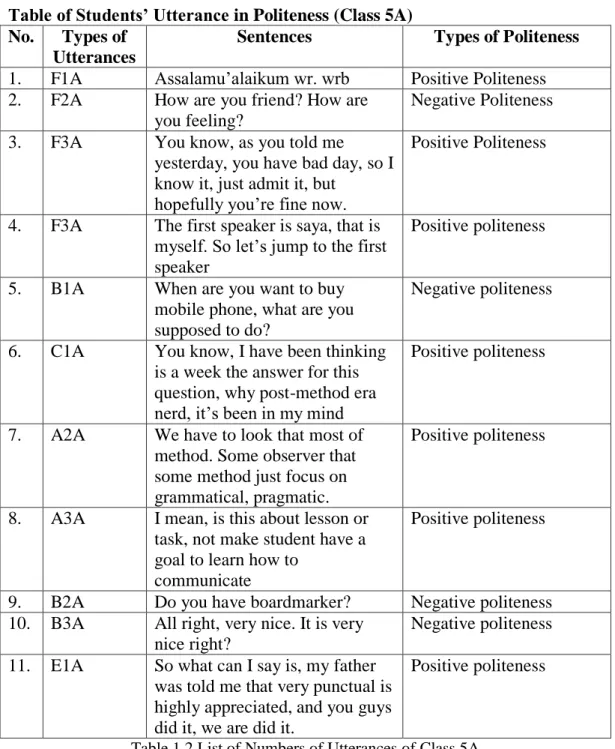
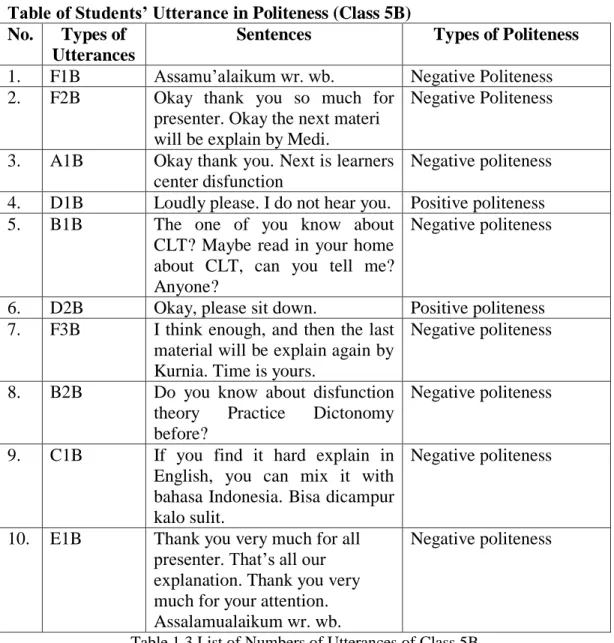
Table 1.1 List of Student‟s Utterances
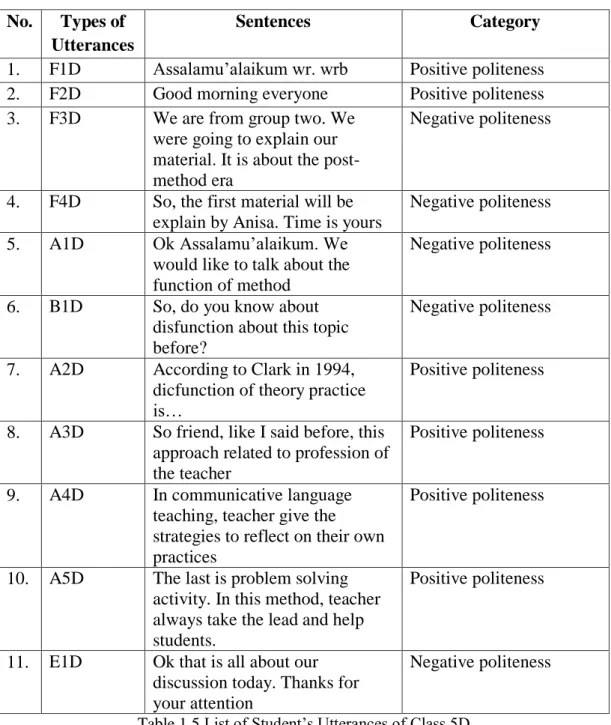
Table 1.2 List of Numbers of Utterances of Class 5A Table 1.3 List of Numbers of Utterances of Class 5B Table 1.3 List of Numbers of Utterances of Class 5C Table 1.4 List of Numbers of Utterances of Class 5D
LIST OF FIGURES
Figure 1.1 Possible Strategies for doing FTAs Brown & Levinson Figure 1.2 Component of Data Analysis
CHAPTER I INTRODUCTION
A. Background of Study
People need a language to communicate with others. According to KBBI (2005), language is a symbol of sound system that arbiters, which used by community for doing work together, doing interaction, and self- identify1. In addition, Oxford defined language as system of communication in speech and writing used by people of a particular country2. Chomsky defined language as a set (finite or infinite) of sentences, and language is the mirror of mind.3 So, language is a tool for speaking and writing by people in daily life.
Briefly, language separates into 2 forms, spoken language andwritten language. Spoken language is a language that spoken directly by person. Spoken language said by someone when they communicatewith other people, like in the market, talking with friends, chatting with family, and many more. Example of spoken language is “Hello guys, how are you today?”
Written language is a language that written or printed. Written language also defined into standard and non-standard language. The
1KBBI, 2005.
2Oxford Dictionary.2008. Oxford University Press. p. 247
3Chomsky, N. (1975). “Reflections on language”. Research in Chris Werry :Reflections on language: Chomsky,linguistic discourse and thevalue of rhetoricalself consciousness, January 2006. San Diego :San Diego State University
example of written language is in newspaper, magazine, textbook, and others. Spoken language has a connection with pronunciation, because good pronunciation will make other people understand with our words.
The same as written language. Written language has a connection with grammar, word structure, and things like that, because written language written on the paper and people will read it. The words and sentences in the paper must be written correctly so that readers could understand the meaning of the texts. In spoken language we could use gesture or could pointing at something we want to say, but written language could be different, so that‟s why written language must written correctly and readers will not misunderstand the content. Spoken language and written language separates into two parts, formal language and non-formal language. Formal language is a language that fit with fixed spelling or well-formed.Formal language is use in situations that are serious or that involve people we do not know well4. For example “She has decided to accept the job”. Non-formal language, also called informal language, is a language that use for speak without heed a row-composition-word.
Informal language is more commonly used in situations that are more relaxed, or involve people we know well5. For example “She‟s decided to accept the job”. These sentences also can be found in spoken and written language.
4Cambridge Online Dictionary. 2018.
5Ibid.
Politeness is needed in every particular life. Politeness is about keeping good relations with your listener or reader6. Politeness is important because it is showing the listener or reader that we value and respect them, and changing or softening what we say so is not too be forceful7. Politeness is also needed in academic purposes for make teaching-learning process well. The example of politeness in academic is when it is practiced in discussion class, or when teacher doing an affective process.
Discussion is a group activity. According to Oxford Dictionary, discussion is the action or process of talking about something in order to reach decision or to exchange ideas8. Discussion used for pedagogical purposes are instructional conversations and substantive conversations.
Discussion also an important way for delivering some topic, because it would compiled all aspirations from many people in one group discussion.
That is why discussion is used in school and university, so students could improve their speaking ability and learnt how to solve a problem with cooperation of many people to get solutions. Discussion would show student‟s capability in delivering material to others, explain the problems, found new information, some facts, even found answers from these critical problem.
Nowadays, students are familiar with discussion in class and almost of subject given use discussion as a method. It will improve
6Ibid.
7Cambridge Online Dictionary. 2018.
8Oxford Dictionary.2008. Oxford University Press.
students confident and they will try to understand the material that they have responsibility to tell it to the audience. So, what is the connection with language? Of course as tool for transfer the material. Beside from communicate in real life, language also use in teaching-learning process, in the class, for academic purpose. Christensen said that teaching explained as engagement with learners to enable their understanding and application of knowledge, concepts, and process. The aim of teaching is not only to transfer information, but also make students transform from passive recipients into active delivers9. In Merriam Webster Dictionary, learning is an activity or process of get and improving knowledge or skill by study, practice, being taught, or experiencing something10.There are 3 definitions, as teaching is a process of transform knowledge and culture to students. Others, teaching also an organized activity or arranged environment as well and make it connected with students. Teaching made teacher has a role as the omniscient and as a person that organize anything that has relation with learning and students.
From explanation above, teaching-learning process is acts that give experiences to meet goals that already fixed, such as cognitive, affective, psychomotor. In this activity, teacher and student will communicate for understanding the material that given that day. Discussion activity make
9C. Roland Christensen, David A. Garvin, and Ann Sweet (edited). 2013. Education for judgment:
The artistry of discussion leadership. Cambridge, MA: Harvard Business School.
10Merriam Webster Dictionary. 2013. Retrieved from https://www.sun.ac.za/english/learning- teaching/ctl/t-l-resources/curriculum-t-l-assessment
students improve their logical thinking because, there is an argumentation session in discussion. Next, feedback could be given directly, so presenter could correct their speaking, including language feature and non-language feature, like formal language. That is why language is so important in discussion session, especially when we taking EFL class.
Unfortunately, students nowadays are not too aware about how they will provide material to audience, especially in IAIN Bengkulu. They just talk in their own repertoire without care about the language. Although they are English students, there are many students that do not understand how to use language in formal situation, like in the class. They think that English has the same level in speak for forum and speak with friends, not like in Indonesia language. In Indonesian language, we could tell the difference between formal and non-formal language, and it is quite hard to tell the difference in English because of same words. That is one of the reasons why students did not really care about formal language in formal situation. Other reasons, they did not have good vocabulary, and did not understand what the word, what the sentences that they have to use in doing discussion. This problem often happen in students of higher level, for example 5th until high semester.
People think that students in higher level are capable to speak well, including doing discussion. In fact, they often do not know about that.
They just do discussion like they do speaking test, so they did not know what they have to do or what rule they have to follow in discussion
session, because they arenot familiar with politeness during discussion, even they do not know realize that sometimes they use politeness in class or discussion.
According to these problem, it is true that students in IAIN Bengkulu had problems in delivering material using formal language in discussion session in their class. Therefore, the researcher was interested in doing research entitled “The Use of Politeness by Students during Discussion Session in EFL Class (A Descriptive Qualitative Study in Fifth Semester of English Department of IAIN Bengkulu Academic Year 2018/2019)”.
B. Identification of The Problem
There are many problems faced by students of Fifth semester in English Department of IAIN Bengkulu in using politeness, or formal language during discussion. They lack in vocabulary and understanding the meaning. They can remember more vocabulary, but they often forget, so when they want to said or delivered something, they did not understand what they have to say. Students hard to find a proper word and choose to use daily words they know.
Actually, we could not know what the factors that affected students for use the formal language, but it is according to the class. When they get a class that not care much about speaking way, students will use word that they think as long as the audience understand what he said. On the other
side, if they get a class that pay attention to speaking way and politeness, they will find it hard to choose proper word, so they often doing presentation using mixing language, for example English and Bahasa Indonesia. Actually, this is makes some problem, because for students with higher grade or higher semester, they are have been asking for speaking well in English, with fixed grammar and pronunciation. EFL (English as Foreign Language) Class always demand their students to good at speaking, is different from ESL (English as Second Language) Class.
As we know, ESL Class is for students that could speaking English fluently, because they use English as second language, so they did not have much problem in speaking and how to speak in formal forum and daily forum. They talk and speak naturally, and did not have any problem in deliver material in English. ESL Class is applied in countries that use English as their second language for daily activity, for public communication, and for education, for example India, Malaysia, Singapore, and many more. For EFL, students are learning English as foreign language for improve their skill. It means that students just know some of English, and they have to speak in English for each material for improve their ability. It is because English is not their language. They consider English as foreign language. EFL is applied in countries that still developing their state, such as Indonesia. These countries did not use English as their language for daily activity. English just learnt for
academic purpose, or in a course. So that is why English is not common for communication tool for citizen, just people that have needs whose use English. Many students in the school, even in University level just learnt English for get a score in school, or else academic purpose. English major students are not out of exception in this case. They also have difficulties in learnt basics English such as politeness for discussion.
C. Limitation of The Problem
The study is limited on students in using politeness during discussion session in EFL Class at the fifth semester of English Department in IAIN Bengkulu. The students‟ level that will be researched is the fifth semester of English Department in IAIN Bengkulu.
D. Research Question
Based on the background above, the rob formulation of the problem is: How students using politeness during discussion session in EFL Class?
E. The Objective of Study
The objective of this research is to describe about the students‟
using politeness during discussion session in EFL Class based on their age at the fifth semester students of English Department IAIN Bengkulu.
F. Significant of The Study
The study is significant from theoritical and practical perspectives.
First, theoritically, this study is expected to inform students especially who are doing discussion session as their way in study to improve their level of speaking in formal situation, like academic purposes level. Second, for improve their confidence when speaking in front of the class and improve their ability in speaking using politeness. Last, it could help lecturer of the class find how to improve student‟s ability in speaking during academic purposes using politeness or formal language.
G. Definition of Key Terms
Based on the explanations above, it is important to define some key terms that become center of this research; they are :
1. Language is a tool for speaking and writing by people in daily life.
language separate into 2 forms, spoken language and written language.
Spoken language is a language that spoken directly by person. Written language is a language that written or printed.
2. Politeness is about keeping good relations with your listener or reader.
Politeness is important because it is showing the listener or reader that we value and respect them, and changing or softening what we say so is not too be forceful.
3. Discussion is a group activity. It is the action or process of talking about something in order to reach decision or to exchange ideas.
Discussion used for pedagogical purposes are instructional conversations and substantive conversations.
4. EFL Class is class where students are learning English as foreign language for improve their skill. It means that students just know some of English, and they have to speak in English for each material for improve their ability.
CHAPTER II LITERATURE REVIEW
A. The Concept of Using Politeness
1. The Definition of Language and Politeness a. Language
Language is tool of communication. People need language to communicate with others. Chomsky defined language as “a set (finite or infinite) of sentences, each infinite in length and constructed out of finite set of elements”.11 So, language is a tool for speaking and writing by people in daily life.
Briefly, language separate into 2 forms, spoken language and written language. Spoken language is a language that spoken directly by person. Spoken language said by someone when they communicate with other people, like in the market, talking with friends, chatting with family, and many more. The example of spoken language is “Hello guys, how are you today?”
Written language is a language that written or printed.
Written language also defined into standard and non-standard language. The example of written language is in newspaper, magazine, textbook, and others. Spoken language has a connection
11N. Chomsky. “Reflections on language”. Research in Chris Werry : Reflections on language:
Chomsky, linguistic discourse and the value of rhetorical self consciousness, January 2006. San Diego : San Diego State University.
with pronunciation, because good pronunciation will make other people do not misunderstand with our words. It is different with written language. Written language has a connection with grammar, word structure, and things like that, because written language written on the paper and people will read it. The words and sentences in paper must write correctly so that readers could understand the meaning of contexts. In spoken language we could use gesture or could pointing at something we want to say, but written language could not do that, so that‟s why written language must written correctly and readers will not misunderstand the content. Spoken language and written language separates into two parts, formal language and non-formal language. Formal language is a language that fit with fixed spelling or well-formed. Formal language is use in situations that are serious or that involve people we don‟t know well12. For example “She has decided to accept the job”. Non-formal language, also called informal language, is a language that use for speak without heed a row-composition-word.
Informal language is more commonly used in situations that are more relaxed, or involve people we know well13. For example
“She‟s decided to accept the job”. These sentences also can find in spoken and written language.
12Cambridge Online Dictionary. 2018.
13Ibid.
b. Politeness
Politeness is one of sociolinguistics form. It is because politeness has a relation with sociolinguistics itself. According to Ronald Wardhaugh (2009), sociolinguistics is a study for observing relationships right above language and society. The goal is for being a better understand the language structure and how the function of language in society class. The goal of sociolinguistics is how when we studying the language, we could also understood about its social structure.14 Politeness as a kind of sociolinguistics, is one way to analyze how make students understand the material during discussion with use politeness as a part of communication without reduce the learning goals. Usually, students do not want to use politeness, because they think that their classmate which not fluent in English will hard to absorb the material.
The concept of politeness is come from Goffman‟s work (1955,1967). In social interaction, people represent the face to others and vice versa15. It is also applied when we doing a discussion in the class, because class involve of students and teacher. The class is a social place, so politeness has to use in kind of situation, especially during discussion.
It can be summarized that politeness is the use of an appropriate word or phrase in the appropriate context, which is
14 Ronald Wardhaugh. (2009). An Introduction to Sociolinguistics. Oxford : Wiley-Blackwell. p.12
15Ibid.p.291
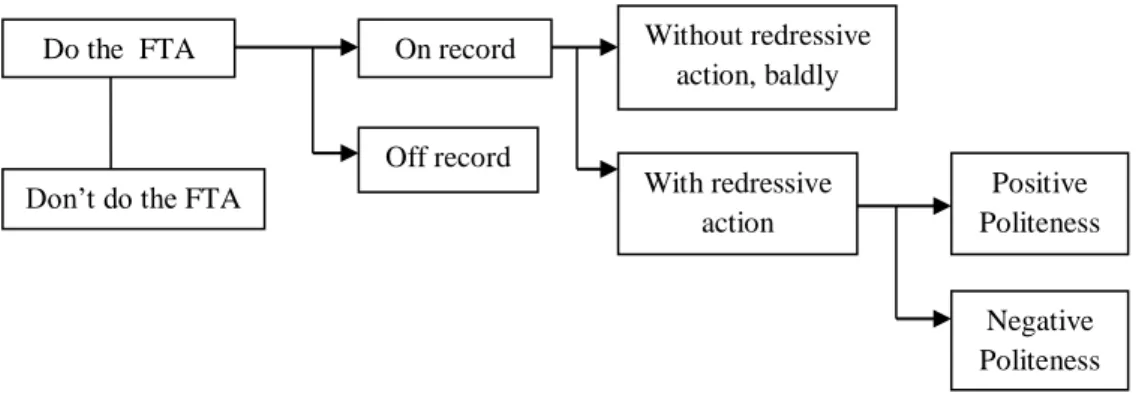
determined by the rules that are prevalent in society. In social interaction, to maintain politeness is to maintain harmonious and smooth social interaction, and avoid the use of speech acts that are potentially face-threatening or damaging. The principle is based on the use of politeness intimacy, closeness, and relationships, as well as the social distance between the speaker and the hearer. People choose and implement certain values in certain pragmatic scale, according to the culture and conditions of the existing situation in social interaction. Brown and Levinson's politeness theory16 classifies five strategies:
- to follow what it says, bald on record
- perform speech acts using positive politeness (refers to the positive face)
- perform speech acts using negative politeness (refers to the face of a negative)
- indirect speech act (off the record)
- do not do speech act or say anything (do not do the FTA).
16 Brown, P. & S. Levinson. (1987). Politeness. Cambridge: Cambridge University Press
In connection with this politeness strategy, here are the possible strategies for doing FTAs
Figure 1.1 Possible Strategies for doing FTAs Brown & Levinson
Politeness is about to keeping good relations with your listener or reader17. There are two types of politeness :
1. Showing the listener or reader that you value and respect them 2. Changing or softening what you say so as not to be direct or
forceful
In the late 1970‟s, the subject of politeness became a major concern in the field of pragmatics and it has been discussed widely among pragmaticists. Based on latest criticism of early theories of politeness, it is possible to establish a context for the teaching of politeness in English subject in EFL Class. According to Brown and Levinson‟s theory, it did not attend explicitly to the study of politeness18. Brown and Levinson said that face, being the public self-image that every
17Ibid
18Brown, P. & S. Levinson. (1987). Politeness. Cambridge: Cambridge University Press.
Do the FTA
Don‟t do the FTA
On record
Off record
Without redressive action, baldly
With redressive action
Positive Politeness
Negative Politeness
s
member of society wants to claim for himself, consist of two aspect, positive and negative face19. The first acknowledges the fact that we want others to show us what we are liked, accepted and understood.
Richard Watts has another opinion. He said that politeness is a dyamic processby which being polite is connected with individual‟s interpretation of linguistics structures as polite or impolite during a conversation20.
As shown in figure above, there are two types of politeness with action, positive politeness and negative politeness. Negative politeness, with its derivative politeness of non-imposition, is familiar as the formal politeness that the notion politeness shows up directly.
Positive politeness is little bit obvious. The reduction of a person's public self-image or personality to a want that one's wants be desirable to at least some others can be justified in this way. The most important aspect of a person's personality in interaction is what that personality requires of other person that did interaction. It includes the desire to be assessed, understood, approved, liked or admired. The next step is to represent this desire as the want to have one's goals thought of as desirable.
Positive politeness is orientated toward the positive face of person, the positive self-image that he claims for himself. Positive politeness
19Ibid
20Watts, Richard. 2003. “Politeness”. CJS Online January-February 2005. Cambridge : Cambridge University Press.
is approach-based, that treated the face of the addressee by indicating that in some respects, for example by treating him as a member of an in-group, a friend, a person whose wants and personality traits are known and liked. The potential face threat of an act is minimized in this case by the assurance that in general A wants at least some of B's wants. For example, that A considers B to be in important respects, same as he, with in-group rights and duties and expectations of cooperation, or with implication that A likes B so that the FTA doesn't mean a negative evaluation in general of B's face. The example of positive politeness are when we need a help and we want another person to help us, like “Sorry Anne, because you have a good memory, can you help me to how to analyze this task that gave by our Professor this afternoon?”
Negative politeness, on the other hand, is basic want to maintain claims of territory and self-determination. Negative politeness is essentially avoidance based, and realizations of negative-politeness strategies consist in assurances that the speaker recognizes and respects the addressee's negative-face wants and will not (or will only minimally) interfere with the addressee's freedom of action. It follows that negative politeness is characterized by self-effacement, formality and control, with attention to very restricted aspects of B's self-image.
Face-threatening acts are balanced with apologies for interfering, with linguistic and non-linguistic politeness, with limitation on the
interactive force of the act, with impersonalizing mechanisms and with other softening mechanisms that give the addressee a result, permitting him to feel that his response is not threatened others. The example of negative politeness is “Hi Julie, I am sorry to disturb, but can you tell me what task that gave by Mr. Jack this afternoon?”. The more unbothered answer like “No” we got, the more polite that utterances said by person.
According to Brown and Levinson, these are strategies and example for positive politeness and negative politeness21 :
1. Positive Politeness
- Notice, attend to interest, wants, needs, & goods (Strategy 1)
- Exaggerate (interest, approval, symphaty) (Strategy 2) - Intensify interest (Strategy 3)
- Use in-group identify markers (Strategy 4) - Seek agreement (Strategy 5)
- Avoid disagreement (Strategy 6)
- Presuppose/raise/assert/common ground (Strategy 7) - Joke (Strategy 8)
2. Negative Politeness
- Be conveniently indirect (Strategy 1) - Question, hedge (Strategy 2)
21 Brown, P. & S. Levinson. (1987). Politeness. Cambridge: Cambridge University Press. p.316
- Be pessimistic (Strategy 3)
- Minimize the imposition (Strategy 4) - Give deference (Strategy 5)
- Apologize (Strategy 6)
For discussion in the class, showing the audiences that you value or respect them is a basic rule in politeness. It means that the presenter or moderator in discussion care enough about audiences presence and listen to their opinions, questions, critics and advices in the forum. It is same with softening the way when spoke in the class. The presenter arrange their tone and chose words that not forceful, so audiences did not feel like spoiled by presenter or group that do discussion, they talked in discussion naturally and shared their opinion without fear and could deliver it wisely.
Teaching pragmatics, such as politeness, has many considerations, because there are difficulties in grammar for students. Teacher could provide student with speaking opportunity by giving them a communicative task. It could improve their conversational skill22Many teachers already covers matters of politeness or impoliteness in the class without realizing it. The teaching of the use of formal or informal language in different contexts, direct or indirect speech, hedging, value language, greetings, making farewell, and others.
22AnetaSubertova. 2013. Aspect of politeness in a classroom of English as a second language.
Prague : Charles University in Prague.
B. The Concept of Group Discussion 1. The Definition of Discussion
Discussion is a group activity. According to Oxford Dictionary, discussion is the action or process of talking about something in order to reach decision or to exchange ideas23. Discussion used for pedagogical purposes are instructional conversations and substantive conversations. Group discussion is a regular process that involve some people on face informal interaction with many experiences or information, getting conclusion or problem solve. So, group discussion is an activity that has tied on a main problem or questions, and member of that forum solved it together.
There are some kind of discussion :
a. Whole-group discussion, discussion that member of group consist not more than 15 persons.
b. Buzz-group, a big group that separates into 2 until 8 small groups. If needed, these small group will reporting their result to big group.
c. Panel, in this discussion, one small group (consist of 3-6 persons) discuss about subject, and they sit in semi-circle and facing another big group.
d. Symposium, this technique same with panel, but with more formal situation. In this discussion, moderator not active as in
23Oxford Dictionary.2008. Oxford University Press.
panel discussion. Moderator only coordinates interaction.
Sometimes, people did not want to doing this type, because not active as panel, and hard to find opponent that has good material that efficient and comprehensively. The benefit of Symposium is member discuss actual report and give a chance to participant actively.
e. Caologium, is a discussion that doing with one or more informants, that give an opinion, and answering questions directly, not like speech.
f. Informal-Debate, in this discussion class is separate into two groups with same level and same number.
g. Fish-Bowl, consists of one moderator and one or three informants.
There are another division of group discussion, they are
a. Class Discussion. Also called group discussion, is a process of problem solving that doing by all of class member as a participant. Teacher will divide class into some groups, and then give each group a problem that must be solving by them.
When doing presentation, group will given 10-15 minutes for solve the problem. Then, participant could give presenter a questions. After that, presenter will give an answer and moderator will conclude the result.
b. Small Group Discussion, doing by divide students into some groups. The member of each group are 3-5 students.
Performance starts with teacher give a problem to them. In the end, leader of each group will deliver the result.
c. Symposium, is a teaching method with discussing a problem from many point of view depend on skill.
d. Panel Discussion, is discussing problem which doing by some panelists that consists of 4-5 persons in front of audiences. In panel discussion, audiences did not participate directly, but has a role for analyze the panelists. After that, students will decide the result of discussion.
The most common of discussion that applied in the class by teacher or lecturer are class discussion and small group discussion. These are the easy type of discussion that could be use by student. Class discussion or group discussion would helped student analyze the problems, found the solution, and shared it in front of class. It increased their social experience, such as understand each other opinions, then gathered the opinion, and found a solution together. They could also improved their public speaking by shared the solution in front of the class. For small group discussion, it is have the same way as group discussion. The differences is, if group discussion
just said the result in front of the class, the small group discussion let each group talked one by one in front of the class in rotation. Per group discuss one topic, and it takes 10-15 minutes for explanation for the topic.
2. The Benefit and Weakness of Group Discussion a. The Benefits
There are many benefits that we could get from doing discussion. First, group discussion is one of the ways of teaching- learning process that applied on all of subject with limit of discussion. Second, students could shared information for cover new ideas or solved problem. Third, they could improved their understanding on important issues. Next, they could enhanced their ability in think and communicated. Others, this is could develope students‟ discipline on planning and taking decision, and students‟
work spirit and responsibility.
b. The Weakness
Beside from benefit, discussion also has weakness that can affect them, like, this method need more time than usual method.
Member did not participate actively and just gave responsible to member that has good ability, and of course this would dominate
by certain persons. They just point of one person that they sure he/she has ability to take whole activities.
C. The EFL (English as Foreign Language) Class 1. The Definition of EFL Classroom
An EFL (English as Foreign Language) is where the teacher teaches English to students in a country where English is not the native language24. For example, Indonesia, Chinese, Japan, and many more.
An EFL Classroom is in a country where English is not the dominant language. The teacher may be the only native English Speaker they have exposure to, or teacher from that country but he has good repertoire and fluent in English. Outside of classroom, students have a less opportunities to use English. They just use English in academic purposes, without needs to improve their English in daily basis.
An EFL student usually came from the same country. They would have the same culture and made similar mistakes in the target language. EFL student is far more likely to be learning the language for academic purposes and the emphasis of teaching will be different.
Students are usually more receptive to learning reading and writing and less concerned with speaking and listening, unless they work in an industry where they communicate with native speaker. The teacher
24 William Lake. 2013. The Difference between ESL and EFL : Teaching English. New York : Bright Hub Education. p. 1
will be required change the teaching strategy depend on student‟s need25.
Kate Bell from Oxford University, said that there are some needs for EFL students improve their ability26 :
a. Lots of practice using English, especially orally. Not just get them speaking in the classroom, but also practice outside class b. Exposure to living English. Do anything to make students think
that English is not just remembering the words or grammar.
Pen-pals, watching movies is good for students to feel like English is come alive.
c. Reasons to learn English, and motivation to stick with it. Find out what student‟s other passion and tied with English. Make English as powerful tools for help them develop their passion.
D. The Concept of Using Politeness during Discussion Session in EFL Classroom
English has a double role of being both the medium of instruction and object of study. The interaction in the class using English still dominate by teacher27. The teacher dominates in giving instruction, giving explanation, showing appreciation, and many more. Besides that, students did not take a big role like their teacher in doing group discussion in the
25Ibid.
26 Kate Bell. 2011. How ESL and EFL Classrooms Differ.Oxford : Oxford University Press ELT.
p. 1
27Senowarsito. 2013. Politeness Strategies in Teacher-Student Interaction in an EFL Classroom Context. TEFLIN Journal.p.6
class. They just speak with English as much as it need, even they mixed it with their mother language, in this case is Bahasa Indonesia.
Teacher talked most in politeness when in class instead of students.
For example, greet before gives material. Teacher will called “Class”
instead of „students‟ or „children‟ or „boy‟. Students will call their teacher with „Ma‟am‟ or „Sir‟. It showed their respect for each other. Students understand these things when it comes to study, because they not talked too much. Other side, they did not apply it when doing presentation. They just did great in opening. When they presented the member, for example, they did not use „Ms.‟ or „Mr.‟ for telling who they are to the audience.
They use their daily language, like call their name directly. Maybe this is not a big problem for people in the class, but when they doing presentation in other place, they will have difficulties in adjustment other people way.
Many people think that learning language, especially foreign language, did not need exact attention or treatment. As long as they could speak fluently, is done. In fact, it is not. Fluent in English is not enough, we have to know how to speak according to situation. With this ability, students will understand that language function not just to communicate, but what behavior we must to have when uses English as a tool for communicate.
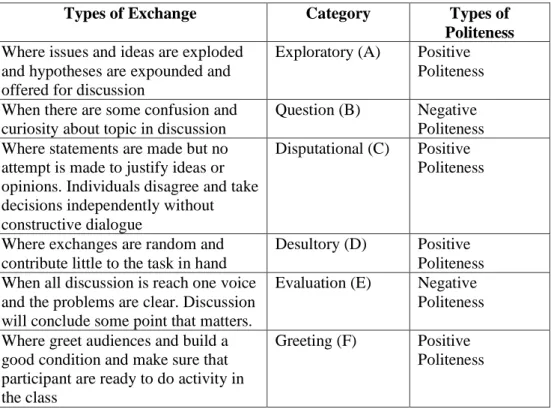
Students‟ speak activity during discussion session called Utterances. It means about a statement from person, or a spoken words. In discussion, utterances means the expression of thought that made into spoken word
that takes turn for each member in the group28. Kinds of utterances that spoken by students during discussion session are list on the table below :
Table of Student’s Utterances in Politeness
Types of Exchange Category Types of
Politeness Where issues and ideas are exploded
and hypotheses are expounded and offered for discussion
Exploratory (A) Positive Politeness When there are some confusion and
curiosity about topic in discussion
Question (B) Negative Politeness Where statements are made but no
attempt is made to justify ideas or opinions. Individuals disagree and take decisions independently without constructive dialogue
Disputational (C) Positive Politeness
Where exchanges are random and contribute little to the task in hand
Desultory (D) Positive Politeness When all discussion is reach one voice
and the problems are clear. Discussion will conclude some point that matters.
Evaluation (E) Negative Politeness Where greet audiences and build a
good condition and make sure that participant are ready to do activity in the class
Greeting (F) Positive Politeness
Table 1.1 List of Student‟s Utterances
E. Related Previous Studies
There are some researches relate to this study. One of them was the politeness strategies to improve teacher-student interaction in the class.
The first study was done by the student of IKIP PGRI of Semarang, Senowarsito (2013), entitled “Politeness Strategies in Teacher-Student Interaction in an EFL Classroom Context”. The writer took the sample of 11th grade in Senior High School Number 2 of Semarang. The subjects
28Mark Aronoff and Janie Rees-Miller (editors).2001.The handbook of linguistics.Blackwell Handsbook in Linguistics (xvi). Oxford : Blackwell
were two non-native English teachers (42-year-old male and 36year-old female) and 59 students in two different classes. In this research, as the object of the study was speech acts used by teacher and students in English classroom interaction, English has a double role of being both the medium of instruction and the object of study. The interaction between teacher and students was conducted in English, but the interaction among the students mostly used Bahasa Indonesia and or Javanese. The interaction in the classroom was still largely dominated by the teacher. The teachers dominated in giving instruction, giving explanation, showing appreciation, encouraging, motivating, and answering student‟s questions. The students mainly responded to teacher‟s instruction, questions and encouragement.
The second studies was about to analyze the teacher, how the teacher do politeness in towards their class. This studies was done by Ayfer Sülü (2015), students from Inonu University, School of Foreign Languages in Turkey, entitled, “Teacher’s Politeness in EFL Class”.
This study is about to analyze whether cultural and contextual differences in communication have impact, or make any change in politeness in the class and if it is have impact on the interaction between students and the teacher itself. The writer took the data from English preparatory class at a university in Turkey. This class consists of 25-year old American teacher of English and 22 Turkish students. The teacher has been in Turkey for 6 months and has not been familiar with Turkish before. All the students were all pre-intermediate level of English and they all have taught by their
teacher for 5 months. The writer use observation technique and use tape- recorder to support her data. The class took two hours for doing activities.
All the data were transcribed and analyzed for relate the politeness strategies.
Those previous studies give much input in conducting the research because they have the same topic, so that writer will be able to improve the research about how students use politeness EFL class during discussion session.
CHAPTER III RESEARCH METHOD
A. Research Design
This reseach applied descriptive-qualitative method. This kind of research is to interpret, analyze, and tell the data with current situation that happen that time. The goal of this research is to reveal a fact, situation, phenomenon, and condition that happen during research base on reality.
The descriptive-qualitative research is one kind of case study. According to Yin, case studies is used to explain, explore or describe events or phenomenon in daily context that already happened29. It means that the case study reseacher typically observes the characteristics of an individual unit- a student, a clique, a class, a school or a community. The purpose of such observation is to prove deeply and to analyse intensively the multifarious phenomena that constitude the life cycle of the unit with a view to establishing generalisations about the wider population to which that unit belongs.
Arikunto said that, descriptive research is research that ,leans to observed situation, condition or others, such as act or accident, which is the result shown in a research term. Researcher just captured what
29Robert K. Yin. “Case study research, design and method”. In Sarah Crowe et al. The case study approach. 2011. US National Library of Medicine National Institute of Health. Retrieved from https://www.ncbi.nlm.nih.gov/pmc/articles/PMC3141799/
happened that day in an object or observed place, then told the result in a research report as clear as can be30.
According to Sandelowski, qualitative research is research that understand and interpret the phenomenon that happen in the natural set.
Qualitative research with descriptive approach is research that refer for describe and analyze phenomenon, social activities, attitude, trustworthy, perception, person‟s mind of group or individual.31
From explanation written above, It means that descriptive- qualitative as a reseach method that explore a certain case in detail and intensive which included into descriptive reseach, it can be concluded that descriptive-qualitative research is a descriptive reseach that examination of an instance in action. In this reseach, the reseacher focus on examining the use of politeness by students during discussion session in EFL Class on fifth semester of English Department of State Institute for Islamic Student (IAIN) Bengkulu in academic year 2018/2019. In addition, descriptive- qualitativeresearch is an explorationof a bounded system or a case (or multiple cases) over time through detailed, in-depth data collection involving multiple sources of information rich in context. In this reseach, the reseacher will try to explore in detail about the students‟ case of their process in using politeness during discussion session on their educational process through in-depth data collection that involves sources of information in richcontext in the classroom investigation.
30S. Arikunto. Prosedurpenelitian. Jakarta :PT RinekaCipta.
31 M. Sandeloswki. 2010. What’s in a Name?Qualitative description revisited. Research in Nursing & Health, 33(1). doi:10.1002/nur.20362. p. 77-84
B. Location and Subject of the Research
Source of data in this research gave a resultin discussion session in EFL Class. The students were in fifth semester of English Department IAIN Bengkulu. The students were in fifth semester in Class VA, VB, VC, and VD of English Department IAIN Bengkulu in academic year 2018/2019 that consist 30 students each class. Then it is also important to explore students- lecturer activities. How students and lecturer do activities in the class during teaching-learning process, or when they did a discussion. Researcher observed how student‟s attention during discussion, are they paid attention or not.
In this research, researcher observed one class with their lecturer of 5th semester English Education Program in Tarbiyah and Tadris Faculty of IAIN Bengkulu. Researcher will get the data from students at one class of 5th semester, and do analysis and observation. Researcher observedthe activities in that class. Researcher just recorded the activity, and observe what the participants do in the class, and make a notes about that.
C. Data Collecting Technique
In collecting the data, the researcher used recording, noting, and oral question methods. The researcher recorded in form of video all students- lecturer interactions during the process of teaching and learning in prose and poetry class. Then, the researcher made important note of all activities
that are regarded important in using politeness during discussion session, or we can call during academic purposes.
The researcher followed the teaching learning activities in the class and made some observation about howoften students using politeness during discussion session in the class. The researcher reported about the result in every meeting in the class.
In collecting the data, the researcher used : 1. Formality and Address Analysis
When following class activity, the researcher gathered all the important notes in every meeting about the students' wisdom in using politeness during discussion. Researcher also made a video about student‟s activity in class for support all the data that needs.
Researchers made an analysis of the results obtained using politeness during the discussion session that doing by students.
2. Participants and Lecturer Observation
Researchers observed all teaching and learning activities in the classroom from start to end of the EFL class especially the subject that use discussion method. The result of the observation revealed that all teacher demonstrated increases in use of instructional behavior toward targeted objectives, and the students show concomitant increases in performance of targeted objectives. Then, it also important to describe clear differences between lecturers‟ existed
regarding the consistency and frequency of implementation of the instructional support strategies. The researcher observed how the lecturer gives the teaching and how the lecturer's actions toward students. Researchers also observed the efforts of the lecturers when the results achieved by students are low.
3. Interview and Field Notes
In this research, the reseacher used brief interview. The purpose of interview in this reseach are, to complete documentations that willbe gather as source of data, learn where documentation may reside,to make sure the observation data and new data interview be conducted interviewin the classroom to lecturer and students get impact.
Student‟s using politeness during discussion session. The impact students‟ performance on comprehending materials.Then teacher‟s perception was gathered through interview.
Field notes is a support for documentation during research. With field notes, researcher wrote what happen in the class during research.
In this field notes, there are description, whose the participant, what are they doing in the class, how about their attitude during the class, and how lecturer act during the class.
4. Documentation
Documentation used to obtain data from all document. Document is a compiled of event that happen in the past. Document could be form in written text, picture, monumental art of someone. Life histories, story, biography, rule, art, or commander also called document. Document is a complement of data observation method and interview in qualitative research. Arikunto also said that documentation is observed in form of notes, booksand other sources besides human beings32.In this reseach, the documentation data is photographs during the teaching and learning process especially student and teachers‟ interaction, observation sheet and notes recording and video. The documentation data above a could be use to support to describe autenticity of the data in the reseach.
D. Research Instrument
In this research, researcher will use:
1. Video Recording
Video recording is the instrument that used to shoot all activity in the class. With video, researcher will analyze the activity and make conclusion and get the data that support this paper.
32Arikunto. 2008. Prosedurpenelitian. Jakarta : PT RinekaCipta.
2. Student’s Utterances in Using Politeness
Student‟s utterances are compilation of what student said during discussion session. Utter means “to say”. Anything that said or out from mouth is utterances, such as “Hey!”, “Thank you”, “Good job”, and many more. Utterances are something we can hear, if we can not hear, that is not utterances. This is an important data for this research because researcher will analyze and get data from these. Student‟s utterances contains sentences and words that spoken during discussion in the class
3. Observation Checklist
Observation sheet need as a table time for researcher to make sure what happen in the class, and is it matches with the criteria or things that researcher want to know to support the research.
4. Question and Field Notes
Question is need for make sure about class condition. Researcher will ask some question relate to politeness, about do they know about politeness before, or are they applied that in the class, and some easy question as support with observation and video recording.
Field notes is some note that takes by researcher about little and important things during research. It will help to explain things that
caught on camera but the research not sure about what happen that time, so, field notes will help researcher to recall that activity.
E. Data Analysis
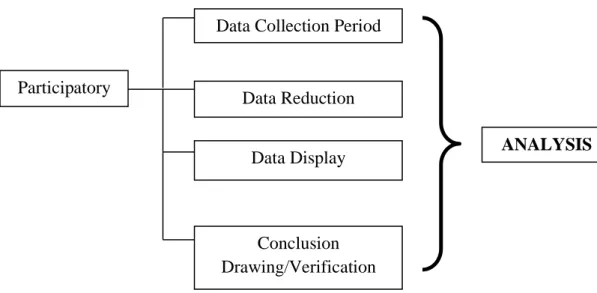
The important part of the reseach is how the reseachers analyze the data after collecting them. In the reseach, the data analyze will use interactive model of data analyze proposed buy Miles and Huberman (1994)33.
1. Data Reduction
Data reduction occurs continually through out the analysis. In early stages, it happen through editing, segmenting and summarizing the data. In the middle stages, it happens through coding and meaning, and associated activities such as finding themes, cluters, and patterns. In the latter stages it happens through conceptualizing snd explaining, since developing abstract concept is also a way of reducting the data.
2. Data Display
Data display organizes, compress and assemble information. The activities in this stages are, Making summary, descriptively and
33Matthew B. Miles and A. Micheal Huberman. 1994. Alternative Data Analyze(A Severed Third Edition). USA : Sage Publishing. p.174
systematically in order to know about the central idea easily and interpreted them critically.
3. Drawing and Verifying Conclusion
Reducing and displaying the data aim to help drawing conclusions. While drawing conclusions logically follows reduction and display of data. Then, possible conclusion can be noted and need to verify. The activities in drawing and verifying the conclusion, the researcher will conduct the following activities34:
a) Describe the students‟ mistake in did not using politeness during discussion session. Then, explore the kinds of the mistakes, whether the mistakes from point of view of person, language, or other factors.
b) Describe the lecturers‟ treatment to teach the student‟s impoliteness during discussion session. Then, explore the kinds of the methods and observe analyze the actions the lecturer whenstudents still lack in words, vocabulary, and ability using politeness.
F. Technique of Data Analysis
There were some steps that done by researcher to do the research.
First, researcher took a video about the student activity during discussion
34M.B. Miles, and A. M. Huberman,. 1994. Qualitative Data Analysis : An expanded sourcebook (Second Edition). Newbury Park, CA : Sage Publishing. p. 16
session, did they use politeness or not. Second, researcher will take a chit- chat during activity with some students in the class to know about their participation during activity. Researcher also takes some notes and check the observation list to matches some activity that happen during the class.
Next, after activity done, researcher will do some interview with lecturer and some student as a sample. Asking a question is an adding data to support video that take during the activity. It is not a hard or deep interview, just brief interview to know about class‟s knowledge to politeness during learning process. After all data complete, researcher will analyze all the data and combine one and another to get some important and related point. With these data, researcher will make conclusion and write the result into this paper
Figure 1.2 Components of Data Analysis Mills and Huberman Participatory
Data Collection Period
Data Reduction Data Display
Conclusion Drawing/Verification
ANALYSIS