PROSIDING
The 5 th International Seminar On Social, Humanities, and Malay Islamic
Civilization
Tema:
“Remaking Indonesia: Globalization Religion, Multiculturalism and Democracy”
Palembang, 9-10 Oktober, 2018 Ballroom Hotel Aston Palembang
Editor:
Anita Restu Puji Raharjeng, M.Si., BioMed. Sc Fahmi, M.Pd.I
Penerbit:
Universitas Islam Negeri Raden Fatah Palembang
Jl. Prof. K. H. Zainal Abidin Fikry No.3,5 Palembang 30126 E-mail : [email protected]
Website: http://radenfatah.ac.id/
PROSIDING
The 5th International Seminar On Social, Humanities, and Malay Islamic Civilization
Tema:
“Remaking Indonesia: Globalization Religion, Multiculturalism and Democracy”
Steering Committee:
Prof. Drs. H. M. Sirozi, Ph.D Dr. ismail Sukardi, M.Ag
Dr. H. Zainal Berlian, MM., DBA Dr. Rr. Rina Antasari, SH., M.Hum Drs. H. Andi M. Darlis, M.Pd.I Drs. Mirwan Fasta, M.Si Susunan Panitia:
Dr. Abdur Razzaq, MA.
Dr. Muhammad Uyun, M.Si Reny Kurniasari, M. Pd Dra. Elisma Harfiani, MM Dr. Irham Falahudin, M.Si Yanto, M. Hum. M.IP
Anita Restu Puji Raharjeng, M.Si., BioMed. Sc Syahrin, S.Pd.I
Indah Dwi Sartika, M.Pd Izza Fitri, M.Pd
Editor:
Anita Restu Puji Raharjeng, M.Si., BioMed. Sc Fahmi, M.Pd.I
Reviewer:
Prof. Kamaruzzaman Yusoff Ass. Prof. Dr. Muhammad Anshari ISBN : 978-602-71703-6-0
Penerbit:
Universitas Islam Negeri Raden Fatah Palembang
Jl. Prof. K. H. Zainal Abidin Fikry No.3,5 Palembang 30126 E-mail : [email protected]
Website: http://radenfatah.ac.id/
Hak cipta dilindungi undang-undang
Dilarang memperbanyak karya tulis ini dalam bentuk dan dengan cara apapun tanpa izin tertulis dari penerbit
SAMBUTAN REKTOR Assalamu’alaikumwarahmatullaahiwabarakaatuh
Alhamdulillah, International Seminar on Social, Humanities, and Malay Islamic Civilization (ISSHMIC) Universitas Islam Negeri (UIN) Raden Fatah Palembang tahun 2018 yang akan diselenggarakan pada tanggal 9 sampai dengan 10 Oktober 2018 ini sudah memasuki tahun kelima sejak diadakan pertama kali tahun 2014. Seminar ini adalah bagian dari upaya implementasi visi internasional UIN Raden Fatah Palembang dan sekaligus menegaskan distingsi UIN Raden Patah sebagai pusat pengkajian peradaban Islam Melayu.
Di samping itu seminar internasional ini juga merupakan wujud nyata dari kontribusi UIN Raden Fatah Palembang dalam memperkaya wacana, diseminasi, dan publikasi hasil-hasil riset tentang berbagai isu dalam bidang ilmu-ilmu agama, ilmu-ilmu social, dan humaniora yang terus berkembang setiap saat. Seminar ini sekaligus juga merupakan forum urun-rembuk para ahli, sarjana, ilmuwan, dan akademisi dalam rangka memberikan alternatif solusi bagi persoalan-persoalan riil manusia modern dalam bidang keagamaan, social dan kemanusiaan.
Seminar internasional tahun ini mengambil tema “Remaking Indonesia: Globalization, Religion, Multiculturalisme, and democracy". Tema ini masih actual karena sebagai negara yang sangat plural, Indonesia telah menunjukkan perkembangan yang sangat baik dan penerapan demokrasi. Akan tetapi demokrasi yang dikehendaki tentu yang kompatibel dengan Islam (agama mayoritas penduduk negeri), relevan dengan keragaman suku-budaya, cocok dengan ideology kebangsaan Negara Kesatuan Republik Indonesia (NKRI), dan mampu menjawab tantangan modernisasi dan globalisasi. Bagaimana membangun kembali Indonesia agar lebih maju, berdaya saing tinggi, sekaligus damai dan harmoni? Inilah persoalan utama yang ingin didiskusikan melalui seminar internasional kali ini. Oleh karena itu kami mengajak semua pihak (para ahli, sarjana, akademisi, ilmuwan, peneliti, para guru besar, dan pihak-pihak yang berkepentingan) untuk berpartisipasi aktif baik sebagai peserta regular maupun pesertacall for paper demi menyukseskan acara ini.
Ucapan terimakasih dan penghargaan yang setinggi-tingginya kami sampaikan kepada semua narasumber, panitia, pimpinan universitas dan fakultas, calon-calon peserta, semua civitas akademika, dan semua pihak yang turut serta menyukseskan kegiatan seminar internasional ini. Selamat berseminar, semoga bermanfaat.
Wassalamu’alaikumwarahmatullaahiwabarakaatuh
Rektor UIN Raden Fatah Palembang
Prof. Drs. M. Sirozi, M.A.,Ph.D
PROGRAM SCHEDULE Hari Pertama
Seminar Internasional
Universitas Islam Negeri Raden Fatah Palembang
Tempat : Hotel Aston Palembang, Selasa, 09 Oktober 2018
Pukul Aktivitas Pemateri Lembaga
07.30 – 08.00 WIB
Registrasi Panitia registrasi
08.00 – 09.00 WIB
Moderator Anita Trisiah, M.Sc
Dr. Soleh Sakni, M.Ag
Speakers Pemateri 1
Prof. Rober W. Hefner
PardeeScool of Global Affairs, Boston University 09.00 –
09.30 WIB
Pemateri 2 Ari Van Buuren
University Medical Center Netherland 09.30 –
10.00 WIB
Pemateri 3
Sherif Saad Mohammed Aljayyar
Beni Suef
University- Egyptian Ministry of Culture 10.00 –
11.30 WIB
Pemateri 4
Prof. Dr. Azumardi Azra, M.A., M. Phil
UIN Syarif
Hidayatullah Jakarta
11.30 – 12.00 WIB
Pemateri 5
Prof. Syafaatun
Almirzanah, M.A., M.Th.,Ph.D., D.Min
UIN Sunan Kalijaga Yogyakarta
12.30 – 13.30 WIB
Makan siang
Siang parallel presentasi Hari Pertama
Seminar Internasional
Universitas Islam Negeri Raden Fatah Palembang
Tempat : Hotel Aston Palembang, Selasa, 09 Oktober 2018
Pukul Aktivitas Kelompok/ Room Penanggung Jawab 13.30 –
14.40 WIB
Moderator
Dr. Dewi Warna, M.Pd Kelompok/ Room 1 Maksimal 15 peserta
Donny Meilano, 14.40 –
15.40 WIB
Moderator
Dr. Maftukhatusolikhah, M.Ag
Kelompok/ Room 2 Maksimal 15 peserta 15.40 – Moderator
16.40 WIB Dr. Endang Rohmiatun, M.Hum
Kelompok/ Room 3 Maksimal 15 peserta
M.H.I
15.40 – 16.40 WIB
Moderator
Dr. H. Abdur Razzaq, M.A
Kelompok/ Room 4 Maksimal 15 peserta 16.40 –
selesai WIB Hari Kedua
Seminar Internasional
Universitas Islam Negeri Raden Fatah Palembang
Tempat : Hotel Aston Palembang, Rabu, 10 Oktober 2018
Pukul Aktivitas Pemateri Lembaga
07.30 – 08.00 WIB
Registrasi Panitia registrasi
08.00 – 09.00 WIB
Moderator
Anita Trisiah, M.Sc Dr. Soleh Sakni, M.Ag
Speakers Pemateri 1
Prof. Drs. H.M. Sirozi, M.A., Ph.D
UIN Raden Fatah Palembang
09.00 – 09.20 WIB
Pemateri 2 Dr. Thomas Gotz
University of
Heidelberg, Germany 09.20 –
09.40 WIB
Pemateri 3
Prof. Dr. Zabidi Al Hussin PSK
Perdana University Malaysia
09.40 – 10.00 WIB
Pemateri 4
Dr. Hamidah, M.Ag
UIN Raden Fatah Palembang
10.00 – 10.20 WIB
Pemateri 5
Dr. Heri Junaidi, M.Ag
UIN Raden Fatah Palembang
10.20 – 11.40 WIB
Pemateri 6
Dr. Kusnadi, M.A
UIN Raden Fatah Palembang
11.40 – 12.00 WIB
Pemateri 7
Dr. Muhammad
Noupal, M.A
UIN Raden Fatah Palembang
Makan Siang
Siang parallel presentasi
Hari Kedua
Seminar Internasional
Universitas Islam Negeri Raden Fatah Palembang
Tempat : Hotel Aston Palembang, Rabu, 10 Oktober 2018
Pukul Aktivitas Kelompok Penanggung Jawab 13.30 –
14.40 WIB
Moderator
Dr. Yenrizal, M.Si Kelompok/ Room 1 Maksimal 15 peserta
Donny Meilano, M.H.I
14.40 – 15.40 WIB
Moderator
Dra. Anisiatul Mardiyah, Ph.D
Kelompok/ Room 2 Maksimal 15 peserta 15.40 –
16.40 WIB
Moderator
Dr. Marsaid Umar, M.A
Kelompok/ Room 3 Maksimal 15 peserta 15.40 –
16.40 WIB
Moderator
Dr. Muhamad Uyun
Kelompok/ Room 4 Maksimal 15 peserta
16.40 – selesai WIB
DAFTAR ISI
INTERNATIONAL SEMINAR:
THE 5
thINTERNATIONAL SEMINAR ON SOCIAL, HUMANITIES AND MALAY ISLAMIC CIVILIZATION
i Cover Depan
iii Sambutan Rektor iv Progran Schedule vii Daftar Isi
1-2 Conference On Re-Making Indonesia: Globalization, Religion, Multiculturalism And Democracy– A Dutch Experience. Rev Ari van Buuren, MA; ThM; Gestalttherapist
3-9 Globalization, Artificial Intelligence and Education. Dr. Thomas Götz 10-17 Globalization and The Changing Of The System From The National To
The GlobalA Reading In The Egyptian Experience. Dr. Sherif Al- Jayyar
18-18 Contribution of the Field of Neurosciences to the Development of Religious, Multicultural and Social Harmonies in a Globalised World.
Prof. Dr. Zabidi – Hussin FRCPCH
19-43 Gender Equality And Justice : Women And Family Community Economic Resilience Of Coastal Marine District Breech Banyuasin Ii South Sumatra. Heri Junaidi
44-61 Aktivitas Perdagangan dan Perkembangan Islam pada Masa Sriwijaya.
Ahmad Berkah
82-84 The Idea Of Traditional Reconstruction On Musabaqah Tilawatil Quran (MTQ) at Indonesia in The Perspective of Rahmatan Lil 'Alamin. Dr.
Alfi Julizun, M. Ag
85-113 Implementasi Manajemen Kesiswaan pada Sekolah Menengah Kejuruan Negeri (SMK) 2 Palembang. Amilda
114-131 Karakteristik dan Problematika Hukum di Sektor Nir Laba Menuju Good Corporate Governance. Dr. K. A. Bukhori, M. Hum
132-147 Penanaman Nilai - Nilai Karakter Pada Anak Usia Dini. Lidia Oktamarina, M.Pd, Indah Dwi Sartika, M.Pd
148-156 The Challenge of Da’wa in Multicultural Communities in Central Kalimantan. Nor Muslim, Abdul Aziz, Siti Zainab
157-176 Tradition of Manyanggar: Conflict Resolution and Simbolic Communication in Barito River Stream, Central Kalimantan. Hakim Syah, Ajahari
177-196 Peningkatan Keterampilan Berpikir Kritis Siswa Melalui Pembelajaran Contextual Teaching And Learning (CTL). Indah Wigati, Riri Novita Sunarti, Okta Rumaini
197-226 Solidaritas Nasional Sebagai Upaya Penguatan Negara Kesatuan Republik Indonesia. Karoma
227-240 Manajemen Hubungan Masyarakat (Humas) Dalam Lembaga Pendidikan. Dr. Leny Marlina, M.Pd.I
241-255 Women Participation In Community Development Program In Pt. Bukit Asam, Indonesia. Maya Panorama, Muhajirin, Juwita Anggraini 256-276 Efikasi Diri Dengan Kecemasan Dalam Proses Penyusunan Skripsi Pada
Mahasiswa Fakultas Tarbiyah UIN Raden Fatah Palembang. Muhamad Uyun, Arini Rahayu
277-290 Multicultural Education Perennial Philosophy Perspective. Dr. H.
Ahmad Zainuri, M.Pd.I
291-317 Tingkat Relevansi Dan Reklasifikasi Tujuan Sustainable Development Goals (SDGS) Terhadap Kesesuaian Framework Maqashid Syariah (Studi di Indonesia). Peny Cahaya Azwari, Qadariah Berkah
318-347 Hermeneutika Al Quran Tafsir Al-Azhar (Analisi Hermeneutis Ayat-Ayat Akidah dan Ibadah). Pathur Rahman
348-364 Pendidikan Karakter Sebagai Upaya Menciptakan Akhlak Mulia. Sabar Budi Raharjo
365-396 Indonesia dalam Multikulturalisme Beragama (Studi Pembaharuan Nilai- Nilai Keislaman dan Keindonesiaan). Ris’an Rusli
397-411 Pernikahan Dini pada Suku Anak Dalam (Studi Etnografi Anak Usia Dini pada Suku Anak Dalam di Taman Nasional Bukit Dua Belas Kecamatan Air Hitam Kabupaten Sarolangun, Provinsi Jambi). Elsa Cindrya dan Fahmi
412-425 Memperbarui Paradigma Mengajar di Era Global. Fitri Oviyanti
426-472 Penerapan Budaya Religius di Sekolah Menengah Atas Negeri 2 Unggul Sekayu. Dr. Febriyanti, M. Pd. I
473-497 Karakter Berbasis Tauhid Sebagai Orientasi Pendidikan Sekolah Islam di Era Globalisasi. Dr. Yuniar, M. Pd.I
498-504 Strengthening Religiosity In Multiculrtural Higher Education In Indonesian Context: Facing Global Challenges. Meinarni Susilowati, Mudjia Rahardjo
505-522 Hadith In The Modern Era. Dr. Hj. Uswatun Hasanah, M.Ag
523-533 Pola Rekrutmen Dan Kaderisasi Partai Golongan Karya Terhadap Perempuan di Kota Jambi. Sutri Destemi Elsi, Hartati
534-556 Using Cooperative Discussion Questioning (Coop-Dis-Q) Strategy toward Narrative Reading to the Tenth Grade Students of MA Al-Fatah Palembang. KMS. Badaruddin, Mirrah Salsabila
557-570 Religious Activity of Women Force in Partai Keadilan Sejahtera: Study of Political Motivation and Public Role of Women Force in Ppartai Keadilan Sejahtera on Bandung City. Naan, S.Psi, M.Ag
CONFERENCE ON RE-MAKING INDONESIA: GLOBALIZATION, RELIG- ION, MULTICULTURALISM and DEMOCRACY–a DUTCH EXPERIENCE
Rev Ari van Buuren, MA; ThM; Gestalttherapist
Choosing interculturalization: Pak Ari put this concept into practice serving in the University Medical Center-Utrecht as Director of the Department Spiritual Care.
Whether recovering or dying, patients meet all kinds of experts. The mission of Spiritual Care is: healing by mobilizing the inner spiritual potencies and values, hidden in every person and every religion.
1. COMPASSION
Our passions may be beautiful, but they can also be very violent. Howev- er, we share compassion as the Gol- den Rule. Every Surah opens ―in the Name of Allah, the Compassionate, the Merciful‖. Jesus reaches out to all those who are ill or afflicted. The Buddha of Compassion is depicted with over thousand arms. Compassion opens up to syn-energy and sym- phony.
2. COMMON HISTORY & DECO- LONIZATION
Indonesia and the Netherlands have a shared history of 350 years of coloni- zation by the Netherlands. After World War II the process of global decolonization started. As a Dut- chman I feel very much ashamed concerning your struggle for indepen- dence, as we committed terrible crimes of war.
3. IN THE DELTA: RIVERBED &
FLOW
The Netherlands is a delta of rivers and arms of the sea. We learned: the waterbed leads the flow, the flow changes the waterbed. As a metaphor it applies to many countries, cultures and religions. The last 70 years the Netherlands had to cope with a conti- nuous stream/flow of immigrants.
4. THE FRAGRANCE OF JASMINE Our historical accounts are often nei- ther objective nor complete. They are often selfish, selective and ambiva- lent. In the year the Berlin Wall was taken down in 1989, the civil War in Lebanon ended nearly unnoticed. In Beirut I experienced the compassio- nate scent of Jasmine.
5. MIGRATION & DEMOCRACY With the influx of thousands of im- migrants after World War II, the Netherlands developed itself into a
multicultural society of 17 million people. So 4 million are migrants by origin. You will no longer find one dominant group of citizens with a common background in our big cities.
Once more we have to learn democ- racy: acknowledging the space and rights for all minorities.
6. PANCASILA & DIVERSITY The concept of Pancasila as intro- duced by Sukarno is a fascinating one as it focusses on integration of plural- ism and diversity. Multiculturalism is an intrinsic part of it. In the Nether- lands multiculturalism was forced by external forces. Discord is growing.
Today one out of six Dutch citizens demonstrates a lack of knowledge, hospitality and humility.
7. MULTICULTURALISM
Since 9-11 Islamophobia is growing as well as radicalization of certain Muslim factions. The war in Syria and the terror of IS produced millions of refugees seeking asylum in Europe.
Simultaneously there is a rise of ultra- right-wing political parties, like the Dutch PVV and the German AfD. On
the whole multicultural, multireli- gious societies and peaceful coexis- tence are now being discredited.
8. SECULARIZATION & MULTI RELIGIOUS BELONGING
The Netherlands is both a secular and a multireligious country. A mere 39%
of the population has ties with Chris- tian churches. The second religion is Islam, 5%. This does not imply that the rest of the population is atheistic.
A recent study of the Free University Amsterdam proved some 3,1 million people consider themselves ‗flexible believers‘. This so called Multi Reli- gious Believing (MRB) is a new phe- nomenon on the spiritual map of the Netherlands.
9. INTERCULTURALIZATION Interculturalization means choosing the path to peace and blessing we should make ever again. Since the last 25 years Spiritual/Pastoral Care has its role in the vanguard. We now have interreligious teams in healthcare, prisons and the army. This Dutch ex- perience is made clear in this last chapter.
Globalization, Artificial Intelligence and Education
Dr. Thomas Götz
SES Bonn
Selamat pagi (siang) hadirin se- kalian
I am going to talk on globalization, ar- tificial intelligence (AI) and education. I am thankful and proud that I have the opportunity to talk to you in this seminar.
I‘m here in Palembang on invitation of UIN Raden Fatah. I‘m here to make some suggestions in order to potentially improve the process of software devel- opment and teaching .
When I arrived at Palembang 10 days ago, I made a short walk over the campus of UIN Palembang and saw the poster with the announcement of ISSH- MIC. Without realizing that this was the seminar where I had to talk, I took a pic- ture from the poster because I found the text so exciting, impressive and motivat- ing:
―As a country and nation that is multi-ethnic, multi-religious, and multi- cultural, Indonesia continues to carry out dynamics in political, religious, social and cultural life. This dynamics is influ- enced by the process of globalization,
religious change, cultural diversity and the implementation of political democra- cy. The seminar invited experts, re- searchers, academics and scholars to come down and contribute to rebuild an advanced and dignified Indonesia in the midst of the dynamics of change.‖
Reading now the text again I‘m still im- pressed, it is a concept that leads the right way into the future and I‘ll be hap- py if I can contribute a little bit.
--- What does this have to do with Artificial Intelligence? It is my strong believe, that artificial intelligence is the key technology for the future. Globaliza- tion creates a level playing field for ad- vanced technologies like AI. Aspects like awareness, popularity, education, training, methodology, tools and coach- ing are driving globalization for ad- vanced technologies. We already know that advanced technologies like artificial intelligence are no longer just the do- main of Silicon Valley and New York City. We already see, that China starts
playing a leading role in AI and it may happen very well, that countries like In- donesia are going to follow.
--- The visionary historian Yuval Ha- rari says in an interview with Djakarta Post: as of 2018, it's much better than a century ago, when liberal democracy was actually just a very small number of countries around the world. Most of the world was empires. Indonesia was a Dutch empire, nobody thought of having a liberal democracy in Indonesia — it was a Dutch colony. So I think Indonesia is one of the examples of the erratic suc- cess of the recent wave of democratiza- tion and liberalization around the world.
This optimistic viewpoint probably nev- er finds its way into the newspapers. The reason is simple: bad news are good news for the media, good news are no news at all. Sad to say: in the German media we see Indonesia mainly in con- nection with natural disasters.
Another good news, that probably never reached the newspapers: I‘ve learned, that almost halve of the students of UIN Palembang deal with computer sciences and by the way more than half are fe- male. I‘m going to explain, why this is really good news, for UIN Palembang and for for Indonesia.
--- I‘m tracking the development of artifi- cial intelligence for more than 40 years now. 30 years were quite boring
Robots moved colored bricks
Chess programs reached quite good results but mainly by using brute force method
Translation programs were more funny than useful. ―They do not know anything about the real world, they do not know the context of a word or a phrase‖ was the explana- tion.
Since 10 years or so, the world of AI has changed completely and matters became really exciting. These are the main reasons.
1. computers are getting faster and faster
2. new ties between AI and other fields (such as statistics, economics and mathematics)
3. new software developments: neural networks and deep learning
4. the availability of an enormous amount of data in connection with the ability to structure these data and to draw conclusions from them
We shall get an idea, what
―enormous amount of data‖ really means: the volume of data stored all over
the world is growing every day by 2.5 Exabyte.
Does anybody know, know how much is one Exabyte?
I didn‘t know either, Wikipedia told me, that 1 Exabyte = 10^18 Bytes what still didn‘t tell me very much, but
1 Exabyte = 20000 * the data con- tained in all books ever written
5 Exabyte = all words ever spoken by human beings (stored as text)
There are 500 million tweeds per day on twitter, 500 million photos being uploaded daily to facebook. Facebook‘s
―friendship graph‖ has 1 billion nodes and 100 billion edges.
It is my opinion, that the availa- bility of so many data in connection with the ability to structure them and to draw conclusions from them is the most im- portant reason for the rapid development that AI took during the last 10 years.
--- Two examples:
Some of you may remember the Facebook-Cambridge Analytica data scandal. Earlier this year it became pub- lic that Cambridge Analytica, a company that had worked on Donald Trump's US presidential election campaign, had har- vested the personal data of millions of people's Facebook profiles without their
consent, and used it for political purpos- es.
In connection with that affair, a study was published according to which a few dozen ―likes‖ in Face book can give a strong prediction
of which party a user will vote for,
reveal their gender and whether their partner is likely to be a man or woman,
provide powerful clues about whether their parents stayed togeth- er throughout their childhood
and predict their vulnerability to substance abuse.
And it can do all this without any need for delving into personal messages, posts, status updates, photos or all the other information Facebook holds, it can do all this without using the data sources we mentioned, it simply has to evaluate a very limited number of Facebook
―likes‖.
--- In that light another story be- comes interesting: like millions of other people I use Google‘s calendar and Googles contacts both on my PC at home and on my smartphone here and my wife does the same. So our calendars and our contact data are always synchro- nized. To make this work, we have to be
logged in to our Google accounts. In terms of data collection and data abuse this can be dramatic. Everything we do using Google‘s applications can easily be assigned to our accounts, to us as hu- man beings. In the light of the previous example you can imagine, which conclu- sions can be drawn from this.
You may question, why we do this after having that knowledge? The answer is simple and is given millions and millions of times every day: because it is so in- credible convenient. And this conveni- ence is the price that we get, when we sell our data. According to internet guru Jaron Lanier an extremely unfair deal, the price that we get, the value of the service that we get, is much lower than the value of the data we give away.
--- Bill Schmarzo says in a blog on Data Science Central: AI has snuck into our daily lives and there is nothing to stop it. Not only does AI power auto- nomous vehicles, but AI already decides what products you should buy, what movies you should watch, what music you should listen to, and whom you should date. If you talk to your iPhone, Google Home, and Amazon Echo, you are talking to an AI engine that powers these personal virtual assistants. AI de-
cides whether you are approved for a loan, determines the outcome of a job applications, identifies threats to national security, and recommends medical treatment.
Apart from this, there is one question, concerning people: Which im- pact will AI have on our jobs? Apart from building cars together, which white collar jobs may be strongly influenced by artificial intelligence?
Andrew Kucheriavy states on Forbes Technological Council ―at this point, you must have heard about how advances in AI are disrupting industries and posing a threat to the job security of millions of workers worldwide. The jobs of office clerks, receptionists, customer service representatives, analysts, marketers, doctors, lawyers, underwriters and creatives could be replaced by AI in the next decade‖. As Sundar Pichai, the CEO of Google put it,
―In the next 10 years, we will shift to a world that is AI-first.‖
--- Let‘s look at some of these ex- amples firstly on a standard task of law- yers:
There was a study conducted by AI- vendor LawGeex in partnership with professors from Stanford University,
Duke University School of Law, and the University of Southern California. 20 experienced lawyers against a three- year-old algorithm trained to evaluate contracts.
Participants were given four hours to identify and highlight 30 pro- posed legal issues in five standard non- disclosure agreements (NDAs). It was not enough to merely skim the agree- ments, a deeper analysis was required.
Lawyers and the AI, for instance, were penalized for missing an exemption rele- vant to the contract, or mistakenly identi- fying an exemption where it was irrele- vant.
In the end, LawGeex‘s neural network achieved an average 94 percent accuracy rate, compared to the lawyers‘
average of 85 percent. And while it took humans anywhere from 51 minutes to more than 2.5 hours to complete all five NDAs, the AI engine finished in 26 seconds.
Surprising? Not really. The num- ber of contracts a lawyer sees during his professional life may go into thousands.
That of the programm may easily reach millions.
--- Let‘s now move to autonomous driving.
The artificial intelligence market research and media platform TechEmer- gence has asked the top 11 global auto- makers from Daimler to Volvo on their timelines for self-driving cars. Let‘s first define, what is understood by a self- driving cars.
Usually we distinguish five levels of self-driving. Omitting the first 3 of them,
Level 4 automation is a car that can drive itself almost all the time with- out any human input, but might be programmed not to drive in un- mapped areas or during severe weather. This is a car you could sleep in.
Level 5 automation means full au- tomation in all conditions
More or less all of the global au- tomakers agreed, that they would deliver Level 4 cars at the beginning of next decade, most of them restricted to high- ways and they expect to deliver the dri- verless level 5 car between 2025 and 2030.
There are two important consid- erations when looking at car company predictions. First, there are a lot of rea- sons for companies to be slightly overly optimistic, including: Generating nation- al or company pride, earning media at- tention, and so on.
The other consideration is that these timelines depend heavily on the regula- tory developments in the next few years.
There are serious liability concerns when machines operate themselves in a poten- tially dangerous environment. Up to now only Volvo has promised to take full lia- bility for their cars when they operate in autonomous mode.
Yuval Harari notes: what hap- pens if several pedestrians jump in front of a self-driving car and it has to choose between killing, say, five pedestrians or swerving to the side and killing its own- er? Now you have engineers producing the self-driving cars and they need to get an answer to this question. So I don‘t see any reason to think that AI will make morality any less relevant than before. I would like to add: the society has to dis- cuss questions like this, politics must setup rules.
Note: we are not talking about science fiction. In the first example the algorithm already exists for 3 years, in the second example we are talking about the next 2 to five years.
History repeats itself, and the fourth Industrial Revolution is on the way
Let‘s repeat the question: How big of a threat is AI to your employ-
ment? Well, consider this: AI is cheaper and more productive than you are. It doesn‘t sleep, need breaks, get sick or take vacations, and it doesn‘t need health insurance or retirement benefits. It can work around the clock, is much faster than you are, can instantly scale to levels that human workers can‘t simply achieve, can quickly acquire and learn new skills, and it doesn‘t make mistakes.‖
Research company Gartner states in a recent report: By 2020, artificial in- telligence (AI) will generate 2.3 million jobs, exceeding the 1.8 million that it will wipe out. In the following five years to 2025, net new jobs created in relation to AI will reach 2 million, according to the report.
There is a problem with such predictions. It might be possible to guess with sufficient accuracy, which jobs may disappear. But it is very hard to estimate how many new jobs will arise. I would trust the number of 1.8 million jobs dis- appearing much more than the 2.3 mil- lion of new jobs. But I‘m 100% sure, that a large number of new jobs will arise in IT-related fields.
The Advisory Board from San Francisco School of Management was trying to find out what the university
must do to be relevant in 2025. Here‘s what they came up with:
Goal: Create fearless, well- rounded students (for the non-English natives: well-rounded does not mean looking like this, it means involving or having experience in a wide range of ideas or activities)
Create a results-centric, contextual curri- culum which includes:
Outcomes (results) focused, not process-focused, which teaches stu- dents how to identify, validate, val- ue and prioritize the solution re- quirements.
Logical reasoning – both deductive and inductive– that trains students how to decompose a problem into smaller, more manageable problem sets.
Accepting of critical feedback as the foundation for improving. Learn to get feedback from both hard (per- formance) data as well as soft (be- havioral) data.
Mastering the ―Art of Failure‖ as the foundation for learning. Be willing to try new things, approaches, and techniques in order to come up with ideas that ―might‖ provide better re- sults.
Critical thinking skills in order to challenge or question the initial ideas and results in order to find bet- ter.
These are the basic skills that tomorrow‘s leaders – the Millennials – are going to need in order to stay relevant in a world of constant technology change that can unleash new work and life opportunities. In fact, these are the basic skills that everyone is going to need to master to stay relevant in a world of constant technology change.
Watching academic live at UIN Palem- bang, I am confident, that you are in a good position to manage these chal- lenges.
Terima kasih atas perhatian Anda
Globalization and the Changing of the System From the National to the Global A Reading in the Egyptian Experience
Dr. Sherif Al-Jayyar
Vice Dean of faculty of Alsun Beni Suif University -Egypt
The Egyptian history is really the history of a moral productive land. In the beginning was Egypt, born before histo- ry itself. There man turned from an ani- mal running through the jungles to flee a danger, or looking for a female partner, to a thinking man: contemplating, draw- ing, and responsible for his actions. It was the stage of conscience which no human being has been recognized before the Egyptians on this blue planet, its point of departure the Egyptian Ethical system described by the great American thinker, James Henry Breasted, in his book entitled: The Dawn of Conscience:
"It was a dark day for my inherited re- spect for the theological dogma of "reve- lation." I had more disquieting expe- riences before me, when as a young orientalist I found that the Egyptians had possessed a standard of morals far supe- rior to that of the Decalogue over a thou-
sand years before the Decalogue was written".
It is scientifically proven that the Egyptians reached completely new cog- nitive models of life that were not based on any previous experience, from the cultural point of zero through the first human revolution, namely: the discovery of agriculture. On the Nile Delta lies the oldest agricultural settlement in the world (Merimde Beni-Salame, south of Giza), dating back to about 7100 BC. As Breasted says, the Egyptian people are the only ones on the planet that guaran- teed stable food through a sophisticated system of irrigation, which has led to the cultivation of the whole Nile Valley, re- sulting in a population boom, an explo- sion by that time.
Then appeared the city, the stone architecture, the integrated provinces, and the large markets. This culminated in the first unified state in history in
4241 BC, where tremendous human ca- pacity that enabled Egypt to offer to the world the first agriculture, the first in- dustry, the first trade, the first religion, the first law, the first astronomy, the first medicine, the first solar calendar, the first alphabet, the first mining industries, the first jewelry, furniture, clothing, glass, dyeing, chemistry and navigation.
The list is long and includes all the earli- est human activities that man has known.The Greek historian Herodotus says that the Egyptians were content with what they had. During the period between 4241 BC and about 1750 BC, Egypt lived a secure state until a pastoral migration from Armenia (most likely) came to the fore. It included Arab, Jew- ish and Canaanite tribes, known in Egyp- tian history as the Hexos, with horse- drawn carriages, which Egypt did not know at that time. They overthrew the national rule in northern Egypt and set- tled in those areas for about 150 years, during which the Egyptians discovered iron, tamed horses and achieved inde- pendence.The ancient Egyptian realized the need to protect his country and its land from the east where the invaders came, then the imperial era began. The great king Thutmose III sent seventeen military campaigns to Syria, Palestine,
Jordan, northern Saudi Arabia, southern Turkey and western current Iraq, all end- ing in complete victory.
The Egyptian empire was not a colonial in the sense we know, but was disciplinary and defensive against the shepherds, from the status of settlement or blatant exploitation, as much as the presence of sovereignty and subordina- tion. The rulers of Egypt allowed the sons of the rulers of foreign lands to have education in the capital of the coun- try, similar to scientific missions of to- day. Consequently, Egyptian civilization spread in the regions of the empire, and the markets in the Middle East were united.
With the end of the era of the Egyptian Empire, and the return of Egypt to its current recognized geo- graphical borders, the era of great em- pires that dreamed of the unification of the world, has emerged, beginning with the Assyrian, Persian, Greek, Roman, Islamic, Mamluk, and finally the Otto- man Empire. All of them dreamed of the unity of the world politically and eco- nomically. As a result of this, since 332 BC Egypt fell prey to foreign rulers and plundering colonial states, to become the oldest colony in history. It was colonized by foreigners since Alexander the Great
and his successor Ptolemy until the end of the British occupation of Egypt in 1954. During this long history, my coun- try was either the center of a foreign em- pire, or attached to the imperial center by virtue of its multiple assets, where it was called by the Romans (the food basket of Rome).
However, at the beginning of the 19th century, the link between the au- thority of the Ottoman Turkish Islamic Caliphate and its colony of Egypt deteri- orated and the Mamluk administrative systems were dissolved. It began with a separatist tendency of independence, the most powerful of which was Muhammad Ali Pasha, who inherited a country with a pastoral past, and its Mamluk (Mughal) administration, which left the country in a state of pitiable corruption and under- development. With the help of France and the scientists of the San Simon group, Mohammed Ali fought his great political, economic and military battles in a self-development experiment as a national state, turning Egypt into a major regional power opposed to the prevailing world order led by Britain, Austria, Rus- sia and France, all stood against the project of Muhammad Ali in the Treaty of London in 1840. Accordingly, Egypt became a part of the global economy,
and was fully dependent on the British occupier since 1882. The Western influ- ence began to dominate the Egyptian society via economic penetration and political power until 1952, when it took over the revolution of July; especially after President Gamal Abdel Nasser took over the issues of national liberation from British colonialism, and began an experiment similar to that of Muhammad Ali. He cut off all threads of dependence on the global capitalist system and moved eastward and left.
However, this project fell as did the project of Mohammed Ali, because of aspirations of Arab nationalism, and his desire to expand in the region, as well as the intervention of Nasser in mo- tivating the national liberation move- ments in the third world, to be consi- dered the opposite of the prevailing capi- talist system. They tried in 1967 to top- ple Nasser and his regime as a regional power.
With the beginning of the seven- ties and the return of Sinai to Egypt after an Israeli occupation, Egypt returned to the circle of the global capitalist system, to become within the circle of globaliza- tion with the rule of President "Anwar Sadat," who turned his back to the Soviet Union in 1974, and passed the laws of
economic open door policy, to surrender to the doctrine of globalization, wester- nization as manifested in America, Western Europe, and Japan in that period, where the dominance of the economy prevailed all aspects of human activity, as if the capitalist system - at the height of its development – was suggesting Karl Marx's principle: economics is the engine of history.
In this sense, globalization re- quired the elimination of the laws that the (national) States placed in the face of a liberal trade movement without any constraints; thus, the nation State was the first opponent of globalization.
And since the Egyptian society in 1974 is based on the public sector and the state ownership of the major produc- tive projects in all aspects of public ac- tivity, and since globalization is a West- ern capitalist product belonging to a democratic framework rooted within so- cieties of economic abundance and great scientific and cultural progress, having respect for human rights and tools of maintaining social balance among the classes, in addition to regulatory institu- tions and judicial and media bodies that ensure transparency and the possibility of easy review of errors, the problem is no longer just economic, but also politi-
cal, cultural and social, entailing the ex- istence of a class of skilled administra- tors with good scientific qualifications.
This was what Egypt lacked in 1974.
Privatization of the public sector and its companies began without any scientific calculations, ending in the con- trol of a group of owners of parasitic capital, tending to speculations and deal- ings in imported consumer goods, neg- lecting the national industries, leaving the field open to foreign companies. As a result, corruption prevailed in most insti- tutions, and the Egyptian education col- lapsed as well as all public institutions, reaching to the stage of revolution on 25 January 2011. The revolution broke be- cause the policies of the free markets and trade ended in social injustice, unem- ployment, illiteracy and the collapse of education, health and culture, all this was accompanied by the absence of de- mocracy and good governance, leaving the arena to the parasitic private sector, which led to the decline of all national performance rates of health, education, facilities, industry and agriculture, until the public treasury is mainly based on remittances of Egyptians working abroad, the Suez Canal revenues, some energy sources, tourism and taxes.The most im- portant economic activity for Egyptians
became the real estate market and prod- ucts imported from abroad. Egypt has become - as President Sisi said in 2014:
a semi-state!
Because globalization and the doctrine of free trade have been accom- panied by a huge scientific and informa- tion revolution, supported by proper management methods and sophisticated education, it has been successful in countries with such a scientific base. Un- fortunately, Egypt - under the rule of former President Mubarak - especially in the first decade of the twentieth century - until 2011, lying behind the slogans of the nation-state, putting a foot on globa- lization, and withdrawing the other away, after the desertion of democracy, human rights, good education and good gover- nance, in a framework of transparency and freedom of information; this is what happened in the national states of the Arab spring (specifically Iraq, Syria, Yemen and Libya).Because these re- gimes are an outright antithesis of globa- lization, their fate was trying to pull apart their national systems, even if it required the chaos that has not yet be- come creative. Egypt was planned to suffer a painful fate, like the fate of Syria, Iraq, Yemen and Libya.
In the face of this existential dan- ger that beset a 6260-year-old unified state, threatening to divide it, the Egyp- tian army, supported by the people, in 30 June 2013, intervened to maintain the minimum of the survival of the unified Egyptian state and its national identity, which almost fell into the hands of reli- gious fascism (the Muslim Brotherhood), which reached the rule of Egypt in 2012, and wanted to dominate the state, but the Egyptian people loathed it after less than a year in power; because they do not be- lieve in the borders of the homeland, its history, and civilization, something which was a clear reason for the terror- ism that Egypt and its people faced and still facing in Sinai. This is the terrorism that the Egyptian army is fighting on be- half of the world to stop the fascist plan, which wants to dominate the Middle East, to divide it, and turn it into semi- states fighting each other, unable to live or resist.
There is no globalization without good administration and sophisticated education, no globalization without in- formation, transparency, human rights, democracy, the circulation of power and competitive capacities. Otherwise, the benefits of globalization will go into the pockets of brokers, adventurers and pa-
rasitic classes, to perpetuate social injus- tice, hence intolerance, racism and ter- rorism.
The time has come to put an end to this impasse, today we see the Egyp- tian regime having a serious determina- tion to end all the outstanding problems that have hampered the Egyptian expe- rience, the most important of which is the Palestinian issue and the Arab-Israeli conflict, which has exhausted a great deal of Egyptian capabilities to achieve lasting peace in the region ), The crea- tion of a modern educational revolution, the establishment of specialized scientif- ic departments,the use of a large infor- mation network, the lifting of subsidies on goods (with supporting the poor), lift- ing of the state's hand on economic ac- tivity, the establishment of an economic structure that is entirely part of the glob- al market, and the attempt to create a competitive advantage within the mar- ket,with the establishment of the indus- trial zone of the Suez Canal region, as well as the establishment of several in- dustrial zones in preparation for the de- cline of the role of the state at a later stage. This is the vision of 2030 an- nounced by President "Abdelfattah Sisi,"
which has achieved several giant nation- al projects, aiming at a general sustained
development. The Egyptian Prime Mi- nister announced the achievements of the Egyptian state in the last four years, which were reflected in 7777 imple- mented projects, 3392 projects under implementation, 4131 planned projects.
Therefore, globalization is not an evil for those who do have great educa- tion, free media, true democracy, ba- lanced social policies, professional and qualified administrative institutions.
Globalization is essentially an attempt to unify the world into a single market cen- tered in Western Europe, America and Japan, and the successful political re- gime is the one who seeks to revitalize its sources of power, to ascend a step on the ladder of the world hierarchy, to come near the center of the world, this is what the Asian Tigers have done, and what Indonesia is doing, approaching, step by step, the center of globalization, with a rational management, empower- ment of science and democracy, and the many competitive advantages of the di- versity of the Indonesian economy.
The Egyptian experience may be the best guide for the country of Indone- sia, to avoid the mistakes that occurred in Egypt in previous periods. These mis- takes have been realized by the Egyptian regime of today after forty years of si-
lence. The Egyptian state is now em- barking on a truthful fight against cor- ruption in all its forms in all public and private institutions, calling on the reli- gious and cultural institutions, as well as the civil society, and the political parties to renew their religious and cultural dis- course, in order to promote the civil state which is based on citizenship, democra- cy, law, intellectual, cultural, cognitive and religious diversity.
The prevailing thinking in Egypt believes that globalization will remain, perhaps until the end of the century, as an ideal form of cultural advancement. It creates an opportunity for learners to de- velop and reach a partnership with major centers of globalization, opening hori- zons of great scientific explorations.
What is rumored about the exis- tence of anti-globalization regimes are ideological dreams that reality rejects;
even our great economic thinker, Dr.
Samir Amin, who has passed away re- cently, has long preached the fall of glo- balization; because of the resistant re- gimes in China, Russia, India and Brazil, has returned in the most recent days to say that globalization will remain as long as the capitalist system remains; as Glo- balization/ Mondialisation, a necessary changing stage, and a pivotal civiliza-
tional development in contemporary his- tory, representing a comprehensive stra- tegic vision, aiming at re-formulating the world according to the new current reali- ty in the second of half of the twentieth century, offering its results in the final decade with the fall of the Berlin Wall in 1989 and the end of the Cold War, the collapse of the Soviet Union and the dismantling of its international system, the Warsaw Pact (1991), the American domination of the world, and the domi- nation of its model over nations and hu- man societies through a cultural informa- tion system devoted to the concept of
"globalization", bringing about the uni- versal character and the transition from the international to the global, and the appearance of a borderless world, and the end of the nation states, the erosion of borders and the growth of cross- border and regional relations")1(. This trend has been manifested in many inter- national terms, such as "the cosmopoli- tan village, the global village, the world community, the revolution of communi- cation, the center and the periphery, the new world order ..." and others, in two books issued in the 1970s; the first is:
"War and Peace in the Global Village"
( )1
Jan Nederveen Pieterse, Globalization and Culture: Global Mélange, Arabic Version, p:
27.
by the Canadian Marshall McLuhan, the second is "Between two Ages: America and the Technetronic Age" by the Polish- American Zbigniew Brzezinski, in addi- tion to the American Alvin Toffler's book entitled)2(: "The Third Wave"
(1980). This global change has been ac- companied by a rapid progress in science, information technology, communication and the international wide web, whose influence has exceeded the new capitalist dimension, to include the political, eco- nomic, media, cultural, pedagogical and educational dimensions, starting a new era, a different stage of humanity, based on communication and interactive activi- ty, known as the post-human age, or the age of "medium entity", in which man delays the ego and its conflicts, and opens up freely to the other participant in the planet: to exchange, talk, make the future, bypassing the limited space, and the authority of the censor. It is the new space of man who has been changed into a numerical object carrying the name and image of symbols and digital codes navigating with them in this reality, which works only with the coding sys- tem..")3("This cultural shift of globaliza-
( )2
c. Hussein, The Origins of Globaliza- tion and its Effects, in middle-east-online.com
( )3
Kalthoum Zena, The Principle of Communication, Reference to Digital Literature, Between Technology and Philosophical Thinking,
tion and its cyber culture is a significant intellectual, philosophical, and creative stage in human history, pushing man to- wards the stage of electronic digital communication, which represents the third natural and cumulative evolution of human civilization, after the oral and written stages.
Thus, the developing countries will not dispense with the unified inter- national market, only through integration with their competitive advantages. Oth- erwise, it will continue to depend on the capitalist system as they are today. The road to integration will be the implemen- tation of the UN Universal Declaration of Human Rights on 10 December 1948, through resisting the sectarian and racist claims, with modern policies that ac- company the developments in education and scientific research, censorship and information.
Magalat Makaleed, University of Satif, Algeria, n. 3, December, 2012, p: 165, also Ibid. p: 164.
Contribution of the Field of Neurosciences to the Development of Religious, Multicultural and Social Harmonies in a Globalised World
Prof Dr Zabidi - Hussin FRCPCH
Fellow of the Royal College of Paediatrics and Child Health of UK and Professor of Paediatrics of Perdana University
There is little doubt that efforts to propel good governance and leadership will result in a world, free of rancour and hostilities. A good leader will have the abilities to strike an ultrafine balance between the demands of his followers and his own wishes.
History has witnessed disastrous consequences when such balance was disrupted in the past and also at present.Fine leaders will ensure that there exist religious,multicultural and social harmoniesthat will guarantee survival in any forms of globalised world. The understanding of human neurosciences has led to interesting discovery that there exists within the deep structures of our brain, remarkable centres of emotions such as empa- thy , compassion , and other common positive values that have the abilities to commu- nicate with brain centres of physical actions and reactions through a series of complex brain cell interactions. What is more remarkable is that, these physical emotional reac- tions centres in the human brain can be positively influenced by repeated exposure to good deeds and reinforced with honourable acts which is continuously undertaken throughout one‘s life. Such discoveries reinforced the Islamic notion that encourages good values and deeds to be demonstrated to children from a very young age by adults that surrounds the child. Furthermore there are a number of hadiths that encourages good deeds to be done in little but with regular frequencies and not is done as a ―one off‖
phenomena.
GENDER EQUALITY AND JUSTICE:
WOMEN AND FAMILY COMMUNITY ECONOMIC RESILIENCE OF COASTAL MARINE DISTRICT breech BANYUASIN II SOUTH SUMATRA
Heri Junaidi
(The Center for the Study of Gender and Children LP2M / Lecturer Faculty of Shariah and Law UIN Raden Fatah Palembang)
Email: [email protected]
ABSTRACT
This study stems from a desire for answers to economic power relations in building a harmonious family. Changes occur in the structure of household roles due to the influence of culture and socio-economic development. Culturepatriarchy is consi- dered auspicious men and reconstruct the subordination of women, according to the sis- tem matrilinieal kinship. The approach used is interpretive paradigms that are part of non-positivistic paradigm. In addition, the methodology of this study also uses the prin- ciple of gender perspective as the focus of the analysis. This study also uses qualitative approach. This research subject is determined by a combination of the two ways of de- termining the informants in the qualitative study, the combination of snowball and acci- dental. Subjects were husband and wife who are in the research object with kretaria used by researchers to determine the subject.Data collected by means of observation, interviews, and dokumentasi.Analysis with data reduction techniques to get the answer of this research. Presented in narrative and descriptive text, matrix, graphs, and charts.
Analysis of the data is processed into data that a systematic, organized, and structured.
The results showed (1) Relation power of women in improving the economy of the family in society Breech Sea Coast Banyuasin II South Sumatra has a variety of conditions. While Acceptance man against the power of women in improving the economy of the family in society Breech Sea Coast Banyuasin II South Sumatra di- verse. Resistance discourse power of women in inflation on family resilience in com- munities Breech Sea Coast Banyuasin II South Sumatra mememiliki various views of the husband as head of the family.
A. Introduction
This work is the result of research based on the assumption that researchers developing concepts and
theories of gender mainstreaming 1 in Indonesia raise two important issues to
1see Law No. 7 of 1984 andPermendagri 67 OF 2011, See also Mainstreaming Strategy, Gender - Jakarta: ILO Jakarta 2003-2005;
be explored and analyzed in a scientific study, namely:
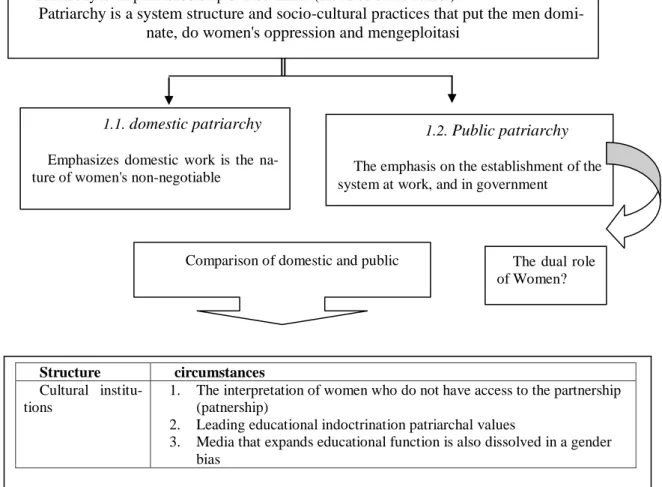
First, the issue of gender doing in strengthening the family economy is not an issue. The main issue is how the economic foundation of the family can be assured "healthy"; second, stratification in the household, although in conclusion appears to "lift" one sex but still have the fire in the hull that eventually crystallized in the form of the rebels due to the culture of power relations in the household.
The assertion assumption of some of the conclusions in the discussion about the economy and the resilience of families that have marginalized gender rated the beginning of expectations on the basic concept that the building household is inseparable from the division of roles structural members is a source of discrimination and subordination as gender issues are no longer an issue. General acceptance that arise in the implementation of domestic life where men and women spend a lot of time is not tergabungkan, yet maintains the discourse of women are economically ketidakmandirian in spirit along with the power of women in the domestic sphere.
The conclusion is like the theory Denys Lombard 2 and Clifford Geertz3who called the dominating power of women in the family Java community.
Denys Lombard study stating that women in Indonesia plays an important role very prominent and rank much higher than in other Asian women in society, their power, even from behind the scenes, but powerful and sourced items in their societies.
Clifford Geertz has stated though Javanese female domination occur in domestic affairs but the impact of values taught by Javanese women in food processing, seehingga can still undergo survival, which in turn extends into a form of real power. In matters of the kitchen, Javanese women have a significant role in managing the financial condition of the household. Instead of in a state of economic crisis, food security management functions in the hands of women can generate Java since the
2see Denys LombardNusa Java: Cross- Cultural: Integrated History Studies, Jakarta:
Gramedia Pustaka Utama, 2000; as a comparison see alsoChristina S Handayani; Ardhian Novianto, Power of Women Java, Yogyakarta:
LKiS: Distribution, LKiS Rainbow Literacy 2004
3 Clifford Geertz, Local
knowledge:Further Essays In Interpretive Anthropology, USA: Basic Books, 2008.
planting, harvesting, storing, to the presentation of that enjoyed by families4, Brenner analyze the domestic construction of Solo in Central Java has its own power, because male assigning them to deal with spending and cash from income5 , Janet Carstendevelop idiosyncratic ideas in the study of Fisherman community in Peninsular Malaysia which shows the lives of fishermen are away from home and his village is a competitive atmosphere. The fishing community of men more emphasis on meeting basic needs, rice, obtained from the market. Cash from the sale of fish given to women at home, it was intentional for reasons of efficiency improper by men6
The development step the contemporary women studied Irzum Farihah which concluded that the contemporary women already have autonomy in economic, Those who have their own income, on the one hand to
4Differences in study see also Noor Hayati Ab Rahman and free hearty, Women's Studies Malaysia-Indonesia, Jakarta: Yayasan Pustaka Torch, 2016
5Suzanne April Brenner, The Domesti- cation of Desire: Women, Wealth, and Moderni- ty in Java, USA: Princeton University Press, 1998. For comparison Shatifan, N. Gender Needs in Indonesia,, Project Identification Report Au- sAID, Canberra, 2001.
6 Further see Janet CarstenThe Heat Of The Hearth: The Process Of Kinship In A Malay Fishing Community, Oxford: Clarendon Press, 1997
exploit and develop their potential and earn their own income, so that women can meet their needs, and at the same time can donate their income to meet the economic needs of the family7, The changes are in line with the opening of the construction of women's participation in employment and economic activity family, has contributed greatly to the welfare of the family, especially the economic field8,
Heri Junaidi in the study also debunk ideas and adigium developed by economists "discriminatory" or "post racial" which states that the nation's economy wilt not be able to compete with capitalist and liberalist economic performance. Inability to compete communities wither result of the workings of a simple, did not dare to speculate, and prefers a quiet life9, without assessing stratification he
7Irzum Farihah, "Work Ethics And Po- werful Women in the Family: A Case Study of Family Fisherman, In Brondong, Lamongan, East Java," Palastren Journal Vol. 8, no. 1, June 2015, p. 145
8Janet Carsten, Money and Morality of Change, Australia: Cambridge University, 1989, p. 131
9 In majalah.com mentioned various structures Malay community work such as (1) look down and unsure of their own nation but highly respected by the Chinese; (2) prefer to communicate and work together with other na- tions than the nation itself; (3) Berlambat slow,
"let me slow survived origin"; (4) expert menge- kritik without solutions and help; (4) there is no concern of his own country,, accessed May15, 2015
mentioned that the division of male and female roles are very strong Malay simultaneously capable of reaching parts of the world in his time. Even in the era of the ruling Sultan Iskandar Muda in Aceh, Aceh kingdom among the five largest empire in the world. Kingdom of Srivijaya, Majapahit, Aceh, Malacca and Demak a milestone in the greatness of Malay, self berjati economic activity is strong, able to adapt to changes, resilient and active role in the sustainability of the nation and strengthen the efficiency and empower local wisdom10,
At various strata of society in both urban and rural villages that perform various job classifications this new model does not change the total financial decisions. Two different studies, Viktor. T. King assess husband control over money is not a sign of female conquests, but rather something rather different nature of their role.
While Rudie also mentions this role as an ethos "duosentrik" the separation of certain roles in marriage, that 'separate
10Heri Junaidi, "Working Culture Malay Entrepreneurs in Developing College Students In Palembang" Palembang: UIN LP2M Raden Fatah Palembang, p. 1. The one that shows the existence of Malay women were assessed at the constriction of the culture of "shame", see Tengku M. Lah Husny, Trails of History of Civilization and Culture Population Malay- Coastal Deli, East Sumatra, 1612-1950, Jakarta:
Ministry of education and culture, 1978
but work together'. However Rudie found 'duosentris' of Malay households continues, in some cases the financial autonomy of women has decreased, their expectations regarding the separation and parallel cooperation of their husbands have changed11,
In the present development, the number of women workers in Indonesia will continue to increase with increasing educational opportunities for women, the success of family planning programs, the number of child care and technological advances that allow women to solve the problem of family and work issues as well. Another significant impact is concluded that the increase in female labor participation also affect the labor market constellations the one hand and the other hand to develop the shift of power relations in the household12,
Loekman Soetrisno able to further observe to the power of women in poor communities in Indonesia, particularly communities disadvantaged areas where dual role into a given structure of women
11Ingrid Rudie, Visible Women in East Coast Malay Society, Oslo: Scandinavian Uni- versity Press, 1994.
12Antho Mudzhakar, et, el, Women Within the Community Indonesia, Yogyakarta:
Sunan Kalijaga Press. 2001, p. 189; see also Ma- sika, R & Joekes, S. Employment and Sustaina- ble Livelihoods: A Gender Perspective, Report No. 3, Swedish International Development Co- operation Agency, tt