i
LIGHT EMITTING DIODE (LED) ILLUMINANCE IN UNDERWATER
ENVIRONMENT FOR MARINE AQUACULTURE
NUR FAEZA FARHANA BINTI ANGGU
THESIS SUBMITTED IN PARTIAL
FULFILMENT OF THE REQUIREMENT FOR DEGREE OF BACHELOR OF MECHANICAL
ENGINEERING
FACULTY OF ENGINEERING UNIVERSITI MALAYSIA SABAH
2022
DECLERATION
I hereby declare that this thesis, submitted to University Malaysia Sab�h as partial fulfilment of the requirement for the degree of Bachelor of Mechanical Engineering, has not been submitted to any other university for a degree. I also certify that the work described herein is entirely my own, except for quotations and summaries of sources that have been duly acknowledged.
1 st July 2022
NUR FAEZA FARHANA BINTI ANGGU BK18110158
CERTIFIED BY
SUPERVISOR
ii
NAME MATRIC NO.
TITLE
DEGREE
DATE OF VIVA
SUPERVISOR
CERTIFICATE
NUR FAEZA FARHANA BINTI ANGGU BK18110158
LIGHT EMITTING DIODE (LED) ILLUMINANCE IN UNDERWATER ENVIRONMENT FOR MARINE AQUACULTURE
BACHELOR OF ENGINEERING WITH HONOURS (MECHANICAL ENGINEERING)
25th JULY 2022
CERTIFIED BY:
SIGNATURE Dr. Mohd Kamel Wan Ibrahim
iii
iv
ACKNOWLEDGEMENT
First and foremost, I would like to thank my research supervisors, Dr. Mohd Kamel Wan Ibrahim. This paper would have never been accomplished without his assistance and dedicated involvement in every step throughout the process. I would like to express my gratitude for your patience and understanding over the period completing this thesis.
It is required more than just academic assistance throughout the whole process, and I am grateful to so many people for listening and tolerating me over the last three years. I cannot begin to express how grateful I am for their friendship.
Throughout my time at university, my classmates have been unwavering in their personal and professional support.
Most importantly, none of this would have been possible without the kind support of my family. To my parents and sisters who support and encourage me, it would be an understatement to say that we have had some ups and downs as a family over the last three years. You never let me quit when I was ready, and I will be forever grateful. This thesis is a great tribute to your unwavering love and encouragement.
Nur Faeza Farhana Binti Anggu 15th July 2022
v
ABSTRACT
Sustainable underwater lightings were developed to be use as a fish attractor for fisherman living in the coastal area within Malaysia and navigation aid for divers. The underwater lighting equipment consist of Light Emitting Diode (LED) module, wind generator, turbine blades and rechargeable lithium-ion battery. The underwater lighting will use wind power to generate electricity where then will be stored inside lithium-ion battery. For the LED module test, the illuminance of eight different colours of LED was studied which are white, green, blue, red, yellow, purple, cyan and deep sky blue. Based on the result obtained, the illuminance of all colours of LED will decrease as distance between LED and light meter increase when 5 V of voltage supplied to the LED. Deep sky blue colour of LED has the highest illuminance while red colour of LED has the lowest illuminance. As an example, when the distance between LED and light meter is 0.1 m, the illuminance of deep sky-blue LED is 812 lux while red colour of LED has illuminance of 52 lux. Next, the minimum voltage for all colours of LED to reach 20 lux of illuminance increase as distance between LED and light meter increase. Red colour of LED required the highest minimum voltage with a value of 3.67 V while both cyan and deep sky blue colour of LED required the lowest minimum voltage to reach 20 lux of illuminance with value of 2.36 V and 2.39 V respectively. For the validation part, the value of HSubmerged Theoretical for 1 m length of floating station pipe with weight of 3.4 kg is 0.474 m while the value of HSubmerged Theoretical obtained from buoyancy test is in the range of 0.438 m until 0.556 m. The average percentage errors obtained by comparing the value of submersion height is 7.80%. However, the complete prototype with 1 m of floating station with weight 3.4 kg was placed inside it is fast tilting and unstable. On the other hand, the complete prototype with 2 m of floating station and 8.75 kg weight placed inside the floating station can be stable as float in seawater. Based on the buoyancy test, the prototype became more stable as the average HSubmerged Experimental increase. When the average HSubmerged Experimental small which is 1.29 m the prototype fast tilting and unstable and become vertical and constantly stable as the average HSubmerged Experimental increase to 1.5 m.
vi
ABSTRAK
Pencahayaan bawah air yang lestari dikembangkan sebagai tarikan ikan bagi nelayan yang tinggal di kawasan pantai dalam Malaysia dan bantuan navigasi untuk penyelam. Peralatan lampu bawah air terdiri daripada modul Light Emitting Diod (LED), penjana angin, bilah turbin dan bateri litium-ion yang boleh dicas semula.
Pencahayaan bawah air ini akan menggunakan tenaga angin untuk menjana tenaga elektrik yang mana akan di simpan di dalam bateri litium-ion. Bagi ujian modul LED, kecerahan lapan warna LED berbeza telah dikaji iaitu putih, hijau, biru, merah, kuning, ungu, cyan dan biru langit dalam. Berdasarkan keputusan yang diperoleh, pencahayaan semua warna LED akan berkurangan apabila jarak antara LED dan meter cahaya meningkat apabila voltan 5 V dibekalkan kepada LED. LED dengan warna biru langit dalam mempunyai pencahayaan tertinggi manakala LED berwarna merah mempunyai pencahayaan paling rendah. Sebagai contoh, apabila jarak antara LED dan meter cahaya ialah 0.1 m, pencahayaan LED biru langit dalam ialah 812 lux manakala LED berwarna merah mempunyai pencahayaan 52 lux. Seterusnya, voltan minimum untuk semua warna LED untuk mencapai 20 lux pencahayaan meningkat apabila jarak antara LED dan meter cahaya meningkat. LED berwarna merah memerlukan voltan minimum tertinggi dengan nilai 3.67 V manakala kedua-dua warna cyan dan biru langit dalam LED memerlukan voltan minimum terendah untuk mencapai 20 lux pencahayaan dengan nilai 2.36 V dan 2.39 V masing-masing. Bagi bahagian pengesahan, nilai teori Hsubmerged bagi panjang paip stesen terapung 1m dengan berat 3.4 kg ialah 0.474 m manakala nilai HSubmerged Experimental yang diperolehi daripada ujian daya apungan adalah dalam julat 0.438 m hingga 0.556m. Purata peratusan kesilapan yang diperoleh dengan membandingkan nilai Hsubmerged ialah 7.80%. Walau bagaimanapun, prototaip lengkap dengan 1 m stesen terapung dengan berat 3.4 kg diletakkan di dalamnya adalah tidak stabil. Sebaliknya, prototaip lengkap dengan 2m stesen terapung dan berat 8.75 kg diletakkan di dalam stesen terapung boleh terapung dengan stabil di atas air laut. Berdasarkan ujian daya apungan, prototaip menjadi lebih stabil apabila purata Hsubmerged meningkat.
Apabila purata Hsubmerged kecil dengan panjang 1.29 m, prototaip menjadi condong dengan cepat dan tidak stabil. Manakala prototaip menjadi tegak dan sentiasa dalam keadaan stabil apabila purata HSubmerged Experimental meningkat kepada 1.5m.
vii
TABLE OF CONNTENTS
Page
TITLE i
DECLARATION ii
CERTIFICATE iii
AKNOWLEDGEMENT iv
ABSTRACT v
ABSTRAK vi
TABLE OF CONTENTS vii
LIST OF TABLES x
LIST OF FIGURES xi
LIST OF ABBREVIATIONS xiii
LIST OF SYMBOLS xiv
LIST OF APPENDIXES xvi
CHAPTER 1: INTRODUCTION 1
1.1 Overview 1
1.2 Problem Statement 2
1.3 Research Objectives 4
1.4 Scope of Works 4
1.5 General Research Methodology 5
1.6 Research Expected Outcomes 6
1.7 Research Contributions 6
1.8 Research Commercialisation 6
1.9 Research Gantt Chart 7
CHAPTER 2: LITERATURE REVIEW 9
2.1 Overview 9
2.2 LED Light In Aquaculture 9
2.3 Technical Requirement 10
2.4 Marine Aquaculture Environment 12
2.4 Previous Research on The LED Illuminance 12
viii
CHAPTER 3: METHODOLOGY 15
3.1 Overview 15
3.2 The Flow of Research 15
3.3 Design of Floating Station of Underwater LED With Suitable Length of Concrete
16
3.3.1 The Design of Floating Station 16
3.3.2 The Suitable Length of Concrete Inside the Floating Station
19
3.4 The Production of Green Colour Waterproof Underwater LED 21 3.5 Test Run the Buoyancy and Stability of The Prototype 23 3.6 The Effect of Distance Towards Illuminance of the LED 24 3.7 The Minimum Voltage Supply Needed for The Illuminance of
LED To Reach 20 lux
27
CHAPTER 4: RESULTS AND DISCUSSION 28
4.1 Overview 28
4.2 The Suitable Length of Concrete in The Floating Station of The Underwater LED Light
28
4.3 The Buoyancy and Stability of The Prototype 32 4.3.1 For 1 m Length of Floating Station Pipe with Weight
Of 3.4 kg
32
4.3.2 The Complete Prototype of The Underwater LED With Arm Design And 2 m Floating Station of Pipe Length with Weight Of 8.75 kg
33
4.4 The Light Test to Study the Effect of LED Illuminance with Different Distance
36
4.5 The Light Test to Study the Minimum Voltage Supply for LED Reach 20lux Of Illuminance
37
CHAPTER 5: CONCLUSION 40
5.1 Overview 40
5.2 Conclusion 40
5.2 Limitations 42
5.3 Future Works 42
ix
REFERENCES 44
APPENDIX A 48
APPENDIX B 55
APPENDIX C 57
APPENDIX D 59
APPENDIX E 63
x
LIST OF TABLES
Page Table 1.1: Gantt Chart for Semester 1-2021/2022 7 Table 1.2: Gantt Chart for Semester 2-2021/2022 8 Table 2.1: The Effect of LED Wavelength Toward the Attraction of
Marine Life
13
Table 2.2: The Effect of LED Illuminance Toward the Attraction of Marine Life
14
Table 3.1: The Dimensions of The Underwater LED Light 20 Table 4.1: Height of Concrete and Its Resulting Height of
Submersion
28
Table 4.2: The Relationship of The Height of Submersion and Length of Concrete with Metacentric Height Value,𝐺𝑀̅̅̅̅̅ And the Distance from Center of Buoyancy to Center of Gravity, 𝐶𝐺̅̅̅̅
31
Table 4.3: The Experimental Result of The Buoyancy Test Of 1m Pipe with Weight Of 3.4 kg
32
Table 4.4: The Illuminance (lux) With Respect to The Distance (m) Between LED And Light Meter for All Colours of LED
36
Table 4.5: The Minimum Voltage Supply to Different Colour of LED Light With the Distance Between LED And Light Meter (m) When Illuminance Is 20 lux
37
xi
LIST OF FIGURES
Page Figure 1.1: The Flowchart of The Project Research Methodology 5
Figure 3.1: The Flow of Research 15
Figure 3.2: The Design of The Underwater LED With Floating station
17
Figure 3.3: The Prototype of The Underwater LED with Floating Station
17
Figure 3.4: Components of The Underwater LED Floating Station 18
Figure 3.5: Components of The Arms 18
Figure 3.6: The Floating Station Prototype of The Underwater LED Light
19
Figure 3.7: The Floating Station Component with Labelled Dimensions
20
Figure 3.8: The Material and Equipment to Produce Waterproof LED
21
Figure 3.9: The Waterproof Green LED 22
Figure 3.10: Steps in Producing Waterproof LED 22 Figure 3.11: The Setup of Buoyancy Test For 1 m Floating Station 23 Figure 3.12: The Setup of Buoyancy Test for Complete Prototype
in The Seawater
24
Figure 3.13: The Glass Sided Tilting Flume 24
Figure 3.14: The LED 25
Figure 3.15: The Light Meter 25
Figure 3.16: The Application Used to Control the LED Colour 25 Figure 3.17: The Setup of Apparatus for LED Test to Study the
Effect of Distance Towards Illuminance of the LED
26
Figure 3.18: The Setup of Apparatus for LED Test to Study the Minimum Voltage Supply Needed for The Illuminance of LED To Reach 20 lux
27
Figure 4.1: The Relationship of Lconcrete and Hsubmerged 30
2) Hardener 3) UV glue
4) Green colour dust 5) Mold
6) Wax
7) Electronic weight scale 8) LED
9) LED base
xii
Figure 4.2: The Relationship of Average HUnsubmerged Experimental and HSubmerged Experimental 0.5 m Until 0.8 m
34
Figure 4.5: The Free Body Diagram (FBD) Of the Complete Prototype
35
Figure 4.6: The Illuminance (lux) With Respect to The Distance (m) Between LED And Light Meter for All Colours Of LED
36
Figure 4.7: The Minimum Voltage (V) With Respect to The
Distance (m) Between LED And Light Meter for All Colours of LED To Reach 20 lux Of Illuminance
38
xiii
LIST OF ABBREVIATIONS
CFD - Computational fluid dynamics FBD - Free Body Diagram
FOWT - Floating offshore wind turbine LED - Light Emitting Diode
xiv
LIST OF SYMBOLS
𝝀 - Wavelength
D - Diameter
Do - Outer diameter
Di - Inner diameter
A - Area
ρ - Density
𝜌𝑤𝑎𝑡𝑒𝑟 - Density of water
t - Thickness
Lo - Outer length
Li - Inner length
Lconcrete - Length of concrete
m - Mass
𝑚𝑐𝑎𝑝 - Mass of cap
𝑚𝑒𝑛𝑑𝑐𝑎𝑝 - Mass of end cap
𝑚𝑈𝑃𝑉𝐶𝑃𝑖𝑝𝑒 - Mass of UPVC pipe
𝑚𝑐𝑜𝑛𝑐𝑟𝑒𝑡𝑒 - Mass of concrete
𝑚1m f loatig station - Mass of 1 m floating station
𝑚weight - Mass of weight used
V - Volume of water displace
I0 - Moment of inertia of water line area
xv
𝐹𝐵 - Buoyancy force
𝑊 - Weight
G - Center of gravity
M - Metacenter
C - Center of buoyancy
GM̅̅̅̅ - Metacentric height
CG̅̅̅̅ - Distance from center of buoyancy to center of gravity
HSubmerged Theoretical - Theoretical value of submersion height
HSubmerged Experimental - Experimental value of submersion height
HUnsubmerged Experimental - Experimental value of unsubmerged height
xvi
LIST OF APPENDICES
Page Appendix A Modelling To Find Length of Concrete In The
Underwater LED Light Floating Station
48
Appendix B The Calculation to Determine the Value of HSubmerged Theoretical For 1 m Length of Floating Station Pipe with Weight Of 3.4 kg
55
Appendix C The Submersion Height of Complete Prototype of The Underwater LED With Arm Design And 2 m Floating Station of Pipe Length with Weight Of 8.75 kg
57
Appendix D The Light Test to Study the Effect of LED Illuminance with Different Distance
59
Appendix E The Light Test to Study the Minimum Voltage Supply for LED Reach 20 Lux of Illuminance
63
1
CHAPTER 1
INTRODUCTION
1.1 Overview
According to Loomis (2020), underwater lights are lights that able to be installed under the surface of water. There are many types of underwater light such as xenon, mercury vapor, metal-halide, halogen bulbs and light emitting diode (LED). The most popular lighting in marine lighting market is LED lights. The LED has shorter wavelength that able to penetrates deeper into the seawater and lot of marine organism or marine life are sensitive to the LED light (Davies et al., 2020).
The LED lights are more energy efficient and durable as well as reliable compared to other marine lightings (Your Guide to LED Underwater Lighting, 2021). In order to make the LED light waterproof and can be installed 5m underwater, the protection effect of the LED lights should reach IP69 and more.
The LED lights consist of many different colours such as white, blue, red, green, yellow and more. The colour choices will be differ based on the application of the LED light (Haynes, 2021).
The LED light start to be introduced in 1907 and in 1960s, the LED light start to be use as indicator lamp. The design of the LED light then being develop and improve until the range of application of LED become wider. The LED light start to be use in underwater application in 2000s and nowadays it is become the most popular underwater lights. Nowadays, for depth of 6000m, the standard LED lights able to provide about 3.4 lumens of light per dollar compared to halogen light which only able to provide 2.3 lumens per dollar (Chew, 2011).
There are many benefits of underwater lights, such as for fishing, ambience and safety (Your Guide to LED Underwater Lighting, 2021). LED lights able to attract
2
marine life such as fish, crab and prawn. Some application of artificial light to attract marine life done by fisheries such for squid-jigging and net. Artificial light such as LED lights also can be used to prevent bycatch. According to Sakamoto, et al.
(2017), bycatch is a situation where unintentionally caught marine life or species.
Example for bycatch animal such as dolphins, turtles, whales, and sharks. These are low population species. Not only fish, but other animal such as turtles also get attract to light. According to John Wang, as mentioned by Sakamoto, et al. (2017), a turtle also attracted to light when placed in a dark tank. Differently to specific light characteristic such as intensity, wavelength, colour, flickering and polarization.
The respond of the species such as showing attraction., no response or repulsion.
Therefore, by using LED light, the fishing operation can be improved (A. C. Utne- Palm et al., 2018).
According to (Gietler, n.d.), different colour disappear at different depth underwater. This is because, water absorbs different wavelength of light to different degrees. The water will absorb red then orange and yellow accordingly because water will first absorb a light that has a longest wavelength with the lowest energy. The colour red, orange, yellow and green will disappear with depth underwater of 15ft, 25ft, 35ft until 45ft and 70ft until 75ft respectively.
The term light always being related to the term of illuminance and luminance. According to (Phillips, 2020), luminance is the amount of light that being emitted and reflected from a surface. The term of luminance can also indicate brightness. A colour luminance can be measured by using spectrophotometer. The International System of Unit (SI Unit) for luminance is candela per meter square (cd/m2). On the other hand, illuminance is the amount of light falls upon a surface area. This indicates the total of light that the object receives. The illuminance can be measured by using light meter and the SI unit for illuminance is lumen per meter square or lux.
1.2 Problem Statement
According to Loomis (2020), fish eyes can capture blue wavelength at 425nm until 490nm at near UV wavelength in 320nm until 380nm due to colour receptor in their eyes. Shrimp also has both wavelengths in their colour vision as well as green
3
receptor at 530nm. Phytoplankton are microscopic marine algae that that require sunlight to grow and live. So, phytoplankton get attracted to underwater LED light at night. This is because, at night, there is no sun light, so phytoplankton swarm LED light as a food source. Since phytoplankton is a food source for other aquatic life, they will be following phytoplankton. This will create an underwater fish feeder. LED light can provide high lumen output at lower electrical cost. Different LED light will release different lumen outputs as measure of their power. The white, green, aqua, red and blue LED light will release 180, 130, 110, 90 and 50 lumens per LED respectively. Hight intensity of LED light can increase visibility of light and increase the lumen output. Higher lumen output will attract more phytoplankton and aquatic life. Fish will get attract to LED light with a colour of green, aqua, white, blue and red accordingly.
According to Barki et al. (2021) as mentioned in a study conducted by Lee (n.d.), guppies were most attracted to white LED light and least attracted to red light.
Based on her study, Rasbora fish get attracted to green, red, and white LED light but not to blue LED light. This is because, Rasbora can differentiate wavelengths, and only react to mixed, intermediate or long wavelengths, but not to short wavelengths.
Different species of fish may have different preference of colour and attract to different colour. Based on study conducted by Sakamoto, et al. (2017), blue light with wavelength of 465nm attracted most fish, while red light with wavelength of 633nm attract the least number of fish. According to Marchesan et. al. (2005) and Ryer and Olla (2000) as mentioned in the study, several studies have shown that the reaction of fish towards light varies depending on its species according to the intensity and wavelength of the light. According to Kroger (2013) as mentioned by Nguyen (2019), most of squid and cuttlefish are colour blind. The Japanese squid will get attracted to blue, green and white light but not red light. On the other hand, crab will move toward blue light and white light but not affected by the red and green light.
Crab also will move away from purple light. The colour vision of a species are depends on the structure of the eye.
The brightness of the LED light will also affect the attraction of marine life.
According to article “How LED lights can help with night fishing or squid fishing”
(2019), a super bright light will scare some fish away while squid are fond to super bright light. Blue and bright green LED light will be ideal to attract squid. Based on
4
the study conducted by Nguyen (2019), anchovy preferred the underwater illuminance of 0.03 lux until 6.00 lux (Inoue, 1972) and the optimal underwater illuminance for mitre squid is
between 1.5 lux until 22.5 lux (Ibrahim and Hajisamae, 1999). This information shows that, different species of marine life will prefer different underwater illuminance. Therefore, the problem statement of this study is how to design a good underwater LED. LED in a buoyant in the market has been design for specific application or purpose and cause to limits the targeted species and the power also need to be brought by human. This cause fish not schooling. Therefore, the project will design LED in floating station that can be powered by wind turbine where it will be use to attract fish.
1.3 Research Objectives
The objective of this project are:
i. To develop the underwater light floating station with proper length and weight of concrete inside the floating station to make sure the underwater LED light can partially be submerged on a sea water.
ii. To measure the illuminance of underwater LED light in a dark and underwater environment.
1.4 Scope of Works
The scope of works is as below:
i. Wind turbine will power the underwater LED light by using USB power supply.
ii. Sustainable where it can be use repeatedly and did not release chemical compound.
iii. Not suitable for a major application or big scale of project since the underwater LED light is small size.
iv. Cannot be use in bad or extreme weather.
v. This study only covers the underwater LED with floating buoyant not include battery and wind turbine.
5 1.5 General Research Methodology
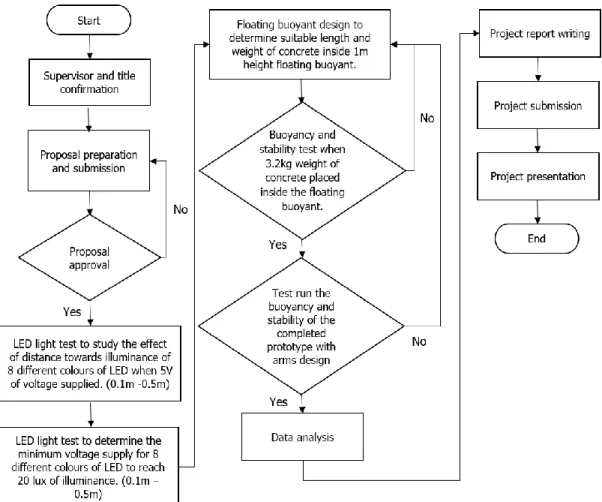
Figure 1.1 shows the flow chart of the project research methadolohy.
Figure 1.1: The Flowchart of The Project Research Methodology
6 1.6 Research Expected Outcomes
The research is expected to have the following outcome:
i. Able design the underwater light floating station with proper length and weight of concrete inside the floating station so that the buoyancy force and body weight will be balance when the underwater light partially submerged on the sea water.
ii. Able to explain the relationship between illuminance of LED light with the distance of the LED light and the light meter.
iii. Able to explain the relationship between illuminance of LED light with the voltage supply to the LED light.
iv. Able to test run the buoyancy and stability of the underwater light prototype.
1.7 Research Contributions
The research contribution of this project is as follow:
i. Success in constructing an underwater LED lighting that is low cost for marine life application.
ii. The underwater LED lighting can be construct easily to with different LED light illuminance to attract different species of marine life.
iii. The LED light for the underwater lighting can be change easily according to the desire brightness to attract different species of marine life focusing to fish.
iv. The LED light for the underwater lighting can be change easily according to the desire colour to attract different species of marine life focusing to fish.
1.8 Research Commercialisation
The research commercialization of the project is as follow:
i. Suitable for most of the people as the underwater LED lighting can be construct and operate easily.
ii. Low maintenance and construction cost.
iii. Sustainable design since the underwater LED light can be used repeatedly and did not release any chemical compound.
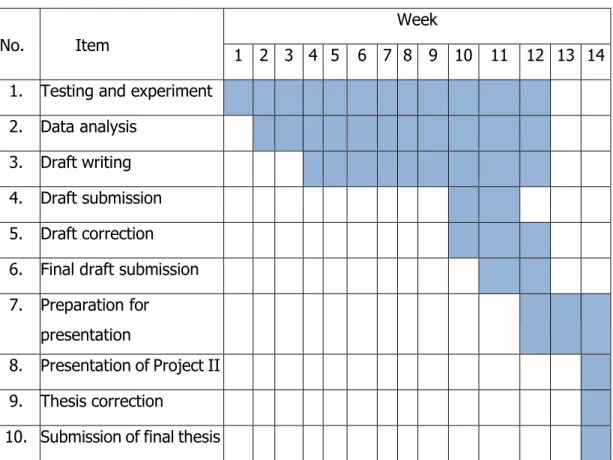
7 1.9 Research Gantt Chart
Table 1.1: Gantt Chart for Semester 1-2021/2022
No. Item
Week
1 2 3 4 5 6 7 8 9 10 11 12 13 14 1. First project briefing
2.
Confirmation of
supervisor and research title
3. Project proposal writing 4. Project proposal
submission 5. Brainstorm ideas 6. Introduction 7. Literature review 8. Methodology
9. Project I report writing
10.
Finding the suitable length for the
underwater LED light 11. LED light test
and prototype construction
12. Project I report submission 13. Preparation for
presentation
14. Presentation of Project I
8
Table 1.2: Gantt Chart for Semester 2-2021/2022
No. Item
Week
1 2 3 4 5 6 7 8 9 10 11 12 13 14 1. Testing and experiment
2. Data analysis 3. Draft writing 4. Draft submission 5. Draft correction 6. Final draft submission 7. Preparation for
presentation
8. Presentation of Project II 9. Thesis correction
10. Submission of final thesis