NOBULI: A CHATBOT FOR TACKLING CYBERBULLYING AMONG
YOUNGSTERS
TAN MEI JUN
FACULTY OF COMPUTING AND INFORMATICS UNIVERSITI MALAYSIA SABAH
2022
NOBULI: A CHATBOT FOR TACKLING CYBERBULLYING AMONG
YOUNGSTERS
TAN MEI JUN
THESIS SUBMITTED IN PARTIAL FULFILLMENT FOR THE DEGREE OF BACHELOR OF COMPUTER SCIENCE WITH
HONOURS
(NETWORK ENGINEERING)
FACULTY OF COMPUTING AND INFORMATICS UNIVERSITI MALAYSIA SABAH
2022
ii
DECLARATION
I hereby declare that the material and content in this project is my own except for definitions, summaries, and references, which have been duly acknowledged.
17 January 2022 ____________________
Tan Mei Jun BI18110195
iii
CERTIFICATION
NAME : TAN MEI JUN
MATRIC NUMBER : BI18110195
TITLE : NOBULI: A CHATBOT FOR TACKLING CYBERBULLYING AMONG YOUNGSTERS
DEGREE : BACHELOR OF COMPUTER SCIENCE WITH HONOURS (NETWORK ENGINEERING)
VIVA’S DATE : 17 JANUARY 2022
CERTIFIED BY;
1. SUPERVISOR Signature
Dr. Chin Pei Yee
iv
ACKNOWLEDGEMENT
First of all, I am very thankful for all the guidance, support, motivation and feedback provided by my supervisor, Dr. Chin Pei Yee and examiners Dr. Tan Soo Fun and Madam Shaliza Hayati A. Wahab. The countless guidance, support, motivations, and feedback given has allowed me to improve and go beyond what I had intended to do which is a huge step of growth and improvement for me. In relation to that, I am able to build my confidence and upskill myself to aim at a higher goal than before.
I am also very thankful to my parents for the unconditional support and care given to me to ensure that my well-being is at tip-top throughout my entire journey in completing this report. They have provided me with a very comfortable and great environment to complete the project as well.
I would also like to thank all my friends for all the motivation and support.
The support given has driven me to work hard and give my best as well.
Tan Mei Jun 17 January 2022
v
ABSTRACT
Cyberbullying is increasing at an alarming rate not only in Malaysia, but globally. The increase of cyberbullying could be directly related to the increase of users on the internet and the increase in time spent online which could be due to the Covid-19 pandemic. Governments, schools, and parents have been voicing out their concerns in relation to cyberbullying as the most vulnerable group to be victimized by cyberbullying would be youngsters. Youngsters who are also known as teenagers are mostly school students who lack the education and awareness on the context of cyberbullying in general and might even take up the role as a cyberbully without themselves being aware of their actions or on the other hand, end up being a victim of cyberbullying. Hence, this project involved the development of a chatbot known as Nobuli which is a chatbot to tackle cyberbullying among youngsters and the Nobuli chatbot is integrated into a mobile application. The objectives of this project are (i.) to investigate the implementation of Natural Language Processing (NLP) to detect cyberbullying in chatbots, (ii.) to design a chatbot in a mobile application on cyberbullying and (iii.) to evaluate the effectiveness of chatbot in increasing the cyberbullying awareness among youngsters using functional testing and user acceptance testing. The developed Nobuli chatbot and Nobuli mobile application are developed using the Agile software development methodology consisting of seven phases and there are a total of five modules implemented which includes the About Cyberbullying module, the Nobuli Chatbot module, the Quiz module, the News module and the Report module. After the entire Nobuli mobile application has been developed with the modules implemented, the Nobuli mobile application is tested using functional testing and user acceptance testing. Overall, the chatbot would be expected to educate, spread awareness, and persuade youngsters to report cyberbullying cases which will contribute to a decrease in cyberbullying cases in the future.
vi
ABSTRAK
(NOBULI: CHATBOT UNTUK MENANGANI BULI SIBER DI KALANGAN REMAJA)
Peningkatan kes buli siber dengan kadar yang amat membimbangkan bukan merupakan satu isu yang hanya berlaku di Malaysia tetapi di peringkat global.
Peningkatkan kes buli siber boleh dikaitkan dengan peningkatan dalam penggunaan internet dan secara langsungnya, peningkatan tersebut juga mengakibatkan peningkatan dalam masa penggunaan internet secara atas talian yang merupakan salah satu kesan daripada pandemik Covid-19. Pihak kerajaan, sekolah dan ibu bapa telah menyuarakan kebimbangan dan kerisauan mereka terhadap isu-isu yang berkenaan dengan buli siber kerana kebanyakkan mangsa dalam kes-kes buli siber terdiri daripada golongan remaja yang juga merupakan pelajar. Golongan remaja kurang kesedaran and tidak mempunyai ilmu yang mencukupi tentang buli siber dan juga ada kemungkinannya remaja-remaja tersebut terlibat dalam kes-kes buli siber sebagai pembuli tanpa pengetahuan mereka sendiri. Justeru, projek ini bertujuan untuk membangunkan satu chatbot yang dinama sebagai “Nobuli” untuk menangani isu buli siber di kalangan remaja yang diimplementasikan di satu aplikasi mudah alih.
Objektif-objektif dalam projek tersebut adalah (i.) menyiasat pelaksaan Pemprosesan Bahasa Semula Jadi (NLP) untuk mengesan kandungan buli siber di chatbot, (ii.) merancang dan mereka chatbot di aplikasi mudah alih dan (iii.) menilai keberkesanan chatbot dalam meningkatkan kesedaran mengenai buli siber di kalangan remaja melalui ujian kefungsian dan ujian penerimaan pengguna. Chatbot yang dibangunkan akan menggunakan metodologi Pengembangan Perisian Agile yang terdiri daripada tujuh fasa dan terdapat lima modul yang merangkumi modul Perihal Buli Siber, modul Chatbot Nobuli, modul Kuiz, modul Berita dan modul Laporan. Setelah aplikasi mudah alih Nobuli telah dibangunkan, aplikasi mudah alih Nobuli diuji melalui ujian fungsian dan ujian penerimaan pengguna. Secara keseluruhan, chatbot tersebut diharapkan dapat mendidik, meningkatkan kesedaran dan meyakinkan para remaja untuk melaporkan kes-kes buli siber yang akan menyumbang kepada penurunan kadar kes- kes buli siber pada masa depan.
vii
LIST OF CONTENTS
Page
TITLE i
DECLARATION ii
CERTIFICATION iii
ACKNOWLEDGEMENTS iv
ABSTRACT v
ABSTRAK vi
LIST OF CONTENTS vii
LIST OF TABLES xi
LIST OF FIGURES xii
CHAPTER 1: INTRODUCTION 1.1 Problem Background/Motivation 1
1.2 Problem Statement 3 1.3 Project Objectives 3
1.4 Project Scope 4
1.5 Report Organization 6
CHAPTER 2: LITERATURE REVIEW 2.1 An Overview of Cyberbullying 9
2.2 Initiatives to Curb Cyberbullying 10
2.2.1 Cybersafe 11
2.2.2 ReThink™ - Stops Cyberbullying 12
2.3 Definition and History of Chatbot 13
viii
2.4 The Chatbot Infrastructure 14
2.5 Related Works of Chatbot 15
2.6 Natural Language Processing (NLP) 16
2.6.1 Introduction of NLP 16
2.6.2 Techniques of NLP 17
2.6.3 Classifiers 19
2.6.4 Supervised, Semi-supervised and Unsupervised Approaches 20
2.7 Review of Chatbots Related to Bullying 22
2.7.1 Akancha 24
2.7.2 Etisalat's Bully Bot 27
2.7.3 Comparisons of Reviewed Chatbots 33
CHAPTER 3: METHODOLOGY 3.1 Introduction and Description 36
3.2 Tools 40
3.3 Modules 41
CHAPTER 4: SYSTEM ANALYSIS AND DESIGN 4.1 Introduction 43
4.2 Use Case Diagram 44 4.3 Sequence Diagram 45 4.4 Data Flow Diagram 46 4.5 Flow Chart 48 4.6 User Interface Design (Mock-up or Prototype) 49
CHAPTER 5: RESEARCH IMPLEMENTATION/EXPERIMENTS 5.1 Introduction 58
ix
5.2 First Experiment 58
5.3 Second Experiment 60
5.4 Third Experiment 62
5.5 Fourth Experiment 64
5.6 Trial Implementation 66
CHAPTER 6: SYSTEM/PRODUCT IMPLEMENTATION
6.1 Sign Up Page 68
6.2 Login Page 69
6.3 Dashboard 69
6.4 About Cyberbullying 71
6.5 Nobuli Chatbot 71
6.6 Quiz 72
6.7 News 73
6.8 Report 74
6.9 Firebase 75
6.10 Dialogflow 76
CHAPTER 7: TESTING
7.1 Testing 77
7.2 Functional Testing 77
7.2.1 Sign Up and Login 77
7.2.2 Dashboard 78
7.2.3 About Cyberbullying 79
7.2.4 Nobuli Chatbot 79
7.2.5 Quiz 79
7.2.6 News 80
x
7.2.7 Report 81
7.3 User Acceptance Testing 81
7.3.1 Respondent Demographics 82
7.3.2 Ratings for the Modules 83
7.3.3 Ratings for the Nobuli Application 84
CHAPTER 8: CONCLUSION 87
REFERENCES 90
xi
LIST OF TABLES
Page
Table 1.1 : Summary of the Modules in the Nobuli Mobile Application 6 Table 2.1 : Comparisons and Differences of Reviewed Chatbots 33
Table 2.2 : Limitations of Reviewed Chatbots 34
Table 3.1 : Tools Used in the Project 40
Table 4.1 : Overview on the Sections and Figures of the User Interface
Design (Mock-up or Prototype) 49
Table 7.1 : Test Case for Sign Up and Login 77
Table 7.2 : Test Case for Dashboard 78
Table 7.3 : Test Case for About Cyberbullying 79
Table 7.4 : Test Case for Nobuli Chatbot 79
Table 7.5 : Test Case for Quiz 79
Table 7.6 : Test Case for News 80
Table 7.7 : Test Case for Report 81
xii
LIST OF FIGURES
Page
Figure 2.1 : Screenshots of One of the Games in Cybersafe 11 Figure 2.2 : A Screenshot of the ReThink™ - Stops Cyberbullying
Application 12
Figure 2.3 : Chatbot Developed by NLP 14
Figure 2.4 : Example of Tokenization 18
Figure 2.5 : Example of Stemming and Lemmatization 18 Figure 2.6 : Example of Text or Intent Classification 19 Figure 2.7 : An Overview on Supervised Learning, Semi-supervised
Learning and Unsupervised Learning 20
Figure 2.8 : Examples of Supervised Learning and Unsupervised
Learning 21
Figure 2.9 : Example of Semi-supervised Learning 22 Figure 2.10 : Screenshot and Translation of the Chatbot where the
Chatbot Acts as a Bully Agent and Victim Agent 23 Figure 2.11 : Overview of the Akancha Chatbot 24 Figure 2.12 : The List of Options under the Menu Section of Akancha 24
Figure 2.13 : Sample Chats of Akancha 25
Figure 2.14 : Replies Regarding Cyberbullying by Akancha 26 Figure 2.15 : A Brief Introduction about the Etisalat’s Bully Bot 27 Figure 2.16 : The Settings of the Simulation of the Etisalat’s Bully Bot 28 Figure 2.17 : A Series of Screenshots of a Simulation Conducted with
the Etisalat’s Bully Bot 30
Figure 2.18 : The Etisalat’s Bully Bot Providing Information on
Cyberbullying 31
Figure 2.19 : The Etisalat’s Bully Bot’s Request on Spreading
Awareness 32
Figure 2.20 : Examples on the Limitations Found in the Akancha
Chatbot 34
Figure 2.21 : Example on the Limitations Found in the Etisalat’s Bully
Bot 35
Figure 3.1 : The Overview of the Phases Involved in the Project 37 Figure 4.1 : Use Case Diagram of the Chatbot Design 43 Figure 4.2 : Use Case Diagram of the Nobuli Application 44
xiii
Figure 4.3 : Cyberbullying Chatbot Sequence Diagram 45 Figure 4.4 : Data Flow Diagram of Nobuli Chatbot 46 Figure 4.5 : Data Flow Diagram of Nobuli MobileApplication 47 Figure 4.6 : Flowchart of the Nobuli Application 48 Figure 4.7 : Menu of the Nobuli Mobile Application 50
Figure 4.8 : About Cyberbullying Page 50
Figure 4.9 : Start of the Chat with Nobuli Chatbot 51 Figure 4.10 : Chatting with Nobuli Chatbot about Cyberbullying 51 Figure 4.11 : Chatting with Nobuli Chatbot about Cyberbullying and
Requesting for More Information 52
Figure 4.12 : Chatting with Nobuli Chatbot about Cyberbullying and Does Not Request for More Information 52 Figure 4.13 : Requesting for the Identification of Cyberbullying 53 Figure 4.14 : Scenarios or Texts Identified as Cyberbullying 54 Figure 4.15 : Scenarios or Texts Not Identified as Cyberbullying 54
Figure 4.16 : Reporting a Cyberbullying Case 55
Figure 4.17 : Ending the Chat with Nobuli Chatbot 55
Figure 4.18 : Quiz Page 56
Figure 4.19 : News Page 56
Figure 4.20 : Report Page 57
Figure 5.1 : First Experiment using Python on Google Colaboratory 58 Figure 5.2 : Second Experiment using Python on Google Colaboratory 60 Figure 5.3 : Third Experiment using Python on Google Colaboratory 62 Figure 5.4 : Fourth Experiment using Dialogflow 64
Figure 5.5 : Dialogflow Web Demo 65
Figure 5.6 : Dialogflow Web Demo 66
Figure 5.7 : Dialogflow Web Demo 66
Figure 6.1 : Sign Up Page Demo 68
Figure 6.2 : Login Page Demo 69
Figure 6.3 : User Dashboard Demo 69
Figure 6.4 : Admin Dashboard Demo 70
Figure 6.5 : About Cyberbullying Demo 71
xiv
Figure 6.6 : Nobuli Chatbot Demo 71
Figure 6.7 : Quiz and Manage Quiz Demo 72
Figure 6.8 : News and Manage News Demo 73
Figure 6.9 : Report and Manage Report Demo 74
Figure 6.10 : Firebase Authentication for Users 75
Figure 6.11 : Realtime Database 75
Figure 6.12 : Storage 76
Figure 6.13 : Dialogflow Intents 76
Figure 7.1 : The Demographics of Respondents 82
Figure 7.2 : Ratings for the Modules 83
Figure 7.3 : Projection on the Ratings Received by Respondents for
the Nobuli Application 84
Figure 7.4 : Projection on the Modules which theUsers would like to
remain on the Nobuli Application 85
Figure 7.5 : Projection on the Effectiveness of the Nobuli Chatbot in
increasing Cyberbullying Awareness 85
1
CHAPTER 1
INTRODUCTION
1.1 Problem Background/Motivation
The proliferation of Internet use has exposed youngsters and brought various risks to the public such as online frauds, cyberbullying and fake news. In recent years, cyberbullying is an emerging societal issue in the digital era (Chan et al., 2021) and the cyberbullying cases among youngsters are increasing at an alarming rate.
Cyberbullying, also known as cyber harassment, is defined as using electronic communication devices to harass or bully a person which includes intimidating or threatening actions via the action of sending messages (Watercutter, 2011).
According to the Malaysian Communications and Multimedia Commission (MCMC) (2020), there is 88.7% of the Malaysian population who are Internet users in 2020 and there is a 155% increase of children between the age of 5 to 17 years old using the Internet in comparative to the year 2016, from 18.4% to 47% in 2020. According to a study done by Ipsos (2018), there is an increase in the number of reports regarding cyberbullying among children as reported by parents. Malaysia has achieved a high level of social media bullying or also known as cyberbullying which is at 71% (Zuckerman, 2020). According to a survey conducted by Comparitech, the age group that has the highest number of reports on their children getting bullied physically or via the cyberspace (59.9%) are children with the age group of 14 years old to 18 years old (Cook, 2021). Teenagers are very exposed and are high potential victims of cyberbullying due to their exposure on the internet as well as the lack of understanding on what should not be shared on social media.
2
Increasing cyberbullying cases has made the Malaysian government to come up with various initiatives and interventions to tackle cyberbullying. One of the interventions done by the government is coming up with an initiative known as CyberSAFE in Schools and it is a programme that was initiated by DiGi, Ministry of Education Malaysia, CyberSecurity Malaysia and Childline Malaysia (Malaysian Communications And Multimedia Commission (MCMC), 2014). The CyberSAFE in Schools program was initiated due to a suvey done by DiGi that receives worrisome statistics where as high as 26% of school children reported that they were bullied online and the age group that was reported the most are from 13 to 15 years old.
The level of online harassment or cyberbullying is above 70% as well. Hence, the initiative was created to create awareness, educate, and empower students to stay safe in the cyberworld. Such initiatives done by the government are very time- dependable where students would have to be present at a specific timeframe to gain knowledge regarding cyberbullying.
Chatbot is an upcoming trend in terms of education and spreading awareness to the public. According to the Cambridge English Dictionary, chatbots could be defined as computer programs that are designed to have a conversation with human beings, especially over the internet. Shawar and Atwell (2007) defined chatbots as software programs that interact with users using natural language. A chatbot receives a user’s questions and undergoes processes such as the matching of patterns and classification to determine which automated replies should be used to respond or by using Natural Language Processing (NLP) techniques to convert texts into structured data and then reply as naturally as possible to the user. This increases the accuracy of the chatbot in responding and providing the correct reply to the users. Currently, there are various limitations found in existing cyberbullying chatbots and chatbots these days have a more empathetic approach which specifically targets users who might be victims of cyberbullying. One of the limitations found in current cyberbullying chatbots is that it does not help users to detect or verify if what the users are going through could be considered as cyberbullying. Next, there is limited chatbots that educates, and spreads awareness related to cyberbullying from a teenager’s perspective. Another limitation found is that chatbots (e.g. SimSimi) could end up as a medium for people especially children to cyberbully as well (BBC News, 2017).
3 1.2 Problem Statements
While the cyberbullying cases among youngsters are increasing and there is lack of intervention to educate and increase the awareness of cyberbullying to this population, this project aims to design and develop a chatbot named Nobuli.
Hence, the following are the problem statements for this project:
(i.) There is limited understanding on how chatbots could use Natural Language Processing (NLP) to detect cyberbullying content in texts.
(ii.) There is no cyberbullying chatbot intervention in Malaysia.
(iii.) There is little study on investigating the capability and effectiveness of chatbots in terms of educating and spreading cyberbullying awareness.
1.3 Project Objectives
The purpose of this project is to develop a mobile application integrating a chatbot that is able to give automated responses to the users in questions related to cyberbullying.
The following are the objectives of the project:
(i.) To investigate the implementation of Natural Language Processing (NLP) to detect cyberbullying in chatbots.
(ii.) To design a chatbot in a mobile application on cyberbullying.
(iii.) To evaluate the effectiveness of chatbot in increasing the cyberbullying awareness among youngsters using functional testing and user acceptance testing.
4 1.4 Project Scope
The targeted audience of this project are youngsters who would also be known as teenagers. This targeted group are mainly school students, and they are chosen as the targeted group because teenagers are at a very high risk of being exposed to cyberbullying. The targeted group could be differentiated into three groups which are teenagers with entirely no knowledge on cyberbullying, teenagers with mild knowledge on cyberbullying and teenagers who might be involved in cyberbullying.
Hence, the modules prepared are to suit the three groups of our targeted audience to educate and assist them in gaining awareness on cyberbullying. This project uses a creative intervention which is by developing a mobile application which consists of the modules of About Cyberbullying, Nobuli Chatbot, Quiz, News and Report. The first module which is About Cyberbullying focuses on the information about cyberbullying which gives an overview on what is cyberbullying to the users. For the About Cyberbullying module, the admin is able to manage the texts and edit it from the admin interface.
For the module of Nobuli Chatbot, the integration of the chatbot into the mobile application occurs here with the aim of spreading awareness about cyberbullying to the targeted audience in an easier and friendly manner. The chatbot would also be able to help users to differentiate if the texts typed and the scenarios provided by the users are related to cyberbullying. After that, the chatbot would be able to educate the targeted group of users to take appropriate actions when facing with cyberbullying. If the chatbot was able to identify that there is cyberbullying content, the chatbot would educate the user to report the cyberbullying issue. This chatbot would be a text-based chatbot as well. Next, the targeted audience who are teenagers would be more sensitive on the approaches or language used in a chat.
Hence, the terms used and the way of chatting with the targeted audience via the Nobuli Chatbot would be focused as well.
Next, the Quiz module in the mobile application will allow users to answer the quizzes that were managed by the admin. After the users answered the quizzes, the
5
users will receive a test score and are abled to refer to a score table to know about their level of understanding. For the Quiz module, the admin is able to manage the quizzes where the admin could add, update and delete the quizzes.
Another module in this project is the News module. For the News module, users will be able to read up news about cyberbullying that has been posted by the admin. For the News module, the admin is able to manage the news where the admin could add, update and delete the news.
Last but not least, the Report module in the mobile application enables the user to report on cyberbullying cases where the user is required to type in the email subject and content in the app and after that, the email application would be opened.
Then, the email would have been drafted readily including the email addresses of the respective organizations. For the Report module, the admin is able to manage the email addresses of the receiver by adding, updating and deleting the email addresses.
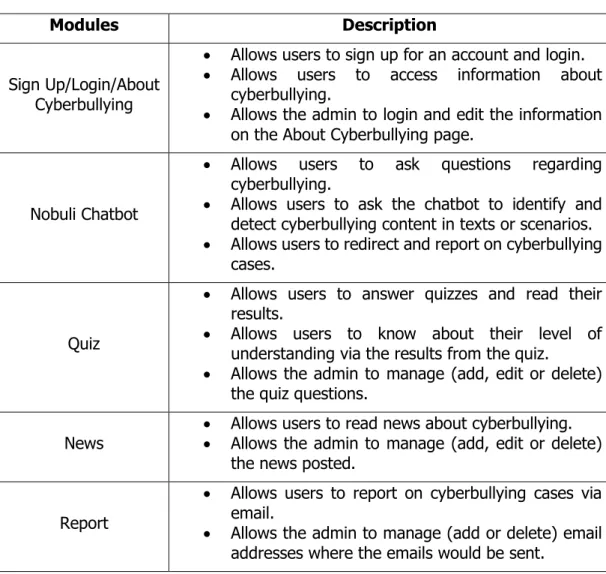
Overall, the users would be able to understand more about cyberbullying, chat with Nobuli chatbot on cyberbullying, play with the quizzes provided, read up on cyberbullying news and report cyberbullying cases. Hence, this mobile application would be able to serve as a pocket cyberbullying helper for teenagers. Table 1.1 shows the summary of the modules in the Nobuli mobile application.
6
Table 1.1: Summary of the Modules in the Nobuli Mobile Application
Modules Description
Sign Up/Login/About Cyberbullying
• Allows users to sign up for an account and login.
• Allows users to access information about cyberbullying.
• Allows the admin to login and edit the information on the About Cyberbullying page.
Nobuli Chatbot
• Allows users to ask questions regarding cyberbullying.
• Allows users to ask the chatbot to identify and detect cyberbullying content in texts or scenarios.
• Allows users to redirect and report on cyberbullying cases.
Quiz
• Allows users to answer quizzes and read their results.
• Allows users to know about their level of understanding via the results from the quiz.
• Allows the admin to manage (add, edit or delete) the quiz questions.
News • Allows users to read news about cyberbullying.
• Allows the admin to manage (add, edit or delete) the news posted.
Report
• Allows users to report on cyberbullying cases via email.
• Allows the admin to manage (add or delete) email addresses where the emails would be sent.
1.5 Report Organization
Chapter 1 which consists of the introduction of the project covers the problem background, problem statements, objectives, and project scope to allow the readers to understand the purpose of the entire project.
Chapter 2 covers the current existing systems which are relatable to the project to understand deeper on the limitations of the existing systems. Comparisons between the existing systems would be discussed in this chapter as well. Research on chatbots, Natural Language Processing (NLP) techniques, classifications,
7
supervised, unsupervised and semi-supervised learning approaches would be done and discussed in this section.
Chapter 3 discusses on the software development methodology chosen which is the Agile methodology and each phase would be described. There are a total of seven phases where amendments are made from the common Agile methodology.
The seven phases are the planning phase, the research phase, the designing phase, the developing phase, the testing phase, the implementation phase, and the evaluation phase. The tools that would be used in the project is discussed in this section as well.
Chapter 4 discusses on the system analysis and design of the project. The overall design of the project and chatbot would be shown using Use Case Diagrams, Sequence Diagrams, Data Flow Diagrams and Flowchart to understand the flow of the project. The overall interface of the application and chatbot would be shown in this chapter as well.
Chapter 5 discusses on the research and experiments that are done to understand the processes of NLP and how it functions in a chatbot. The testing of tools is done as experiments in this chapter as well to determine the suitability of the tools for the project.
Chapter 6 covers the system and product implementation area which shows the overall mobile application and its functions. This chapter shows all the modules found on the mobile application.
Chapter 7 discusses on the testing phase which involves Functional Testing and User Acceptance Testing. The Functional Testing is done by myself while the User Acceptance Testing involves 15 respondents to test the usability of the mobile application.
8
Chapter 8 involves the conclusion of the mobile application where the limitations and future improvements are stated.
9
CHAPTER 2
LITERATURE REVIEW
2.1 An Overview of Cyberbullying
Cybercrimes are crimes that happen through technology. According to Nurse (2018) cybercrimes could be known as crimes that are conducted or enabled through the use of digital technologies such as personal computers, laptops, smartphones, smart devices (e.g., voice assistants, internet-connected cameras), smart systems and infrastructures which includes buildings that are driven by the Internet of Things, IoT as well. The common cybercrimes among youngsters would be cyberbullying or harassment, hacking, cyber stalking, defamation, cheating, scams, frauds, e-mail spoofing and password sniffing (Arora, 2016). Based on a Global Youth Online Behaviour Survey which was conducted by Microsoft, one out of three Malaysian children are victims of cyberbullying and this survey was conducted among children whose age ranges from eight to seventeen (Digital News Asia, 2012). According to Alim (2016), one of the traits that teenagers these days have is the early exposure and frequent use of technology which contributes to the exposure of teenagers to cyberbullying.
Cyberbullying which is one of the most common cybercrimes could be said to originate from traditional bullying. The transition from traditional bullying which were limited to face-to-face interactions evolved to bullying on cyberspace which in short known as cyberbullying is due to the technological advancements and evolutions (Donegan, 2012). In comparison with traditional bullying and cyberbullying, cyberbullying could be said as a more serious form of bullying as it could happen anywhere and anytime where the potential targeted audience is huge as well