
Oxidation Coupled with Extraction to Remove Thiophene and Benzothiophene from Dodecane using [Mmlm)DMP Ionic Liquid.
by
Nurul Suhaira Abdullah
Dissertation submitted in partial fuffillment of
The requirements for the
Bachelor of Engineering (Hons) (Chemical Engineering)
JANUARY 2009
Universiti Teknologi PETRONAS Bandar Seri Iskandar
31750Tronoh Perak Darul Ridzuan
CERTIFICATION OF APPROVAL
Oxidation Coupled With Extraction To Remove Thiophene And Benzotiophene From Dodecane Using Mmim[Dmp J Ionic Liquid.
Approved by,
by
Nurul Suhaira Abdullah
A project dissertation submitted to the Chemical Engineering Programme Universiti Teknologi PETRONAS in
partialfulfilment of the requirement for the
BACHELOR OF ENGINEERING (Hons) (CHEMICAL ENGINEERING)
UNIVERSITI TEKNOLOOI PETRONAS TRONOH, PERAK.
January
2009CERTIFICATION OF ORIGINALITY
This is to certifY that I am responsible for the work submitted in this
project,that the original
work is my own except as specified
in the references and acknowledgements, and that theoriginal work contained herein have not been undertaken or done by unspecified sources or
persons.
ACKNOWLEDGEMENT
In the name of Allah, the Most Gracious, the Most Merciful. Praise to Him the Almighty that in his will and given strength, had I managed to complete this final year research project.
I would like to thank numerous individuals for their tremendous support in performing this project. Deepest gratitude goes to my supervisor Dr. Chong Fai Kait for her continuous support in term of knowledge and time throughout the research project.
My sincere and heartfelt thanks to all the research officers of Ionic Liquid Project especially Ms.
Hawatulaila for their enlightening supervision and countless hours spent in sharing their insightful understanding, profound knowledge and valuable experiences
My thanks also go to all lab teclmicians who were so helpful and their never-ending supports 'with a smile'
had
made this project going smoothly and completed in the specified period. Last but not least, to all my friends and family memhers who have directly or indirectly show their support.ABSTRACT
High concentration release of sulfur from fuel to the environment can cause accumulation in the ecological system, thus posing a significant danger to human health. The available technology of for sulfur removal from fuel which is hydrodesulfurization (HDS) are rather expensive, require severe operating condition,
high
hydrogen consumption, and limited to aliphaticsulfur
species.Therefore, vigorous studies are being conducted to develop more effective and cheaper alternatives. One of the promising alternatives that attract high attention is using ionic liquid for desulfurization due to its unique properties as a solvent and catalyst. This project is focused on removing sulfur from crude oil model by using oxidation coupling with extraction method. The ionic liquid use in this research work is methylmethylimidazolium dimethylphospate,[Mmim]DMP. There are five main stages in this project which are preparation of ionic liquid, characterization of ionic liquid properties, model oil preparation, desulfurization and data analyzing. Two sulfur species were used: thiophene and benzothiophene. Three different amount of sulfur in model oil were employed which are 2%, 4% and 6%. The desulfurization process was conducted at ambient temperature. The percentages of sulfur removal were analyzed using X-ray fluorescence (XRF). The results showed that percentage of sulfur removal always followed the order of thiophene > benzothiophene. The significance of this finding is such that although thiophene and benzothiophene cannot be removed efficiently by HDS process, they can be easily extracted by ionic liquid. This is due to strong 11:-x interaction between unsaturated bonds of those sulfur species and the imidazolium ring of ionic liquid.
TABLE OF CONTENTS
ABSTRACT. I
CHAPTER I: INTRODUCTION
.
11.1 Background of Study • 1
1.2
Problem Statement5
1.3 Objectives and Scope of Study
6
CHAPTER2: LITERATURE REVIEW
. 8
2.1
Preparation of Ionic Liquid8
2.2
Factors Affecting Desulfurization Efficiency.9
2.3
Regeneration of Used ILs 13CHAPTER3: METHODOLOGY .
14
3.1
Preparation of Ionic Liquid15
3.2
Characterization of Ionic Liquid Properties16
3.3
Model Oil Preparation18
3.4 Desulfurization
19
3.5 Data Analysis .
19
CHAPTER4: RESULTS AND DISCUSSION
20
4.1 Preparation oflonic Liquid ([Mmim}DMP) •
20
4.2
Ionic Liquid Properties20
4.3 Data Analysis •
25
CHAPTERS: CONCLUSION AND RECOMMENDATIONS
27
5.1
Conclusion27
5.2
Recommendations27
REFERENCES
28
APPENDICES 30
LIST OF FIGURES
Figure 2.1: Effect of Temperature on Desulfurization Figure 3.1: Experiment Flow Chart.
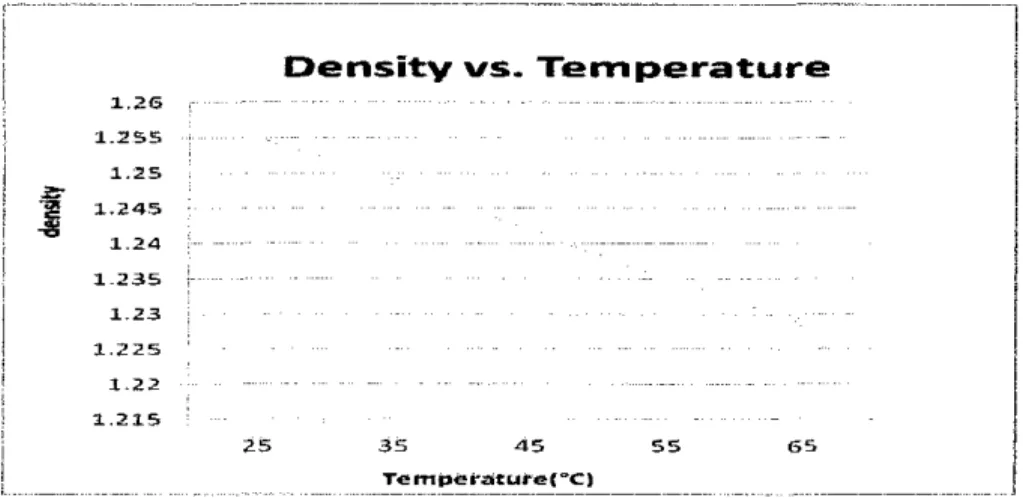
Figure 4.1: Graph of density vs. temperature
• 11
14 21
Figure 4.2: FTIR Spectrum ofMMIM[DMP] 25
Figure4.3: StructureofMMIM[DMPJ 24
Figure 4.4: Comparison of percentage of sufur removal for different sulfur species 25
LIST OF TABLES
Table 1.1: Composition in Crude Oil 3
Table 1.2: Composition of Hydrocarbon Constituent in Crude Oil 4 Table2.1: Effect of water content in IL on Sulfur Partition Coefficients • 10 Table2.2: Desulfurization results at different mass ratio • 10 Table 2.3: Desulfurization results of [BPy JBF 4 at different temperatures • 12
Table 2.4: Desulfurization of Regenerated [BPy]BF 4 13
Table 3.1: Volwne for Mixing 15
Table4.1: Density of [Mmim ][DMPJ 20
Table4.2: Water Content in [MmimJ[DMPJ 22
Table 4.3: Identified structure of the sample 24
Table4.4: Desulfurization of Model Oil with
benzothiophene
as the sulfur species 25 Table4.5: Desulfurization of Model Oil with Thiophene as the sulfur species.
251.1 Background of Study
1.1.1
Ionic LiquidCHAPTER I INTRODUCTION
Ionic liquid is salts that have melting point below l OO"C
[l-
3] and consist of organic cations and inorganic anions that are poorly coordinated. At least one ion has a delocalized charge and one component is organic, which prevents the formation of a stable crystal lattice [2}. Most of ionic liquid is liquid at room temperature (RTIL's). The constituents of ionic liquids are constrained by high coulombic forces, exhibiting practically no vapor pressure, and hence can emit no volatile organic compounds (VOCs) [3]. This property provides an advantage for ionic liquid, offering lower toxicity compared to the other lower boiling point solvents [1}. Both components (anion and cation) of the ionic liquids can be varied to fulfill the requirement of certain process to yield various fascinating properties including melting point, viscosity, hydrophobicity and density. This is so called "designer solvents" [4].In general, ionic liquids consist of a salt where one or both the ions are large, and the ' cation has a low degree of symmetry. These factors tend to reduce the lattice energy of the crystalline form of the salt, and hence lower the melting point [5]. Ionic liquid can be·
classified as simple salts and binary ionic liquid [3
J.
Simple salts is made of single anion and cation such as [EtNHJ][NOJ].This type of ionic liquid show simple melting behavior.On the other hand, binary ionic liquid is salt where equilibrium between ions is involved
and
consists of several different ionic species such as mixtures of aluminum (Ill) chloride and l, 3-dialkylimidazolium chlorides. The melting point depends on the composition of each ions exist in the ionic liquid.One of the first RTILs was a mixture of {EMIM]CI with AICI3 forming a series of equilibrium between [EMIM][AIC4J, {EMIM][AizCJ,J, and [EMIM][AI3ChoJ. This RTIL is not water stable. The discovery of water-insoluble RTILs such as [BMIM][PF6]
allowed the development of new work-up methods, including the separation of water- soluble byproducts by simple extraction. Some transition metal catalysts that are soluble in ionic liquids may be recycled together with the ionic liquid,
after
extraction with water and the non-polar organic solvent used for product separation. The catalyst and ionic liquid may be recycled several times.A major drawback was their moisture sensitivity and, though to a somewhat lesser extent, their acidity/basicity, and the latter which can sometimes be used to an advantage. In 1992, Wilkes and Zawarotko reported the preparation of ionic liquids with alternative, 'neutral', weakly coordinating anions such as hexafluorophosphate ([PF6}) · and tetrafluoroborate ([BF4]r, allowing a much wider range of applications for ionic liquids.(6] It was not until recently that a class of new, air- and moisture stable, neutral ionic liquids was available that the field attracted significant interest from the wider scientific conununity.
More recently, people have been moving away from [PF6] ·and [BF4] ·since they are highly toxic, and towards new anions such as bistriflimide ((CF3SOz)zN] · or even away from halogenated compounds completely. Moves towards less toxic cations have also been growing, with compounds like ammonium salts (such as choline) being just as flexible a scaffold as imidazole.
The application of ionic liquid in petroleum industry especially in desulfurization process had gained much interest and many studies are being conducted. This is due
topossibility of cost reduction as ionic liquid can be recycled as well the reaction involve is not complicated compared to molecular solvent. It also requires simple equipment and procedures.
1.1.2 Crude Oil
Petroleum or crude oil is a naturally occurring, flammable liquid found in rock formations in the
Earthconsisting of a complex mixture of hydrocarbons of various molecular weights, plus other organic compounds [7].
Hydrocarbon group is the
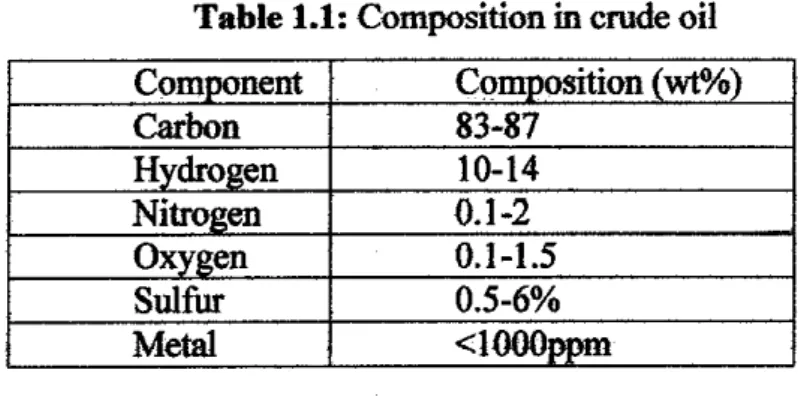
mainconstituent in crude oil. Crude oil consist of various hydrocarbon namely alkanes, cycloalkanes and various aromatic hydrocarbons while the other organic compounds contain nitrogen, oxygen and sulfur, and trace amounts of metals such as iron, nickel, copper and vanadium. The composition of each component is listed in the table below {8J:
Table 1.1:
Composition in crude oil Component Composition (
wt"/o)Carbon 83-87
Hydrogen 10-14
Nitrogen 0.1-2
Oxygen 0.1-1.5
Sulfur 0.5-6%
Metal
<lOOOppmGenerally, crude oil can be divided into two types which are sweet crude oil and sour crude oil. These two types are different in amount of sulfur content. Sweet crude contain
<0.5 wt"lo sulfur [9] and usually used to produce gasoline, kerosene and high quality diesel. Sour crude consist of> 1% sulfur and mainly process to produce heavy oil such as diesel and fuel oil [10].
Four different types of hydrocarbon molecules appear in crude oil. The relative percentage of each varies
from
oil to oil, determining the properties [ 11J.
Table 1.2:
Composition of Hydrocarbon Constituent in Crude Oil.Composition
by
WeightHydrocarbon Range Average
Parafins
15-60% 30%Naphtenes 30-60% 49%
Aromatics 3-20% 15%
Asphaltics remainder 6%
1.1.3 Desulfurization Proeess
Sulfur exists in crude oil as elemental sulfur and hydrogen sulfide. High content of hydrogen sulfide can cause crude oil to be toxic and corrosive. At low concentrations the oil has the smell of rotten eggs, but at high concentrations the inhalation of hydrogen sulfide is instantly fatal. At higher concentrations, the hydrogen sulfide can damage the olfactory nerve, rendering the gas effectively odorless and undetectable, while paralyzing the respiratory system. If exposure is not fatal, its effects on the human body are similar to
that of Gulf War Syndrome including chronic fatigue, headaches, dizziness, skin problems, memory problems, birth defects, and a host of breathing problems such as
asthma.
Such sour crude oil needs to be stabilized by having hydrogen sulfide gas (H2S) removed from it before being transported by oil tankers for safety reasons[12].
In the petroleum refining industry, hydrodesulfurization (HDS) is the conventional process to reduce the sulfur levels of the fuels. However, in the HDS process, to achieve very low sulfur content, higher hydrogen pressure, higher reaction temperature, and more active catalysts are needed. This is because aromatic sulfur such as dibenzothiophene, benzothiophene and thiophene
are
very hard to remove by HDS, owing to theirsterec
hindrance [ 13].1.2 Problem Statement
1.2.1 Problem IdentifiCation
Due to environmental regulation, sulfur content in transportation fuels need to be decreased to the specified amount. For example, in
2005,
the maximum sulfur content will be limited to10-50
ppm, compared to today'spermitted
value of500
ppm in most western countries. This is due to formation of sulfur oxide (SOx) that will disperse throughout the air and inhibits pollution problem that lead to negative health and environmental impact. As the issued became a very common topic to be discussed, a lot of researchhad
been done to solve the problem.The conventional method applied in refinery around the world is catalytic hydrodesulfurization (HDS). Although the process is quite effective for sulfur removal,
this process required extremely high operating conditions that lead to high consumption of hydrogen at escalated cost. It also reduced the quality of the crude by decreasing the octane number. Besides that, this method also has some limitations in removing aromatic sulfur compound such as thiophene, benzothiophene and dibenzothiophene.
1.2.3 Significance of the Project
To overcome those problems, a few alternatives that provide potential solutions had been studied. One of the most favorable alternatives is using ionic liquid due to its unique properties as an extractant and catalysts. This alternatives also promising lower cost of operation as ionic liquid can be regenerated for further use.
Oxidation followed by extraction using ionic liquid has found to be one of the effective techniques of removing sulfur. Investigation to synthesis ionic liquid has been broadly conducted. Furthermore, other type of ionic liquid can be produced from the available ionic liquid by the reaction of the ionic liquid with suitable salt.
1.3 Objectives and Seope of Stndy
The objectives of this project are:
• To study the alternative for desulfurization process using ionic liquid.
• To apply technique of oxidation coupled with extraction to remove thiophene and benzothiophene from dodecane.
The scopes for this project cover all the activities listed below:
• Identifying the types of sulfur-based compound in crude oil.
• Snythesis [Mmim]DMP ionic liquid
• Applying oxidation coupling with extraction teclmique for desulfurization.
CHAPTER2
LITERATURE REVIEW
2.1 Preparation of Ionic Liquid
Imidazolium-based phosphoric ionic liquids were used to remove sulfur containing compound in Nie et a1.(2006) [14] experimental work. [MMIM][DMP], [EMIM]{DEP]
and [BMIM][DBP] were prepared by reacting N-methylimidazole and the corresponding trialkyl phosphate at 423 K for 1 Oh with a yield of 97%. The resulting yellowish viscous liquid was washed three times with diethyl ether at room temperature followed by rotary evaporation under reduced pressure for l2h to remove all volatile residues. The purity and structure of these ILs have been analyzed by NMR and electronic spray mass
spectrum.Wang
etal. (2007) [15] in their research performed the desulfurization process using N-
alkyl-pyridinium ionic liquids.
Inthis experimental work, N-butyl-pyridinium bromide
and N-ethyl-pyridinium bromide were synthesized by
mixingpyridine (0.5 mol) and 1-
bromobutane (0.5 mol).
Theresulting ionic liquid was found to be in form of solid with
white colour. It was washed two times with ethyl acetate to avoid any contaminants and
impurities. The other ionic liquids such as N-butyl-pyridinium tetrafluorobarate, N-butyl-
pyridinium nitrate, N-butyl-pyridinium acetate, N-ethyl-pyridinium tetrafluoroborate, N-
ethyl-pyridinium nitrate and N-ethyl-pyridinium acetate were
preparedby implementing
methathesis method that used N-butyl-pyridinium bromide and N-ethyl-pyridinium
bromide as the starting material with appropriate solvent.
In other research,
Sehmidt (2008)[16]
hadstudy the ability of [BMIM][AlC4] ionic liquid to remove sulfur. The ionic liquid was prepared by adding 200 mL of N- methylimidazolium to 500 mL of n-butyl chloride. The mixture was refluxed for 30 minutes, after which a second
phasewas formed. Other procedures of synthesis were done until crystallized phase was obtained after 3 days at -20°C. To 125 g of the obtained n- butyl-N-methylimidazolium chloride, 175 g of
dry AlCl3 was added in small portions. N-Butyl-N-methylimidazolium tetrachloroaluminate was obtained as a dark green liquid.
Huang
et aL (2004)[12] proposed extraction with new ionic liquids as an alternative for desulfurization.
Inthis process, sulfur- containing compound which is thiophene was extracted using Cu
(I)based ionic liquid namely BMimCu
2Cl3. The room-temperature ionic liquid in this study was synthesized by mixing l-butyl-3-methylimidazolim chloride (BMIC) and purified anhydrous CuCl according to a BMIC:CuCl molar ratio of 1:2, at a temperature of 80°C in heptanes. The BMIC was synthesized according
toprevious literature [17].
2.2
Faetors Effeeting Desulfurization Effieieney
2.2.1 Water ContentWater content of ionic liquid is a very important parameter that needs to
beconsidered in
desulfurization process. According
to Nie et al. (2006} [14],even 1% of water content in
ionic liquid can decrease desulfurization efficiency by 20%. It is recommended that the
water content
inionic liquids to
bereduced as low as possible to achieve better
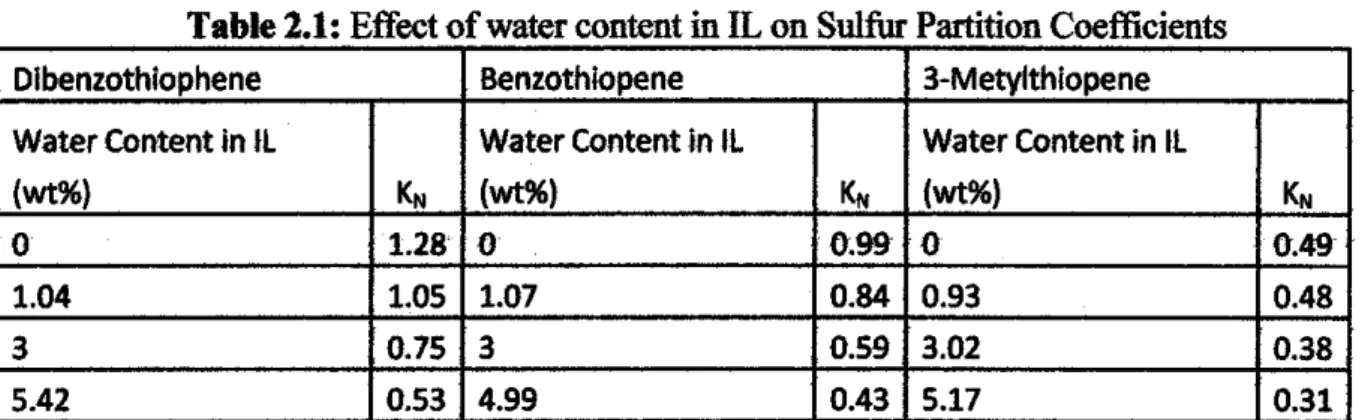
desulfurization efficiency. Table 2.1 below illustrates the effect of water content on the sulfur partition coefficients.
Table 2 1· Effect of water content in IL on Sulfur Partition Coefficients . .
Dlbenzothiophene Benzothlopene 3-Metylthiopene
Water Content in IL Water Content In IL Water Content in IL (wt%)
0 1.04 3 5.42
KN
(wt%)KN
(wt%)KN
1.28 0 0'.99" 0 0'.49
1.05 1.07 0.84 0.93 0.48
0.75 3 0.59 3.02 0.38
0.53 4.99 0.43 5.17 0.31
2.2.2 Chemical Properties
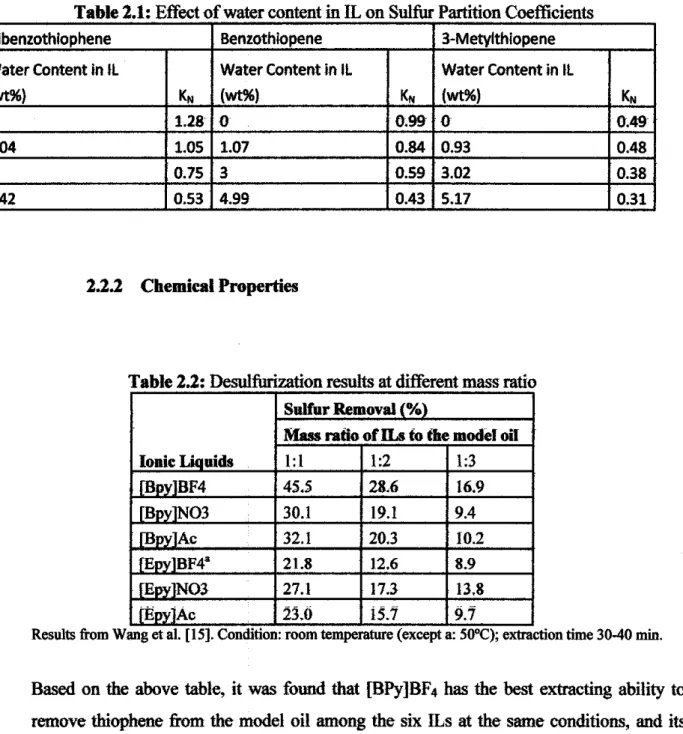
Table 2.2· Desulfurization results at different mass ratio .
Sulfur Removal(%)
Mass ratio ofiLs to the modef oif
Ionic: Liquids I: I 1:2 1:3
[Bpy]BF4 4S.S 2U 16.9
[Bpy]N03 30.1 19.1 9.4
[Bpy]Ac 32.1 20.3 10.2
fEpy]BF4• 21.8 12.6 8.9
[Epy}N03 27.1 17.3 13.8
jiipy]Ac
..
2j.oiS.7 9.7
Results from Wang et al. [15]. Condition: room temperature (except a:
so•q;
extraction time 30-40 min.Based on the above table, it was found that [BPy]BF4 has the best extracting ability to
remove thiophene from
themodel oil among
thesix ILs at the same conditions, and its
extracting ability increases with the mass ratio of ILs to the model oil. The variation in
anion and cation that form the ionic liquid do affect the capability of the ionic liquid.
Asdata shows, with the same anions (BF4·, N03·, Ac}, N-butyl-pyridinium based ILs with the substitution of a longer alkyl group to the pyridinium
ring,
have higher desulfurization ability than N-ethyl-pyridinium-based ILs. But when cations of ILs are the same (BPy, EPy), the desulfurization ability of ILs connects with the chemical property of anion. The lone pair electrons of pyridine and the electron donating ability of alkyl substitutions make the N-alkyl-pyridinium have higher polarizable aromatic "-electron density than pyridine. The strong affinity of the ILs for the aromatic sulfur compounds is related to the high polarity of the ILs. This is due to formation of liquid-clathrate compounds and "-"interactions between aromatic structures of the extraction target and pyridinium ring system [18, l9J.
2.2.2 Temperature
o"L---~10~----~~~----~~---~4~0--
Timc (min)
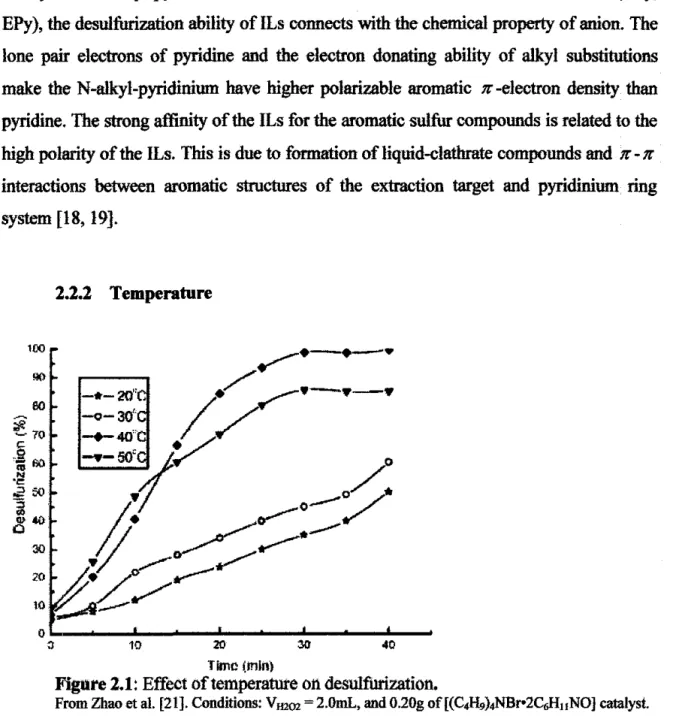
Figure 2.1: Effect of temperature on desulfurization.
From Zhao et al. [21]. Conditions: Vm02 = 2.0ml., and 0.20g of[(C4H,)4NBr•2CJI11NO] catalyst.
Sun et al. (2008)
[21) had study the effect of temperature to the desulfurization efficiency. Their result hadbeen
presented as in figure l. Figure l shows the effect of thereactive temperature on the desulfurization (%) of model oil. The reaction activity increased remarkably when the temperature increased from 20 to 40°C. 98.8%
desulfurization efficiency was obtained at 40°C within 30
min.
However, this is the highest percentage that canbe
achieved due to limitation. When the temperatureincreased
to 50°C, the desulfurization efficiency reduced to 85.7%. This is due to the decomposition ofH202 at high temperature in the presence of an amide compound. [22].Table
2.3:
Desulfurization results of [BPy]BF 4 at different temperatures.
Temperature (°C) 25 32 40 50 60
SUlfur removal (%) 45.5 45.8 46 46.9 48.3
Results from Wang et al. [14]. Condition: BPy]BF
..
4, mass ratio of ILs/model gasoline = 1:1;extraction time 30-40 min.
Another research on effect of temperature to the percentage of sulfur removal
had
been done by Wang et al. (2007} [14]. From the table, it is clearly show that the% of sulfur removal is directly proportional to the temperature increment. This is due to reduction of viscosity of the ILs molecule and sulfur-containing compound in the oil have higher chance to contactwith
each other, resulting in high sulfur removal. However, the effect of temperature on the desulfurization is limited tocertain
level of temperature. Extreme temperature will cause the ILs to decompose.2.2.4 Amount of Hydrogenperoxide (H1~)
Besides effect oftemperature, Sun et aL (2008) [21] also studied the effect of the mount of H202 on desulfurization. It is found that, desulfurization efficiency increase with increment of H2~ amount.
With
the increase of H2~. the oxidant and sulfur compoundhad more opportunity to react, thus increase desulfurization
(%).However, due to cost limitation, the optimal amount ofH202 is
2mLin the present study.
2.3 Regeneration of Used
ILsRotary evaporation at 1 00°C and re-extraction in tetrachloro-methane was suggested by Wang
etal.
(2007)[14} in their paper work to be apply as a technique to regenerate the used ILs. They also identified that re-extraction method is better than rotary evaporation.
Their findings are presented in table
5below:
Table
2.4:Desulfurization of regenerated
{BPy]BF4 Sulfur removal (%)Regeneration method Fresh tls Regenerated tLs
Rotary evaporation 45.5 39.4
Re-extraction using tetrachloro-methane 455 43.8
CHAPTER3
METHODOLOGY
The methodology of this project can be divided into five main stages as illustrated by flowchart below:
Preparation ofionic liquid ([Mmim][DMP]) by using synthesis method.
Characterization oflonie Liquid
Properties
(Density, water content, structure)l
Model oU preparation i) Dodecane +thiophene ii) Dodecane + benzothiophene
I
Desulfurization
i) Mixing
ii) Separation1
Data Analysis
-
Analyzing sulfur content using XRF Figure 3.1: Experiment Flow Chart3.1 Preparation oflonic Liquid
3.1.1 Distillation of 1-methylimidazole
1. 1-methylimidazole was distilled to remove impurities. Distillation apparatus was set up as in appendix A-1.
2.
1 OOml of 1-methylimidazolewas
poured in tri-neck round flask at room temperature.3. The Potassium Hydroxide (KOH) was added to 1-methylimidazole to avoid the production of moisture in the flask.
4. The solvent was being heated in vacuum pressure condition until it reached its boiling point ("" 140°C) and the product produced in the round flask is the
pure
1- methylimidazole.3.1.2 Mixing of 1-methylimidazole and Tri-methylphosphate
1. Purified 1-methylimidazole (0.5 mol) and trimethyl phosphate (0.5 mol) were mixed in a tri-neck round-bottom flask fitted with a reflux condenser and a drying tube. Reflux apparatus is set up as in appendix A-2.
2. The temperature was maintained between the ranges 55 - 65°C with continuous flow of nitrogen gas and the reaction was left for 3 days.
a e
. . .
oume or IXmgTbi31Vl 11 M' .
Solutions Mol Molecular Weight Density Volume (em,)
(gmol) (g/cm3)
M1M
0.5 82.11 1.03 39.86M3P04 0.5 140.08 1.21 57.88
3.1.3 Washing
1.
After 3 days, the [Mmim][DMP] ionic liquid was washed by using diethyl ether.
2.
Theequivolume of diethyl
etherwas added into [Mmim}[DMPJ ionic liquid and two layer was formed. This step was repeated for 3 times.
3.1.4 Solvent Removal and Drying
1.
Diethyl ether was remove from
the[Mmim][DMP] solution by using rotary evaporator at 50°C for 3 hours.
2. The pure IL was then dried in the vacuum line to remove moisture. (Please refer to appendix A-5 for
thearrangement of vacuum line).
3.2 Characterization of Ionic Liquid Properties.
3.2.1 Analyzing Density using density meter
1. The density meter was warmed-up by pushing the light button.
2. 5 cc syringe full of Mili-Q water was took up. The syringe was kept on the cell.
3. The
5cc syringe was then filled
withAcetone.
Airbubble was removed, then 3-4 mL of acetone was injected into the inside slide of the cell.
4. The
airpump tube was inserted into the inlet side of the cell and then the pump key was pressed.
5. The pump was automatically turned off after 3 minutes.
6. The 5 cc syringe was then filled with [Mmim]DMP. Air bubble was removed, then 3-4
mL
of [Mmim ]DMP was injected into the inside slide ofthe
cell.7.
The readings were taken at temperature 25°C, 35°C, 45°C, 55°C, and 65°C.3.2.2 Analyzing Water Content using Karl Fisher
1. The main switch was switch on.2. RUN button was ten pressed.
3. Method 1 (H20 standard) was chosen.
4. Pretitration took places.
5. The system go to standby mode
after
pre-titration was compleed.(Drift
must less than 20).6. Sample button was pressed.
7.
Analysis of sample came out (max weight 5g).8. OK
button waspressed.
9. [Mmim][DMP] was added into the titration cell.
10. Weight value was entered.
11. Readings were taken for 3 times.
3.2.3 Analyzing
StruetureUsing
FTIR 1. The power of the instrument was turned on.2. The sample holder was cleaned up with acetone.
3. The "spectrum" software on the desktop was launched.
4. [Mmim]DMP was placed on the sample holder. As the sample is liquid, the procedure was proceeded to collect the spectrum by pressing the "Apply"
and "Start" button.
5. The software was then
turn
offafter
the result was obtained.3.3 Model
Oil
Preparation3.3.1 Dodeeane
with
Thiophene1. Sulfur content in
99"/oof liquid thiophene was determined.
2. Amount of thiophene that represents 2%, 4% and 6% of sulfur content in dodecane was determined.
3.
Thecalculated amounts of thiophene were added to dodeeane with basis of 100 mL solution of model oil.
4. lmL H20z was then added to eaeh of the model oil.
3.3.1 Dodeeane
with
Benzothiophene1. Sulfur content in 97% of benzothiophene was determined.
2. Amount of benzothiophenet hat represents 2%, 4% and 6% of sulfur content in dodeeane was determined.
3. The calculated amounts of thiophene were added to dodecane with basis of 100 g solution of model oil.
4. lmL H20z was then added to eaeh of the model oil.
• Please refer to appendix C for the sample calculation.
3.4
Desulfurization
1. Model oils prepared were added to ionic liquid in a syringe with 1:1 volume ratio
(2mleach).2. Each sample was mixed using vortex mixer for 5 minutes with
speedof 2500 rpm (please refer to appendix B-1 for the illustration). Desulfurization process occurred during the mixing.
3. The well mixed
mixtureswere separated in centrifugal for 1 minute. Two clear layers of liquid were formed (appendix B-4).
4. The two layers which represent ionic liquid and model oil were then separated and put in vial.
3.5 Data Analysis
1. The sulfur content in ionic liquid and model oil were analyzed using XRF.
CHAPTER4
RESULTS AND DISCUSSIONS
4.1 Preparation of look Liquid
There
are five main steps involved in
thepreparation of [Mmim}DMP ionic liquid which are distillation, mixing, washing, solvent removal and drying. During the distillation process, potassium hydroxide (KOH) was added to absorb moisture and impurities from 1- methylimidazole.Nitrogen gas was continuously purge throughout the
mixingprocess to avoid moisture content from contaminating
theionic liquid. The reaction temperature was maintained between 55-65°C. This is because, if reaction temperate is below 55°C, the reaction will not occur. On the other hand, if the temperature exceeds 65°C, the ionic liquid will decomposed. The reaction was completely done when the ionic liquid become viscous and in reddish color. The optimal
periodof reaction had
beenfound
tobe 72 hours.
4.2 Ionie Liquid Properties
4.2.1
DensityTable 4.1:
~.
offMmimlfDMP]
Temperature
("C)Density (g/cm,) so
25 1.255 1.259
35 1.249 1.256
45 1.242 1.254
55 1.235 1.253
65 1.229 1.253
l..2G :1..255
~.25
....
. ) 1.:24.5 1.24
J..23 1.225 1.22 1..215
Density vs. Tern perature
25 35 45 55 65
Figure 4.1 : Graph of density vs. temperature.
The density of [Mmim]DMP ionic liquid was determined using Anton Paar,
DMA 5000 density meter. From the graph plotted, it can
beseen the density of
[Mmim](DMP] is inversely proportional with temperature. The results also
show that the density of [Mmim](DMP] is greater than the density of water
which is lg/cm
3•4.2.2 WaterContent
Table 4.2:
Water Content in [MmimJ[DMP]
Weight(g) Water Water
Content(ppm) Content(wt%)
Sample 1 0.4978 17149.16 1.7149
Sample2 0.6505 12973.21 1.2973
Sample3 0.4064 20784.36 2.0784
Total 50870.73 5.0871
Average 16956.91 1.6957
Table 4.2 show the water content of 3 samples of [Mmim]DMP. The equipment used is Karl Fisher titrations Coulometer (Mettler Toledo DL39). From the results obtained, it clearly indicate that [Mmim ]DMP ionic liquid appears to be hygroscopic at ambient temperature as it exceed 1%.
Water content is an essential property that needs to
bedetermined in ensuring the
performance of
theIL. It had proved that even 1% of water content in IL can decrease
the extracting ability by 20% [ 14].
4.2.3 Structure Analyzation.
%T
I
125
o-r-
i -I-25+ --· -,- :
""""
--
3600 3200c ... t
-
---~---
No.of$cJIII$;
R~molulion;
Apodil.alibn;
----:-- ---:---:---
Date/Time; 03120109 16:52:14 U,er, C>Jwmic dl.:n!Wry
'
.
---·-- _ _i
Figure 4.2: FT1R spectrum ofMMIM[DMP]
a
e. .
enti structure o sampleT bl
4.3 Id "fied fthe IFunctional Group Molecular Motion Wavenumber (cm"1)
Alcohol 0-Hbond 3650-3300
Alkanes C-It
stretch2950-2800
Amines C-N stretch 1200-1025
Phosphine Oxides P=O 1210-1140
{"·'€//M}o-[o"·
0- "'
Figure
4.3:
Molecular Structure of[Mmim]DMPThe types of functional group of a sample can be identified by referring to the value of the wavenumber at each peak occurred. By analyzing to the spectrum ofiL in figure
4.2 ,
the11
contains the functional group of alcohols (0-H bond with wavenumber range between 3650- 3300cm"1), alkanes (wavenumber range between 2950-2800cm"\amines
with C-N stretch (wavenumber range between 1200-1025cm·1) and phosphine oxides (wavenumber range between 1210-1140cm·1). Thus, by comparing the results with the structure in figure 4.3, the sample tested is verified as MMIM{DMP] ionic liquid.4.3 Data Analysis
T bl 4 4 Desulfuri a e .
:za1ono
ffMod lO"l with e
I benzo opJ eneas th sulfur
thih e · spec1es
Sulfur Content (%) BEFORE AFTER
MODEL OIL Model Oil Model Oil IL Sulfur Removal (%) 2% BT in Oodecane 1.781 0.862 0.164 51.60
4% BT in Oodecane ---- - 3.348 -- ___ , __ 1.753 0.381 47.64 ...
6% BT in Oodecane 4.587 2.783 0.59 39.33
Table 4.5: Desulfurization of Model Oil with Thiophene as the sulfur species
Sulfur Content (%) BEFORE AFTER
MODEL OIL Model Oil Model Oil
2% Thiophene in Dodecane 0.208 0.079 4% Thiophene in Dodecane 3.997 1.315 6% Thiophene in Dodecane 3.912 1.895
80
70
~ 60
E 50
~···
~
~ 40
a 30 c
""
20 100
0 2 4 6 B
%of sulfur in dode-cane
ll Sulfur Removal (%) 0.022 62.02
0.408 67.10 0.383 51.56
--···-G-···,·Bcnzothiopht:>n0 ----Thiophene
~I
I
Figure
4A:Comparison of percentage of sufur removal
fordifferent sulfur species.
Table 4.4 and 4.5 listed the results of desulfurization with [MmimJDMP ionic
liquid.
[Mmim]DMP ionic liquid shows remarkable ability for removing sulfur. After ()xi®tiQ!l/extraction with the ionic liquid, more than 67% of the sulfur compounds have been removed from the model oil.
For each S-component studied, the percentage of sulfur removal always followed .the .order of Thiop~ne > Benzothiophene. The significance of this finding is such that although Thiophene and Dibenzotbiopbene cannot be removed efficiently by HDS
prQCeSS,
they can .be easily extracted by ionic liquid. This is due to strong x-x interaction between unsaturated bonds of those sulfur species and the imidazolium ring of ionic liquid [14].The rate of sulfur removal can be improved by repeating the extraction process for several times
instead
of using single extraction.CHAPTERS
CONCLUSION AND RECOMMENDATIONS
5.1 Conclusion
In conclusion, [Mmim ]DMP show remarkable ability in extracting oxidative thiophene and benzothiophene sulfur species which are difficult to remove using HDS process. The desulfurization (%) of thiophene-containing model oil and benzothiophene-containing model oil can reach 67.1% and 51.6% respectively. This is due to strong
:n:-x
interaction between unsaturated bonds of those sulfur species and the imidazolium ring of ionic liquid.The [Mmim]DMP ionic liquid is an advantageous ionic liquid because it is not expensive for commercial application. Consequently, the [Mmim]DMP is a promising ionic liquid in oxidation/extraction process.
5.2 Recommendations
Based on the project, there are several recommendations that can be done to improve the outcome of the research:
l. Apply the desulfurization technique in this project to the crude oil.
2. Use ionic liquid that can be synthesis using natural and widely available resource such as glucose.
REFERENCES
L Ionic liquids. 29 Oct 2008< http://www.organic-chemistrv.org/topics/ionic- liguids.shtm.
2. Earle, M.J.; Seddon ,K.R. 2000, "Ionic liquids. Green Solvents for the future,"
Pure Appl. Chem
72(7): 1391-13983. Freemantle, M. 1998,
Chem. Eng. News16,
32-37.4. Seddon, K.R. 1998, "Proceedings of 5th International Conference of Molten Salt Chemistry and Technology" in Vol.
5-6,
H. Wendt (Ed.), pp. 53-62In Molten Salt Forum.
Wilkes, J.S; Zaworotko, M.J. 1992,Chemical Communications
965-967.5. Petroleum. 29 Oct 2008. <http://en.wikioedia.org/wiki/Petroleum>
6. Speight,
James,
G. 1999,The Chemistry and Technology of Petroleum.
Marcel Dekker, pp. 215-216.
7. Sweet Crude Oil. 29 Oct 2008. <
http://en.wikipedia.org/wiki/Sweet_ crude_ oil>.
8. Sour Crude Oil. 29 Oct 2008. <
http://en.wikipedia.org/wiki/Sour crude oil>.
9. Hyne, Norman J. 2001.
Nontechnical Guide to Petroleum Geology, Exploration, Drilling, and Production.
Penn Well Corporation, p.4.10. Sulfur. 29 Oct 2008. < http://en.wikipedia.org/wiki/sulfur >.
11. Lu, L; Cheng, S; Gao, J; Gao, G; He, M.Y., 2007,
Deep Oxidative
Desulfttrization of Fuels Catalyzed
byIonic Liquid in the Presence of H202
21:383- 384.12. Huang, C; Chen, B; Zhang, J; Liu, Z; Li, Y., 2004,
Desulfttrization of Gasoline
byExtraction with New Ionic Liquids
18:1862-1864.13. Bosmann, A.; Datsevich, L.; Jess, A.
Chem. Commun.
2001,2494-2495.14. Nie, Y; Li, C; Sun, A; Meng' H; Wang, Z., 2006,
Extractive Desulfttrization
Of Gasoline Using Imidazolium-Based Phosphoric Ionic Liquids
20:2083-2087.
15. Wang, J.L; Zhao, D.S; Zhou, E.P., 2007, Desu/jitrization of Gasoline by Extraction with N-Alkyl-Pyridinium-Based Ionic Liquids 35(3):293-26.
16. Schmidt, R., 2007, [BMIM][AIC/4} Ionic Liquid for Deep Desu/jitrization of Real Fuels 22:1774-1778.
17. Adams, C.J.; Earle, M. J.; Roberts, G.; Seddon,
K. R.Chern. Commun. 1998, 2097-2098.
18. Jiang, X.C.; Yu, C.Y.; Feng, J.; Li, C.X.; Wang, Z.H., 2006, Journal of Beijing University of Chemical Technology (Natural Science Edition) 33: 5-7.
19. Stepnowski, P.; Muller, A.; Behrend, P; Ranke, J.; Hoffmann, J.; Jastorff, B., 2003, Journal of Chromatography A. 993:173-178.
20. Holbrey, J.D.; reichert, W.M.; Nieuwenhuyzen, M.; Sheppard, 0.; Harrdacre, C.; Rogers, R.D., 2003, Chem. Commun 4:476-477.
21. Sun, Z; Zhao, D; Li, F; Liu, R; Shan, H., 2008, Oxidative Desu/jitrization of Thiophene Catalyzed
(C,J/9)~Br•2Cd[
11NO Coordinated Ionic
Liquidxxx.
22. Cooper, M.S.; Heaney, H.; Newbold, A.
J.;Sanderson, W. R. Synlett. 1990,
533-535.
APPENDICES
Appendix A: Preparation oflonie Liquid 1.
Distillation of 1-methylimidazole
Figure A-1:
Set up of distHiation apparatus
2. Preparation ofMMIM DMP ionic liquid (Reflux)
•
Figure
A-2: Reflux Set
3. Washing ionic liquid with diethyl ether
&Rotary evaporator used to remove residue
inionic liquid.
re A-3: Two layer of diethyl ether and ionic liquid
Figure A-4:Rotary evaporator set 4. Drying of ionic liquid
Figure A-S: Vacuum Line
Appendix B: Desulfurization I) Mixing
Figure B-1: Mixing oflonic Liquid and Model Oil Using Vortex Mixer
2)
Separation
I
Figure B-2:
Centrifuge equipmentFigure B-3:
Inside centrifugeFigure B-4: After separation
Appendix C: Example of Calculation for Model Oil Preparation 1) Dodecane + 2% Thiophene
For thiophene (99.5% purity), Molecular formula = C4H.S Molar Mass= 84.14 g /mol Density= 1.05 g /em 3
Molar mass of sulfur = 32.06glmol
38.1% sulfur= 99.5% thiophene
Zx99.5
2% sulfur=-- 39.:
= 5.22% thiophene.
= 38.1%
--JOOmL model oil requires 94.8 mL dodecane and 5.2mL thiophene.
2) Dodecane + 2% Benzothiophene
For henzotbiophene (97% purity),
Molar Mass= 134.2 g /mol Molar mass of sulfur= 32.06g/mol
23.17% sulfur = 97% benzothiophene ...,. J~;::
2% sulfur = .::..::....:..
23.!.7
= 8.37% benzothiophene.
= 23.17%
-+IOOg model oil requires 91.63 g dodecane and 8.37g benzothiopbene.

![Table 2.4: Desulfurization of regenerated {BPy]BF4 Sulfur removal (%)](https://thumb-ap.123doks.com/thumbv2/azpdforg/11059554.0/21.848.49.714.600.729/table-2-desulfurization-regenerated-bpy-bf4-sulfur-removal.webp)
![Table 4.2: Water Content in [MmimJ[DMP]](https://thumb-ap.123doks.com/thumbv2/azpdforg/11059554.0/30.846.148.667.268.536/table-4-2-water-content-in-mmimj-dmp.webp)
![Figure 4.2: FT1R spectrum ofMMIM[DMP]](https://thumb-ap.123doks.com/thumbv2/azpdforg/11059554.0/31.846.94.783.277.801/figure-4-2-ft1r-spectrum-ofmmim-dmp.webp)
![Figure 4.3: Molecular Structure of[Mmim]DMP](https://thumb-ap.123doks.com/thumbv2/azpdforg/11059554.0/32.846.144.650.242.648/figure-4-3-molecular-structure-of-mmim-dmp.webp)
