Removal of Benzothiophene and Thiophene Using Butyl-methyl-imidazolium Dibutylphosphate [BMIM] [DBP] from Crude Oil Model
by
Mohd Ariff Bin Zul-lkifli
Dissertation submitted in partial fulfilment of the requirements for the
Bachelor of Engineering (Hons) (Chemical Engineering)
JUNE 2009
Universiti Teknologi PETRONAS
Bandar Seri Iskandar 31750 Tronoh
Perak Darul Ridzuan
CERTIFICATION OF APPROVAL
Removal of Benzothiophene and Thiophene Using Butyl-methyl-imidazolium Dibutylphosphate [BMIM] [DBF] from Crude OU Model
by
Mohd Ariff Bin Zul-lkifli
A project dissertation submitted to the Chemical Engineering Programme Universiti Teknologi PETRONAS in partial fulfilment of the requirements for the
BACHELOR OF ENGINEERING (Hons) (CHEMICAL ENGINEERING)
Approved by,
Senior Lecturer
Fundamental 5Applied Sciences Dspsrl Universiti Teknologi PETRONAS, PEPAi
UNIVERSITI TEKNOLOGI PETRONAS
TRONOH, PERAK
June 2009
CERTIFICATION OF ORIGINALITY
This is to certifythat I am responsible for the work submitted in this project, that the original work is my own except as specified in the references and acknowledgements, and that the original work contained herein have not been undertaken or done by unspecified sources or
persons.
MOHI^ARIFF BIN ZUL-LKIFLI
TABLE OF CONTENTS
ABSTRACT i
ACKNOWLEDGEMENT ii
LIST OF SYMBOLS, ABBREVIATIONS AND NOMENCLATURE hi
CHAPTER 1: INTRODUCTION 1
1.1 Background of Study I
1.2 Problem Statement 3
1.3Objective and Scope of Study 5
CHAPTER 2: LITERATURE REVIEW 6
2.1 Desulfurization of fuel oils using N,N dialkylimidazolium dialkylphosphate 6 2.2 Desulfurization of fuel oils using trimethylamine hydrochloride (A1C13-TMAC) 9 2.3 Desulfurization of oil fuels using butyl-methyl-imidazolium
tetrachloroaluminate [BMIM|A1CI4
2.4 Desulfurization of gasoline using N-alkyl-pyridinium based ionic liquids 11 2.5 Desulfurization of Fuel Using N-ethyl-N-ethyl-imidazolium diethylphosphate,
[EEIM][DEP]
CHAPTER 3: METHODOLOGY 17
3.1 Preparation of Alkylphosphate Ionic Liquid 17
3.2 Characterization 18
3.3 Liquid-liquid Extraction 19
CHAPTER 4: RESULTS AND DISCUSSION 25
CHAPTER 5: CONCLUSION AND RECOMMENDATION 31
APPENDICES 32
REFERENCES 43
LIST OF FIGURES
Figure 1.1: Relationship between the Type and Size of Sulfur Molecules in Various
Distillate Fuel Fractions
Figure 2.1: Structures of N,N-dialkylimidazolium dialkylphosphate Ionic Liquids 7
Figure 2.2: GC-MS of the Fuel Oil (Gasoline) 8
Figure 2.3: Absorption Capacity of AICI3 - TMAC Ionic Liquids for Model Compounds 10
Figure 3.1: The Structure of [BMIM][DBP] 17
Figure 3.2: The Milestone for FYP (First Semester) 21
Figure 3.3: The Milestone for FYP (Second Semester) 22
Figure 3.4: Gantt Chart for FYP 23
Figure 4.1: The Colour of the Residue When Heated and When It Is Cooled 25 Figure 4.2: The Change of the Liquid Before and After the Reflux Process 26 Figure 4.3: Fourier Transform Infrared SpectroscopyAnalysis of [BMIM][DBP] 27 Figure 4.4: Extraction Performance of [BMIM][DBP] from Crude Oil Model with
Benzothiophene
4
29
LIST OF TABLES
Table 1.1 Table 1.2 Table 2.1 Table 2.2 Table 2.3 Table 2.4
Table 2.5
Table 3.1 Table 4.1 Table 4.2
Table 4.3 Table 4.4
Typical Crude Compositions 2
Typical Hydrocarbon Compositions in Crude 2
Value of Km and Km between Selected Ionic Liquids and Fuel Oil at 298.15K 8 Solubility of Gasoline in Ionic Liquids at 298.15K 9
Desulfiirization Results of ILs at Different Mass Ratio of ILs to Model Oil 12
KN Values at 298.15K for Extraction of S-compounds with Different
13
Phosphate ILs
Summary of the Literature Review 14
List of Chemicals and Equipments Used for FYP 24
Density of [BMIM][DBP] 26
Water Content of [BMEvi][DBP] 26
Sulfur Content of Crude Oil Model and [BMIM][DBP] 29
Sulfur Content of Crude Oil and [BMIM][DBP] 30
LIST OF APPENDICES
Appendix A: Calculations of the Solvent Volume 32
Appendix B: Ionic Liquid Synthesis Process 33
Appendix C: Sulfur Compound in Crude Oil Model Calculations 36
Appendix D: Desulfurization of Crude Model Process 37
Appendix E: Equipment Used for Characterization and Analysis of the Extraction
Performance
Appendix F: FTIR Correlation Table 41
ABSTRACT
This report contains the study on desulfurization of crude oil model using butyl-methyl- imidazolium dibutylphosphate [BMIM][DBP] (ionic liquid). The classical desulfurization process involves catalytic hydrogenation of sulfur compounds (hydrodesulfiirization, HDS) into hydrogen sulfide. The hydrogen sulfide which is separated from the desulfurized crude is oxidized catalytically with air into elemental sulfur. However, some S-compounds such as dibenzothiophene, methyl dibenzothiophene, and 4,6-dimethyl dibenzothiophene are less reactive to HDS. The ionic liquids gained increasing interest over the past years due to its unique properties both as extractant and also as catalyst. Therefore, extractive desulfurization using the ionic liquids has been identified as the alternative to the conventional method. The scope of this study includes preparation of [BMIM][DBP] followed by the characterization and finally the extraction of benzothiophene and thiophene (sulfur compound, S) from the crude oil model. The study is mainly done in the lab. It is include determining the sulfur content in the crude in order to create the crude oil model, characterizing the ionic liquids and testing the extraction ability of the ionic liquids. Based on the result obtained, the extraction of benzothiophene from the crude oil model using [BM3M][DBP] is ranging from 50% to 92%. The extraction performance of [BMIM][DBPj for thiophene is between 40% to 67%.
This shows that the extraction performance of [BMIM][DBP] is remarkable. The extraction performance can be improved if the multiple pass extraction is done. Therefore, the extractions of sulfur compound using the ionic liquids have the bright potential to replace the conventional technique.
ACKNOWLEDGEMENT
In the name of Allah, the Most Gracious, the Most Merciful, I would like to express my deepest appreciation to my dedicated supervisor, Dr. Chong Fai Kait for her guidance, critism, suggestion, support, care and help as long as this project is being held. This project will not successfully complete without the assistance from her.
Also, I would like to thank all the Research Officers, Malaysian Ionic Liquid Lab, Universiti Teknologi PETRONAS especially to Ms. Hawatulaila, Ms. Mona, Ms. Naimmatul Hani and Ms. Hasiah for their cooperation in providing the information and assistance for this project.
Deepest appreciation is also extended to all lecturers and technicians gave me untiring help during my difficult moments and for their generosity of letting me use their equipments and facilities for conducting the experiments throughout this project. Without them, it's looking hard for me to complete my project paper and all the laboratory works.
Warmest thank you to my fellow friends that working together; Mr. Alamin, Mr. Syed, Mr.
Faisal, Ms. Anis, Ms. Suhaira and other friends who provides me the moral support, valuable advice, friendly help and extensive discussions which have been very helpful for this project.
I would like to express my deepest gratitude to my beloved family for all of their help especially encouragement, support and also advices throughout my study.
Last but not least, my deep gratefulness to Chemical Engineering Department and also Universiti Teknologi PETRONAS (UTP) which provides me the facilities to conduct the experiment and analysis for my final year project.
Thank you.
11
list of symbols, abbreviations and nomenclature [BEIMj[DBP]
[BEIM][DEP]
[BMIM][DBP]
[BMIM][DMP]
[BMIMJA1CU [BPy]Ac [BPy]BF4 [BPy]N03 [EEIM][DEP]
[EMIM][DEP]
[EMIM][DMP]
[EPyjAc [EPy]BF4 [EPy]N03 [MMIM][DMP]
°C 3-MT
AICI3-TMAC
atm
BT C DBT DEGEE EDS FT1R H
H20
HDS HNMR IL K
Butyl-ethyl-imidazolium Dibutylphosphate Butyl-ethyl-imidazolium Diethylphosphate Butyl-methyl-imidazolium Dibutylphosphate Butyl-methyl-imidazoliumDimethylphosphate Butyl-methyl-imidazolium Tetrachloroaluminate Butyl-pyridinium Acetate
Butyl-pyridinium Tetrafluoroborate Butyl-pyridinium Nitrate
Ethyl-ethyl-imidazolium Diethylphosphate Ethyl-methyl-imidazolium Diethylphosphate Ethyl-methyl-imidazoliumDimethylphosphate Ethyl-pyridinium Acetate
Ethyl-pyridinium Tetrafluoroborate Ethyl-pyridinium Nitrate
Methyl-methyl-imidazoliumDimethylphosphate Celcius (Temperature)
3-methylthiophene
Trichloroaluminate Trimethylamine Hydrochloride Atmospheric (Pressure)
Benzothiophene
Carbon
Dibenzothiophene
Diethylene Glycol Monoethyl Ether
Extractive Desulfurization
Fourier Transform Infrared Spectroscopy Hydrogen
Water
Hydrodesulfurization
Proton (H*) Nuclear Magnetic Resonance
Ionic LiquidKelvin (Temperature)
111
Km Sulfur Partition Coefficient (molar basis) KN Sulfur Partition Coefficient (mass basis)
kPa Kilopascal (Pressure)
Me Mercaptan
ml Milliliter
N Nitrogen
NMR Nuclear Magnetic Resonance
ppm Parts Per Million
S Sulfur
SG Specific Gravity
S02 Sulfur Dioxide
S0X Sulfur Oxides
XRF X-Ray Fluorescence Spectrometer
IV
CHAPTER 1 INTRODUCTION
1.1 Background of Study
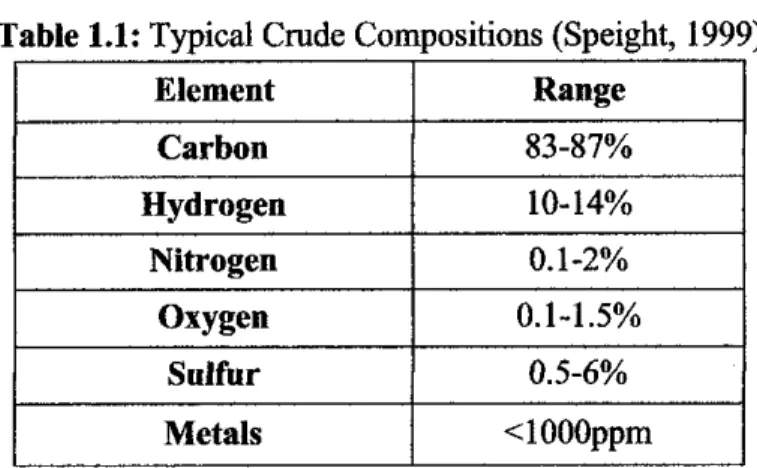
Crude oil is a complex mixture of hydrocarbons and other compounds (Wang & Buckley, 2003).
These components can be classified as saturates, aromatics, resins and asphaltenes (SARA) (Fan
& Buckley, 2002). Saturates consist of saturated hydrocarbons with straight or branched chains without ring structure (paraffins) or with one or more rings attached (cycloparaffins). It contains little or no nitrogen, sulfur, oxygen or metals. Aromatics are hydrocarbons containing one or more aromatic ring. Resins are also known as polars. It is the second heaviest fraction in crude oils. Asphaltenes are highly polar high molecular weight solids. The fraction is insoluble in low- molecular weight aliphatic hydrocarbons. It consists of highly condensed aromatic ring system with high nitrogen, sulfur, oxygen and metal content. Crude oil can be categorized into two types: sweet crude and sour crude. Sweet crude is the crude with less than 1% sulfur content and sour crude contain a substantial concentration of sulfur compounds such as hydrogen sulfide, sulfur dioxide and mercaptans (more than 1% sulfur) (Hyne, 2001). In addition to elemental sulfur and hydrogen sulfur, over 200 sulfur containing organic compounds, classified as thiols, sulfides, thiophenes and substituted benzo- and dibenzothiophenes, have been identified from crude oils (Lu et al., 1999). However, the sulfur compounds which predominate in so-called heavy fractions are primarily in the form of condensed thiophenes. For example, in some Texas oils, as much as 70% of the organic sulfur is present as dibenzothiophenes (DBTs), and in some Middle East oils, the alkyl-substituted benzo- and dibenzothiophenes contribute up to 40% of the organic sulfur present (Finnerty, 1982). The typical composition of crude oil is shown in the
Table 1.1:
Table 1.1: Typical Crude Compositions (Speight, 1999)
Element Range
Carbon 83-87%
Hydrogen 10-14%
Nitrogen 0.1-2%
Oxygen 0.1-1.5%
Sulfur 0.5-6%
Metals <1000ppm
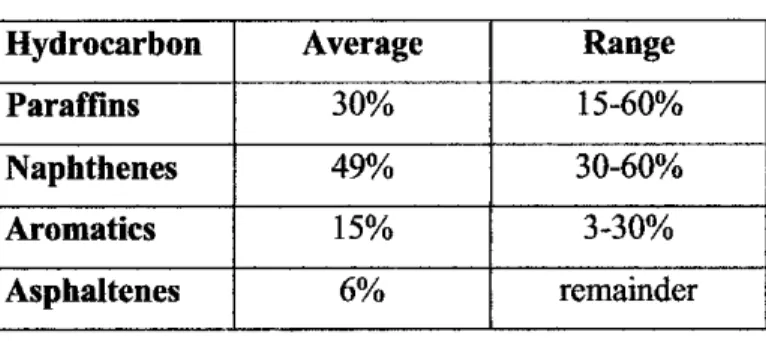
Four different types of hydrocarbon molecules appear in crude oil. The relative percentage of each varies from oil to oil, depends on the properties of the oil (Hyne, 2001):
Table 1.2: Typical Hydrocarbon Compositions in Crude
Hydrocarbon Average Range
Paraffins 30% 15-60%
Naphthenes 49% 30-60%
Aromatics 15% 3-30%
Asphaltenes 6% remainder
Sour crude also can 'attack' the metal components of the oil well, as well as the pipelines and storage tanks which could cause corrosion of the metal components (Collins, Mestetsky, &
Savaiano, 1998). The service life of the well producing sour crude is less than five years while the actuating rod and tube within the well casing may have several months of service life (Collins, Mestetsky, & Savaiano, 1998). The replacement of the equipment that is damaged does not only involve the capital, but also the downtime of the well which can affect daily production (Collins, Mestetsky, & Savaiano, 1998). Besides, the same problem with sour crude during the refining process also happens in Kuwait. The refinery equipment is exposed to risk of failure and corrosion due to the crude oil impurities problem. The most damaging impurities are inorganic salts, organic chlorides, organic acids, and sulfur compounds (Shalaby, 2005).
However, that's not only the problem due to the sulfur compounds in the crude oil. The
2
increasingly stringent limitations on SOx emissions are imposing urgent requirement to reduce the sulfur content in the fuels. Therefore, it is preferable to reduce the sulfur content of crude oil before the oil is refined. In extractive desulfurization (EDS) process, ionic liquid is used to extract the organosulfur compounds. Therefore, the main study of this project is mainly on the ionic liquids and its potential to reduce the sulfur content in the crude oils.
1.2 Problem Statement
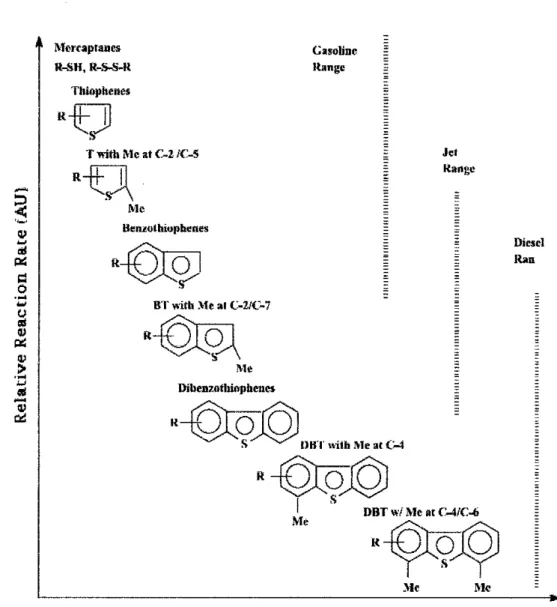
Ionic liquids have gained increasing interest over the past years due to its unique properties both as extractant and also as catalyst. The classical desulfurization process involves catalytic hydrogenation of sulfur compounds (hydrodesulfurization, HDS) into hydrogen sulfide. Typical reaction conditions are 300-350°C and 30-100 atm hydrogen pressure (Shafi & Hutchings, 2000). The hydrogen sulfide which is separated from the desulfurized oil is oxidized catalytically with air into elemental sulfur. However, some S-compounds such as dibenzothiophene, methyl dibenzothiophene, and 4,6~dimethyl dibenzothiophene are less reactive to HDS due to the sterical hindrance adsorption of these compounds on the catalyst surface (Jian-long et al., 2007). The qualitative relationship between the type and size of sulfur molecules in various distillate fuel fractions and their relative reactivities is shown in Figure 1.1:
§
V
!_•
aj
a
•>->
o V PS V
>
Merrapranes R-SH, R-S-S-R
Thiophenes
TwithMcat^2/C-5
Me
Ben/ulhiuphenes
;C5
B1 with Mc al C-2/C-7
Dibenzotliiophcnes
S' ^ OBI with Me at CM
*4T)\q
Gasoline Range
Jet
Range
Me DBTw/Me«C-4/C-6
K
Diesel Ran
Increase in Size & Difficulty for HDS
Figure 1-1: Qualitative Relationship between the Type and Size of Sulfur Molecules in Various Distillate Fuel Fractions (Song, 2002)
Besides, HDS also consume high energy and hydrogen for its process and more capital cost involved if deep HDS process is done. Thus, alternative ways without utilizing hydrogen such as oxidative desulfurization, biodesulfurization, extractive desulfiirization and adsorptive extraction have been studied by the researchers (Jian-long et al., 2007). Since the main study of this project is ionic liquids, extraction or reactive extraction of S-compounds from crude oil could be one of
an alternative to HDS.
1.3 Objective and Scope of Study
The objective of this study is to determine the sulfur-compounds removal efficiency of the selected ionic liquid from the crude oil models. Besides, there are many ionic liquids that can be used to extract the organosulfur compounds from the crude oil models which also have many different types of hydrocarbon such as alkanes, paraffins, aromatics and many more. Therefore, this smdy is mainly to determine the most suitable ionic liquid and also the method to extract the sulfur effectively.
CHAPTER 2
LITERATURE REVIEW
Basically, ionic liquids are salts with melting temperature below the boiling point of water (Wilkes, 2002). Some ionic liquids, such as ethyl ammonium nitrate are in a dynamic equilibrium where at any time more than 99.99% of the liquid is made up of ionic rather than molecular species. Ionic liquids are electrically conductive and have extremely low vapor pressure. Their other properties are diverse. Many have low combustibility, excellent thermal stability, a wide liquid range, and favorable solvating properties for diverse compounds. Ionic liquids have been studied for applications related to green chemical processes, such as liquid- liquid extractions, gas separations, electrochemistry and catalysis. The EDS is an attractive alternative for HDS because the process is applicable at ambient conditions without special equipment requirements. Besides low energy consumption, hydrogen consumption and handling is also eliminated. In general, ionic liquids have higher density than organic liquids and water.
Therefore, many ionic liquids exist as a separate phase when in contact with the organic and aqueous phases. These ionic liquids also can be recycled for use of multiple extractions. Many researches have been conducted on EDS process but until now there is little known research
conducted on crude oil.
2.1 Desulfurization of fuel oils using N,N-dialkylimidazolium dialkylphosphate
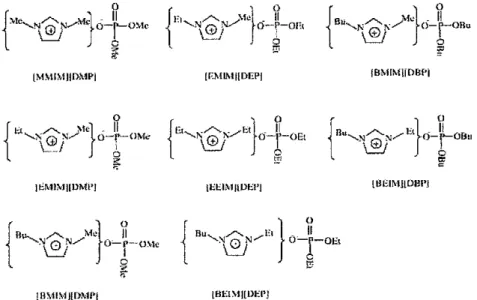
The research is done on the various structures of N,N-dialkylimidazolium dialkylphosphate (Nie et al., 2008) ionic liquids structure as shown in Figure 2.1.
IMMIMJiDMP]
^N@.^ lo-r-OM, J -@
jtMlMIIUMt1)
NS)^"
{BMIMJlDMPj
Q
II O— C—OMc
i
o
6
[RMIMUDEPj
&-, ^-x^^.-fct O II 0-P-OEl
iKtlMRDlil'J
BU^N{0;N""li' [o-P-Otl
IBHIMitUHP]
^N^N^M%--P-QBo
IBMIMllDBP]
iiu -lit
IBlilMilDBi']
Figure 2.1: Structures of N,N-dialkyIimidazolium dialkylphosphate ionic liquids (Nie et al., 2008)
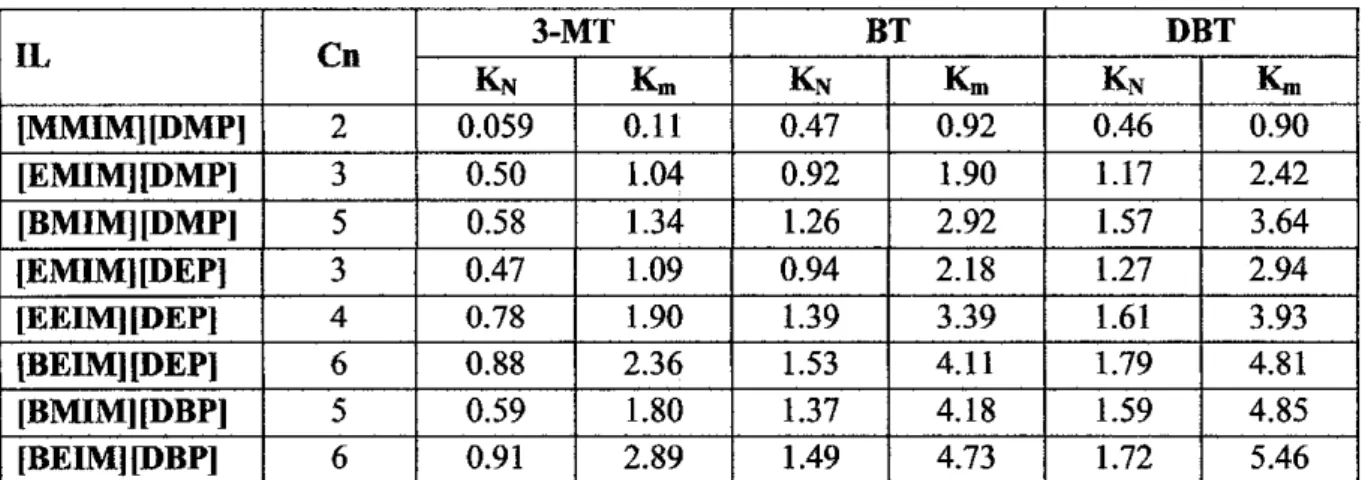
The ionic liquids used in this study are butyl methyl imidazolium dimethylphosphate, [BMIM][DMP] and butyl ethyl imidazolium diethylphosphate, [BEIMjfDEP]. The ionic liquids are prepared by mixing the N-butylimidazole and corresponding trialkylphosphate equimolarly via one-pot reaction. The resulting yellowish viscous liquid is washed several times with diethyl ether at room temperature followed by rotary evaporation for 12h. The ionic liquid is identified by using proton nuclear magnetic resonance (HNMR). The sulfur partition coefficient on mass basis, Kn is an important parameter for EDS process and the higher the Kn, the better the desulfurization process. Table 2.1 shows the value of Kn and Km between selected ionic liquids and fuel oil at 298.15 K. The fuel oil used in this study is gasoline and the GC-MS of the gasoline is shown in Figure 2.2:
i&aasifflflM]
*jO-
va^aA-VV /W_a/l
2.0 2.5 3.C 3.5 4.0 +.5 S.0
Figure 2.2: GC-MS of the Fuel Oil (Gasoline) (Nie et al, 2008)
Table 2.1: Value of KN and Km between Selected Ionic Liquids and Fuel Oil at 298.15K (Nie et al, 2008)
IL Cn
3-MT BT DBT
Kn Km K\ Km Kn Km
IMMIM][DMP] 2 0.059 0.11 0.47 0.92 0.46 0.90
[EMIM][DMP] 3 0.50 1.04 0.92 1.90 1.17 2.42
[BMIM][DMP1 5 0.58 1.34 1.26 2.92 1.57 3.64
[EMIMHDEP] 3 0.47 1.09 0.94 2.18 1.27 2.94
[EEIM11DEP] 4 0.78 1.90 1.39 3.39 1.61 3.93
(BEIM][DEP] 6 0.88 2.36 1.53 4.11 1.79 4.81
[BMIMHDBP] 5 0.59 1.80 1.37 4.18 1.59 4.85
[BEIM][DBP] 6 0.91 2.89 1.49 4.73 1.72 5.46
*Cn: Carbon numberofalkyl substitutes in imidazole ring; Average molecular weight ofstraight run gasoline is 114 based on the component distribution shown in Figure 2.2; Km on a mass basis; Km on a molar basis.
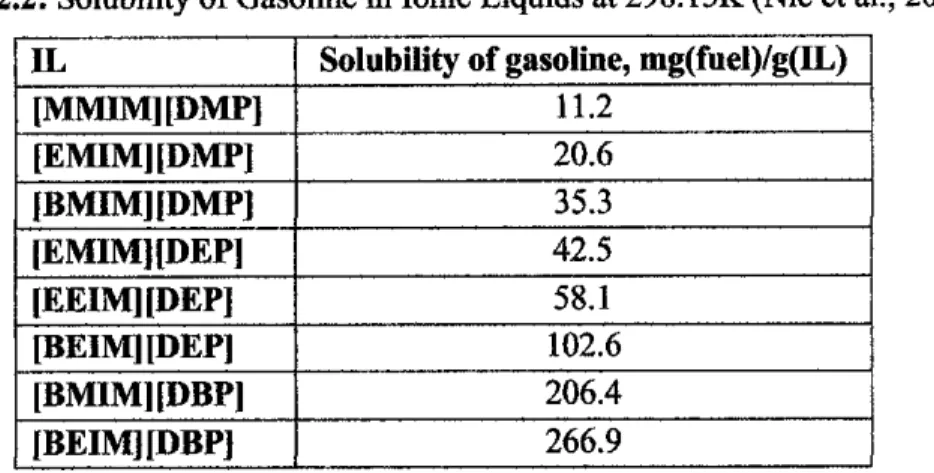
Besides the Kn and Km value, the mutual solubility also become an important factor to evaluate the ionic liquids applicability as an extractant, because solubility of imidazolium based ionic liquids in oil may contaminate the fuel and cause NOx pollution and high solubility in oil results in higher separation cost. Table 2.2 shows the solubility of gasoline in selected ionic liquids at
298.15 K.
Table 2.2: Solubility of Gasoline in Ionic Liquids at 298.15K (Nie et al., 2008)
IL Solubility of gasoline, mg(fuel)/g(IL)
[MMIM][DMP] 11.2
[EMIMJ[DMP] 20.6
[BMIM][DMP] 35.3
[EMIM][DEP] 42.5
[EEIM][DEP] 58.1
[BEIM|[DEP] 102.6
[BMIM][DBP1 206.4
[BEIMJIDBP] 266.9
From the experiment on the ionic liquids above, it shows that [BMIM][DMP] shows remarkable selectivity for extraction of aromatic S-compounds; 3-methylthiophene and dibenzothiophene from the gasoline. It is attributedto the formation of complex between rc-electrons of aromatic S- compound and the charged imidazolium ring of the ionic liquids, which is largely affecting the size ofthe alkyl substitutes via steric effect and dispersion interaction involved.
2.2 Desulfurization of fuel oils using trimethylamine hydrochloride (A1C13-TMAC)
The other ionic liquid that studied by the researcher is trimethylamine hydrochloride (AICI3- TMAC) (Zhang, Zhang, & Zhang, 2003). The ionic liquid is prepared by preparing two acidic trimethylammonium chloroaluminate ionic liquids with Al-TMAC with ratio of 1.5 and 2.0, respectively.
a) 2.0:1.0 A1C13 - TMAC ionic liquid
Aluminum trichloride (2 mol) was added slowly to trimethylammonium chloride salt (TMAC, 1 mol) in a glovebox under dry nitrogen the reaction between the two solids was exothermic. A light brownish liquid was formed. The liquid was stirred for 5h. It has
density of 1.4 -1.5 g/cm3 atroom temperature. The product was stable as a liquid atroom
temperature under dry atmosphere.
b) 1.5:1.0 A1C13- TMAC ionic liquid
The same procedure as described above for preparation of 2.0:1.0 AICI3 - TMAC ionic liquid was applied, except the molar ratio of 1.5 for AICI3-TMAC was used. A light yellow liquid was formed.
The quantitative analysis of sulfur content was conducted using X-Ray Fluorescence (XRF) Spectrometer. The HNMR is used to determine the ionic liquids structure. Some ionic liquids with absorbed sulfur compounds were analyzed using Fourier Transform Infrared (FTIR). In this experiment, they studied the absorption capacity of AICI3-TMAC ionic liquids for the model compounds (fuel oil). The results of the experiment are shown in Figure 2.3.
B 1.5AICI3-1.0TMAC 0 2.0AICI3-10TMAC
Model Compound
Figure 2.3: Absorption capacity of AICI3 - TMAC ionic liquids for model compounds (Zhang, Zhang, & Zhang, 2003)
From the result obtained, AICI3-TMAC ionic liquids were found to have remarkably high absorption capacities for aromatics, but their regeneration is quite problematic. A methyl group on the aromatic rings was found significantly reduce the absorption capacity because of the steric
effect.
10
2.3 Desulfurization of oil fuels using butyl-methyl-imidazolium tetrachloroaluminate [BMIM]A1CL,
Besides, butyl-methyl-imidazolium tetrachloroaluminate, [BMIMjAlCU also can be done to remove more sulfur (Schmidt, 2008),. [BMjM]A1C14 [s prepared by adding 200ml of N- methylimidazolium to 500ml of n-butyl chloride in a 1L three-neck flask under nitrogen. The mixture was refluxed for 30 min, after which a second phase formed. The mixture was continuously refluxed for 7h in order to complete the reaction. Excess n-butyl chloride was distilled off in vacuum at elevated temperature. From the studies, this ionic liquid can significantly lower the sulfur content in oil fuels (gasoline and diesel).
2.4 Desulfurization of gasoline using N-alkyl-pyridinium based ionic liquids
The ionic liquids used in this research are N-butyl-pyridinium tetrafluoroborate, [BPy]BF4, N- butyl-pyridinium nitrate, [BPy]N03, N-butyl-pyridinium acetate, [BPyjAc, N-ethyl-pyridinium tetrafluoroborate, [EPy]BF4, N-ethyl-pyridinium nitrate and [EPy]N03, N-ethyl-pyridinium acetate, [EPyjAc (Jian-long et al., 2007). The ionic liquids are prepared by adding pyridine (0.5 mol) and 1-bromobutane (0.5 mol) into a magnetic stirred slurry of cyclohexane (50ml) in round- bottom flask fitted with a reflux condenser and drying tube. The mixtures was stirred at 64°C for 24h until no further precipitation. The white precipitate was filtrated off, then the resulting solid was washed two times with ethyl acetate. The resulting N-butyl-pyridinium bromide was evaporated in a vacuum drying oven to remove the remaining ethyl acetate, raw material and solvent. N-ethyl-pyridinium bromide was preparedas the same procedure as N-butyl-pyridinium bromide. Ionic liquid N-butyl-pyridinium tetrafluoroborate was prepared by adding N-butyl- pyridinium bromide (0.3 mol) and sodium fluoroborate (0.35 mol) to acetone (300 ml), and then the mixture was agitated at room temperature for 24 hours. Then the resulting precipitate was filtered off, and the solvent was removed by rotary evaporation to leave a yellowish liquid. The trace quantity of acetone was removed by vacuum evaporation. N-ethyl-pyridinium tetrafluoroborate was prepared as the same procedure as N-butyl-pyridinium tetrafluoroborate.
Ionic liquid N-butyl-pyridinium nitrate was prepared by adding equal amount (mole) ofN-butyl- pyridiniumbromide and ammonium nitrate to methyl alcohol, and then the mixture was agitated at room temperature for 48 hours. Then the resulting precipitate was filtered off, and the solvent
11
was removed by rotary evaporation to leave a brown liquid. The trace quantity of methyl alcohol was removed by vacuum evaporation. N-ethyl-pyridinium nitrate, N-butyl-pyridinium acetate, N-ethyl-pyridinium acetate were prepared as the same procedure as N-butyl-pyridinium nitrate.
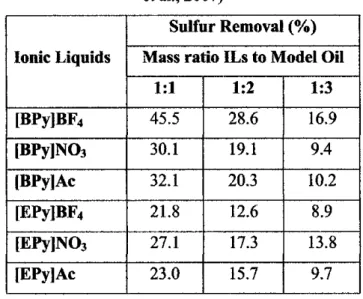
The extractioneffect of varioustypes of ionic liquidscan be summarized as in the Table 2.3.
Table 2.3: Desulfurization Results of ILs at Different Mass Ratio of ILs to Model Oil (Jian-long etal.,2007)
Ionic Liquids
Sulfur Removal (%)
Mass ratio ILs to Model Oil
1:1 1:2 1:3
[BPy]BF4 45.5 28.6 16.9
[BPy]N03 30.1 19.1 9.4
[BPy]Ac 32.1 20.3 10.2
[EPy]BF4 21.8 12.6 8.9
[EPy]N03 27.1 17.3 13.8
[EPy]Ac 23.0 15.7 9.7
From the table above, it is shown that [BPy]BF4 has the best extraction ability to remove sulfur component among the other pyridinium based ionic liquid and its extracting ability increase with the mass ratio of ILs to the model oil. However, the application of tetrafluoroborate and hexaflourophosphate anion for ionic liquids in the industry is not favorable because these types of ionic liquids will produce hydrofluoric acid, which is very corrosive to the equipment with the presence of water (Seddon, 2004).
12
2.5 Desulfurization of Fuel Using N-ethyl-N-ethyl-imidazolium diethylphosphate,
1EEIMKDEP]
The ionic liquids used in this study are N-ethyl-N-methyl-imidazolium dimethylphosphate,
[EMIM3[DMPj, N-ethyl-N-ethyl-imidazolium diethylphosphate, [EEIM][DEP] and N-butyl-N-
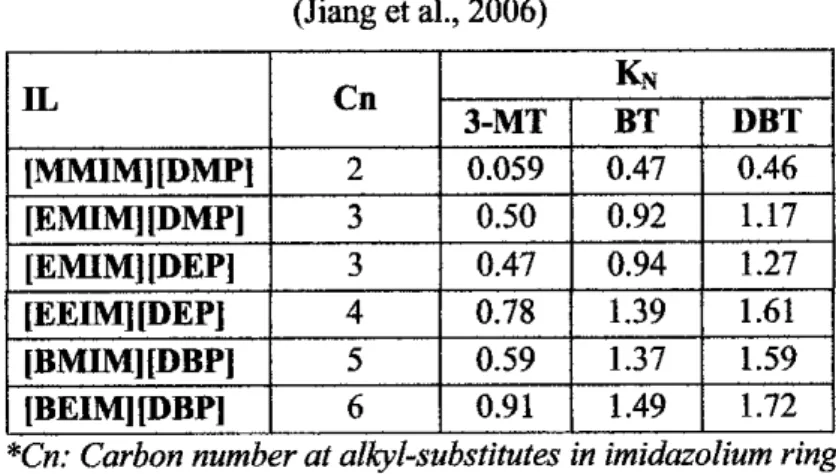
ethyl-imidazolium dibutylphosphate, [BEIM][DBPj (Jiang et al., 2006). These ionic liquids are prepared by adding equimolar quantities of N-ethyl-imidazole and the corresponding trialkylphosphate to a round-bottom flask fitted with a reflux condenser andthenreacting them at 423 K for 10 h with a yield of 98%. The resulting yellowish viscous liquid was cooled to room temperature and then washed several times with diethyl ether followed by rotary evaporation under reduced pressure of about 1 kPa for 12 hours to remove all volatile residues, e.g., the reactants remained and diethyl ether. The structures of these ionic liquids are determined by using the HNMR. The results of the desulfurization are shown in Table 2.4.Table 2.4: KN Values at 298.15K for Extraction of S-compounds with Different Phosphate ILs (Jiang et al., 2006)
IL Cn Kn
3-MT BT DBT
(MMIM][DMP] 2 0.059 0.47 0.46
[EMIM][DMP] 3 0.50 0.92 1.17
[EMIMJ1DEP] 3 0.47 0.94 1.27
[EEIM][DEP] 4 0.78 1.39 1.61
[BMIM][DBP] 5 0.59 1.37 1.59
[BEIM][DBP1 6 0.91 1.49 1.72
*Cn; Carbon number at alkyl-substitutes in imidazolium ring
Based on the Table 2.4, [EEIM][DEP] has shown remarkable extraction ability which is measured by sulfur partition coefficients, KN (higher the KN, higher the extraction effect).
[EEIM][DEP] also less soluble in the fuel (Table 2.2). Besides, [EEIM][DEP] also can be recovered by dissolution with water followed by simple distillation for clear separation of IL and
water.
13
The literature review above can be summarized as in the Table 2.5:
Table 2.5: Summaryof the Literature Review
IL(s) Preparation IL Characterization Performance Remarks
[BMIM][DMP], IL is prepared by Sulfur partition [BMIM][DMP] show [BMIM][DMP]
[BEIM][DEP] mixing equal moles coefficient on strong preferential shows
of N-butylimidazole mass basis (Kn) extraction for DBT and remarkable and the [ratio of sulfur 3-MT vs. toluene. selectivity for corresponding concentration (S- Selectivity factor of DBT the extraction
trialkylphosphate concentration) in versus toluene for IL of aromatic
(the purity >99%) IL to the S- [BMIM][DMP] is above compounds 3- via one-pot reaction concentration in 12. MT and DBT
with a yield of fuel oil] of IL
above 97%. increase due to
increasing size of alkyl group in the imidazolium ring.
AICI3-TMAC Aluminum In this AICI3-TMAC ionic Regeneration trichloride (2 mol) experiment, the liquids were found to ofIL is quite was added slowly to absorption have remarkably high problematic trimethylammonium capacity of AICI3- absorption capacities for
chloride salt TMAC ionic aromatics. A methyl (TMAC, 1 mol), in liquids for the group on the aromatic a glovebox under model rings was found
dry nitrogen the compounds (fuel significantly reduce the
reaction between oil) was absorption capacity
the two solids was determined because of the steric
exothermic. A light effect
brownish liquid was formed. The liquid
was stirred for 5h. it
has density of 1.4-
1.5 g/cm3 at room
temperature. The
14
IL(s)
[BPy]BF4
Preparation IL product was stable as a liquid at room temperature under dry atmosphere.
N-butyl-pyridinium
tetrafluoroborate
was prepared by adding N-butyl- pyridinium bromide (0.3 mol) and
sodium fluoroborate
(0.35 mol) to acetone (300 ml),
and then the mixture was
agitated at room temperature for 24
h. Then the
resulting precipitate was filtered off, and
the solvent was
removed by rotary evaporation to leave a yellowish liquid.
The trace quantity
of acetone was
removed by vacuum evaporation.
Characterization
The lone pair
electrons of
pyridine and the electron-donating ability ofalkyl
substitutions make the
N-alkyl-
pyridinium have higher polarizable
aromatic %~
electron density than pyridine.
15
Performance
Desulfurization results of IL at different mass ratios
of IL to model gasoline
IL
[BPy]
BF4
Sulfur removal
t|/%
mass ratio of IL to the model oil
1:1 1:2 1:3 45.5 28.6 16.9
Remarks
BF4 and PF6 anion for ionic
liquids in the industry is not
favorable because these
types of ionic liquids will produce HF, which is very
corrosive to the
equipment with the presence of
water
IL(s) Preparation IL Characterization Performance
— - . . „ -
Remarks
[BEIM][DBP], IL were prepared The extractive KN-value being [EEIM][DEP]
[EEIMJfDEP], by adding ability of the [BEIM][DBP] = 1.72, also can be
[EMIM][DMP] equimolar quantities alkylphosphate [EEIM][DEP] = 1.61 and recovered by of N-ethylimidazole ILs was [EMIM][DMP] = 1.17, dissolution and the dominated by the respectively for DBT. with water
corresponding structure of the followed by
trialkylphosphate to cation and simple
a followed the distillation for
round-bottom flask order clear
fitted with a reflux [BEIM][DBP] > separation of
condenser and then [EEIM][DEP] > IL and water
reacting them at 423 [EMIM][DMP]
K for 10 h with a for each S-
yield of 98%. The compound resulting yellowish studied viscous liquid was
cooled to room
temperature and
then washed several
times with diethyl ether followed by rotary evaporation
under reduced
pressure of about 1
kPaforl2hto remove all volatile
residues, e.g., the
reactants remained
and diethyl ether.
Based on the literature review done on various types of ionic liquids, this project will be using the [EEIM][DEP] because the yield in the desulfurization is high, lower solubility for fuel and thus negligible influence on the constituent of fuel and ease of regeneration via water dilution process. However, due to some unforeseen circumstances, the ionic liquid used for this research is [BMIM][DBP]. Even though [BMIM][DBP] have high solubility in gasoline, but there are no evidence to support that [BMIM][DBP] is soluble in crude oil.
16
CHAPTER 3 METHODOLOGY
Based on the literature review, these projects will mainly involve laboratory experiments. The experiments will be conducted by using suitable ionic liquids in order to extract the sulfur content from the crude oil model. The duration of this experiment will be approximately 20 hours per week. The detailedmethod is described below:
3.1 Preparation of Alkylphosphate Ionic Liquid
100ml of 1-methylimidazole is purified by distillation. Butyl-methyl-imidazole dibutylphosphate [BMIM][DBP] (Figure 3.1) was prepared by adding equimolar (0.2mol) quantities of 1-methylimidazole and the tributylphosphate to a round-bottom flask fitted with reflux condenser and then reacting them at 363K for 3 days (yield of 98%) with nitrogen gas.
The detail calculations of the volume used to make ionic liquids are shown in Appendix A.
Resulting yellowish viscous liquid was cooled to room temperature and then washed several times with diethyl ether followed by rotary evaporation under reduced pressure of about 1 kPa for 3 hours to remove all volatile residues (the reactant remained and diethyl ether).
Finally, the ionic liquid is dried using the vacuum line connected to liquid nitrogen. After drying, the ionic liquid was verified by NMR and FTIR. The photographs showing the sequence of the ionic liquid synthesis process are shown in the AppendixB.
H3C- :n.
0
.N
0:
H.CJ
Figure 3.1: The Structure of [BMIM][DBP]
17
3.2 Characterization
The following methods were employed for the characterization of [BMIM][DBP]
i. HNMR
Nuclear magnetic resonance (NMR) spectroscopy is a technique which exploits the magnetic properties of certain nuclei. Many types of information can be obtained from an NMR spectrum. The most important applications for the organic chemist are proton NMR and carbon-13 NMR spectroscopy. The function of NMR is to identify functional groups and type of chemical entities in molecules. Proton NMR is the application of nuclear magnetic resonance in NMR spectroscopy with respect to hydrogen nuclei within the molecules of a substance, in order to determine the structure of its molecules. Proton NMR spectra are characterized by chemical shifts in the range +12 to -4 ppm and by spin-spin coupling between protons (Silverstein, Bassler, & Morrill, 1991).
ii. Density Meter (Density)
[BMIM][DBP] is inserted in the density meter and then the equipment will show the density at different temperatures (25°C, 35°C and 45°C). The density is measured based on the function of the oscillation of U-tube inside the density meter and it is more accurate than other density measurement equipment (Fitzgerald, 2000).
iii. Coulometer (Water Content)
Karl Fischer titration is a widely used analytical method for quantifying water content in a variety of products. The fundamental principle behind it is based on the Bunsen Reaction between iodine and sulfur dioxide in an aqueous medium. The alcohol reacts with sulfur dioxide (SO2) and base to form an intermediate alkylsulfite salt, which is then oxidized by iodine to an alkylsulfate salt. This oxidation reaction consumes water. The reactive alcohol is typically methanol or 2-(2-Ethoxyethoxy)ethanol, also known as diethylene glycol monoethyl ether (DEGEE), or another suitable alcohol. Water and iodine are consumed in a 1:1 ratio in the reaction. Once all of the water present is consumed, the presence of excess iodine is detected voltametrically by the titrator's indicator electrode. That signals the end-point of the titration. The amount of water present in the sample is calculated based on the concentration of iodine in the Karl Fisher
18
titrating reagent (i.e., titer) and the amount of Karl Fisher Reagent consumed in the titration (Aquastar, 2002).
iv. FTIR
FTIR is most useful for identifying chemicals that are either organic or inorganic. It can be utilized to quantitate some components of an unknown mixture. It can be applied to the analysis of solids, liquids, and gasses. FTIR is perhaps the most powerful tool for identifying types of chemical bonds (functional groups). The wavelength of light absorbed is characteristic of the chemical bond as can be seen in this annotated spectrum.
Samples for FTIR can be prepared in a numberof ways. For liquid samples, the easiest is to place one drop of sample between two plates of sodium chloride (salt). Salt is transparent to infrared light. The drop forms a thin film between the plates (Service, 2008).
v. Ion Chromatography
Ion chromatography is a process that allows the separation of ions and polar molecules based on the charge properties of the molecules. It is used for water chemistry analysis.
Ion chromatographs are able to measure concentrations of major anions, such as fluoride, chloride, nitrate, nitrite, and sulfate, as well as major cations such as lithium, sodium, ammonium, potassium, calcium, and magnesium in the parts-per-billion (ppb) range.
Concentrations of organic acids can also be measured through ion chromatography.
Sample solutions pass through a pressurized chromatographic column where ions are absorbed by column constituents. As an ion extraction liquid, known as eluent, runs through the column, the absorbed ions begin separating from the column. The retention time of different species determines the ionic concentrations in the sample (Bruckner, 2008).
3.3 Liquid-liquid Extraction
Model oil (dodecane) with known S-content in mg(S) kg(IL)"! was prepared by dissolving a
definite amount of thiophene and benzothiophene in known quantities of dodecane. Known quantities of [BMIM][DBP] was used to extract the sulfur species from the crude oil model.
Sulfur partition coefficient (KN), which defined as ratio of S-concentration in dodecane, is an
19
important parameterfor EDS process, higher Kn indicates better desulfurization performance of IL. The samples with extracted sulfur content were analyzed with the CHNS elemental analyzer. Forthe beginning, 100ml crude model is prepared with 2% sulfurcontent in it. The detail calculations of the thiophene amount used in the model are shown in Appendix C. The crude model prepared is mixed with the [BMIM][DBP] in the ratio of 1:1 (2ml dodecane with thiophene : 2ml [BMIM][DBP]). The mixture was then mixed in the vortex mixer for about 1 minute. The samples were then centrifuged for about 5 minutes forming two phases of liquids. The layers were separated and transferred into vials and followed by analysis using CHNS elemental analyzer. The ionic liquid also tested on the crude oil to analyze the extraction performance. The procedure for the extraction is same with the crude model is same except the crude is preheated to 80°C before mixed using the vortex mixer for 10 minutes. Then, the mixture is then preheated again at 80°C and lastly centrifuged it for 15 minutes. The sample was transferred into the vials and the analyzed by the CHNS elemental analyzer.
i. CHNS Elemental Analyzer
CHNS elemental analyzers provide a means for the rapid determination of carbon, hydrogen, nitrogen and sulfur in organic matrices and other types of materials (Thompson, 2008). They are capable of handling a wide variety of sample types, including solids, liquids, volatile and viscous samples, in the fields of pharmaceuticals, polymers, chemicals, environment, food and energy. It is used to determine the total sulfur compound in the samples.
The pictures of equipments for characterization and analysis are shown in Appendix E.
20
The suggested milestone for the smdy is shown in Figure3.2 and Figure 3.3:
W«eh/^sk 2 3 4 5 6 7 8 9 10 11 12 13 14
Submission of Proposal
Literature review
Submission ofPreliminary g
Report *
Further review
Seminar 1 9 m
o
_ a
Submission of Progress Report fP «
Request the chemicals &
equipment
Continue further review
Submission of Interim Report 9
*Oral Presentation (
Key:
# Suggested milestone
^H Process
*Note: The lab work will continue during the semester break (1st December 2008 onwards) Figure 3.2: The Milestone for FYP (First Semester)
21
I
Week/Task 1 2 3 4 5 6 7 8 9 19 11 12 13 14
Project work continue Submission of Progress Report 1
Project work continue Submission of Progress Report 2
Seminar
Project work continue
Poster exhibition
Submission of Project Dissertation (soft bound)
Oral Presentation
Submission of Project Dissertation (hard bound) Key:
9 Suggested milestone IProcess
Figure 3.3: The Milestone for FYP (Second Semester)
22
The Gantt Chart for the project is shown in Figure 3.4:
rjikSsnE
EJjTiSsbi 9*3tn39(al [.reisers tevevf
=•?»ii-ti fiery tBjonjersajiB' Sji-nSi&r e' = r»(L-ni-3r.- =srcr:
- j nie "»»*•//
SBUnar
^ssj?~ 'ot ~bh c=s S ssjIjiis-:
CB^Kue'jmBr teyfe*
verm ^ejpi: a res bib: e i sjj-sbs&i i'- "term re mp.
Oisi'sssiaS"; srajsra:^-.
Orai»!ssei:attoi :.ss »Btt S 'jniefsinjy
Ce--:"-e las was S*jn*f s:jo?
=;tgret* =teion: srsjars'ier Sjj-n&aSn c'srsjrass 'Ursr::
oe-niisr
se*:i"-jB iss won: £ ";riers:jev epEsr Bc.nsllfr"
»»Jss: jMSBKUi JfBJS'SiCi 5.13116=01Bfffin^'f: ^ssetstS-: [ztr. m-j'-S
Prcjsct typgsrtt ctert Date Met 10.2708
Til*
5? it
Uj!3:tei
1 fa.'' UD5,='
« Saya?
( e*yT
1 est •>
?0BVE7
1 cay- 1 DB,'T
s cays' 1 e=y 5 sal a?
t say*
51 days-*
11 cays' 1 931'
13 Bays?
itsy?
1 «,•' 7 ea'.'E'
usiiy*'
1 93V ' 11sa.jT may 6 savet I mi
s:ar.
>,'?*• T;J5'3S TJg T:ib;3S Tjs B'-s.'BS VbiJ-IS.05 ViBC5.-3.05
T-ij ?.i1;is'
»rl5.':».,3s' VD-B.'Is.'Os"
Vrj- lO.'iUiJo'
T-jS:1S'0;
Vrj- tSWOi T.'e 13-'S5,-3S A"BS13.":»''35 Vo- H'J-'OS
».•<!- nnm'
>.'91 l.'J&'H tj= imb.m
•.vssj.'ii.'os T.-e 3.'3'0S
TU S.'ia;03
Vol 3.'5B.'0&
vs.-! -j-'i'-os
Vo-i iS.'GS srl}lS7'99
sni;17.'0B
•/-.'BSi.iS-'CS -It-
VbiT'IS.-35 Tri3.,1j-55 SaiS.'H.-aS V91 5-15-BS T.e B-'».'G5
A'bcS.13'3-3 V5-1 =.'1 =.'33 Vol 13.t3.-03 (VBC13:«.'3S vo-io.':t,-55 rjB IB.'Ja.Ho SjiH.'CTS
\-6- n.'j.'ss
Vd- 2.'2.'39 TjbMS-'OS t-j* J-H'oe l'<n 3-'1S,'33 Tje J.'17.'0S T-.J J.-15.-C?
•iviet.iif
= ni.j:09 Vtr *.•«• 39
= rH,'1!'5S t j . i'ii.'5S
•.\-eei-t3.'39
»s Sit 5---n-nary
Hj. lAjsit
SXlBr-s'TittS
*(i iitensU'iecs-B •-'>•
Figure 3.4: Gantt Chart for FYP
23
••vTfTv Is Ts j * i t jw I t Iv l sTs"l 'T? jw I t j
I:
I IB
»
For the lab work, this project is utilizing the following chemicals and equipments:
Equipments:
No. Description Purpose
1. Separating funnel (100ml)
Synthesize the ionic liquids
2. Syringes (10ml)
3. Measuring cylinder (100ml)
4. Retort stand
5. Clamp for retort stand
6. Beaker 7. Pipette (10ml)
8. Distillation apparatus (with tube)
9. Reflux apparatus(round bottom flask & reflux condenser)
10. Stirrer 11. Water bath 12. Rotavap
13. Rotavap flask with clamp
14.
15.
Vacuum oven
Storage bottle Store the ionic liquids
16. Test tube
Analyze the ionic liquids
17. Liquid cup and mylar for XRF
18. Karl Fisher 19. XRF 20. FTIR 21. GC
22. NMR
Chemicals:
No. Description Purpose
1. Diethyl ether
Synthesize the ionic liquids
2. 1-Methylimidazole
3. Tributyl phosphate
5. Nitrogen gas
4. Dodecane (crude model) Determine the sulfur
extraction ability in the
crude model 5. Thiophene
6. Dibenzothiophene
Table 3.1: List of Chemicals and Equipments Used for FYP
24
CHAPTER 4
RESULTS AND DISCUSSION
During the distillation of l-methylimidazole, vacuum pump is used in order to lower the boiling point of l-methylimidazole and hence make the process faster. The l-methylimidazole was also mixed with potassium hydroxide to absorb the water and impurities in the l-methylimidazole solution. The residue changed into yellowish colour when the mixture is heated up and slowly
changes to whitecolourwhenbecome cool (Figure 4.1).Figure 4.1: The Colour of the Residue When Heated (left) and When It Is Cooled (right)
After the vacuum distillation has completed, l-methylimidazole was then refluxed with tributyl
phosphate in the nitrogen atmosphere for 3 days. Nitrogen gas is used in this process in order to
avoid oxidation during the process since the ionic liquid is sensitive to oxidation. Thetemperature andpressure used in this process is 90°C and 1 atm. This temperature was selected
because l-methylimidazole will decompose if the temperature is higher than 90°C. If it is decomposed, the ionic liquid will not form. After 3 days, the viscous liquid can be seen (Figure4.2) and the mixture is washed with diethyl ether to remove the residual in the mixture. The
washing process wasrepeated several times until there were no two layers formed in the mixture.Then, the mixture was rotaevaporated for 3 hours to remove any diethyl ether residual. Finally, the ionic liquid was dried using the vacuum line connected to liquid nitrogen.
25
Figure 4.2: The Change ofthe Liquid Before and After the Reflux Process
The properties of the ionic liquid such as the density and water content were analyzed using the density meterand coulometer. The resultof the analyses is shown in Table 4.1 and Table 4.2:
Table 4.1: Density of [BMIM][DBP]
Temperature (°C) Density (g/cm3) SG
25.001 1.039866 1.04295
34.995 1.032855 1.03906
44.999 1.025906 1.03605
^Equipment Model: AntonPaar, DMA 5000 Density Meter
Table 4.2: Water Content of [BMIMj[DBP]
Run No. H2O Content (ppm)
1 3088.529
2 4052.154
3 4064.154
^Equipment Model: Karl Fischer Coulometer DL 39 Mettler Toledo
26
From the analyses, the density of [BMIM][DBP] is higher than water and the average water content is about 3735ppm, approximately 0.3%-0.4% (Aquastar, 2002). The ionic liquid produced should not have high water content since it will affect the extractionperformance.
The synthesized ionic liquid is analyzed and verified using FTIR and NMR. The results of FTIR are shown in figure below:
V--.-/
!il
I / I-/•-?¥- -•h-
N
150-
%T 125
100-
75-
50
25- %T
- - h .
s
-25 -+-
4000 3600
bmimdbp
Comment;
bmimdbp
i A
3200 2800 2400 2000
No. of Scans-, Resolution;
Apodization;
1800
ml ™
.ii.v:s—S-
A*"
Ass
5l-
1600 1400 1200 1000 800
Datemme; 04/16/09 10:33:04 User, Organic chemisdy
Figure 4.3: Fourier Transform Infrared Spectroscopy Analysis of [BMIM][DBP]
*Equipment Model: ShimadzuFTIR 8400S
27
600 1/cm
Based on the analyses in Figure 4.3, the valley of the wavenumber indicates the types of the functional group in the ionic liquid. The types of functional group can be determined through the correlation table in Appendix F. From the analyses, the ionic liquids (based on Figure 3.1)
contains O-H bond (wavenumber: 3600-3200cm"1), alkyl group (wavenumber: 2900-2800cm'1), amine with alkyl group (wavenumber: 1200-1025cm"1) and phosphine oxide (wavenumber:
1210-1140cm"1). Therefore, the analysis illustrate that the [BMIM][DBP] is verified.
For NMR analysis, the resulting data are as follows:
HNMR, 8H (400 MHz, D20)
H 5 (Shift)
2 8.56
4,5 7.32
6,7 4.05
8 3.74
10 3.73
^fMR predictor. Basically, the re and is acceptable.
In the extraction process, 100ml crude oil model was prepared by adding thiophene (sulfur compound) into dodecane. The sulfur content in the model is about 2% and the ionic liquid used is [BMIM][DBP]. The model and IL is mixed by 1:1 ratio. The mixture is mixed using the vortex mixer in order to have the higher mass transfer area which can increase the extraction of the sulfur content. The mixture was then centrifuged to separate the mixture into two phases: ionic liquid with sulfur extracted and the crude oil model. The mixture was then transferred into vials for analyses using the CHNS elemental analyzer. From the result obtained, the sample with mixing time 5 minutes extract more content of sulfur compared to the others.
For the next experiment, the crude model is tested with the [BMIM][DBP] with different sulfur content (benzothiophene). The same procedure as the first experiment is applied and the mixture is analyzed using the CHNS elemental analyzer. The analyses of CHNS elemental analyzer for the crude oil model with different concentration of thiophene and benzothiophene after
extraction is shown in the Table 4.3:
28
Table 4.3: Sulfur Content of Crude Oil Model and [BMIM][DBP]
^^M_°il(^.'^^M_t typ^M??) Before extraction (%)
0.042 Oj046
After extraction (%) o.m¥
01125" "
65i5 "
Model oil (dodecane + benzothiophene) Before extraction (%) \ After extraction (%)
"1.907" f ~0Ml"~~
3.848 1 CL716""
11 1115^6817111 T~.l "-™Q749g"~ ^ |^
^Equipment Model: CHNS 932 Leco
Extraction Performance (%)
Z1Z~1 Z??a3„. 171 I
40.48" " "
'6739
.._.._L
Extraction Performance (%)
50.34"
™ 81.39
"""~™91~5i
Extraction Pei foimmiceof (BM1M]{DBP] from Model Oil + Benzothiophene
Mi
•s
4»'o
6°o Sulfur Content in Model Oil
Figure 4.4: Extraction Performance of [BMIM][DBP] from Crude Oil Model with Benzothiophene
The ionic liquid also tested on the crude to analyze the extraction performance. The result of CHNS for the crude with the ionic liquid is shown in the Table 4.4:
29
Table 4.4: Sulfur Content of Crude Oil and [BMIM][DBP]
Extraction Performance (%) Crude Oil
Before extraction (%) | After extraction(%)
"~"~3.579"~ ; " 3~423~
""'ljm"~
1 3387~
^Equipment Model: CHNS932 Leco
436
"2.7_0
Based on the result in Table 4.3 and Figure 4.4, the extraction performance for the IL is good since it is only single pass extraction. The performance could be improved if the extraction process is done through multiple extractions. The sulfur content using thiophene is quite low because thiophene is highly volatile therefore affecting the sulfur content during the preparation
of the model oil.
The result of the extraction from the crude model with benzothiophene is increasing (from 50%
to 92%) since ionic liquid has its own Kn value which is constant. In order to achieve equilibrium, if the sulfur concentration is increasing and the other condition is constant, the extraction performance is increasing according to Le Chatelier's Principle (If a dynamic equilibrium is disturbed by changing the conditions, the position of equilibrium moves to counteract the change) (Clark, 2002). This is same with the extraction of thiophene by [BMIM][DBP].
From Table 4.4, it is shown that the extraction performance from the crude oil is low since there are many complex structure of organosulfur compound compared to the crude model. Besides, the extraction performance also decreases because of the sterical hindrance of the organosulfur compounds and makes the extraction less effective. Based on the literature, the sulfur content will be reduced because the mechanism for the extraction of aromatic S-compounds with imidazolium-based IL is related to the formation of liquid clathrate due to the %-% interaction between unsaturated bonds of aromatic S-compound and the imidazole ring of ILs (Holbrey et al., 2003).
30
CHAPTER 5
CONCLUSION AND RECOMMENDATION
Based on the result obtained, the extraction of benzothiophene from the crude oil model using [BMIMj[DBP] is ranging from 50% to 92%. The extraction performance of [BMIM][DBP] for thiopheneis between40% to 67%. This shows that the extractionperformance of [BMIM][DBPj is remarkable. The extraction performance can be improved if the multiple pass extraction is
done.
The extraction performance of sulfur compounds from the crude oil using [BMIM][DBP] is low since there are many complex sulfur compound structure making the extraction less reactive.
Therefore, further smdy is needed to find suitable ionic liquid so that the EDS can be developed
in the future.
Based on the recent studies by the researchers on the EDS, S-component can be extracted by the ionic liquids. Therefore, the EDS process can at least be used as a complementary technology for the traditional HDS process.
As a conclusion, the EDS has high potential to extract sulfur compound which is cannot done by the HDS due to the steric hindrance of the sulfur compound molecules. Besides, EDS is also economical compared to HDS because it is done in ambient condition and without utilizing the hydrogen gas. Besides, usage of ionic liquids, known as 'green chemicals', also have reduced the environmental impact and the pollution because the ionic liquid used in EDS can be recycled.
31
APPENDIX A
Calculations of the Solvent Volume
Solvent No. of mol Molecular
Weight (g/mol)
Density
(g/cm3)
Volume
(ml)
Boiling Point (°C)
1-methylimidazole 0.2 82.11 1.03 15.94 198
Tributyl phosphate 0.2 266 0.97 54.85 289
m
n = ; m=MW*n
MW
for the imidazole, n-0.2mol,m-82.11x0.2
-16.42g
m , , m
p^ ~;V« —
V p
.,V- 16-4^^i5.94ml
1.03g/cm3
for the tributyl phosphate, n=0.2mol, m=266*0.2
=53.2g m ., m
p=—;v=—
v p
•••V= 53'2g =54.85ml
0.97g/cm3
32
APPENDIX B
Ionic Liquid Synthesis Process
Equipment semp for the distillation process
Purified l-methylimidazole
33
Equipment setup for the reflux process
"3
Two layers formed during the washing process
34
Rotary evaporator setup to remove the residual in mixture (left) and the ionic liquid after the process (right)
Ionic liquid drying equipment setup
The IL synthesized [BMIM][DBP]
35