~HlC A
I In (11 (..
t..,..;... It (C:-
lv -- / WAr ,- "', 1 £ C If ~ lot-- v c-
t..t / ~
INVESTIGATION ON SOLID WASTE
MANAGEMENT IN TOWNSHIPS: CASE STUDY OF UMLAZI, DURBAN
BY
LINDOKUHLE LUCRECIA NJOKO 9701582
Submitted in fulfillment of the requirement for the MASTER OF ART in the Department of Geography and Environmental Studies at the
University of Durban Westville
SUPERVISOR: MR. J. S. LUTCHMIAH
Declaration
I, undersigned, hereby declare that the dissertation hereby submitted by me for the Magister Artium at the University of Durban Westville is my own independent work and has not previously been submitted by me or anyone
at another university or faculty
Name: Lindokuhle Lucrecia Njoko
Date
pervisor's Signature
I;
DateAcknowledgement
For this Dissertation to be complete different people put their efforts on it. I am delighted to thank the following people:
1. God Almighty for His wisdom, strength, and love He gave me when I was doing my research. He is the source of all my desires and without Him I wouldn't be here.
2. My special thanks goes to Mr. J. S. Lutchmiah, my supervisor, who encouraged me and showed me a way for two year.
3. Mr D. Macozoma from CSIR and Mr. V. Skosane from DEAT for all the information they provided and advices they gave concerning the research.
4. Njoko, Ntanzi and Khanyeza families for their support, and more especially my father and mother who've been so great and supportive to me up to this far.
5. Mr. Musa Khanyile who acted like a mentor, co-supervisor and a brother in difficult times when I was doing my research.
6. My colleagues: S'thabile, Khumbulani, and Mrs Madlala.
7. Keep Durban Beautiful Association Resource Centre, and Munitech consultants.
8. My special friends: Yongama, Smanga, Unathi, Obrigado, Futhi, Bonang, Phindile, Nhlanhla, Futhi, Mpho and my sisters and brothers who gave me enough time to do my work. Your prayers saints kept me this far, may the Good Lord richly bless you.
9. Lastly, community members at Umlazi and councillors who participated in the study.
Abstract
Today environmental degradation is perceived to be a global phenomena, since the Earth Summit of 1992 gained phenomenal interest among the international community. Consequently there was a major interest among conservationist, environmentalist and other disciplines to write about the alarming rate at which natural resources are being polluted and over utilized and eventually depleted. This is evident when one looks at land, air, water pollution, and deforestation and soil erosion. Human dependence on these resources, most of which are non-renewable, compounded by growth in popUlation numbers will inevitably impact the quality oflife of the global community.
Most developing Urban areas in South Africa and formal residential areas where waste removal services are supposed to be available, are characterised by solid waste being illegal dumps on open spaces, streets etc. The heaps of waste have become breeding grounds for insects and pests. The odour emanating from these sites together with potential for diseases can have serious implications on the health of residents as well as aesthetic nature of the environment. It is not yet understood why such situations exists within formal serviced areas. This provided the motivation for the investigation.
The purpose of the study was to investigate solid waste management practices in a forn1al residential area of Durban namely Umlazi and its negative impact on the human and natural environments. The effect of the social dimensions of households on solid waste
current waste practices. Current perceptions, attitudes and solid waste practices of households were assessed to explain the influence of socio economIC factors in the planning and operations of solid waste management systems in townships.
Questionnaires relating to the problem were administered to the residents ofUmlazi. The results indicated that the waste collection system is characterised by inefficiency. The study revealed that attitudes and perceptions, educational status and income are significant factors that contribute to effective waste management processes. The analysis of data for domestic solid waste showed that the evaluation of both the social demographic and solid waste generation rates is crucial in understanding why such inefficiency in formally serviced areas exists. This in turn could provide guidelines on the possible roles that households can play in the planning and implementation of domestic solid waste. Amongst others the consumption patterns, knowledge about waste management practices and preferences for service provision were interpreted.
Based on the findings of this study and the review of related literature, it is concluded that attitudes and perceptions of residents need to change. Residents need to become responsible for caring for their environment and a different mind set towards solid waste is needed. Appropriate policy backed by legislation and enforceable regulations must underpin the strategic alternatives selected to deal with waste management in the purban Metropolitan Area (DMA). Policy legislation and regulations at the local level must be fitting with those set at national and provincial levels of government. The planning of
encouraged between the DMA authorities and communities who will benefit from the waste management plan. The public and private organisations that handle waste in the municipality should be seen as part of the solution, not a problem, of waste management.
Effective waste management should be appreciated as a public good from which benefits such as opportunities for employment, resource recovery, safe disposal of hazardous waste, reduced pollution and community development projects can spring.
CONTENT
Acknow Iedgement Abstract
List of Figures List of Tables
CHAPTER ONE: Introduction and Contextualisation of problem
1.1 Preamble
1.2 Waste management
l.3 Contextualization of the problem lAAims and objectives
1.5 Chapter sequence 1.6 Conclusion
CHAPTER TWO: Solid Waste Management: A Theoretical View
2.1 Introduction
2.l.1 Definition of terms
2.1.2 The status of the environment in the society 2.2 Types of solid waste
2.2.1 Strategies for the improvement in solid waste management 2.3 Waste Management Processes
2.3.1 Waste generation, handling, and separation 2.3.1.1 Residential dwelling
2.3.1.2 Commercial facilities
2.3.2 Collection and transportation of waste 2.3.2.1 Collection of non- separated waste 2.3.2.2 Collection of separated waste at source 2.3.3 Disposal methods
2.3.3.1 Open dumping
PAGE
III
IV
x
..
XI-Xll
1-4 5-9
9-10 10 10-11 11
12 12-14 14-17 17-18 18-19 20 20 21-22 22-23 23-24 24 25-27 27-28 29-31
2.3.3.3 Incineration
2.3.3.4 Recycling and recovery 2.3.3.4.1 Paper and board content 2.3.3.4.2 Cilass
2.3.3.4.3 Metals 2.3.3.4.4 Plastic
2.4 Solid Waste Management at different levels 2.4.1 International
2.4.2 National
2.4.2.1 Principles of Sustainable living in South Africa 2.4.2.2 Models of waste collection in South Africa 2.4.2.3 Waste management strategy for South Africa 2.4.2.4 Legislation and enforcement in South Africa 2.4.2.5 Environmental management status
2.4.2.5.1 Capacity building
2.4.2.5.2 Participation and information 2.4.2.5.3 Pollution and waste
2.4.3 Local
2.4.3.1 Waste storage
2.4.3.2 Collection by the Contractor 2.4.3.3 Legislation and Enforcement 2.5 Conclusion
CHAPTER THREE: Methodology and Study Area 3.1 Introduction
3.1.1 An early history ofUmlazi Reserve Mission 3.1.2 Description of the study area
3.2 Methodology 3.3 Conclusion
38 39 39-40 40-41 41-43 43-444 44 44-50 50 50-60 60-63 63-64 64-67 67 67 67-68 68-69 69-71 71-72 72-73 73-74 74-75
76 76-77 77 79-87
88
CHAPTER FOUR: Results and Data Analysis
4.1 Introduction
4.2 Secondary Data analysis 4.3 Primary Data analysis
4.3.1 Socio-demographic characteristics of the respondents 4.4 Characteristics of the dwelling
4.5 Solid waste status
4.6 Illegal dumping and its impact
4.7 Recycling and waste reduction 4.8 Community patiicipation 4.9 Conclusion
CHAPTER FIVE: Evaluation and Discussion
5.1 Introduction 5.2 Evaluation 5.3 Conclusion
CHAPTER SIX: Recommendations and conclusion
6.1 Introduction 6.2 Recommendations 6.3 Conclusion
References Appendix
89-90 90-95 96 96-102 102-104 104-117 117-127 127-134 134-141 141-143
144 144-154 155
156 156-162 162-165 166-171
LIST OF FIGURES
Figures Description Page
2.1 Waste Management Processes 20
2.2 Metal Separation Method 42
2.3 Solid Waste Management Hierarchy 48
3.1 Map: Um1azi Township 78
4.l How do people rate waste removal and street cleaning? 105
4.2 Types of waste that people dispose 106
4.3 Amount of waste generated per week per household 107 4.4 Rating waste collection services provided in the area 112
4.5 Distance to the illegal dumping site 119
4.6 Reasons why people dump waste illegally 125
4.7 Suggestions on improvement of SWM in the area 140
LIST OF TABLES
Tables Description Pages
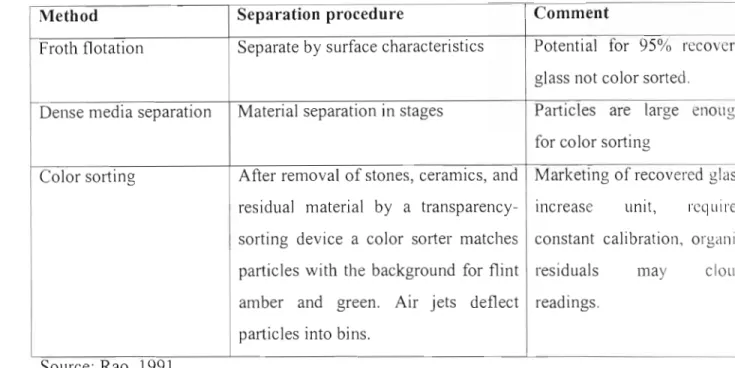
2.1 Glass separation method 41
3.1 Open ended questions 86
3.2 Close ended questions 87
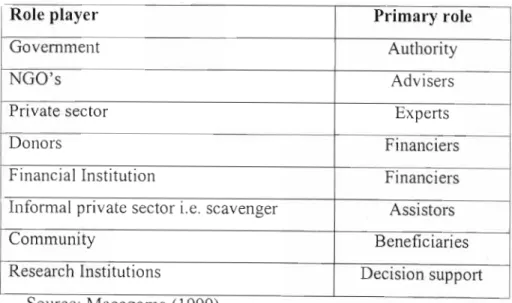
4.l Role players in SWM 90
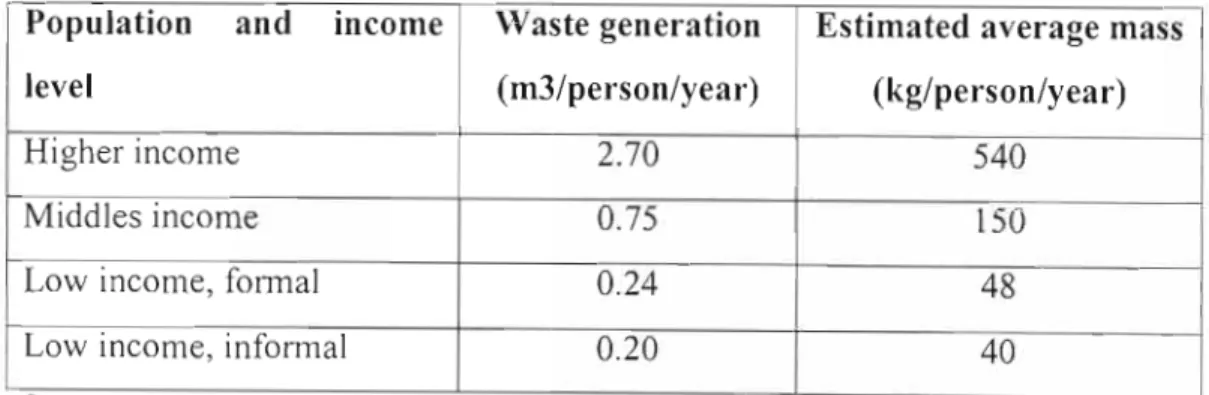
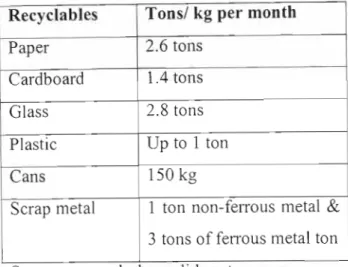
4.2 Quantities of waste produced per person per year in DMA 91 4.3 Waste disposal on landfill and marine pipeline in DMA 1996 93 4.4 Recyclables removed from Ballair Refuse and Recycling Center 95
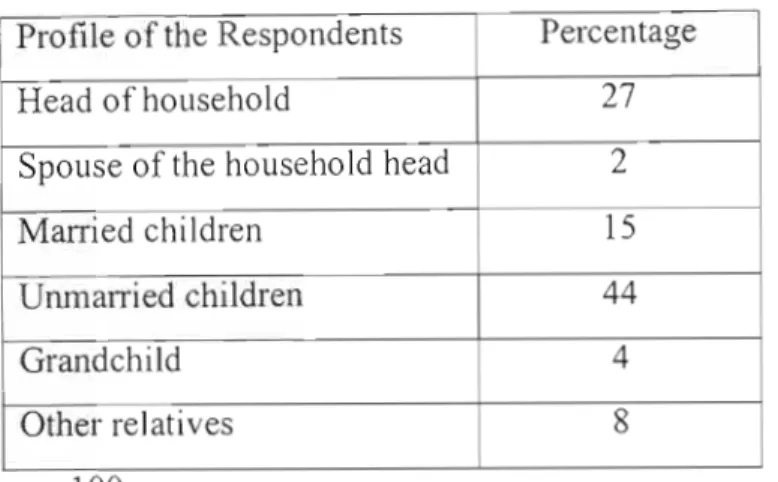
4.5 Profile of respondents 96
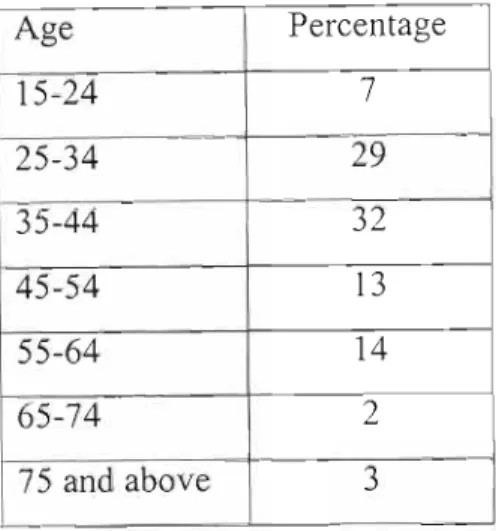
4.6 Age of the respondents 97
4.7 Sex of the respondents 98
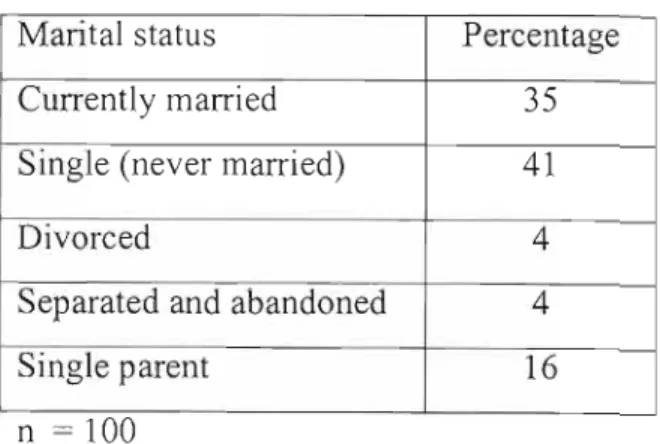
4.8 Marital status 98
4.9 Monthly income 99
4.10 Employment status 100
4.11 Educational level 101
4.12 Work place 102
4.13 Number of people living in the property or house 103
4.14 Duration of stay in the house or area 103
4.15 Waste removal and street cleaning 104
4.16 Storage of domestic waste 108
4.17 Disposal of garden waste 110
4.18 Disposal of scrap metals 111
4.19 Refuse skip provided to store waste before collection in the area 111
4.20 Scavengers during waste removal days 114
4.21 Last time in which sewer blockage happens 114
4.22 Illegal dumping as a problem in the area 116
4.23 Environmental impacts of illegally disposed waste 121
4.25 Availability of Environmental Awareness Campaigns 127
4.26 Solid Waste Recycling Projects 129
4.27 How do people dispose off recyclable materials 132
4.28 Stakeholders responsible for complains based on solid waste
Related problems 134
4.29 Knowledge about Solid Waste Management Policy 137
CHAPTER ONE
Introduction and Contextualisation of problem
1.1 Preamble
Environmental conditions are directly related to human health since people interact with the environment on their daily activities. Environmental problems should not be viewed in isolation but within a social and economical context. Economical factors are relevant in that poor communities, often without basic services impact negatively on natural resources. This can include things like cutting trees for fuel wood or house construction and polluting water resources. Due to population growth (social factor) more reliance is on the enviromnent where by people require more resources for their
Most countries are faced with different environmental challenges, which need close and adequate consideration. Environmental problems facing most countries include depletion of natural resources, deteriorating infrastructure and social amenities.
These problems are caused by factors like destruction of protected areas, poverty, exploitation of natural resources, inadequate and lack of law enforcement and population growth. These factors are inextricably linked to each other.
(W'vVW.ClllC.gov.za)
Environmental issues impact on communities in the developed as well as developing world. Developing countries are focusing much on development and Ignore environmental protection. Environmental problems can start locally but cross- national borders and affect the whole world. For example one group of people dump waste in rivers, which has a negative impact on communities living downstream.
Also gases emitted by industries can cause health problems to those people being
away of the area. Environmental problems can be seen or not seen, felt or not but still is there to stay if people don't act before it's too late. It's the responsibility of the govemment to act on issues affecting the environment or people will suffer. People need to be involved since its their activities that cause such problems. Awareness on the relationship between the environment and human health requires immediate action so as to protect the present and future generations. (www.unido.org)
In the past ignorance on environmental management in South Africa (SA) has caused the state to give less priority to the environment. Although laws are passed to protect the environment they are not correctly managed or administered and are fragmented. Based on the South Africa's Environment Conservation Act, 78 of 1989, people have a right to an environment that is healthy and protected to benefit present and future generations. But this is not the case in SA where most areas are faced with situations where the environment is not correctly managed. The main problem when it comes to the SA environment is the lack of planning, lack of information and lack of appropriate legislation. (Govemment Gazette, 1998)
Amongst the problems in KZN facing the environment are deforestation, solid waste, pollution, desertification, soil erosIOn and many more. Deforestation IS
environmental in a sense that it is the destruction of indigenous forests. Forests are removed for different reasons such as agriculture, commercial purposes to provide timber, also for household uses like firewood or house construction. Deforestation can lead to alteration of local and global climate through disruption of water and carbon cycle, and can cause extinction of species (www.botany.uwc.ac.za)
Pollution destroys the envirom11ent m different ways depending on where it is concentrated, and it can be viewed as any substance that the environment cannot handle having an effect on human beings and other living things. This can include
substances that are not biodegradable. Pollution types can be classified based on the ecosystem that it affects, for example air, water and land pollution. The best way to deal with pollution include focusing basic things like point source pollution, non- point pollution and polluters-must-pay principles. (www.botany.awc.ac.za)
Desertification is the process that occurs due to the poor management of the land making productive land become non-productive. This is mainly caused by overgrazing, cultivation of marginal land, and destruction of vegetation, poor grazing management and incorrect irrigation practices. The process affects land; wildlife, domestic animals, agricultural crops and even people at large. Soil erosion is a natural problem but human activities speed up the process. Wind and water speed up erosion with plant cover as one of the influential factor. Plants are important in a sense that they slow down over land flow, whereby its roots prevent soil from being washed away, and water is absorbed by plant leaves before reaching the soil
(WWVJ. botany. uwc. ae. :oa)
Most people are concerned with solid waste management in developing countries.
The main causes of these problems are people's activities that affect the environment.
According to the ECA (1989) activities that cause environmental problems need to be identified and that includes water use and disposal, waste and sewage disposal, recreation, industrial processes, renewable resources and many more activities.
People are not allowed to engage in these activities unless authorized by the Department of Environmental Affairs and Tourism. Activities have an effect on people's health and the environments they live in. Some resources that people overuse are those needed for economic development. On the other hand as popUlation increase pollution increases causing change in the environment, and this leads to vulnerability of the urban settlement and infrastructure. Therefore, not everyone can be catered for when it comes to services provision, and people end Up
occupying areas that are vulnerable to natural disasters or areas that are not favorable for living. Basic needs like water, housing, sanitation, solid waste collection and disposal services, education etc end up being scarce because of the increase in population. Due to this people need to have other means to substitute these needs, which lead to environmental degradation. (German Committee for Disaster Reduction, 2002)
Solid waste management seems to be the biggest challenge that confronting South African authorities. Since waste is a serious issue affecting the environment and people living in it in these days, there are three things that can be done to eliminate the problem viz reduce, reuse and recycling. Reduce-includes shopping carefully, avoids over-packaged products, buy what can be recycled, use your own plastic bags for shopping, and many more. Re-use includes returning goods that have deposit capabilities, use papers writing one side for rough work, reuse plastic containers for food storage, give cloths or any related things to charities and repair things instead of throwing away. Recycle material with an aim to reduce waste to the landfill and this can include glass, tin, paper, plastic and copper (www. botany. uwc. ac. za)
The community, due to solid waste being disposed off in the streets, back yards and open space, encounters problems. People end up being faced with bad odors and diseases calTied by small insects like mosquitoes, ants, cockroaches etc., which breed on this dump sites. The four steps that are used appropriately to eliminate illegal dumping problem includes source reduction, recycling, conversion to energy and land filling. Through recycling as part of waste management energy can be saved by displacing virgin materials (Jackson and Jackson, 1996).
1.2 Waste management
Solid waste management can be defined as "the discipline associated with control of generation, collection, transfer and transport, processing and disposal of solid waste in the manner that is in accord with the best principle of public health, economics, engineering, conservation, aesthetics and other environmental considerations,"
(Tchobanoglous et aI., 1993). Objectives of waste management are: avoidance of waste production at source; use of degradable packaging material; sorting of household waste to encourage disposal and recycling; and reuse and recycling of waste; dispose residual in an environmentally acceptable way. The problem might be that there is no policy that helps in the achievement of these objectives, no incentives that help in waste reduction; legislations are fragmented, no unifonn set of by-laws for waste management at a local level (Fuggle and Rabie, 1994)
Solid waste can be divided into different categories based on where it is being produced. Household waste can include domestic property, residential home, educational establishment etc. This is referred to as garbage produced during preparation of or storage of meat, fruit, vegetables etc. and usually contains moisture content of about 70%. Commercial waste usually is generated from premises used for trade or business of sport, recreation and entertainment (Bahu et aI, 1997).
Industrial waste includes "chemicals, plants, sand, metal ore processing, fly ash, sewage treatment sludge, etc," (Rao, 1991 :). Hazardous waste includes chemical that are highly toxic to most life forms. Biological waste sources are hospitals and biological research facilities. Its characteristics are that it has an ability to infect other living organisms and produce toxins. Flammable waste is potentially hazardous in storing, collection and disposal, and may be in liquid or gaseous or solid form.
Can include organic solvent, oils, plastisizers, and organic sludge. (Rao, 1991)
Although there are different types of waste this study focus on household waste. An inadequate provision of refuse collection services and disposal of both solid and liquid waste seems to be a classified environmental problem. This inadequacy can be viewed as the basic problem to environmental health, as unmanaged collection and disposal of waste have impact on human health and productivity. The United Nations Development Programme that the most serious problems in urban areas include insufficient solid waste collection and insufficient solid waste disposal sites.
(www.unido.org)
Solid waste dumped on the streets or any other open area can percolate the soil and contaminate the ground water. In Accra (Ghana) the Waste Management Department collects only two third of the generated waste and only 10% of households have home- collection services. In Kinshasa (Zaire) most of the waste is dumped in open spaces or roads of the cities. The inadequate collection and management of waste lead to illegal dumping of waste that can cause breeding areas for mosquitoes, flies, and insects that are good transmitters of diseases. (www.unido.org)
South Africa, alone, generates a total solid waste stream between 340 and 480 million tones per year with 15 million tones from municipal waste (Macozoma, 1999 cited from CSIR, 1991). From municipal waste generated every year in South Africa a very small amount of it is recycled. A large amount of waste is subject to illegal dumping. This is due to the fact that about 40% of SA people don't have access to waste collection services these communities resort to illegally dump on open spaces resulting in degraded environment which affects people's health and their living area.
(www.sajhe.org.za)
The poor functioning of municipalities is due to issues like deteriorating financial situations and political interferences. In trying to address the problem of environmental degradation the planning of regulation should not be at central Government level but rather be at a local and institutional level. At the same time the
b
local interested and affected parties must be involved in all decision-making. It is also important for communities to take initiatives to manage solid waste. A group of nine people from Khayelitsha in Cope Town serves as the best example for their involvement. This group was contracted by City of Tygerberg refuse collection scheme to collect refuse for five years. This opened employment opportunities for local people. The community has stated that the current service is far better that when the municipality was collecting waste. (www.cmc.gov.za)
Waste cnses In KZN have been a problem ever since the Bulbul Drive, Durban collapse in September 1997. The closing down of this landfill site left the province with no hazardous waste disposal sites. Due to this dangerous waste such medical waste and other waste generated from industries need to be transported longer distances for disposal. This cause a lot of money for producers to transport and dispose in another province. (www.miiu.org.za) Another issue can be traced from Mhlathuze sub-region with its sites decreasing in number and sites available are faced with capacity decrease. For those existing sites its difficult to expand due to the fact that its waste pollute groundwater or surface water and/ or can have a negative effect in the residential areas. (www.miiu.org.za)
Most cities are faced with a solid waste crisis where by there are no land to dispose waste thus causing an increase in illegal waste dumps. This is due to NIMBY (Not In My Back Yard) syndrome that most people and even communities have. People dump their waste in open areas increasing breeding grounds for mosquitoes and causing odor problems. Landfills face the problem of leachate (liquid seepage from
landfill) due to water, liquid by- products and rain. This also needs to be controlJed or to be treated since water from landfill contaminates groundwater or surface water.
(Sara, 1990)
In Durban Metropolitan Area (DMA) there are both formal and informal settlements, and problems experienced by these settlements are almost the same. Informal settlements involve those areas where people occupy land illegally with an aim to be close to work places. These areas lack services and their lives deteriorate each and every day. Durban has several townships like KwaMashu, Clermont, Umlazi, lnanda, Chesterville, Chatsworth, Lamontville and many more. These townships are formal settlements that are expected to have all services including sanitation; refuse removal and collection services, waster, electricity and many more. Life in formal townships in supposed to differ from that in informal areas. This is not the case because most people don't have access to waste and refuse collection services. People face different problem due to the fact that servIces provided are inadequate and insufficient. (www.durbansolidwaste.org.za)
During the apartheid era black communities were not catered for in the provision of enough collection and disposal services, and this was the reason that people dump waste on any open area. The existence of the problem can be supported by the fact that in 1999 townships like Umlazi and other townships were included in the Durban municipality. The aim of this incorporation was to make sure that these townships have waste management and refuse collection services that are similar to other Durban areas. (www.durbansolidwaste.org.za)
The Durban Solid Waste (DSW) is responsible for the provIsion of waste management services in the whole of the Durban areas. The DSW collects commercial, industrial, and domestic waste and dispose it on their own disposal sites.
There are different landfill sites under the DSW but among them the busiest is the Bisasar Road Landfill (Springfield) that was established in 1980 receiving an average of 3000 tones daily. Both plastic bags and containers are used to store waste before collection day. In areas where bulk waste is produced two-wheeled containers are used to make it easier to transport waste to the collection station. The responsibility of the DSW is also to sweep and clean the streets of Durban, this happens mostly in cities with the townships left unattended with respect to waste. In some areas tenders are given to contractors to provide collection and disposal services. These contractors work with DSW to ensure that people receive services necessary for their lives. (www.durbansolidwaste.org.za)
1.3 Contextualization of the problem
There are different townships in Durban and they are all faced with different problems. Part of these problems includes that of solid waste management. The main reason for this was the issue of racial discrimination where people were separated according to their race, with different townships for Blacks, Coloreds, Indians and Whites. Black townships were situated on the outskirts of town with whites close to the CBD. Due to the uneven distribution of services and resources, townships were left at risk with much attention being paid on those in cities.
Sustainable management can be successful if both community and management approaches be involved. That is, communities need to clean and collect waste while the management approach works in transfer and disposal of waste. The success of solid waste management lies on the acceptance of community-based contractors whereby people become more involved. Based on the Environmental Conservation Act (ECA) no. 78 of 1989 people have a right to clean environment but looking at the situation in townships it's really difficult to accept that the state govemment cares
for people's health and environment. Waste minimization (reduction), recycling, reuse, and recovery are also considered as important elements in solid waste management. So the question that arises is that if the government is concerned about health of the people and the environment why is the situation of illegal dumping increasing in Umlazi township? This question raised the motivation for the study to be done in this area.
1.4 Aims and objectives
1.4.1 Aim:
.:. The aim of the study is to investigate the solid waste management practices in Umlazi Townships.
1.4.2 Objectives:
.:. To compile the socio-economic profile of the community
.:. To determine the different types of waste disposed by the community .
• :. To investigate about waste removal services provided to the people .:. To look at the role of the stakeholder in trying to eliminate waste .
• :. To investigate the causes of illegal dumping in the area .
• :. To look at how waste affects human health and envirOJm1ent
1.5 Chapter sequence
Following on the motivation for this study as outlined in this chapter a comprehensive review of waste management and practices will be presented in chapter two. The focus in the third chapter will be on a description of the study area as well as on the methods or teclmiques used to execute this study. The data gathered from the implementation of the methods described in chapter three will be depicted
graphically and in tables in the forth chapter. In the fifth chapter the emphasis wi 11 be on discussion of the results and recommendations. The final chapter of this study wi 11 dwell on an overall conclusion of this investigation.
1.6 Conclusion
The findings on the study will make it easier to conclude on how some, if not all, urban areas under Durban Metropolitan Area practice the solid waste management.
This will also give the full insight on whether the authorities play any role in the management of waste or not. This will also help to assess if the society is aware of the impact that their activities have on the environment.
CHAPTER TWO
Solid Waste Management: A Theoretical View
2.1 Introduction
There are many problems facing the environment in whole world, whether developed and developing country. Most problems cause impact to human lives, and these problems are either seen or unseen, felt or not felt. Urbanization, increase in informal settlement, discharge of pollutants, environmental degradation, depletion of natural resources, deteriorating infrastructure and social amenities cause change in the environment. Before elaborating much on the topic of solid waste management it's important to give brief definition of terms. These are not the only definitions but everything depends on the how one sees something to be. (www.cl11c.gov.za)
2.1.1 Definition of terms
Environment is the "living area for people, and other organisms like animals, plants and insects. The environment is made up of renewable and non-renewable resources (air, water, land etc), natural ecosystem, and natural habitats that are made or changed by people living in it," (Environmental Management Policy, 1999)
Waste is "an undesirable or superfluous by-product, emission or residue of any process or activity that has been discarded, accumulated or been stored for the purpose of discarding or processing". (National Waste Management Strategy, 1999)
Municipal solid waste is any "refuse from household; non-hazardous waste from industrial, commercial and institutional establishment; market waste; yard waste;
and street sweepings ", (World Bank and Agenda 21, 2002).
Solid waste management can be defined as "the discipline associated with control of generation, collection, transfer and transport, processing and disposal of solid waste in the malU1er that is in accord with the best principle of public health, economics, engineering, conservation, aesthetics and other environmental considerations,"
(Tchobanoglous et aI., 1993).
Pollution includes air, waters and land pollution, and cannot be seen, cannot be smelt and cannot be measured but contaminate now and leachate cause effect to future generation. The waste that is found on the environment affect either land or water, so due to this the brief definition of waste can be given based on the what was given by the National Waste Management Strategy (National Waste Management Strategy 1999).
Definition of waste varies from country to country making it impossible to compare one country to the other. In less developed countries 50-70% of urban waste is collected (1992 figures) and the rest is left on streets and open spaces. These areas end up being the breeding grounds for vermin and then lead to the spread of diseases (Jackson and Jackson, 1996). Nations with higher standard of living and productivity generate more municipal solid waste compared to those in less developed countries. This led to scarcity of land for waste disposal, which cause disposal to be costly and increases the demand for the new expensive ways of disposal. On the other hand some of the existing landfill close down because they don't meet regulations or they have reached their capacity. Due to the lack of geographic suitable site and the NIMBY syndrome it's difficult to relocate these landfills. At the same time politicians are unwilling to take strong position that might alienate their constituents, and this is due to what is termed NIMEY (Not-In-My-Election-Year) (Fuggle &
Rabie,1994)
Solid waste management and problem experienced in developing countries differs form that of developed countries due to some reasons. This includes the socio- economIC and political issues that exist. Developed countries focus more on recycling, environmentally acceptable disposal methods. Developing countries have an inadequate waste collection and transportation with few environmentally friendly disposal sites. Developing countries use the informal sector solid waste recycling (ISSWR) mostly in informal settlement areas where the government fails to provide refuses collection services. (Enger & Smith, 2000)
Main aim of managing municipal solid waste is to protect health of the population, promote environmental quality and sustainability, and support economlC productivity. In most countries the municipality is responsible to manage municipal solid waste. For most low- and middle-income countries solid waste services are not effective and sufficient for human use and they end up having negative impact on the urban environment and public health. In dealing with solid waste management an integrated system is needed which calls for minimizing waste, promote reuse and recycling, promote sound disposal and treatment of waste, and extend coverage on waste services. (World Bank and Agenda 21,2002)
2.1.2 The status of the environment in the society
Environmental management is the only available solution to the existing environmental problems. For this management to be effective and efficient legislation and policies are needed to give guidelines and rules on how things should be done. The word environment can mean different things to different people but at the end everybody has a responsibility to care for the environment. Based on the definition of environment given above it is clear that people interact with the environment and they are the ones responsible for the sustainability of the enviromnent. (EMP, 1999)
The activities, culture, politics and social systems, and economic activities affect
"how people interact with the natural ecosystem and habitats, how they use natural resources that are available, and the meaning they give to different forms of life, ecosystem, physical landscape, cultural landscape and places," (EMP, 1999). This is the reason why environment need to be managed in a way that will give clear understand to the people forming part of the environment, but there are some obstacles that hinders environmental management.
Obstacles to environmental management are financial resources, governmental fragmentation and staff expertise. Financial resources-are greater obstacle on the management of the environment and this usually face the local government. At the same time scarce resources compete with environmental needs. Cities or towns with proper funding have extensive environmental management programs and other cities are left suffering. Government fragmentation-governments have a responsibility in the management of the environment but this seems not to be the case for most countries where by the responsibility is shifted to private sector. The main problem is that the government entities cannot share responsibility on the environmental matters (Macozoma, 1999).
Lack of funding leads to the lack in staff expertise, which is required for the environmental management. Large cities hire consultant for waste collection while small cities have no choice but to rely on environmental groups, state officials, etc.
The insufficient staff is caused by the lack of information about management techniques, which makes it impossible for local governments to adapt to new programs since there are no sources (Magazine, 1997)
The management of solid waste, which includes collection, removal and transportation, treatment, recycling and resource recovery, and disposal, is the core in all countries. Disposal could be in form of landfills, surface impoundment, land application, deep well injectetion etc. So by recycling old town dumps and the backyard dumps having detrimental effect to human health can be reduced or eliminated. Residential and commercial wastes are most common forms of waste in the municipal landfills consisting of "food and garden waste, paper products, plastic and rubber, textile, wood, ashes and the soil used as cover material," (Owesis &
Khera, 1990).
The insufficient and inefficient resources in the society promote the increase in open dumping in most areas, which end up putting public health in danger and increase environmental degradation. So the local authorities has a responsibility to improve services provided to people and at the same time upgrade the environment. (World Bank and Agenda 21, 2002). Burning of municipal solid waste cannot be the solution to the last end since fly ash and bottom ash are produced during this burning. The fly ash absorbs the metals, dioxin and other compounds.
For sound and successful management of solid waste local authorities need to focus on affordability, participation and demand, which are impOliant measures in the provision of waste services in poorer communities. Most poor communities are situated next to open dumps, so improvement to be successful these dumps be closed. In that way the sanitary landfill could be the only choice available for the disposal of solid waste. In minimizing the amount of waste that reaches these landfills recycling, reuse, composting and waste-to-energy are complementing systems necessary for this. These systems could only be successful if education campaigns are organized and incentives are used to encourage people to reduce waste. Participation of private sectors in decision-making and implementation of any
project should be encouraged mostly in micro- and small-scale enterprises. In this manner the cooperative measures would help municipalities to share solution when it comes to collection and disposal. (World Bank and Agenda 21, 2002)
2.2 Types of solid waste
Waste includes all those materials bumed by the law from being used or those not appropriate for use. This waste includes household, industrial and commercial waste that can be disposed via licensed disposal sites or with necessary consents. For all this waste there are special and hazardous waste in them. Household waste includes domestic property, residential home, educational establishment etc. This is referred to as garbage produced during preparation of or storage of meat, fruit, vegetables etc.
and usually contains moisture content of about 70%. (Bahu, et ai, 1991)
Commercial waste usually is generated from premises used for trade or business of sport, recreation and entertainment. Industrial waste includes "chemicals, plants, sand, metal ore processing, fly ash, sewage treatment sludge, etc," (Rao, 1991 :).
Industrial waste is waste generated in areas occupied by scientific research association, from degrading operations, arising from tunneling, arising from aircraft, vehicle or vessels which are not occupied for domestic purposes poisonous or noxious waste arising from mixing or selling paints, etc. All this waste could have effect on the environment and to human health.
The hazardous waste are those waste that have a hazard to human health or living organisms. It can be classified into radioactive substance, chemicals, biological wastes, flammable waste, and explosives. The radioactive substances emit ionizing radiation and are hazardous because their exposure to radiation results in damage to living organisms. It persists over long period of time. Sites of disposal for radioactive substances cannot be used for disposal for other solid wastes. Chemicals are
hazardous because are highly toxic to most life forms. Biological waste sources are hospitals and biological research facilities. Its characteristics are that it has an ability to infect other living organisms and produce toxins. In this hazardous waste malignant tissues taken during surgical procedures are included and contaminated needles, bandages and outdated drugs. (Bahu at aI, 1997)
2.2.1 Strategies for the improvement in solid waste management
• Strategic service planning- in implementing the solid waste management system in a metropolitan area demographic and industrial growth should be considered. Services are provided based on the people's demand and affordability, mostly focusing on urban poor people. At a national and provincial level the policy framework should link public health, environment and decentralization. Incentives is the best measurer that can be used by local authorities to deliver sufficient services, gain more costs from users, and work hand in hand with other municipalities.
• More efficient operational management-both private and public sectors should be involved in decision-making mostly facility siting and design service delivery. Allowing people to participate in taking decisions will exacerbate the success of any proposed project. On the other hand
participation will limit the NIMBY (Not In My Back Yard) syndrome, which usually hinder development in urban areas. On the other side private sectors
pmiicipation lower costs and improve efficiency and are used to mobilize investment funds and give new ideas and skills needed.
• More efficient financial management-in most countries generators of waste and the government share the cost of waste collection, transfer and disposal.
Charges imposed to those who generate waste can be used as incentives
whereby people who generate more are to pay more, and this help to recover the portion of costs for solid waste management. In some instance people are willing to pay for collection but not for disposal in landfills. The management capacity of municipal authorities and corresponding municipal finance system should be improved as a way to improve solid waste management.
• Improved environmental management-the sanitary landfill is the only choice left to be used for waste disposal, so there is a need to close dump sites and finance the operation of landfills. The lack of experience and financial resources hinders management of the landfill, so there is a need for financial and technical assistance to the lower- and middle-income countries.
Municipalities also have a responsibility to help each other because environmental problem in one area can affect the other. (Fuggle and Rubie, 1994)
2.3 Waste Management Processes
There are six waste management process involved in the waste stream and each process will be discussed in details in the whole section of 2.3.
Figure 2.1
Waste generation Storage
+
• . - - - COlltction---,.
Transfer! transportation ...
I---l+---.~
ProcessinglremovalI
L - -_ _ _ _ _ _ _ _ _ ~~ Disposal ...I
Source: Fuggle and Rabie, 1994
2.3.1 Waste generation, handling, and separation
Storage of waste in a container is not the only activity in handling waste but other activities include the transportation of a container to the collection point and return the container to its point. Different people responsible for the handling of waste generated on different onsite sources. Different handling and separation methods are used at residential and the commercial sources. Separation methods are used at residential and the commercial sources for purposes of recycling waste materials (Bradshaw et ai, 1992).
The generation of waste in any urban area depends on the time of the day, day of the week, week of the month and month of the year. For example during month ends people generate more since they have more money to buy compared to the beginning of the month. Also during Christmas or vacation times people receive bonus and they generate more waste. Weather conditions, especially moisture content can impact
size of waste generated or waste to be disposed off. In the development of the solid waste management solution moisture, particle size, chemical makeup, density, and composition should be taken into consideration. (Bradshaw, 1992)
There are four levels involved in the handling of municipal solid waste, those are source reduction (where manufacturers has to produce what contains fewer toxins and less packaging, and people have to buy what is durable and non-disposable products); recycling and reuse (where recycling helps to prevent useful material from being placed in landfills, reuse save energy and natural resources); waste combustion (to provide benefit of energy production); and landfill (used to keep waste that cannot be recycled or combusted, and this included even the residues from waste combustion). The waste handling in the residential dwelling differs from the commercial facilities and the brief overview of this will be done below. (Bradshaw et aI, 1992).
2.3.1.1 Residential dwelling
At this source houses with more than one floor are used to classify the methods used in handling and separation of waste. There are three different ways that can be used to classify methods at this source. Firstly, at low-rise detached dwelling that has floors less than four. In this dwelling it's the responsibility of the residents or tenant to place solid wastes, generated from different locations on the containers. And in most communities of US that fall under category are not expected to separation waste but instead to store mixed waste with little or no standardization.
At some stages people had to separate recyclable materials and store it on the separate bag or container, and then transport the container to the collection point.
Secondly medium-rise apatiment are those with floors between four and seven. In
these apartments, the residents had to place containers outside their doors and waste collectors pick up waste from each door. (Bradshaw et ai, 1992).
According to Tchobanoglous (1993), storage location and collection methods vary with basement storage, outdoors storage, and compactor storage. In basement storage the owner of the building provides on area where people carry their recyclable and non-recyclable waste and deposit it on the right place. Then the maintenance staff transports containers to the curbside collection area, and retum containers after collection. In the outdoor storage the container is outside and tenants had to carry their waste and recyclable material to the appropriate container, then the collection vehicle is responsible to empty the container (Tchobanoglous, et aI, 1993).
2.3.1.2 Commercial facilities
Commercial dwelling wastes are collected from individual offices or work location and put on containers. But for most commercial building this is the problem since wastes are emptied from containers to burlap drop cloths. If these cloths are full before collection time there could be bad odors. Any onsite storage of solid wastes takes consideration of the "effect of storage on the component, type of container to be used, container location, and public health and aesthetics," (Tchobanoglous, 1993).
The effect of storing wastes involves things like biological decomposition that result due to bacteria and fungi if food and other waste are placed in onside storage containers. If wastes are mixed together paper can absorb moisture from food depending on duration between the collections. The contamination of major waste components takes place if wastes are stored for long time. Therefore this reduces recycling possibility (Tchobanoglous, et aI, 1993). Types of container to be used depend on characteristics of solid waste to be collected, collection frequency and the
space for placement. Low-rise dwelling in a commercial dwelling use light containers that are easy to handle since collection is manually. Highly loaded containers can cause injuries to collectors. These containers can be in a metal or plastic fonn depending on the homeowner. The metal container is noisy and can be damaged when emptied while ultraviolet rays can bum plastic containers (Bradshaw, et aI, 1992).
Although individual containers are used for one apartment, in areas where apartments are close to each other people share containers. So if the container is full collectors have to pick it up otherwise people will litter anywhere. Medium-size and high-size apartments use chutes; separate storage containers are not used and wastes are stored in containers on the premises between collections. These containers include the large open-top containers, enclosed storage containers and special containers used in conjunction with processing equipment. Containers are located on the sides or near the house, in alleys where alley collection is used and in garage where available. (Bradshaw et ai, 1992).
2.3.2 Collection and transportation of waste
High-income areas use hi-tech hydraulic compactor trucks for waste collection and transportation. Low-income areas use hi-tech hydraulic compactor trucks, open top trucks, tractors, trailers, animal drawn trailers, one person contractors, skip loaders, tricycle, pushcarts and so on. At last this waste can be hauled directly to the landfill or to the transfer station. As the waste increases the collection becomes more complex in most urban areas.
Complexity of waste collection is due to the reason that wastes are generated at residential and commercial industrial level, as well as streets, parks, and vacant areas. The other reason is that fuel and labor costs are high. Collection does not mean
only gathering solid waste from different places but also dragging solid waste forcibly. The dragging and unloading are similar for most collection system while facilities, activities or locations determines the gathering and picking of waste.
(Bradshaw et aI, 1992).
2.3.2.1 Collection o/non- separated waste
In residential areas the collection services type varies depending on type of dwelling unit. In a low-rise dwelling the curb, alley, setout-setback, and backyard carry are mostly used collection services. In the curb services the homeowners have to empty containers at the curb and maintain their containers until next collection. Setout- setback service is where homeowner is responsible to take out the container and setback after being emptied. In the backyard carry service the crew enters the homeowners' property and removes stored waste. Most residential waste collection includes the direct lifting and carrying of containers, rolling of loaded containers or drop cloths. (Bradshaw et aI, 1992).
In the medium-and high-rise apartment the curbside collection is used where the maintenance staff is responsible for transporting containers to the curb side collection, which is emptied by collection vehicles. In the commercial industrial facilities the manual and mechanical means are used for collection. Usually waste from the commercial facilities is collected in the late evening or early morning with an aim to avoid accidents on large cities. In manual collection wastes are collected from plastic bags or any other disposable containers and placed on a curb. One of the crewmember remains in the collection vehicle to control it. Movable containers or large-capacity open top containers are used on commercial industrial facilities, and at times containers are emptied mechanically depending on its size and type (Tchobanoglous et aI, 1993).
2.3.2.2 Collection of separated waste at source
The separated waste is collected before disposal or recycling and for residential areas the curbside collection is used. In this method residents either have two containers to put recyclable and non-recyclable waste, or the crew has responsibility to separate wastes material. The recyclable wastes include waste like paper, plastic, glass, etc.
Vehicles used for the collection of source separate wastes include open-bin manually loaded (where the crew has to load the bins), open-bin manually loaded mechanically emptied (where the crew load the bin then the vehicle is used to empty the bin), container mechanically emptied (where the vehicle emptied the container), and mobile container system. (Tchobanoglous et ai, 1993).
At the commercial level the hauler has the responsibility to collect the source- separated wastes. Recyclables are stored at a separate container and collected by those responsible for it, and the city crew collects the contaminated municipal solid wastes. The collection system used can be viewed by looking at their mode of separation and be grouped into: -hauled container system (HCS) and stationary container system (SCS). The HCS is the system where the containers used for storage are hauled to the disposal site, emptied and taken to the storage point. SCS is system where containers are only moved for emptying in the curb otherwise remains at the waste storage location. The hauling container systems are used in areas where waste generation is high and usually large containers are used. These large containers save time during collection where workers don't have to collect many small containers, and these containers can be in different sIzes and shapes (Tchnobanoglous et ai, 1993)
There are three types of hauled container system-: host tmck systems, which is used with stable compactors where waste is mechanically loaded in a collection vehicle; tilt-frame container systems which used by vehicles that have the capacity to haul
and unload the large containers usually use the open-top containers and the stationary compactors; and lastly trash-trailer system where the heavy rubbish can be easily collected by this system and is usually used to collect demolition wastes at constructions sites (Tchobanoglous et aI, 1993).
The stationary container system can collect any wastes but usually vary in type and quantity of wastes to be collected. In systems with mechanically loaded collection vehicles the trip to the recovery facility or disposal area is done when the vehicle is full. This system is usually used for the collection of the residential wastes but cannot collect heavy rubbish and demolition and construction waste. A system with manually loaded collection system can be used for the collection of residential wastes or litter. This system of manual loading is used because most people could not have access to mechanized self-loading system. In the stationary container system labuors are needed. In the hauled container system only the collector driver is needed who is then responsible for all activities involved in the wastes collection (Tchobanoglous et aI, 1993).
Due to congestion and narrow streets in most town and urban areas of small vehicles are used to collect wastes from homes then transfer it to larger vehicles loaded at ground level. Then large vehicles would transport wastes to the transfer station, which lead to the concrete platforms (Rao, 1991). According to Tchobanoglous (1993) transfer station are used for economic consideration and that can be proved when small manually loaded collection vehicles are used, when large quantities of wastes are hauled for long distance, and when one station is used by different collection vehicles.
There is a need to mull over the distance waste collectors spend going to and from the waste collector truck. So due to this there are different methods that can used in
trying to decrease the burden left on the waste collector, but all these methods have negative impacts. This can include garbage grinders that reduce the amount of waste but put extra load on the wastewater treatment. Pneumatic pipes where waste is transported through underground pipes and delivered to the plant. In larger communities the transfer stations can be used for daily waste intake. Thus resulting in workers spending more time collecting and less time traveling. The green cans on wheel are also widely used methods to transport waste to trucks and this can even be done by households themselves since there are hydraulic lift that help in emptying the can. (Bradshaw, et aI, 1992)
In America the packer trucks are used to haul the wastes and are able to compress and reduce waste to volume of 60%. The drawbacks in collection waste are that it is expensive, whereby $65.00 needed just for one truck. Trash collection is hazardous and cause detrimental effect to human being and the environment. Using the packer truck makes it impossible to separate one resource from the other e.g. glass, metal, paper etc. Large trucks used in metropolitan areas usually cause traffic congestion and noise or air pollution (Owen, 1989:447). Different methods can be used in the disposal of wastes such as open dumping, sanitary landfill, incineration and recovery and recycling.
2.3.3 Disposal methods
Waste stream need be identified before disposing any waste, where chemical and physical composition be considered. It is the responsibility of the producer to look at some environmentally sensitive contaminants like heavy metals, clinical waste. The nature of waste need be given more attention that is solid or liquid waste. The largest percentage of solid waste is disposed by landfill. Different reasons cause the increase in illegal dumping like insufficient collection services, ignorance of people on the environment, high rates that people have to pay for collection, and many more.
Landfills cannot be used for flammable solvents and heavy metals can be incinerated in order to reduce enviromnental impact. Location of disposal facilities can affect viability of some options. It is the responsibility of one company to visit the site in order to look at its management and records (Feates & Barrett, 1995).
The average municipalities need to avoid the future problems when selecting the solid waste disposal methods. The waste disposal practices are hindered by the increased scarcity of land that is suitable for the landfill site. This is due to the fact that more land is used for other land uses such as development related issues. At the same time the informal settlements increase in urban areas, and are clustered together. These settlements are characterized by inadequate, insufficient refuge removal services making the waste collection impossible. The lack of awareness increases waste volume such that people don't know about waste minimization or recycling (www.cmc.gov.za)
Any chosen method needs to meet the present requirements and care for the future situations. The waste disposal can be either on public or private sector depending on the decision of that country. In the United Kingdom (UK) in 1996, "the disposal of industrial wastes was undertaken either by the waste producing company itself, often simply dumping the waste within its own cartilage; alternatively a small local quasi- specialist hauler would be contracted to collect the wastes generally no more precisely defined than 'chemical wastes', and left to his own entrepreneurial skills to find suitable place at which to tip," (Henstock, 1983). Therefore due to lack of legislation thousands of sites for waste disposal were created, which at the end of the day needed special consideration.
2.3.3.1 Open dumping
Open dumping involves the low-lying areas and outskirts of the town. It is mostly used in most countries because it is cheap and requires no planning. In some instances wastes are burnt causing health problems to humans and can encourage breeding of flies, rats, mosquitoes and other pests. Usually this kind of disposal lead to the increase of infectious diseases like cholera, since during rainy days the water from these areas run to the open surface water used by people (Rao, 1991). Due to the increase of waste problems in India different projects were started with an aim to close the open dump areas. It is important for communities, states or local governments to work in partnership to address solid waste issues. This can help one nation or city to share the information and experience with another. Also the success of one nation can act as the incentive to the other.
Thus different tribes in India engage to different waste management plan programs.
Some nations can be used to demonstrate these problems faced by most countries in the world and also the success of management. Most, if not all, projects were done under the funding of the United States Environmental Protection Agency (EP A). St Regis Mohawk Tribe (SRML) to Expand Solid Waste Program-the municipal waste management program of SRML made a great success in trying to reduce waste. Best used technique to reduce waste was through educational projects and community outreach. Under the EPA SRML funds were received where people were taught about the good disposal means and about the impact of burning municipal solid waste on backyards. Different things were done under proposed nations integrated solid waste management program. Also funds were used to clean up all open dumps and to prevent the future dumping. (www.epa.gov/epaoswer)
These dumps (40 in all) were ranked according to their impact on the environment and human health. Environmental Education and Outreaches were used whereby
posters were used to display the negative impact of improper waste management practices. It was deemed important to reduce wastes at source, recycling, and energy- efficiency issues. By using the media information on waste management it was easier to reach other nations (www.epa.gov/epaoswer).
The main aim of the program was to identify similar solid waste issues and share them with other nations in order to get successful approach to address. The Yurok Tribe of the Yurok Reservation in India was the first nation that received attention and in this area different illegal dumps were found and for the project in Yurok the elimination of these dumps was important. One best example is Weitchpec dumpsite in NOlihern California, which existed 40 years before the project, and it grew to about 1.200 cubic yards extending even to the highways. The extension of this dumpsite and impacts motivates the community to stand and wish to make a change (www.epa.gov/epaoswer).
The Yurok tribe government did not want participate since the site was located on the privately owned land but Yurok Tribal staff and on-reservation communities tried to convince the government. That was a success, and then California Integrated Waste Management Board (CIWMB) awarded $600.000 to the project that Weitchpec be used as state clean-up project. Clean-up crews were trained and other regions of EPA were used to get the campaign know to the pUblic. The problem rouse on what could be the legal dumpsite for Yurok. Then the Indian Health Service (IHS) gave $150.000 to create the transfer station where waste could be stored before hauled to a landfill. The land used by California Depaliment of Transport was used the for transfer station (www.epa.gov/epaoswer).
The success of the Yurok cleanup project lies on the responsibility of the people, community, state, and country. Therefore the community was educated about
reduction methods that could be used to dispose waste. Funds from HIS were used to develop recycling and source reduction education programs. Just because of clean-up project people no longer drove through garbage. Burning periodically was reduced, vectors diminished, and the wildlife returned to the area. According to Self Murguia the Planning Director for the Yurok project, the cleaning of visible larger sites make it easier to clean other nearby illegal sites (www.epa.gov/epaoswer).
Based on the problem of open dumpsites the tribal council, Indian Health Services (HIS) and Bureau of Indian Affairs (BIA) came together and in 1993 an aggressive solid waste management plan was adopted with an aim to close dumps in order to reduce volume of solid waste streams. Approximately 140 tons of waste was generated in Bois Forte reservation per year, and different elements were used to manage waste. Transfer stations where recycling took place were built. The used oil, tires, scrap metal, plastic, paper, and aluminum were recycled in these stations.
People had to pay $5 for five bags in which they may be able to dispose their wastes.
Also for the implementation of the solid wastes management program people had to pay $12 per month and businesses $100 per month (www.epa.gov/epaoswer).
The funding facility came directly from the local authorities. Education is a most important way of passing information to the people, and this helps to get the community involved in the community programs. In Bois Forte people were educate