
South Africa and Malaysia:
Identity and History in South-South Relations
A thesis submitted in fulfillment of the requirements for the degree of
DOCTOR OF PHILOSOPHY Of
RHODES UNIVERSITY
by
Muhammed Haron
June 2007
ABSTRACT
The focus of this thesis is on the bilateral relationship between South Africa and Malaysia. The thesis appropriates ‘critical theory,’ and as a flexible theoretical tool, and, as an open-ended, loose frame in order to give voice to the marginalized and voiceless from the South. The thesis thus looks at the politico-economic ties that have been developed and brings into view the socio-cultural relations that had been established between the peoples of the two sovereign nation-states during the apartheid and post- apartheid eras respectively.
The basic purpose of this study was fivefold: (a) to contribute to the extant literature that concentrates on South Africa’s relations with Malaysia, (b) to examine the relationship at political and economic ties in some detail, (c) to demonstrate that apart from the afore- mentioned bonds IR specialists should also take into account the socio-cultural dimensions of international relations, (d) to bring to light the nation-state’s limitations when discussing the role of non-state actors and considering the contributions of other factors such as globalization, and (e) to stimulate further research on bilateral and multilateral relations in the South – particularly between South Africa and other states in Asia and Latin America - that would assist to better understand the past, present and perhaps the future.
KEY WORDS: South Africa, Malaysia, International Relations, Critical Theory, South, Globalization, Middle Power, Identity, Community, Ethnicity, Culture, Religion, Diaspora, Citizenship, Partnership.
TABLE OF CONTENTS
Abstract 2
Table of Contents 3
Illustrations 7
Acronyms 8
Preface and Acknowledgement 11
Dedication 14
Declaration 15
PART ONE Chapter One: Introduction – The Opening Passages of the Tale of Two Sovereign Nation-States 16-38 1. Introduction 16
2. The Thesis’ Purpose Statement 20
2.1 Rationale for ‘purpose statement’ 21
2.2 Research Questions 22
2.3 Its Hypothesis 23
2.4 Its Methodology 25
3. Reviewing the Literature 27
3.1 IR Writings on Asia/Asean 27
3.2 IR Literature on South African-Malaysian Relations 31
4. The Thesis’ Outline 37
Chapter Two: Identifying & Constructing a Theoretical Framework - towards Understanding South African-Malaysian Relations 39-70 1. Introduction 39
2. Significance of Theory and Paradigm 40
3. A Synopsis of IR Theory 42
4. A Relevant Theory and Relating Tales 47
4.1 Critical Theory 48
4.2 Critical Theory through the ‘Art of Story-Telling’ 57
4.3 Identity: A Crucial Concept for Critical Theorists in IR 61
5. Concluding Remarks 68
PART TWO
Chapter Three: South Africa and Malaysia – Telling the Tales of Two Sovereign States (circa 1960-1990) 71-126
1. Introduction 71
2. The Conceptualizing the ‘State’ and the ‘Nation’ 74
2.1 State 76
2.2 The Nation 79
2.3 Nation-State 83
2.4 Ibn Khaldun’s conceptualization of the ‘body politic’ 86
3. South Africa and Malaysia: Recollecting Stories of their past 92 3.1 Describing and Comparing the Two States circa 1948–1990 93 3.1.1 The Early Years: 1940s–1960 93
3.1.2 The Decade of Consolidation of the Federation & the Apartheid State, Circa 1960 – 1970 97
3.1.3 The Decade of Facing Internal and External Challenges: 1970-1980 104
3.1.4 The Decade of Botha’s Exit & Mahathir’s Entrance 1980-1990 108
3.2 ‘South Africa’ in Malaysia’s Foreign Policy (circa 1957-1990) 113
3.2.1 Tunku Abdul Rahman’s Narrative against Apartheid, circa 1957-1970 115
3.2.2 Dr. Mahathir’s Story: Showing support for the ANC, circa 1981-1990 122
4. Concluding Remarks 125
Chapter Four: South Africa and Malaysia – Narrating Their ‘Upstairs’ Ties in the Post-Apartheid Period (circa 1990-2005) 127-190 1. Introduction 127
2. Middle Powers and Partnership: Unpacking Two Conceptual Tools 131 2.1 Middle Powers 132
2.2 Partnership 136
3. South Africa and Malaysia’s Socio-Political Bonds 141
3.1 Their Partnership in the Making: The Tale of Cementing South-South Connections 141
3.2 Re-Connecting: From informal support to diplomatic ties 142
3.3 Being Connected: From diplomatic ties to a sustained relationship 148 3.4 Consolidating Connections: Laying Foundations for a Partnership 161 3.5 Expanding Connections: Towards a ‘Strategic Partnership’? 167
4. South Africa and Malaysia’s Trade Ties 173
4.1 Commercial Connections: Demonstrating a Solid Partnership 173 4.2 Explaining Commercial Connections 174
4.3 South Africa’s Economic Position vis-à-vis Malaysia 175
4.4 Narrating SA-Malaysian Trade Figures: Towards a Tentative Interpretation 179
5. Closing Remarks 188
Chapter Five: South Africa and Malaysia’s Cultural Activists’ Narratives - Forging ‘Downstairs’ Socio-Cultural Connections in the South 190-250 1. Introduction 190
2. Conceptualizing ‘Community’ and ‘Non-State Actors’ 193
3. Cultural Citizenship in the Diaspora: The Experiences of Hj. Rabi’ah and Her relatives in the Federation of Malaya 197
3.1 Introduction 197
3.2 The Conceptual Tools: Citizenship and Diaspora 200
3.3 South African and Malaysian Citizenship: Setting the Context 203
3.4 South African Families Trekking to the Federation by Default 206
3.5 Bringing Hajjah Rabi’a’s Story to a Close 218
4. Ismail Petersen’s Narrative: A South African Cultural Activist’s contribution to IR 219
4.1 Introduction 219
4.2 Employing Suitable Variables to Construct a Framework for this Story 220
4.3 Creating Cultural Connections during the Era of Apartheid 223
4.4 Bringing Petersen’s Episode to a Close 236
5. GAPENA, Tan Sri Ismail Hussein & the SMA: Malaysia’s Cultural Activists and Structures 238
54.1 Introduction 238
5.2 GAPENA: The Malaysian Cultural Vehicle 239
5.3 Ismail Hussein: The Outstanding Malaysian Cultural Activist 240
5.4 The International Malay Secretariat 246
5.5 Rounding of Tan Sri’s Narrative 248
6. Concluding Remarks 249
PART THREE Chapter Six: Bringing the IR Narratives of These Two Sovereign Nation- States to a Close 251-294 1. Introduction 251
2. Malaysians & South Africans: Promoting South-South Cooperation 253 2.1 A (Brief) Tale of Two Bandungs 253
2.2 Defining the Concepts: Third World and South 255
2.3 Malaysia’s Long Narrative in the South-South Cooperation Project 259
2.4 South Africa’s Short Story in the South-South Cooperation Project 265
3. South Africa and Malaysia: Different Dreams but Similar Styles and Common Causes 274
3.1 Asian Renaissance vis-à-vis African Renaissance 277
3.2 Anwar Ibrahim’s Asian Renaissance 277
3.3 Thabo Mbeki’s African Renaissance 286
4. Concluding Remarks 291 Chapter Seven: CODA - The Final Passages of the Tale of the Two Sovereign Nation-States 295-304
APPENDICES
Section One: Chronology of Socio-Historical and Political Events 305-315 Section Two: Maps of South Africa and Malaysia 316-317 BIBLIOGRAPHY 318-359
ILLUSTRATIONS
Tables and Figures
Figure 2.1 Stages of International Relations Theory 45
Figure 2.2 Habermas and his Theory of Knowledge 52
Figure 2.3 Levels of Identity 63
Figure 2.4 Identity formation in International Relations 68
Figure 3.1 State and Nation: A Symbiotic Relationship 75
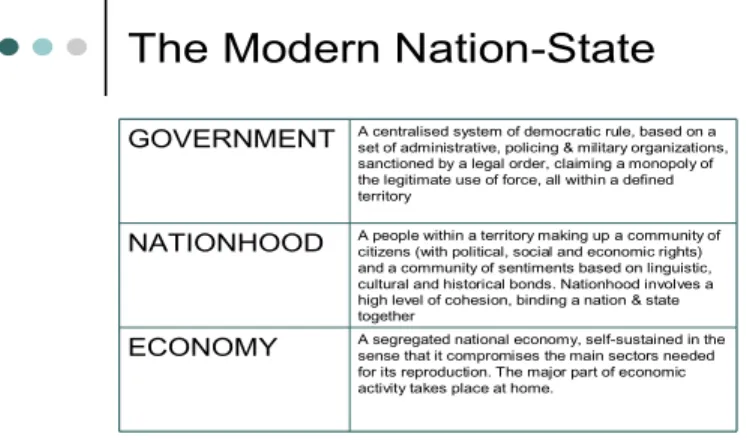
Table 3.1 The Modern Nation State 84
Figure 3.2 Sovereignty and the Nation-State 86
Table 3.2 Ibn Khaldun and the State’s 5 Stages of Growth & Decay 91
Figure 3.3 Malaysia’s Nation-Building Project 97
Fgure 3.4 Mahathir’s Contests for Power (circa 1981-1990) 111
Table 3.3 Malaysian Foreign Policy: 1957 – 1990 113
Table 4.1 Power Structures in International State System 134
Figure 4.1 South Africa – Malaysia: Towards a Partnership 140
Figure 4.2 South Africa: Foreign Policy Phases 141
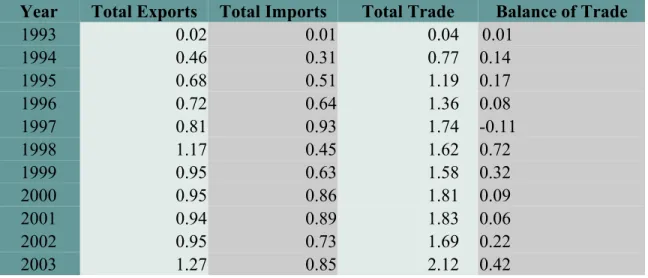
Table 4.2 Malaysian – South African Trade circa 1993-2003 183
Figure 4.3 A Graphic Interpretation of Malaysian-South African Trade 184
Figure 4.4 A Graphic Interpretation of Malaysian-South African Trade 185
Table 4.3 Bilateral Trade Relations: Imports and Exports 186
Figure 5.1 International Relations Actors 196
Figure 5.2 Three International Relations’ Variables 222
Figure 6.1 South – South Cooperation 258
Figure 6.2 An Afro-Asian Renaissance (?) 294
Acronyms
AAITPC Asia-Africa Investment and Technology Promotion Centre ABIM Angkatan Belia Islam Malaysia
AFC Africa Fund Committee
APRM Africa Peer Review Mechanism ASN National Unit Trust
ASB Bumiputra Unit Trust Scheme
ASEAN Association of Southeast Asian Nations ANC African National Congress
AU African Union
BEE Black Economic Empowerment BN Barisan Nasional
CCFMSA Commonwealth Committee of Foreign Ministers on Southern Africa
CHOGM Commonwealth Heads of Government Meeting CODESA Convention for a Democratic South Africa COGSA Commonwealth Observer Group to South Africa COMSA Commonwealth Observer Mission in South Africa COSATU Congress of South African Trade Unions
DCA Department of Civil Aviation DEIC Dutch East India Company DFA Department of Foreign Affairs EAEC East Asian Economic Caucus EPG Eminent Person’s Group
ERWG Ethnic Redistribution with Growth FDI Foreign Direct Investment
FPDD South African Foreign Policy Discussion Document GAPENA Malaysian Federation of National Writers’ Union GDP Gross Domestic Product
GEAR Growth, Economic and Redistribution Program GNU Government of National Unity
HSRC Human Sciences Research Council ICA Industrial Coordinating Act
IDC Industrial Development Corporation IFP Inkatha Freedom Party
IMSC Indonesian and Malaysian Seaman’s Club IOR-ARC Indian Ocean Rim -
ISCOR Iron & Steel Corporation
ISEAS Institute of South East Asian Studies IT International Trade
JSE Johannesburg Stock Exchange KLSE Kuala Lumpur Stock Exhange LID Langkawi International Dialogue MAS Malaysian Airlines Systems
MASSA Malaysian South-South Association MCA Malayan Chinese Association MCS Malayan Civil Service
MIC Malayan Indian Congress
MSABC Malaysian – South African Business Council MTCP Malaysian Technical Cooperation Programme MTUC Malayan Trade Union Congress
MU Malayan Union
NAIL New African Investment Limited NAASP New Asia Africa Strategic Partnership NACTU National Council of Trade Unions NAM Non-Aligned Movement
NDP National Development Policy NEC National Empowerment Consortium NEP National Economic Policy
NESS National External Security Strategy NIC New Industrialized Countries
NEPAD New Partnership for Africa’s Development NP National Party
NRF National Research Foundation NRM Nortier’s Rooibos Museum NSA Non-State Actors
NOW New World Order
OAU Organization of the African Union OIC Organization of Islamic Conference PAC Pan African Congress
PAS Parti Islam se-Malaysia PPP People’s Progressive Party
RDP Reconstruction and Development Program SACP South African Communist Party
SADC Southern African Development Community SAID Southern Africa International Dialogue SAITEX South African International Trade Exhibition SAMCB South African Malay Chamber of Business SEANIC Southeast Asian New Industrialized Countries SMA International Malay Secretariat
SOE State-Owned Enterprise
TCP Technical Cooperation Programme TEC Transitional Executive Council TRC Truth and Reconciliation Commission UDF United Democratic Front
UMNO United Malay National Organization
UNCED United Nations Conference on Environment and Development UNCHE United Nations Conference on Human Environment
UNCTAD United Nations Cooperation for Technical Development UNOMSA United Nations’ Observers’ Mission in South Africa
UR Uruguay Round
WMO World Meteorological Organization ZOPFAN Zone of Peace, Freedom and Neutrality
Preface & Acknowledgment
This thesis grew out of my special interest in South Africa’s ties with the Muslim world in general and Malaysia in particular. Since my maiden voyage to the Malaysian Peninsula in 1993, I have somewhat grown attached to it via my social and academic contacts. And through these and over the years I became familiar with aspects of the Malaysian society; in fact, each visit that I undertook provided me with new insights and pieces of information that continued to enrich me. The gradual accumulation of information resulted in my desire to capture some of these as well as others via this research project that would assist in demonstrating nature of the ties that had been forged over the years at different levels.
On the one level, the South African democratic government gradually transformed its friendly diplomatic link and trade ties into a strategic partnership; and at another level, a people-to-people connection was steadily forged through business partnerships, marriage relationships and other socio-cultural activities. Many of these significant developments have unfortunately gone unnoticed, and in the process these have not been recorded and nor analyzed. And because of the paucity of material that have thus far been produced from within the social science sector, it spurred me on to research, explore and write about some aspects of the evolving socio-political and cultural connections that emerged over the many years, particularly from the time formal diplomatic links were established between South Africa and Malaysia in 1993. It was therefore felt that a research project such as this would help to capture the special relationship that evolved and developed between these two sovereign states over the years at both the diplomatic and non- diplomatic levels. The idea behind this thesis was, inter alia, (a) to contribute in a more substantial way to South-South connections, and (b) to closely study and examine the formation of a fairly good socio-political, economic and cultural relationship between these two sovereign nation-states since South Africa became one of the significant African democracies in the Southern African region since April 1994.
That said, this research project would not have been possible if it had not been for the constant moral and critical support from my supervisor, Professor Peter Vale. I, however, wish to acknowledge the following for their assistance in making important contributions towards the aspects of the text at different stages: Abdullah Ali & Imtiyaz Ahmad Haron, my two sons who were undergraduate students at the University of the Western Cape in the Economic and Management Sciences Faculty, for tracing and obtaining some of the bibliographical material. Moreover, I need to thank a coterie of scholars for providing me with their publications that were not readily available.
Furthermore, I express my gratitude to: (a) The National Research Foundation (NRF) that provided partial financial support for my research on South Africa-Malaysia Relations, (b) the University of Malaya (Kuala Lumpur), the National University of Malaysia (Bangi), and the Institute of South East Asian Studies (ISEAS – Singapore) that permitted me to use their library facilities whenever I passed through Southeast Asia for an academic meeting, and (c) the School of Oriental and African Studies – University of London, the University of Cape Town, the University of the Western Cape and the University of Botswana for having allowed me to use their library facilities.
Sincere thanks should go to Tan Sri Professor Ismail Hussein, GAPENA’s president for having always extended me invitations to participate in GAPENA’s gatherings and conferences over the years. I also extend my gratitude to Professor Asma from the Universiti Pendidikan Sultan Idris, who organized the Malay Civilization conference in 2004, and whose institution financially supported me to attend and present part of Chapter Five in one of panels. Appreciation is also expressed to Mr. Ismail Petersen and Hajjah Rabi’ah for having granted me the opportunities to interview them and permitting me to include their stories as part of this research project. At the same time I also thank those friends and colleagues who – in their busy schedules - read through the drafts of some of the chapters especially Keith Gottschalk (Political Science at University of the Western Cape), and Professor Sharifah Zaleha (Social Anthropology at the National University of Malaysia). I am also grateful to the former South African High Commissioner, Dr. Abraham Nkomo, and his first secretary, Mr. Philip Riley, in Kuala
Lumpur for their continuous interest in this project.
And finally, I want to express my sincerest gratitude and thanks to two sets of people that have provided me with continuous moral support. The one group of persons is my colleagues in the Department of Theology and Religious Studies at the University of Botswana (where I am currently based) for having granted me the chance to pursue my research amidst my hectic teaching schedule and other (minor) administrative duties. And the other set of people is my beloved Cape Town families, who have had to endure my continuous absence from home and who deserve special praise for appreciating the work that has occupied my life over the past few years.
DEDICATION
This research project is dedicated to my dearest, beloved mother, Galiema Sadan-Haron, who supported me through trying times.
DECLARATION
I hereby wish to declare that this thesis has not been submitted in any form to any other tertiary institution in or outside South Africa to attain a post-graduate qualification.
CHAPTER ONE
INTRODUCTION :
The Opening Passages of the Tale of Two Sovereign Nation-States from the South
1. Introduction
The end of the Cold War, which abruptly ended in 1989, was a defining period in world history because it, according to Mayo (2005: 81), signaled ‘a new triumphalism’ that has largely been dominated by USA capitalism. Even though Holm & Sorenson (1995: 3) responded negatively to the question whether the end of the Cold War produced a ‘new world order’, some scholars took the emergence of such an order for granted. In fact, the argument goes that the end of the Cold War also marked the End of History as was contended by Francis Fukuyama, but for others the doors of the old order closed and the gates of ‘the New World Order ushered in new complexities into the world system’ (Morris 2002: 6). This order, however, brought into focus a multitude of developments; examples of theses outcomes were: the merging of transnational corporate companies such as Mittal Steel buying out rival companies (cf. Mayo 2005: 16-17), the creation of regional structures such as the European Union competing with similar structures in the economic arena (cf. Keohane 1995: 175), the development of cross- border state alliances such as Greenpeace yearning for environmental justice and peace (Mayo 2005: 66-67), the establishment of trans-cultural links such as GAPENA networking with diasporia ethnic communities (Haron 2005: 57-59), and the formation of new nation-states such as Serbia, Croatia, and Bosnia emerging out of the former Yugoslavia (De Rivero 2001: 20).
All of these occurrences form part of the process of an ‘uneven’ globalization that Holm
& Sorenson (1995: 4-7) discussed in their introductory chapter. Mayo (2005: 22) argued that globalization is a process that has not benefited every nation-state equally for it inherently contains both risks and opportunities (Holm & Sorenson 1995: 5). The process
- in which nation-states are not mere passive but active institutions - has however impacted upon and influenced bilateral and multilateral relations that have been (and are being) forged between sovereign nation-states such as South Africa and Malaysia and regional institutions such as the Southern African Developing Countries (SADC) – which, as a matter of information, was previously known as Southern African Development Community (SADCC) when it was initially formed in 1980 - and the Association of Southeast Asian Nations (ASEAN) in different and diverse ways.
It was thought, according to De Rivero (2001: 33), that when the Cold War ended that the international community was ‘poised on the threshold of a new world order based on capitalist democracy and global prosperity.’ De Rivero lamented the fact that this, alas, was not to be and it instead evolved into a ‘modern barbarism.’ The new world order affirmed the intensification of the North’s - represented by 24 nation-states and spearheaded by the USA with the UK along its side - stranglehold over the South - represented by more than 140 nation-states under the leadership of South Africa and Malaysia (in the Non-Aligned Movement [NAM]) - and its unstoppable penetration of
‘all national sovereignties with their merchandise, services, capital, technology … and patterns of consumption’ (ibid 45). In the newly constructed international system in which the state’s role has been radically transformed, the industrialized/modernized North devised and instituted rules and regulations via the Bretton Woods institutions such as the World Bank and the International Monetary Fund that obliged the developing South ‘to integrate into the global economy … (even though these quasi nation–states were and are) unable to withstand the (one-sided) competition’ (De Rivero 2001: 5, 20, 27; Mayo 2005: 16).
The North, in other words, preferred ‘an imbalanced’ international state system or – to put to it slightly differently – a new world ‘disorder’ that served its interest and dissuaded any developing quasi nation-state from seeking alternatives (ibid). The desired system thus promoted the North’s interest and affairs at the expense of the South and as a consequence of this they were challenged by critical theorists whose ideas will be loosely employed to frame the exploration of this thesis’ contents (cf. Chapter Two). As the
dominant group in the international system, the North set down the rules of the new world (dis)order for the new millennium and maintained strict control so that whatever takes place in it only serves its interest and not those who choose alternatives. The liberal policies that it proposed and implemented for the world had to be strictly adhered to by the South otherwise action in the form of sanctions and other disciplinary measures would be imposed. Sovereign nation-states such as South Africa and Malaysia from the South were thus caught up in this web of international arrangement during this era of globalization in which the North intensified its exploitation of the rest of the world (Mayo 2005: 140). These nation-states thus had to fall in line with the North’s prescriptive measures by adopting and implementing without question the liberal – exploitative - (socio-economic) policies and cultural practices.
Changes, however, did not only occur across Europe at the end of the Cold War; they also took place in other parts of the world. South Africa was one of the ‘beneficiaries,’ if one may describe it as such, of these transformations. After much international pressure throughout 1989 F.W. De Klerk, who took over from P.W. Botha and who did not initially show any commitment to change (Landsberg 2004: 70), was forced to bring about the required socio-political changes. He increasingly became aware of the fact that the ‘total onslaught’ strategy was no more tenable and that the best option was to accept the soft approach that entailed negotiating with the apartheid regime’s ‘enemy’ and receiving financial rewards from the international community in general and the North in particular. De Klerk’s parliamentary speech on the 2nd of February 1990 – contrary to what he wanted people to believe at that time and afterwards - was a clear indication that he yielded more to international pressure rather than internal coercion when he informed the public of the significant changes that were in the offing; the first was Nelson Mandela’s release and the second was the liberation movements’ unbanning (ibid 85-88).
As a result of these unexpected developments, the South Africans and the international community adjusted themselves to the new South African socio-political order.
Subsequently De Klerk led his National Party (NP) to the Convention for a Democratic South Africa (CODESA) table and began negotiations in earnest with the ANC under the
guidance of Mandela as well as with other political parties (ibid 111, 120). Their intense meetings between mid 1991 and early 1993 resulted in the formulation and acceptance of the interim Constitution. The agreements and the compromises, as captured in the sunset clauses, at these meetings, in turn, opened the path for the South Africans to go to the polls in April 1994 in order to vote into power their first democratically elected government. Throughout these intense meetings, Mandela demonstrated that he had the strength to lead the South Africans into a new era. And by the time Mandela was appointed as democratic South Africa’s first democratically elected president, many nation-states queued to establish ties with South Africa.
Whilst these events were unfolding and impacting on the Southern African region as a whole, developments of a different kind were also unfurling in Malaysia. At the end of 1989 the Malaysians were bruised by the disputes and disagreements within Malaysia’s major national party namely the United Malays National Organization (UMNO). These internal squabbles, which led to an internal split, created a sense of uncertainty within UMNO as well the other parties that made up Barisan Nasional (BN) coalition party as to whether they would win the 1990 elections (Cheah 2002: 220). Fortunately for Dr.
Mahathir Mohamed and UMNO Baru – as it came to be called after the break up - the BN coalition party scraped through in the 1990 elections and secured a two thirds majority by a mere seven seats (Khoo 2001: 322; Cheah 2002: 220). Undaunted by this marginal win at the polls Mahathir looked ahead; since he and the BN were slightly jolted by this victory they tried to re-build their confidence by reclaiming the necessary support from the Malaysian populace, who had been deeply affected by the political separation within UMNO. And since the National Economic Policy (NEP) that was introduced in the early 1970s came to an end, Mahathir devised the National Development Program (NDP) that spelt out a new national plan for the future to replace it. In February 1991 he presented
‘Malaysia: The Way Forward’ and he enunciated his Vision 2020 that confidently charted a map that would assist Malaysia to become a fully developed nation-state by the year 2020 (Khoo 2001: 327-331). By the mid 1990s, after Mahathir injected a renewed sense of purpose and direction, Malaysia attained the status of being among the emerging newly industrialised countries (NICs). The buoyant economy, the strong (refreshed)
political leadership with Anwar Ibrahim having joined the executive team, and the modernisation programme underway gave Malaysia the required self-assurance and conviction that it could cast its sights beyond the ASEAN region. This self-confidence thus drove Malaysia to seek bi-lateral ties with established and emerging democratic states in SADC. Since changes were in the offing in South Africa, Mahathir considered it opportune to pursue bi-lateral relations with the De Klerk regime in 1993.
These historical episodes, events and developments, which belong to a more detailed narrative that will be elaborated upon in this thesis, influenced my thinking particularly during the time I coordinated the seminar at University of the Western Cape between Malaysians and South Africa in April 1993. It, in fact, prompted me to ask a series of research questions that concentrated on the relationship that was unfolding between South Africa and Malaysia since that time (see 2.2 Research Questions). These questions again raced through my mind when I was a visiting lecturer at the National University of Malaysia (UKM) from December 1993 until May 1994. Even though a Memorandum of Understanding was eventually signed between UKM and UWC, the MoU and tentative agreements that were reached had to be shelved because of Malaysia’s economic meltdown in 1997 and 1998. Nonetheless, all of these developments stimulated me to explore and investigate the ties that evolved between these two nation-states during the final decade of the 20th century.
2. The Thesis’ Purpose Statement:
The purpose of this study is to explore the relationship between two sovereign nation- states from the South. It thus focuses on (a) South Africa, which represents a new, inexperienced voice from within the SADC region, and (b) Malaysia, which represents a reasonably old, experienced voice from within ASEAN; both states belong to that group of states that have been aptly described as ‘middle powers’ because of their standing in international affairs and that belong to the ‘South/Third World.’ The study therefore intends to delve into and explore the relationship - which has simply been defined as ‘the way in which two … countries behave towards each other or deal with each other… or
the way in which two or more … (countries) are connected’ (Oxford Advanced Learner’s Dictionary 2001: 989) - and wishes to unpack it from two distinct but interrelated angles;
from one level, it proposes to look at the government-to-government ties and, from the other, it plans to assess the people-to-people’s connection.
Rationale for the ‘purpose statement’
Bearing in mind the general ‘purpose statement’ as well as its central concept that underpins the connection between the two sovereign nation-states, I thought it useful to, albeit briefly, elaborate on the rationale behind embarking upon this research project;
since there are quite a few reasons for pursuing this important research project, I will limit myself to a few. Firstly, my concern was why did Malaysia adopt an ‘adversarial’
attitude towards South Africa, and what role did it play in the international community against South Africa’s status as a sovereign nation-state. I was therefore quite keen to study Malaysia’s foreign policy towards South Africa from 1957 until the dramatic changes in 1990 (cf. Muda 1996). Secondly, I was increasingly eager to have a deeper insight into the two sovereign nation-states’ bilateral relations by assessing their socio- political and economic connections and wanting to know to what extent they have carved out important niches for themselves within the international system. Thirdly, I was spurred on to explore the significant role non-state actors have in the international system; of late, they have increasingly come under the spotlight because of their transnational cultural activities that meant not just side-stepping sovereignty but moving
‘beyond sovereignty’ (cf. Magnusson 1996; Sorenson 2001; Cohen 2003). The personal stories of the cultural activists intrigued me and one definite conclusion that I reached was that they substantially contributed towards ‘the return of culture and identity in IR theory’ – to use Lapid & Kratochwil’s (1996) title (cf. Krause & Renwick 1996).
Fourthly, I felt that since I was dealing with nation-states from the South that it was incumbent that I take a closer view of the terms ‘state’ and ‘nation’ respectively as critical concepts. In the process of unpacking these concepts I was pressed to understand the process of globalization; a process that has had an immeasurable impact upon nation- states (Opello & Rosow 2003). And finally, I could not resist questioning the role of
democratic South Africa and Malaysia in the affairs of the South vis-à-vis the North; their joint participant in a number of international forums such as NAM, G-77 and other similar bodies drew my interest and eventually forced me to examine the extent of their participation and to know to what degree they have made a difference, if any, in the South-South Cooperation Project in order to advance the cause and perhaps improve the quality of life in the South as whole. And since these two nation-states were driven by particular visions, it induced me to undertake a brief comparative study of the ‘Asian Renaissance’ and the ‘African Renaissance’ that their respective political leadership advocated during the latter part of the 1990s.
Research Questions:
Since mention was made of some of the critical questions that I referred to en passant in the afore-mentioned paragraphs, I would now like to list them for they assisted me in plodding through the various sections of this research project and helped me in achieving its main objectives. I, however, started out by asking two fairly general questions. The first concerns itself with the question of theory: Which theory would be appropriate to assess the relationship between South Africa and Malaysia? And the second relates to ontological and empirical concerns: What was the nature of the relations between South Africa and Malaysia before and after the South African democratic government was installed?
The questions set the stage for more specific ones such as: What caused Tunku Abdul- Rahman and Dr. Mahathir Mohamed to adopt an ‘adversarial’ approach towards South Africa for almost three decades? How did each of them contribute towards isolating South Africa in the international arena and how effective were their inputs? In which way did Malaysia change its foreign policy agenda towards South Africa? Why did Malaysia change its stance in the 1990s and how did it benefit from the diplomatic ties that were forged in 1993? Who were the driving forces behind forging diplomatic bonds that exist between these two nation-states? Have the SADC and ASEAN - in which South Africa and Malaysia are located - also gained from the bi-lateral ties or were they mainly in the
interest of the respective sovereign nation-states? Were these two states prompted by their concerns for the South or did they forge connections because of self-interest? Are the states the only acceptable political units within the international system? Have the identities of these two nation-states change? After having found answers for these, I was then prompted to ask: What about non-state actors?
Do non-state actors not play a critical role in international relations? Have South Africa and Malaysia recognised the contributions of non-state actors or cultural activists who crisscross their boundaries? What factors stimulated these actors to make religio-cultural and ethnic connections? Does the state consider these variables important when signing bilateral or multilateral ties? How have the cultural activists’ activities impacted upon foreign policies of nation-states? Has the nation-states’ sovereignty been compromised when cultural connections were made in this era of globalization? Who benefits from these ties? Have South Africa and Malaysia’s foreign policies accommodated the new players in the changing international system? In closing, all of these questions fed into the research project and helped me to attain one of my objectives and that was to evaluate the nature of the relationship between South Africa and Malaysia.
Its Hypothesis:
Before clarifying the thesis’ hypothesis I wish to preface it with three basic assumptions that are important to state at this point. The first is the ontological assumption that questions the relevancy and reality of the proposed project. Since I come from a particular religious, ethnic and cultural background, a certain degree of prejudice might be reflected in this research – an issue that is in line with critical traditional thinking that regards the distinction between the subject and object as one of its essential features (cf.
Jackson & Sorenson 1999). The main reason for this is that I concentrated upon an area that has been under-researched and one that requires the attention of the foreign policy practitioners, international relation specialists and a host of other interested stakeholders and groups. The second relates to the epistemological assumptions that are embedded in the project. Once again I undertook preliminary studies reflecting my interest in the
region and particularly South Africa’s socio-cultural links with Malaysia. The axiological assumptions brings into question the values and biases reflected by me as a researcher.
And the last issue raises the project’s methodological assumptions; since it is associated with the qualitative paradigm its approach is inductive based upon the shaping of factors, patterns observed, categories identified, and theories employed for the understanding and explaining of the various state actors and non-state actors, namely the cultural activists.
With these thoughts in mind, I want to very simply state the thesis’ hypothesis.
Malaysia’s behaviour towards South Africa was ‘adversarial’ from 1961 until Mandela was released in February 1990. It was firmly against South Africa’s discriminatory policies towards its oppressed Blacks, and clamoured at various forums for punitive measures and sanctions against the apartheid state. And it only changed its hard-line stance towards South Africa when F.W. De Klerk, who came to power at the end of 1989, was pressurised from outside as well as within South Africa to make swift socio-political transformations in the beginning of 1990. The internal modifications that were made and mentioned earlier were naturally welcomed by the international community including Malaysia. And as a consequence of these transformations, the international community represented by states such as Malaysia steadily changed their behaviour and attitude towards the South African regime.
Malaysia, unlike a few other states from the Association of Southeast Asian Nations (ASEAN), patiently bided its time before forging ties with South Africa. During the time when South Africa’s bona fide political parties were rounding off their CODESA meetings, Malaysia set up a liaison office in South Africa that laid the foundations for the formation of diplomatic and commercial ties in 1993. And when the ANC - with whom UMNO had a warm relationship - came into power after the historic democratic elections at the end of April 1994, Malaysia intensified its ties through increasingly investing in diverse projects in South Africa. Although Malaysia had to re-adjust its economic structures after the Southeast Asian economic meltdown during 1997 and 1998, it maintained its links with South Africa. Subsequent to this period, the ties were strengthened and bolstered through investments and reciprocal official visits between
2002 and 2006; these activities and events transformed relationship into a ‘close partnership.’
Its Methodology
During the time I was collecting data for this research project I carefully considered a suitable and an applicable theory. For me this was an important entry point since it’s purpose was to assist me in unpacking the nature of the relationship between the two contemporary nation-states that have been active in the international system during the post-Cold War period on behalf of the South. After searching the relevant literature that covered International Relation theories and their interpretations, I consciously chose Critical Theory (CT); in my view I felt that CT was not only a useful theory and an applicable approach to organize and understand the data but one that was fairly flexible in terms of its relevance and its application (cf. George 1994; Devetak 1996; Burchill &
Linklater 2001; Chapter Two). This theoretical frame - as well as the variety of questions that I posed - has without doubt impacted upon the outcome of this thesis.
In any case, during the course of deciding on the theoretical model for the project, I dug out primary and secondary sources. I passionately felt that the variety of sources that I could lay my hands on would provide me to adopt a fairly holistic approach to this important topic. As a result of this understanding I consulted primary texts such as parliamentary reports, statements/speeches and letters/correspondence. I must confess that I did not exhaust the primary sources as I should have; time was one factor that counted against a detailed scrutiny of these sources, and the other factors were my geographical location and the lack of funding to obtain some of the primary sources from Malaysia’s archives. Nonetheless, I gathered whatever material I could to write a fairly comprehensive socio-political overview of the relations between these two states.
However, when it comes to the section that dealt with the trade ties between the two states in Chapter Four, I eagerly acknowledge that I was treading on shaky grounds since I am no economist and nor satisfactorily familiar with issues pertaining to direct foreign investments. That said, I tried as best as I could to interpret the available data.
Despite this drawback, the interpretation was of a tentative nature and it is definitely open for further scrutiny and re-interpretation by specialists. Some of the primary pieces of information were further supported by a few in-depth interviews that I conducted; a point that I will return to in a moment. I then also made use of secondary material such as academics papers, articles, books and newspaper clips that directly and indirectly reflected not only upon the topic that was being scrutinized but also the variety of variables that have been employed to enhance the understanding of the study and the issues at hand. I thus scanned these secondary sources for relevant information that were extracted, amended, re-constructed, and inserted into the text.
As stated earlier, I conducted interviews that were crucial to Chapter Five in this thesis.
I included the stories of three ‘cultural activists’ in order to demonstrate their significance within the international system as such. For this particular chapter I relied heavily on extensive face-to-face interviews because they essentially revealed how the system of international relations has changed because of non-state actors’ inputs, contributions and interventions. These interviews, as already mentioned, were further shored up by the extant correspondence and newspaper clips that supported their oral claims of having been involved in transnational activities. One shortcoming of this thesis was that I did not interview some of the state representatives such as High Commissioners or the First Secretaries that have been directly involved in strengthening the relationship between South Africa and Malaysia and nor did I reach out to CEO’s of corporate companies that have made investments in South Africa; if I had done so it would have further enriched the contents of the project. In any case, this is perhaps what another researcher should consider doing for it would either complement the overall findings of this thesis or take issue with some of its conclusions.
Let me round off by stating that the thesis, despite some of its noticeable shortcomings, sees itself as a significant contribution to South – South relations and more specifically to the relationship between South Africa and one of Southeast Asia’s active – unquestionably not a paper - tiger, namely Malaysia. Few have ventured to examine the relationship between South Africa and Malaysia in depth. Whilst laudable attempts have
been made by scholars such as Janis van der Westhuizen to cover particular dimensions of South Africa and Malaysia in publications, the nature of their works was such that they were not able to deal with some of the issues that I reported on, discussed, analyzed, and interpreted in this thesis. In it I provide a detailed overview of the existential relationship that had evolved between these two states over many decades from a variety of angles. At this stage it might be prudent to review some of the available literature on the subject and illustrate where my contribution fits into the field of IR.
3. Reviewing the Literature
Rapid changes have indeed been witnessed since the very beginning of the 1990s in the field of international relations; many academic works and journalistic columns have captured these changes. Some of these published outputs demonstrated how South Africa’s foreign policy and its IR agenda that reflected a particularist apartheid approach have transformed and shifted to one in which it adopted a universalist IR approach towards Asia and other non-traditional states (Bischoff 1998). A coterie of scholars has analyzed, from different dimensions, the types of relations South Africa forged with selected states on the Asian continent over the past number of years; for example, a sizeable amount of literature has been produced that gave attention to South Africa’s relations with countries such as China, Japan and the Koreas. Alas, very little covered its relationship with ASEAN in general and Malaysia in particular. In fact, only a paucity of material, which focused on South African – Malaysian relations, exists and it is these writings that need to be assessed and evaluated at this point.
3.1 IR Writings on Asia/Asean:
South African scholars like their counterparts elsewhere shifted their sights to new areas of research when socio-political changes were underway in the post-Cold War era. From amongst the first few who brought Asia into the academic arena and who ventured to take this road was Deon Geldenhuys, a professor of Political Studies at Rand Afrikaans University (now University of Johannesburg). In his South Africa: from international
isolation to reintegration, a conference paper that was subsequently published, he made reference to Asia and the Middle East as new areas for research. Mr. L. Evans - in his capacity as the Director-General of the Department of Foreign Affairs - complemented the latter’s paper when he penned South African Foreign Policy and the New World Order during 1993; he outlined the changes and challenges which South Africa faced as it forged ties with the new world, and he made particular reference to the links with the Middle East and Asia. In Asiaweek, an Asian magazine (18 May 1994), an anonymous contributor wrote ‘Building a Nation: Asia’s experience may hold lessons for South Africa’; he/she suggested that South Africans should consider looking at Asia when embarking upon their nation building project. This article as well as the general surveys sketched by Geldenhuys and Evans respectively provided a start and an acknowledgement that there was a need to forge relations with these neglected regions.
In the absence of a dedicated Centre/Institute on Southeast Asian Studies in South Africa, research projects continued to follow this generalist trend by the mid 1990s. Midway through South Africa’s first ten years of democracy I came across the works of Marie Muller who was a political scientist at the University of South Africa; she had, by then, written two related articles. The first appeared in her jointly (with Walter Carlnaes) edited work Change and South Africa’s External Relations (1996), and the second titled ‘South African Diplomacy and Security Complex’ (1999) - which complemented and updated the earlier one. In it she attempted to correct and reinforce the importance of these areas by making ample reference to South Africa’s representation in the Muslim world; a large chunk of which forms part of Asia. Moreover, Carlsnaes & Muller’s edited work has, to some extent, made an effort to also include many of the neglected areas of research. In this volume Greg Mills has a chapter entitled ‘South Africa and Asia: New Opportunities, Lessons and Dilemmas’ in which he referred to heavily Muslim populated countries such as Malaysia and Indonesia and in which he stressed that cultural issues, which caught his eye, should also be given due attention when assessing the links that have been forged between South Africa and these Asian sovereign nation-states.
This edited work was succeeded by a number of others; they are: Paul-Henri Bischoff’s
useful study, which focused on ‘Democratic South Africa and the Asian Paragon: Issues of Foreign Policy orientation,’ appeared in Afrika Spektrum; it gave a broad overview of South Africa’s foreign policy towards Asia after 1994. In the course of discussing South Africa’s stance he did not neglect to highlight the important trade relation that developed between South Africa and Malaysia. At the time when the latter’s contribution appeared, two other interesting articles appeared; these were written in French. The one was co- authored by Jean Coussy & Jerome Lauseig and rhetorically titled ‘La renaissance afro- asiatique? It basically compared the two continents and went on to discuss the extent to which the respective continents have been commercially active in one another’s affairs, and it examined issues such as affirmative action and black empowerment. And it also addressed to what extent Asian states were involved in supporting the liberation movements in South Africa and Zimbabwe and the regional connections that existed and continue to exist. The other article in the same issue of Politque Africaine (Decembre 1999) was penned by Jerome Lauseig and addressed ‘Quand la Malaysia Inc, joue la carte Sud-Sud en Afrique subsaharienne’. It captured the involvement and expansion of Malaysian business companies in Sub-Saharan Africa and made brief reference to the business investments in South Africa. From within the South African sector another article appeared; it was essentially an address by the Deputy Governor, Dr. Tim Thabane, of the South African Reserve Bank. The article basically assessed ‘Asia’s economic recovery and its implications for the African Renaissance’ with no specific reference to Malaysia; it appeared in the BIS Review (1999).
These contributions were further complemented by Andre Snyder’s ‘Asia-Pacific:
Weathering the Storm’ in the South African Yearbook of International Affairs 1999/2000;
in which he (1999: 200) devoted only one paragraph to South African-Malaysian relations. The joint edited work by Monika Glinzler, William Mabene and Greg Mills titled Multilateral Organizations in Asia-Pacific: Lessons for Southern Africa (2001) consists of at least two articles that are of (minor) significance since they dealt with SADC’s relations with APEC: the one is Jacques De Vos’ ‘SA’s Relationship with the Asia-Pacific Region,’ and the other is Greg Mills’ ‘Regional Institution-Building in the Asia-Pacific and Southern Africa.’ Both Vos and Mills make mention of South Africa’s
relationship with Malaysia in passing but does not offer any detailed discussion as one would like to have seen. Not long after this work Greg Mills and Garth Shelton produced their co-authored work titled Asia-Pacific and Africa (2003); though these two scholars provided comparative understandings of these two regions and discussed the types of relations that presently exist between them, they – perhaps understandably so - avoided discussing specific bilateral connections between nation-states from these two continents.
At the same time when these were published by South African Institute of International Affairs (SAIIA), the Africa Institute of South Africa (AI www.ai.org.za) produced Asia’s Economic Miracle: Lessons for NEPAD?, which was jointly written by Jane Shen &
Hussein Solomon (2003); the paper studied the economic development in the New Industrialized Economies in Asia and extracted some basic lessons from these countries for Southern Africa. And P.J. Botha’s ‘South Africa and Asia & Australia,’ which appeared in Elizabeth Sidiropoulos’ edited work South Africa’s Foreign Policy 1994-2004: Apartheid Past, Renaissance Future (SAIIA 2004) is yet another that underscored the point I made at the outset. The Institute of Global Dialogue (IGD), which has been circulating its informative analytical Global Dialogue newsletter, published Francis Kornegay’s Pax AfroAsiatica? Revisiting Bandung amid a changing world order (2004) occasional paper; this paper basically surveyed the dynamics of African and Asian regionalism and essentially attempted to re-conceptualise the new Afro-Asian multilateral terrain without raising or debating the bilateral relations between South Africa and Malaysia as a case study.
These specific contributions gave overall attention to the Asian region and regional organizations and not to particular countries. It is however my opinion that instead of providing paint brush pictures of South Africa’s relations with regions or regional structures, a detailed account could have been offered by the researchers/contributors on the relationship between South Africa and Asian countries such as Malaysia; this approach would not only have given a better insight into the nature of the relationship at a specific level as compared to one on a broader regional level but also assisted in encouraging emerging potential scholars and researchers to advance the scholarship in a
more intense manner that would be of benefit to the public and private sectors in South Africa and Malaysia respectively.
The general intransigence to pursue serious research between South Africa/SADC and ASEAN could be attributed to, inter alia, the following: (a) the lack of funding for such research, (b) the importance that has been given to China as opposed to the significance of ASEAN in the region, and (c) the non-availability of qualified persons who were able to pursue research on ASEAN and more specifically on Malaysia. The absence of qualified expertise on Asian matters in South Africa, as noted by Alden (2002: 376-377), and the lack of research on South Africa/SADC’s relations with ASEAN should act as a stimulus for potential individuals and researchers to pursue with vigour. The absence of skilled human resources and the lack of research on (Far East, Southwest and Southeast) Asia basically signify that the opportunity to explore the relationships and partnerships, which exist between South Africa and the many nation-states in Asia, is essentially an open terrain. And finally, if individuals are encouraged to pursue concentrated IR studies then I am confident that important lessons for social scientists and other stakeholders in South Africa would be learnt.
3.2 IR Literature on South African-Malaysian Relations:
Despite the highlighted problems in the academia (and NGO sector), the general outlines on IR issues have however stimulated some scholars to closely scrutinize the bi-lateral relations between South Africa and selected Asian states and also allowed some to study specific issues in these states that would be of relevance to South Africa. The first to touch on the latter issue was Professor Gillian Hart, a University of California based scholar who is also associated with the University of KwaZulu Natal; she published her article The NEP and Redistribution in Malaysia: A Model for Post-Apartheid South Africaduring the time when transformation was afoot in South Africa, and when Malaysia was being bandied about as a model that South Africa could appropriate in order to restructure its economy and bring about racial reconciliation via affirmative action. In the light of these developments, Hart undertook a critical study of Malaysia’s NEP and the
developments that took place since its implementation. Hart’s article was somewhat complemented by the contribution of the South African Communist Party (SACP) which was included in its quarterly journal The African Communist (1995). n SACP’s editorial and in an article printed in that issue, it critically responded to the views espoused by Minister Stella Sigcau, the then Minister of Public Works in Nelson Mandela’s government, and other commentators who held the notion that Malaysia was a viable and indeed practical model to follow in various sectors such as racial reconciliation, affirmative action and economic reconstruction. The critical SACP article emphasised the weaknesses in the Malaysian model and the need to look at other examples too; one of the problems it pointed out was the existence of a viable and strong trade union body that would work in the interest of the indigenous population. During the time when these debates were raging on within confined governmental and NGO circles, Ian Emsley also produced his monograph entitled The Malaysian Experience of Affirmative Action:
Lessons for South Africa (1996); the latter’s text thus added to the debate and tried to demonstrate the strengths and weaknesses of the Malaysian model with regards to its affirmative action policies, and maintained the view that South Africa has much to learn from the Malaysian model.
Before elaborating upon the inputs of other South African scholars, it is necessary to give attention to the contributions of two Malaysian scholars on this topic. Mention should be made of the fact that Southeast Asian scholars in general and Malaysian scholars in particular like the South African social scientists were also guilty of not directing their attention to one another’s regions or nation-states prior to the 1990s. Nevertheless, a start was made by the Institute of Strategic and International Studies, a Malaysian Think Tank, in 1988 when it published Shridath Ramphal’s, the then Secretary General of the Commonwealth, The South African Crisis: Why the Bells of Apartheid Tolls for Everyone monograph to provide some information about what was taking place in South Africa at that time when Mr. P.W. Botha was still at the helm of the affairs of the South African apartheid regime. Serious interest by Malaysian scholars was only demonstrated in the early 1990s when diplomatic ties were initiated and eventually forged.
The two Malaysians who initiated scholarship in the IR arena came from two different backgrounds; the one, Juhaidi Yean Abdullah, was a journalist and he wrote ‘Nkosi Sikele I’Africa: An Overview of Malay-South Africa Relations in the Post-Apartheid Era.’ This illustrated article appeared in the first issue of the Institute of Strategic Studies 1995 Malaysian publication Agenda Magazine. And the second was Mohammad Muda, a diplomat, who wrote ‘Malaysia-South Africa Relations and the Commonwealth, 1960-1995;’ this appeared in the 1996 October issue of The Round Table: The Commonwealth Journal of International Affairs.Both articles provided some useful insights into the diplomatic and commercial ties that began to develop since Malaysia resumed its relationship with South Africa in the early 1990s. On the whole, both Juhaidi Yean Abdullah and Mohammad Muda offered very valuable overviews of the connections that existed and continued to exist between these two important sovereign states until 1994. Since Juhaidi Yean Abdullah was a seasoned journalist, I found his analysis to be more simplistic in some instances when compared to the text of Mohammad Muda, the trained and informed diplomat.
Moving back to South Africa, I explored ‘Forging International relations at grassroots level between the SA Muslims and the Southeast Asians: An Unacknowledged Diplomat’
(1996); the article, which has been amended and included in this thesis, approached the study of international relations from a cultural activist’s perspective and demonstrated this cultural activists operated beyond state sovereignty and trans-nationally. During the same year when my article appeared Glenda White wrote Grassroots Foreign Policy: A Case for Provincial Participation? (1996); in her paper she mentioned the significance of the twinning of provinces in South Africa with provinces in other countries. She referred to the fact that Gauteng twinned with one of Malaysia’s key economically strong provinces, namely Selangor Darul-Ehsan, and that Malaysia had by then made a sizeable contribution towards the development of housing in South Africa. Another article, which did not address the issue of twinning but learning regional lessons from the other, was the one penned by Robert Curry Jr.; he entitled his text ‘A note on ASEAN as a possible model for post-Apartheid SADC,’ and it appeared in the Journal of Third World Studies 13(1): 41-56, Spring 1996.
One of the most significant articles that first appeared in 1997 and which went through two more editions was that of Vishnu Padayachee and Imraan Valodia; their article concretely depicted the trade relationship between these two states. Their joint article was initially titled ‘Malaysian Money: Sustainable Investments?’ and it basically related the trends of foreign investment inflows into South Africa; and it also recorded the development of South-South cooperation via these investment packages. When Padayachee and Valodia’s seminal article appeared and was subsequently updated, Southall ventured to undertake an interesting comparative study between South Africa and Malaysia (1997) with specific reference to the two dominant parties in the respective countries, namely the ANC and UMNO. Southall, whose article was entitled ‘Party Dominance and Development: South Africa’s prospects in the light of Malaysia’s experience,’ argued that since South Africa was in need of rapid economic growth, which had been in a decline, it was very much encouraged by the fast growing economies of Asia and wanted to imitate the strategies that they adopted and the way they advanced their economies. Since South Africa was an emerging economy and a powerful player in the Southern African arena it was assumed that it would become Africa’s first ‘Tiger’.
Southall however pointed out that it was in the experience of Malaysia that there was of particular interest because that country had earned itself a reputation for combining rapid growth with a racial redistribution of wealth. Greg Mills then followed with his
‘Malaysia’s Economic Crisis: A Comparative Perspective’, which appeared in the South African Yearbook of International Affairs (1999). Mills sketched a background to the Malaysian crisis before looking at the economic recovery plan, political and regional environments. He concluded with lessons for South Africans that could be drawn from the crisis. In 2000 Fanie Cloete’s HSRC publication titled At Full Speed the Tiger Cubs Stumbled: Lessons from Southeast Asia about Sustainable Public Service Delivery. The study, which focused upon ‘good governance,’ ‘service delivery,’ and sustainable capacity in the region, set aside chapter 4 to discuss the Malaysian model; it essentially highlighted the strength and pitfalls in each of the mentioned areas.
These studies and assessments coincided with Janis van der Westhuizen’s important
research outputs at the turn of 2000. It should be stated that van der Westhuizen has been the only South African scholar who has made some serious inputs on South African – Malaysian relations to date. He pursued a comparative study between aspects of South African and Malaysian social life with respect to the issue of governance and globalisation; he titled his chapter: ‘Comparative Responses to the Challenges of Governance and Globalization: Malaysia and South Africa’ (2001). The ideas contained in this article emerged out of a more extensive and detailed study that he pursued and subsequently published under the title Adapting to Globalization: Malaysia, South Africa and the Challenges of Ethnic Redistribution of Growth (Praeger 2002); as a matter of information, the publication is a revised version of his doctoral dissertation that was completed at the University of Dalhousie in Halifax, Canada. The study identified both Malaysia and South Africa as ‘Competition States’ and it illustrated how both states’
elites, namely the Afrikaner (in the case of South Africa) and the Malay (in the case of Malaysia), ‘in the precocious Keynesian regimes’ managed their transformations towards the mentioned ‘competition state.’ The work thus compared these two elite groups by applying the ‘ethnic redistribution with growth’ model, and showed how these nationalists pursued the model until the 1970s and when changes in international political economic system took effect from the mid-1970s onwards these developments effectively forestalled the emulation of ‘ethnic redistribution of growth.’ And this naturally resulted in a divergence in the 1980s and beyond. Apart from van der Westhuizen’s critical and stimulating comparative study of specific issues between Malaysia and South Africa, there has been no other study that followed up on his work.
Subsequent to van der Westhuizen’s comparative study, Eric Germain, a French scholar who is attached to the Paris based EHESS, presented a paper ‘Religion and Ethnicity in South Africa and Malaysia: Some Preliminary Comparisons’ at UKM’s Third International Malay Studies Conference during 2001; from the paper’s title it clearly indicated that it was essentially another comparative study. Even though the debate regarding appropriating Malaysia as a model has come to a close, it was interesting to read the editorial of The Financial Mail (February 2002) that addressed the issue; the editorial argued in favour of looking at Malaysia as a model but with a critical eye.


![Table 4.3: Bilateral Trade (ZA Rand '000 – 1 ZAR = 0.515 RM [Source: DTI, SA])](https://thumb-ap.123doks.com/thumbv2/pubpdfnet/11776174.0/186.918.162.733.213.587/table-bilateral-trade-za-rand-zar-source-dti.webp)
