ICACSIS
2011
ISBN: 978-979-1421-11-9
zyxwvutsrqponmlkjihgfedcbaZYXWVUTSRQPONMLKJIHGFEDCBA
M ob ile A gen t Im p lem en tation
In
L ocation -B ased
S ervices
Rendy Eka Saputra and Sri WahjunizyxwvutsrqponmlkjihgfedcbaZYXWVUTSRQPONMLKJIHGFEDCBA
Laboratory of Net-Centric ComputingFaculty of Mathematics and Natural Science, Bogar Agricultural University
E-mail: [email protected]@ipb.ac.id
Abstract-Most devices in ubiquitous network environment have limited memory and processing power, thus they can't provide all services even when in suitable locations. Mobile agent technology could be implemented to improve resource efficiency. The goal of this paper is to propose mobile agent technology in location-based service. The system consists of three parts: (1) mobile agent server, (2) location-based service server, .(3) client. It is observed that mobile agent offers many advantages for ubiquitous and mobile computing settings.
I. INTRODUCTION
A
CCORDING to Mark Weiser [6] and referenced
by Ichiro Satoh
[3], a goal of ubiquitous
computing is to provide various services by
making multiple computers available throughout the
physical environment, but, in effect, making them
invisible to the user. Another purpose of ubiquitous
computing
is
to
integrate
physical
world
with
cyberspace. In fact, today technology is able to detect
location and position of someone or an object.
Context-awareness, particularly user-awareness and
location-awareness, become a very important feature
of the services currently used in everyday life [3].
According
to
Ichiro
Satoh
[3],
ubiquitous
computing devices is not suitable to provide services
that have multiple purposes and personalized services,
because most of the devices tend to have limited
storage capacity and processing power thus unable to
maintain a variety of software and profile databases on
the users.
However Sawal [4] noted that the use of mobile
agent technology could make resources used more
efficiently. Resources can be more efficient because
mobile agent could be implemented in a model where
a program code sent to a data location or a node, that
program code is a mobile agent. The code only gathers
required data to be sent back to client. A mobile agent
uses the network only for a relatively short period
during this migration [5]. This process could reduce
the use of resources.
This paper will introduce mobile agent technology
as a mechanism for deployment of location-based
services. Since most devices used in ubiquitous and
mobile environment only have limited resources, they
cannot provide all services required due to limited
computational resources, even if they are at suitable
locations [3]. Thus, mobile agent could be used to
deploy services dynamically to support devices that
need services.
II. APPROACH
The goal of this paper is to propose implementation of
mobile agent technology in location-based services.
A. Example Scenario
To outline the goal of this paper, we present a
scenario for it. A user enters a building, and finds
himselflherself need to print a document. A printing
service can be included in location-based services, so
that when he/she connected to local area network,
he/she will be offered list of services that run on the
network. Then he/she will be able to print his/her
document through mobile agent technology.
B. Location-sensing Systems
To make the scenario work, system or user must
know that location-based services are offered at
current connected network. So there're two approaches
to achieve this. First, user device check periodically
whether it connected to a network where there are
services offered. Second, a server in the network set to
check
for
newly
connected
device
and
send
information to the device that there are services
offered in the network.
zyxwvutsrqponmlkjihgfedcbaZYXWVUTSRQPONMLKJIHGFEDCBA
C. Location-based Services
Location-based services utilize location information
from an entity, process it and give relevant services
from user point of view.
In ubiquitous computing environment, the system
must support broad range of device which many of
them may have limited memory and processing power.
To overcome this situation mobile agent technology
introduced to deploy services to the user.
Mobile agent has the following advantages for
ubiquitous and mobile computing settings: [3]
• Each mobile agent can travel from computer to
computer under its own control. When a mobile agent
moves to another computer, both the code and the state
rcxcsrs
2011
ISBN: 978-979-1421-11-9
of the agent are transferred to the destination. Each agent only needs to be present on the device at the time when the device is required to offer the services provided by that agent. Therefore, mobile agent can help to conserve the limited resources of computing devices. After arriving at its destination, a mobile agent can continue working without losing the results .
• Since each mobile agent is programmable entity, the framework enables application-specific services, including the user interface and application logic, to be implemented within mobile agents. It then separates application-specific services from itself. Therefore, it can be a general infrastructure for a variety of location-aware services. It can also directly access various equipment belonging to that device as long as
the security mechanisms of the device permit this.
zyxwvutsrqponmlkjihgfedcbaZYXWVUTSRQPONMLKJIHGFEDCBA
D. Java Agent Development Framework (JADE)To make use of mobile agents, a system has to incorporate a mobility framework. The framework has to provide facilities that support all of the agent modes, including the navigation model. For the life-cycle model, we need services to create, destroy, start, suspend, stop, etc, agents. The computational model refers to the computational capabilities of an agent, which include data manipulation and thread control primitives. The security model describes the ways in which agents can access network resources, as well as the ways of accessing the internals of the agents from the network. The communication model defines the communication between agents and between an agent and other entities (e.g., the network). All issues referring to transporting an agent (with it without its state) between two computational entities residing in different locations are handled by the navigation model. Obviously, the framework incurs certain costs including increased memory requirements and execution and access delays on every participating device. The underlying technology, however, is
evolving rapidly
zyxwvutsrqponmlkjihgfedcbaZYXWVUTSRQPONMLKJIHGFEDCBA
[I].JADE (Java Agent Development framework) is a completely distributed middleware system with a flexible infrastructure allowing easy extension with add-on modules. The framework facilitates the development of complete agent-based applications by means of a run-time environment implementing the life-cycle support features required by agents, the core logic of agents themselves, and a rich suite of
graphical tools. JADE is written completely in JavazyxwvutsrqponmlkjihgfedcbaZYXWVUTSRQPONMLKJIHGFEDCBA [2 ].
III. DESIGN
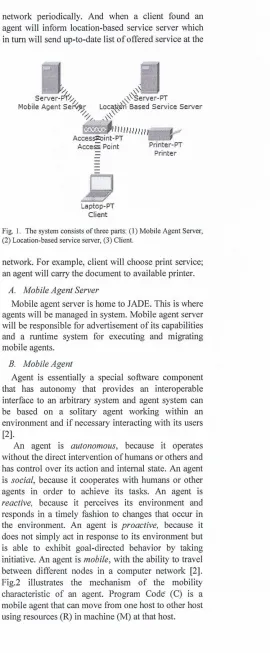
The system consists of three parts: (1) mobile agent server, (2) location-based service server, (3) client. The first part provides method for location-based service and clients interact. As shown in Fig.l , mobile agent will check for new connected device on the
network periodically. And when a client found an agent will inform location-based service server which
in turn will send up-to-date list of offered service at thezyxwvutsrqponmlkjihgfedcbaZYXWVUTSRQPONMLKJIHGFEDCBA
Laptop-PT
Client
Fig.!. The system consists of three parts: (I) Mobile Agent Server, (2) Location-based service server, (3) Client.
network. For example, client will choose print service; an agent will carry the document to available printer.
A. Mobile Agent Server
Mobile agent server is home to JADE. This is where agents will be managed in system. Mobile agent server will be responsible for advertisement of its capabilities and a runtime system for executing and migrating mobile agents.
B. Mobile Agent
Agent is essentially a special software component that has autonomy that provides an interoperable interface to an arbitrary system and agent system can be based on a solitary agent working within an environment and if necessary interacting with its users [2].
An agent is autonomous, because it operates without the direct intervention of humans or others and has control over its action and internal state. An agent issocial, because it cooperates with humans or other agents in order to achieve its tasks. An agent is
reactive, because it perceives its environment and responds in a timely fashion to changes that occur in the environment. An agent is proactive, because it does not simply act in response to its environment but is able to exhibit goal-directed behavior by taking initiative. An agent ismobile,with the ability to travel between different nodes in a computer network [2 ]. Fig.2 illustrates the mechanism of the mobility characteristic of an agent. Program Code' (C) is a mobile agent that can move from one host to other host using resources (R) in machine (M) at that host.
[image:2.600.301.571.71.724.2]ICACSIS
2011
ISBN: 978-979-1421-11-9
zyxwvutsrqponmlkjihgfedcbaZYXWVUTSRQPONMLKJIHGFEDCBA
M igm IiO I\(3)
zyxwvutsrqponmlkjihgfedcbaZYXWVUTSRQPONMLKJIHGFEDCBA
D. Service Request-response Mechanism
1
zyxwvutsrqponmlkjihgfedcbaZYXWVUTSRQPONMLKJIHGFEDCBA
'location .b ased iseniie! serveu
i
M igration(1)
, M
[image:3.600.25.544.25.831.2]....
~
... SiteAFig. 2. Design of distributed system with mobile agent
The following code is a simple "Hello world" program in that illustrates mobile agent. This code implements cyclic behavior each time a m.essage is received, it prints the message onto the standard output
and replies to the sender with a 'Hello!' message.
zyxwvutsrqponmlkjihgfedcbaZYXWVUTSRQPONMLKJIHGFEDCBA
import jade.core.Agent;
import
jade.core.behaviours.CyclicBehavio ur;
import jade.lang.acl.ACLMessage;
public class HelloWorld extends
Agent{
public void setup() {
System.out.println("Hello. My
name is "+getlocalname());
addBehaviour(new
CyclicBehaviour() {
public void action() {
ACLMessage msgRx = receive();
If (msgRx != null) {
System.out.println(MsgRx);
ACLMessage msgTx = .
msgRx.createreply();
msgTx.setContent("Hello!U) ;
send (msgTx) ;
} else {
block ();
}
}) ;
Fig. 3. Source code of "hello world" with mobile agent
C.
Location-based Service ServerLocation-based service server provides and maintains up-to-date information about services offered at the network. Location-based service is utilizing location information from an entity, process it and give relevant service from user point of view.
Sitae
: connect
: fetchServiceU st
Servicet.Ist
. mcvenocument
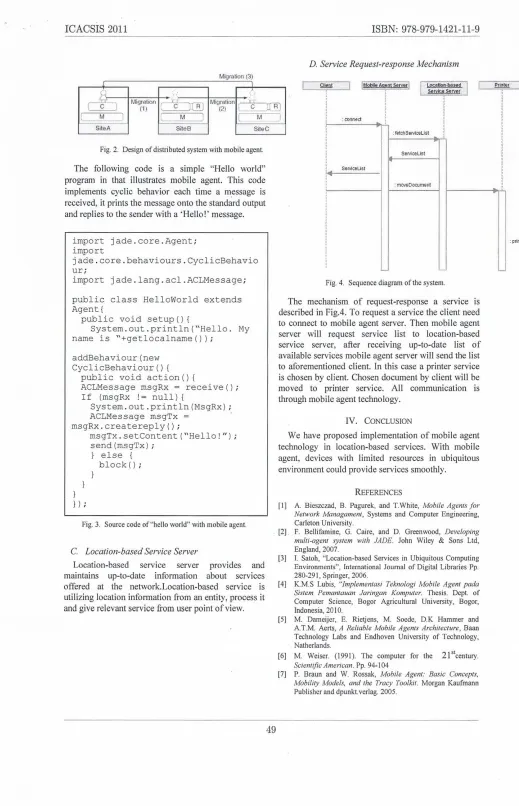
Fig. 4. Sequence diagram of the system.
The mechanism of request-response a service is
described in
zyxwvutsrqponmlkjihgfedcbaZYXWVUTSRQPONMLKJIHGFEDCBA
FigA . To request a service the client need to connect to mobile agent server. Then mobile agentserver will request service list to location-based service server, after receiving up-to-date list of available services mobile agent server will send the list to aforementioned client. In this case a printer service is chosen by client. Chosen document by client will be moved to printer service. All communication is through mobile agent technology.
IV. CONCLUSION
We have proposed implementation of mobile agent technology in location-based services. With mobile agent, devices with limited resources in ubiquitous environment could provide services smoothly.
REFERENCES
[1] A Bieszczad, B. Pagurek, and T.White, Mobile Agents for Network Managament, Systems and Computer Engineering, Carleton University.
. [2]. F. Bellifamine, G. Caire, and D. Greenwood, Developing multi-agent system with JADE. John Wiley & Sons Ltd, England, 2007.
[3] L Satoh, "Location-based Services in Ubiquitous Computing Environments", International Journal of Digital Libraries Pp. 280-291, Springer, 2006.
[4] KMS Lubis, "Implementasi Teknologi Mobile Agent pada Sistem Pemantauan Jaringan Komputer. Thesis. Dept. of Computer Science, Bogor Agricultural University, Bogor, Indonesia, 2010.
[5] M. Dameijer, E. Rietjens, M. Soede, D.K Hammer and AT.M. Aerts,A Reliable Mobile Agents Architecture, Baan Technology Labs and Endhoven University of Technology, Natherlands.
[6] M. Weiser (1991). The computer for the
21
stcentury. Scientific American. Pp, 94-104[7] P. Braun and W. Rossak, Mobile Agent: Basic Concepts, Mobility Models, and the Tracy Toolkit. Morgan Kaufmann Publisher and dpunkt. verlag. 2005.
49
zyxwvutsrqponmlkjihgfedcbaZYXWVUTSRQPONMLKJIHGFEDCBA
ICACSIS
2011
ISBN: 978-979-1421-11-9