accredited by DGHE (DIKTI), Decree No: 51/Dikti/Kep/2010 79
Stabilization of Unmanned Air Vehicles over Wireless
Communication Channels
Qing-Quan Liu
College of Equipment Engineering, Shenyang Ligong University No. 6, Nan Ping Zhong Road, Hun Nan Xin District, Shenyang, 110159, China
e-mail: [email protected]
Abstrak
Makalah ini membahas masalah stabilisasi untuk kendaraan udara tak berawak melalui saluran komunikasi digital dan nirkabel dengan waktu tunda. Secara khusus, kasus ini dilakukan pada saluran band-terbatas. Kebijakan kendali umpak-balik keadan berbasis berbasis pengamat digunakan untuk menstabilkan sistem kendali linier kendaraan udara tak berawak tersebut. Sebuah kondisi yang cukup pada laju data minimum untuk stabilisasi kuadrat rerata diturunkan, dan kuantisasi, penyandian, dan kebijakan kendali baru dihadirkan. Hasil simulasi menunjukkan validitas dari skema yang diusulkan.
Kata kunci: kendaraan udara tak berawak, waktu tunda, data rate, berarti stabilisasi persegi
Abstract
This paper addresses the stabilization problem for unmanned air vehicles over digital and wireless communication channels with time delay. In particular, the case with band-limited channels is considered. An observer-based state feedback control policy is employed to stabilize the linear control system of unmanned air vehicles. A sufficient condition on the minimum data rate for mean square stabilization is derived, and a new quantization, coding, and control policy is presented. Simulation results show the validity of the proposed scheme.
Keywords: unmanned air vehicles, time delay, data rate, mean square stabilization
1. Introduction
The research on networked control systems has received resurgent interests in recent years [1-3]. Some salient examples include unmanned air vehicles (UAVs), unmanned ground vehicles (UGVs), and unmanned underwater vehicles (UUVs) [4-6]. The presence of such digital and wireless communication channels which connect the sensor and the controller or the actuator and the controller brings up many challenges, and makes some traditional control approaches inapplicable or inefficient.
One of the earliest papers on the topic is [7], where a weaker stability concept called containability was introduced, and the issue of coding and communication protocol became an integral part of the analysis. The research on stabilization of linear time-invariant systems with limited data rate was addressed. The fundamental problem of finding the lower bound on the data rate for stabilization was solved in [8-10]. There has been a lot of new interest in quantized feedback control where the measurements are quantized, coded and transmitted over a digital communication channel. A fundamental problem is how to design a quantization, coding and control scheme in order to achieve some given control performances.
The research on quantized feedback control can be categorized depending on whether the quantizer is static or dynamic. Static quantizers were employed in [11-13]. In particular, it was shown in [8] that the coarsest quantizer is logarithmic. The results were generalized in [13] to a number of output feedback problems using a sector bound approach. Furthermore, dynamic quantizers were employed in [14-18]. It was shown in [14] that stabilization of a single-input single-output (SISO) linear time-invariant (LTI) system could be achieved by employing only a finite number of quantization levels. It was shown in [15] that a feedback policy could be designed to bring the closed-loop state arbitrarily close to zero for an arbitrarily long time by employing a quantizer with various sensitivity.
networked control systems with limited data rates over noisy communication channels [19]. The case with both measurement quantization and control signal quantization was considered in [20] and the case of LQG systems subject to both input and output quantization was addressed [21]. In this paper, we investigate the stabilization problem for unmanned air vehicles, where the sensors and the controllers are connected via digital and wireless communication channels. The case with random channel propagation delay is considered. Here, a buffer is employed in order to achieve better control performance. Our work here differs in that we present an observer-based state feedback control policy to ensure stabilization of unmanned air vehicles over digital and wireless communication channels with random time delay, and derive the sufficient condition on the data rate for stabilization.
The remainder of this paper is organized as follows: Section 2 introduces problem formulation. Section 3 presents the sufficient condition on the data rate for stabilization. Section 4 gives a numerical example. Conclusions are stated in Section 5.
2. Problem Formulation
Here, we examine unmanned air vehicles and consider a realization of the feedback linear time-invariant system of the form
)
(
)
(
)
(
),
(
)
(
)
(
)
1
(
k
DG
k
CX
k
Y
k
FW
k
BU
k
AX
k
X
(1)
[image:2.595.214.383.451.537.2]where X(k)
R
n is the plant state, U(k)
R
p is the control input, Y (k)
R
q is the observation output, G(k)
R
l is the bounded additive disturbance, and W(k)
R
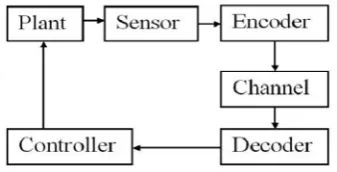
m is the process disturbance, respectively. A, B, C, D, and F are known constant matrices with appropriate dimensions. Here, we address the case that the sensors and the controller are geographically separated and connected via digital and wireless communication channels with time delay.Figure 1. Networked control systems
Without loss of generality, assume that the pair (A, B) is controllable, and the pair (A, C) is observable. The initial condition X(0) and process disturbance W(k) are mutually independent
random variables with zero mean, satisfying
E
X
(
0
)
2
0
andE
X
(
k
)
2
W
, respectively. Here, assume that W(0),
,W(k) are independent and identically distributive (iid).Here, we try to implement an observer-based state feedback control law of the form
).
(
ˆ
)
(
,
))]'
(
(
,
)),
(
(
[
)
(
ˆ
)),
(
)
(
(
)
(
)
(
)
1
(
1
k
X
K
k
U
k
x
q
k
x
q
k
X
k
X
C
k
Y
L
k
BU
k
X
A
k
X
n
(2)
Miby the formula
q(zi(k)) =
1
, ( ) ( ) ( )
2 1
, ( ) ( ) ( )
2
( ) 1 1 1
, ( ) ( ) ( ) ( ) ( )
( ) 2 2 2
i i i
i i i
i
i i i i i
i
M if z k M k
M if z k M k
z k
if M k z k M k
k
(3)
where we define
z
:
max
k
Z
:
k
z
,
z
R
.the indexes
M
andM
will be employed if the quantizer saturates [22]. The closed-loop system (1) can be written as
(
k
1
)
M
(
k
)
N
(
k
)
Q
(
k
)
(4) where.
0
0
:
,
)
(
)
(
:
)
(
,
)
(
)
(
:
)
(
,
0
0
:
,
:
,
)
(
)
(
:
)
(
LD
F
Q
k
G
k
W
k
k
X
k
X
k
BK
BK
N
LC
A
LC
BK
A
M
k
X
k
X
k
In this paper, our main task is to present a quantization, coding and control policy to stabilize the system (1) in the mean square sense
2
) ( sup
lim k E X k (5)
by employing the limited data rate of the channels, and to derive the sufficient condition on the data rate for stabilization of the system (1).
3. Control over Wireless and Digital Channels with Time Delay
This section deals with the stabilization problem for linear control systems of unmanned air vehicles where the sensors and the controllers are geographically separated and connected via wireless and digital communication channels with time delay.
First, we give a lemma which comes from [23].
3.1. Lemma
Let
z
R
denote a random variable andz
denote an estimate of z. Define R(D) as the information rate distortion function betweenz
and z. The expected distortion constraint isdefined as
d
R
. GivenD
E z
z
2, there must exist a quantization and coding scheme if the data rate R satisfies the following condition:2 2
1
( )
( )
log
2
z
R
R D
D
(bits/sample) (6)
2 2( )
z
E z
Ez
.Proof: See [23].
The following theorem is our main result.
3.2. Theorem
Consider the closed-loop system (4) where the sensors and the controller are connected via the digital and wireless communication channel with time delay. Let
i(
)
denote the ith eigenvalue of a matrix. Then, there exists the quantization, coding, and control policy to stabilize the closed-loop system (4) in the mean square sense (5) if the data rate R of the channel satisfies the following condition:)
/
(
)
'
(
log
2
1
2
bits
sample
M
M
R
i i
(7) where
:
i
(
1
,
,
n
)
:
i(
M
'
M
)
.Proof: Notice that the closed-loop system (4) can also be rewritten as
)
(
)
1
(
)
(
)
(
))
(
)
(
(
))
(
)
(
(
)
1
(
k
Q
k
k
MV
k
Q
k
N
k
M
k
k
M
k
(8)where we define
)
(
)
(
:
)
(
k
k
k
V
.Here,
(k
)
denotes the centroid of the uncertain region of the plant states at timek
. Then it follows that))
1
(
'
)
(
(
2
)
'
)
(
'
)
(
(
2
))
1
(
'
)
(
(
2
)
'
(
)
(
)
'
(
)
1
(
2 () ( 1) ()
k
k
QE
tr
Q
k
k
MEV
tr
k
k
MEV
tr
Q
Q
tr
tr
M
M
tr
k
E
V k k k
(9)where we define
). ( ' ) ( : ), 1 ( ' ) 1 ( : ), ( ' ) ( : ) ( ) 1 ( ) ( k k E k k E k V k EV k k k V
Notice that
V
(
k
)
,
'
(
k
1
)
and
(
k
)
are mutually independent. Then, it follows that.
0
)
1
(
'
)
(
,
0
)
(
'
)
(
,
0
)
1
(
'
)
(
k
k
E
k
k
EV
k
k
EV
)
'
(
)
(
)
'
(
)
1
(
k
2tr
M
M
V(k)tr
(k 1)tr
Q
Q
(k)E
. (10)There exists a quantization, coding, and control policy to make the following inequality hold:
)
(
)
'
(
)
(
k
2
tr
M
M
V(k)
tr
(k1)E
.It means that for any
(
0
,
1
)
, it holds that)
(
)
'
(
)
(
k
2
tr
M
M
V(k)
tr
(k1)E
. (11)Substitute (11) into (10) and obtain
)
'
(
)
(
)
1
(
k
2E
k
2tr
Q
Q
(k)E
.Thus, it follows that
.
1
1
)
'
(
)
(
)
(
2 1
0 ( )
1 2
2
W k
O k
k
i k
i k k
Q
Q
Q
tr
o
E
k
E
Thus, we have
W
k
E
k
Q
2 2
1
1
)
(
sup
lim
.It states that there exists the quantization scheme (3) and control policy (2) to stabilize the system (4) in the mean square sense (5).
Notice that
.
)
(
)
(
)
(
)
(
)
(
1 1
1
d i
d d i d
i
d
k
Z
A
k
X
i
d
k
Z
d
k
X
A
k
X
Here, we define
)
(
0
)
(
k
Z
k
Z
. Then,Z
(
k
)
(
k
)
(
k
)
.It follows that
)
(
)
(
)
(
k
Z
k
V
k
Z
))
(
(
)
'
(
))
(
(
2 1 1 2k
v
M
M
i
k
z
i n i n i ii
.Then, it follows from Lemma 3.1 that
)
/
(
)
'
(
log
2
1
))
(
(
log
2
1
2 2 2sample
bits
M
M
D
k
z
R
i i i i i
where
:
i
(
1
,
,
n
)
:
i(
M
'
M
)
.3.3. Remark
It is shown in Theorem 3.2 that, the exists that a quantization, coding, and control policy such that the system (1) is stabilizable in the mean square sense (5) if the data rate of the digital and wireless communication channel that connects the sensors and the controller is larger than the lower bound given by Theorem 3.2. Clearly, the data rate has important effects on stabilization of the control system of unmanned air vehicles.
4. Numerical Example
In this section, we examine a class of networked control problems of unmanned air vehicles, and consider linear control systems over digital and wireless communication channels with time delay. In particular, we present a numerical example to illustrate the proposed quantization, coding and control scheme. Here, we consider an open-loop unstable system as follows: ). ( 24 . 2 ) ( 52 . 1 45 . 1 26 . 0 35 . 0 53 . 1 23 . 2 ) ( ), ( 23 . 0 ) ( 51 . 2 50 . 0 25 . 2 ) ( 72 . 1 27 . 0 13 . 0 25 . 0 73 . 2 32 . 0 61 . 0 24 . 0 41 . 3 ) 1 ( k G k X k Y k W k U k X k X
Let X(0)[5000,2000,5000]' and W1000. Here, we try to implement an
observer-based state feedback control law of the form
1.34 0.51 2.81
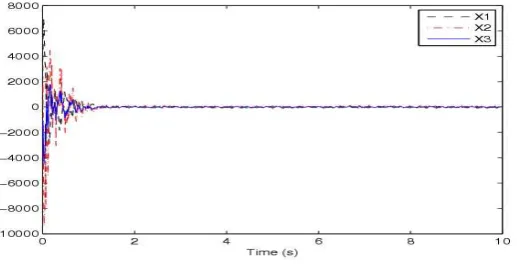
ˆ( ). ) ( , ))]' ( ( , )), ( ( [ ) ( ˆ )), ( 52 . 1 45 . 1 26 . 0 35 . 0 53 . 1 23 . 2 ) ( ( 32 . 1 51 . 2 12 . 0 43 . 1 31 . 0 22 . 1 ) ( 51 . 2 50 . 0 25 . 2 ) ( 72 . 1 27 . 0 13 . 0 25 . 0 73 . 2 32 . 0 61 . 0 24 . 0 41 . 3 ) 1 ( 1 k X k U k x q k x q k X k X k Y k U k X k X n Figure 2. The responses of system states when R180bits/s
[image:7.595.159.419.359.492.2]It is shown in Fig.2 that there exists no quantization, coding and control scheme to stabilize the system if the data rate of the channel is smaller than the lower bound given by Theorem 3.2. If we assume that R240bits/s, a corresponding simulation is given in Fig.3. It is shown in Fig.3 that the quantization, coding, and control scheme can stabilize the unstable system if the data rate R of the channel is greater than the lower bound given by Theorem 3.2.
Figure 3. The responses of system states when R240bits/s
If we assume that R480bits/s, a corresponding simulation is given in Fig.4. It is shown in Fig.4 that the system is stabilizable in the mean square. The data rate has important effects on the control performance. That is, the greater the data rate R of the channel, the better the control performance.
[image:7.595.165.424.606.738.2]5. Conclusion
In this paper, we addressed the stabilization problem of linear control system of unmanned air vehicles. Our results stated that the data rate of the digital and wireless communication channel has important effects on the control performance of unmanned air vehicles. Thus, the data rate of the channel that connects the sensors and the controller would be larger than the lower bound given in our results. The simulation results have illustrated the effectiveness of the proposed scheme.
References
[1] S Tatikonda, SK Mitter. Control under Communication Constraints. IEEE Transaction Automat Control. 2004; 49(7): 1056-1068.
[2] QQ Liu, GH Yang. Quantized Feedback Control for Networked Control Systems under Information Limitation. Information Technology and Control. 2011; 40(3): 218-226.
[3] QQ Liu, F Jin. Quantised Output Feedback Control via Limited Capacity Communication Networks.
International Journal of Systems Science. 2012; 43(12): 2288-2296.
[4] HZ Kotta, K Rantelobo, S Tena and G Klau. Wireless Sensor Network for Landslide Monitoring in Nusa Tenggara Timur. TELKOMNIKA. 2011; 9(1): 9-18.
[5] Tumiran and CSA Nandar. Power Oscillation Damping Control Using Robust Coordinated Smart Devices. TELKOMNIKA. 2011; 9(1): 65-72.
[6] DM Atia, FH Fahmy, NM Ahmed and HT Dorrah. A New Control and Design of PEM Fuel Cell System Powered Diffused Air Aeration System. TELKOMNIKA. 2012; 10(2): 291-302.
[7] J Bailieul, P Antsaklis. Control and Communication Challenges in Networked Real Time Systems. Proceedings IEEE. 2007; 95: 9-28.
[8] J Bailieul. Feedback Designs in Information-Based Control. Lecture Notes in Control and Information Sciences. 2002; 35-58.
[9] G Nair, R Evans. Exponential Stabilisability of Finite-Dimensional Linear Systems with Limited Data Rates. Automatica. 2003; 39(4): 585-593.
[10] G Nair, R Evans. Stabilizability of Stochastic Linear Systems with Finite Feedback Data Rates. SIAM J. Control Optim. 2004; 43(2): 413-436.
[11] N Elia, K Mitter. Stabilization of Linear Systems with Limited Information. IEEE Transaction Automat Control. 2001; 46(9): 1384-1400.
[12] N Elia. Design of Hybrid Systems with Guaranteed Performance. IEEE Conference Decision Control.
2000; 993-998.
[13] M Fu, L Xie. The Sector Bound Approach to Quantized Feedback Control. IEEE Transaction Automat Control. 2005; 50(11): 1698-1711.
[14] S Tatikonda, SK Mitter. Stochastic Linear Control Over a Communication Channel. IEEE Transaction Automat Control. 2004; 49(9): 1549-1561.
[15] DF Delchamps. Stabilizing a Linear System with Qunatized State Feedback. IEEE Transaction Automat Control. 1990; 35(8): 916-924.
[16] RW Brockett, D Liberzon. Quantized Feedback Stabilization of Linear Systems. IEEE Transaction Automat Control. 2000; 45(7): 1279-1289.
[17] F Bullo, D Liberzon. Quantized Control via Locational Optimization. IEEE Transaction Automat Control. 2006; 51(1): 2-13.
[18] D Liberzon, D Nesiec. Input-to-State Stabilization of Linear Systems with Quantized Feedback. IEEE Conference Decision Control. 2005: 8197-8201.
[19] QQ Liu. Observer-Based Dynamic Feedback Control Under Communication Constraints. ICIC Express Letters. 2011; 5(7): 2149-2156.
[20] QQ Liu and GH Tao. Quantized Feedback Stabilization Over Data-Rate Constrained Channels. ICIC Express Letters. 2011; 5(7): 871-876.
[21] QQ Liu and GH Yang. Input and Output Quantized Control of LQG Systems Under Information Limitation. ICIC Express Letters. Part B: Applications . 2011; 2(4): 833-840.
[22] D Liberzon, D Nesiec. Input-to-State Stabilization of Linear Systems with Quantized State Measurements. IEEE Transaction Automat Control. 2007; 52(5): 767-781.