i
E-BUS SYSTEM USING NEAR FIELD COMMUNICATION (NFC)
ZULFAHMI BIN ZAINAL
This Report Is Submitted In Partial Fulfillment of Requirements for the Bachelor Degree of Electronic Engineering
(Industrial Electronic)
Fakulti Kejuruteraan Elektronik dan Kejuruteraan Komputer Universiti Teknikal Malaysia Melaka
v
DEDICATION
This thesis is dedicated to parents, supervisor, and friends
vi
ACKNOWLEDGEMENT
vii
ABSTRACT
viii
ABSTRAK
ix
TABLE OF CONTENTS
PROJECT TITLE i
BORANG PENGESAHAN STATUS LAPORAN ii
x
1.2 Problem Statement 2
1.3 Scopes 3
1.4 Project Significance 3
1.5 Sustainable Development 4
1.6 Potential Commercialization 4
1.7 Conclusion 4
3.5 Project Requirement 18
3.6 Summary 19
CHAPTER IV 20
ANALYSIS 20
4.1 Introduction 20
4.2 Problem analysis 21
4.3 Requirements Analysis 22
CHAPTER V 26
RESULT AND DISCUSSION 26
5.1 Introduction 26
xi
5.3 Project Outcome 31
5.4 Novelty and Inventiveness 40
5.5 Potential of Commercialization 40
5.6 Discussion 41
CHAPTER VI 43
CONCLUSION AND RECOMMENDATION 43
6.0 Introduction 43
6.1 Conclusion 43
6.2 Observation on Weaknesses and Strengths 44
6.3 Propositions for Improvement 44
6.4 Contribution 45
6.5 Conclusion 45
REFERENCES 46
APPENDIX A 46
xii
LIST OF TABLES
Table 2.1 Comparing NFC to other close range communication technologies
7
Table 5.1 Fares of the bus according to specified zone 36
xiii
LIST OF FIGURES
Figure 2.1 NFC Communication Modes 8
Figure 2.2 Jeju Bus Information System website 11 Figure 2.3 STM Société de transport de Montréal website 12
Figure 2.4 Transport for London website 13
Figure 3.1 Project Methodology (flowchart) 15
Figure 3.2 Example of NFC Tag 16
Figure 4.1 Use case of Current System at Bus stop in Kuala Lumpur
20
Figure 4.2 Activity diagram of current system at Bus stop in Kuala Lumpur
20
Figure 4.3 Use Case of E-Bus System using NFC 21
Figure 4.4 Activity diagram of E-Bus System using NFC 22 Figure 5.1 State chart diagram for E-Bus System 26
xiv
Figure 5.3 Save link to the NFC tag 28
Figure 5.4 E-Bus System using NFC website 29
Figure 5.5 Home Page of E-Bus System website 30
Figure 5.6 About us page in E-Bus System website 31 Figure 5.7 Bus Route page in E-Bus System website 32
Figure 5.8 Map page in E-Bus System website 33
Figure 5.9 Bus Schedule page in E-Bus System website 34 Figure 5.10 Fares page in E-Bus System website 35 Figure 5.11 Gallery page in E-Bus System website 36 Figure 5.12 Contact page in E-Bus System website 37 Figure 5.13 Potential of Commercialization for E-Bus System 38
Figure 5.14 Flow chart of the application 39
xv
ABBREVIATION
NFC - Near Field Communication RFID - Radio Frequency Identification EAT - Expected Arrival Time
xvi
LIST OF APPENDICES
APPENDIX A Poster 46
1
CHAPTER I
INTRODUCTION
2
NFC also known as Near Field Communication, as a subset of RFID, is a bidirectional short range communication technology. The working principle of NFC is via electromagnetic field induction, thus it is designed for simple and safe data exchange directly between two devices. NFC allows an interaction distance of approximately 5-10 cm. NFC offers three different operation modes which are passive tag (card emulation), actives device for reading and writing of passive tags, and peer to peer communication (both device are active). E-Bus System using NFC is a technology that uses NFC (looks like SIM card or card reader). NFC is a contactless technology which uses radio waves to connect NFC enabled smartphones like Samsung SIII, Samsung SIII Mini and the latest smartphone is Blackberry Z10 to the NF reader which is look like a mini sticker. NFC technology allocates two devices to communicate by tapping them together. With NFC, people can tap the mobile devices to everyday objects and certain pre-defined actions will be performed like exchanging digital contents, interacting with social networks, changing device settings or even open an application on the other device.
1.2 Problem Statement
• The schedule that provided by bus company is hard to be announced and updated as it use paper-based information. This situation make peoples cannot get the latest information such as delayed bus, bus schedules changes and etc.
• Paper-based schedules or schedule board used as medium of information may cause related information cannot be reached at respected people efficiently. For example, sometimes the papers that are detaching from soft board are missing or has been tear off by people.
3
Objectives
The objectives of this project are:
• To investigate the use of NFC technology for bus application in
The project covers software design using NFC Simulator Application, NFC Task Launcher/NFC Tag Reader/Writer/NFC Tag info and Java programming. The purpose of this NFC software system in order to assist the real-time in bus system. Software requirements are a field that compromise with establishing the needs of the users that are will be solved by software. In this project it also consist with hardware requirement that can be defined by any operating system or software application is the physical computer resources or components, that also known as hardware. Types of hardware for this project are NFC Tag and devices that have NFC (smartphone).
1.4 Project Significance
4
1.5 Sustainable Development
E-Bus System Using NFC (Near Field Communication):
• Will make shuttle bus system become more effective
• Use only software and hardware which does not harm any nature resources
• Future improvement – bus ticket purchasing (bus station)
1.6 Potential Commercialization
• Shuttle Bus Company (Rapid KL, Panorama)
• Other Bus Company (Transnasional, KKKL, MARA Liner, Inter City and etc.)
• Terminal Bus Company (Terminal Bersepadu Selatan-TBS)
1.7 Conclusion
In conclusion, this project can make people lifestyle easier and more comfortable. This project also can gain benefit as it consumes lower waiting time. All the information like problem statements, objectives and expected output are described briefly in this chapter. In the next chapter, will be discussing about the literature review and project methodology used throughout the development lifecycle.
6
CHAPTER II
LITERATURE REVIEW
This chapter includes the review about research or experiment that has been conducted regarding this project.
2.1 Introduction
This chapter will discuss about the literature review and methodology of the project. Literature review is a summary of valuable information of the research sources of the project being used to be as references to build a better system. The literature reviews will provides background information and discovers how the project is related to the works of others.
7
2.2 Fact Finding
2.2.1 NFC (Near Field Communication)
NFC is a very important techniques. Here will be the integration of technology in mobile phones to make people's lives much easier. Among those companies Nokia and some other companies in the market today with the presence of NFC in mobile phones of their own. Will be part of mobile phones in the future. NFC has a lot of applications in everyday life. We will not be need to carry cards, different electronic such as access cards, debit cards / credit cards and identity will be the cards are already in the cell phone, and will use them anywhere we want and will not transfer data easily from any device to another. Even more, we can buy and store e-tickets on the cell phone and there is also a set of criteria to determine the work of smart phones and similar devices to be the wireless contact them by touching each other or make them side by side, and not more than the distance of a few centimeters. There is also the current and anticipated applications include data sharing, and simplified setup of more complex communication such as Wi-Fi. Communication is also possible between the device and the NFC chip unpowered NFC, which is named "tag".
8
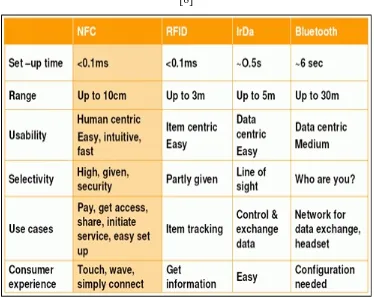
communications including. [1]
Table 2.1: Comparing NFC to other close range communication technologies [8]
Radio Frequency Identification (RFID)
RFID enables a one way wireless communication, typically between an unpowered RFID tag and a powered RFID reader. RFID tags can be scanned at distances of up to 100 meters without a direct line of sight to the reader and as such RFID is used globally for asset tracking in warehousing, airport baggage handling, livestock identification and much more. RFID operates at a range of radio frequencies each with their own set standards and protocols
2.2.2 NFC Modes of Communication