Metalurgi (2018) 2: 91 - 100
M
ETALURGI
Available online at www.ejurnalmaterialmetalurgi.com
L
ANTHANUM AND
N
ICKEL
R
ECOVERY FROM
S
PENT
C
ATALYST USING
C
ITRIC
A
CID
:
Q
UANTITATIVE
P
ERFORMANCE
A
SSESSMENT USING
R
ESPONSE
S
URFACE
M
ETHOD
Himawan Tri Bayu Murti Petrus
a,*, Ardyanto Wijaya
a, Yusuf Iskandar
b, Danu
Bratakusuma
b,
Hendrik Setiawan
a, Wiratni
a, Widi Astuti
ca
Department of Chemical Engineering, Universitas Gadjah Mada Jl. Grafika 2 Yogyakarta, Indonesia
b
PT. Pertamina Tbk, UP Balongan, West Java, Indonesia
c
Research Division for Mineral Technology, Indonesian Institute of Sciences (LIPI) Jl. Ir. Sutami Km. 15, Tanjung Bintang, Lampung Selatan, Indonesia
*Email: [email protected]
Masuk Tanggal : 06-06-2018, revisi tanggal : 26-08-2018, diterima untuk diterbitkan tanggal 29-08-2018
Intisari
Pengambilan logam tanah jarang dan logam berat dari sumber sekunder (katalis bekas, limbah padat industri, dan abu terbang) menjadi alternatif karena pertimbangan lingkungan dan ketersediaan bijih di alam yang semakin sedikit. Pertimbangan tersebut yang mendasari studi tentang pengambilan lantanum dan nikel dari katalis bekas dengan menggunakan asam asetat. Bahan untuk penelitian ini adalah katalis bekas dari Penyulingan Pertamina Unit VI, Balongan. Sebelum pelindian dilakukan katalis bekas didekarbonasi dengan perlakuan panas pada 725 °C selama 10 menit. Proses pelindian dilakukan dengan memvariasikan suhu dan konsentrasi asam asetat. Hasil eksperimen ditinjau menggunakan RSM (response surface method) dan terbukti sebagai metode yang dapat diandalkan untuk menggambarkan dan menganalisis karakter proses pelindian. Molaritas asam merupakan variabel independen yang secara signifikan mempengaruhi respon dalam pengambilan lantanum. Walaupun begitu, berdasarkan hasil analisis Pareto, tidak ada variabel yang secara signifikan mempengaruhi pengambilan nikel. Model fitting polinomial orde dua juga terbukti cocok dengan respon proses pengambilan lantanum daripada nikel. Hasil RSM menunjukkan bahwa kondisi optimum dari ekstraksi lantanum dan nikel adalah pada pH 2 dan suhu 45 °C dimana lantanum dapat 100% terambil dan nikel sebanyak 60%.
Kata Kunci: Pelindian, katalis bekas, lantanum, nikel, RSM (response surface method)
Abstract
Heavy metals andrare earth elements extraction from secondary sources (spent catalyst, industrial solid waster, fly
ash) has become an alternative due to environmental issue and shortage of primary sources. Considering those facts study on lanthanum and nickel from spent catalyst using acetic acid has been conducted. The raw material used in this work is spent catalyst from Pertamina Refinery Unit VI, Balongan. The spent catalyst is decarbonized with a heat treatment at 725 °C for 10 minutes before the leaching process. The leaching process was done with varied temperature and acid concentration. The results were assessed by RSM (response surface methodology) and were proved to be a reliable method to depict and analyze the leaching characteristics. The molarity of the citric acid is the most significant independent variables used in the research for lanthanum recovery response. However, based on the Pareto analysis result, there are no significant variables that affect the recovery of nickel. The second order polynomial fitting model was also proved to be compatible with the response of lanthanum recovery but was less compatible with nickel recovery. Furthermore it is found that the optimum operating condition for lanthanum
extraction (100% recovery) is at pH 2 and temperature of 45 оC in which nickel obtains optimum recovery of 60%
aside from different leaching characteristic.
1.
INTRODUCTION
The sharp growth of demand for electronic devices such as tablet PCs, smart phones, and other gadgets in the last years leads to a huge demand for valuable metals (gold, copper, lithium, cobalt, nickel, etc.) and REEs (rare earth elements) [1]-[4]. On the other hand, due to their special characteristics, rare earth materials are also nowadays important part of the catalysts used in petroleum chemical industries [5]. However, aligned with its frequent use, the waste generated is also rising by a significant amount. Disposal by landfilling is the oldest and was the most widely used method years ago. Due to the increased of consciousness to environmental protection and more strict environmental regulations, landfilling is, fortunately, less and less used. The issue is that liability still belongs to the waste producer as long as this waste has not been destroyed, and thus lasts for long term [6]. Today the wastes are becoming a serious global threat [7]. This is because spent catalysts are composed of heavy metals and REEs such as iron, chromium, nickel, palladium, manganese, and lanthanum. Instead of using new raw them being considered as highly valuable metals. Nowadays, their price and presence have become a serious concern to many countries which also led to the rapid studies and researches for their extraction from secondary sources [8]-[10]. In this experiment the main constituent in the spent catalyst which is nickel and a REE element lanthanum are the main focus.
Heavy metals and REEs extraction from industrial wastes becomes important because any disposal may affect the environment. Previous research by Jinxia et al. [11], stated that lanthanum may affect the soil ecosystems at a concentration slightly above natural condition level (6.6-50.0 mg La/kg dry soil). A study by Parhi et al. [14] shows that the recovery of nickel (up to 99%) from Ni-Al2O3 spent catalyst is
from spent catalyst also stated that lanthanum can also be extracted to as high as 90% by using sulfuric acid. In addition to that the sustainability issue has been the major consideration of applying organic acids in leaching technique on both primary and seconday resources [16]-[18].
However, there is still lack of study in terms of REEs extraction, from spent catalyst using organic acid. In this regard, this work was done to study the effect of temperature and acid concentration on lanthanum and nickel extraction from spent catalyst using citric acid using response surface method (RSM).
2.
EXPERIMENTAL
2.1 Raw Material Characterization
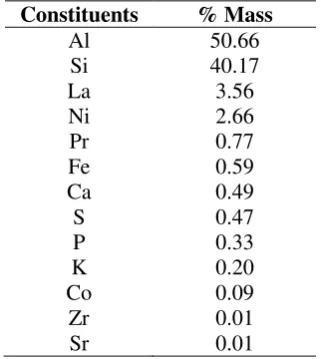
Spent catalyst as the raw material used in this experiment was obtained from PT. Pertamina Refinery Unit VI, Balongan, Indramayu, Indonesia. The obtained spent catalyst was then calcined in a muffle furnace to remove the carbon content from this material. The calcination process for the de-carbonization of spent catalyst was conducted at 725 °C for 10 minutes. The calcined spent catalyst powder was then analyzed using EDS (energy dispersive spectroscopy) for its elemental content as shown in Table 1 and XRD (x-ray diffraction) as it can be seen in Figure 1.
Table 1. EDS result of calcined spent catalyst
Constituents % Mass
Figure 1. XRD pattern of the hydrocracking spent catalyst
2.2 Leaching Experiment
The leaching experiment was conducted by mixing the calcined spent catalyst with solution of citric acid with various concentrations (0.1 M, 1 M and 2 M). 10 grams of calcined spent catalyst was poured into an Erlenmeyer flask containing 50 mL of citric acid solution. The leaching process was conducted for 4 h in a waterbath equipped with shaker with varying process temperature (30, 60 and 80 °C). The set up of the leaching experiment is described in Figure 2.
Figure 2. Set up of the spent catalyst leaching experiment using citric acid in shaker waterbath
2.3 EDS Analysis of Leachate
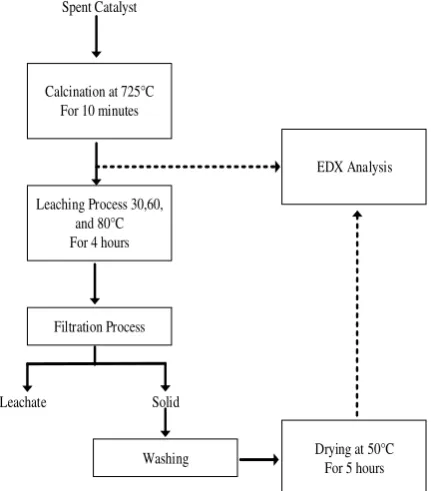
At the end of the leaching process, the obtained leachate was filtered from the remaining unreacted spent catalyst using filter paper. The unreacted spent catalyst was washed and dried in an oven at 50 °C for 5 h. The dried spent catalyst was then analyzed using EDS for its metal content. The summary of the leaching experiment flowsheet and preparation of sample analysis is described in Figure 3.
Spent Catalyst
Calcination at 725°C For 10 minutes
Leaching Process 30,60, and 80°C For 4 hours
Filtration Process
Leachate Solid
Washing Drying at 50°C For 5 hours EDX Analysis
Figure 3. Flow diagram of the leaching experiment and sample preparation
One of the constituents in spent catalyst is silica which is widely considered as an inert material in the leaching process using acidic solution. Leaching using acid has been generally used to purify leach heavy metals in silica purification process [19]-[20]. As EDS data in in the form of weight percentage, in order to calculate the mass of metals in the residue, the mass of silica in the residue is assumed to be the same as the mass of silica before the leaching process. The mass of observed metal can then be derived from the weight percentage difference of silica and observed metal using the following equation.
%
Weight of Silica %
t
w Metal w
W x
w Silica w
(1)
The equation for the recovery of REE from spent catalyst was then formulated as follows.
(2)
With %R as the recovery percentage of metal. W0
and Wt as the weight (mg) of metals contained in
2.4 Design of Experiment and Statistical
Analysis
In order to better understand the effect of observed variables on the recovery of REE as the dependent variable, the use of REM (response surface methodology) was employed. A simple three-level factorial design was employed on two variables (acid molarity and temperature) which was assigned as independent variables. The recovery percentage of the metals from spent catalyst was assigned as dependent variable. Experimental range and level of independent variables used in the design of the RSM analysis is shown in Table 2.
Table 2. Experimental range and level of independent variables
Independent variables Range and level
+1 0 -1
Acid Molarity, M (X1) 0.1 1 2
T, °C (X2) 30 60 80
A second-order polynomial equation was used to study the trend of the response (dependent variable) and the factors (independent variables). The polynomial equation can be described by using basic general equation as follows [21]:
(3)
with Y as the response; xi and xj as the factors (i
and j are the range from 1 to k); β0 as the constant
coefficient; βi, βii, βij as the coefficients for the
linear, quadratic and interaction effect, respectively and ε as the error value.
The accuracy of the mathematical model used RSM was described using the coefficient R² with value ranging from 0 to 1. The closer the value of coefficient R2 to 1, the more accurate the model [22]. The responses (Yi) in this mathematical model are the recovery percentage of lanthanum (Y1) and nickel (Y2).
3.
RESULT AND DISCUSSION
3.1 Leaching Phenomenon and Statistical
Analysis
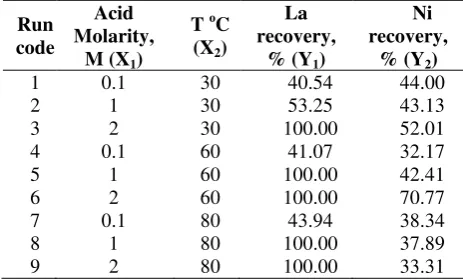
There are two responses that were assessed in this work: lanthanum recovery (Y1) and nickel
recovery (Y2). Using the analysis method of the
raw material and calculation in Equation (3), the experimental results are obtained as shown in
The empirical relationship between responses and the independent variables are expressed in the second order polynomial equations as it is introduced in equation (3). The model fitting was performed using Minitab software.
(4)
(5)
The correlation of metal recovery of both lanthanum and nickel as a function of acid concentration and temperature as shown in equation 4 and 5 enabling to determine the optimum operating condition. In case of lanthanum, recovery of 100% can be achieved at optimum operating condition; temperature of 45 and pH 2. At the same optimum operating condition, it was found that recovery of nickel is 60%. This finding resembles the characteristic of lanthanum and nickel extraction from hydrocracking spent catalyst inorganic acid [15].
The highest recovery of both metals using low concentration of organic acid incomparison to the high concentration of inorganic acid [15] is due to the mechanism of leaching with organic acid that is not only dominated by the existence of proton (H+) but also there is metal chelation complex formation. In case of citric acid, there are three carboxylic groups resulting three stages of partial dissociation with Ka <1 [23]:
The partial dissociation will be in accordance with the equation 6.
While the proton attacts (3H+) to metals in the hydrocracking catalyst is shown in equation 7.
(7)
And then further complexation/chelation occurs in accordance with equation 8.
(8)
Somehow the recovery of nickel is lower than that of lanthanum is due to the different association of both elements. As it can be seen from Figure 1, the nickel is associated with silicate mineral which is much more difficult to extract even using inorganic acid [15].
3.2 Effect of the Independent Variables
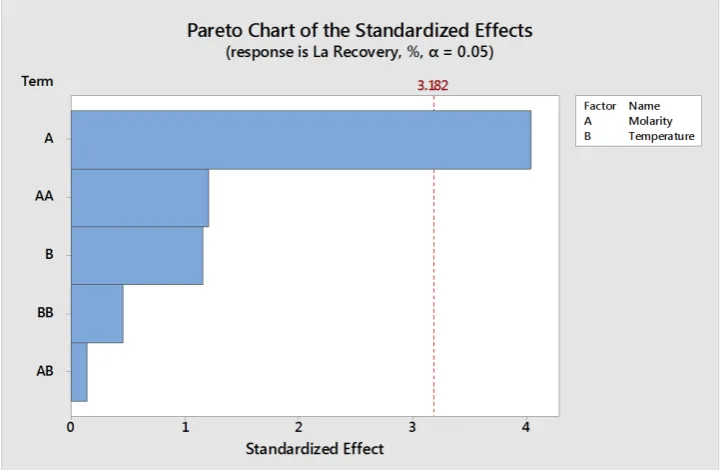
The significant effect of the independent variables to the responses are assessed by Pareto chart. The results were processed using Minitab software. In the Pareto chart, bars that cross the reference line (the dotted-red line) are statistically significant for the calculated response. The bars represent the factors that are created in Equations (4) and (5). The results of the Pareto chart are shown in Figure 4 and 5.
From figure 4 and 5, it can be seen that the acid concentration provides significant effect on this extraction process although in nickel extraction it was found insignificant for both acid concentration and temperature.
Figure 5. Pareto chart showing the standardized effect of independent variables and response Y2
Molarity
T
e
m
p
e
ra
tu
re
2.0 1.5
1.0 0.5
80
70
60
50
40
30
>
–
–
– < 40 40 60 60 80 80 100 100 % Recovery,
La
Contour Plot of La Recovery, % vs Temperature, Molarity
Molarity
T
e
m
p
e
ra
tu
re
2.0 1.5
1.0 0.5
80
70
60
50
40
30
>
–
–
–
– < 35 35 40 40 45 45 50 50 55 55 % Recovery,
Ni
Contour Plot of Ni Recovery, % vs Temperature, Molarity
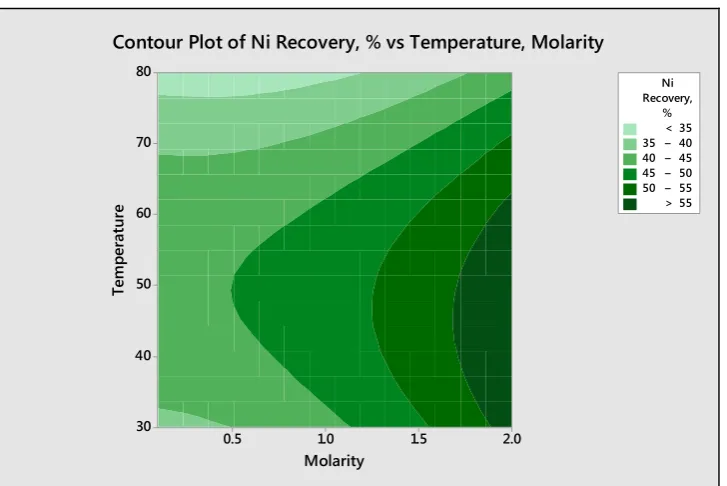
Figure 7. Contour plot showing the effect of independent variables on nickel recovery
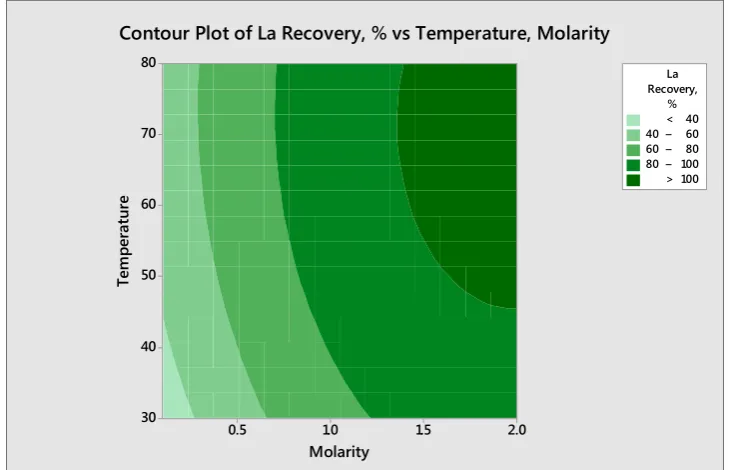
In order to be able to depict the recovery distribution along with the incremental variation of both variables contour plots of both lanthanum and nickel extraction are presented in Figure 6 and 7. The responses present the influence of the two variables in the process. This contour plots were also generated from Minitab software to describe the effect visually.
From figure 6, it shows that the higher the temperature, the higher the recovery of lanthanum. At higher acid concentration, the lanthanum recovery decreases due to the absent of metal complex formation [23]. About the same tendency was observed in nickel recovery as shown in Figure 7. However, at higher temperature the nicke recovery decreases that might be due to the nickel association with silicate at which high temperature will make the bond is stronger.
3.3
Assessment of Models’ Accuracy
It is important to ensure the accuracy of the model to verify the proposed model. The accuracy of the proposed model compared to the experimental data can be expressed by coefficient of correlation (R2). The coefficient of correlation will be compared between the experimental result
of the responses and the model’s result. Visually,
the correlation is shown in Figure 8 and 9.
Figure 8. Linear fitting plot of experimental response and predicted response of Y1
Figure 9. Linear fitting plot of experimental response and predicted response of Y2
From the R2 values obtained from this study at which lanthanum recovery represented by the response Y1 gives a more compatible result with
recovery that is represented by the response Y2
with R2 value of 0.5243.
4. CONCLUSION
In this research, a three-level response surface design is proved to be effective in determining the most significant independent variable to the response of Y1 (lanthanum recovery). The
molarity of the citric acid significantly affects the leaching result of lanthanum. However, based on the Pareto analysis result there are no significant variables that affect the response of Y2 (recovery
of nickel). The second order polynomial fitting model is also proved to be compatible with the response of Y1 but is less compatible with Y2.
Using citric acid, nickel and lanthanum can be extracted from the spent catalyst with recovery as high as 60% and 100%, respectively at optimum operating condition at temperature of 45 оC and pH 2. The equation that represents the significance effect of variables can be formulated in accordance with the equation 4 and equation 5 and can be used to predict the performance of the extraction of nickel and lanthanum from spent catalyst by using citric acid.
ACKNOWLEDGMENT
High appreciation is acknowledged to the Ministry of Higher Education for the financial support through the KLN scheme with contract number:1677/UN1/DITLIT/DIT-LIT/LT/2018 which helps to complete this study.
REFERENCES
[1] A. Isildar, J. van de Vossenberg, E. R. Rene, E. D. van Hullebusch, and P. N. L. Lens,
“Two-step bioleaching of copper and gold from discarded printed circuit boards
(PCB),” Waste Manag., vol. 57, pp. 149-157, 2016.
[2] J. Li, P. Shi, Z. Wang, Y. Chen, and C. C.
Chang, “A combined recovery process of
metals in spent lithium-ion batteries,”
Chemosphere, vol. 77, no. 8, pp. 1132-1136, 2009.
[3] E. Alonso, A. M. Sherman, T. J. Wallington, M. P. Everson, F. R. Field, R. Roth, and R. E. Kirchain, “Evaluating rare earth element availability: A case with revolutionary demand from clean technologies,” Environ. Sci. Technol., vol. 46, pp. 3406-3414, 2012. [4] H. Setiawan, H. T. B. M. Petrus, I. Perdana,
"A kinetics study of acetic acid on cobalt
[5] Z. Wangcheng, G. Yun, G. Xueqing, G. Yanglong, W. Yanqing, and L. Guanzhong,
“Current status and perspectives of rare
earth catalytic materials and catalysis,”
Chinese J. Catal., vol. 35, pp. 1238-1250, 2014.
[6] P. Dufresne, “Hydroprocessing catalysts
regeneration and recycling,” Appl. Catal., vol. 322, pp. 67-75, 2007.
[7] Z. Zhao, Z. Qiu, J. Yang, S. Lu, L. Chao, W. Zhang and Y. Xu, “Recovery of rare earth elements from spent fluid catalytic cracking catalysts using leaching and solvent
extraction techniques,” Hydrometallurgy, vol. 167, pp. 183-188, 2017.
[8] R. L. Thompson, T. Bank, E. Roth, and E.
Granite, “Resolution of rare earth element
interferences in fossil energy by-product samples using sector-field ICP-MS,” Fuel, vol. 185, pp. 94-101, 2016.
[9] D. P. Sari, A. Tawfiequrahman, H. T. B. M. Petrus, F. R. Mufakir, W. Astuti, Y. Iskandar, dan D. Bratakusuma, "Valuable metals extraction from hydrocracking spent catalyst using citric acid," Seminar Nasional Teknik Kimia Kejuangan, 2018, pp. 1-4. [10] M. Hartono, M. A. Astrayudha, H. T. B. M.
Petrus, W. Budhijanto and H. Sulistyo, "Lithium recovery of spent lithium ion battery using bioleaching from local sources microoraganism," Rasayan J.Chem., vol. 10, no. 3, pp. 897-903, 2017.
[11] L. Jinxia, R. A. Verweij, and C. A. M. Van
Gestel, “Lanthanum toxicity to fi ve different species of soil invertebrates in
relation to availability in soil,” Chemosphere, vol. 193, pp. 412-420, 2018.
[12] Abhilash, S. Sinha, M. K. Sinha, and B. D.
Pandey, “Extraction of lanthanum and cerium from Indian red mud,” Int. J. Miner. Process., vol. 127, pp. 70-73, 2014.
[13] S. Kuang, Z. Zhang, Y. Li, H. Wei, and W.
Liao, “Extraction and separation of heavy rare earths from chloride medium by α
-aminophosphonic acid HEHAPP,” J. Rare Earths, vol. 34, no. 3, pp. 304-310, 2017.
[15] W. Astuti, N. M. Prilitasari, Y. Iskandar, D. Bratakusuma, and H. T. B. M. Petrus,
[16] K. C. Wanta, I. Perdana and H. T. B. M. Petrus, "Evaluation of shrinking core model in leaching process of pomalaa nickel laterite using citric acid as leachant at atmospheric conditions," IOP Conf. Ser. Mater. Sci. Eng., 2016, vol. 162, no. 1, pp. 012018.
[17] W. Astuti W, T. Hirajima, K. Sasaki, and N. Okibe, "Comparison of effectiveness of citric acid and other acids in leaching of low-grade Indonesian saprolitic ores,"
Minerals Engineering, vol. 85, pp. 116, 2016.
[18] W. Astuti, T. Hirajima, T. Sasaki, and N. Okibe, "Kinetics of nickel extraction from Indonesian saprolitic ore by citric acid leaching under atmospheric pressure,"
Minerals & Metallurgical Processing, vol. 32, pp. 176-185, 2015.
[19] C. P. Faizul, C. Abdullah, B. Fazlul, and H.
J. Noorina, “Extraction of silica from palm ash using organic acid leaching,” Key Eng. Mater., vol. 595, pp. 329-333, 2014.
[20] I. C. Santos, A. P. G. O. N. Alves, C. S. Santos, M. Almeida, and M. H. Afonso,
“Purification of metallurgical grade silicon by acid leaching,” Hydrometallurgy, vol. 23, pp. 237-246, 1990.
[21] M. A. Bezerra, R. E. Santelli, E. P. Oliveira,
L. S. Villar, and L. A. Escaleira, “Response
surface methodology (RSM) as a tool for
optimization in analytical chemistry,”
Talanta, vol. 76, no. 5, pp. 965-977, 2008. [22] N. Vedaraman, K. V. Sandhya, N. R. .B.
Charukesh, B. Venkatakrishnan, K. Haribabu, M. R. Sridharan, and R. Nagarajan, “Ultrasonic extraction of natural dye from rubia cordifolia, optimisation using response surface methodology (RSM) & comparison with artificial neural network (ANN) model and its dyeing properties on
different substrates,” Chem. Eng. Process. Process Intensif., vol. 114, pp. 46-54, 2017. [23] Shriver and Atkins, Inorganic Chemistry, 5th