PAPER • OPEN ACCESS
Development strategy of PALAS rice in Lampung Province
To cite this article: E Suroso et al 2019 IOP Conf. Ser.: Earth Environ. Sci.230 012003
View the article online for updates and enhancements.
Development strategy of PALAS rice in Lampung Province
E Suroso1, T P Utomo1, S Hidayati1, and D Puspitorini2
1
Agroindustrial Technology Study Program, Agricultural Product Technology Department, Agricultural Faculty, the University of Lampung, Lampung, Indonesia 2 Food Security Agency, South Lampung Regency, Lampung, Indonesia
E-mail: [email protected]
Abstract. PALAS rice was an origin rice of South Lampung Regency, Lampung Province. PALAS rice could be acronymed as Original Rice Produces of South Lampung. The purpose of this study were to identify the factors that become the strengths, weaknesses, opportunities, and threats and determine the strategy of PALAS Rice development. This research method used SWOT analysis. The result showed that the main strength of PALAS Rice was the abundant amount of product, while the weakness was the PALAS Rice has not been certified of SNI quality; the main opportunity of PALAS Rice was a cooperation between rice mills and village-owned enterprises (BUMDes), while the threat was good quality others rice on the market
1. Introduction
In Indonesia, the main food commodity of the people is rice. Rice is a staple of most Indonesian people so that it becomes an opportunity for rice farmers to develop their business. Beside rice is important to farmers, it also plays important role ini Indonesia Economics as one of agricultural commodities. The role of the agricultural sector in the national economy influences the formation of national GDP. GDP is one of the macroeconomic indicators to determine the role and contribution given by a product to national income.
As a policy to meet the need for rice, the Government of Indonesia always monitors the development of production, land area, and productivity for national rice to remain balanced. Land area and rice production in Indonesia year of 2011-2014 were 13,203,643 hectares (65,756,904 tons), 13,445,524 hectares (69,056,126 tons), 13,835,252 hectares (71,279,709 tons), 13,797,307 hectares (70,846. 465 tons), and 14,115,475 hectares with production of 75.397841 tons [1].
South Lampung Regency, one of the rice production center in Lampung Province, in 2014 had a total paddy field area of 78,583 hectares with a production of 434,969 tons and a total rice field area of 10,272 hectares with a production of 34,488 tons [2].
2
(Rp. 9,318.75), medium (Rp.8,530.83), original (Rp.7,856.50), in 2015 with super quality (Rp.10,714.17), medium (Rp.9,803.25), and original (Rp. 9,029,25) [3].
There was a unique condition and might be problem in the future in South Lampung Regency, rice price fluctuations was influenced by the uniqueness in the rice distribution chain and also the consumption culture and eating habits of the people of South Lampung. In rainy season, the farmers produce stored only 25 percent of the grain for family consumption, while 75 percent will be sold as a substitute for planting capital and as the next planting capital (during the dry season). Farmers sell grain to agents, which are then resold to local mills as much as 40 percent and 60 percent are sold outside the district, including Serang, Karawang, Subang and Cianjur.
Based on this condition, South Lampung Regency Governments has taken strategic efforts to start developing a local brand of rice produced by South Lampung, in order to reduce the release of grain from other regions, so that the stock of food reserves is stable, price fluctuations can be suppressed and South Lampung can be known as a producer of quality rice. This can be started from the PALAS area as the largest producer of rice production in South Lampung to become a model for quality rice. PALAS Rice is a brand that is used to provide identification of rice originating from South Lampung Regency with acronym for "Original Production of South Lampung"
The objectives of this research were to identify the factors that are strengths-weaknesses, opportunities in the development of PALAS rice and formulate strategies for developing PALAS rice.
2. Materials and Method
2.1. Materials
This research was conducted in South Lampung Regency. Primary data is obtained through observation, discussion and direct interviews, with related parties namely rice businessman (PD Garuda Mas), Aacademics (experts from Faculty of Agriculture, The University of Lampung) and Secretary of the PALAS Rice Developing Team). Secondary data was obtained from sources of information in the form of written reports available to PALAS rice business operators and through literature studies of relevant books, scientific journals, Statistics Indonesia (BPS), Work Units in South Lampung Regency.
2.2. Research Design
Analysis of the data used in the research carried out qualitatively and quantitatively includes the stages of data processing and interpretation of data objectively. Data obtained, both primary data and secondary data is processed so that it can be read and analyzed further, so that it can be interpreted. Data processing is done manually with the help of the MS Office Excel program. The three stages of the strategy formulation analysis consist of internal and external environmental analysis (IFE and EFE), IE analysis, SWOT analysis [4, 5].
3. Results and Discussion
3.1. PALAS Rice
PALAS Rice is the original production of South Lampung rice which was launched by the Regent of South Lampung on March 24, 2017 based on the Decree of the Regent of South Lampung number: B/ 165/IV.10/HK/2017 concerning the Appointment of PALAS Rice Growing Team in South Lampung Regency.
Ishadi at Palas Jaya Village, Palas District. At this stage the marketing targets are South Lampung Regional Government officials.
3.2. Internal-External Factors Analysis
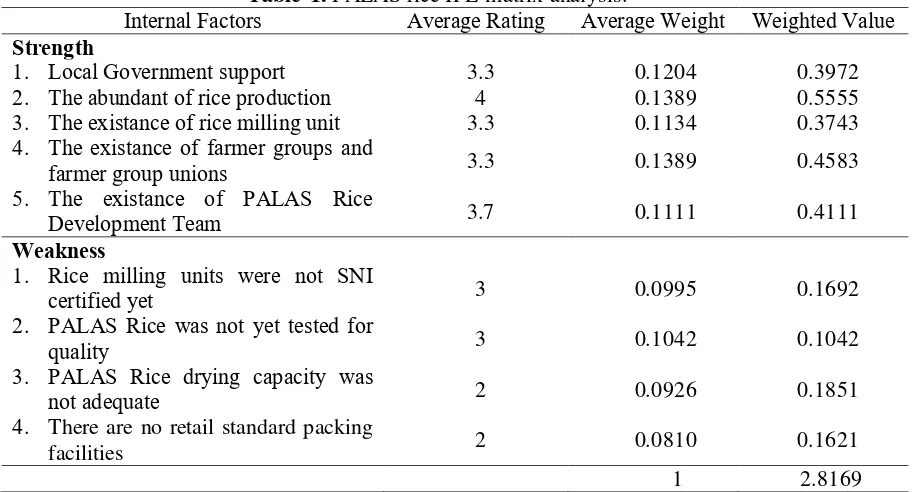
The result of Internal and External Factor Analysis of PALAS rice were described in Table 1 and 2 below.
Table 1. PALAS rice IFE matrix analysis.
Internal Factors Average Rating Average Weight Weighted Value
Strength
1. Local Government support 3.3 0.1204 0.3972
2. The abundant of rice production 4 0.1389 0.5555
3. The existance of rice milling unit 3.3 0.1134 0.3743
4. The existance of farmer groups and
farmer group unions 3.3 0.1389 0.4583
5. The existance of PALAS Rice
Development Team 3.7 0.1111 0.4111
Weakness
4. There are no retail standard packing
facilities 2 0.0810 0.1621
1 2.8169
Table 2. PALAS rice EFE matrix analysis.
External Factors Average Rating Average Weight Weighted Value
Opportunity
1. Rice as a staple food 4 0.1166 0.4664
2. Government employee as routine consumers
4 0.1314 0.5257
3. Cooperation between rice milling unit and BUMDes
3.7 0.1582 0.5852
4. Availability of adequate human resources
3.3 0.0955 0.3153
5. Avaliability of marketing media 2 0.0776 0.1551
Threat
4
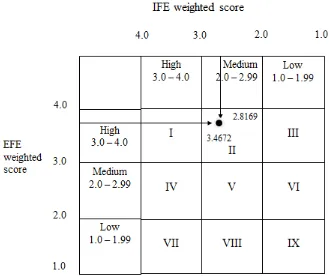
score value of the EFE matrix of 3.4672, the results of the score shows that the position of Palas rice is in Quadrant II, which was in the grow and build position (Figure 1).
Figure 1. PALAS rice IFE-EFE matrix analysis
In this quadrant position, PALAS rice should be managed with an intensive strategy (product development, market penetration, and market development). Product development can be done by improving the quality of PALAS rice meet Indonesia National Standard for Rice (SNI 6128-2015) and packaging with a variety of weight sizes that are 5 kg, 10 kg, 20 kg, 25 kg, and 50 kg. Market penetration and market development can be done by broader marketing PALAS rice products not only to government employee but also received by people outside South Lampung Regency.
For comparison, the analysis of environmental factors of the company was in a position of growth/ stability of Cimanuk Rice through quality improvement showed that the strategy that can be done was market penetration and product development. Alternative recommendations for priority strategies, namely the application of production technology to obtain quality rice, increase and maintain the quality of rice in accordance with the grade and the selection of rice to maintain consumer loyalty, increase HR quality through informal channels in the fields of production and marketing and other factors that have been recommended as alternative strategies. Cimanuk Rice requires overall quality improvement, both grain quality, production machine quality, managerial HR quality, improvement in packaging quality, and harmonization between raw material / farmer suppliers and harmonization with customers / partners [6].
Buru regency government needs to take advantage of strategic factors and considering the strengths and weaknesses opportunities and threats and have a relatively high interest. Factors leading force in the development of main commodities of rice are agricultural sector's contribution to the local economy. Weakness strategic factor for the development of superior commodities paddy land is not used optimally. Factors opportunities that have relatively high interest is the potential of agricultural resources owned Buru such as farmland, water sources and climate. Then factor central government policies that support rice farming as basic pricing, subsidies and import ban. While the threat owned Regency factor in the development of leading commodity rice is the lack of young workers in the agricultural sector. Policy recommendations that can be done Buru local governments for the development of leading commodity paddy with the order of priority are: 1) Improved quality or quality of paddy / rice; 2) Optimizing the use of existing land, opening new market opportunities; 3) Develop agribusiness centers (the industry that lead to the agri-food sector (paddy rice); 4) Application of technology of agricultural machinery and planting seeds; 5) Increasing rice production through extension; 6) Increase the promotion of superior products paddy rice [8].
3.3 SWOT Analysis
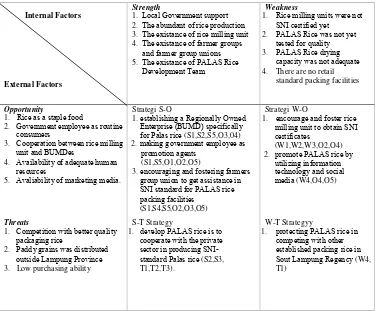
The result of PALAS Rice SWOT Analysis was desribed in Figure 2 below.
Internal Factors
External Factors
Strength
1. Local Government support
2. The abundant of rice production
3. The existance of rice milling unit 4. The existance of farmer groups
and farmer group unions
2. Government employee as routine consumers
3. Cooperation between rice milling unit and BUMDes
4. Availability of adequate human resources
5. Avaliability of marketing media.
Strategi S-O
1. establishing a Regionally Owned Enterprise (BUMD) specifically for Palas rice (S1,S2,S5,O3,04) 2. making government employee as
promotion agents
1. Competition with better quality packaging rice
Figure 2. Result of PALAS rice SWOT analysis
6
specifically for Palas rice, 2) making government employee as promotion agents, 3) encouraging and fostering farmers group union to get assistance in SNI 6128-2015 for PALAS rice packing facilities.
WO strategies is a strategy that aims to correct weaknesses by utilizing external opportunities can be offered for the development of PALAS rice business were 1) encourage and foster rice milling unit to obtain SNI certificates, 2) promote PALAS rice by utilizing information technology and social media.
ST strategy is a strategy that uses power to avoid or reduce the impact of threats can be offered to develop PALAS rice is to cooperate with the private sector in producing SNI-standard Palas rice.
Strategic WT is a strategy aimed at reducing internal weaknesses and avoiding external threats can be offered to protect PALAS rice in competing with other established packing rice in Sout Lampung Regency.
The strategy of developing rice agribusiness through the pattern of rice estate in Kubu Raya Regency, namely: Agribusiness-based area development, with activities: economic empowerment of farming communities, improvement of facilities and infrastructure and infrastructure improvements by the Regional Government, counseling and mentoring of farmers and enhancement of agricultural institutions. Increased human resources and production, with activities: increasing knowledge and skills of agricultural extension workers, farmers groups and the application of Agricultural Technology. Improvement and improvement of products, with activities: Development of intensification and extensification and selection of varieties to be planted and optimization of the quality of rice mills [9].
Similar study in Buru, Indonesia showed that Buru Regency Government needs to do a strategy based on priorities obtained from the results of this study, in order to achieve rice self-sufficiency and ultimately improve regional food security and food security of the country. Beside, Buru regency government needs to improve the factors of weakness and improve the strength factor. Similarly, the opportunity should be exploited and pay attention to the threat. Based on the first order of the operational strategy of the development of superior commodities of rice in Buru, then further research that can be done is related to the improvement of the quality or the quality of rice in Buru.
Other study in Iran about wheat farmers, showed that SWOT analysis indicates a framework for helping the planners to identify the strategies of achieving goals. It is a technique used to analyze the strengths, weaknesses, opportunities and threats of businesses. In all countries, farming practices play a vital role in food security. Population growth is the major reason for increased food demands and it puts additional pressure on the natural resource. Based on the results, the considered identified strategies play a vital role in farming system development and in increasing food security in this area. The important strategies that must be considered are as follows.
1. Development of poor local market opportunities and infrastructure. 2. Planting of crops with high economic values.
3. Development of governmental supports.
4. Preparing strategic plans for development of organic farming. 5. Considering the quality of crops.
6. Considering farm sustainability indexes. 7. Using sustainable water resources management.
8. Development of extension programs based on farmers’ needs [10]
4. Conclusions
References
[1] Badan Pusat Statistik Provinsi Lampung 2017 Lampung Province in Figure 2017. [In Indonesian]
[2] Badan Pusat Statistik Kapubaten Lampung Selatan 2017 South Lampung in Figure 2017. [In Indonesian]
[3] BKP Lampung Selatan 2015 South Lampung Regency Food Security Agency 2015 Report. [In Indonesian]
[4] Marimin 2004 Compound decision making criteria technique and application Grasindo Jakarta Indonesia. [In Indonesian]
[5] Kinnear T C, Taylor J R 1998 Marketing research: an applied approach McGraw Hill
[6] Nasir, Bintoro M H, Limbong W H 2012 The feasibility and business development strategies of cimanuk rice through quality improvement by PD Jaya Saputra, sub district Cimanuk, Pandeglang district, Banten Province Manajemen IKM 7 2 102-110. [In Indonesian]
[7] Shafieyaan M, Homayounfar M, Fadaei, M 2017 Identification of strategies for sustainable development of rice production in Guilan province using SWOT analysis Int. J. Agric. Manag. Dev. 7 2 141-153.
[8] Wahyuningsih T 2016 The development strategy of main commodities of rice in Buru district, Maluku World J. Agric. Res. 4 1 9-17.
[9] Syahrizal S, Yusra A H A, Gafur S 2013 Strategi pengembangan agribisnis padi melalui pembangunan rice estate di Kabupaten Kubu Raya (The strategy of developing rice agribusiness through rice estate development in Kubu Raya Regency) J. Social Economic of Agriculture2 2 32-59. [In Indonesian]