1
COVERAGE, DIVERSITY, AND COHERENCE OPTIMIZATION FOR MULTI-DOCUMENT SUMMARIZATION
Khoirul Umam, Fidi Wincoko Putro, Gulpi Qorik Oktagalu Pratamasunu, Agus Zainal Arifin, and Diana Purwitasari
Department of Informatics, Faculty of Information Technology, Institut Teknologi Sepuluh Nopember, Kampus ITS Sukolilo, Surabaya, 60111, Indonesia
E-mail: [email protected], [email protected]
Abstract
A great summarization on multi-document with similar topics can help users to get useful informa-tion. A good summary must have an extensive coverage, minimum redundancy (high diversity), and smooth connection among sentences (high coherence). Therefore, multi-document summarization that considers the coverage, diversity, and coherence of summary is needed. In this paper we propose a novel method on multi-document summarization that optimizes the coverage, diversity, and coher-ence among the summary's sentcoher-ences simultaneously. It integrates self-adaptive differential evolution (SaDE) algorithm to solve the optimization problem. Sentences ordering algorithm based on topical closeness approach is performed in SaDE iterations to improve coherences among the summary's sen-tences. Experiments have been performed on Text Analysis Conference (TAC) 2008 data sets. The experimental results showed that the proposed method generates summaries with average coherence and ROUGE scores 29-41.2 times and 46.97-64.71% better than any other method that only consider coverage and diversity, respectively.
Keywords: multi-document summarization, optimization, self-adaptive differential evolution, sen-tences ordering, topical closeness
Abstrak
Peringkasan yang baik terhadap dokumen-dokumen dengan topik yang seragam dapat membantu pembaca dalam memperoleh informasi secara cepat. Ringkasan yang baik merupakan ringkasan de-ngan cakupan pembahasan (coverage) yang luas dan dede-ngan tingkat keberagaman (diversity) serta ke-terhubungan antarkalimat (coherence) yang tinggi. Oleh karena itu dibutuhkan metode peringkasan multi-dokumen yang mempertimbangkan tingkat coverage, diversity, dan coherence pada hasil ring-kasan. Pada paper ini dikembangkan sebuah metode baru dalam peringkasan multi-dokumen dengan mengoptimasi tingkat coverage, diversity, dan coherence antarkalimat hasil ringkasan secara simul-tan. Optimasi hasil ringkasan dilakukan dengan menggunakan algoritma self-adaptive differential evolution (SaDE). Algoritma pengurutan kalimat yang menggunakan pendekatan topical closeness ju-ga diintegrasikan ke dalam tiap iterasi algoritma SaDE untuk meningkatkan koherensi antarkalimat hasil ringkasan. Uji coba dilakukan pada 15 topik dataset Text Analysis Conference (TAC) 2008. Ha-sil uji coba menunjukkan bahwa metode yang diusulkan dapat menghaHa-silkan ringkasan dengan rata-rata koherensi 29-41,2 kali lebih tinggi serta skor ROUGE 46,97-64,71% lebih besar dibandingkan dengan metode yang hanya mempertimbangkan coverage dan diversity hasil ringkasan.
Kata Kunci: optimasi, pengurutan kalimat, peringkasan multi-dokumen, self-adaptive differential evolution, topical closeness
1. Introduction
The contents of a document can be long. It pres-ents several information with specified topic. Cur-rent technological developments makes people can find related documents with similar topic easi-er than before. The otheasi-er documents can be had a long contents too. It means there is a massive qua-ntity of data or information with similar obtain-able topic.
The massive quantity of data available in the Internet today has reached such a huge volume. It becomes humanly unfeasible to get efficiently us-eful information from the Internet [1]. Thus, auto-matic methods are needed in order to get useful information from the documents efficiently.
February 2015
the original documents relevantly. Document su-mmarization can be classified based on the num-ber of document processed simultaneously, i.e. si-ngle-document and multi-document summariza-tion. Single-document summarization processes only one document into a summary, whereas mul-ti-document summarization processes more than one document with similar topic into a summary.
Various kinds of algorithms are proposed on multi-document summarization problem. These algorithms include ontology-based, clustering, and heuristic approach. The example of document summarization method that uses ontology-based approach is the proposed method in [2]. It can perform multi-document summarization by utili-zing Yago ontology to capture the intent and con-text of sentences in documents. It can choose the exact meaning of sentences that has ambiguous word based on Yago ontology scores.
Multi-document summarization methods ba-sed on clustering approach have been also propo-sed. For example, the method proposed in [3]. It generates a summary from sentences set that ha-ve been clustered based on similarity between sentences. In the other multi-document summa-rization method that has been proposed in [1] also there is a clustering stage.
Whereas the multi-document summarization methods based on heuristic approach are methods that utilize optimization algorithm in order to se-lect the summary's sentences properly. One of multi-document summarization methods that use this approach is Optimization of Coverage and versity for Summarization using Self-adaptive Di-fferential Evolution (OCDsum-SaDE) method that proposed in [4]. In the method, an optimal sum-mary is searched by considering the coverage and diversity of summary's sentences.
Multi-document summarization cannot be separated from sentences ordering process. The process is needed to be performed in order to ob-tain the composition of the summary's sentences that allows users to get information easily. Several summary's sentences ordering methods had been proposed in [5-7]. It considers a variety of appro-aches, i.e. chronological, probabilistic, topical clo-seness, precedence, succession, semantic, and text entailment approaches. The process is generally carried out after the document summarization pro-cess completes. Thus, the results of sentences or-dering depend on the summary.
A good summary is expected to meet three factors. These factors are: 1) an extensive cover-age; 2) high diversity or minimum redundancy; 3) high coherences among summary's sentences [4]. Summary that have an extensive coverage indica-tes it has summarized all information from
origin-nal documents. Summary's sentences with high di-versity or minimum redundancy indicate the sum-mary able to presents information without any convoluted. On other hand, the smooth connecti-vity between summary's sentences may help the users to understand and absorb information from summary easily.
Process to obtain the best summary can be considered as an optimization problem [8]. There-fore, the process to generate a summary with high level of coverage, diversity, and coherences amo-ng the sentences also can be considered as an opti-mization problem. Thus, a multi-document sum-marization method that considers optimizing those factors simultaneously is needed to study in order to generate a good summary.
In this paper, we propose a novel method for multi-document summarization that considers the coverage, diversity, and coherence of the summa-ry. This method is inspired by self-adaptive differ-ential evolution (SaDE) algorithm from [4] and sentences ordering algorithm using topical close-ness approach in [6]. SaDE algorithm is used to solve the coverage, diversity, and coherence opti-mization problem. Whereas the topical closeness approach that integrated to SaDE iterations helps to find the solution of summary with optimal co-herences. Thus, this method can generates sum-mary with an extensive coverage, minimum re-dundancy, and high coherence among the summa-ry's sentences.
2. Methods
Summary's Quality Factors
In this section, we describe three factors of sum-mary's quality (i.e. coverage, diversity, and cohe-rence) that optimized in our proposed method.
Coverage
Let N denotes the number of sentences from docu-ments that will be summarized, M denotes the nu-mber of distinct terms in documents, 𝑠𝑒𝑛𝑛 denotes the nth sentence from documents which has nor-malized form 𝑠𝑒𝑛𝑛𝑛𝑜𝑟𝑚, 𝑡𝑒𝑟𝑚𝑚 denotes the m-th
di-stinct term from documents, 𝑡𝑓𝑛𝑚 denotes the nu-mber of occurrences of 𝑡𝑒𝑟𝑚𝑚 in 𝑠𝑒𝑛𝑛𝑛𝑜𝑟𝑚, 𝑖𝑠𝑓𝑚
denotes inverse sentence frequency of 𝑡𝑒𝑟𝑚𝑚, and
𝑁𝑚 denotes the number of sentences containing
𝑡𝑒𝑟𝑚𝑚 . Term's weight of 𝑡𝑒𝑟𝑚𝑚 in 𝑠𝑒𝑛𝑛𝑛𝑜𝑟𝑚
(𝑤𝑛𝑚) can be calculated using term frequency in-verse sentence frequency (TF-ISF) scheme in equ-ation(1) and equation(2):
𝑖𝑠𝑓𝑚= 𝑙𝑜𝑔 (𝑁𝑁
𝑚). (2)
The 𝑠𝑒𝑛𝑛𝑛𝑜𝑟𝑚 is represented as a vector which
has M components such that 𝑠𝑒𝑛𝑛𝑛𝑜𝑟𝑚= [𝑤𝑛1, … , 𝑤𝑛𝑀].
The similarity between sentences can be calcula-ted using cosine measure formulation in equa-tion(3):
𝑠𝑖𝑚(𝑠𝑒𝑛𝑖𝑛𝑜𝑟𝑚, 𝑠𝑒𝑛𝑗𝑛𝑜𝑟𝑚) =
∑𝑀𝑘=1(𝑤𝑖𝑘,𝑤𝑗𝑘)
√∑𝑀𝑘=1𝑤𝑖𝑘2⋅∑𝑀𝑘=1𝑤𝑗𝑘2. (3)
Summary’s coverage value reflects the cove-rage of summary’s contents towards contents in original documents. It can be calculated by con-sidering similarity between main content in ori-ginal documents with main content in candidate summary [4]. Radev et al. [9] describes that main content of documents set is reflected by its
cen-troid or its term’s weight means.
Centroid of original documents and candi-date summary are represented as a vector with M
components. Let 𝑆𝑝(𝑡) denotes set of sentences in
p-th candidate summary on t-th generation and 𝑁𝑝𝑆(𝑡) denotes the number of sentences in 𝑆𝑝(𝑡).
Each component 𝑜𝑚of the original documents’s centroid 𝑂 and each component 𝑜𝑝,𝑚𝑆 (𝑡) of the p
th candidate summary’s centroid on current gen er-ation 𝑂𝑝𝑆(𝑡) can be calculated using equation(4) and equation(5), respectively:
𝑜𝑚=𝑁 ∑ 𝑤1 𝑛𝑚 𝑁
𝑛=1
, (4)
𝑜𝑝,𝑚𝑆 (𝑡) =𝑁1
𝑝𝑆(𝑡)𝑠𝑒𝑛 ∑ 𝑤𝑛𝑚 𝑛
𝑛𝑜𝑟𝑚∈𝑆𝑝(𝑡)
. (5)
Alguliev et al. [4] also describes that by con-sidering the similarity between main content of original documents and main content of summary, we will know the importance of summary towards original documents. Moreover, by considering the similarity between main content of original docu-ments with each summary’s sentence, we will kn-ow the importance of each summary’s sentence towards its original documents. The greater simi-larity between main content of original documents
with a summary’s sentence reflects the more im -portance of the sentence towards original
docu-ments. Therefore, greater summary’s coverage va-lue reflects better summary. The formulation to calculate summary’s coverage value 𝑓𝑐𝑜𝑣𝑒𝑟𝑎𝑔𝑒 is shown in equation(6). In the equation(6), 𝑈𝑝𝑏𝑖𝑛(𝑡) denotes binary form of vector solution for the pth candidate summary on t-th generation and 𝑢𝑝,𝑛𝑏𝑖𝑛(𝑡) denotes the nth component of 𝑈𝑝𝑏𝑖𝑛(𝑡). Process to generate this vector will be described in the next section.
Diversity
Summary’s diversity value reflects the diversity
of summary’s sentences. It can be considered by calculating similarity between each summary’s sentences. If the summary has high total value of sentences similarity, then it has low diversity. Otherwise, if the summary has low total value of sentences similarity, then it has high diversity be-tween its sentences [4].
Summary with low diversity between its sen-tences tends to present a poor summary because its sentences tend to discuss redundant informa-tion. Therefore, in order to get a good summary, the combination of summary’s sentences that has high diversity have to be found. In other words,
the combination of summary’s sentences with low total value of its sentences similarity have to be found, because it can present the information with minimum redundancy.
In this paper, the summary's diversity value is defined as total value of its sentences similarity. Therefore, its diversity value is related with sity of its sentences inversely. The lower its diver-sity value reflects the more diverdiver-sity in its senten-ces and also the better summary.
The formulation to calculate summary’s di-versity value 𝑓𝑑𝑖𝑣𝑒𝑟𝑠𝑖𝑡𝑦 is shown in equation(7). Equation(7) only sums similarity between
summa-ry’s sentences and ignores sentences which not in the summary [4].
Coherence
Summary’s coherence value reflects the summa
-ry’s sentences coherences degree. It corresponds with smooth connectivity between summary's sen-tences. Thus, it also corresponds with readability of information in summary by readers. A summa-ry with higher coherences degree is expected to be easier for reader in order to understand the infor-mation which presents by the summary.
Generally a summary can simplify the
read-𝑓𝑐𝑜𝑣𝑒𝑟𝑎𝑔𝑒(𝑈𝑝𝑏𝑖𝑛(𝑡)) = 𝑠𝑖𝑚 (𝑂, 𝑂𝑝𝑆(𝑡)) ⋅ ∑ 𝑠𝑖𝑚(𝑂, 𝑠𝑒𝑛𝑛𝑛𝑜𝑟𝑚)𝑢𝑝,𝑛𝑏𝑖𝑛 𝑁
𝑛=1
. (6)
𝑓𝑑𝑖𝑣𝑒𝑟𝑠𝑖𝑡𝑦(𝑈𝑝𝑏𝑖𝑛(𝑡)) = ∑ ∑ 𝑠𝑖𝑚(𝑠𝑒𝑛𝑖, 𝑠𝑒𝑛𝑗)𝑢𝑝,𝑖𝑏𝑖𝑛𝑢𝑝,𝑗𝑏𝑖𝑛 𝑁
𝑗=𝑖+1 𝑁−1
𝑖=1
February 2015
Algorithm 1. Sentences Ordering Type A Algorithm
1. From sentences in the candidate summary, choose two sentences (𝑠𝑒𝑛𝑖 and 𝑠𝑒𝑛𝑗) which has highest similarity (𝑠𝑖𝑚(𝑠𝑒𝑛𝑖, 𝑠𝑒𝑛𝑗)) and then make it as initialization of ordering result → 𝑜𝑟𝑑 = [𝑠𝑒𝑛𝑖, 𝑠𝑒𝑛𝑗].
2. Change 𝑠𝑒𝑛𝑖 and 𝑠𝑒𝑛𝑗 status to be head and tail, respectively.
3. For each sentence which has not in ordering result, choose a sentence (𝑠𝑒𝑛𝑥) which has highest similarity if paired with head or tail.
4. Do one of following conditional:
a. If 𝑠𝑖𝑚(ℎ𝑒𝑎𝑑, 𝑠𝑒𝑛𝑥) ≥ 𝑠𝑖𝑚(𝑡𝑎𝑖𝑙, 𝑠𝑒𝑛𝑥), then put 𝑠𝑒𝑛𝑥 in front of the head and change 𝑠𝑒𝑛𝑥status to be head → 𝑜𝑟𝑑 = [𝑠𝑒𝑛𝑥, 𝑠𝑒𝑛𝑖, 𝑠𝑒𝑛𝑗].
b. If 𝑠𝑖𝑚(ℎ𝑒𝑎𝑑, 𝑠𝑒𝑛𝑥) < 𝑠𝑖𝑚(𝑡𝑎𝑖𝑙, 𝑠𝑒𝑛𝑥), then put 𝑠𝑒𝑛𝑥 behind the tail and change the 𝑠𝑒𝑛𝑥status to be tail → 𝑜𝑟𝑑 = [𝑠𝑒𝑛𝑖, 𝑠𝑒𝑛𝑗, 𝑠𝑒𝑛𝑥].
5. Repeat steps 3-4 until the entire sentences are in the ordering result.
Algorithm 2. Sentences Ordering Type B Algorithm
1. From sentences in the candidate summary, choose two sentences (𝑠𝑒𝑛𝑖 and 𝑠𝑒𝑛𝑗) which has highest similarity (𝑠𝑖𝑚(𝑠𝑒𝑛𝑖, 𝑠𝑒𝑛𝑗)) and then make it as initialization of ordering result → 𝑜𝑟𝑑 = [𝑠𝑒𝑛𝑖, 𝑠𝑒𝑛𝑗].
2. Choose the other sentence (𝑠𝑒𝑛𝑘) which has highest similarity if paired with one of sentence in ordering result (𝑠𝑒𝑛𝑖or 𝑠𝑒𝑛𝑗). 3. Do one of following conditional:
a. If 𝑠𝑖𝑚(𝑠𝑒𝑛𝑖, 𝑠𝑒𝑛𝑘) ≥ 𝑠𝑖𝑚(𝑠𝑒𝑛𝑗, 𝑠𝑒𝑛𝑘), then put 𝑠𝑒𝑛𝑘 beside 𝑠𝑒𝑛𝑖 and set 𝑠𝑒𝑛𝑗 and 𝑠𝑒𝑛𝑘 status as head and tail, respectively → 𝑜𝑟𝑑 = [𝑠𝑒𝑛𝑗, 𝑠𝑒𝑛𝑖, 𝑠𝑒𝑛𝑘].
b. If 𝑠𝑖𝑚(𝑠𝑒𝑛𝑖, 𝑠𝑒𝑛𝑘) < 𝑠𝑖𝑚(𝑠𝑒𝑛𝑗, 𝑠𝑒𝑛𝑘), then put 𝑠𝑒𝑛𝑘 beside 𝑠𝑒𝑛𝑗 and set 𝑠𝑒𝑛𝑖 and 𝑠𝑒𝑛𝑘 status as head and tail, respectively → 𝑜𝑟𝑑 = [𝑠𝑒𝑛𝑖, 𝑠𝑒𝑛𝑗, 𝑠𝑒𝑛𝑘].
4. For each sentence which has not in ordering result, choose a sentence (𝑠𝑒𝑛𝑥) which has highest similarity if paired with tail. 5. Put 𝑠𝑒𝑛𝑥 behind the tail and change the 𝑠𝑒𝑛𝑥 status as tail.
6. Repeat steps 4-5 until the entire sentences are in the ordering result.
ers to understand the information if its sentences are ordered such as two adjacent sentences discuss similar content or topic. It has same principle with topical closeness approach that has been presented in [6]. The closeness between sentence’s topics can be considered using similarity value between the sentences. The greater similarity between ad-jacent sentences reflects that they have similar contents or topics.
Based on the description we can make con-clusion that a good summary is a summary with high coherences degree between its adjacent sen-tences. However, a good summary have to pre-sents the information about its original documents contents to readers in simple form (i.e. the sum-mary has a little number of sentences). Therefore, the summary’s coherence value𝑓𝑐𝑜ℎ𝑒𝑟𝑒𝑛𝑐𝑒 in this paper is formulated as mean value of adjacent summary’s sentences similarities as shown in equ-ation(8). The 𝑈𝑝𝑜𝑟𝑑(𝑡) in equation(8) denotes the ordered form of vector solution for the p-th candi-date summary on t-th generation and 𝑢𝑝,𝑛𝑜𝑟𝑑(𝑡) den-otes the n-th component of 𝑈𝑝𝑜𝑟𝑑(𝑡). Process to generate this vector will be described in the next section.
In order to improve the coherences among summary's sentences, the sentences ordering
pro-cess is performed. In this paper we proposed two types of sentences ordering algorithm as described in Algorithm 1 and 2. The proposed algorithms are inspired from topical closeness approach that had been presented in [6]. The first type (Type A) is an algorithm that maximizes similarity between adjacent sentences. Whereas the second type (Ty-pe B) is an algorithm which emphasizes two sen-tences with most similar topic should be at the be-ginning of summary’s paragraph.
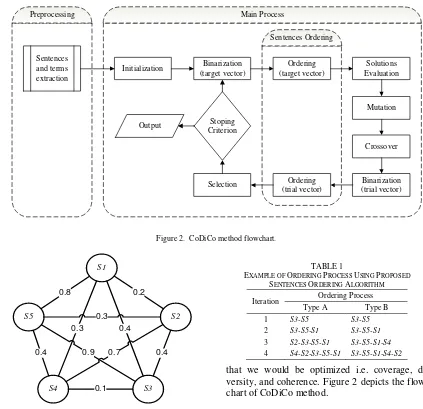
Example. Let S1, S2, S3, S4, and S5 as five summary's sentences which will be ordered by sentences ordering algorithm type A and B. Assume that they have similarities as shown in Figure 1. Their ordering processes using sentences ordering algorithm type A and B are shown in Table 1.
Based on the algorithms, pair of sentences which have highest similarity are chosen as the initial of sentences ordering result. Therefore pair of S3 and S5 which has the highest similarity (0.9) is chosen on the first iteration in each algorithm. In algorithm type B, after the initial sentences are chosen, each sentence is labeled as head and tail. Therefore on this iteration S3 and S5 are labeled as head and tail, respectively.
On the second iteration, S1 is chosen to pair 𝑓𝑐𝑜ℎ𝑒𝑟𝑒𝑛𝑐𝑒(𝑈𝑝𝑜𝑟𝑑(𝑡)) =∑ 𝑠𝑖𝑚(𝑠𝑒𝑛𝑠(𝑖)
𝑛𝑜𝑟𝑚, 𝑠𝑒𝑛 𝑠(𝑖+1)𝑛𝑜𝑟𝑚) 𝑁𝑝𝑆(𝑡)−1
𝑖=1
𝑁𝑝𝑆(𝑡) − 1 , 𝑠(𝑖) = 𝑢𝑝,𝑖
TABLE 1
EXAMPLE OF ORDERING PROCESS USING PROPOSED
SENTENCES ORDERING ALGORITHM
Iteration Ordering Process
Type A Type B
1 S3-S5 S3-S5
2 S3-S5-S1 S3-S5-S1
3 S2-S3-S5-S1 S3-S5-S1-S4
4 S4-S2-S3-S5-S1 S3-S5-S1-S4-S2 Sentences
and terms extraction
Initialization Binarization
(target vector)
Ordering (target vector)
Solutions Evaluation
Mutation
Stoping Criterion
Selection Ordering
(trial vector)
Binarization (trial vector) Crossover Output
Preprocessing Main Process
Sentences Ordering
Figure 2. CoDiCo method flowchart.
Figure 1. Example of sentences similarities.
S1
S2 S5
S4 S3
0.8 0.2
0.3 0.4
0.4 0.7
0.3
0.1 0.9 0.4
with S5 because it has higher similarity (0.8) than the pair of S3 with S1 or S2 (0.4). Using the same rule in algorithm type A, S2 and S4 are chosen to put in front of S3 on the next iterations. But in al-gorithm type B, S4 and S2 are put behind S1 since
S1 become the tail and the algorithm only pairs re-maining sentences with tail after the second iter-ation by considers their similarities.
Summary's Quality Factors Optimization
The coverage, diversity, and coherence optimiza-tion process in our proposed method consists of preprocessing and main process phase. The main process implements self-adaptive differential evo-lution (SaDE) algorithm inspired from [4] with the additions of the sentences ordering phase. For the convenience, we denote our proposed method as CoDiCo method which stands for three factors
that we would be optimized i.e. coverage, di-versity, and coherence. Figure 2 depicts the flow-chart of CoDiCo method.
Preprocessing Phase
Preprocessing phase is a step to prepare the data which would be used in main process. In this step there are some processes, i.e.: 1) sentences extrac-tion; 2) sentences normalizaextrac-tion; 3) distinct terms extraction; 4) term weights matrix preparation; 5) sentences similarity matrix preparation.
Sentences extraction is a process to take each sentence from documents that have same topic in dataset. The process will produce N sentences. Ea-ch extracted sentence 𝑠𝑒𝑛𝑛 is represented as a single line of data in sentences list D such that
𝐷 = [𝑠𝑒𝑛1, . . . , 𝑠𝑒𝑛𝑁].
After the extraction process, each sentence 𝑠𝑒𝑛𝑛 is normalized into 𝑠𝑒𝑛𝑛𝑛𝑜𝑟𝑚 using stop-word
removal, punctuation removal, and stemming pro-cess. We use 571 stop-words from Journal of Ma-chine Learning Research stop-word list1 for the
1
February 2015
stop-word removal process. For the stemming pr-ocess, we use Porter Stemmer algorithm2.
On the next step we perform distinct terms extraction from each 𝑠𝑒𝑛𝑛𝑛𝑜𝑟𝑚. This process prod-uces M distinct terms. Each extracted term 𝑡𝑒𝑟𝑚𝑚 is stored into terms list T such that 𝑇 = [𝑡𝑒𝑟𝑚1, . . . , 𝑡𝑒𝑟𝑚𝑀].
Based on N normalized sentences and M dis-tinct terms, we generate a terms weight matrix W
which has 𝑁 × 𝑀dimensions. Each component in
W stores the term’s weight of 𝑡𝑒𝑟𝑚𝑚 in norma-lized sentence 𝑠𝑒𝑛𝑛𝑛𝑜𝑟𝑚 (𝑤𝑛𝑚). The weights calcu-lation is conducted using TF-ISF scheme in equa-tion(1) and equation(2).
Each term’s weight then used to calculate the sentences similarity. Similarity value between
𝑠𝑒𝑛𝑖𝑛𝑜𝑟𝑚 and 𝑠𝑒𝑛𝑗𝑛𝑜𝑟𝑚 for 𝑖, 𝑗 = [1, . . . , 𝑁] can be
calculated using cosine measure scheme in equa-tion(3). This process will produce a sentences si-milarity matrix that has 𝑁 × 𝑁 dimensions. Main Process Phase
The main steps in main process phase of CoDiCo method as shown in Figure 2 consist of initializa-tion, binarizainitializa-tion, ordering, evaluainitializa-tion, mutainitializa-tion, crossover, stopping criterion, and output steps. Binarization and ordering steps can be divided in-to two phases, i.e. binarization and ordering for target vectors (i.e. solution vectors which genera-ted by initialization and selection steps)
and bina-rization and ordering for trial vectors (i.e. solution vectors which generated by cross-over step). The brief descriptions for each step is describes in the next subsection.
Initialization
Initialization is a step to provide a set of solutions
U that would be used to find the optimal solution of summarization. Let P and t denote the number of generated solutions and the current generation, respectively, such that 𝑈(𝑡) = [𝑈1(𝑡), . . . , 𝑈𝑃(𝑡)] for
𝑡 = 0. Each solution in U is referred as a target vector. Each target vector 𝑈𝑝(𝑡) for 𝑝 = [1, . . . , 𝑃]
is represented as a vector which has N compone-nts such that 𝑈𝑝(𝑡) = [𝑢𝑝,1(𝑡), . . . , 𝑢𝑝,𝑁(𝑡)] where
𝑢𝑝,𝑛(𝑡) denotes the n-th component in p-th target
vector.
Each target vector’s component in this step
𝑢𝑝,𝑛(0) is randomly initialized by a real-value
be-tween specified lower bound 𝑢𝑚𝑖𝑛 and upper bou-nd 𝑢𝑚𝑎𝑥. The formulation to initialize 𝑢𝑝,𝑛(0) is shown in equation(9):
2 http://tartarus.org/martin/PorterStemmer/
𝑢𝑝,𝑛(0) = 𝑢𝑚𝑖𝑛+ (𝑢𝑚𝑎𝑥− 𝑢𝑚𝑖𝑛) ⋅ 𝑟𝑎𝑛𝑑𝑝,𝑛, (9)
where 𝑟𝑎𝑛𝑑𝑝,𝑛 denotes a uniform random value between 0 and 1 for the nth component in p-th tar-get vector [4].
Binarization
Binarization is a step to encode real-value of
𝑢𝑝,𝑛(𝑡) into binary-value. The binary-values are
used to indicate the sentences from D which used as sentences in the p-th candidate summary 𝑆𝑝(𝑡). If 𝑢𝑝,𝑛(𝑡) = 1, then it indicates that the 𝑠𝑒𝑛𝑛 in D
is selected as sentence in the 𝑆𝑝(𝑡). Otherwise, if 𝑢𝑝,𝑛(𝑡) = 0, then it indicates that the 𝑠𝑒𝑛𝑛 in D is
not a sentence in the 𝑆𝑝(𝑡).
Alguliev et.al. [4] describes that encoding pro-cess of real-value 𝑢𝑝,𝑛(𝑡) into binary-value
𝑢𝑝,𝑛𝑏𝑖𝑛(𝑡) can be performed by comparing 𝑟𝑎𝑛𝑑𝑝,𝑛
value with sigmoid value of 𝑢𝑝,𝑛(𝑡). The formula-tion for this process is shown in equaformula-tion(10) and equation(11):
𝑢𝑝,𝑛𝑏𝑖𝑛(𝑡) = {1, if 𝑟𝑎𝑛𝑑𝑝,𝑛< 𝑠𝑖𝑔𝑚 (𝑢𝑝,𝑛(𝑡))
0, otherwise , (10)
𝑠𝑖𝑔𝑚(𝐴) =1 + 𝑒1−𝐴. (11)
The 𝑟𝑎𝑛𝑑𝑝,𝑛 in this step has same value with the one which have been used in initialization step.
Ordering
In this step, 𝑁𝑝𝑆(𝑡) sentences for each 𝑆𝑝(𝑡) derived
from 𝑈𝑝(𝑡) solution are ordered using sentences
ordering algorithm which described in Subsection 2.3. Ordered form of 𝑈𝑝(𝑡) is stores in ordering-solution vector 𝑈𝑝𝑜𝑟𝑑(𝑡) which has 𝑁𝑝𝑆(𝑡)
com-ponents 𝑢𝑝,𝑦𝑜𝑟𝑑(𝑡) such that,
𝑈𝑝𝑜𝑟𝑑(𝑡) = [𝑢𝑝,1𝑜𝑟𝑑(𝑡), . . . , 𝑢𝑝,𝑁𝑝𝑆
𝑜𝑟𝑑(𝑡)]
The 𝑢𝑝,𝑦𝑜𝑟𝑑(𝑡) component stores sentences index which include as summary's sentences in 𝑆𝑝(𝑡) (i.e. 𝑢𝑝,𝑦𝑜𝑟𝑑(𝑡) = [1, … , 𝑁]).
Solutions Evaluation
The best and the worst solutions on current generation can be determined using each soluti-on's fitness value. The best solution on current ge-neration (local best) 𝑈𝑏𝑒𝑠𝑡(𝑡) is a target vector that has the highest fitness value. Otherwise, the worst solution on current generation 𝑈𝑤𝑜𝑟𝑠𝑡(𝑡) (local
worst) is a target vector that has the lowest fitness value. In this step we also can update the global best 𝑈𝑔𝑏𝑒𝑠𝑡(𝑡) i.e. the best solution until current generation using the rule which formulated in equation(13).
Mutation
Mutation is a step to generate mutant vectors set V
from target vectors set U. Mutation process of
𝑈𝑝(𝑡) is conducted by involving 𝑈𝑔𝑏𝑒𝑠𝑡(𝑡) vector,
𝑈𝑏𝑒𝑠𝑡(𝑡) vector, a randomly selected vector 𝑈𝑝1(𝑡)
where 𝑝1 = [1, . . . , 𝑃] and 𝑝1 ≠ 𝑝, and a mutation factor for current generation 𝐹(𝑡). The formulati-on to generate p-th mutant vector on current gene-ration 𝑉𝑝(𝑡) is shown in equation(14), whereas the formulation to calculate the 𝐹(𝑡) value is shown in equation(16):
𝐹(𝑡) = 𝑒−2𝑡/𝑡𝑚𝑎𝑥. (16) In equation(16) 𝑡𝑚𝑎𝑥 denotes maximum generate-on which specified in initializatigenerate-on step [4].
One or more 𝑉𝑝(𝑡) components 𝑣𝑝,𝑛(𝑡) have a probability to violate the boundary constraints. Its values can be less than 𝑢𝑚𝑖𝑛 or greater than 𝑢𝑚𝑎𝑥.
Each 𝑣𝑝,𝑛(𝑡) which its value violates the boundary constraints have to been reflected back. The rules to reflect back the 𝑣𝑝,𝑛(𝑡) value is formulated in equation(15).
Crossover
Crossover is a step to generate trial vectors set Z. Each trial vector 𝑍𝑝(𝑡) has N components 𝑧𝑝,𝑛(𝑡),
which its value is derived from the value of
𝑢𝑝,𝑛(𝑡) or 𝑣𝑝,𝑛(𝑡) [4]. The purpose of this
operati-on is to increase the diversity of solutioperati-on vectors in order to expand the search space.
Alguliev et.al. [4] describes that to generate the 𝑍𝑝(𝑡) vector, relative distance between 𝑈𝑝(𝑡)
vector and 𝑈𝑏𝑒𝑠𝑡(𝑡) vector 𝑅𝐷𝑝(𝑡) has to be calcu-lated first. The 𝑅𝐷𝑝(𝑡) then used to calculate the crossover rate 𝐶𝑅𝑝(𝑡). Equation(17-19) shows the formulation to calculate the 𝑅𝐷𝑝(𝑡) and 𝐶𝑅𝑝(𝑡).
The rule to determine trial vector component 𝑧𝑝,𝑛(𝑡) value is formulated in equation(20). In
eq-uation(20) k is a randomly selected integer value for 𝑘 = [1, … , 𝑁]. It ensures that at least one com-ponent of trial vector is obtained from the mutant vector. It will ensure that the solutions on the next generation have differences with the solutions on current generation [4].
𝑅𝐷𝑝(𝑡) =
𝑓𝑖𝑡(𝑈𝑏𝑒𝑠𝑡(𝑡)) − 𝑓𝑖𝑡 (𝑈𝑝(𝑡)) 𝑓𝑖𝑡(𝑈𝑏𝑒𝑠𝑡(𝑡)) − 𝑓𝑖𝑡(𝑈𝑤𝑜𝑟𝑠𝑡(𝑡)).
(17)
𝐶𝑅𝑝(𝑡) =
2𝑡𝑎𝑛ℎ (2𝑅𝐷𝑝(𝑡))
1 + 𝑡𝑎𝑛ℎ (2𝑅𝐷𝑝(𝑡))
. (18)
𝑡𝑎𝑛ℎ(𝐴) =𝑒𝑒2𝐴2𝐴−1+1. (19)
𝑧𝑝,𝑛(𝑡) = {𝑣𝑢𝑝,𝑛(𝑡), if 𝑟𝑎𝑛𝑑𝑝,𝑛≤ 𝐶𝑅𝑝 or 𝑛 = 𝑘 𝑝,𝑛(𝑡), otherwise ,
(20)
𝑈𝑝(𝑡 + 1) = {𝑍𝑝(𝑡), if 𝑓𝑖𝑡 (𝑍𝑝(𝑡)) ≥ 𝑓𝑖𝑡 (𝑈𝑝(𝑡))
𝑈𝑝(𝑡), otherwise .
(21)
Selection
Selection is a step to generate a novel target vec-tors set for the next generation 𝑈(𝑡 + 1). The vec-tors are derived from 𝑈(𝑡) vectors and 𝑍(𝑡) vec-tors which have the best fitness value [4]. In other words only the best solution for each pair is survi-ved from this operation. It ensures that the search-ing of optimal solution is always approach to the best solution until the last iteration. The rule to
𝑓𝑖𝑡 (𝑈𝑝(𝑡)) =
𝑓𝑐𝑜𝑣𝑒𝑟𝑎𝑔𝑒(𝑈𝑝𝑏𝑖𝑛(𝑡))
𝑓𝑑𝑖𝑣𝑒𝑟𝑠𝑖𝑡𝑦(𝑈𝑝𝑏𝑖𝑛(𝑡))
⋅ 𝑓𝑐𝑜ℎ𝑒𝑟𝑒𝑛𝑐𝑒(𝑈𝑝𝑜𝑟𝑑(𝑡)). (12)
𝑈𝑔𝑏𝑒𝑠𝑡(𝑡) = {𝑈𝑏𝑒𝑠𝑡(𝑡), if 𝑓𝑖𝑡(𝑈𝑏𝑒𝑠𝑡(𝑡)) > 𝑓𝑖𝑡 (𝑈𝑔𝑏𝑒𝑠𝑡(𝑡 − 1))
𝑈𝑔𝑏𝑒𝑠𝑡(𝑡 − 1), otherwise
. (13)
𝑉𝑝(𝑡) = 𝑈𝑝(𝑡) + (1 − 𝐹(𝑡)) ⋅ (𝑈𝑔𝑏𝑒𝑠𝑡(𝑡) − 𝑈𝑝1(𝑡)) + 𝐹(𝑡) ⋅ (𝑈𝑏𝑒𝑠𝑡(𝑡) − 𝑈𝑝1(𝑡)). (14)
𝑣𝑝,𝑛(𝑡) = {2𝑢2𝑢𝑚𝑖𝑛− 𝑣𝑝,𝑛(𝑡), if 𝑣𝑝,𝑛(𝑡) < 𝑢𝑚𝑖𝑛
February 2015
TABLE 2
ROUGE SCORES COMPARISON OF EACH TESTED METHODS
Methods ROUGE Score Average
ROUGE-1 ROUGE-2 ROUGE-L ROUGE-SU
OCDsum-SaDE 0.3701 0.0794 0.3424 0.1254 0.2293
CoDiCo-A (without threshold) 0.5144 0.1395 0.4820 0.2256 0.3404 CoDiCo-B (without threshold) 0.5279 0.1524 0.4933 0.2351 0.3522 CoDiCo-A (𝑇𝑠𝑖𝑚= 0.9) 0.5118 0.1443 0.4749 0.2172 0.3370 CoDiCo-B (𝑇𝑠𝑖𝑚= 0.9) 0.5163 0.1525 0.4785 0.2304 0.3444 CoDiCo-A (𝑇𝑠𝑖𝑚= 0.8) 0.5322 0.1473 0.4963 0.2310 0.3517 CoDiCo-B (𝑇𝑠𝑖𝑚= 0.8) 0.5464 0.1747 0.5127 0.2640 0.3744 CoDiCo-A (𝑇𝑠𝑖𝑚= 0.7) 0.5620 0.1611 0.5205 0.2674 0.3777 CoDiCo-B (𝑇𝑠𝑖𝑚= 0.7) 0.5296 0.1448 0.4923 0.2434 0.3525
choose the p-th target vector on the next genera-tion 𝑈𝑝(𝑡 + 1) is formulated in equation(21).
Stopping Criterion
In this step, the iteration of optimal solution sear-ching process is determined to be stopped or not. The stopping criterion in this paper is uses a spe-cified number of generation. If the iteration has reached the maximum generation 𝑡𝑚𝑎𝑥, then the iteration is stopped. Otherwise, if the iteration has not reached the 𝑡𝑚𝑎𝑥, then the iteration is conti-nued.
Output
This step is the final step in main process of Co-DiCo method. In this step, the global best solution of summarization on the last generation 𝑈𝑔𝑏𝑒𝑠𝑡
(𝑡𝑚𝑎𝑥) has been acquired. Its binary form 𝑈𝑔𝑏𝑒𝑠𝑡𝑏𝑖𝑛
(𝑡𝑚𝑎𝑥) denotes the sentences index in D which has
selected as summary’s sentences, whereas its ord-ered form 𝑈𝑔𝑏𝑒𝑠𝑡𝑜𝑟𝑑 (𝑡𝑚𝑎𝑥) stores the order of the su-mmary’s sentences index. Furthermore a senten-ces set which indicated in 𝑈𝑔𝑏𝑒𝑠𝑡(𝑡𝑚𝑎𝑥) are
return-ed as the summary. 3. Results and Analysis
In this paper we use Text Analysis Conference (TAC) 2008 dataset from National Institute of Standards and Technology (NIST)3 to test our
Co-DiCo method. This dataset provides articles that classified into some topics and coherent summa-ries which created manually by human for each topic. We choose 15 topics for the testing. Each topic contains 10 documents that would be sum-marized.
The experiments are performed using Matlab R2013a and run on Microsoft Windows platform. We test both the proposed sentences ordering al-gorithm type A and type B using CoDiCo method.
3http://www.nist.gov/tac/2008/summarization/
We represented these methods as CoDiCo-A and CoDiCo-B, respectively. In order to compare the summarization results from CoDiCo method with another multi-document summarization method that considers coverage and diversity factors only, we use the OCDsum-SaDE method from [4].
We also test both of our proposed sentences ordering algorithm by involving a threshold 𝑇𝑠𝑖𝑚 in sentences similarity value in order to evaluate the impact of similarity between summary's sen-tences toward the optimal summary's solution. We use three threshold values, i.e. 0.7, 0.8, and 0.9. In this scenario, the sentences ordering process ex-clude every pair of sentences that have similarity value greater than or equal to 𝑇𝑠𝑖𝑚 value. The ex-cluding pair of sentences will not be chosen as ad-jacent sentences in summary's solutions.
Both of our proposed method (CoDiCo) and the compared method (OCDsum-SaDE) use four specified parameters in the initialization state i.e. population size (P), maximum generation (𝑡𝑚𝑎𝑥), lower bound (𝑢𝑚𝑖𝑛), and upper bound (𝑢𝑚𝑎𝑥) wh-ich sets to 20, 500, -5, and 5, respectively. Those parameters values assign based on heuristic choi-ces. After the multiple-documents summarizations were processed using the tested methods, we get the summarization results as many as selected to-pics. Therefore, we have 15 summaries from 15 selected topics for each method.
The testing results are evaluated using Re-call-Oriented Understudy of Gisting (ROUGE) method [10]. This method compares candidate su-mmaries (i.e. susu-mmaries generated by proposed and compared methods) with reference summaries (i.e. summaries that created manually by human which provided in TAC 2008 dataset). There are 4 type of ROUGE method which is used to evaluate our experiments i.e. ROUGE-1, ROUGE-2, ROU-GE-L, and ROUGE-SU.
It is computed by divides the maximum number of n-grams co-occurring in candidate summary and set of reference summary with total sum of the number of n-grams occurring at the reference summary. ROUGE-L is a ROUGE method that considers about longest common subsequence (LCS) between candidate summary and reference summary. It is computed as the ratio between LCS's length with reference summary's length. In other hand ROUGE-SU considers the unigram va-lue on candidate summary and reference summary as counting unit [4,10]. The formulas and comple-te explanation about usage of ROUGE method can be read in [10].
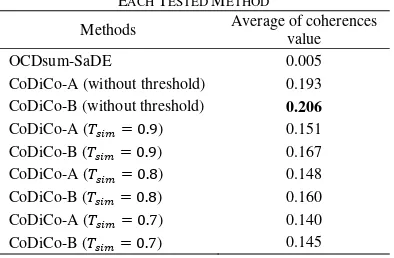
ROUGE score for CoDiCo-A, CoDiCo-B, and OCDsum-SaDE methods are presented in Table 2. It shows the comparison of ROUGE sco-res among each tested methods. The highest ROUGE scores for each ROUGE type are indi-cated by bolded text. We also evaluate our propo-sed method by considering the averages of sum-mary's coherence value which generated by each tested method. The comparison of averages cohe-rence value from tested methods is shown in Ta-ble 3. The highest value is indicated by bolded text.
Discussion
Series of experiment has been conducted to evalu-ate our proposed method (i.e. CoDiA and Co-DiCo-B) in comparison with compared method (OCDsum-SaDE). Based on the evaluation results as shown in Table II, we know that the CoDiCo-A method using 𝑇𝑠𝑖𝑚= 0.7 has higher ROUGE score on ROUGE-1, ROUGE-L, and ROUGE-SU than the other methods. Whereas in ROUGE-2 can be shown that CoDiCo-B method using 𝑇𝑠𝑖𝑚=
0.8 has higher score than the others. From Table II we also know that the lowest average ROUGE score of CoDiCo method is 0.3370 which obtain-ed by CoDiCo-A using 𝑇𝑠𝑖𝑚= 0.9 and the highest average ROUGE score is 0.3777 which obtained
by CoDiCo-A using 𝑇𝑠𝑖𝑚= 0.7. Whereas the ave-rages ROUGE score of OCDsum-SaDE method only reached 0.2293. It means all of CoDiCo me-thod variants have better performance than the co-mpared method.
It should be noted that in CoDiCo method, by considering the coherences of sentences while selecting the best solution will adjust the coverage and diversity factors simultaneously to find the optimal solution. It will produce different summa-ry compared with method that only considers the coverage and diversity factors. But the summary is more similar with summary that created manu-ally by human. It causes the ROUGE scores of CoDiCo method are greater than ROUGE scores of compared method.
By comparing the averages ROUGE score for each CoDiCo method with the average ROU-GE score of OCDsum-SaDE method, we know that CoDiCo methods have averages RO-UGE sc-ore in range 46.97-64.71% higher than the aver-ages ROUGE score of compared method. It shows that the multi-document summarization method that considers coverage, diversity, and coherence simultaneously can produce better summary than summarization method that considers coverage and diversity only.
Based on the evaluation of averages of sum-mary's coherence value that shown in Table 3, we know that CoDiCo-B method without threshold reaches the average coherence value higher than the others do. We also know that the lowest avera-ge coherence value among the variants of CoDiCo method is 0.145 which obtained by CoDiCo-B method using 𝑇𝑠𝑖𝑚= 0.7. Nevertheless, the value is higher than the average coherence value of SaDE. If we compare it with OCDsum-SaDE method, CoDiCo-B without threshold can produce summary with average coherence value about 41.2 times higher than the OCDsum-SaDE method, whereas CoDiCo-B method using 𝑇𝑠𝑖𝑚= 0.7 can reach average coherence value about 29 times higher than OCDsum-SaDE method. It sho-ws that the CoDiCo method, which involves orde-ring step in optimization process, can produce summary with better coherences or smoother con-nectivity among sentences than the other method which does not consider the ordering of summa-ry's sentences.
The comparison of two proposed sentences ordering algorithm with same threshold value usi-ng their ROUGE scores shows that CoDiCo-B is better than CoDiA. As shown in Table 2, Co-DiCo-B has higher average ROUGE score than CoDiCo-A when do not using a threshold, using 𝑇𝑠𝑖𝑚= 0.9, and using 𝑇𝑠𝑖𝑚= 0.8. Whereas
CoDi-Co-A only has higher average ROUGE score than
TABLE 3
AVERAGES COHERENCE VALUE COMPARISON FROM
EACH TESTED METHOD
Methods Average of coherences value
OCDsum-SaDE 0.005
1, February 2015
CoDiCo-B when using 𝑇𝑠𝑖𝑚= 0.7.
If we compare the averages coherence value between both of sentences ordering algorithms as shown in Table 3, we know that CoDiCo-B has higher average coherence value than CoDiCo-A when using all variants of threshold value. This performance comparison indicates that ordering sentences strategy which arrange sentences by higher similarity on the beginning of paragraph is better than ordering sentences strategy which ma-ximize similarity between two sentences in the su-mmarization result.
4. Conclusion
This paper proposes and describes a new method on multi-document summarization by considering the coverage, diversity, and coherence factors am-ong the summary's sentences simultaneously. The proposed method tries to improve connectivity among summary's sentences in order to enhance the readability of summary by adding sentences ordering phase in summary optimization process. Thus, the process of sentences ordering is no lo-nger relying on the summary.
The experimental results show that the mul-ti-document summarization method that considers the coverage, diversity, and coherence factors in summary simultaneously is able to provide better summary than other methods, which only conside-rs the coverage and diveconside-rsity of summary. In our experiments it has performances 46.97-64.71% better than the compared method. In addition to the consideration of the coherence factor in sum-mary, method that consider this factor can provide summary with better readability compared with another method that do not consider this factor. In our experiments, it provides summaries that have readability rate 29-41.2 times better than the other method. This research can be developed further. Further development can be done by considering the other approaches in the sentences ordering al-gorithm in order to improve the readability of the summary.
References
[1] R. Ferreira, L.S. Cabral, F. Freitas, R.D. Lins, G.F. Silva, S.J. Simske, & L. Favaro,
“A Multi-Document Summarization System Based on Statistics and Linguistic
Treatme-nt”, Expert Systems with Applications, vol. 41, pp. 5780-5787, 2014.
[2] A. Baralis, L. Cagliero, S. Jabeen, A. Fiori, & S. Shah, “Multi-Document Summarization Based on The Yago Ontology”, Expert Sys-tems with Applications, vol. 40, pp. 6976-6984, 2013.
[3] R.M. Aliguliyev, “A New Sentence Sim ilari-ty Measure and Sentence Based Extractive Technique for Automatic Text
Summariza-tion”, Expert Systems with Applications, vol. 36, pp. 7764-7772, 2009.
[4] R.M. Alguliev, R.M. Aliguliyev, & N.R.
Isa-zade, “Multiple Documents Summarization Based on Evolutionary Optimization
Algo-rithm”, Expert Systems with Applications, vol. 40, pp. 1675-1689, 2013.
[5] R. Barzilay, N. Elhadad, & K. McKeown,
“Inferring Strategies for Sentence Ordering in Multidocument News Summarization”,
Journal of Artificial Intelligence Research, vol. 17, pp. 35–55, 2002.
[6] D. Bollegala, N. Okazaki, & M. Ishizuka, “A Preference Learning Approach to Sentence Ordering for Multi-Document
Summarizati-on”, Information Sciences, vol. 217, pp. 78-95, 2012.
[7] P. Sukumar, & K.S. Gayathri, “Semantic Ba -sed Sentence Ordering Approach for
Multi-Document Summarization”, International Journal of Recent Technology and Engineer-ing (IJRTE), vol. 3, no. 2, pp. 71-76, 2014. [8] L. Huang, Y. He, F. Wei, & W. Li, “Mo
-deling Document Summarization as
Multi-objective Optimization”, Third International Symposium on Intelligent Information Tech-nology and Security Informatics (IITSI), 2010.
[9] D.R Radev, H. Jing, M. Stys, & D. Tam,
“Centroid-based Summarization of Multiple
Documents”, Information Processing and Management, vol. 40, pp. 919-938, 2004. [10] C.Y Lin, “ROUGE: A Package for Auto