CATCH ESTIMATION AND SIZE DISTRIBUTION OF BILLFISHES LANDED IN PORT
OF BENOA, BALI
Bram Setyadji, Jumariadi and Budi Nugraha
Research Institute for Tuna Fisheries Benoa
Received August 2-2011; Received in revised form May 29-2012; Accepted June 6-2012 email: [email protected]
ABSTRACT
Billfishes are generally considered as by-product in tuna long line fisheries that have high economic value in the market. By far, the information about Indian Ocean billfish biology and fisheries especially in Indonesia is very limited. This research aimed to elucidate the estimation of production and size distribution of billfishes landed in port of Benoa during 2010 (February – December) through daily observation at the processing plants. The result showed that the landings dominated by Swordfish (Xiphias gladius) 54.9%, Blue marlin (Makaira mazara) 17.8% and Black marlin (Makaira indica) 13.0% respectively, followed by small amount of striped marlin (Tetrapturusaudax), sailfish (Istiophorus platypterus), and shortbil spearfish (Tetrapturus Angustirostris). Generally the individual size of billfishes range between 68 and 206 cm (PFL), and showing negative allometric pattern except on swordfish that was isometric. Most of the billfish landed haven’t reached their first sexual maturity.
KEYWORDS: Catch, species composition, billfish, length and weight
INTRODUCTION
The term “Billfishes” has been globally accepted and referred to the large pelagic fishes of the families of Xiphiidae and Istiophoridae. The fishes characterized by the prolongation of the upper jaw, much beyond its lower, into a long rostrum which is flat and sword-like (swordfish) or rounded and spear-like (sailfishes, spearfishes, and marlins) (Nakamura, 1985). Billfishes are primarily oceanic, epipelagic species inhabiting the coastal and offshore waters of all tropical and subtropical seas (Pepperell & Grewe, 1999) they usually swim to the water layers above the thermocline, but some of them may occur at greater depths (up to 915 m) (Conamar, 2008).
The catch of billfish is generally considered as one of the tuna long line fisheries by-product (secondary catch which have an economic value), and it is often poorly recorded, being lumped together in to single category, misidentified or the fish is discarded (Campbell et al., 1998). The contribution of billfishes to the fishery is significant, and the catch has increased considerably over the years highlighting their importance in the large pelagic offshore fishery in Indonesia. The recorded catch from Indonesian vessels increased to over 400,000 MT in 2007 by all fleets in the Indian Ocean (Mahiswara & Prisantoso, 2009), that mainly landed in Port of Benoa, Bali and two other main fishing ports, Cilacap and Palabuhan Ratu.
Knowledge of Indian Ocean billfish biology and fisheries especially in Indonesia, and the status of
and information of the fishery. This research aimed to elucidate the estimation of production and size distribution of billfishes landed in port of Benoa, Bali. MATERIALS AND METHODS
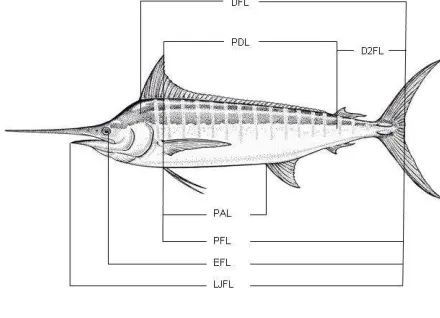
The data analyzed were part of the result of daily observation at processing plants in Port of Benoa, Bali conducted from February to December 2010, following the IOTC protocol (IOTC, 2002). The data taken covers Pectoral Fork Length (PFL) (the frozen billfishes are usually came with no head and fins; in centimeters) (Figure 1), HDD Weight (dressed carcasses with heads and fins off and tail present; in kilogram), name and number of vessels, with notice: every samples were weighted but weren’t always measure its length due to difficulty and limitation at the processing plant. Species identification based on Nakamura (1985); Pepperell & Grewe (1999).
Calculation of the total catch based on following formula (IOTC, 2002):
CM = LM * AVM ...……….………. 1)
Where:
CM : Total catch per month (in Ton) LM : Total landing per month (in Ton)
AVM : Average catches per month (Catches sample/ Landing sample)
Figure 1. Type of measurement used for billfish
RESULTS AND DISCUSSION
Catch estimation
There were six identified species of billfishes (from 12 known worldwide; Froese & Pauly (2011) ) which landed in Port of Benoa. One species belong to the family Xiphiidae (Xiphias gladius) while the others are from family Istiophoridae (genus Istiophorus:
Istiophorus platypterus; genus Tetrapturus:
Tetrapturus audax, Tetrapturus angustirostris; genus Makaira: Makaira mazara, Makaira indica).
Total of billfishes sampled during February to December 2010 at the processing plant in Port of Benoa showed that the catch was dominated by Swordfish (Xiphias gladius) 54.9%, Blue marlin (Makaira mazara) 17.8% and Black marlin (Makaira indica) 13.0% respectively and then followed by small group of Striped marlin (Tetrapturus audax), Sailfish (Istiophorus platypterus) and Shortbill spearfish (Tetrapturus angustirostris) (Figure 2).
Monthly catch estimation of billfishes landed in Port of Benoa showed that total landing of swordfish likely fluctuated every month but reached its highest in June for about 137.927,21 ton and dominated the total catch throughout the year. Blue marlin and black marlin followed with different pattern which occur
Remarks:
PAL : Pectoral Anal Length PFL : Pectoral Fork Length EFL : Eye-Fork Length LJFL : Lower Jaw-Fork Length DFL : Dorsal-Fork Length PDL : Pectoral-Dorsal Length D2FL : Second Dorsal Fork Length
Source: Poisson & Paquet (2001) after IOTC (2005)
Figure 2. Total Billfishes landed in Port of Benoa during February – December 2010.
Remarks : SWO (Swordfish; Xiphias gladius), BLM (Black marlin; Makaira indica), BLZ (Blue marlin; Makaira mazara), MLS (Striped marlin; Tetrapturus audax), SFA (Sailfish; Istiophorus platypterus), SSP (Shortbill spearfish; Tetrapturus angustirostris)
Figure 3. Catch estimation of billfishes landed in Port of Benoa during February – December 2010.
According to Indonesian Tuna Long line Association (ATLI) during 2005 – 2009 the production of billfishes landed in Port of Benoa had increased which Swordfish was the common commodity (up to more than 3,000 ton in 2008 and 2009) followed by group of marlins and sailfish (about 1,500 ton in 2009) (Figure 4). This result seemed to follow the pattern of the billfishes production in Indian Ocean waters of Indonesia (Western Sumatera, Southern Java and Lesser Sunda) for which it fluctuated in 2004 – 2007 period but still showed the same catch composition in which swordfish was the common species, while striped marlins showed in small quantities (Mahiswara & Prisantoso, 1999) (Fig. 5)
-2005 2006 2007 2008 2009
N
Figure 4.Nominal catch of Billfishes landed in Port of Benoa during 2005 – 2009.
Source : Indonesian Tuna Longline Association (ATLI)
Figure 5.Billfish production from Indian Ocean Waters of Indonesia 2004 – 2007.
Source : Mahiswara & Prisantoso (2009)
Size distribution
From sampling activities carried out from February to December 2010, generally the individual size of billfishes range between 68 and 206 cm (PFL). The swordfish landed sized 68 – 197 cm (PFL) (Fig. 6) which relatively similar with Poisson & Fauvel (2009) report in southwestern Indian Ocean and Sun et al.,
(2005) in the waters around Taiwan, regardless its sex. Black marlin and blue marlin ranged from 108 to 206 cm (PFL). Maldeniya et al., (1999) reported, in Sri Lanka waters the blue marlin catch ranged from 110 to 270 (FL), the size range noted of black marlin caught in Indian Ocean by Japanese long liners during 1960s ranged between 121 and 260 body length (LJFL), which also mentioned for the maximum recorded total length of black marlin is 448 cm and maximum recorded weight was 708 kg (game fishing record, caught off Peru in 1953) (Pepperell, 2000). Size range for striped marlin was from 95 to 158 cm (PFL) as for information in equatorial west Indian Ocean ranged between 120 and 190 cm (Eye Fork-Length; EFL) (Merret, 1968 (after Ueyanagi & Wares, 1975)), while sailfish ranged from 114 to 175 cm (PFL) which is bigger compared to study by Hoolihan (2006)
Ganga et al., (2008) in Indian coast. There were also three individuals of shortbill spearfish measured that ranged 124 to 127 cm (PFL), Novianto et al., (2010) reported the size of shortbill spearfish caught in Indian Ocean from September – December 2008 ranged 135 – 175 cm (LJFL).
Pectoral fork length (cm)
SWO (N =
Pectoral fork length (cm)
BLZ (N = 87)
Pectoral fork length (cm)
BLM (N =
Pectoral fork length (cm)
MLS (N = 42)
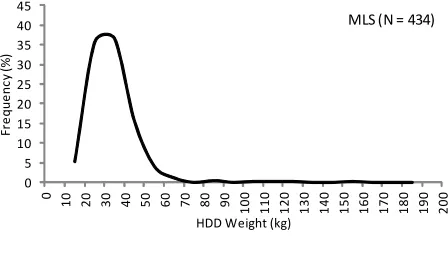
In artisanal and industrial tuna fisheries, tuna, billfish, tuna-like species and by-catch species are processed in many different ways and landed in different states (round, gilled and gutted, headed etc) (IOTC, 2005). Measurements of actual size (length and weight) are recorded before processing when observers are onboard fishing vessels or when fish are landed whole. Given that processing is common practice, being able to convert different measures of dressed and undressed fish to whole fish is essential. Almost all billfishes came with no head, gills, fins and eviscerated. Fish can also be frozen at -20°C (for the European market), or at -50°C for the tuna destined for the Japanese sashimi market and the loins for the European market (Poisson & Taquet, 2000). The weights of billfishes are likely grouped between 30 and 50 kg (HDD) with the lowest about 1 kg and maximum up to 206 kg (Fig. 7). The landing record represents that most of the catch are slightly lower compared to reports in southeastern Pacific (Vega et al. 2009).
Figure 7. HDD Weight frequency distribution of dominant billfihes landed in Port of Benoa, February – December 2010
Length – Weight Relationship
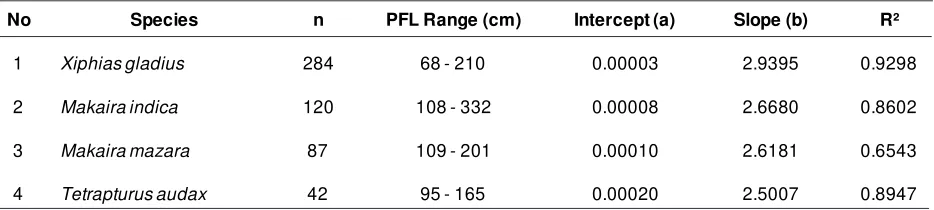
Results of the t-test of the b < 3 except for Xiphias gladius, b = 3 shown in Table 1. It indicates beside swordfish the growth pattern of billfish were likely negative allometric, where growth in length is faster than growth in weight. There were rarely or yet any information found about the relationship between PFL x HDD weight. Swordfish formed different pattern of this relationship worldwide, in Indian Ocean (Bali, Indonesia) showed isometric pattern, in the waters around Taiwan was positive allometric (Sun et al., 2005; Wang et al., 2006) while in south-western equatorial Atlantic (North Brazil) was negative allometric (Asano-Filho et al., 2004).
Length at First Capture (Lc)
for striped marlin was 137.02 cm (PFL). Size at first capture (longline fisheries) of T. audax is approximately 80 cm eye-fork length (Nakamura, 1985). Size at first maturity generally estimated
between 140 and 150 cm eye-fork length (Bromhead
et al., 2004; Nakamura, 1985) while the others like sailfish and shortbill spearfish could not be estimated due to insufficient specimens.
Table 1. Parameters of length – weight relationship of dominant billfishes landed in Port of Benoa, February – December 2010.
No Species n PFL Range (cm) Intercept (a) Slope (b) R²
1 Xiphias gladius 284 68 - 210 0.00003 2.9395 0.9298
2 Makaira indica 120 108 - 332 0.00008 2.6680 0.8602
3 Makaira mazara 87 109 - 201 0.00010 2.6181 0.6543
4 Tetrapturus audax 42 95 - 165 0.00020 2.5007 0.8947
CONCLUSION
Based on billfishes landing data in Port of Benoa during February – December 2010, total 6 species were measured and the samples were dominated by swordfish (Xiphias gladius) 54.9%, blue marlin (Makaira mazara) 17.8% and black marlin (Makaira indica) 13.0% respectively, followed by small amount of striped marlin, sailfish, and shortbil spearfish. Generally the individual size of billfishes range between 68 – 206 cm (PFL), and showing negative allometric pattern except for swordfish which was isometric. Most of billfishes landed haven’t reached their first sexual maturity.
ACKNOWLEDGEMENT
The authors would like to thank to all enumerator members in Research Institute for Tuna Fisheries Benoa for their contribution in collecting data throughout the year.
REFERENCES
Asano-Filho, M., Holanda, F. C. A. F., Santos, F. J. D., Lucena, F. & G. D. L. Pantaleão. 2004. A short note on the catch composition and weight-length relationship of tunas, billfishes and sharks of north Brazil. Brazilian Journal of Oceanography. 52 (3/ 4): 249-253.
Bromhead, D., Pepperell, J., Wise, B., & J. Findlay. 2004. Striped marlin: biology and fisheries. Bureau of Rural Sciences. Canberra. p.15–37.
stocks and fisheries within the western AFZ and the Indian Ocean. Report to Western Tuna MAC, AFMA, Canberra. 123 pp.
Conamar. 2008. Billfish: threatened resources in the
eastern Pacific Ocean. 3 (4). Year 3.
www.fconamar.org (downloaded on March 25th,
2011).
Froese, R. & D. Pauly. 2011. FishBase. World wide
web electronic publication. www.fishbase.org,
version (02/2011).
Ganga, U., Pillai, N. G. K. & M. N. K. Elayathu. 2008. Billfish fishery along the Indian coast with special reference to the Indo-Pacific sailfish Istiophorus platypterus (Shaw and Nodder 1792). J. Mar. Biol. Ass. India. 50 (2) : 166 – 171.
Hoolihan, J. P. 2006. Age and growth of Indo-Pacific sailfish, Istiophorus platypterus,from the Arabian Gulf. Fisheries Research. 78: 218–226.
IOTC. 2002. Field manual for data collection on tuna landings from longliners. IOTC Technical Report
02/02. 15 pp.
IOTC. 2005. Biological data on tuna and tuna-like species gathered at the IOTC Secretariat: Status Report. IOTC-2005-WPTT-05. 22 pp.
Mahiswara & B. I. Prisantoso. 2009. Billfish fisheries in Indonesia. IOTC-2009-WPB-14. 10 pp.
in the pelagic fisheries in Sri Lanka. IOTC proceedings. 2-5: 1999-2002.
Nakamura, I. 1985. FAO species catalogue. Vol. 5. Billfishes of the world. An annotated and illustrated catalogue of marlins,, sailfishes, spearfishes and swordfishes known to date. FAO Fish. Synop., 5 (125): 65.
Novianto, D., Nugraha, B. & A. Bahtiar. 2010. Komposisi ukuran, perbandingan jenis kelamin, dan tingkat kematangan gonad ikan todak berparuh pendek (Tetrapturus angustirostris) di Samudera Hindia. BAWAL. 3 (2): 123 – 128.
Pepperell, J.G. 2000. Brief synopsis of the biology of the black marlin (Makaira indica), with reference to the indian ocean. IOTC Proceedings. 3 (2000): 214-220.
Pepperell, J.G. & P. Grewe. 1999. A field guide to the Indo-Pacific billfishes. CSIRO Marine Research, Hobart, TAS. 16 pp.
Poisson, F & C. Fauvel. 2009. Reproductive dynamics of swordfish (Xiphias gladius) in the southwestern Indian Ocean (Reunion Island). Part 1: oocyte development, sexual maturity and spawning.
Aquat. Living Resour. 22: 45–58.
Poisson, F & M. Taquet. 2000. French swordfish longline fishery in south west Indian Ocean : preliminary results from the PPR program. IOTC Poceedings. 3 (2000): 169-20.
Sun, C. L., Wang, S. P & S. Z. Yeh. 2002. Age and growth of the swordfish (Xiphias gladius L.) in the waters around Taiwan determined from anal-fin rays. Fish. Bull. 100: 822–835.
Sun, C.L., Wang, S.P., Porch, C.E, & S.Z. Yeh. 2005. Sex-specific yield per recruit and spawning stock biomass per recruit for the swordfish, Xiphias gladius, in the waters around Taiwan. Fisheries Research 71 : 61 – 69.
Ueyanagi, S. & P. G. Wares. 1975. Synopsis of biological data on striped marlin, Tetrapturus audax
(Philippi), 1887. Richard S. Shomura and F. Williams (eds.) Proceedings of the international billfish symposium, Pt.3. U.S. Department of Commerce, NOAA Technical Report NMFS SSRF 675, p.132-159.
Vega, R., Licandeo, R., Rosson, G. & E. Yáñez. 2009. Species catch composition, length structure and reproductive indices of swordfish (Xiphias gladius) at Easter Island zone. Lat. Am. J. Aquat. Res., 37 (1): 83-95.
Wang, S. P.,Sun, C.L. and Su-Zan Yeh. 2003. Sex ratios and sexual maturity of swordfish (Xiphias gladius L.) in the waters of Taiwan. Zoological Studies 42 (4): 529-539.
Wang, S. P., Sun, C.L., Yeh, S. Z., Chiang, W. C., Su, N. J., Chang, Y. J. & C.H. Liu. 2006. Length distributions, weight-length relationships, and sex ratios at lengths for the billfishes in Taiwan Waters.
BULLETIN OF MARINE SCIENCE, 79 (3): 865– 869.
Yabe, H., Ueayanagi, S., Kikawa, S. & H. Watanabe. 1959. Study on the life-history of the swordfish,