C-3
BIOSORPTION OF TECHNICAL DIRECT DYES BY ACTIVATED SLUDGE Dewi Yuanita Lestari and Endang Widjajanti LFX
Chemistry Education Department of UNY
Abstract
This study aimed to determine the effect of adsorbent mass, adsorption time and concentration of dye on adsorption efficiency of activated sludge toward technical direct dyes and to know the effect of the adsorption process of the COD (Chemical Oxygen Demand) value in technical direct dyes solution.
The subject of this study was activated sludge. The object of this study was the activated sludge adsorption efficiency on technical direct dyes. Adsorption process was done by conditioning the variation of the mass of adsorbent, adsorption time and concentration of technical direct dyes. Technical direct dyes solution before and after adsorption were quantitatively analyzed with a COD reactor. Technical direct black dyes solution after adsorption were analyzed quantitatively by UV-Vis spectrophotometer. Adsorption efficiency expressed in terms of concentration of adsorbed dyes divided by the initial concentration of dye solution and multiplied by 100%.
The results showed that: the greater the mass of adsorbent, the higher the adsorption efficiency of activated sludge to technical direct dyes, the longer the time given to the process of adsorption, the higher the adsorption efficiency of activated sludge to technical direct dyes, adsorption efficiency decreases with increasing concentration of technical direct dyes, chemical Oxygen Demand (COD) value technical direct were decrease after adsorption process by activated sludge.
Keywords : activated sludge, technical direct, adsorption
INTRODUCTION
Direct dyes are used on cotton, paper, leather, wool, silk and nylon. Direct dyeing is normally carried out in a neutral or slightly alkaline dye bath at or near boiling point with the addition of either sodium chloride or sodium sulfate [1]
The residual Direct dyes from several industries (e,g. Textille industries, pulp and paper industries, craft industries) are considered a wide variety of pollutants introduced into the natural water resources. The discharge of dye containing effluents into environtment is undesirable because of the toxicity and visibility. Dyes are persistent in nature and strongly absorb sunlight which decrease the intensity of light absorbed by water plants and phytoplankton reducing photoshynthesis and dissolve oxygen of the aquatic ecosystem and result in increase of chemical oxygen demand (COD) [1]
Treatment of the effluent containing residual direct dyes is important for the protection of natural water resources. Biosorption technique is considered to be an effective method for lowering the concentration of direct dyes in waste water. Biosorption involves a combination of active and passive transport mechanisms starting with the diffusion of the adsorbed component to the surface of the microbial cell [2]
sludge is biological flok consists of microorganisms (i.e. bacteria, protozoa). More than 300 species of bacteria were found in activated sludge. The common Genus were: Zooglea, Pseudomonas,Flavobacterium,Alcaligenes,Bacillus,Achromobacter,Corynbactum,Comomonas, Brevibacterium,danAcinetobacter [3]. Activated sludge is industrial waste so using activated sludge to reduce dyes concentration in wastewater can support zero-waste principal.
RESEARCH METHOD
Batch experiment were carried out in Beakker glass containing the aqueous technical Direct dyes solution of the desired concentration and the known mount of activated sludge. The mixture was agitated for a minute using manual stirrer and allowed at contact time. The dyes solution was separated from activated sludge by centrifugation. The dyes concentration of supernatant was determinned by using uv-visible spectrophotometer. Batch experiment were performed for technical Direct Black and Blue at different contact time : 1; 1,5; 2; 3; 4; 5; and 24 hours, adsorbent mass : 1; 2; 3; 4; 5 grams, initial concentration: 500; 700, 800; 900 ppm. Chemical Oxygen Demand (COD) of direct dyes solution before and after biosorption were measured using COD reactor.
Adsorption efficiency expressed in terms of concentration of adsorbed dyes divided by the initial concentration of solution and multiplied by 100%.
Adsorption ef iciency =Co − CaCo x 100%
Co = Initial concentration of direct dyes (mg/L) Ca = concentration of adsorbed dyes (mg/L)
RESULT AND DISCUSSION
1. Biosorption of direct dyes by activated sludge
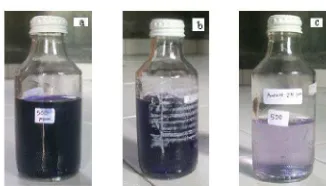
Biosorption of direct dyes solution by activated sludge consist of two steps : adsorption as non-enzyme system and followed by degradation as enzyme system [4]. In this research, biosorption was done by aerobic system using aerator as oxygen supplier for aerobic bacteria in activated sludge.Oxygen supply in biosorption process increased the lifetime of microorganisms in activated sludge. In general, steps in decolorization by aerobic bacteria were adsorption of matrix (plasma membrane) of aerobic bacteria followed by metabolite production (i.e. enzyme) by aerobic bacteria [5]. Plasma membrane of aerobic bacteria used to flow oxygen, nutrient, and waste in aerobic bacteria cell. The adsorption process could be seen by colour change of bacteria flok in activated sludge from grey to black. Aerobic bacteria used carbon and nitrogen from direct dyes solution as carbon-nitrogen source to support their life so the enzymatic decolorization occurred [6]. The process caused colour intensity and concentration of direct dyes solution decrease.
supply in aeration process very important to aerobic bacteria in activated sludge. Aerobic bacteria need oxygen to break down organic compound to get energy. The energy was used to grow and multiply cells [7]. Microorganism was able to break azo bonding (-N=N-) in direct dyes so the colour intensity of direct dyes solution was decrease.
Fig 1. Biodegradation of dye
Fig 2. (a) Technical Direct Blue solution before biosorption (b) biosorption without aeration (c) biosorption using aeration
[image:3.612.241.404.297.390.2]2. Effect of Biosorbent Mass
Fig. 3 showed that adsorption efficiency increase with the increase of biosorbent mass. It occurred both in Direct Black and Direct Blue Dyes.There were correlation between biosorbent mass and number of active sites[8]. The increase in the adsorption efficiency with biosorbent mass is due to greater availability of biosorbent surface area [2] and hence more active sites. The greatest adsorption efficiency values were found in 5 grams biosorbent mass both for Direct Black and Direct Blue dyes. The adsorption efficiency values for Direct Black and Direct Blue dyes recpectively were 40% and 32 %
3. Effect of Contact Time
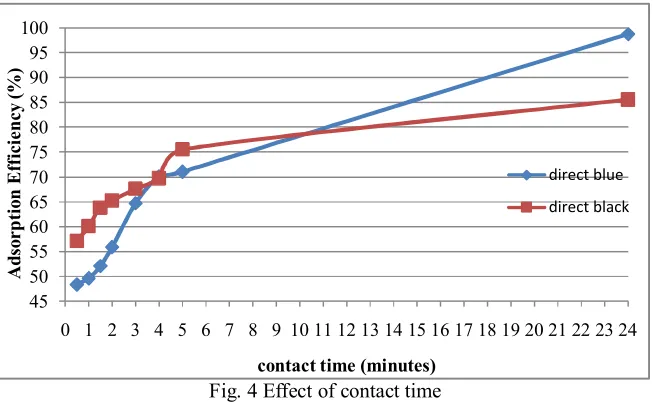
Contact time was time during adsorption. Fig. 4 showed that increase in contact time both for Direct Black and Direct Blue dyes solution caused the increase in adsorption efficiency. The increase of contact time caused active sites on activated sludge had longer time and also more chance to interact with adsorbate (Direct dye molecules) so the adsorption capability of activated sludge increased[9].
The increase of adsorption efficiency showed that some sites still active adsorbing direct dyes during 24 hours contact time. The greater adsorption efficiency values of Direct Black and Direct Blue solution occurred at 24 hours contact time and the values were respectively 85,51% and 98,73%
leading to maximum rates. But as the biosorption proceeds, the bulk concentration reduced approaching the equilibrium values and the rate decreased [2].
Fig 3 Effect of biosorbent mass
4. Effect of Initial Concentration
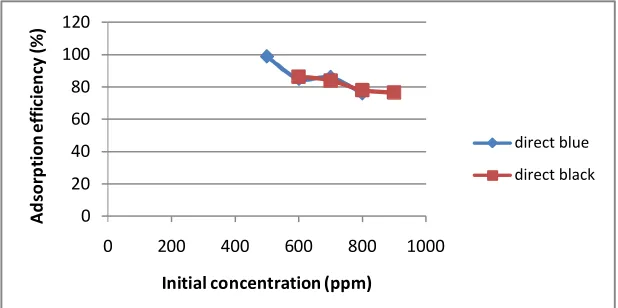
[image:4.612.143.470.427.628.2]Fig 5. Showed that adsorption efficiency decreased with the increased of initial concentration of Direct Dyes solution. The increase of initial concentration cause the actives site were full of Direct dyes molecules. Insufficient number of active sites available for the biosorption of all the dye molecules, lead to higher residual concentration in solution, with increasing initial dye concentrations
Fig. 4 Effect of contact time 5. COD values
COD value usually use to know whether an environtment was polluted or not. COD value was the amount of oxygen (mg O2) needed to oxydize organic compounds in one litre aqueous sample. The higher COD value means that the environment was more polluted. Table 1 showed that COD values in 600 ppm Direct Black and Direct Blue solution after 24 hours biosorption decreased. The result showed that aerobic bacteria in
10 15 20 25 30 35 40 45 50
0 1 2 3 4 5 6
A dso rption ef fic ie nc y % direct blue direct black
biosorbent mass (gram)
45 50 55 60 65 70 75 80 85 90 95 100
0 1 2 3 4 5 6 7 8 9 10 11 12 13 14 15 16 17 18 19 20 21 22 23 24 contact time (minutes)
activated sludge were able to decrease COD value of Direct Dyes solution. Aerobic bacteria did non-enzyme and enzyme process toward direct dyes so the concentration of dyes decreased. The decrease of direct dyes concentration cause oxygen amount to oxydize Direct dye compounds was lower.
Fig. 5 Effect of Initial Concentration
Table 1. COD values
Dyes COD value
Before Biosorption After Biosorption
Direct blue 28656,00 mg/L 4776,00 mg/L
Direct black 3184,00 mg/L. 1751,20 mg/L.
CONCLUSION AND SUGGESTION
The results showed that: the greater the mass of biosorbent, the higher the adsorption efficiency of activated sludge to technical direct dyes, the longer the time given to the process of adsorption, the higher the adsorption efficiency of activated sludge to technical direct dyes, adsorption efficiency decreases with increasing concentration of technical direct dyes, chemical Oxygen Demand (COD) value technical direct were decrease after adsorption process by activated sludge.
REFERENCES
[1] Neetu Sharma, D.P. Tiwari, S.K. Singh. (2012). Decolorization of Synthetic Dyes by Agricultural Waste-A review. IJSER. Vol 3 Issue 2
[2] Ratnamala and Brajesh. (2013). Biosorption of Remazol Navy Blue Dye from an Aqueous Solution using Pseudomonas putida. IJSET. Vol 2. No.1.
[3] (http://www.kelair.bppt.go.id/Sitpa/Artikel/ Tekstil/tekstil.html)
[4] Dewi RS. (2005). Potensi Bakteri Limbah Industri Tekstil Sebagai Agen Pendekolorisasi Pewarna Azo Sumber Pencemaran Warna Perairan. Prosiding Seminar Nasional dan Kongres Biologi XII: Yogyakarta, 19-22 April 2005
[5] Awaluddin. (2001). Biodekolorisasi. Bogor : Institut Pertanian Bogor
[6] Sharma, P., Singh, L., Dilbaghi, N. 2009. Optimization of Process Variable for Decolorization of Disperse Yellow 211 by Bacillus subtilis using Box-Behnken Design. Journal of Hazardous Materials. Vol 164. pp 1024-1029
0 20 40 60 80 100 120
0 200 400 600 800 1000
Ad
so
rp
tion
effi
cien
cy
(%)
Initial concentration (ppm)
direct blue
Wiley & Sons, Inc
[8] Puvaneswari, N., Muthukrishnan, J. & Gunasekaran, P. (2006). Toxicity Assessment and Microbial Degradation of Azo Dyes. Indian Journal of Experimental Biology. Vol. 44, Hlm.: 618-626