... ··- - ·--- .... ... ... ·--·-·-· - -- -····-·- -·'"--- -··- --
··-···-A THESIS
By:
WAHIDIN
PURBA
Reg. No. :045010143
_ _ __ _ .. _... ·--· ·- ·1:
\"r.JIIUK
PERPlJSlAKAAN ·
1
l
UNif\1!~~-1
Su6mitua
lo tfuqraluate
<Programojf£ng[isfi_7tppfiea£inauistic.s
In Partia[ t'f'ufl 'f[ment or · tMniom
ENGCISH APPUIED LINGUISTICS
GRAI)UATE PROGRAM
THE STATE UNIVERSIY OF
MEDAN
A THESIS
INTERPERSONAL MEANINGS IN RADIO DIALOGUES
Arranged by :
Wabidin Purba
Jleg.~o.045010143
English Applied Linguistics Graduate Program
State University of Medan
Consultan
I
Has been defended before thesis Examination
Committee, on August.
23"',2006
And declared to have fulflUed the requh·cmeuts
Approved
by
Coosultan ll
Dr. Lince Sibom bing, M.Pd.
Head
of
English
Applied
Linguistics
Directo
Progra
Prof. Dr. JawasiNaibaho
NIP.
t3 0 0 9 58 9 0
Name : Wahidin Purha
Approved on : August. 23"', 2006
1. Prof. Am rio Saragih, MA., Ph.D.
2. Dr. Lince Sihombing, M.Pd.
3. Prof. Dr. Jawasi Naibaho.
4. Prof. D.P.
Tampubolon, Ph.D.5. Dr. Berlin Sibarani, M.Pd.
ACI\.l'IUWLI!:ut.;£MENT
Th 1:s thesis is compieted dut: the guidance,. mot1vat10n, encouragement,
support, and help of many persons. l'ht: wntcr can mention oniy a l~w of them below,
to whom the wnter is very thankful and gratefu1, particuJariy to Prof. Amrin
Saragih, Ph.D, M A, and Dr.Lince Sihombing, M . .Pd at; his consultants who are
always
kind
and helpful to give strong motivation, spirit, correction,and
guidance.Similar thanks are due to Pro.D.P. Tampubolon, Ph.D, MA, Prof. Or
Jawasi Naibabo, Or. Berlin
Sibarani,
M.Pd and Dra. Meisuri MA, who havegiven lots of Important critical commen t ~, suggestions and recommendation m
improvmg h1s thesis.
A htgh respect is offered to all lecturers of English Applied l.inguistics anil
h1s classmates as the writer really has benefited much from their lecturers, and
d1scussion in class durfng my study.
The writer also would like to thank lo the Headmaster of Madrasah Aliyah
Negeri Luhuk Pakam who has given the permtssson during his S-2 program at
UNIMEO.
The most precious appret.:ialion IS expressed to all his friends in Post Graduate
Progr<lm of Applied Linguistics State University of Medan, Pa' Sanggam Siahaan,
Pa' Bloner, W. ~ . Clinton, Ka t Sempa and others, who can not be mentioned one
by one, lor their mtntai support, c:nwuragcincnt, and suggestion in writing this thesis.
Fmally th~ \VTllcr would like to express h1s deepest gratefulness to hi s family.
furba, lor the1r tidehty,
lov<;;,
understandmg ami care without compiainmg forless
anent ion g1vcn to them
during fimshmg his study.
God 131ess Us
Lubuk Pakam, Agustus 20Uo
ABSTRAK
Purba, Wabidin. 2006. MakDa A ntar persona dalam Dialog Radio. Pascasarjana Universitas Negeri Medao.
Tesis
ini
mengkaji makna persona dalam dialog radio, berda.sarkanpendekatan
teori
Linguistik Fwtgsional Sistemik. (LFS),
Tujuan peneJitianadalah
mendeskripsikan ti pepengguna
babasa,penggunaan
bahasayang
direalisasi:kan dalam
M ental Process,modalitas
dan epitet dideskripsikan danpesan-pesan da1am dia!og diinterpretasikn.n dalam realisasi antar persona.
Data dialog diperoleh dari Radio Republic Indonesia. Juni 2006
di
Medan.Metcxle pengumpulan dan penganalisaaan data adalah dengan teknik
observasi dan rekam kemudian mentranskrip data
yang diperole11
ke dalambahasa
tulisan, setelah menentukan data tersebut ke kelompok masalahyang
sedang diteliti . Dalam menganaHsa data, teknik LFS digunakan a~ dapat
memperoleh temuan tt..--muan
·tipe
penggunaan bahasa yang dominan daJamdialog tersebut Temuan temuan
tersebut meng.indik.asikan
bahwabahasa
dominant yang digunakan dalam debat adalah bentuk Mental Proses,
i an dominan adalab modalitas kebiasaan usuali dan
ti
epithet
yang
dominant digunakan dalam radio dialog tersebut adalahripe
evaluatif, yakni menggambarlcan nilai, fimgsi, fakta. nilai esteris. emosi dan
ABSTRACT
Purba,
Wabidiu.2006. lnterpenonsl
Meaniapin
Radio Dialogues. Tbcsis. TbePost Graduate
Program.
State of University Medao.The present th es is ~ that deals with interpersonal meanings JD radio dialogue, is
based on systemic functional linguistics (SFL) theories. The objectives of the study
are to examine the proportion of mcntaJ process,
Modality
andEpif
found andapplied in the radio dialogues. The most dominant proportion of Mental
Process,
Modality. and Epithet are derived and the messages in
the
radio dialogues areinterpreted through the interpersonal meanings. The data are obtained from the Radio
Repu"blik
IndonesiaMedao
broadcasting in June 2006. The radio di8Jogues arcselected as the
source
of data.Methods
ofcoJlecting
and anaJyzing data are observingand recording techniques and transcribing the data. then, determining the
da:fa
intothe problems highlighted. In analyzing the data, SLF technique is applied in order to get lindings of dominant proportion of Mental Process, Modality and Epithet. The
findings indicate that Mental prooess as an aspects of interpersonal mearnngs is
dominantly used. In addition to dominantly used the types of Modality and Epithet
are usuality and evaluative respectively. Tbe use of Mental Process ~
Modality,
and· fact that the s kers ke within of human mind, certajnt;y, a
subjectivity moral judgement.
z
TABLE OF CONTENTS
ABSTRACT ... . .. . ... .. ... -· .. . ... . .
ACKNOWLEOOEMENT . . . . . . . .. .. . .. .... . . . .. . . . .. ... .. .. .. .. . II
IV
LIST OF APPENDICES... .. ... ... .. . . .. . . . . . ... . . .. . . . .. . . .. . . . ... . . . v
LIST Of TABLE ... ... ... ... .. ... .... .. .. . .. ... . ... ... . ... . ·~ ... .. VI
CHAPTER ONE
CHAPTER TWO
: INTRODUCTION ... .. ... . ... . ... ... ... .
1.1. The Backbrround of the Study . .. . .. . . .. . 1
1.2. The Pro blem of the Study .. ... .... ...
6
1.3. The O~jectives of the Study ... .. . ... ... .... .
1.4. The Scope of the Study ... ... .... .
1.5. The Significance of the Study ... .. ... .
:RE VIEW O F LITERATURE ... ... . .. .
2.1. Theoretical Framework ... ... ... ... ..
2.2. Language and Social Context ... ... ... ... .
2.3. Interpersonal Meanings ... ... ... .
2.3. 1. The Process .... .. ... . ... ... .
'i/
8
10
2.3.2. Modality ... ... ... ... ..
16
2.3.3. Epithets .. .... .. . .. .... .. .. ... .. .. .. . ... ... IS
2.4. Radio Dialogues... ... ... ... ... 20
2.4.1. Power ... .... ... .. ... ,.... . .. .. 20
2.5. Radio . . . .. . . .. . . 26
2.5. 1. Radio Republic lnduncs1a .. . .. . ... . .. .. . ... . 27
2.5.2. A Nature of Family -Cl!nning . .. ... . .. .. . . .. 28
CHAPTER THREE :THE RESEARCH M ETHOD .. . . .. . . ... . .. .. . . 29
3 .1. The Re~ea r ch Design . .. .. .. .. . . .. . . .. 29
3.2. The Source of Data . . .. . . .. . .. . . . .. . . . .. . ... 29
3.3. The Techmques of Collecting th~ Data... . 29
3.4. The Proced ure of Analyzing the Oata . . .. . 30
: THE RESEARC H FINDINGS .. .. .. ... ... .. ...
31
4 . 1. Mental Process . .. .. .. . .. . . .. . .. . . . .. . .. . . .. . )l 4.2. Modality .. . .. . . .. . . . .. . . .. .. .. . . .. .. . .
33
4.3. Epithet . .. . .. . .. .. . . ... .. . . .. .. . . .. . . . .. . .. . .. . J6 4.4. Discussion . .. .. . .. . .. . ... .. . ... .. . ... .. . . 39
CHAPTER FIVE : CONCLUSIONS ANO SUGGESTIONS 5.1. Conclusions .. . .. .. .. . ... ... ... .. 5.2. Suggestions .. .. .. ... .. .... ... .. .. .. .. . ... . 41
REfERENCES . .. . . .. . . .. .. . . .. ... .. . . .. . . .. . . .. .. . . .. 42
LIST OF APPENDICES
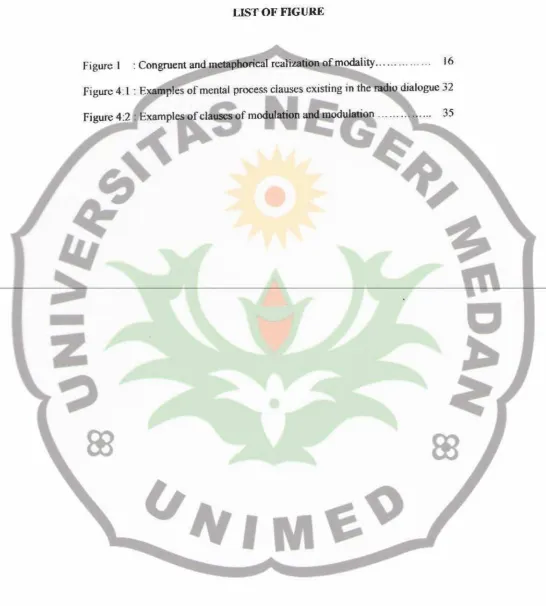
LIST OF FIGURE
Figure 1 :Congruent and metaphorical realization of modality.. ... .. ... 16
Figure 4:1: Examples of mental process clauses existing in the radio dialogue 32
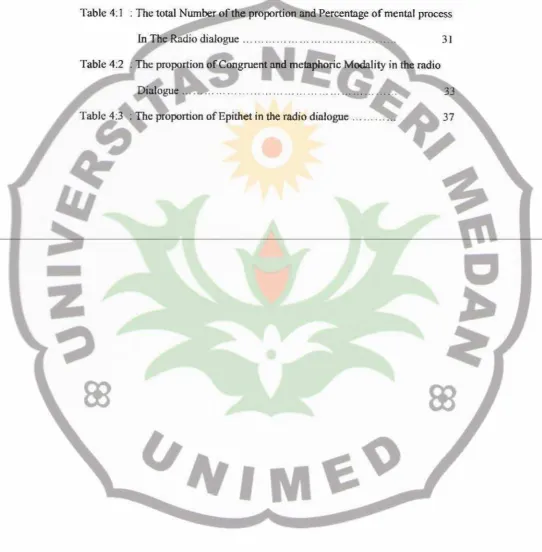
[image:11.612.30.577.84.690.2]LIST OF TABLES
Table 4:1 : The total Num~r of the proportion and Percentage of mental process
In
The Radio dialogue . . . . . . .. 31Table 4:2 :The proportion of Congruent and metaphoric Modality in the radio
33
[image:12.612.33.576.133.685.2]CHArn:.K Oi~~
IN 'l 'KUOLJCI 'I()N
1.1. The Background of the Study
Language
is the best means ofselt:..exP.ression.
1t is through language thathumans express their thoughts, desires, emotions, and feelings ; it IS through tt they
store knowledge, transmit message,
transter
knowledge and expcripnce from oneperson to others, from one generatiOn to another. It is through it humans mteract or
relate to each other. How well
interacllons
are doneby humans
are realized in the 1.1seof language. Thus, a study on the el1t:ctivcness of interaction can be done
by
a stuqyon the use of language. Specifically, the effectiveness of interaction can
be
donC'through the study of interpersonal meaning.
Language
is a social phenomenon. It IS a set of conventionalcomrnunicalJve
signals used
by
humanstor
wmmunication in a community. One learns a language asmembers of the society because one wants to understand that society, or lo be
understood
by
that speech community. lf a language is not used in any socit:ly, itufus
out.
Language
use
is a soc1al event. ft can fully be described only if one;:knows
allabout the people who are involved in it, their personalities, their beliefs, auitudes,
knowledge of the world, relationship to each other, their
sociaf
status, what activitythey a re engaged in, what they are talking at all1 what has gone before linguistically
and non-l inguistically, what happens after, what they are and a host of other facts
Radio is an audio medium, cheap. ponable, and audible.
One
of its functionsin indonesia is to educate people. Radio programs report facts, opinion, whtch arc
val ueablc, interesting, and 5>ibrnificant to many people. ln the radio dialogue on family
planning program, there are t()ur people involved in tts progtam They are (I) Radio
Announcer, t2) Radio Reviewer t13KKBN Officer). {3) Expen on Radio Reviewer,
and Radio Listeners.
Radio program
is chosen
by 13adan Koodinasi Kcluarga BerencanaNasional
{BKKBN) for broadcasting its programs, becau5e of its medium in sending its
messages ro the fndonesian condition related to culture. Jn Indonesia, discussi ng
sexual lite openly in the presence of children is quite ''taboo".
One way to bridge the gap in giving intormaliOn on the family planning
caused
by
cultural constmints "'taboo .. in lndont:sia such as tn North Sumatera, isusing a radio on dialogue interactive is one way to express their gtving and
demanding
infonnation.
Socially, a radio is a very popular language channel used by the sociecy" to
communicate and seek
tor
the information to innovate thelite
quality standard.Howevt!r, the communication proc~s5 usc::d by the:: radio speech community need to be
co,nceptualizcd
tor
thethcorcucal
and practical functions. A speech commumty is agroup of people using the same language rules of the same language in sociocultural
communicative mtcraetton. (Hymes, 1994 ).
A language basica lly
func uons
to convey meaning urtcred by a person toanother one. ijy m eans of language one can convey h1s feeling, tus opinion toward
the readers or hearers can rccetve the miormauon effecuvety. 1 he message can be
understOod 1i" the readers o r hearers are mvoived m the comext o i" sttuauon where rh e
ianguage ts used.
i iow J:X:Opie use language, what meanmg they want to ~,;onvt: y anti what
elements of imgutsuc structure to refer to m a cerram comext can be anaiyze<.i by
appiymg system u.: iuncuona i grammar (SFL) theones. r uncuonai rheones na ·e three
distinct systems ailhough closely related senses: in itS imerpreta uon t i ' of l exls, (2 )
ur the system, and (3) of the elements of iinguistic srrucmre. Funher .flaliiday
elaborates that:
( l ) Language is functional in the sense that everything in the ianguage can oe
explained, ultimately, by reference to how language is used.
(2) All languages are organized around two main kinds of meaning,
' ideational' or ret1ective, and the ' mterpersonar or active. The components belong to
' metafunctions· , that is, to understand the environment (ideational) and the act on the
others in it (interpersonal). As the combination of the two is called ·textual',
breathing relevance into the other two.
(3) Functional grammar construes all ihe units of a language-its clauses,
phrast.:s,
and so on as orgamc configurations of funct1ons . in other words, each panis int~rpreted as functional
with
respect to the whole.from the elaboration above, it can he said ihat it is through fun~ tional
grammar thal any language can be interpreted through its text, system and the
elements of lmgUJstH; structure used. Interpersonal is denved from the word
mevnat>ly c:n a~..:t one 01 the
speech
ro t ~::s mtendeo ana tm erprcleO as a statement.q uestton, command or otter. I he speaker s role can be seen
m
the speech Sttuau on,hts personal t:urmllttment and tnteracl1un w nh others ( i lali u.iay, I~ 12 :":J':I and
Thom son, I Y96 .61J).
Further Halltday state s t hat the cla use ts a lso orgamz.ed as an mlcracuve event
mvolvmg Spt!Hkcr. or wnter, and audience. And he also states that the m...ost
fundamental types of speech role, whtch lie behand all the more S'J)eCt1ic ty pes lhaL we
may e ventually be able to recogn•ze, are JUSLtwo. (1) gavmg. and ( II ) demanding.
Butt ct all ( 191}5:64) states that mte~rs onal meanmgs cover two main art:~.
tlrst . , . concerns the type of interaction which takmg place the kind nf
commodity whtch ts bem g exchanged. The second, ... concerns the way the speakers
take a pos1t1on m thetr messages.
In Indonesia, a radio is strategic mcdta used by the government to
communicate t he government's program, such as the tamtly panning program. ln
.Medan, the Radto Repubtik lndonesta ts one of the pubhc
rad1o
stauon,ti.mctwns
asthe microphone of the government to commumcate the government messages to
Indonesian cittzcns. The mc::ssages may contam facts, ideas. hopes of the
dt:xdopments m any sector such as c ulture, educatiOn. economic , health and
family
p l anning pro gr;:t m ~ . One
intcrcstmg
phenomena m the commumcau onts
m thetopao
of the lamily planmng. The government seems to pay attent1on in this program
senous ly. Th1s essence as realt:ccd th the way 11 IS communtcated m Rad1o Republik
lndonesta. For tllc sake of th1s thes1s, a survey ts conducted to tdentit)' how the
Indonesia Mt:dan. l hey regularly conduct a senes ot rau1o diaiogues oroa<lcasied
tw1ce m a
momll. Compan ngw the
other governments
pro!:,rrams lor mstance,Kadio
l<.epubllk
lndoncs1aMe<laR" only
acctdentally broadcasts messages m economy,culture, polttrc, etc I hey only oroad(;asl m the headtmes news. I hey arc not deSt!,,tned
m a
spec11ic prof,rram suc h as tn rad 1odialogues.
Thcorcttcall), a research m rht: llt:ld ot l mgm s uc~ can be con<Jul:tcd to otter a
solulion to the problem ot the
consc1ous
know ledge otthe
speech commumryot
Radio Rcpubllk Indonesia on the t:.umly planrung message of the
.,government
broadcastcd
m
th.e rad1odtalogues program.
Accordmg to Halliday ( 1994)language rs
a set of rules used
byhuman
tocommunicate and mterpret meaning. Further, it
i~~dthat a ctause
1s
the smallest lingutsttc urut used to measure humanexpenence.
An
tnterpersonal
meaningof
a Janguagc ts rea hzedby
theMental
Process.Mental Process reters to verbs
ind icatmg
perception, atlectJon,and
cognition.f'he Modality is known as the
mterrm:diatc
degree between the posauve and thenegative. In general the term modalaly ts used as stgns of speaker's opmton. The
Modality includes
probab1hty,
usuality, known as modalt7.atton, mchnation andobligation. The modal ity
can b~seen
congruently andmetaphorically. It is said
con!:,rruent when
modal
verb operatoras
apphed mthe
clause and the uses ofadJunct
such as; prubub/y, c ltrtam~y. ulwuys and the use ot modal
grammatical
metaphorsucn
as 1 think .- . 1 hd t~ ve a rc used m metaphoncal modalay T he
Epithet indtcates
some quality
or
rhc subset cxprcssmg tb ~ speak'er attitude that represents anmterpersonal element m the nommal group. rhe F.ptther mclu-des evaluauve,
etlect,
I)
order to lind oui, whtch Epithet 1s apphed m the radio matogucs on tile ram1iy
planning program.
Tht: rt:asons tor studying interpersonal meanings ust;d m the radio programs
are
as
foilow.I. Radio dialogues arc one of the many ways to communicate pohcy of the
governmt:;nt to citizens logically and systematically.
Analyzing radio dtalogues on the Hunily planning program is meant to
tina
out the proportion of Mental Process, Modality and Epithet applied.
Analyzing rad1o dialogues will encourage other writers to make further
research m diftcrcnt filed of writing.
1.2. The Problems of the Sludy
z
I. What is the proportion of Mental Process used in radio dialogues on family The problems are fonnulated as the fo llowing:planning program of the Radio Republik Indonesia?
2. What is the proportion of Modality used in radio dialogues on family planmng
program ofthe Radio Repuhlik Indonesia?
3. What is the proportion of Epithet are applied to realize reaction in radio
I
l.J. The Ohjectiv~ ol the Study
In
relatiOn to the problems. the OOJectJves of th1s research are:I.
lo t.:xammc
proponionof
Mental Proct:ss in the radio dialoguesprogram.
2. to discover the proportion of Modality in the tadi"' dialogues, and
Y. to mvcsttgate the proportion of Epithet to realize
the
reason in therad1o d1alogues.
1.4. Tbe Scope of the Study
The study applies the theories of Sf .F as developed by Halliday and otner
systemicists. The analysis is aimed at observing speaker' s roles in the speech
situation and interaction with others. These can be seen in one of the component.-;; of
functional linguistics, interpersonal m eanings that include the Mental Process.
Modality and Epithet, available in the radio dialogues on family planning program on
Radio Republik Indonesia Medan.
13ased on that, the study is conducted in order to obtain the data describing the"'
proposition
of
the Mental Process that is dominantly used, Modality and Epithet inthe ~ adio dialogues on tamily planning program and the describtion will give some
useful mterpr~talions that can lead to the
findings
required in the study.1.5. The Significance of the Study
i"he tindmgs of this study are expected to be significant -in two respects,
SFi ., panicuiariy on the use of indones1~m spoken ianguagc. Pracucaiiy, tile i'mumgs
wiil be helpful tor the audience m undersrandmg the programs. Funhcrmore, the
findings would be of some use tor the radto broadcasters who are in charge of
5.1. Conclusion
CHAPTER FIVE
CONCLUSIONS AND SUGGESTIONS
40
After analy:ling the data on the radio dialogues, conclusions are drawn as
follows:
I. The dominant proportion of Mental Process used
by
the speakers in the radiodialogues, m~ns that the types of experience negotiated in the. text is
dominately used by the action within of human mind. Further,
it
means thatthe function of the speakers is to develop both the nation and eowJtry.
The dominant proportion of Modality used by the speakers five seventh of the
total clauses in the radio dialogues means that the speakers have certainty
towards something and give some logical and real predictions in expressing
the arguments.
3. The dominant proportion of Epithet used in the radio dialogue is eight
eleventh of the total clauses, implies that in expressing the arguments t~
speakers are influenced
by
their subjectivity in judging, giving facts, value,-II
5.2.
Suggestions
z
':)
In relation to the conclusiOns, suggesttons arc staged as tollows:
It is suggestt!d lor other researchers w ho wanl to conduct further studies on
interpersonal runction to apply different criteria to have more extended
studies.
2. lt is suggested lor the BKK~N Officers who are a l ~o get mvolved m the radio
d ialogue should be more certain to every explainalton
that
he/she delivers,seems BKKBN mfonnation as in thei r field.
3.
It
is suggested for that the radto listeners in the radio dialogue should learn theuse of metaphoncaJ expressiOn in the radio program
by
which they cani .
Hng.tl<lll ~- i'( !'N1 . t)l/( t / 1/u!J n ' ,., .,~ ' ll l' lh tu r / . i!ltlii/IJ/1. <lltll!lr o dllt l t <~li ' " Jih 'n ! T und .I h •t
1•'"' -
Nc•Xiharn I k1ghts · ·\11:-·n and l)actm.Bun. 1 aht:~ .">p111b <tnd Ynllop 1\N.' 'lll.t~ J· llf tttnll<'li 1
,,.t'!"'''ur
In ,._\piul('! ' _,fl'"'"'
':-.\ O il(\ iVlacquan .: tinJ\ersJI\lla l lid:n. \.\.-\ K 147.2. _,,, illfl·,.tfulflu t l 111 i IIIIL! Juoul < 11'<1111/llw IPnr<ion Ld\\ard
:\rnt,ld.
Arnold.
1\fY~ . In ! mruciucflo/1 '" l-lfl7<'11111t<tl I , r o/1/1//tlr l.l'•ndon · 1--.<.h
ani
Arnold.
H:- me!'. Dell. I 11 7-i I ounda11on tn :) ()\: whngm~tJcs . An Hhnograph1c :\pproach
Phdaddplli<L Un!\t·rsJt,;. of Pen ns~ · hanw IJn:ss.
'>h1t'fman . .lert~lll\ .200(l ! 'o l!tt, ·ul mtJJlt Jg<'111< ' lil 111 lilt' indti/1<!.\1<111 }11/JI I Il ' l ' icommg
i 'rn, .. !.I'U/11. l)nn ~:r $itas lnc.J(m~sia.
L<\t~lli~. l'.l'< and ;\tktnS(ln. ~.D. 198-L .\./edru und letlntut".'.!,.\ f ur i .ilt<'IIIUIII '"111
i IW/1111.!~ . U h1 o· lkll and I lowell
\ ;lanin . .II\ IY'-J2 i-.n ,t ~i , _,fl ,,.,.,_.
·'Y-'"'IIl
and .\truc~w-.. · . :\msterdam. John Lknptnin!'1'-J '-~.~- t\ Comcxwai Tt11 ~ory
or
Language. In c·op..:. lL !Vlar~ ~ iantzisteds 1 / /iL' l ' rllt c r of ! . tlero, T : a .lf.l' llre oppruucl! '" l t'<h 'i/111.!:. 11 rtf II'-!!.- Londwl'
I h.; 1-'almcr l'rcss. I 10- 136
Rohani. i\ . 14Y7 . . ~ IL ·dw l ih!!'Ut , ,u,,ui Fclukullf. Jakarta · Rineh.a iln1u.
Sara!_',th. 7\ l'J'J ~ ·l .\flu t 1· r.Jf l< c~Tifl _ t · .- ktrmt ,:, ld H t ':i:.:f /( 11/. M.:l bt-lWrh.·. La 'l wbc
~ 1 11): . i1rll lrl\ rl llcliUili/\.111//( 'A' \ .'>rl.\/(1/ i"t ' Jhi<'li <l/dl/ i .i ll,'.!.lff\lii-: / ' 1111_'.!.\/IJ/Itll
·' ' '' ' !'Iff.' i .-rl l ,!cfttf ' / <i t t! Nul/.t.\t t ritlll li :lu/1/d . :\h: ll ~ ll l I 1~:-- i \.li\.11 IJ
Suc.tana ntn i'fl'-1 i 't\' Utli tlf · ( ihj L·;., dollllll i1llll< i.' t ' ! ndullt " \ h t 1\t ' \ o' lil l't l.\ t /Jl ! ' Pi<;
f ·ntloJ! . .l a~at ta :f ~w mhawn
l ud,i..T ( i i I I~NX . Th~ Lt.::-\i\.'tlgrummar ol i \dJ~Cll \ t.:s