Internet Addiction
Nicola F. Johnson
(7 September 1978 – 28 December 2007)
The Multiplicities
of internet Addiction
The Misrecognition of l eisure and l earning
n icol A f . Johnson
All rights reserved. n o part of this publication may be reproduced, stored in a retrieval system or transmitted in any form or by any means, electronic, mechanical, photocopying, recording or otherwise without the prior permission of the publisher.
n icola f . Johnson has asserted her right under the c opyright, d esigns and patents Act, 1988, to be identi.ed as the author of this work.
published by
Ashgate publishing l imited Ashgate publishing c ompany
Wey c ourt e ast s uite 420
u nion r oad 101 c herry s treet
f arnham Burlington
s urrey, Gu 9 7pT VT 05401-4405
e ngland us A
www.ashgate.com
British Library Cataloguing in Publication Data
Johnson, n icola f .
The multiplicities of internet addiction : the misrecognition of leisure and learning 1. internet - s ocial aspects 2. internet addiction i. Title
303.4'833
Library of Congress Cataloging-in-Publication Data
Johnson, n icola f .,
1976-The multiplicities of internet addiction : the misrecognition of leisure and learning / by n icola f . Johnson.
p. cm.
includes bibliographical references and index. ISBN 978-0-7546-7496-2 (alk. paper) 1. internet addiction. i. Title.
rc 569.5.i54J64 2008 362.196'8584--dc22
List of Tables vii
Acknowledgements ix
introduction: Addiction: it Got Your Attention 1 1 internet Addiction: c ontrasting Viewpoints 9 2 When d o We s ay ‘Too Much’?: Being c autious About ‘o ver-use’
and Virtual r eality 27 3 Technological d evelopment and c hildhood play:
The c hanging n ature of e veryday l eisure 39 4 Bourdieu’s Theory of practice 53 5 introducing s ome Teenage Technological e xperts: d igital insiders 65 6 The Blur Between l eisure, l earning and e xpertise 77 7 internet Addiction in the l ives of Teenagers 89 8 n ew f orms of privilege 101 9 Misrecognition of the practice of l eisure 113 c onclusion: r eframing our Gaze on internet Addiction 123
References 133
Figures
1.1 c ontinuum of dispositions 19 10.1 c ycle of addiction 128
Tables
i am greatly indebted to Kylie s anders who out of the goodness of her heart, read each chapter for me and was very encouraging of my efforts.
Many thanks to Professor Chris Bigum and Professor Tara Brabazon who have provided wonderful support during the nascent stages of my academic career. Thank you to my supervisors Dr Leonie Rowan and Dr Julianne Lynch and my thesis examiners who provided critical feedback on earlier versions of some of this work.
Thanks goes to the Faculty of Education staff at the University of Wollongong who have proved to be very supportive in various ways as I seek to establish my career.
Thank you to Lesley Knapp for the desktop publishing of the figures within this text.
Many thanks goes to Russell Walton for his outstanding proofreading work. Thank you to my parents Warwick and Suzanne Johnson for their support and their belief in me.
Addiction:
it Got Your Attention
popular cultural pundits, theorists and journalists posit the overuse of the internet as problematic, addictive or disruptive. in our daily lives, we hear stories claiming that online use interferes with relationships and that it is not healthy to spend ‘excessive’ time in front of computer screens. People joke about suffering from withdrawal if they cannot check their emails. Some parents worry especially about their children’s use of computers and wonder whether it is to the detriment of other life experiences normally associated with childhood. is it possible that people, some young and some not so young, are addicted to computers and internet use?
On 19 September 2007, I watched an Australian current affairs breakfast show called Today. They discussed virtual worlds and focused on a particular virtual online world popular with children below the age of 12. in featuring d isney’s™ ‘Club Penguin’, one of the first questions about the game was ‘Is it safe?’. The answer was yes, but the question seemed to be based on a premise supposing that a virtual world of play would justify caution. The discussion then focused on the amount of usage deemed to be o K for playing ‘c lub penguin’. What happened next seemed to be a typical link associating high usage with consequent addiction. In asking ‘what about addiction?’, the question was positioned to be ‘natural’ and ‘normal’ to ask of a person who had limited authority to comment on the issue. However, the digital media ‘expert’ (brought in as a regular guest on the show) stated that limiting children to three hours a week was suitable or preferable. What a simplistic answer to a complex issue! It is unlikely that any child will be disadvantaged and have ‘bad things’ happen to them because they play ‘c lub Penguin’ for more than three hours a week. Having a blanket answer for parents to act on suggests not only that parents lack intelligence and require specific directives, but that all players of ‘c lub penguin’ should have the same limit on their leisure. s hould we say that children should only play in the playground for three hours a week? Longer than that, they are bound to be addicted! Should we say that children should not watch television for more than an hour a day because they are likely to become addicted? Labelling someone as ‘addicted to the Internet’ negates their ability to comprehend and critique their own practice. Children and youth are capable of monitoring this. These ridiculous, surface solutions to preferred types of leisure are not aberrant in their ‘safe’ form.
revert to essentialising everyone and everything. Bob Pease (2000, 26) explained essentialism as:
A belief in fixed properties that allegedly define the nature of things, leading to the idea that women and men can be identified on the basis of eternal, transhistorical, immutable essences … for example women being more peace loving and closer to nature than men.
e xamples of essentialism are common within the media. Those who are selling their books to save or rescue people from internet addiction are capitalizing on the popular discourse that suggests internet addiction is rampant and becoming an extremely widespread disorder. The sensationalized and essentialized headlines claiming that poor little Johnny or s ally may be addicted because he or she plays ‘Club Penguin’ for more than three hours a week are causing people to worry about things that may not be worth worrying about.
This chapter introduces the topics to be covered in this book and focuses on the idea that ‘addiction’ is a contestable, misconstrued term. The term ‘dependence’ will be challenged and contested, as will the idea of what constitutes ‘too much time’ on the computer.
The Notion of Dependence
Are we dependent on technology? is dependence a form of addiction? if addiction is determined by degrees of dependency, we can argue that we are addicted to our bathroom, we are addicted to television and we are addicted to using a kettle to boil our water. it is not that we cannot live without these things; it is that these new technologies have been impressed upon our lives and that most of us choose to use these technologies to make our everyday lives easier. People refer to certain web browsing or surfing the World Wide Web as wasting time, but could we not argue that working through a book of Sudoku puzzles or crosswords is also wasting time? Advocates of these puzzles would probably deny this allegation and claim that by getting one’s brain to think through puzzles or crosswords, one is developing cerebral activity whilst engaging in a leisurely activity that helps one to relax and fill in time. To counteract this, I claim that engaging in website activity helps one to relax and fill in time. If that is ‘time-wasting’, then that is OK. However, when one reads and views websites – whether it be BBC news, or Facebook or finding out the latest results of a sports tournament – one is learning at the same time one is engaging in leisure. I will continue to argue this throughout this book.
praxis. Tapscott (1998, 116) raised the issue of addiction and stated, ‘If you ask children online if they are addicted, they will invariably say yes. o n the other hand, they don’t seem too concerned about it because they don’t believe that it’s harmful to them’. h e also added that it is hard to argue that this activity is harmful, unlike dependency on drugs or nicotine. If one plays a lot of tennis and is always
at the tennis club, if one is always watching television or if one is always reading a book, why are those people not also considered to be addicted? The reason for this is the common occurrence that happens when a new technology is introduced and becomes ‘mainstreamed’. people are not sure about the acceptability of the practice and about its possible side effects. This is a natural and commendable suspicion. What I would like to point out is that the possible side effects of people’s involvement in online activity and even in having a home personal computer have not occurred. The side effects predicted with the advent of the radio did not occur. The side effects associated with the advent of the television did not occur (see Chapter 2). Of course, one should admit that there will always be those people who are loath to do anything other than sit on their couch and watch television. But are they addicted? n o, probably not, it is just that their preferred leisure is readily available right there on the couch. But what about their need for a healthy lifestyle? This is an important question, but there are many people who are neither couch potatoes nor have a healthy lifestyle. The need to eat healthily and in a balanced way, coupled with the need for everyday exercise is a challenge that many of us struggle with.1 One of the problems I seriously address in this book is that the
notion of addiction is readily and too easily thrown about in popular discourse. The media is full of it, and to assert that addiction is present is a simplistic and incorrect answer in regard to prolonged engagement with many technologies and activities.
c onsider the example of gamers who regularly and constantly engage in playing video or computer games. Those of us who do not play these sorts of games find it difficult to understand the appeal for these people who constantly play electronic games. Many of us would look down on these gamers who seem not only preoccupied or obsessed but perhaps also addicted to playing these games. h owever, as a counter-argument, in the gaming world, gamers must not only dedicate mountains of time to learning how to play the game effectively, but they relish the challenge of each narrative and the prospect of further mastery (Johnson, N.F. 2007a). For other gamers, they view their fellow successful, top-ranking peers with respect as they value their enterprise, focus, determination and skill that has constituted their success (for example, an international top ranking, high power within a category). I will return to this argument in Chapter 9 where I focus on how the values of one .eld may not apply to another.
The following excerpt from an online article gives insight to my argument:
Surfing the net has become an obsession for many Americans with the majority of US adults feeling they cannot go for a week without going online and one in three giving up friends and sex for the Web. A survey asked 1,011 American adults how long they would feel o K without going on the Web, to which 15 per cent said just a day or less, 21 per cent said a couple of days and another 19 per cent said a few days. Only a fifth of those who took part in an online survey conducted by advertising agency JWT between s ept 7 and 11 said they could go for a week.
‘people told us how anxious, isolated and bored they felt when they are forced off line,’ said Ann Mack, director of trend spotting at JWT, which conducted the survey to see how technology was changing people’s behaviour.
‘They felt disconnected from the world, from their friends and family,’ she told r euters.
The poll found the use of cell phones and the internet were becoming more and more an essential part of life with 48 per cent of respondents agreeing they felt something important was missing without Internet access. More than a quarter of respondents – or 28 per cent – admitted spending less time socializing face-to-face with peers because of the amount of time they spend online. it also found that 20 per cent said they spend less time having sex because they are online. (Reuters 2007)
f or those of us that identify with the idea that they are missing out if they do not go online once a week, this does not mean that we are addicted. However, it does suggest that we, as twenty-first century participants, are dependent on technologies because they make our lives easier and we prefer to use them rather than not.
The Notion of Addiction
‘Facebook can be pretty addictive!’
Sam is ‘wondering whether the addictive nature of Facebook makes it a banned substance??’ (status update)
Jenny is ‘spending waaayyyy too much time on Facebook’ (status update).
The phrase ‘i’m addicted’ merely conveys that one is enthusiastic about it and perhaps just really likes having this ‘thing’ or ‘environment’ in their life. In fact, the phrase ‘i’m addicted’ is a misnomer; they are not addicted as addiction causes serious detriments to happen if one does not ‘kick’ the addiction. We need to encourage people to carefully use these phrases and think about what it actually means to be addicted, and whether high usage and high dependence constitutes addiction or not.
c hapter 1 discusses the nature of addiction, whether one can consider a lot of Internet use to be addiction, and critiques the notion of Internet addiction itself. There is much discussion as to whether Internet Addiction Disorder (IAD) (Young 1998) is actually a legitimate disorder, or whether it is an indication of other problems (Yellowlees and Marks 2007). Competing discourses include those who argue for specific behavioural therapy techniques to be used to treat Internet addiction as a pathological disorder (Young 2007), alongside those that claim further research needs to be conducted before the establishment of a disorder (h uisman, van den Eijnden and Garretsen 2001). Some say the Internet is an environment; therefore it cannot invoke addiction, and that addiction can only be attributed to substances. c hapter 1 will discuss the established criteria for diagnosing disorders such as impulse control disorders, obsessive-compulsive disorders and substance abuse, and contrast this with popular discourse that inadequately falls back on the phrase ‘internet addiction’ to identify practice. d emonstration of the serious disorders surrounding gambling and pornography will highlight the inconclusive reasoning of IAD. Glasser’s (1976) notion of ‘positive addiction’ will be elucidated, as well as the view that for some addicts, the internet is the place where they conduct their previously chosen addictive behaviour (Griffiths 1999; Widyanto and Griffiths 2006). The phrase ‘Pathological Internet Use’ will be introduced as a preferable alternative to the phrase ‘internet addiction’. The notion of temporary obsession will be discussed and offered as an alternative to the knee-jerk label of addiction. As one influencer on the claims about Internet addiction is ‘too much time on the computer’, it is important to address this presumption. After viewing this chapter, readers are likely to concede that this area is indeed complex, and that addiction is a serious matter.
in c hapter 2, i identify and discuss some criticisms of high usage, and the possible side effects. Many of the criticisms were made in the late 1990s and it is fair to say that these possibilities are not actualities. This chapter probes potential problems as a result of ‘too much’ computer use. it discusses the issues surrounding
setting limits on young children and youth in regards to their computer usage. it puts forth the sceptics’ views of the dangers of technology, those that prefer ‘virtual lives’ to biological lives and just what does constitute ‘overuse’.
c hapter 3 discusses concerns about the state of childhood as it once was, and whether children are missing out on the ‘good old days’ through the dominance of technology in western society. in featuring the development of technology throughout history, i show how the digital age is a societal development occurring in similar ways to the move from the agricultural age to the industrial age and to the print age. Through demonstrating that throughout history society has been suspicious of new developments and the effects of technology on everyday life, the chapter claims it is inevitable that society is now suspicious of people who spend many hours of their leisure time using the internet.
As this book builds on and develops Pierre Bourdieu’s theory of practice including the concepts of habitus, field, capital, doxa, misrecognition and
hysterisis, c hapter 4 gives the reader a brief, yet important overview of the f rench
social theorist’s writings focusing on the fundamental concepts of habitus, field
and capital.
c hapters 5–9 focus on understanding the practice of leisure and its blur with learning, evident in this digital age. it argues that the phrase ‘internet addiction’ actually constitutes Bourdieu’s (2000) notion of misrecognition for those who are not avid users of digital technologies.
Chapter 5 presents the recent qualitative study I completed involving eight teenagers in n ew Zealand. These teenagers demonstrated their expertise in their use of a personal home computer and the internet. The study focused on how the teenagers became technological experts and explored the types of practice and leisure common in the lives of contemporary youth. This chapter discusses the perceived and actual differences in perspective and approach between those who have always had computers and digital technologies in their lives (digital
insiders), those who have not (digital newcomers), and those who are indifferent
to digital technologies (digital outsiders).
in my study, i found that for some young people, online engagement may help to develop technological expertise. h ome computer use is a site of learning, leisure and an important social networking tool. The everyday practice that digital
insiders engage in will be described, including how they learn while engaged in
the leisurely use of digital technologies. c hapter 6 delineates the field of home computer use for leisure.
addiction is readily and too easily thrown about in the public consumption of media. This chapter gives real-life examples of this discourse based on recent research. It also identifies the habitus in the field, the doxic practices in the field, and discusses whether addiction is really the case according to Bourdieu and his notion of hysterisis. Through introducing the idea that addiction is misrecognized, the book’s argument suggests that some forms of leisure are also misrecognized. To (mis)recognize something is to (not) ‘acknowledge the existence, validity, or legality of’ someone or something (Macintosh Dictionary Widget 2008).
There are significant influences on cultural, social and economic capital in the lives of young people today. o ne of the many privileges that digital insiders
have is internet access, along with personal computer ownership. c hapter 8 draws attention to the views surrounding privilege in this digital age, and highlights how these new forms of privilege may not only boost both formal and informal learning opportunities, but perhaps induce important self-efficacy in this digital age.
Many young people seem to have a limited connection with their schooling and associated experiences. The students know they should succeed in school, yet school seems to be situated in former fields associated with a print culture, or print-based literacy, which is at direct odds with the digital culture in which they are positioned and the digital literacy that they are developing. c hapter 9 claims that their daily engagement with digital technologies constitutes a practice of leisure, closely aligned with learning and the possible development of expertise. i highlight some of the moral panics and digital myths surrounding the misrecognition of the practice of leisure.
internet Addiction: c ontrasting Viewpoints
There is an extensive amount of literature on addiction to sex, gambling, pornography, drugs and alcohol. n eedless to say, some cases are acute and serious. However, there is a growing amount of questionable literature that suggests Internet addiction is an actual treatable disorder (Block 2008; Ferraro et al. 2007; Gavin et al. 2007; h ardie and Tee 2007; l i and c hung 2006; pinnelli 2002; Wu and Cheng 2007; Young 2007).
Before I continue, it should be acknowledged that within the Internet environment, sex, gambling and pornography are readily available and of course, can exacerbate one’s emerging or existent addiction. it seems the internet provides a lucrative opportunity for some to make money out of selling and providing still and moving images that objectify and belittle women, as well as demean sexual intercourse. o ne of the provisions of the internet is anonymity and being able to access chat rooms (or the 3-D chat room ‘Second Life’) to engage in cybersex allows people to do something considered taboo, within a space they feel is safe. s ome of these people would never consider being sexually involved with others in a ‘s wingers’ type modality, however the anonymity associated with the internet means that, for some people involved in cybersex and/or viewing pornography and participating in online gambling with a false or virtual identity, the availability and likelihood of this participation is enhanced. If people are already interested in gambling, pornography and paedophilia, there is no doubt that the internet advantages them in their further use and exploration of these avenues.
There are many competing discourses or approaches to internet addiction, including preferred descriptors. Multiple views of internet addiction claim it to be:
r eal and is as addictive as drug addiction.
A play on words, an interference with meaning that is questionable. n on-existent, as it is an environment and not a substance, but it enables people to act out their previous addictions or addictive tendencies.
Not the issue as high frequency use is a lifestyle choice and vocational expectation.
At one end of a continuum of addiction.
Better suited to being titled ‘pathological internet u se’. •
I now focus on addressing and critiquing each of these discourses in respective order.
Internet Addiction Does Exist
Many people are convinced that ‘internet addiction’ does exist, but it is possible that some of these advocates might be making money from promoting Internet addiction as an actual disorder. The aim of this book is to criticize the facile generalizations about internet addiction that seem to be so common throughout the media. These generalizations can, unfortunately, be found in numerous pseudo-scholarly works.
d r Kimberly Young is the leading proponent of the existence of internet Addiction. Her books Caught in the Net: How to Recognize the Signs of Internet
Addiction – and a Winning Strategy for Recovery (1998), and Tangled in the
Web: Understanding Cybersex from Fantasy to Addiction (2001) are based on
the premise that internet Addiction does exist, and that she is able to help those who are addicted through advice and through attendance at her c enter for internet Addiction Recovery (see CIAR 2006). As this chapter elucidates, Dr Young’s means of determining Internet addiction are questionable. While Dr Young’s Internet Addiction Test (IAT) may have been relevant in 1998 when the book was published, it is possibly not as relevant now because of the permeation of the internet as essential to one’s job and as a means for one’s improved personal communication with friends and family. The actual internet Addiction Test seems to be out-of-date in 2008–2009. Questions on the iAT include: ‘h ow often do you check your email before something else that you need to do?’ (1998, 31) or ‘How often do you find yourself anticipating when you will go on-line again?’ (1998, 32), or ‘How often do you lose sleep due to late-night log-ins?’ (1998, 32). If I applied these questions to myself it is likely that I would be categorized as addicted to the internet because the personal expectation of friends and family and the expectation of my vocation is that i need to be up to date with my email communication. Ten years ago this was neither a choice nor an expectation. if we applied these IAT questions to watching television, an art or craft, reading, playing board games, an invigorating hobby or exercising, the answers might simplistically suggest we are addicted to anything and everything. Yellowlees and Marks (2007, 1452) captured it well when they concluded:
Young does emphasize how anyone can be an addict and that it is not limited to a particular demographic, and she does rightfully highlight that there is a dark side to cyberspace, where people neglect their personal health and their own families preferring to engage with the internet. Young raises many relevant points to consider including the pertinent focus question of whether one is neglecting other responsibilities or roles in favour of engaging with the internet. h owever, it seems that the internet may be being blamed unfairly for the neglect of one’s responsibilities or roles. There are many things that can entertain us or provide leisure like reading a book, playing a game, watching our pets, viewing a television program or talking on the phone. These types of practices have their place in our modern day society and it is rather easy for some to become engrossed with these activities to the detriment of relationships with others or the neglect of household or work responsibilities. However, what we must keep in mind, as Young rightly points out, is that many forms of entertainment exist in increments or units of time, whereas using the internet is not calibrated by a half-hour or hour-length television program, or a thirty-page chapter, or a two-and-a-half hour movie.
What is problematic with Young’s (1998) book is, as others have discussed (c harlton and d anforth 2007; h uisman, van den e ijnden and Garretsen 2001; Widyanto and Griffiths 2006; Yellowlees and Marks 2007), transferring the diagnostic criteria of other addictions to an intangible environment such as the Internet is unsatisfactory. Young (1998, 9) suggested that, ‘Internet users become psychologically dependent on the feelings and experiences they get while using that machine, and that’s what makes it difficult to control or stop’. She aligns this type of psychological dependence with gambling and overeating. While this may be a possible occurrence there are two notions that contest this attachment to the internet. f irst, if the internet is an environment, then it is disputable as to whether anyone could be addicted to an environment (and of course we go back to examining whether dependence constitutes addiction). Second, if the Internet represents a place where people with already existing addictions can go, or if they have tendencies to be addicted, then of course the internet can become a scapegoat for our discretions.
‘Persistent and recurrent maladaptive gambling behavior as indicated by five (or more) of the following’1:
is preoccupied with gambling (e.g. preoccupied with reliving past gambling experiences, handicapping or planning the next venture, or thinking of ways to get money with which to gamble);
needs to gamble with increasing amounts of money in order to achieve the desired excitement;
has repeated unsuccessful efforts to control, cut back, or stop gambling; is restless or irritable when attempting to cut down or stop gambling; gambles as a way of escaping from problems or of relieving a dysphoric mood (e.g. feelings of helplessness, guilt, anxiety, depression);
after losing money gambling, often returns another day to get even (‘chasing’ one’s losses);
lies to family members, therapist, or others to conceal the extent of involvement with gambling;
has committed illegal acts such as forgery, fraud, theft, or embezzlement to finance gambling;
has jeopardized or lost a significant relationship, job, or educational or career opportunity because of gambling;
relies on others to provide money to relieve a desperate financial situation caused by gambling (BehaveNet 2008).
it is arguable that it is incommensurate to group problematic internet use with this disorder. it should be noted that no criteria for internet addiction have been currently adopted into the ApA’s ds M-iV-Tr , despite recent arguments that they should be (Block 2008). It is somewhat easy to argue that the application of these criteria to the use of the Internet is awkward and incommensurable. In a recent editorial in the American Journal of Psychiatry, Block (2008) argued for the inclusion of internet addiction in the ds M-V. h is editorial included four references to his own work, and eight references to an international symposium on the counselling and treatment of youth Internet addiction held in South Korea (which he attended). This makes his recommendation somewhat biased and it can be argued that, of the s outh Korean conference papers he cited in his brief editorial,2 the participants
could possibly be addicted to things other than the internet such as gaming (Griffiths and Davies 2005) or gambling, or have other impulse control disorders. i suggest that it is more appropriate to title their internet use as problematic or
1 Please note: ‘The specified diagnostic criteria for each mental disorder are offeredPlease note: ‘The specified diagnostic criteria for each mental disorder are offered as guidelines for making diagnoses, because it has been demonstrated that the use of such criteria enhances agreement among clinicians and investigators. The proper use of these criteria requires specialized clinical training that provides both a body of knowledge and clinical skills’ (BehaveNet 2008).
2 I have been unable to find these conference papers online (11 July 2008).I have been unable to find these conference papers online (11 July 2008).
even pathological and explain these terms later in this chapter. it is possible there are inherent biases within these studies that perhaps do not objectively consider whether internet addiction is a reality. There are those whose research stands to gain should internet addiction be recognized as a disorder in the d iagnostic and s tatistical Manual. This is an area that remains subjective and contestable, and is why this book has been written.
Young does suggest some very valid questions to consider in regard to long-term consequences, including: ‘Whom are you hurting?’ ‘Where will you be in your work or school life one year down the road?’ ‘Where can you find greater rewards for your time, effort, and energy?’ (1998, 218). These questions are valid and relevant for any activity we engage in, including (over)work in our vocations or careers. As a result of a preoccupation with the internet, it should be acknowledged it is possible for people to develop mood disorders, sleep disorders, and anxiety disorders. However, the main difficulties with Young’s work are the following premises; high usage of the internet is bad, and will lead to damaging engagement with cybersex, pornography, gambling, dependence on those who are not real, and that online relationships are not as worthwhile as face-to-face ones. While people have become a lot more careful about online privacy and are more wary about sharing personal details with strangers, it is still evident that for many people the internet provides intimacy, hope, and a purpose that is not available to them in their real, or biological lives. Additionally, ‘it is possible that exactly the same high degree of computer use exhibited by two people might be considered either pathological or non-pathological depending upon the impact that this has upon their life’ (Charlton and Danforth 2007, 1533). For many people, online interactions provide security and the ability to consider what they write before they say it, and as Amichai-Hamburger and Furnham (2007) claim, may provide a crossover from positive internet relationships to positive face-to-face relationships.
Play on Words
habit, problem’ (Macintosh Thesaurus Widget 2008).3 There are discrepancies
evident even in these examples.
Another perpetuated phrase in popular discourse is surrounding those that have a ‘slavish addiction to fashion’ (the second definition found on the Macintosh Dictionary Widget 2008). This can be termed a devotion to, dedication to, obsession with, infatuation with, passion for, love of, mania for or enslavement to fashion. if we use this secondary meaning to describe our practice, it may be in fact a correct use of the word: many people have a devotion to, dedication to, obsession with, infatuation with, passion for, love of, mania for, or enslavement to the internet. h owever, it is of another nature to term this use to be pathological. pathological is defined as ‘Involving, caused by, or of the nature of a physical or mental disease’ (Macintosh Dictionary Widget 2008).
h owever, informally, pathological is considered to be ‘compulsive’ or ‘obsessive’ (Macintosh Dictionary Widget 2008). It is interesting that the word ‘obsessive’ is used in both pathological and non-pathological definitions.
To add to this confusing and complicated matrix of linguistics,4 it should be
noted that:
d ependence is ‘the state of relying on or controlled by someone else’ (Macintosh Dictionary Widget 2008).
To depend is to ‘be controlled or determined by’ (Macintosh d ictionary Widget 2008).
Depending on is equal to ‘being conditioned by’ or ‘contingent on’ (Macintosh Thesaurus Widget 2008).
To ‘depend on’ is ‘to need something in order to exist or survive’ (Microsoft Word Dictionary 2008).
Addicted is defined as ‘physically and mentally dependent on a particular substance, and unable to stop taking it without incurring adverse effects’ (Macintosh Dictionary Widget 2008). This is in contrast to the Microsoft Word Dictionary which defines addicted as ‘physiologically or mentally dependent on a harmful drug’ and secondly, ‘very interested in something and devoting a lot of time to it’ (2008). Wikipedia (2008) defines drug dependency as different from drug addiction and claims drug addiction is characterized by a psychological need for a drug rather than a physical need.
3 Nick Webb has an insightful definition of addiction in hisNick Webb has an insightful definition of addiction in his The Dictionary of Bullshit
(2005).
i argue in this chapter that a temporary obsession (in alignment with a secondary definition of addiction) is acceptable and not problematic. To me, drug dependency brings to mind notions of addiction, dependence, reliance, craving, compulsion, fixation, obsession and abuse. If we focus on the notion that addiction constitutes a dependence on substances and that the removal of the substances causes physical and mental problems, then it seems apt to highlight that if someone says they are addicted to smoking, we can reply, no, you are addicted to the nicotine found within cigarettes. u pon removal of the cigarettes, you will suffer the physical and mental problems of withdrawal. The internet is not a substance. if someone ventures to say they are addicted to running, it may be correct in the sense of having a passion for 5, or devotion to running, however, it is possible they may be actually addicted
to the endorphins one can receive from running. c ould this actually be the case that when individuals access and use the internet, they obtain endorphins, and consequently continue the practice in order to attract more of those endorphins? If we come back to the removal of the item, if we remove the Internet, what will happen is that we will be disadvantaged in one of the ways we communicate and in the perpetuation of networking with those whom we deem important to keep in contact with. Therefore, we are not addicted if we do not suffer withdrawal symptoms and mood modification. The Internet is not to blame, just like cigarettes or running are not to blame. It is hard to make things any clearer than Vaughan Bell who stated (2007b, np):
It’s also important to make the distinction between something being compulsive, something that you want to do again (commonly, but confusingly, called ‘addictive’ in everyday language), and a fully-fledged behavioural addiction – a mental disorder where you keep doing the activity even when it has serious damaging effects.
The cinema, reading books, going for walks, chatting to friends and any other enjoyable activity can be compulsive, but it doesn’t make it an addiction, even if it’s a daily time consuming activity and you get pissed off if you can’t do it.
Griffiths (1998) defined addiction as comprising six core criteria: salience, mood modification, tolerance, withdrawal symptoms, conflict and relapse. He made the following distinction with technological addictions:
Technological addictions are operationally defined as non-chemical (behavioural) addictions that involve human-machine interactions. They can either be passive (e.g. television) or active (e.g. computer games) and usually contain inducing and reinforcing features that may contribute to the promotion of addictive tendencies. (Griffiths 1998, 62)
While it is evident that it is possible for someone to be addicted to the internet, it is more possible that popular discourse and phrases used to describe dispositions that are part of our lifestyles in the twenty-first century are not necessarily accurate or beneficial to employ. We need to go beyond literal definitions of words and explore thoroughly the approaches and multiplicities surrounding internet use.
The Internet is an Environment: Internet Addiction Disorder Does Not Exist
Another school of thought believes that the internet is an environment therefore one cannot be addicted to it because only a substance or a behaviour can be addictive. Bell (2007b) claimed the Internet to be a medium for communication hence one cannot be addicted to it.
Building on the arguments stated previously in this chapter, Bell (2007b) claimed internet addiction does not exist because ‘it’s a logical impossibility, a category error, and there’s no good evidence that heavy internet use, in itself, is a risk to mental health’. The Internet is a place or an environment where previous addictions can be acted out, or where previously addictive-like behaviours (or sets of activities) can be practiced. From a comprehensive literature review surrounding the notion of Internet addiction, Yellowlees and Marks (2007, 1452) also concluded that it is ‘unlikely that Internet addiction as a disorder in its own right, exists’.
e ach of us chooses to be involved in things which we deem important. Those things are what we value and prefer to do in the way we live our lives. Are we addicted to them? Well, they may not be a substance, but we do have a level of dependence on them. We have an interest in them. We may have an obsession with them. So, while we are dependent on it, if it is removed we are likely to fill our lives with something else.
of dependence on the Internet has increased? Is this a form of addiction? Griffiths (1998, 71) reported on the rise of technology use in our everyday lives:
Ajayi (1995) has reported that where the Internet is concerned what we are seeing is merely the continuation of a decades-long trend of people spending increasingly more time with technology than with humans. s he argues that the shift away from family and peers to mass media technology as the primary socialization agents can be traced to the advent of radio in the 1930s, followed by television in the 1950s, and computer networks today.
c hapters 2 and 3 further develop this argument. As established in the introduction, the notions of ‘dependence’ and ‘addiction’ are contestable. Many of us have taken up the use of certain technologies, be they digital or not, in order to keep up with the Jones’s, make our chores quicker, or make our lives more comfortable or easier. Our lifestyle is structured so that we are able to take types of work and participate in forms of leisure that were not available to our forebears. in Western society, we no longer have to grow our own food, hand wash our linen or go to the (real) library to find out about a topic. Whereas in previous generations one parent (stereotypically the mother) would need to dwell or remain within the domestic sphere in order to care for the children, run the household and even shop during the limited hours stores were open, both parents are now enabled and are choosing to work.6 Many parents now have the option of childcare for their non-school-aged
children which allows them more time for work (or for leisure). Retail stores have extended hours to cater for the increased demands for goods being available after traditional work hours. In the western world, our leisure time has increased and we are able to sail around our harbours, frequent book clubs, camp in the bush or woods, play weekly sport, attend tapestry classes and meet prospective partners online. Our lack of dependence on labour-intensive activities means that we are able to engage in more-complex, expensive and intricate leisure pastimes that are not what we used to do before. Throughout history, with the advent of each new significant technology, vocational and leisure practice has changed from that of previous generations.
High Frequency Use is a Lifestyle Choice, Leisure Option and Vocational Expectation
Young (1998, 22) suggests that the Internet is a form of escape ‘much like the numbing sensation alcoholics report when they drink’. However, when any of us need to escape, there are various forms of media or activities we can engage in. Sometimes this involves socializing with friends, drinking coffee, exercising, going to the movies, playing a round of golf, reading the newspaper, doing a yoga class or enjoying a glass of wine. This temporary relief can be found in ‘escape-like’ activities. While some are more beneficial than others there are plenty of innocent activities that can be undertaken which, if done too often, can cause the rest of our lives to be unbalanced. if people’s lives are not happy and the problems of real life are too much too handle, is there not a tendency for them to seek to engage more and more in ‘escape-like’ activities? To state the obvious, there are various reasons to escape real life including, but not limited to, loneliness, unhappiness, physical appearance, stress and dissatisfaction with relationships. s ome examples of escapism or avoidance can include playing online games (Wood, Griffiths and Eatough 2007), smoking, shopping, exercising and going online (Morahan-Martin and Schumacher 2000). All of these can be categorized as leisurely activities and habits.
What is so different about losing track of time when on the Internet when one can do the same on Nintendo Wii™ or through reading a book, watching a television program or working long after everyone else has finished? How is losing sleep over a chosen leisure activity any worse than losing sleep while on the Internet? Of course, there are significant and detrimental distractions available on the internet, but pornography is available through the television, while gambling and sex are available through the telephone. if people wish to engage in these types of activities they can do so; the internet is just one of many media that provide this facility.
d espite the fact that tobacco prices have steadily increased over the years, as have warnings and advertisements stating things such as, ‘smoking causes lung cancer’, people continue to smoke. While I cannot empathize with those who are addicted to nicotine as I have not been a smoker myself, there are many people who have given up smoking because they have had a baby, because of their health or because they decide it is too expensive. These people have chosen to be free from the habit.
of leisure they engage in, whether it be reading, shopping, or using the internet. The idea that high engagement with the internet is an acceptable form of leisure, is supported by Charlton and Danforth (2007, 1533) who claimed:
h igh engagement should not be confused with the concept of positive addiction forwarded by Glasser (1985) since the latter features withdrawal symptoms, such as guilt and anxiety, when a behavior (such as running or meditation) is not performed according to schedule. These withdrawal symptoms compel an individual to perform a behavior in order to relieve the symptoms, although the behaviors have positive effects in the form of increasing self-esteem rather than negative outcomes such as conflict. With high engagement, the absence of withdrawal symptoms means that the individual is not compelled to perform the behavior towards the end of symptom alleviation, but rather engages in the behavior in pursuit of enjoyment.
f rom this, we can suggest that high engagement and problematic internet use are more suitable terms to use rather than ‘internet addiction’. We now turn to exploring the notion of positive addiction and a continuum of addictive dispositions.
Continuum of Addiction
Another discourse believes that there are behaviours that are potentially addictive and studies have focused on the nature of gambling, overeating, sex, exercise and computer game playing. What must be realized and acknowledged is that of course when one overindulges in an activity for an extensive period of time, other things in one’s life cannot be attended to in a satisfactory manner. I would like to suggest
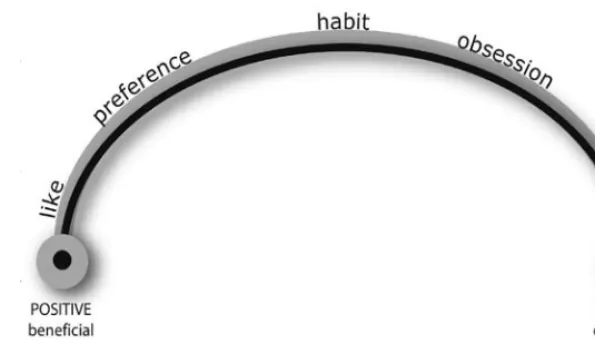
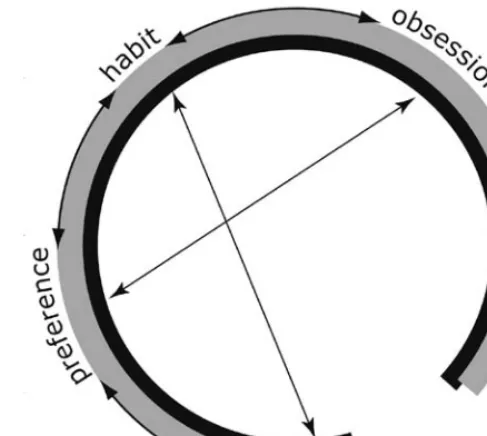
a continuum for the placement of dispositions: where something is liked at one end and that same ‘thing’ may cause addiction at the other.
Figure 1.1 suggests that what may be a liking for something can be positive and beneficial but, as one moves toward the dispositions surrounding obsession and addiction, that the values and beliefs associated with this practice may become negative and destructive. A ‘like’ can become a ‘preference’ which can then become a ‘habit’. h abits can turn into ‘obsessions’ which are debatably different to ‘addiction’ based on the arguments within this chapter. Yet obsessions can turn into addictions should they be perpetuated.
William Glasser argued that not all addiction is negative. His book Positive
Addiction (1976) especially focused on two behaviours (running and meditation)
whereby participants who considered themselves to be addicted to that everyday practice would suffer negative symptoms if they did not engage in the behaviour. Their frame of mind was enhanced when they engaged daily in the behaviour so they became dependent upon the practice in order to function effectively. Admittedly
positive addiction sounds like an oxymoron, so let me explain further.
Glasser (1976) claimed there are three things essential to our human lives – that of loving others and being loved and accepted, being happy and being involved in things we consider to be worthwhile. The case study examples given in his book were of happy people who were actively engaged in running or meditation, who had found meaning in their lives. o ne of the contributors to their happy and meaningful lives was their positive addiction to their preferred activity. e ngaging in that addictive activity gave them the strength to be a person who successfully engaged in what they saw as being worthwhile, not settling for less or giving up which Glasser associated with being weak. He claimed there to be three choices of weak people: firstly to give up, secondly to engage in negative actions and be over-involved in emotions, and thirdly to choose negative addiction to drugs, alcohol, gambling, and so on. Glasser’s thesis was that ‘many people, weak and strong, can help themselves to be stronger, and an important new path to strength may be positive addiction’ (Glasser 1976, 11).
who frequently use the Internet, and suffer negative symptoms from non-use, it is unlikely that they are positively addicted, but a better description is that they are ‘totally absorbed’ (Morahan-Martin and Schumacher 2000, 27), which can lead to losing track of time (Wood, Griffiths and Eatough 2007), and may be considered problematic depending on the person(s) and the context.
Throughout the life of a person it is easy to observe different temporary fads that are at certain times obsessive. i remember as a child, my temporary obsessions included horses and toys such as My l il’ pony™, c are Bears™, and c abbage Patch Dolls™ (though I did not receive either of the latter two). Other examples of obsessions for young children have been slot cars, l ego™, Bratz™ dolls, and Transformers™. For young adults, activities such as skateboarding, skiing, mountain biking, movies, radio controlled vehicles and learning to drive can all be temporary obsessions. o n the internet, people of all ages have access to unlimited topics which the medium provides an endless opportunity to explore. f rom sport, to politics, to gaming, to music, to dating, to entertainment, to work possibilities, to the news, the Internet is infinite and ever growing. For an adult the complexity and infinite nature of the Internet means that a temporary obsession with one topic can move seamlessly to another topic, and so on, and never end. The practice may be seen as ‘addictive’ but really the medium or the environment is a structure that remains the same, and yet continues to offer excitement and new fields to explore. Interest waxes and wanes and obsession spikes and fades. Yellowlees and Marks (2007, 1449) reported, ‘excessive Internet use is something that could wear off over time in the majority of individuals’.
When I first began using the Internet I mainly used email. I was then introduced to instant chat. My interest in music was reignited due to the prevalence of artists promoting their songs online. i began a blog a few years ago. My father suggested we chat on Skype™ when I was overseas. My constant use of Apple™ computers led me to use iTunes™ and the ipod™ as my preferred media players. My brother told me Facebook was ‘really cool’. For my work the use of online search engines and databases proves invaluable. And so i have engaged in and developed my use of the internet medium. The internet does not get stale; new additions and improvements are inevitable and the Internet as a network has both been formed by and is forming society.
Pathological Internet Use
potentially misleading as it ignored contextual and dispositional factors associated with this behaviour’ (Widyanto and Griffiths 2006, 39).
It should be noted that Mark Griffiths also applied the six core criteria of addiction to video game playing and explored whether video game addiction exists (Griffiths and Davies 2005). While being cautious about whether it should be a ‘distinct clinical entity’ (Griffiths and Davies 2005, 365), he also asserted that there is therapeutic value in a wide variety of medical contexts for those who play video games (Griffiths 2005). Video or computer game addiction is one of the sub-types of Internet addiction (Young 1999), 7 all of which according to this
monograph are contestable.
There are multiple labels and acronyms that one should be aware of such as: Internet Addiction Disorder (IAD).8
Pathological Internet Use (PIU) (Morahan-Martin and Schumacher 2000). Excessive Internet Use (EIU) (Hardie and Tee 2007).
Compulsive Internet Use (CIU).
Davis (2001) highlighted two areas of Pathological Internet Use (PIU) – specific and generalized:
Specific pathological Internet use includes those people that are dependent on a specific function of the Internet. Clinical and media accounts of this include overuse (abuse) of online sexual material/services, online auction services, online stock trading, and online gambling. It seems reasonable to assume that these dependencies are content-specific, and that they would exist in the absence of the Internet. Specific PIU is related to only one aspect of the Internet, and exists entirely independent of multiple internet functions. Generalized pathological Internet use involves a general, multidimensional overuse of the internet. it might also include wasting time online, without a clear objective. o ften, generalized piu can be associated with the ‘chat’ found online and dependence on e-mail. This is assumed to be related to the social aspect of the internet. The need for social contact and reinforcement obtained online results in an increased desire to remain in a virtual social life. (Davis 2001, 188)
7 According to Young (1999), the sub-types are cybersexual addiction, cyber-relationship addiction, net compulsions, information overload and computer game addiction.
8 The first person to name ‘Internet Addiction Disorder’, Dr Ivan Goldberg, did not believe it existed. h e did so as a satirical spoof (dates of his instigation range from 1986–1995).
Hence, Davis is attributing specific PIU with previous addictions whereby the internet is the environment where these prior addictions are acted out. h e claims generalized piu to be aligned with pathology and disorders. d avis does not use the term ‘addiction’ to describe these categorical patterns of behaviour: his terms are helpful and specific rather than ‘Internet addiction’ which is unhelpful, general and debatable.
Caplan (2002) preferred to use the label ‘Problematic Internet Use’ which is another preferable phrase to ‘internet addiction’. h e highlighted how people who were already lonely and perceived that there were benefits in using the Internet for social relationships rather than face-to-face relationships were in danger of being more susceptible to problematic internet u se. While his methodologically sound study was cautious in its arguments, c aplan was possibly unfair to those people who like the safety of online engagement and being able to think about their responses before having to say something on the spot or not having to read body language. is this really a sign of poor self-esteem? This suggests that what one person deems unacceptable might be completely acceptable to another (c harlton and Danforth 2007), especially in the field of Internet use for leisure.
The element of choice is something that is perhaps not readily considered and yet should be. We choose which types of technologies we use, we choose which technologies we depend on and we choose which forms of leisure we wish to engage in. s ome of the types of leisure we engage in directly correlate with the technologies we depend on for work, or choose to engage with for our leisure.
The plumb line of ‘who says this is too much’ is a contentious issue. f or one to say ‘one glass of wine per night is too much’ is incommensurate with another who says ‘three glasses of wine per night is fine’. Both these ideas would be abhorrent to someone who thinks one should only drink (if at all) on the weekends. While I have critiqued Young’s application of alcoholism and drug addiction criteria to internet addiction, if we use this same analogy some people will be happy to spend a few hours browsing the internet each evening, whereas others will believe that, if they are focused on their computer screen for more than an hour per evening, they are neglecting their family and their household responsibilities, and that they are overusing the internet.
also have to consider whether they just did not like their job and wanted to get out of it. Some people are incapable of making changes for themselves, and they rely on others to make decisions for them. A question to ask is: did they place more value on their online activity than they did their job? We must be sure of why they spent so much time on the internet to the detriment of their vocational position. Since the termination of their position did they seek treatment for their dependence on technology, have they changed their profession, and have they moved into the realm surrounding the interest that most excites them? h ave they developed their own eBay™ business because they were waiting for the perfect moment to begin? o r are they just addicted and need to attend a centre for internet addiction, just like those who are at the bottom rung of their lives need to attend a rehabilitation centre? We make decisions and choices and, for many of us, we know what the consequences are. Those who suffer from addiction have gone beyond the ability to make responsible decisions.
There are children and young people who will access inappropriate websites. Many adults choose to access these too. Privacy filters and security monitors are continually increasing. c hildren and young people are being educated about what is acceptable in regard to their internet use. h owever, young people have a tendency to wish to explore the ‘no go’ zones. They must make the choices about their future engagement with these sites.9
f or those who are compelled to continue their involvement with certain internet sites and feel they have no choice but to do so, their internet use is problematic. it may be the case that their internet use constitutes addiction. if so, then we should not be readily claiming our ‘inclinations’, ‘likes’ or ‘temporary obsessions’ to be addictions because we undermine the implications and seriousness of the word. Addiction is a serious and complex issue; it is not something that should be glibly referred to as a possibility without extensive consideration of suitable criteria for diagnosis. Being addicted to something is not favourable. in recent times, celebrities have been glorified and received more attention because of a stint in rehab. A report from the United Nations warned us about the influence of celebrity junkies on their fans (ABC 2008). It is common for popular discourse to highlight who is addicted to what and skim over the fact that addiction destroys people’s lives. Being an alcoholic means that one is always an alcoholic; it is a daily, constant battle for anybody who is addicted or who has been addicted just to exist. We should not admire people who are indifferent to being addicted, or who
think it is cool to celebrate ‘going to rehab’. We should not accept this uninformed discourse in the media and in our daily conversations.
What must be realized is that addiction is a serious matter, and that for people to joke, or light-heartedly admit that they are addicted to the Internet, or their smartphone or their favourite television program, is disparaging of and dismissive of the fight that individuals undergo with addiction; it trivializes the ongoing struggle with alcohol and drug addiction and other real addictions. it is arguable that alcoholism and drug addiction not only include psychological and mental addictions, but also a chemical dependency. These three areas are contestable with regard to internet addiction.
When d o We s ay ‘Too Much’?
Being c autious About ‘o ver-use’
and Virtual r eality
In September 2007 every Australian family received a copy of the booklet NetAlert
Protecting Australian Families Online in an attempt to raise family awareness of
the potential impact on children of inappropriate online content as well as online predatory behaviour (DCITA 2007). There are many similar initiatives taken by governments throughout the world to warn parents about their children’s practices. in this chapter, i identify and discuss some criticisms of high usage, of both child and adult users, and the possible side effects of this high usage.
There are multiple reasons for the rise of technological use in western society. As will be discussed in c hapter 8, there are new forms of privilege evidenced by the rise of technologies in the western world and the predominance of neo-liberal economic philosophy or ideology. But there has been an extensive movement toward using computers in classrooms, which is also been influenced by the ‘New r ight’. The following section explains why this is so.
The Push for Computers in Education
There are many articles and books reporting the benefits of using computers (e.g. Clements and Nastasi 1999; McKenzie 2000; Rowe 1993). As well as advantages, there are negative consequences and challenges that accompany using computers in education. Many authors discuss both the negatives and positives of computer technology while acknowledging the costs, potential problems and current issues (e.g. f urlong et al. 2000; Gaines, Johnson and King 1996; Greenhill 1998; Hinostroza, Guzman and Isaacs 2002; Wenglinsky 1998).
2005). Boosters are of the utopian view that placing technologies in schools will improve education and society, and that each successive wave of technology is an improvement on the previous state of play. A sub-group of the boosters are the anti-schoolers who envisage the demise of schooling as technology and the internet develop. e ducation would be customized and negotiable for the paying individual. c ritics are cautious about the use of technologies within schooling and are concerned with the cultural, human and social dimensions of change. d oomsters tend to embrace a dystopic view that life was good before technologies came about and we should get rid of these technological invasions.
Armstrong and c asement are two critics of the boosters’ discourse. They assessed the fundamental reasons for adopting computers in education. They queried the belief held by some that those ‘with computers will outperform those without them’ (Armstrong and Casement 2000, 63). Though computers are not necessary for learning, in a digital age and a digital culture, boosters argue that computer use and literacy is essential, not to learn, but to survive, because of the ramifications of worldwide use of computers, the popularity of computers, globalization, and technology being more and more the way of the future (Morritt 1997; Spender 1995).
However, Armstrong and Casement (2000, 2) raised noteworthy questions about the effects of computers in education on our perceptions of the role of schooling and what constitutes legitimate practice in schools: ‘c omputer technology seems to have taken over public perceptions of what education is all about. It’s almost as if nothing worthwhile goes on in schools unless computers are involved’. This is a pertinent challenge of public perception. This understanding permeates popular culture and discourses of education as, for instance, the o ne l aptop per c hild organisation (OLPC 2008) advocates that each child’s life will be improved and enhanced if they have a computer. The belief is that not only will children’s lives be improved but that their education, and its potential, will be improved. providing children with a laptop is seen as providing them with the power to learn.
Another well-known critic or doomster has been Larry Cuban (2001) who claimed the push for computers in schools stemmed from the n ew r ight movement toward deregulation and the commodification of education. Since the 1980s, this ideology promoted that schools should be made more efficient and productive, suggesting they be run like businesses. In addition, ‘if technology were introduced to the classroom, it would be used; and if it were used, it would transform schooling’ (Cuban 2001, 13), and, consequently, this reform in schooling would help all of those in the future who need to be prepared for the technological revolution in the workplace.
Armstrong and c asement stated computer reform in schools stemmed from
productive, relevant, and interesting for students of all ages. s tudents will learn more and more quickly because they will be more motivated to learn’ (2000, 2). The level of frustration that can occur and the amount of time that can be wasted when computers are used in schools (Healy 1998) raises questions about whether students will learn more quickly. Many studies investigated relationships between computer use and student motivation (see below). Healy (1998) maintained, ‘just because children like something does not mean it is either good for them or educational’ (53–4). Some literature suggests that ‘liking something’ does improve motivation and self-efficacy (Barak, Waks and Doppelt 2000; Howland, Laffey and e spinosa 1997; l iu 1998; s cardamalia and Bereiter 1996; Ward and Tiessen 1997). One study found using a computer did not increase motivation (Miyashita 1994), while another study found results on motivation when using computers can be varied and conditional (Kinzie, Sullivan and Berdel 1992). Additional literature states that those who have had little experience with computers are not as confident, or are not as positive in attitude, as those who have had more experience (Clark 1997; Dawes, Horan and Hackett 2000; Hennessy 2000; Kirkman 1993; Levine and d onitsa-s chmidt 1998; Miyashita 1994; pedretti, Mayer-s mith and Woodrow 1998; Soyibo and Hudson 2000; Woodrow 1994).
The second belief for the rationale of computer use in education is: ‘Because computers play an ever-larger role in our lives, students must understand and be able to take advantage of the potential of technology if they are to participate fully in society’ (Armstrong and Casement 2000, 2). Many educators claim that it is important to educate students about computers and increase their skills, but some think that students are likely to gain these skills anyway because of how ubiquitous computers are within society. The digital divide between those that ‘have’ and ‘do not have’ is still very wide (Brabazon 2008b; Johnson, N.F. 2004). There still exist children whose only use of computers is at school. There are still computers that sit unused in classrooms and their best function at present is to collect dust.
in c hapter 5 i will introduce the concepts of digital newcomers, digital
insiders and digital outsiders, the last of which are disinterested in computers
and do not like to use them. Educators need to think through the ramifications of western society becoming a digital culture, the power of digital discourse (Millar 1998) and whose interests are being served, and whether they will be part of it. These statements challenge us to question whether ‘just because computers can be used in schools is … a good enough reason for deciding that they should be used’ (Armstrong and Casement 2000, 18).
focuses are to fund every secondary school student with a laptop computer and provide fibre-to-the-premises (FTTP) broadband connections to every school:
The d igital e ducation r evolution, as a major part of the Australian Government Education Revolution, is a key strategic tool in achieving a revolutionary improvement in Australia’s education and training to world class standards.
The aim of the program is to contribute sustainable and meaningful change to teaching and learning in Australian schools that will prepare students for further education, training, jobs of the future and to live and work in a digital world. (Commonwealth of Australia 2008)
This suggests that education cannot be world class unless the latest and the best is present within classrooms. Another website stated:
The d igital e ducation r evolution will dramatically change classroom education by ensuring that all students in years 9 to 12 have access to information and communication technology.
The r udd Government believes that every Australian child deserves a world class education.
To be able to compete globally, Australia needs a world class education system.
This includes investing in our school infrastructure – including computers in schools and trade training centres, investing in our teachers and establishing a national curriculum. (Australian Labor Party 2008)