Didirikan pada tahun 1975, Masyarakat Linguistik Indonesia (MLI) merupakan organisasi profesi yang tujuannya adalah untuk mengembangkan
studi ilmiah mengenai bahasa.
PENGURUS MASYARAKAT LINGUISTIK INDONESIA
Ketua : Katharina E. Sukamto, Ph.D., Unika Atma Jaya Wakil Ketua : Dr. Sugiyono, Pusat Bahasa
Sekretaris : Yassir Nasanius, Ph.D., Unika Atma Jaya Bendahara : Ebah Suhaebah, M. Hum., Pusat Bahasa DEWAN EDITOR
Editor Utama : Soenjono Dardjowidjojo, Unika Atma Jaya Editor Pendamping : Yassir Nasanius, Unika Atma Jaya
Anggota : A. Chaedar Alwasilah, Universitas Pendidikan Indonesia; E. Aminudin Aziz, Universitas Pendidikan Indonesia; Benny H Hoed, Universitas Indonesia; Bernd Nothofer, Universitas Frankfurt, Jerman; Asmah Haji Omar, Universiti Malaya, Malaysia; Bambang K. Purwo, Unika Atma Jaya; D. Edi Subroto, Universitas Sebelas Maret; I Wayan Arka, Universitas Udayana; A. Effendi Kadarisman, Universitas Negeri Malang; Bahren Umar Siregar, Unika Atma Jaya; Hasan Basri, Universitas Tadulako; Umar Muslim, Universitas Indonesia; Dwi Noverini Djenar, La Trobe University, Australia; Mahyuni, Universitas Mataram; Patrisius Djiwandono, Universitas Ma Chung.
JURNAL LINGUISTIK INDONESIA
Linguistik Indonesia diterbitkan pertama kali pada tahun 1982 dan sejak tahun 2000 diterbitkan tiap bulan Februari dan Agustus. Dengan SK Dirjen Dikti No. 108/DIKTI/Kep/2007, 23 Agustus 2007, Linguistik Indonesia telah terakreditasi. Jurnal ini dibagikan secara cuma-cuma kepada para anggota MLI yang keanggotaannya umumnya melalui Cabang MLI di pelbagai Perguruan Tinggi, tetapi dapat juga secara perseorangan atau institusional. Iuran per tahun adalah Rp. 100.000 (anggota dalam negeri) dan US$25 (anggota luar negeri). Keanggotaan institusional dalam negeri adalah Rp.120.000 dan luar negeri US$45 per tahun.
Naskah dan resensi dikirim ke Redaksi dengan mengikuti format Pedoman Penulisan Naskah di bagian belakang sampul jurnal.
ALAMAT
Masyarakat Linguistik Indonesia
d.a. Pusat Kajian Bahasa dan Budaya, Unika Atma Jaya JI. Jenderal Sudirman 51, Jakarta 12930
Diglosia, Kontak Bahasa dan Bahasa Minoritas:
Sebuah Studi Awal Kata Serapan dalam Bahasa Rongga
I Nyoman Suparsa dan I Wayan Arka ... 131 Relating the Prefix {meng-}and {ber-} to Verb Roots:
a Semantic Mapping
Dadang Sudana ... 145 Transfer Pragmatik dalam Respon terhadap Pujian dari
Bahasa Indonesia ke dalam Bahasa Inggris
Refnaldi ... 175 Fungsi Frasa Peposisi: Pedikatif Lawan Non-Predikatif
Maslida Yusof ... 197 Argumentasi dan Retorika Perdamaian dalam Pidato Kenegaraan
Presiden RI 2006: Tiada Bangsa Jaya tanpa Ujian
Siusana Kweldju dan Suparno ... 217 Bias Jender dalam Perbedaan Penggunaan Bahasa
oleh Pria dan Wanita
Laelah Azizah Samad Suhaeb dan Wahyu Kurniati Asri ... 247 Strategi Kesantunan Bahasa pada Anak-anak
Usia Prasekolah: Mengungkapkan Keinginan
B. Kushartanti ... 257 Resensi:
Parmjit Singh, Chan Yuen Fook, Gurnam Kaur Sidhu
A Comprehensive Guide To Writing A Research Proposal
Diresensi oleh Julia Eka Rini ... 271DAN BAHASA MINORITAS: SEBUAH STUDI AWAL
KATA SERAPAN DALAM BAHASA RONGGA*
I Nyoman Suparsa Universitas Mahasaraswati
dan
I Wayan ArkaAustralian National University/Universitas Udayana Abstract
Rongga is an Austronesian language spoken by a minority group of 5,000 speakers in the Regency of East Manggarai at the border with Ngadha, Flores, East Nusa Tenggara Province. In the sociolinguistic context of diglossia in Indonesia, Rongga is highly disadvantaged. This paper reports the finding on loan words in Rongga showing a one-way influence and pressure from Indonesian to Rongga. Two prominent linguistic features of Rongga relevant for the Rongganisation of Indonesian words are discussed: the extreme analyticity of Rongga as an isolating language and the feature of open syllable with certain unique phonemes characterising Rongga phonology. The discussion on the theoretical and practical implications of this preliminary study in terms of processes of language contact, multilingualism and endangerment is also given.
Key words: loan words, diglossia, language contact, language endangerment, multingualism.
PENDAHULUAN
Bahasa Rongga merupakan bahasa kecil yang hidup dan berkembang di perbatasan bagian timur Kabupaten Manggarai Timur dengan perbatasan bagian barat Kabupaten Ngadha di pulau Flores Provinsi Nusa Tenggara Timur, tepatnya di Kecamatan Kota Komba yang meliputi empat desa, yaitu desa Tanarata, Watu Nggene, Waelengga, dan Kota Kombai BR berpenutur sekitar 5000 orang. Sebelum memasuki tahun 2004 penelitian terhadap BR belum banyak dilakukan orang. Hanya ada satu penelitian, yaitu Struktur Bahasa Ngadha Dialek Rongga oleh Antonius Porat dan kawan-kawan (1997). Penelitian dokumentasi 2004-2006 menghasilkan tatabahasa acuan ringkas (Arka, Kosmas, and Suparsa 2007), kamus (Arka et al. 2007), kumpulan cerita dan buku ajar (Arka and Ture 2007). Mahasiswa yang ikut penelitian dokumentasi tersebut juga menulis hasil kajian linguitik (Kosmas 2008, Suparsa 2008) dan budaya Rongga (Sumitri 2005). Disamping itu uraian yang lebih khusus tertkait dengan topik-topik tertentu juga telah ada dalam bentuk makalah dan artikel jurnal (Arka 2004, 2005, 2006, 2006, 2007, 2008).
Berdasarkan bukti leksikal dan struktur, bahasa Rongga lebih dekat dengan bahasa Ngadha, dan Porat dkk, 1997 malah menganggap bahasa Rongga adalah dialek dari bahasa Ngadha. Penentuan apakah dua tuturan dialek yang sama dari satu bahasa, atau dua bahasa yang berbeda, adalah hal yang tidak selalu mudah. Dalam makalah ini, juga sesuai dengan studi sebelumnya ( SIL 2001;Arka 2005, Arka, Suparsa Kosmas 2007; Kosmas 2008, Suparsa 2008), BR dianggap sebagai bahasa tersendiri. Dikatakan demikian, karena secara sosiolinguistis Orang Rongga sendiri menganggap bahasanya lain dari bahasa Ngadha (atau bahasa lain tetangganya). Secara budaya etnis Rongga menganut sistem patrilineal, sedangkan etnis Ngadha umumnya menganut sistem matriliineal. Tingkat saling mengerti (mutual intelligibility) juga tidak tinggi antara Penutur BR dengan penutur bahsa lainnya, terutama penutur lain untuk mengertikan tutur bahasa Rongga. BR juga mempunyai perbedaan fonologis, leksikal dan gramatikal yang menunjukkan bahwa BR tidak hanya sekedar dialek dari bahasa lain.ii
Ada dua ciri linguistik BR yang perlu digarisbawahi. Pertama, BR tergolong bahasa isolasi. Artinya, BR tidak mempunyai afiks (prefiks, infiks, sufiks, konfiks, dan simulfiks). Bahasa ini tidak mempunyai proses morfoleksikal. Kata-kata dan morfem-morfem pada bahasa isolasi ini berkorespondensi satu-satu atau setiap kata merupakan morfem atau sebaliknya (Comrie, 1983:30).
Yang kedua, BR merupakan bahasa vokalik, sebab setiap suku kata dalam BR selalu diakhiri oleh vokal. Pertanyaannya, apa yang terjadi untuk unsur serapan, terutama kata-kata yang berakhir dengan konsonan. Ternyata, untuk unsur-unsur serapan dari bahasa lain konsonan yang melekat pada akhir suku kata (yang disebut koda (coda)) cenderung dipertahankan, khususnya pada kalangan penutur yang terdidik.
Tulisan ini mengangkat topik yang terkait dengan sistem fonologi BR ini. Tulisan ini merupakan serpihan kecil dari penelitian disertasi fonologi BR dari Suparsa (2008).
Tulisan ini disusun sebagai berikut. Pada bagian 2, akan diberikan uraian singkat tentang situasi sosiolinguistis kebahasaan di Nusantara yang melatarbelakangi kontak bahasa dan serapan. Selanjutnya, pada bagian 3 akan dipaparkan potensi kebahasaan BR dan BI, khususnya yang terkait dengan aspek sistem fonologi dan fonetisnya. Bagian 4 tulisan ini membahas penyesuaian yang terjadi pada kata serapan. Kesimpulan dan catatan implikasi teoritis diberikan pada bagian penutup tulisan ini.
1 MULTILINGUALISME, KONTAK BAHASA DAN SERAPAN
Ekologi sosiolinguistis Indonesia menggambarkan situasi diglosia (Arka 2007, 2008). Bahasa Indonesia baku merupakan bahasa yang berprestise tinggi dan target yang diinginkan. Target ini dicapai lewat pendidikan formal sampai perguruan tinggi, dan pada kebanyakan situasi, bahasa baku ini terlalu ‘tinggi’ dan tidak pernah tercapai oleh kebanyakan orang. Bahasa daerah merupakan ‘basilek’ pada ruang diglosia ini, dan bahasa-bahasa daerah terentu dianggap kurang atau tidak berprestise. Dengan demikian situasi diglosia ini membentuk
hirarki vertikal, di antara bahasa daerah (rendah) dan bahasa baku (tinggi) ini. Di antara keduanya, terdapat variasi bahasa Indonesia tidak baku, dan juga bahasa regional besar lainnya. Dalam konteks BR di Flores tengah dan barat, bahasa regional yang berperan adalah bahasa Manggarai.
Bahasa Indonesia yang dipakai lisan, baik di Manggarai atau di daerah lainya bisa diklasifikasikan bahasa informal yang tidak baku. Bahasa Indonesia yang tidak baku ini mempunyai rentangan variasi yang besar. Tetapi, dapat diklasifikasikan atas dua variasi (Paauw 2007): bahasa Indonesia lisan umum sehari-hari (colloquial Indonesian) yang dikenal lewat media massa TV, dan bahasa Indonesia tidak baku yang dicirikan oleh banyak fitur kedaerahan penuturnya (yakni dipengaruhi oleh bahasa daerahnya). Keduanya ini bisa jadi tidak ada sekat yang ketat, karena ciri lokal bisa menyebar lewat media. Misalnya, bahasa Indonesia variasi Jakarta (Sneddon 2006) kini semakin dikenal lintas daerah di Nusantara karena penggunaannya pada media TV.
BR sebagai bahasa (etnis) minoritas berada pada posisi yang rendah dalam hirarki diglosia ini. Kontak yang terjadi tidak berimbang; artinya BR cenderung banyak menyerap unsur bahasa lain tanpa ikut menyumbang balik terhadap bahasa lain yang bersentuhan dengannya. Ini bisa dijelaskan karena posisi sosiolinguistis yang tidak berimbang: hampir semua orang rongga multilingual mengerti bahasa sekitar dan bahasa Indonesia, tetapi orang atau etnis lain tidak menguasai BR karena tidak ada kepentingan untuk menguasai bahasa kecil ini.
Kontak bahasa yang melibatkan BR terjadi secara vertikal dan juga horizontal. Secara vertikal tidak hanya terjadi dengan bahasa Indonesia, tetapi juga dengan bahasa Manggarai. Secara horizontal kontak terjadi dengan bahasa tetangga yang secara sosiolinguistik setara, misalnya dengan bahasa Waerana. Mendiskusikan secara komprehensif kontak bahasa vertikal dan horizontal dengan berbagai bahasa, dan sejauh mana kontak tersebut mempunya efek dalam bahasa Rongga, merupakan topik yang besar yang di luar jangkauan tulisan ini. Dalam tulisan ini, topik yang dibahas terbatas pada kontak vertikal dengan bahasa Indonesia saja, dan ini pun terkait dengan aspek fonologinya saja. Yang menjadi pembahasan adalah bagaimanakah cara BR menyesuaikan unsur serapan kosa kata yang berasal dari BI itu. Untuk ini, sistem fonologi bahasa Rongga perlu diuraikan terlebih dahulu.
2 POTENSI SEKITAR BAHASA RONGGA DAN BAHASA INDONESIA Terdapat kesamaan dan perbedaan antara BR dan BI dalam berbagai aspek sistem kebahasaannya. Pada bagian ini tidak semua aspek akan dibahas, tetapi yang dibahas hanya yang terkait dengan topik tulisan ini. Secara fonologis, bahasa Rongga mempunyai segmen bunyi unik yang tidak ditemui dalam bahasa Indonesia.
2.1 Potensi Sekitar Bahasa Rongga 2.1.1 Vokal dan Konsonan BR
Berdasarkan penelitian yang dilakukan, secara fonemis dan fonetis BR mempunyai 6 segmen vokal, yaitu /i, e, ə, a, u, o/ yang menempati semua posisi, kecuali /ə/ hanya menempati posisi awal dan tengah kata. Perhatikanlah bagan vokal berikut.
Posisi Lidah Depan Tengah Belakang Tidak Bulat Bulat Tinggi Tegang i u Tengah Tegang e o
Kendur ə
Rendah Tegang a Bagan Segmen Vokal BR
Tempat Artikulasi Labial Alveolar Palatal Velar Glotal Cara Artikulasi Hambat à TB/B p b t d k g Afrikat à B dZ Implosif à B ɓ ɗ ɠ Pranasalisasi Stop à B Éb <d Ôg Nasal m n N Frikatif à TB/B f v s G h Trill r Lateral l Aproksiman w » Bagan Konsonan BR
Sedangkan, secara fonemis BR ada 25 segmen konsonan, yaitu /p, b, ɓ, Éb, m, f, v, w, t, d, ɗ, ⁿd, n, s, r, l, », dZ, k, g, ɠ,Ôg, N, G, h/. Dan, secara fonetis, BR mempunyai 29 segmen konsonan, yaitu sebagai akibat dari adanya proses fonologi berupa penambahan segmen luncuran semivokal ([ʸ]) dan berubahnya segmen asal konsonan /dZ/ menjadi segmen konsonan [tS], serta penambahan konsonan glottal ([÷]). Kedua puluh sembilan segmen konsonan secara fonetis itu meliputi [p, b, ɓ,Éb, m, f, v, w, t, d, ɗ, ⁿd, n, s, r, l, », tS, dZ, k, g,ʸ, ɠ, Ôg, N, tS,G, ÷, h].
2.1.2 Pola Kanonik BR
Berdasarkan penelitian, pola suku kata BR adalah V dan KV. Pola morfem BR didapat dari sejumlah morfem asal pangkal, yaitu sebagai berikut.
1. Pola V è ([+sil])
Contoh: e /e/ [e] ‘pelembut,partikel’ u /u/ [u] ‘oh, aduh’
2. Pola KV è ([-sil][+sil])
Contoh: dhi /ɗi/ /ɗi/ ‘tuang’ fu /fu/ [fu] ‘rambut’
3. Pola VV è ([+sil][+sil])
Contoh: ou /ou/ [ou] ‘partikel, pelembut’ ea /ea/ [ea] ‘suara burung’ 4. Pola V.KV è ([+sil].[-sil][+sil])
Contoh: ata /ata/ [ata] ‘orang’ eki /eki/ [eki] ‘angkat’ 5. Pola KVV è ([-sil][+sil][+sil])
Contoh: ghea /ɠea/ [ɠea] ‘cair, larut’ sia /sia/ [sia, siʸa] ‘terang’ 6. Pola KVKV è ([-sil][+sil][-sil][+sil])
Contoh: paka /paka/ [paka] ‘harus, rusa’ ndulu /ⁿdulu/ [ⁿdulu] ‘tuntun,ikuti’ 7. Pola KVKVKV è ([-sil][+sil][-sil][+sil][-sil][+sil])
Contoh: keraje /keradZe/ [keradZe] ‘keranjang’ sengasu /saNasu/ [saNasu] ‘seratus’ 8. Pola KVVKV è ([-sil][+sil][+sil][-sil][+sil]
Contoh: saito /saito/ [saito] ‘sedikit’ seolo /səolo/ [səolo] ‘dahulu’ 9. Pola KVKVV è ([-sil][+sil][-sil][+sil][+sil])
Contoh: serae /serae/ [serae] ‘cerai’ sengai /səNai/ [səNai] ‘sebentar’
10. Pola KVKVKVV è ([-sil][+sil][-sil][+sil][-sil][+sil][+sil])
Contoh: lekosui /lekosui/ [lekosuwi] ‘nama tempat’ lukamai /lukamai/ [lukamai] ‘besok’ 11. Pola KVKVKVKV è ([-sil][+sil][-sil][+sil][-sil][+sil][-sil][+sil])
Contoh: mangakana /maNakana/ [maNakana] ‘lengkap’ tanalino /tanalino/ [tanalino] ‘alam semesta” 12. Pola VKVVKV è ([+sil].[-sil][+sil][+sil][-sil][+sil])
Contoh: otaola /otaola/ [ota÷ola] ‘istana, dunia alam semesta’ 13. Pola KVVKVKV è ([-sil][+sil][+sil][-sil][+sil][-sil][+sil])
Contoh: kaejemu /kaedZemu/ [kaedZemu] ‘jantung ayam besar’ 2.2 Potensi Sekitar Bahasa Indonesia
2.2.1 Vokal dan Konsonan BI
Bahasa Indonesia secara fonemis mempunyai 6 segmen vokal, yaitu /i, e, ə, a, u, o/ yang menempati semua posisi kecuali /ə/ hanya menempati posisi awal dan tengah kata dan secara fonetis mempunyai 10 bunyi konsonan, yaitu [i, I, e, ɛ, ə, a, u,U, o, ] (Lapoliwa 1981: 28-35).
TB B
Depan Pusat Belakang Tinggi i u Tengah e ə o Bawah a
Sedangkan, untuk segmen konsonan secara fonemis maupun secara fonetis BI mempunyai 23 segmen konsonan, yaitu /p, b, m, t, d, n, r, l, s, ɲ, p, c, j, k, g, ŋ,÷, y, w, f, z, š, x/ (lebih lanjut bagan konsonan di bawah ini). Ada yang berdistribusi lengkap, seperti /p, b, m, t, d, n, r, l, s, p, k, g, ŋ, f,/. Sedangkan, sisanya tidak berdistribusi lengkap (1981:12-28).
Cara Artikulasi Tempat Artikulasi
Labial Dental/ Alveolar (Alveolar-) Palatal Velar Glotal Hambat TB p t k ʔ B b d g Frikatif TB f s š x h B z Afrikat TB c B j Nasal B m n ɲ ŋ Lateral B l Tril B r Aproksiman B w y
Bagan Konsonan Bahasa Indonesia
2.2.2 Pola Kanonik BI
Berdasarkan penelitian yang dilakukan oleh Hans Lapoliwa (1981:46—49) ada beberapa pola morfem asal pangkal BI, yaitu sebagai berikut.
1. Pola KVKVK è ([-sil][+sil][-sil][+sil])([-sil]) Contoh: bodoh /bodoh/ [bodh] ‘bodoh’
bebas /bebas/ [bebas] ‘bebas’ 2. Pola KVKVè ([-sil][+sil][-sil][+sil])
Contoh: duri /duri/ [duri] ‘duri’ tamu /tamu/ [tamu] ‘tamu’ 3. Pola KVKKVK à ([-sil][+sil][-sil][-sil][+sil][-sil])
Contoh: bersih /bərsih/ [bərsIh] ‘bersih’ banjir /baɲjir/ [baɲjIr] ‘banjir’ 4. Pola KVVK à ([-sil][+sil[+sil][-sil])
Contoh: naik /naik/ [naIk] ‘naik kuat /kuat/ [kuat, kuwat] ‘kuat’ 5. Pola VKKVK à ([+sil][-sil][-sil][+sil][-sil])
Contoh: empat /əmpat/ [əmpat] ‘empat’ ambil /ambil/ [ambIl] ‘ambil’ 6. Pola VKVKà ([+sil][-sil][+sil][-sil])
Contoh: adik /adik/ [adIk] ‘adik’ aduk /aduk/ [adUk] ‘aduk’ 7. Pola KVKKV à ([-sil][+sil][-sil][-sil][+sil])
Contoh: ganggu /gaNgu/ [gaNgu] ‘ganggu’ henti /hənti/ [hənti] ‘henti’
8. Pola VKV à ([+sil][-sil][+sil]) Contoh: isi /isi/ [isi] ‘isi’
ada /ada/ [ada] ‘ada’
9. Pola KVVKV à ([-sil][+sil][+sil][-sil][+sil])
Contoh: suami /suami/ [suami] ‘suami’ Suara /suara/ [suara, suwara] ‘suara’ 10. Pola KVKKVKV à ([-sil][+sil][-sil][-sil][+sil][-sil][+sil])
Contoh: gembira /gəmbira/ [gəmbira] ‘gembira tertawa /tərtawa/ [tərtawa] ‘tertawa’ 11. Pola VKKVKV à ([+sil][-sil][-sil][+sil][-sil][+sil])
Contoh: isteri /istəri/ [Istəri] ‘isteri’ indera /indEra/ [IndEra] ‘indera’ 12. Pola KVKVKV à ([-sil][+sil][-sil][+sil][-sil][+sil])
Contoh: kelahi /kəlahi/ [kəlahi] ‘kelahi’ derita /dərita/ [dərita] ‘derita’ 13. Pola KV à ([-sil][+sil])
Contoh: ia /ia/ [ia, iya] ‘dia’ 14. Pola VVK à ([+sil][+sil][-sil])
Contoh: air /air/ [aIr] ‘air’ 15. Pola VKKV à ([+sil][-sil][-sil][+sil])
Contoh: arti /arti/ [arti] ‘arti’
16. Pola KVKVKVK à ([-sil][+sil][-sil][+sil][-sil][+sil][-sil]) Contoh: negative /negatif/ [negatIf] ‘negatif’ 17. Pola KVK à ([-sil][+sil][-sil])
Contoh: gang /gaN/ [gaN] ‘gang’
3 PENYESUAIAN KATA SERAPAN BAHASA INDONESIA DALAM BAHASA RONGGA
Kosa kata BI yang diserap oleh BR disesuaikan dengan konsonan dan vokal serta pola morfem asal pangkal BR itu sendiri. Ada dua proses yang dapat dilakukan oleh kosa kata BI jika diserap oleh BR. Kedua proses itu adalah (1) proses tanpa penyesuaian, dan (2) proses dengan penyesuaian.
3.1 Proses tanpa Penyesuaian
Proses tanpa penyesuaian itu berarti kosa kata BI yang diserap oleh BR tidak mengalami perubahan karena sudah sesuai dengan pola suku kata dan kata BR. Jadi, kosa kata BI yang seperti ini diserap secara langsung sebagai kosa kata BR.
Contoh: coba /tSoba/ [tSoba] ‘coba’ (BI) à coba //tSoba/ [tSoba] (BR) guna /guna/ [guna] ‘guna’ (BI) à guna /guna/ [guna] (BR) guru /guru/ [guru] ‘guru’ (BI) à guru /guru/ [guru] (BR) meja /medZa/[medZa] ‘meja’ (BI) à meja /medZa/[medZa] (BR)
3.2 Proses dengan Penyesuaian
Proses dengan penyesuaian berarti kosa kata BI yang diserap oleh BR harus mengikuti pola suku kata dan kata BR. BR merupakan bahasa isolatif dan vokalik. Ada empat jenis proses penyesuaian, yaitu (a) proses penyesuaian dengan pola suku kata dan kata BR, (b) proses penyesuaian dengan tipe BR sebagai bahasa vokalik, (c) Proses Penyesuaian dengan sistem artikulasi bunyi yang ada dalam BR, dan (d) proses penyesuaian dengan bunyi yang khas dalam BR.
3.2.1 Proses Penyesuaian dengan Pola Suku Kata dan Kata BR
Apabila BR tidak mempunyai pola morfem asal pangkal seperti yang terdapat dalam BI, maka pola morfem asal pangkal dalam BI itu harus menyesuaikan diri dengan pola morfem asal pangkal BR. BR tidak mempunyai pola morfem asal pangkal KVKKV tetapi mempunyai pola morfem asal pangkal KVKV. Oleh sebab itu, semua kosa kata BI yang berpola KVKKV akan diserap dan disesuaikan dengan pola morfem asal pangkal BR, yaitu KVKV.
Contoh: bangga /baNga/ [baNga] (BI) à /baÔga/ [baÔga] (BR) canda /tSanda/ [tSanda] (BI) à /tSaⁿda/ [tSaⁿda] (BR)
BR juga tidak mempunyai pola kanonik suku kata KVKKVKV yang dipunyai oleh BI. Oleh sebab itu, pola morfem asal pangkalnya harus disesuaikan dengan pola morfem asal pangkal BR, yaitu KVKVKV.
Contoh:
gembira /gəmbira/ [gəmbira] ‘gembira’ (BI) à /gəÉbira/ [gəÉbira] (BR) 3.2.2 Proses Penyesuaian dengan Tipe BR sebagai Bahasa Vokalik
BR sebagai bahasa vokalik, yaitu suatu bahasa yang suku kata dan katanya tidak berakhir dengan konsonan, tentu saja akan menghilangkan konsonan pada akhir suku kata dan kata BI yang diserap. Artinya, bahwa kosa kata BI yang berakhir dengan konsonan pada suku kata dan kata akan menjadi hilang ketika diserap oleh BR. Untuk lebih jelasnya, maka perhatikanlah contoh berikut ini!
Contoh:
bak /bak [bak] ‘tempat air’ (BI) à ba /ba/ [ba] (BR) ajar /adZar/ [adZar] ‘ajar’ (BI) à aja /adZa/ [adZa] (BR)
gampang /gampaN/ [gampaN] ‘gampang’ (BI) à gapa /gapa/ [gapa] kawin /kawin/ [kawIn] ‘kawin’ à kawi /kawi/ [kawi] ‘kawin’ (BR)
Setiap bunyi bahasa yang berstatus sebagai koda seperti [k] pada [bak], [r] pada [adZar] dan [n] pada [kawin] akan dilesapkan menjadi [ba], [adZa], dan [kawi].
3.2.3 Proses Penyesuaian dengan Sistem Artikulasi Bunyi yang Ada dalam BR
Yang unik dalam pembicaraan awal ini adalah artikulasi bunyi bahasa dari kata-kata BI mengalami pergeseran artikulasi bunyi dalam BR.
Contoh:
coba /tSoba/ [tSoba] ‘coba’ (BI) à coba //tSoba/ [tSoba] (BR) guna /guna/ [guna] ‘guna’ (BI) à guna /guna/ [guna] (BR) guru /guru/ [guru] ‘guru’ (BI) à guru /guru/ [guru] (BR) bayar /bayar/ [bayar] ‘bayar (BI) à baja /badZa/ [badZa] (BR)
Secara fonetis (sistem bunyi bahasa) ada sedikit pergeseran, misalnya bunyi [g] yang hambat palatal pada kata guna (dalam BI) menjadi hambat velar (dalam BR). Demikian juga [r] yang aproksiman dental pada kata guru (dalam BI) menjadi trill alveolar (dalam BR). Bunyi [y] yang aproksiman alveolar pada kata bayar (dalam BI) secara fonetis menjadi afrikat palatal [dZ] pada kata baja [badZa] (dalam BR).
3.2.4 Proses Penyesuaian dengan Bunyi yang Khas dalam BR
BR mempunyai beberapa bunyi yang khas, yaitu antara lain [ɓ], [ɗ], [ɠ], dan [»]. Ada sejumlah kosa kata BI yang diserap ke dalam BR yang menyesuaikan diri dengan bunyi yang khas dalam BR.
Contoh: jadi /dZadi/ [dZadi] ‘jadi’ (BI) à jadhi /dZaɗi/ [dZaɗi] (BR) jaga /dZaga/ [dZaga] ‘jaga’ (BI) à jagha /dZaɠa/ [dZaɠa] (BR) bak /bak/ [bak] ‘bak’ (BI) à bha /ɓa/ [ɓa] (BR) Bunyi bahasa BI menyesuaikan diri dengan bunyi yang khas dalam BR, seperti bunyi bahasa [d] yang hambat dental pada kata jadi menjadi [ɗ] yang implosif alveolar dalam BR. Bunyi bahasa [g] yang hambat palatal pada kata jaga menjadi [ɠ] implosif velar dalam BR. Bunyi [b] yang hambat labial pada kata bak dalam BI menjadi [ɓ] implosif labial dalam BR.
4 PENUTUP
4.1 Ringkasan dan Simpulan
BR adalah bahasa kecil, yang secara sosiologis berada pada posisi rendah pada sistem diglosia baik secara regional maupun nasional. Studi BR menunjukkan adanya banyak serapan kosa kata BI ke dalam BR, tetapi tidak sebaliknya. Dalam tulisan, pembahasan difokuskan pada aspek fonologis dan fonetis unsur serapan tersebut. Telah ditunjukkan bawah proses penyerapan tidak berlangsung begitu saja, tetapi mengalami penyesuaikan dengan kondisi dan kendala yang dipunyai oleh bahasa penyerap (BR).
Ada dua proses yang dapat diamati yang terjadi terhadap kosa kata BI jika diserap oleh BR. Kedua proses itu adalah (1) proses tanpa penyesuaian, dan (2) proses dengan penyesuaian. Proses tanpa penyesuaian itu berarti kosa kata BI yang diserap oleh BR tidak mengalami perubahan karena sudah sesuai dengan pola suku kata dan kata BR.
Proses dengan penyesuaian menunjukkan kosa kata BI yang diserap oleh BR mengikuti pola sistem BR. Ada empat jenis proses penyesuaian, yaitu (a) proses penyesuaian dengan pola suku kata dan kata BR, (b) proses penyesuaian dengan tipe BR sebagai bahasa vokalik, (c) Proses penyesuaian dengan sistem artikulasi bunyi yang ada dalam BR, dan (d) proses penyesuaian dengan bunyi yang khas dalam BR.
4.2 Studi Lebih Lanjut dan Catatan Implikasi Teoritis
Apa yang diuraikan pada tulisan singkat di atas hanyalah sebagian kecil dari fenomena kebahasaan akibat kontak bahasa. Untuk mengetahui lebih jauh efek kontak bahasa, perlu penelitian yang lebih komprehensif yang untuk memeriksa sejauh mana juga terjadi pergeseran pada bidang lain, misalnya pergeseran makna, dan juga efek gramatikal dan penggunaan lainnya.
Pengalaman di lapangan penulis kedua tulisan (I Wayan Arka) menunjukkan adanya pengaruh terbatas, yang tidak sepenuhnya bersifat idiolek (perorangan), dari bahasa ibu (BR) terhadap penggunaan bahasa Indonesia setempat. Misalnya, pronomina ‘kau’ pada BI umumnya mempunyai nuansa yang tidak hormat jika dipakai untuk orang tua, atau orang yang lebih tua. Dalam BR, ‘kau’ terdengar dipakai oleh penutur BR muda untuk orang tua. Dalam BR, pronominal ‘kau’ memang bisa dipakai demikian. Ini bisa dianggap interferensi bahasa Ibu (BR) terhadap BI.
Fenomena seperti unsur serapan dan intereferensi bahasa terkait dengan kontak bahasa dan keanekabahasaan. Ini wilayah kebahasaan yang multidimensi, yang mempunyai relevansi linguistik dan non-linguistik, baik secara teoritis maupun praktis.
Secara linguistik, sudah dipaparkan dalam tulisan ini, terjadi penggunaan kata-kata BI oleh penutur BR dengan atau tanpa modifikasi fonologis/fonetis. Kata-kata tersebut kini sudah bisa dianggap khasanah kosa kata BR. Ada yang diserap karena BR memang tidak mempunyainya, biasanya untuk hal-hal yang secara tradisional tidak ada pada BR; misalnya kata-kata terkait teknologi baru seperti ‘pemilu’, ‘oto’, dsb. Ada juga kata-kata BI yang memang belakangan menggantikan kata-kata asli BR; misalnya kata bilangan seperti untuk menghitung, khususnya hitungan jumlah besar (lihat (Arka 2006)).
Secara teoritis, ada tidaknya penyesuaian unsur serapan dan inteferensi dalam penggunaan bahasa kedua (selain bahasa ibu) bisa dijelaskan dan prediksi secara linguistik dan psikolinguistik dari sudut pemerolehan bahasa. Hal ini telah banyak dibahas dalam literatur pemerolehan bahasa dan linguistik kontrastif (Doughty and Long 2003; Fisiak 1984). Intinya, hal-hal yang sama cenderung diadopsi tanpa peruhabahan, hal-hal yang berbeda cenderung disesuaikan. Penyesuaiannya bisa bersifat perorangan, bisa juga menyebar dan diadopsi oleh penutur bahasa ibu terntentu secara meluas.
Penyerapan yang meluas mempunyai aspek historis pula. Tidak mengherankan kontak bahasa adalah salah satu faktor penyebab berubahnya bahasa (language change), atau munculnya variasi tutur baru, yakni proses pijinisasi atau kreolosasi. Melihat fitur isolasi bahasa Rongga dan bahasa-bahasa lain di Flores, ada yang berpendapat bahwa telah terjadi kontak di masa lampau yang memunculkan bahasa-bahasa Flores sekarang. Dalam analisis ini, bahasa Rongga dan bahasa-bahasa Flores lainnya dulu adalah tipe tutur yang tergolong kreol (Arka 2007)). Ini masalah controversial dan perlu penelitian lebih lanjut.
Aspek lain yang perlu diangkat di sini adalah penyerapan yang lebih luas yang mengarah pada marjinalisasi bahasa, dan berakhir pada kepunahan bahasa. Walaupun BR bukan tergolong yang terancam punah secara kritis, berbagai variabel sosiolinguistik menunjukkan BR adalah bahasa minoritas berada pada posisi yang sangat lemah. Kepunahan bahasa adalah titik akhir suatu proses, yang biasanya didahului oleh adanya kontak bahasa (language contact) yang mengkondisikan adanya perubahan dan/atau peralihan bahasa. Proses ini umumya bersifat pelan dan bertahap dalam jangka waktu yang relatif lama (gradual) pada situasi diglosia ke arah bahasa yang lebih berprestise (Dorian 1982; Fasold 1992).
Jadi, penelitian seberapa luas telah terjadi penyerapan, atau peralihan bahasa (language shift) menjadi sangat penting secara praktis. Ini diperlukan agar bisa usaha-usaha nyata diberikan untuk membantu pemulihan vitalitas bahasa dan pemertahanan bahasa (Arka 2007). Untuk bahasa minoritas, seperti BR, masalah pemertahanan bahasa menjadi isu dan mesti dilakukan penuh kesadaran dan dengan berbagai upaya. Karenanya, diperlukan usaha terencana dan sadar untuk mencegah merosotnya penggunaan bahasa lebih jauh dalam kaitan berbagai kondisi tertentu, yang bisa mengarah ke perpindahan bahasa (language shift) atau ke kematian bahasa (language death), (lihat, Marshall 1994; Nahir 1984)).
Apa yang diuraikan di atas tentu tidak berlaku hanya untuk BR, tetapi juga bahasa-bahasa kecil lainnya di Nusantara. Diharapkan tulisan singkat ini, yang dimulai dengan pembahasan kecil tentang unsur serapan pada ranah yang terbatas, dan diakhiri dengan ulasan pentingnya meneliti serapan yang lebih luas dan penelitan tentang pergeseran bahasa akibat kontak bahasa dalam sistem diglosia, bisa menyumbang pada pembangkitan minat untuk memperhatikan nasib bahasa-bahasa kecil di Nusantara kita.
CATATAN
* Penulis berterima kasih kepada mitra bestari yang telah memberikan saran-saran untuk perbaikan makalah.
i
Ucapan terima kasih penulis sampaikan kepada penutur Rongga (terutama Bapak Anton Gelang, Meo, Gregorius Laja, Fransiskus Seda, Yuventius Rau, Yosef Nale, Petrus Nekong, Salesius Nggawang, dan Bapak Fransiskus Dan) serta masyarakat Rongga lainnya yang telah membantu dalam penelitian dan dokumentasi bahasa Rongga. Terimakasih juga disampaikan kepada ELDP SOAS London yang memberikan dana hibah kepada penulis kedua (I Wayan Arka) sehingga penelitian dan dokumentasi Rongga bisa terlaksana, dan juga ANU yang telah memberikan fasilitas kepada penulis kedua untuk menyelesaikan tulisan ini. Penetilian ini juga dibiayai dari NSF (National Science Foundation) grant BCS-0617198.
ii
Namun demikian, harus diakui adanya kenyataan situasi kebahasaan di Flores membentuk kontinuum dialek (dialect chains/continuum) cukup mempersulit penelitian untuk mengetahui batas perbedaan antara dialek dan bahasa, antara unsur serapan dan warisan (inheritance) yang berdasarkan inovasi bersama secara historis dari bahasa (proto) Austronesia kelompok Flores. Diperlukan penelitian lebih lanjut untuk memberikan gambaran yang lebih jelas tentang situasi kebahasaan di perbatasan antara Manggarai Timur dan Ngadha.
DAFTAR PUSTAKA
Arka, I Wayan. 2004. Palatography in a fieldwork setting: investigating and analysing alveolar continuant [r] and [ɹ] in Rongga. In Wibawa Bahasa, edited by I. W. Pastika and I. N. Darma Putra. Denpasar: Program Pascasarjana Linguistik, Universitas Udayana.
———. 2005. Challenges and prospect of maintaining Rongga: a preliminary ethnographic report. In Proceedings of the 2004 Conference of the Australian Linguistics Society, edited by I. Mushin.
http://deneb.library.usyd.edu.au:8080/handle/2123/138.
———. 2006. A note on classifiers and numerals in Rongga. Paper read at the 10th International Conference on Austronesian Linguistics, at Palauan, the Philippines.
———. 2006. Spatial expressions in Balinese and Rongga. Paper read at Congress of the Indonesian Linguistics Society, Padang, Indonesia, 18 -21 Juli 2005; and ICAL Palauan January 2006.
———. 2007. Complexity of maintenance and revitalization of minority languages in Indonesia: Field experiences from Rongga Documentation Project, Flores. Paper read at The 4th International Conference on Austronesian languages and literature, Denpasar Bali Indonesia.
———. 2007. Creole genesis and extreme analyticity in Flores languages. Paper read at ENUS (East Nusantara) Conference, at Kupang Indonesia, August 2007.
———. 2008. Local autonomy, local capacity building and support for minority languages: field experiences from Indonesian. Language Documentation & Conservation Special Publication 1 66-92.
Arka, I Wayan, Jeladu Kosmas, and I Nyoman Suparsa. 2007. Bahasa Rongga: tatabahasa acuan ringkas. Canberra: Linguistics Department, RSPAS, ANU.
Arka, I Wayan, Frasnsiscus Seda, Antonius Gelang, Yohanes Nani, and Ivan Ture. 2007. Rongga-English Dictionary, Kamus Rongga-Indonesia. Canberra: Department of Linguistics, RSPAS, ANU.
Arka, I Wayan, and Ivan Ture. 2007. Nunu nange ngaja Rongga, Cerita bahasa Rongga, Stories from Rongga. Canberra: Linguistics Department, RSPAS, ANU.
Dorian, N. 1982. Language loss and maintenance in language contact situations. In The loss of language skills, edited by R. D. Lambert and B. F. Freed. Rowley, MA: Newbury House Publishers.
Doughty, Catherine J., and Michael H Long, eds. 2003. The handbook of second language acquisition. Malden, MA Blackwell
Fasold, R. 1992. The sociolinguistics of society. Cambridge, MA: Blackwell. Fisiak, Jacek, ed. 1984. Contrastive linguistics : prospects and problems. Vol. .
Berlin: Mouton.
Kosmas, Jeladu. 2008. “Klausa Bahasa Rongga: Sebuah Analisis Leksikal-Fungsional” (Disertasi). Denpasar: Program Pascasarjana Universitas Udayana.
Lapoliwa, Hans. 1981. A Generative Approach to The Phonology of Bahasa Indonesia. Canberra: Department of Linguistics Research School of Pacific Studies The Australian National University.
Marshall, D.F. 1994. Language maintenance and revival. Annual Review of Applied Linguistics (14):20-33.
Nahir, M. 1984. Language planning goals: a classification. Language problems and language planning 8 (3):294-327.
Paauw, Scott. 2007. Malay contact varieties in Eastern Indonesia. Paper read at Workshop on the languages of Papua, Manokwari-Indonesia 8-10 August 2007.
Sneddon, James. 2006. Colloquial Jakartan Indonesian. Canberra: Pacific Linguistics.
Sumitri, Ni Wayan. 2005. Ritual Dhasa Jawa pada masyarakat petani di Rongga
Suparsa, I Nyoman dan I Wayan Arka. 2006. “Segmentasi Éb, ⁿd, dan Ôg sebagai Sebuah Segmen Pranasal Stop dalam Bahasa Rongga”. Makalah disajikan dalam Konferensi Linguistik Tahunan Atma Jaya Ke-4 (Kolita Ke-4) Tingkat Internasional, 15—16 Februari 2006 di Jakarta. Suparsa, I Nyoman. 2007. “Struktur Kata dan Suku Kata Bahasa Rongga”.
Makalah disajikan dalam Seminar Nasional Bahasa Ibu dalam rangka memperingati Hari Bahasa Ibu Internasional, 20—21 Februari 2007 di Program S-2 dan S-3 Linguistik Program Pascasarjana Universitas Udayana Denpasar.
Suparsa, I Nyoman. 2008. “Fonologi Bahasa Rongga: Sebuah Kajian Transformasi Generatif” (Disertasi). Denpasar: Program Pascasarjana Universitas Udayana.
I Nyoman Suparsa I Wayan Arka
VERB ROOTS: A SEMANTIC MAPPING*
Dadang Sudana
Universitas Pendidikan Indonesia Abstract
Afiksasi merupakan aspek penting morfologi Bahasa Indonesia. Berbagai upaya telah dan terus dilakukan untuk mengungkap lebih dalam fenomena keproduktifan bahasa ini. Sejauh ini, upaya pengkajian terutama berfokus pada pengungkapan makna gramatikal yang muncul ketika sebuah afiks melekat kepada bentuk dasarnya. Belum banyak upaya dilakukan untuk mencari penjelasan terhadap mungkin tidaknya suatu afiks melekat pada dasar tertentu. Makalah ini membahas upaya untuk mencari tahu alasan yang melatari hal tersebut. Dicurigai adanya suatu alasan semantik yang berperan pada proses morfologi afiksasi. Untuk maksud tersebut telah dirancang suatu klasifikasi semantik verba. Jenis kata verba tersebut dipilah-pilah kedalam sejumlah sub-kelas semantik. Selanjutnya, dipersiapkan suatu korpus berukuran 70.000 kata yang darinya secara random digunakan 30.000 kata untuk mengetahui distribusi pelekatan afiks terhadap dasarnya dengan bantuan sebuah concordance program. Penelusuran difokuskan pada dua buah afiks: prefiks {meng-} dan prefiks {ber-}. Hasil analisis secara umum menunjukan adanya nuansa semantik yang memungkinkan atau tidaknya afiks melekat pada dasar tertentu.
Kata kunci: afiks, kata dasar, verba, klasifikasi semantik INTRODUCTION
Affixation in Bahasa Indonesia demands further study. Traditionally, most studies focused on its expression side dealing with topics such as the identification of affixes, their various variants, that is, the allomorphs, their morphophonemic environments and their level ordering attachment to their base. The approach proved to be a fruitful undertaking and contributed solid information on those topics to the linguistics of Bahasa Indonesia.
The content side of affixation is often conceived as being less consistent; thus it has been relatively neglected from any in-depth study. To a certain extent, attempts to reveal the meaning of affixation have also been made; yet, this semantic approach to the explication of affixation to date seems superficial. For example the constructional meaning of an affix is identified as do ‘root’, or another one as a tool, etc. Examples of this approach to the description and analysis of affixation can be found in many publications, such as in Alwi et al. (1998), Keraf (1979), Kridalaksana (1996), Muhadjir (1984), Ramlan (1987), and Wolff (1986). Kridalaksana (1996: 40) acknowledges the impressionistic nature of this approach; thus he calls for a more rigorous effort.
There are studies which were intended to reveal aspects of affixation in Bahasa Indonesia more rigorously (e.g. Dardjowidjojo, 1971, 1977;
Ekowardono, 1982; Pelo, 1987; Subroto, 1982, 1986; and Tampubolon, 1996). Nonetheless, most of these studies focus on the syntactic correlates of affixation; thus, less is said about meaning and its relation to the expression side of the morphological level of affixation. The present study is an attempt to find such a relationship in which it has tried to reveal the meanings of affixation using the prefix {meng-} and {ber-}with verb roots and how these meanings are related to their expressions to discover if there is any useful pattern of relationship or a map between expression and content. It seems plausible to assume that there might be a general principle that could be drawn at this level of grammar.
1 THEORETICAL FRAMEWORK
The present study attempts to offer further explanation about the phenomenon of affixation from a semantic perspective by scrutinizing the semantic nature of the root to which an affix attaches. Semantic classification of words (Jackson, 1990) and componential analysis (Katz, 1972) have been used to examine the semantics of the verb roots in Bahasa Indonesia from which a semantic framework of affixation has been developed. Relevant information from Alwi et al. (1998) has contextualised the developed framework for that purpose. 1.1 Situation types and verb types
Alwi et al. (1998: 87) state that verbs inherently have the meanings of perbuatan ‘actions’, proses ‘processes’, and keadaan ‘states’. Alwi et al. (1998: 88) make clear that verbs of actions are used to answer the question what has been done by the subject? The verb lari ‘run’ in [1.1] illustrates the point.
[1.1] Pencuri itu lari. Thief that run
‘That thief ran away.’ (Alwi et al., 1998: 87) The verb lari ‘run’ in [1.1] is the answer to the question what has been done by the thief? The answer to that question is pencuri itu lari ‘the thief ran away’; hence, lari ‘run’ is an action verb.
Verbs of processes are used to answer to the question what happened to the subject? (Alwi et al., 1998: 88). The verb meledak ‘explode’ in [1.2] illustrates the point.
[1.2] Bom itu seharusnya tidak meledak. Bomb that must have not explode
‘The bomb must not have exploded.’ (Alwi et al., 1998: 88) The verb meledak ‘explode’ in [1.2] is the answer the question what happened to the bomb? The answer to that question is bom itu seharusnya tidak meledak ‘the bomb must not have exploded’; hence, meledak ‘explode’ is a process verb.
In general, verbs of states cannot be used to answer to the two previously mentioned questions and are difficult to differentiate from adjectives (Alwi et al., 1998: 89). These verbs are used to suggest that their references are in a particular situation, as illustrated by the verb suka ‘like’ in [1.3].
[1.3] Orang asing itu tidak akan suka masakan Indonesia person foreigner that not will like food Indonesia ‘That foreigner will not like Indonesian food.’
The verb suka ‘like’ in [1.3] does not suggest an action or a process, but the state of the foreigner’s liking of the Indonesian food.
Jackson (1990) provides a more detailed semantic specification of verbs. Drawn mainly from Quirk et al. (1985), Jackson (1990) offers an interesting way of describing the grammar of English from a semantic perspective. When language is being used, it can be related to situation types which are basically concerned with the notions of STATES, EVENTS, and ACTIONS (Jackson, 1990: 8). These semantic notions can be related in one way or another to word classes, such as verbs, nouns, adverbs and adjectives; yet, in the case of verbs, the relationship can be quite straightforward, that is, the verbs can express the notions of STATES, EVENTS, and ACTIONS. His semantic perspective on syntactic classification of words has been adapted for this study.
1.2 State verbs
Jackson describes states as referring “to the way people or things are, what they are like, the condition they are in, where they are, the position they have taken up, and the like” (Jackson, 1990: 9). There are four sub-types of state verbs: (a) qualities, (b) temporary states, (c) private states, and (d) stance (Jackson, 1990: 10-11). “A ‘quality’ is a more-or-less permanent characteristic of someone or something, while a ‘state’ is a less permanent type of situation” (Jackson, 1990: 10), such as the verb ‘be’ in [1.4] for a quality verb and ‘be’ in [1.5] for a temporary sate verb.
[1.4] It was a quiet place.
[1.5] She was silent again (Jackson, 1990: 9) In [1.4], being ‘quiet’ is a permanent characteristic of the place; whereas, in [1.5] being ‘silent’ is only temporal.
The private states “refer to subjective states of mind and feeling” (Jackson, 1990: 10) and are further divided into intellectual states, such as ‘know’; states of emotions or attitude, such as ‘like’; states of perception, such as ‘hear’; and states of bodily sensation, such as ‘hurt’. Finally, the state verbs of stance are “the position that someone or something is in” (Jackson, 1990: 11), such as ‘stand’ and ‘sit’.
Conflating the distinctions of types of state verbs as suggested by Jackson (1990) with Katz’s model of a lexical reading from Katz’s dictionary entry (Katz, 1972) would result in the semantic framework for state verbs in Formula 1.1.
[F1.1] . . . {State Verb} a. (quality) …
b. (temporary state) …
c. (private state) (intellectual) … (private state) (emotion/attitude) … (private state) (perception) … (private state) (bodily sensation) … d. (stance) …
The semantic framework of Katz’s dictionary entry for state verbs in [F1.1] should be able to identify a root of the state verbs and categorise it into the appropriate group. This is illustrated in the use of the verb tahu ‘know’ in [1.6].
[1.6] Saya tahu akhirnya hal itu akan menjadi jelas. I know end-its matter that will become clear ‘I knew that eventually it would become clearer.’
The lexical reading of the verb tahu ‘know’ in Katz’s dictionary for its sense in the above sentence might look like that shown in Formula 1.2.
[F1.2] tahu {State Verb}
(private state) (intellectual) … [being aware of the progression of something]
Formula 1.2 Lexical reading of tahu in Katz’s dictionary
Affixes Verbs Roots States Quality Temporary States Private Stance
Intellect Emotion Perception Bodily Sensation {meng-}
{ber-}
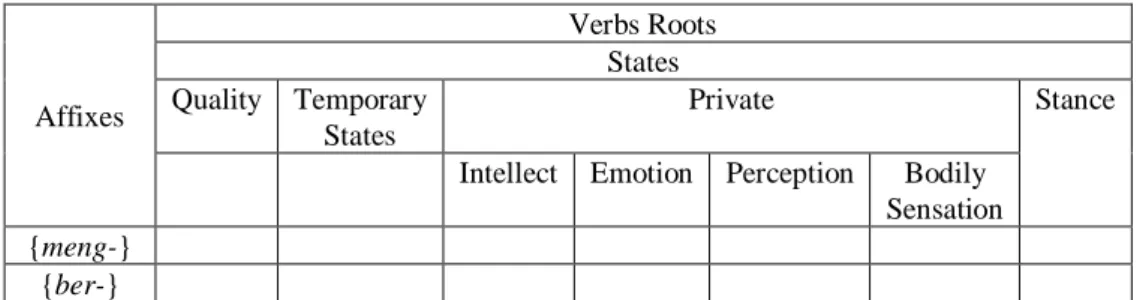
Table 1.1 Semantic framework of affixation for state verbs in Bahasa Indonesia
Being able to identify in a more precise way the semantic information of a root is one of the fundamental objectives of the present study. The result of such an endeavour is expected to be able to disclose important information about the phenomenon of affixation in Bahasa Indonesia. Table 1.1 has been developed to investigate the semantic behaviour of the selected affixes when they interact with root state-verb roots in the online Bahasa Indonesia corpus. 1.3 Event Verbs
For the situation type of events, Jackson writes that events refer to things that happen and that there is
no stated human or other animate instigator or agent for an event: they simply occur. In essence this is the feature which distinguishes events from actions. Actions are set in train by a (usually) human agent; events occur without a human instigator being involved (Jackson, 1990: 12).
There are four types of situation referring to events: (a) goings-on, (b) process, (c) momentary, and (d) transitional. A goings-on event “takes place involving an inanimate force or object. The event is viewed as being in progress (going on), and there is no indication of an end to the goings-on,” (Jackson, 1990: 12). A process event involves or implies a change of state. “A process is also viewed as taking place over a period of time, but it issues in a conclusion, the new state” (Jackson, 1990: 12). A momentary event refers to an event which happens, “but is viewed as taking place in a moment of time” (Jackson, 1990: 12). A transitional event is similar to the momentary event in
which both are viewed as taking place in a moment of time; yet, a change of state is also identified in the transitional event.
Jackson (1990: 13) has also noted important information regarding the notions of ‘change of state’ and ‘the view of the event as lasting through a period of time, contrasted with the view of it as taking place in a moment of time’. The first notion distinguishes the process and transitional events from the goings-on and momentary events. There is a change of state in the process and transitional events, but there is not in the goings-on and momentary events. The second notion distinguishes the goings-on and processes from the momentary and transitional events. The events are lasting through time in the goings-on and processes, but are momentary in the momentary and transitional events.
For the notion of ‘change of state’, Jackson (1990: 13) uses the term conclusive which involves a change of state, and the term non-conclusive which does not involve a change of state; while for the notion of ‘the event as lasting through a period of time, contrasted with the view of it as taking place in a moment of time’ he uses the term durative which lasts through time and punctual which takes place in a moment of time. These distinctions made by Jackson are illustrated in Table 1.2.
DURATIVE PUNCTUAL
NON-CONCLUSIVE goings-on momentary event
CONCLUSIVE process transitional event
(Jackson, 1990: 13)
Table 1.2 Distinctions between event verbs
Conflating the distinctions of types of state verbs as outlined by Jackson (1990) with Katz’s model of a lexical reading from a dictionary entry (Katz, 1972) would result in the semantic framework for state verbs in Formula 1.3.
[F1.3] . . . {Event Verb}
a. (goings-on) … b. (process) …
c. (momentary event) … d. (transitional event) …
Formula 1.3 Semantic framework of affixation for Bahasa Indonesia event verbs
The lexical reading of the verb tiba ‘arrive’ in Katz’s dictionary might look like that in Formula 1.4.
[F1.4] tiba {Event Verb}
(transitional event) … [being at a new place]
Formula 1.4 Lexical reading of tiba in Katz’s dictionary
The verb tiba ‘arrive’ denotes the senses of conclusiveness and punctuality of an event.
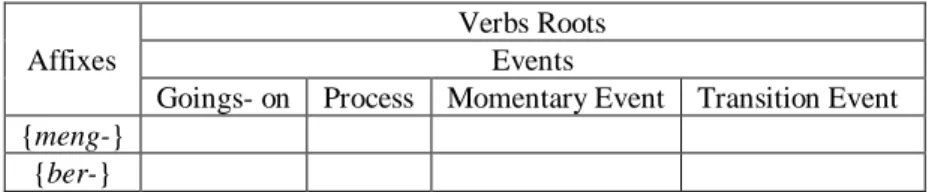
Table 1.3 has been developed to investigate the semantic behaviour of the selected affixes when they interact with event-verb roots in the online corpus. This framework offers a more detailed specification of event verbs than the one mentioned in Alwi et al. (1998: 88) about process verbs.
Affixes
Verbs Roots Events
Goings- on Process Momentary Event Transition Event {meng-}
{ber-}
Table 1.3 Semantic framework of affixation for the event verbs in Bahasa Indonesia
1.4 Action Verbs
Jackson notes that actions do not just happen by themselves. He states that “actions are usually performed by human, or at leat animate, agents or instigators. They are normally the result of the exercise of a will or intention on the part of the agent. Actions are done by somebody” (Jackson, 1990: 13). There are four types of situation referring to actions: (a) activity, (b) accomplishment, (c) momentary act, and (d) transitional act.
The activity action occurs in a situation in which “a person or other animate agent is involved in doing something. The action is viewed as durative (lasting over a period of time), but no result or achievement is implied (i.e. it is non-conclusive)” (Jackson, 1990: 14). The action of an accomplishment refers to a situation where “a person undertakes an action with a result or achievement, i.e. it is conclusive. Like activities, though, accomplishments are viewed as taking place over a period: they are durative,” (Jackson, 1990: 14). The action of a momentary act refers to a situation in which “an agent performs an action which is viewed as punctual (taking place in a moment of speaking), but the action has no end-result (i.e. it is non-conclusive),” (Jackson, 1990: 14). The action of a transitional act refers to a similar situation with the action of a momentary act except with a conclusive result, that is, it involves a change of state. Table 1.4 summarises the distinctions that have been made for the types of action.
DURATIVE PUNCTUAL
NON-CONCLUSIVE activity momentary act
CONCLUSIVE accomplishment transitional act (Jackson, 1990: 14)
Table 1.4 Distinctions between Action Verbs
Conflating the distinctions of action verbs as outlined by Jackson (1990) with Katz’s model of a lexical reading from a dictionary entry (Katz, 1972) would result in Formula 1.5, the semantic framework for action verbs.
[F1.5] . . . {Action Verb} a. (activity) …
b. (accomplishment) … c. (momentary act) … d. (transitional act) …
Formula 1.5 Semantic framework of affixation for Bahasa Indonesia action verbs
The lexical reading of the verb baca ‘read’ in Katz’s dictionary might look like that in Formula 1.6.
[F1.6] baca {Action Verb}
(activity) … [doing a non-conclusive action]
The verb baca ‘read’ in a particular context can indicate a non-conclusive activity taking place over a period of time.
Affixes
Verbs Roots Actions
Activity Accomplishment Momentary Act Transition Act {meng-}
{ber-}
Table 1.5 Semantic framework of affixation for Bahasa Indonesia action verbs
Table 1.5 has been developed to investigate the semantic behaviour of the selected affixes when they interact with action-verb roots in the online Bahasa Indonesia corpus. The same verb root may belong to a semantically different group depending on the context of uses. For example, the verb baca ‘read’ in [1.7] and [1.8] denotes two different senses.
[1.7]
Kami baca koran tiap hari. we read newspaper every day ‘We read newspaper everyday.’
[1.8]
Kami baca koran pagi ini. We read newspaper morning this ‘We read newspaper this morning.’ The verb baca ‘read’ in [1.7] denotes the sense of durative and non-conclusive; while the verb baca ‘read’ in [1.8] denotes the sense of durative and conclusive.
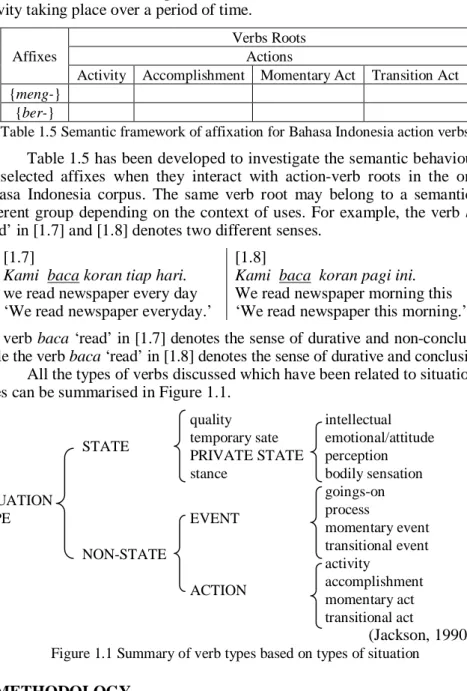
All the types of verbs discussed which have been related to situation types can be summarised in Figure 1.1.
SITUATION TYPE
STATE
quality intellectual temporary sate emotional/attitude PRIVATE STATE perception stance bodily sensation
NON-STATE EVENT goings-on process momentary event transitional event ACTION activity accomplishment momentary act transitional act (Jackson, 1990: 15)
Figure 1.1 Summary of verb types based on types of situation
2 METHODOLOGY
A descriptive linguistics approach to the study of affixation in Bahasa Indonesia has been adopted for this study using the Conc, a concordance generator for Apple Computers and a set of semantic frameworks. An online language corpus of several Indonesian magazines and newspapers was built and the selected affixes were subjected to analyses such as their frequency of occurrence and their grammatical meanings. Semantic frameworks to capture the semantic properties of roots were developed to give a more comprehensive description of affixation.
2.1 Online Corpus
The online corpus is a collection of written texts of about seventy thousand words from Indonesian online magazines and newspapers published in the period of August 1998 to September 1999. A sample of six online magazines and ten newspapers basing their head offices in various locations in Indonesia have been chosen to represent formal written Bahasa Indonesia.
Given the limitation of the present study, not all areas in Indonesia are covered and represented in the selection of articles from the mass communication media in Bahasa Indonesia. The purpose of the present study is not so much to provide a comprehensive account of the lexicon of Bahasa Indonesia but rather to apply a semantic framework that would identify the semantic properties of roots in Bahasa Indonesia. The complete list of the magazines and newspapers and their geographical locations of their head offices can be seen in the Table 2.1.
The time period of the data collection marked one of the situations of instability in the context of political, economic, and social life in Indonesia as captured in the corpus. The topics covered are grouped into five broad categories: businesses/banks, computer/technology, the legal system, social issues and politics. The social issues cover several subtopics, such as labour, education, entertainment, sports, and folklore. The topics and their approximate number of words can be found in the Table 2.2. The corpus covers various genres in the forms of commissioned articles, reportage, feature articles, and editorials.
Magazines Locations Islands
1. Forum Jakarta West Java
2. Gatra Jakarta West Java
3. Info Komputer Jakarta West Java
4. Swasembada Jakarta West Java
5. Tempo Jakarta West Java
6. Tiara Jakarta West Java
Newspapers Locations Islands
1. Bali Post Denpasar Bali
2. Banjarmasin Pos Banjarmasin Kalimantan
3. Internet sites ? ?
4. Kompas Jakarta West Java
5. Pikiran Rakyat Bandung West Java
6. Pos Kupang Kupang Kupang
7. Republika Jakarta West Java
8. Suara Merdeka Jakarta West Java
9. Surabaya Pos Surabaya East Java
10. Waspada Medan North Sumatra
Table 2.1 Names and locations of the online magazines and newspapers
Topics Number of Words Percentage
1. Business/Banks 6,247 8.93 %
2. Computer/Technology 13,701 19.59 %
3. Legal system 3,379 4.83 %
4. Social Issues 18,525 26.48 %
5. Politics 28,100 40.17 %
Total number of words 69,952 100 %
This online corpus was subjected to a computer analysis (see Sub-section 2.2, this chapter) and serves as the main source of linguistic information about the selected affixes and the roots to which these affixes attach. Implementing a semantics analysis has proved to be a daunting job; consequently a sample of about 30,000 words was randomly drawn from this online corpus for further analysis in this study.
2.2 Instruments
There are two instruments used in this project to analyse data: (a) Conc – a concordance generator for Apple Computers and (b) Semantic frameworks for analysing affixes. What follows are descriptions of each of these instruments. 2.2.1 Conc
The computer software used to investigate the occurrences of affixes in complex words in the language corpora was Conc, a concordance generator for Apple Computers. The version used in this study was Version 1.70 beta, by John Thomson and the Summer Institute of Linguistics, February 1992. “Conc is a program designed to facilitate the intensive study of a flat text or an interlinear text by producing a list of all the words occurring in it, with a short section of the context preceding and following each occurrence of a word” (Thomson, 1992: 2). An illustration of a concordance analysis of students’ of Bahasa Indonesia uses of the {ber-} affix is given in Table 2.3.
643 mengerti lain and bekerjaan dengan etika. Untuk 1062 universitas. Jam bekerjaan sama dengan lembaga 28 gambarkan kondisi berdasarkan penediaan dan
467 penting karena ini berdasarkan untuk dijual, dan dasar 628 masalah pekrjaan berdasarkan standar etis yang 639 menjadi sulit berdasarkan etika. Adalah banyak 666 diantara karyawan berdasarkan prestasi. Sistem insentif 864 oleh Jepang berdasarkan perundingan dengan IMF
Table 2.3 A sample of the {ber-} affix in the student corpus
Other useful features of the software are its ability to produce an index, which is a list of individual words in a document and their place and number of occurrences in the document, and “simple statistical studies of a text such as counting the number of occurrences of words that match a pattern” (Thompson, 1992: 2). The index feature of the concordance is illustrated in the Table 2.4.
{ber-} Affix Frequency Line Numbers
Bekerja 2 924, 952 bekerjaan 2 600, 998 bekuasa 1 687 belajar 4 12, 76, 571, 634 Belajar 2 75, 1068 Berada 2 557, 722 berangkat 1 723 berarti 4 36, 325, 723, 1114 berati 1 691 berbagai 3 289, 358, 576 berbahaya 1 924 berbanding 1 375 berbeda 17 34, 147, 440, 441, 442, 446, 470, 485,486, 489, 597, 855, 931, 945, 975, 1025, 1131
The texts that have been used for this study are flat texts from the online service. Affixes were identified in complex words by entering a pattern to the software to generate all the words in the corpus which matched that pattern. This way of identifying the occurrences of affixes within their supplied linguistic environment is an efficient way to reveal valuable linguistic information. Some refinement had to be done to delete many of the unwanted words which happened to match the pattern. The omit and include words submenu was a useful tool to eliminate such words. On the semantics analysis of the roots, however, the software’s main function is to offer the context of their uses. Semantic information and the syntactic classes of the roots to which the selected affixes were attached have to be drawn from informed native speakers’ judgments and comprehensive dictionaries, such as that of Alwi et al. (2001). 2.2.2 Semantic Frameworks of Affixes
The developed semantic frameworks described in Section 2 have been used to collect and analyse the data for this study. These frameworks have been developed based on the assumption that all roots, bound or free, have meaning(s) and syntactic classes. These frameworks have been used to find out if there is a pattern of affixation for each affix in relation to the semantic nature of its root.
2.3 Data Analysis
Several steps were followed in the analysis of the semantics of the selected affixes. a. Identifying the syntactic class of each root: This step was done by using a
standard dictionary of Bahasa Indonesia (Alwi et al., 2001).
b. Identifying the meaning of each root: This step was done by using a standard dictionary of Bahasa Indonesia (Alwi et al., 2001) and by using native speakers’ judgments.
c. Allocating a root to its appropriate semantic group: This task has proved to be extremely difficult. Information from a dictionary alone is not sufficient to be able to assign a root appropriately into its semantic group. Subtle nuances of a root’s meanings are easier to understand when it is used in context. So, each root should be analysed one by one in its context of use. Katz’s componential analysis was also a further aid to help understand the meanings of a word.
d. Filling the developed semantic frameworks: All of the developed semantic frameworks for the four syntactic classes were filled with the relevant data from the previous step. Having made this step, a semantics map of each affix emerged and was used to provide further semantics information regarding each affix.
3 FINDINGS AND DISCUSSION
This section presents the findings from the analysis of the selected affixes in the online corpus of Bahasa Indonesia. These affixes are described according to their distribution, meanings, and possible semantic patterns.
3.1 General Mapping of the Prefix {meng-} and {ber-}
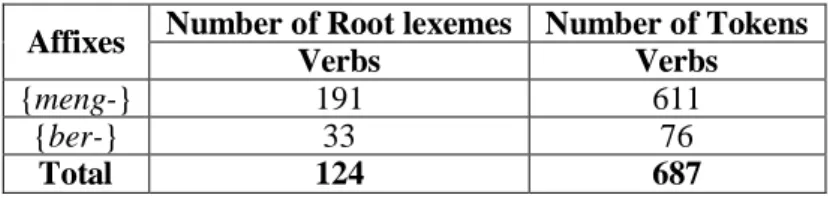
Before examining closely the semantic behaviour of each affix in relation to the roots of the verb, it is important to get a general picture of how the target affixes have interacted with them in the corpus. Table 4.1 presents this picture. In this table, Number of Root Lexemes refers to all of the root lexemes which appear in the corpus, whereas Number of Tokens refers to frequency of occurrences of such lexemes. As an illustration, Table 4.1 shows that in the corpus the prefix {meng-} attaches to 191 different verb-root lexemes.
Affixes Number of Root lexemes Number of Tokens
Verbs Verbs
{meng-} 191 611
{ber-} 33 76
Total 124 687
Table 3.1 General mapping of affixation
In turn, the different frequency of occurrence of the tokens for each of these lexemes is different. Some of them may occur only once, while others more than once. In this case, all of the 191 different verb-root lexemes have 611 tokens. The figures for the prefix {ber-} are to be read in a similar way. Table 4.1 indicates that all of the target affixes in the corpus attach to a total number of 124 verb-root lexemes. The prefix {meng-} has more frequent number of attachments to these verb-root lexemes, of which there are 191. 3.2 Meanings of Affixes
What follows are the grammatical meanings of the target affixes identified from the corpus. Attempts have been made to identify nuances of grammatical meanings of an affix. It is expected that this will make the meanings clearer despite any possible overlap. The meanings are arranged according to their frequency of occurrence; thus, this may also indicate their relative importance for expressing ideas. Some examples of the derived words are provided for illustrative purposes.
Roots Meanings Freq. Percent Examples
Verb do ‘root’ 411 67.3 melanggar, melihat, memilih, mengukur, mengasah, mengecek, mengikat, etc. state of being ‘root’ 194 31.8 melorot, mencuat, mendapat,
menetap, etc.
event of being ‘root’ 6 1.0 meledak, melanda, mendatang Total frequency of occurrence 611 100
Table 3.2 Meanings of {meng-}
Table 3.2 indicates that the prefix {meng-} attaches to verb roots. The main function of this prefix is verb forming. For verb the grammatical meaning of do ‘root’ is the most frequent one, 67.3%. Another important grammatical meaning of the prefix {meng-} is the meaning of state of being ‘root’. That meaning takes the second most frequent grammatical meaning of this prefix when it attaches to verb roots (31.8%).
In Table 3.3, it can be seen that verb roots to which the prefix {ber-} attaches are 76 tokens. The grammatical meaning of state of being ‘root’ is the most persistent (77.6%).
Roots Meanings Freq. Percent Examples
Verb 1. state of being ‘root’ 59 77.6 berada, berdiri, berlipat, berkembang, berjejal, berkutat, etc.
2. do ‘root’ 17 22.4 berantem, berbuat, berkunjung, berpaling, berlibur, etc.
Total frequency of occurrence 76 100
Table 3.3 Meanings of {ber-}
3.3 Verb Roots and the Semantics of Affixation
For the purpose of explaining semantic characteristics of the target affixes, verb roots to which they attach are grouped into three broad categories: verbs of states, verb of events, and verbs of actions. Information about the nature of this grouping can be found in Section 2. The steps of how to put a root lexeme into its semantic group are explained in Section 3. The list of the derived words with the syntactic class of their roots for the target affixes is given in Appendix 1. The complete semantic aspects of verb-root lexemes are provided in Appendix 2A, 2B, and 2C. What follows is a description of the distribution of verb roots (states, events, and actions) in relation to each of the target affixes. 3.3.1 State Verbs
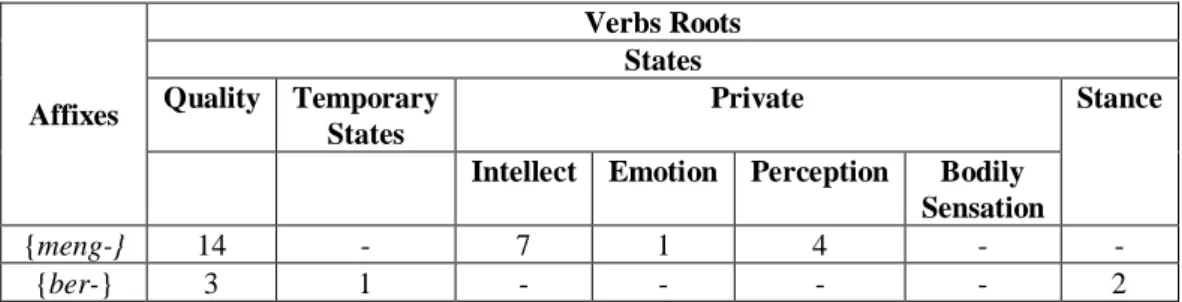
Table 4.4 shows numbers of state verb roots in the corpus which interact with the target affixes. The numbers in the table do not represent the frequency of occurrence of roots (tokens) for each affix, but they indicate the numbers of different lexemes for each of state verbs that attach to a related affix. As an illustration, for the prefix {meng-} there are 14 different state-verb roots of quality; 7 private state-verb roots of intellect; 1 private state-verb root of emotion; and 4 private state-verb roots of perception. The information in Table 4.4 to Table 4.6 is to be read in a similar way.
Affixes Verbs Roots States Quality Temporary States Private Stance
Intellect Emotion Perception Bodily Sensation
{meng-} 14 - 7 1 4 -
-{ber-} 3 1 - - - - 2
Table 3.4 The distribution of state-verb roots
Table 3.4 shows that there are 26 different root lexemes in the corpus which attach to the prefix {meng-} and 6 different root lexemes to the prefix {ber-}. The total number of different state-verb root lexemes which attach to the target affixes is 32.
Table 3.4 displays the tendency of distribution for each affix in relation to state-verb roots. For the prefix {meng-}, 14 out of the total 26 lexemes or 53.8% are the quality type of the state-verb roots; 7 lexemes or 26.9% are intellect type of private state-verb roots; 1 lexeme or 3.8% is emotion type of the private state-verb root; 4 lexemes or 15.4% are perception type of private state-verb roots; and no lexemes can be found in the corpus for the rest of state-verb root types. The quality type of the state-verb roots seems to dominate the affixation process with the prefix {meng-}.
3.3.2 Event Verbs
The total number of lexemes for event-verb roots is 31 which is less than the number of lexemes for state-verb roots. As can be seen from the table, the most frequent root lexemes are the goings-on and process types of event-verb roots. The momentary event roots are the least frequent to attach to any of the target affixes.
Affixes
Verbs Roots Events
Goings- on Process Momentary Event Transition Event
{meng-} 8 7 - 1
{ber-} 9 6 -
-Table 3.5 The distribution of event-verb roots
Table 3.5 indicates the distribution of the target affixes with the event-verb roots. Fifty percent or 8 of the total roots of 16 lexemes which attach to the prefix {meng-} are the goings-on type of event verbs; thirty-nine percent or 7 roots are the process type of event verbs; and 1 root is the transitional event type. The verbs categorised as goings-on and process have about the same number of occurrences for each prefix {meng-} and {ber-}. Sixty percent or 9 out of the total 15 lexemes for the prefix are the goings-on type, and the other forty percent or 6 are the process type.
3.3.3 Action Verbs
Table 3.6 reveals that most roots for verb roots are of the action type. In terms of numbers of lexemes which attach to an affix, the top affix is the prefix {meng-} with 149 out of 161 lexemes.
Affixes
Verbs Roots Actions
Activity Accomplishment Momentary Act Transition Act
{meng-} 82 48 5 14
{ber-} 10 1 - 1
Table 3.6 The distribution of action-verb roots
In general, Table 4.6 displays that the total number of lexemes of the activity type of action-verb roots is the biggest which is 92 out of 161 lexemes; then followed by the accomplishment type which is 49; the transitional act type which is 15; and finally by the momentary act type which is 5. It is also interesting to note that the activity type of action-verb root is the most frequent roots to attach to each affix.
3.4 Semantic Aspects of Affixation
Attempts to analyse the phenomenon of affixation in Bahasa Indonesia in a more rigorous way have been made as early as in the1960s, for example in the work of Aliyewa (1963) and more recently in the work of Wolff (1989). These linguists are among those who believe that there should be some kind of semantic explanation of the possibility of creating complex words through the process of affixation by involving a particular affix with a particular base.
However, the difficulty of presenting a semantic account of the phenomenon is well acknowledged by many prominent linguists of Bahasa Indonesia such as Dardjowidjojo (1971) and Kridalaksana (1996a). The prevailing view is that a semantic account of the phenomenon of affixation is counter-productive because there are too many exceptions; thus, there will not be any reliable semantic generalization which could be made regarding affixation. The findings from the present study, to a certain point, have supported the claims of both sides. There are semantic explanations available for some examples but not for all.
The process of analysing data in this study was not only laborious, but it was also extremely difficult. The concordance software used in this study, the Conc. for Mac, has made some of the mechanical work easier to carry out, which would otherwise have been a formidable task. However, the essence of the analysis in this study had something to do with linguistic meanings of root lexemes in Bahasa Indonesia. Yet, there is not any computer software available so far which can perform linguistic meaning analysis of lexemes of Bahasa Indonesia. Consequently, all of the semantic analysis of thousands of root lexemes was done manually. Each of the verb roots has been defined manually as accurately as possible into its correct semantic group inspired mainly by the work of Jackson (1990). This task has proved to be difficult and is open to dispute.
A good dictionary is necessary to perform such a task, one which gives accurate information about the syntactic class of a particular root lexeme. This dictionary must also give clear information about meaning(s) of a root in a good number of contextual examples. Such a dictionary can be found, for example, in the work of Alwi et al. (2001). Furthermore, a relevant theory of linguistic meaning has proved to be helpful. Katz’s semantic componential analysis (1971) has helped increase scholars’ awareness of the nature of semantic components.
With the corpus size of just about 30,000 words, the value of the generalizations about patterns of semantic characteristics of affixation in Bahasa Indonesia may be somewhat limited. However, this study offers some interesting information. The model implemented in this study might look quite straightforward. However, it appears to be the first of its kind applied to the analysis of affixation in Bahasa Indonesia and as a newly developed model, it is prone to imperfections.
Information regarding grammatical meanings of each affix is provided in Tables 3.2 to 3.3. Not all grammatical meanings of particular affixation in the language are provided because of the limitation of the type and size of the corpus. Still, the findings provide new information. For example, the information in Table 3.2 has not only confirmed the commonly held belief that the main grammatical meaning of the prefix {meng-} is not only do ‘root’, but it also gives the relative frequency of this meaning compared to the other