1
The Dynamic of Cultural Expression of Ethnicity on Palembang’s Riverside Urban Structure
Widya Fransiska F. Anwar1, Ismail Said2, Dilhsan R Ossen 3 and Muh. Hisyam Rasyidi4 1
PhD Candidate, Faculty of Built Environment, University Teknologi Malaysia
2Assoc Prof, Faculty of Built Environment, University Teknologi Malaysia 3, 4Senior Lecturer, Faculty of Built Environment, University Teknologi Malaysia
Correspondence address: [email protected]
ABSTRACT
This study investigates the expression of ethnic cultural activities on Palembang’s riverside urban structure from 1700s to 2000s. Its objectives are: (1) to understand the cultures of Chinese, Arabian and Native Malay-Palembang in perspective of their daily activities; (2) to investigate how their living environments accommodate the activities; and (3) to differentiate the physical spatial order of riverside settlement between the three ethnics. This study answers a research question of how those cultures are reflected in the Palembang urban structure. From literature review, the study explores the history and culture of the three ethnics. The figure ground analysis and field observation are conducted to examine the urban structure of the ethnics’ settlements. The interview strengthens the analysis to obtain the cultural expression of each ethnic in their living environments. It is found that each ethnic expressed their social culture on their living environment and reflected it in form of building and spatial order, the use of open space, and accessibility to the Musi River and towards the land. The dynamics that influenced the expressions are social culture values and change in transportation network.
Keywords: cultural expression, urban structure, riverside settlement
Introduction
Palembang was well known as an international hub from the 6th century. It was known as the international harbor, center of Buddhism study and center of Islamic study. The coming of many foreigners to this city made the acculturation cultures between native and non native’s. The city’s structure consists of some old settlements at Musi riverside area where each ethnic positioned their living environment. This paper aims to investigate the cultural expression of each ethnic on the physical and spatial setting of their living environment. By understanding their culture, this paper investigates how the living environments accommodate their cultural activities. The paper assumes that each ethnic express their culture in daily activities and reflects it on physical and spatial order in their living environment.
First of all, this paper elaborates the theoretical review on culture value and its relationship with the urban structure. The second part of this paper discusses the history of native Malay Palembang and the coming of Chinese and Arabian to Palembang to obtain the background of each ethnic. Further this part elaborates the culture of each ethnic on a basis of daily activities. It relates the activities to the physical and spatial order of each ethnic living environment in order to understand the culture being expressed in physical world. In the discussion session, paper elaborates the urban structure of each ethnic settlement to examine the dynamics of cultural expression on the physical spatial structure.
Theoretical framework
Culture, Identity and Urban Morphology
2
physical structure and values or cultural activity through formation and transformation process (Karakul, 2009). Culture also reflects the development of life system of a society, as a result of human adaptation to the new living environment. Working in an integrated system, the culture shows the practices of adaptation of social value and social activities. It is a kind of people’s reaction towards the new context coming from changes in human life (Wostl, 2008; Ganis, 2009; Mendes and Carbita, 2009)
Considering cultural aspects in studying the city is important since the diversity of culture along with the new innovation and trend in human life have shaped the morphology of a city. The persistent of a cultural continuity carried by the persistent urban elements contributes to the specific identity of the city (Mendes and Carbita, 2009)
Culture Transformation
An urban element and its configuration are categorized as tangible culture, while the values and cultural activities are categorized as intangible culture1 (Karakul, 2009). These two kinds of culture are interrelated one another and created the historical environment. The urban elements interact with the changes in society such as development of technology, new trend and new economic demand and create the transformations in urban structure and value. Previous studies mentioned that the transformation will be ended in some conditions. Karakul (2009) mentioned the ending of transformation will be (1) no changes, (2) changes and (3) disappear, while Boblic mentioned that it will be ended in (4) continuity or (5) discontinuity2 of urban elements. The key for this process is the cultural activities that influence the transformation process and then affect the change of physical structure and/or social value (Boblic, 1990; Rapoport, 2004; Karakul, 2009). Human as the user of built environment reacts to the transformation process and the result. The reaction can appear in various ways; such resistance, acceptance, re-adaption, and creation new meanings caused by the changes of physical elements and spaces arrangement (Rapoport, 2004; Ganis, 2009).
Methodology
This paper explores the old settlement at Musi riverside area in Palembang, South Sumatera. The settlements chosen in this study are the ones that have historical value, were known as old settlement in Palembang, and have uniqueness coming from the ethnicity of the village. From literature review, the study explores the history and culture of the three ethnics. The figure ground analysis and field observation are conducted to examine the urban structure of the ethnics’ settlements. The interview of the residents strengthens the analysis to obtain the culture activity of each ethnic in daily life and the adaptation towards the changes in social life reflected in the living environments.
1
Karakul (2009 )mentioned that the interrelation between tangible and intangible culture produce the environment .
2
3
Figure 1. The methodology frame work of study
Further the historical studies and interview were conducted to obtain the historical and cultural background of each ethnic from the era of 1700s until 2000s. The analysis of figure ground strengthens the result of interview and historical studies to determine the settlement pattern of each ethnic as reflection of cultural activities. From direct observation, this study attained the persistency of cultural activities that accommodate by current physical and spatial structure. Through analysis of settlement pattern, cultural activities and ethnics’ adaptation towards the social transformation, the study determined the way people of each ethnic express their culture in the media of their living environment. It also determined the dynamics that influence the cultural expression of each ethnic.
The richness of cultural diversity at Musi riverside
Palembang developed as a maritime kingdom with role as international hub in South East Asia. It became an international city where many foreigners came for trading and staying. Regarding the settlements zone policy, since the era of Pre Sultanate, Palembang ruler had placed a land use policy. The ruler divided the main zone of the city into two areas, Ilir and Ulu. He put the Ilir area as the higher value land based on past philosophy3. Further, he allocated the royal family and the natives to have a place in Ilir area while the non-natives were placed at Ulu area. He also ruled that only the natives and privileged family could have a place on land. As a defense strategy, he only allowed the foreigner to stay on the water so he could prepare the action to overcome any threats came from the outsiders (Taim, 2002; Utomo, 2006).
The Native Malay Palembang Settlement
According to Hanafiah (1995) the history of Malay Palembang was started from the history of Demak refugee who came to Palembang in 1540s. This group of people was lead by Ki Gde Ing Suro Tuo and built a new community at Musi riverside area with Kuto Gawang asthe first palace. By adapting with the nature of Musi riverside and native Malay people, this new community had acculturated and assimilated the Java and Malay culture, later it is known as Palembang culture. In the era of the third successor, Kimas Hindi, known as Sultan Abdurahman or Sunan Cinde Walang (1659-1706), Palembang proclaimed its independence from any ideology and cultural relationship with Mataram Kingdom in Java and declared itself as Palembang Darussalam Sultanate.
As the Palembang main role in South east Asia was an international hub for trading activities, the Malay Palembang also lived in trading life system where was also influenced by the water as the main natural resources. People utilized water for their daily activities, including trading and transportation. Waterline was important line as it connected all area in Palembang. As described by Yeng-yai sheng-lan-chiao-chu (1100s) a Chinese trader, the people of Palembang lived at their home in two different ways; firstly, they used rafting houses. This group of people lived on the water, and had no obligation to pay tax to the sultan. The other group is the leaders stayed on land using pillar house. The other historical notes also mention the linier form of the city following the river line.
“This place was surrounded by water and very small area of dry land. The leaders stayed on dry land at riverside area. The ordinary people houses were separated from the leaders’. They stayed on the floating houses which were
3
4
bound using a rope to a pillar on the land” (journey notes of Yeng-yai sheng-lan-chiao-chu, 1100s in Hanafiah, 1995)4.
“The people were the genuine Malay, who would not build their houses on the dry land as long as they were able to build a house on the water, and they would not go anywhere by walk, as long as the destination could be reached by boat” (noted by Alfred Wallace Russe; 1800s)
"no wonder, it could be believed that the size of this city is as same as when hearing the sound of a rooster in the very beginning of the day, continuously replied by other roosters with the distance more than 100 prasang. This is because of the villages are connected one another continuously " (translation from the journey of Arabian voyager, Abu Zaid Hasan when visited Palembang in 851)
"the size of the city is described as where the cat can walk upon the roof of the houses without touching the land, from the Old Palembang to Batanghari Leko, since the cat can jump from one roof of the house to another houses'" (notes by Ducth Officer, L.C. Westenenk, 1800)
The life of Malay was influenced by the Islamic philosophy. Most of big religious communal activities were held at mosque. Beside the religious function, it was a focal point for traveler outside Palembang to visit and stay overnight. The mosque is the focal point at Malay settlement. Most of the old mosques were located near by the riverbank. The smaller communal activities were held at traditional limas house, accommodated by the main room of the house which consists of several split level. The main room also had a flexible wall construction which enabled to switch the function from the semi private in normal day to public use in occasional day. The big size of the main room reflected the social activities that could be accommodated by the house.
As mentioned before, the Malay Palembang settlement was located at the Ilir Area, near by the Palace of Sultan. The surrounding area of The Kuto Besak Palace was addressed to the royal family or other privileged family to stay. Now, the position of this area is located at Jalan Temon, which is known as Sekanak Village. Unfortunately, the big fire hazard in 1976 had demolished many old Limas Buildings. Only two Limas were left, owned by the Family of Hasyim Ning5.
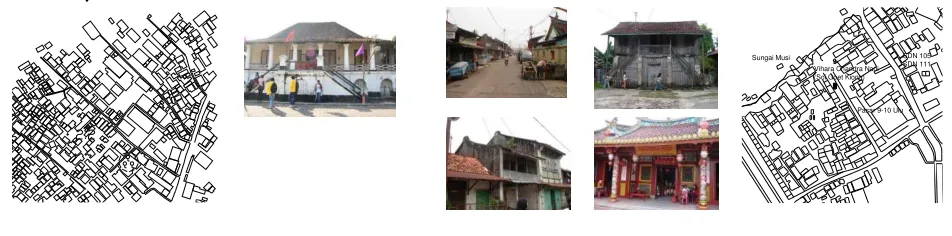
Figure 2. The Malay settlement morphology (Left: Suro Village; Right Sekanak Village)
Another area for Malay settlement can be found at Suro Village, 30 Ilir, which is well known as the center of songket industry. Based on the interview, the Malay native people were traders in the past time. Usually they sold the hard commodities such as coffee and tin from Bangka. At this village, some of Limas can be found facing the street, some of them can be found facing the river Musi. In the Suro Village, there are some old warehouses located near by
4
http://www.palembang.go.id
5
5
the old houses (limas). Now, the old warehouses' function is not the same as in the past. Some of them are used as residence for the family of the old houses or being rent to other people.
By analyzing the historical studies and interview, it can be inferred that the old Malay Palembang people life was dominated by the trading activities. As Palembang was the international hub for foreigner traders, the Malay Palembang people also included the international trading activities in their life. The linier form of the city following the river line showed that the trading activity on water was the main activity of people in Palembang, including Malay Palembang.
The Chinese Palembang Settlement
The relationship between China and Palembang had happened from the era of Sriwijaya. It was predicted that they had came to Palembang since the 7th century. The form of relationship between two empires was economic and culture co-operation. They conducted international trading with locals or other foreign trader in Palembang, as well as learning Buddhism at Sakyakirti, the centre of Buddhism at Bukit Siguntang. Some of them decided to stay and married locals and built up Chinese community in Palembang. The Chinese existence in Palembang was retained even the Sriwijaya had conquered by Majapahit. In pre Sultanate Era, Chinese stayed on the water using floating house since Sultan prohibited foreigners to stay on the land. Using floating house, Chinese could move from one place to other places easily in doing trading activities. Not only being famous as trader, Chinese were also well known as craftsmen. Their skills were utilized in some sultanate projects such as Masjid Agung development. Chinese who converted to Islam were pointed as leader in society by Sultan with Demang's title. Starting from the era Dutch colonization, the foreigner could stayed on the land, including Chinese
Currently, the ruins of physical border of Chinese settlement have not existed anymore. Only some of old houses are left at riverside area. The building style is a combination of with combination of Chinese, Dutch and local architecture. There are two Chinese settlements left, namely Kapiten Village at 7 Ulu ward and Klenteng Village at 9/10 Ulu ward. Kapiten village consists of some buildings that were owned by a Chinese Kapiten family. In the past time, the complex was occupied by the Kapiten family as well as his servant, and surrounded by the wall fence. There are three main building in this village, consists of two Kapiten’s residence and an ashes house. These main houses are facing the Musi River and have a court yard in the front of the houses. The architecture of the houses is a combination of Doric style at its pillar, traditional Chinese style at the roof form, and local traditional at its pillar construction. This complex has a pier at North West side of village.
.
Vihara Chandra Nadi (Soi Goet Kiong)
Pasar 9-10 Ulu SDN 105 SDN 111 Sungai Musi
Figure 3. Kapiten Village Figure 4. Klenteng Village
6
west side of the temple was used as houses for the worker when the temple was developed. The temple is facing the Musi River and has open space in the front of it. There were two old Chinese trader houses at this village, which are owned by Willem family (Kim Tsik family). The houses were also facing the river, and had a pier for jetty in the front of the house.
Some of Chinese houses are also founded at other village at Musi riverside area. At 5 Ulu villages, there are two old Chinese houses, which are not now owned by Chinese anymore. The houses are facing the Musi River as same as the houses of Willem at 9/10 Ulu. Based on observation, the houses have no pier, but from the location of the buildings, it can be concluded that the houses were built near by the water to accommodate the accessibility to the water transportation.
Figure 5. Chinese house at 5 Ulu Village
Comparing with the Chinese architecture style, the form of Chinese houses in Palembang is slightly different from the genuine one. It is a result of re-adaptive effort of Chinese to respond the nature of Musi River. For the Chinese, inner court is a part of the houses as a place for doing activity, daily basis and occasionally basis (Moh. Tajuddin and Cheah, 2011)6. Because of the tidal of Musi River, Chinese adapted the local architecture and combined it with the genuine Chinese architecture using the wooden as the main building material. Based on the figure ground analysis and observation, the houses still applied the inner court but they applied it in pillar houses. The activities that were used to be conducted at landed court were held at the open space in the front of the houses, just near by the riverbank.
It is obviously seen that the activity as trader that utilized Musi River for main transportation network has influenced the way Chinese in Palembang chosse the location for their houses. The business life system was more dominated their life style. They daily activities as trader determine their choice in choosing the place to stay. They used Musi River as water ways for coming in and out Palembang. Therefore they utilized waterways not only as transportation network but also as a part of business network. Moreover, they used the river banks as place for supporting their trading activities such as loading dock area. River became the focal point, and the culture was adapted to the nature of river. The way Chinese adapted to the nature of riverside shows how river became the main influencing aspects in Chinese life in the past time.
The Arabian Palembang Settlement
Arabian came to Palembang as sailors, traders and religious teachers in the same time. In the Sultanate Era, they had special position as sultanate religious advisor. Unlike the other foreigners who were prohibited to stay on land, Sultan gave a right for Arabian to stay on land. The first Arabian settlement is located at Kuto Batu, Ilir area, same area as Malay or the privileged family. The first Arabian settlements are knows as Sungai Bayas and Muaro village. Based on archival studies, there are some other Arabian village located at Ulu area in
6
7
Palembang, named by the name of family; Bahrak Village, Al Munawar Village, Al Hadad Village, Al Habsyi Village, Alkaff Village and Assegaf Village.
...Except the local-native people, there were Chinese, Arabian and other foreigner lived in the city. The first one stayed on the water using the floating houses. Arabians had their own villages.... the number of Arabians were registered in 500 persons; most of them had their own houses. ... (Report wrote by Sevenhoven, 1821)
Arabian in Palembang came from Hadramaut, Yemen. Their ethnic was well known as a sailor and trader (Gilsenan, 2003). They have their own life philosophy; whenever you go far from the homeland, there are only two things to bring along, the kitab and nisan. Kitab is referred to the Islam value in Al Quran and Hadits, while nisan is referred to a signage of their tombs if they died in the foreign land (Novita, 2011). Based on this philosophy, the Arabians adapted to the new place, and blended to the native community, without eliminating the Islamic value in their life system. This philosophy was reflected on their settlement. The adaptation is shown in the architecture style of the old houses at Arabian village. According to interview, there are three main important elements in Arabian village, namely the old houses, the open space and the mushola. Unfortunately because of the urban change, some of open space at Arabian village is destructed by the development of alley, so that the form of the open space cannot be detected by figure ground analysis. There are two villages that still have clear open space formation, namely Bahrak village and Al Munawar Village.
The Bahrak Village is a complex of old Arabian houses located next to Kapiten Village, near by the Aur River, a tributary of Musi River. It belonged to a family of Arabian trader; Bahrak family, consisting eight houses facing to the open space. From the architecture style, the houses have richness in style with a lot of ornaments. Unfortunately, some of the houses have already been sold to new person who are non-relatives. The houses ornaments are rich with woodcarving and also paintings. The reason for selling the houses is because of conflict of heritage among inheritors.
The Al Munawar Village is also a complex of Arabian houses, located nearby Temenggungan River, also one of the tributaries of Musi River. The complex was built by Habib Abdurahman Al Munawar, also one of Arabian big trader. The condition of the complex is still well maintained. The buildings are also rich in decoration, interior ornament, and architecture style. This complex also has an open space at the center and it is surrounded by the surrounding old houses. The character of this open space is very strong, even though the new buildings are built at the back side of the old ones. The houses and open spaces are still owned and used by the family of Al Munawar.
8
From the previous study by Novita (2011), it mentioned that the basic consideration in choosing the location of settlement was the accessibility to the Musi River and its tributaries. Generally, at the Arabian village, the building and open space are located just approximately 50 - 175 meter from the Musi riverbank, or 2-5 meters from the tributaries. This condition shows that the Arabian built their settlement in responding to the nature of Musi River, and further adapting their cultural activities in Palembang.
Figure 6. Arabian Settlement Left : Bahrak Village; Right Al Munawar Village
Result and Discussion The cultural expression
Form the exploration on each ethnic culture; each ethnic brought their culture into their living environment. For Malay, as the native one, the settlement was founded as respond to the trading activity which was dominated in Palembang. The religious philosophy also influenced the pattern of Malay settlement. For Chinese which had profession as trader, trading activities also determined their ways in building the settlement. They tend to build the house at riverbank, so that the pier was just in front of the house, like Chinese house at 5 Ulu. The other way of their adaptation was they built the houses with distance from riverbank, in order to provide a place for loading the trading commodity as well as for pier, like Chinese house at 9/10 Ulu. For the Chinese who had political role, the complex of Chinese settlement reflected the high social status of the family. The building size is relatively bigger than the trader’s. Similar to other Chinese settlement, the pier was also provided for transportation purpose. The Arabian have their value in living in foreign, by adapting to the locals’ without forgetting the Islamic philosophy of life. The activity as trader, religious teacher, and community leader also reflected in the formation of settlement. The building style utilized the local architecture can be seen at the main or oldest house, owned by the village’s founding father which used limas architecture. The other old houses, which are owned by the children, used the Indisch style. The open space and musholla are the other key element in Arabian village, as they accommodated religious activity and the social activities based on religious value. This kind of activity still exists now, and become the social character of Arabian society. Unfortunately, only al Munawar village has the open space with clear form and border, and still accommodate the cultural activity.
9
addition, the trading activity also contributed to the way people decide the location of the house and warehouse. The way each ethnic expressed their culture in their living environment is shown at Figure 6.
Figure 6. Cultural expression of ethnic in the past time
The change of cultural expression
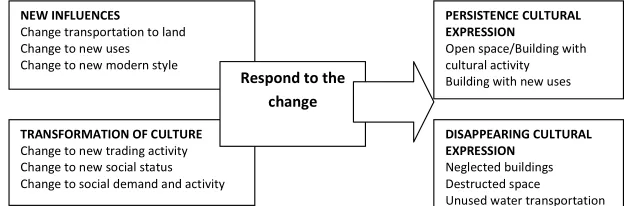
As the time goes by, the changes in urban life have impacted the physical and spatial structure at old village in Palembang. The influences were coming from (1) the change of transportation network, from water transportation to the land transportation, (2) new trend in architecture style and (3) new function demanded by daily and cultural activities. The built of KH Azhari street at Ulu area and Depaten Lama street at Ilir area along with the reclamation of Kapuran and Tengkuruk river to become Merdeka street and Sudirman street in Ducth Colonization Era had impacted the decreasing usage of river transportation. The economic activities which were used to be conducted on the water had shifted to the land by utilizing public land market built by the colonial. Each of ethnic’s settlement respond the development by built access to the dry land area. For the Malay settlement which had linier pattern following the river line, the street become the new orientation for the new building. It is found in Suro village, that some of the old limas buildings are facing the street while some others are facing the river. For Arabian settlement and Chinese settlement which have concentric pattern, the land access was built to connect the open space of village to the street. Since the open space of the village is the center point, the strong character of the village is still strong even the new buildings were built facing the street.
Unlike the native Malay who utilized Limas traditional building as the house in their settlement, Chinese tried to combined their genuine Chinese traditional spatial order without leaving the local traditional in their houses. The idea of mixing the pillar house constructions, Doric style and traditional Chinese spatial order in their house make the Chinese houses have specific character as reflection of their culture. In Arabian settlement, the adaptation of architecture in the building was applied in every single building. In the village, the oldest house used Limas traditional style and while the other old buildings used Indisch style as their adaptation to the local architecture and new trend in style. The lower ground of the Limas house was used to be the warehouse for trading commodities. Now as the type of commodities has changed, the function of warehouse has changed to evening Islamic class and primary school.
For those villages which maintain their cultural activities, the persistent cultural expression can be found in current situation, in the form of urban elements which are accommodated the cultural activities. The new uses accommodated at old urban elements also create persistence in cultural expression at urban elements. If the cultural activities as well as social values have been disappeared, then the cultural expression will disappeared too. The
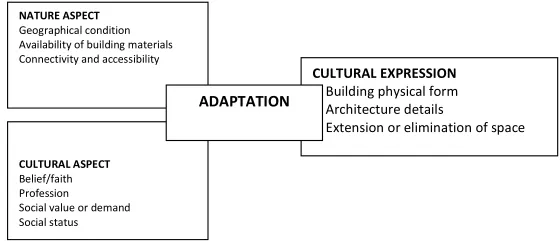
NATURE ASPECT Geographical condition Availability of building materials Connectivity and accessibility
CULTURAL ASPECT Belief/faith Profession Social value or demand Social status
CULTURAL EXPRESSION
Building physical form Architecture details
Extension or elimination of space
10
physical development also can destruct the cultural expression. Like at Arabian village, most of open spaces are missing because it was built by new buildings or new alley. Both of the persistent and the disappeared cultural expression are the result of transformation in urban life. The disappeared cultural expression leads to the loss of cultural identity of the ethnic. The persistence of cultural expression leads to the rebuild and re-strengthen cultural identity of the ethnic, as shown in Figure 7.
Figure 7. The transformation of Cultural expression in current time
Conclusion
Palembang urban culture is dynamic. This dynamic comes from the process of cultural acculturation between ethnics. By applying re-adaption on geographical condition, the three ethnics reflect their social culture in the living environment. Each ethnic express their social culture on living environment in various ways and these contribute to the richness of river life at riverside area. There are two factors influencing the cultural expression of three ethnics on the living environment: Social cultural value, and Transportation network change. These expressions are reflected in form of physical form, building spatial order, open space and accessibility.
References:
Boblic, 1990, The Role Of Time Function In City Spatial Structure Past And Present, Gower Publicshing Co Ltd, UK, p.25-51
Ganis, Mary, 2009, Adaptable Places: Planning for Urban Change, Proceedings of International IAPS-CSBE&Housing Network, IAPS-CSBE & Housing Network,p.1-11
Gilsenan, 2003, Out Of Hadhramaut, London Review Of Books, p.7-11
Hanafiah, 1995, Melayu-Jawa, Citra Budaya Dan Sejarah Palembang, Raja Grafindo Persada
Karakul, Ozlem, 2009, A Conservation Approach To Interrupted Interrelations Between Tangible And Intangible Cultural Heritage Revitalization, Proceedings of International CSBE&Housing Network, IAPS-CSBE & Housing Network, Istanbul, Turkey
Novita, 2011, Warisan Palembang Ada Di Kampung Arab, Majalah Arkeologi Indonesia, Mei 2011
Mandes and Carbita, 2009, The Built Environment Of Lisbon Region: Cultural Identity And New Uses, Proceeding, international IAPS-CSBE and HOUSING Network, 2009, http://www.iscte.academia.edu, p.1-9
Rapoport, Amos, 2004, Local Environment In Global Context, Proceeding of EBRA 2004 International Symposium, 2004, p1-15.
Taim (2002), Permukiman Tepi Sungai Kota Palembang Dari Masa Ke Masa, Jurnal Siddhayatra, Vol.7. No.2
November 2002, p.25-40
Tajuddin and Cheah, 2011, Kepincangan perumahan malayisa: adat dan ritualkaum cina, UTM press.
Utomo (2006), Tinggalan Budaya Masa Lampau Di Palembang, Manfaatnya Untuk Pengembangan Wisata Budaya Dalam Konteks IMT-GT, Jurnal Siddhayatra, Vol.11 No.1 November 2006, p1-12