Early praise for
Good Math
Mark Chu-Carroll is one of the premiere math bloggers in the world, able to guide readers through complicated concepts with delightful casualness. InGood Mathhe brings that same skill to a book-length journey through math, from the basic notion of numbers through recent developments in computer programming. If you have ever been curious about the golden ratio or Turing machines or why pi never runs out of numbers, this is the book for you.
➤ Carl Zimmer
author of “Matter,” a weekly column about science inThe New York Times(http://bit.ly/NYTZimmer); and “The Loom,” aNational Geographic Magazineblog (http://phenomena.nationalgeographic.com/blog/the-loom)
Fans of Mark Chu-Carroll’s lively and informative blog, Good Math/Bad Math, will find much to savor in this mathematical guide for the“geekerati.” Chu-Carroll covers it all, from the basics of natural, irrational, and imagi-nary numbers and the golden ratio to Cantor sets, group theory, logic, proofs, programming, and Turing machines. His love for his subject shines through every page. He’ll help you love it, too.
➤ Jennifer Ouellette
author ofThe Calculus Diaries
Good Math
A Geek’s Guide to the Beauty
of Numbers, Logic, and Computation
Mark C. Chu-Carroll
The Pragmatic Bookshelf
Dallas, Texas • Raleigh, North CarolinaMany of the designations used by manufacturers and sellers to distinguish their products are claimed as trademarks. Where those designations appear in this book, and The Pragmatic Programmers, LLC was aware of a trademark claim, the desig-nations have been printed in initial capital letters or in all capitals. The Pragmatic Starter Kit, The Pragmatic Programmer, Pragmatic Programming, Pragmatic Bookshelf, PragProg and the linkinggdevice are trademarks of The Pragmatic Programmers, LLC.
Every precaution was taken in the preparation of this book. However, the publisher assumes no responsibility for errors or omissions, or for damages that may result from the use of information (including program listings) contained herein. Our Pragmatic courses, workshops, and other products can help you and your team create better software and have more fun. For more information, as well as the latest Pragmatic titles, please visit us athttp://pragprog.com.
The team that produced this book includes: John Osborn (editor)
Candace Cunningham (copyeditor) David J Kelly (typesetter)
Janet Furlow (producer) Juliet Benda (rights) Ellie Callahan (support)
Copyright © 2013 The Pragmatic Programmers, LLC. All rights reserved.
No part of this publication may be reproduced, stored in a retrieval system, or transmitted, in any form, or by any means, electronic, mechanical, photocopying, recording, or otherwise, without the prior consent of the publisher.
Printed in the United States of America. ISBN-13: 978-1-937785-33-8
Encoded using the finest acid-free high-entropy binary digits. Book version: P1.0—July 2013
This book is dedicated to the memory of my father, Irving Carroll (zt"l). He set me on the road to becoming a math geek, which is why this book exists. More importantly, he showed me, by example, how to be a mensch: by living
honestly, with compassion, humor, integrity, and hard work.
Contents
Preface . . . . . . . . . . . xi
Part I
—
Numbers
1. Natural Numbers . . . . . . . . . 3
1.1 The Naturals, Axiomatically Speaking 4
1.2 Using Peano Induction 7
2. Integers . . . . . . . . . . . 9
2.1 What’s an Integer? 9
2.2 Constructing the Integers—Naturally 11
3. Real Numbers . . . . . . . . . 15
3.1 The Reals, Informally 15
3.2 The Reals, Axiomatically 18
3.3 The Reals, Constructively 20
4. Irrational and Transcendental Numbers . . . 23
4.1 What Are Irrational Numbers? 23
4.2 The Argh! Moments of Irrational Numbers 24
4.3 What Does It Mean, and Why Does It Matter? 26
Part II
—
Funny Numbers
5. Zero . . . . . . . . . . . 31
5.1 The History of Zero 31
5.2 An Annoyingly Difficult Number 34
6. e: The Unnatural Natural Number . . . . . 37
6.1 The Number That’s Everywhere 37
6.2 History 39
6.3 Does e Have a Meaning? 40
7. φ: The Golden Ratio . . . . . . . . 41
7.1 What Is the Golden Ratio? 42
7.2 Legendary Nonsense 44
7.3 Where It Really Lives 45
8. i: The Imaginary Number . . . . . . . 47
8.1 The Origin of i 47
8.2 What i Does 49
8.3 What i Means 50
Part III
—
Writing Numbers
9. Roman Numerals . . . . . . . . 55
A Positional System 55
9.1
9.2 Where Did This Mess Come From? 57
9.3 Arithmetic Is Easy (But an Abacus Is Easier) 58
9.4 Blame Tradition 61
10. Egyptian Fractions . . . . . . . . 65
10.1 A 4000-Year-Old Math Exam 65
10.2 Fibonacci’s Greedy Algorithm 66
10.3 Sometimes Aesthetics Trumps Practicality 68
11. Continued Fractions . . . . . . . . 69
11.1 Continued Fractions 70
11.2 Cleaner, Clearer, and Just Plain Fun 72
11.3 Doing Arithmetic 74
Part IV
—
Logic
12. Mr. Spock Is Not Logical . . . . . . . 79
12.1 What Is Logic, Really? 81
12.2 FOPL, Logically 82
12.3 Show Me Something New! 86
13. Proofs, Truth, and Trees: Oh My! . . . . . 91
Building a Simple Proof with a Tree 92
13.1
13.2 A Proof from Nothing 94
13.3 All in the Family 96
13.4 Branching Proofs 98
Contents
•
viii
14. Programming with Logic. . . . . . . 103
14.1 Computing Family Relationships 104
14.2 Computation with Logic 108
15. Temporal Reasoning. . . . . . . . 117
15.1 Statements That Change with Time 118
15.2 What’s CTL Good For? 123
Part V
—
Sets
16. Cantor’s Diagonalization: Infinity Isn’t Just
Infinity . . . . . . . . 127
16.1 Sets, Naively 128
16.2 Cantor’s Diagonalization 131
16.3 Don’t Keep It Simple, Stupid 135
17. Axiomatic Set Theory: Keep the Good, Dump the
Bad . . . . . . . . . 139
17.1 The Axioms of ZFC Set Theory 140
17.2 The Insanity of Choice 147
17.3 Why? 150
18. Models: Using Sets as the LEGOs of the Math
World . . . . . . . . 153
18.1 Building Natural Numbers 154
18.2 Models from Models: From Naturals to Integers
and Beyond! 156
19. Transfinite Numbers: Counting and Ordering Infinite
Sets . . . . . . . . . 161
19.1 Introducing the Transfinite Cardinals 161
19.2 The Continuum Hypothesis 163
19.3 Where in Infinity? 164
20. Group Theory: Finding Symmetries with Sets . . 167
Puzzling Symmetry 167
20.1
20.2 Different Kinds of Symmetry 171
20.3 Stepping into History 173
20.4 The Roots of Symmetry 176
Contents
•
ix
Part VI
—
Mechanical Math
21. Finite State Machines: Simplicity Goes Far. . . 183
21.1 The Simplest Machine 183
21.2 Finite State Machines Get Real 187
21.3 Bridging the Gap: From Regular Expressions to
Machines 189
22. The Turing Machine. . . . . . . . 197
22.1 Adding a Tape Makes All the Difference 198
22.2 Going Meta: The Machine That Imitates
Machines 203
23. Pathology and the Heart of Computing . . . 209
23.1 Introducing BF: The Great, the Glorious, and the
Completely Silly 211
23.2 Turing Complete, or Completely Pointless? 214
23.3 From the Sublime to the Ridiculous 215
24. Calculus: No, Not That Calculus—λ Calculus . . 219
24.1 Writing λ Calculus: It’s Almost
Programming! 220
24.2 Evaluation: Run It! 224
24.3 Programming Languages and Lambda
Strategies 226
25. Numbers, Booleans, and Recursion . . . . 231
But Is It Turing Complete? 231
25.1
25.2 Numbers That Compute Themselves 232
25.3 Decisions? Back to Church 235
25.4 Recursion: Y Oh Y Oh Y? 237
26. Types, Types, Types: Modeling λ Calculus . . . 243
26.1 Playing to Type 244
26.2 Prove It! 249
26.3 What’s It Good For? 250
27. The Halting Problem . . . . . . . 253
27.1 A Brilliant Failure 254
27.2 To Halt or Not To Halt? 256
Bibliography . . . . . . . . . 261
Contents
•
x
Preface
Where
’
d This Book Come From?
Growing up, some of my earliest memories of my father involve math. My dad was a physicist who worked for RCA doing semiconductor manufacturing, so his job involved a lot of math. Sometimes he’d come home with some unfin-ished work to do over the weekend. He’d be sitting in the living room of our house, with a scattering of papers around him and his trusty slide rule by his side.
Being a geeky kid, I thought the stuff he was doing looked cool, and I’d ask him about it. When I did, he always stopped what he was doing and explained it to me. He was a fantastic teacher, and I learned so much about math from him. He taught me the basics of bell curves, standard deviations, and linear regression when I was in third grade! Until I got to college, I never actually learned anything in math class at school because my dad had always taught it to me long before we got to it in the classroom.
He did much more than just explain things to me. He taught me how to teach. He always told me that until you could explain something to someone else, you didn’t really understand it yourself. So he’d make me explain things back to him as though he didn’t know them.
Those times with my dad were the foundation of my love of math, a love that’s lasted through the decades.
Back in 2006 or so, I started reading science blogs. I thought that these blog things were really fascinating and really exciting. But I didn’t think that I had anything to say that would interest anyone else. So I just read what others wrote, and sometimes I commented.
report erratum • discuss
And then one day I was reading a blog called Respectful Insolence, written under the pseudonym “Orac,” by a guy who was a professional cancer surgeon. He was talking about a paper written by a couple of crackpots who had drawn ridiculous conclusions from data published in a public database. Orac dismantled their arguments meticu-lously, explaining why the authors’ claims about basic medicine and biology were ridiculous. But in reading the original paper, what struck me was that refuting the authors’ misunderstanding of biology was unnecessary; their entire argument turned on interpreting graph data in a way that was completely bogus. That’s when I realized that while tons of biologists, doctors, neurologists, physiologists, and physicists were blogging about their specialties, no one was blogging about math!
So I went to Blogger and created a blog. I wrote up my cri-tique of the sloppy math in the paper and sent a link to Orac. I figured that I’d probably get a couple of dozen people to read it and that I’d probably give up on it after a couple of weeks.
But once I’d published that first post on my new blog, I thought about my dad. He was the kind of guy who wouldn’t approve of spending time making fun of people. Doing that once in a while was fine, but making an entire hobby out of it? Not something he’d be proud of.
Remembering how he taught me, I started writing about the kind of math I loved, trying to help other people see why it was so beautiful, so fun, and so fascinating. The result was
my blog,Good Math/Bad Math. It’s been almost seven years
since I started writing it, and my posts now number in the thousands!
When I started my blog, I thought that no one would be interested in what I had to say. I thought that I’d probably be read by a couple dozen people, and I’d give up in disgust after a couple of weeks. Instead, years later, I’ve acquired thousands of fans who read every post I write.
This book is my way of reaching out to a wider audience.
Mathisfun and beautiful and fascinating. I want to share
that fun, beauty, and fascination with you. In this book,
Preface
•
xii
report erratum • discuss
you’ll find the fruits of the time my dad spent with me, teaching me to love math and teaching me to teach it to others.
I still have his slide rule. It’s one of my most prized possessions.
Who This Book Is For
If you’re interested in math, this book is for you! I’ve tried to write it so that it’s accessible to anyone with a basic high-school background in math. The more background you have, the more depth you’ll notice, but even if you’ve only taken high-school algebra, you should be able to follow along.
How to Read This Book
This isn’t a book that you need to read cover-to-cover. Each chapter is mostly stand-alone. You can pick topics that interest you and read them in any order. Within the six parts of the book, chapters will often refer back to previous chap-ters in the same part for details. You’ll get more out of those chapters if you read the referenced sections, but if you don’t feel like it, you should still be able to follow along.
What Do You Need?
For most of the book, you need nothing but curiosity. In a few sections, there are a couple of programs. In case you want to run them, there are links and instructions in the section with the program.
Acknowledgments
It’s always tricky trying to acknowledge everyone who contributed to a book like this. I’m sure that I’ll wind up forgetting someone: if you deserved an acknowledgement but I left you out, I apologize in advance and thank you for your help!
Many thanks to the following people:
• My “blogfather” and friend Orac (aka David Gorski), who gave me the motivation to start my blog and helped me get the attention of readers when I was starting out
report erratum • discuss
Preface
•
xiii
• The many readers of my blog, who’ve caught my mis-takes and helped me become a better writer
• My fellow bloggers at Scientopia
• The people who gave time and effort doing technical reviews of drafts of this book: Paul Keyser, Jason Liszka, Jorge Ortiz, and Jon Shea
• My coworkers at Foursquare, for giving me support and feedback and for making work such a fun place to be • The crew at The Pragmatic Bookshelf, especially David
Thomas and David Kelly, who went above and beyond the call of duty to make it possible to typeset the math in this book
• And, of course, my family, for putting up with a crazed geek writer
Preface
•
xiv
report erratum • discuss
Part I
Numbers
When you think about math, the first thing that comes to mind is probably numbers. Numbers are fascinating things. But when you think about it, it’s crazy to realize just how little most of us actually understand about them.
How do you define what a number actually is? What makes a number
a real number? Or arealnumber? How many numbers are there?
How many different kinds of numbers are there?
I can’t possibly tell you everything there is to know about numbers. That could fill twenty or thirty different books. But I can take you on a sort of a cruise, looking at some of the basic stuff about what numbers are and then looking at some of the weird and interesting numbers among them.
We've left this page blank to make the page numbers the same in the electronic and
paper books.
We tried just leaving it out, but then people wrote us to ask about the missing pages.
Anyway, Eddy the Gerbil wanted to say “hello.”
1
Natural Numbers
What’s a number?
In math, we could answer that question a few different ways.
We could answer itsemanticallyby looking at what numbers
mean. Or we could answer that question axiomaticallyby
looking at how they behave. Or we could answer the ques-tion constructively by looking at how we could build the numbers from some other kind of simpler object.
We’ll start with semantics. What do numbersmean? We all
think we know the answer to this, but in fact, we’re wrong most of the time! People think that a number is just one thing, the thing that you use to count, and that’s it. But that’s not really true. Numbers can have two different meanings, depending on how they’re used.
There are two kinds of numbers. When you see the number
3, you don’t really know what it means. It could have two
different meanings, and without knowing which one you’re using, it’s ambiguous. As we’ll see in a moment, it could
mean3as in “I have three apples,” or it could mean3as in
“I came in third in the race.” The3in “three apples” is a
cardinal number, and the 3in “third place” is an ordinal
number.
Acardinalnumber counts how many objects there are in a group. When I say “I wantthreeapples,” that three is a
car-dinal. Anordinalnumber counts where a particular object
is in a group. When I say “I want the third apple,” that three is an ordinal. In English, this distinction is easy to make because there’s a specific grammatical form called the ordinal
report erratum • discuss
form: “three” for cardinals, “third” for ordinals, and the distinction between cardinal and ordinal is exactly the same distinction used in English grammar.
The cardinal/ordinal distinction really starts to make sense when you talk about the set theoretic basis for math. We’ll look at this in more detail when we talk about set theory in 16,Cantor's Diagonalization: Infinity Isn't Just Infinity, on page
127. For now, this basic idea is enough: cardinals count
objects; ordinals position them.
The axiomatic part is a lot more interesting. In an axiomatic definition we describe what we’re looking at in terms of a
collection of rules, called axioms. The axioms work by
defining how the numbers (or whatever we’re defining) behave. In math, we always prefer to work with axiomatic definitions because an axiomatic definition removes all ambiguity about what is possible and how it works. An axiomatic definition has less intuitive meaning, but it’s absolutely precise, and it’s structured in a way that makes it possible to use it in formal reasoning.
The Naturals, Axiomatically Speaking
We’ll start by talking about the basic fundamental group of
numbers: the naturals. The natural numbers (written N)
consist of zero and the numbers greater than zero that can be written without fractions.
When you talk about numbers, you start with the natural numbers because they’re the most basic fundamental sort of number. Intuitively, natural numbers are the first mathe-matical concepts that we understand as children. They’re the whole numbers, with no fractions, starting at zero and going onward toward infinity: 0, 1, 2, 3, 4, …. (Computer scientists like me are particularly fond of natural numbers because everything computable ultimately comes from the natural numbers.)
The natural numbers are actually formally defined by a set of rules calledPeano arithmetic. Peano arithmetic specifies a list of the axioms that define the natural numbers.
Initial Value Rule: There is one special object called 0, and 0 is a natural number.
1. Natural Numbers
•
4
report erratum • discuss
Successor Rule: For every natural numbernthere is exactly one other natural number, called itssuccessor,s(n).
Predecessor Rule: Zero is not the successor of any natural
number, and every natural numberexcept0 is the
succes-sor to some other natural number, called itspredecessor. Say you have two numbers,aandb; ifbisa’s successor, thenaisb’s predecessor.
Uniqueness Rule: No two natural numbers have the same successor.
Equality Rules: Numbers can be compared for equality. This has three subrules: equality is reflexive, which means that every number is equal to itself; equality is
symmet-ric, meaning that if a numberais equal to a numberb,
thenb = a; and equality is transitive, which means that ifa = bandb = c, thena = c.
Induction Rule: For some statementP,Pis true for all natural numbers if
1. Pis true about 0 (that is,P(0)is true).
2. If youassume Pis true for a natural numbern(P(n)
is true), then you can provethat P is true for the
successors(n)ofn(thatP(s(n))is true).
And all of that is just a fancy way of saying that the natural numbers are numbers with no fractional part starting at 0. On first encountering the Peano rules, most people find them pretty easy to understand, except for the last one. Induction is a tricky idea. I know that when I first saw an inductive proof I certainly didn’t get it; it had a feeling of circularity to it that I had trouble wrapping my head around. But induction is essential: the natural numbers are an infinite set, so if we want to be able to say anything about the entire set, then we need to be able to use some kind of reasoning to extend from the finite to the infinite. That is what induc-tion does: it lets us extend reasoning about finite objects to infinite sets.
When you get past the formalism, what the induction rule really says is, here’s a pattern that you can use. If you make a definition work for your first number, then you can define
report erratum • discuss
1. Natural Numbers
•
5
it for all of the numbers after that first number by talking about what happens when you add 1 to it. With that pattern, we can write proofs about statements that are true for all natural numbers, or we can write definitions that work for all natural numbers. And using similar tricks, we can talk about all integers or all fractions or all real numbers. Definitions are easier, so we’ll do one of them before we try a proof. To give an example of how we use induction in a definition, let’s look at addition. We can define addition on the natural numbers quite easily. Addition is a function “+” from a pair of natural numbers to another natural number called theirsum. Formally, addition is defined by the follow-ing rules:
Commutativity For any pair of natural numbers n and m,
n + m = m + n
Identity For any natural numbersn,
n + 0 = 0 + n = n
RecursionFor any natural numbersmandn,
m + s(n) = s(m + n)
The last rule is the inductive one, and it’s built using recur-sion. Recursion is difficult when you’re not used to it, so let’s take the time to pick it apart.
What we’re doing is defining addition in terms of the succes-sor rule from Peano arithmetic. It’s easier to read if you just rewrite it a tad to use +1 and –1:m + n = 1 + (m + (n – 1)). What you need to remember to help make sense out of this is that it’s adefinition, not aprocedure. So it’s describing what addition means, not how to do it.
The last rule works because of the Peano induction rule. Without it, how could we define what it means to add two numbers? Induction gives us a way of saying what addition
means foranytwo natural numbers.
Now for a proof. Proofs are scary to most people, but there’s no need to fear them. Proofs really aren’t so bad, and we’ll do a really easy one.
1. Natural Numbers
•
6
report erratum • discuss
Using Peano Induction
One simple but fun proof using the natural numbers with
addition is this one: suppose I have a natural numberN.
What’s the sum of all of the integers from 1 toN? It’sNtimes
N + 1divided by 2. So how can we prove that using the induction rule?
We start with what’s called abase case. That means we need
to start with one case that we can prove all by itself, and then that case will be used as the base on which we build the induction. In the induction rule, the first clause says that the fact we want to prove needs to start by showing it for 0, so 0 is our base case. It’s easy to prove this for zero:(0*(0 + 1))/2is0. So our equation is true whenN = 0. That’s it: that’s our base case done.
Now comes the inductive part. Suppose for a numberNthat
it’s true. Now we want to prove it forN + 1. What we’re
going to do here is the heart of induction, and it’s an amazing process. We want to show that since we know the rule is true for 0, then it must also be true for 1. Once we know it’s true for 1, then it must be true for 2. If it’s true for 2, then it must be true for 3. And so on. But we don’t want to have to do a separate proof of each of those. So we just say, “Suppose it’s true for N; then it must be true forN + 1.” By putting the variable in this inductive structure, we’re simultaneously doing “If it’s true for 0, then it’s true for 1; if it’s true for 1, then it’s true for 2, and so forth.”
Here’s what we want to prove:
(0 + 1 + 2 + 3 + ... +n + n + 1) = (n + 1)(n + 2)2
To start, we know this:
(0 + 1 + 2 + 3 + ⋯ +n) = n(n + 1)2
So we can substitute that in and get this:
n(n + 1)
2 +n + 1 =
(n + 1)(n + 2) n
report erratum • discuss
1. Natural Numbers
•
7
Now we expand the multiplication on both sides:
n2 + n
2 + (n + 1) =
n2 + 3n + 2 2
Get a common denominator on the left side:
n2 + n + 2n + 2
2 =
n2 + 3n + 2 2
Finally, simplify the left side:
n2 + 3n + 2
2 =
n2 + 3n + 2 2
And that’s it: we’ve just proven that it works for all natural numbers.
That’s the axiomatic version of the naturals. They’re numbers greater than or equal to zero, where each number has a successor and on which you can use that successor relation-ship to do induction. Pretty much everything that we do with natural numbers, and the bulk of the basic intuitive arithmetic stuff that we learn as children, can be built from nothing more than that.
After all of that, can we say what a number is? Sort of. One of the lessons of numbers in math is that numbers don’t have just one meaning. There’s a whole lot of different sorts of numbers: natural numbers, integers, rational numbers, real numbers, complex numbers, quaternions, surreals, hyper-reals—on and on and on. But the whole universe of numbers starts with what we did right here: the natural numbers. And ultimately, the meanings of those numbers come down to either quantity or position. They’re all ultimately cardinals and ordinals, or collections of cardinals and ordinals. That’s
what a number is: something that isconstructed froma notion
of either quantity or position.
1. Natural Numbers
•
8
report erratum • discuss
2
Integers
Natural numbers are the first numbers that we understand. But they’re nowhere close to sufficient. Given how we use numbers, you inevitably wind up needing something beyond just the natural numbers.
If you go to the store and buy something, you give them money in exchange for what you buy. You could buy something like a loaf of bread for three dollars. If you paid them with a five dollar bill, they’ll give you two dollars back in change.
Just to understand that, you’re doing something that doesn’t really make sense in natural numbers. The money is flowing in two different directions. One, going from you to the store, subtracts from the money you have. The other, going from the store to you, adds to the money you have. Positive and negative integers allow you to distinguish between the two directions in which the money can move.
What
’
s an Integer?
If you have the natural numbers and you want the integers, all you have to do is add anadditive inverse. If you under-stand the naturals and want to underunder-stand the integers, you also only need to add one thing:direction. If you think of a number line, the natural numbers start from zero and go to the right, but there’s nothing to the left of zero. Integers start with the naturals and add negative numbers moving to the left on the other side of zero.
The meaning of integers follows from the notion of direction. Positive integers mean the same thing as the natural
report erratum • discuss
numbers, both as cardinals and as ordinals. Negative num-bers allow you to move in the other direction. If you think in terms of cardinals, integers allow you to talk about moving things between sets. If you have a set of size 27 and another set of size 29, then to make the sets have the same size, you can either add two objects to the first set or remove two objects from the second set. If you add to the first set, you’re doing something with a positive cardinality. If you remove from the second set, you’re doing something with a negative cardinality.
In ordinals, it’s even easier. If you’re looking at the third element in a set and you want to look at the fifth, you move forward two steps, and that motion is described by a positive ordinal integer. If you’re looking at the fifth element and you want to look at the third, you move backward two steps, and that motion is a negative ordinal integer.
Let’s move on to an axiomatic definition. The integers are what you get when you extend the naturals by adding an
inverse rule. Start with the set of natural numbers, N. In addition to the Peano rules, we just need to add a definition
of theadditive inverse. The additive inverse of a non-zero
natural number is just a negative number. To get the integers, we just add these new rules:
Additive Inverse For any natural numbernother than zero,
there is exactly one number –n that is not a natural
number and that is called theadditive inverse of n, where
n + –n = 0. We call the set of natural numbers and their additive inverses theintegers.
Inverse UniquenessFor any two integersiandj,iis the addi-tive inverse ofjif and only ifjis the additive inverse ofi.
With those rules, we’ve got something new. The set of values that we talked about as the natural numbers can’t satisfy those rules. Where do all of these new values—the negative integers—come from?
The answer is a bit disappointing. They don’t come from anywhere; they justare. We can’t create objects in math; we can only describe them. The numbers—naturals, integers,
2. Integers
•
10
report erratum • discuss
reals—exist because we define rules that describe them and because those rules describe something consistent.
All of that is just a fancy way of saying that the integers are all of the whole numbers: zero, the positives, and the negatives.
What’s pretty neat is that if you define addition for the nat-ural numbers, the inverse rule is enough to make it work for the integers as well. And since multiplication on natural numbers is just repeated addition, that means that multipli-cation works for the integers too.
Constructing the Integers
—
Naturally
We can create mathematical constructions torepresentthe
integers in terms of the naturals. These constructions are
calledmodelsof the integers. But why would we want to do
that? And what is a model, precisely?
In a model of something new, like our integers, we’re trying to show that there’s a way of making objects that will obey the axioms that we’ve defined. To do that, you take the things that you already know exist and use them as building blocks. With those building blocks, you build objects that will follow the axioms of the new system. For example, to construct the integers, we’re going to start with the natural numbers, which are objects that we already know about and understand. Then we’re going to use them to create objects that represent the integers. If we can show that the objects in the model follow the axioms of the natural numbers, we know that our definitions of the integers are consistent. Why should we go through all this?
There are two reasons for building constructions like models. First, a model shows us our axioms make sense. When we write a set of axioms, it’s easy to screw up and accidentally write our model in an inconsistent way. A model proves that we didn’t. We can write out a bunch of axioms that look reasonable but are inconsistent in a subtle way. If that’s true, it means that the objects we defined don’t exist, even in the abstract mathematical sense. And worse, it means that if we work as if they do exist, then every conclusion we draw will be worthless. I said earlier that the integers exist because we
report erratum • discuss
2. Integers
•
11
defined them and the definitions are consistent. If we don’t show that it’s possible to create a model, then we can’t be sure that the definitions really are consistent.
The other reason is less abstract: a model makes it easier for us to understand and to describe how the system we are building is supposed to work.
One last caveat before we get to the model. It’s really important to understand that what we’re doing is creating
amodel of the integers, notthemodel of the integers! What
we’re doing here is describing one possible way of represent-ing the integers. The integers are not the representation that I’m going to show you. There are many possible representa-tions; so long as a representation fits the axioms, it can be used. The distinction between the model and the thing that it models is subtle, but it’s very important. The integers are the objects described by the axioms, not the model that we’re building. The model is just a representation.
The simplest way of representing the integers is to use ordered pairs of natural numbers:(a, b). The integer repre-sented by a pair(a, b)is the value of(a – b). Obviously then,
(2, 3), (3, 4), (18, 19)and(23413, 23414)are all representations of the same number. In mathematical terms, we say that the integers consist of equivalence classes of those pairs. But what’s an equivalence class?
When we’re doing things like building a model of the inte-gers, very often the way we define them doesn’t create exactly one object for each integer. We define the model so that for each object in the thing we’re modeling, there’s a collection of values that are equivalent within the model. That group of equivalent values is called an equivalence class.
In our model of the integers, we’re creating pairs of natural numbers to model each specific integer. Two of those pairs
(a, b) and(b, c)are equivalent when the first and second element of each pair are separated by the same distance and
direction on a number line, such as(4, 7)and(6, 9). On a
number line, to go from 4 to 7, you have to take three steps to the right. To go from 6 to 9, you still have to go three steps to the right, so they’re in the same equivalence class. But if
2. Integers
•
12
report erratum • discuss
you look at(4, 7)and(9, 6), you’d go three steps to the right to get from 4 to 7, but three steps to the left to get from 9 to 6. So they arenotin the same equivalence class.
The representation here gives us an easy way to understand what the various arithmetic operations mean when applied to the integers in terms of what those operations mean on the natural numbers. We understand what addition means on the natural numbers, and so we can use that to define addition on the integers.
If you have two objects from our model of the integers, they’re defined as pairs of natural numbers:M = (m1, m2)
and N = (n1, n2). Addition and subtraction on them are
defined by the following rule: • M + N = (m1+ n1, m2+ n2)
• M – N = (m1+ n2, m2+ n1)
• The additive inverse of a numberN = (n1, n2), written
–N, is just the reverse pair:–N = (n2, n1).
The definition of subtraction turns out to be pretty neat.3 – 5
would be(3, 0) – (5, 0), which is equal to(3, 0) + (0, 5) = (3,
5), which is an element of the equivalence class of –2. And
the definition of additive inverse is just a natural result of
how we define subtraction:–N = 0 – N.
That’s all we need to do to get from the natural numbers to the integers: just add additive inverses. We could do subtrac-tion with just the naturals, which would almost require additive inverses in some sense, but it would be messy. The problem would be that in just the natural numbers, you
can’tdefine subtraction as an operation on any two values. After all, if you subtract 5 from 3, the result can’t be defined with just the natural numbers. But with the integers, subtrac-tion becomes a really general operasubtrac-tion: for any two integers
MandN,M – Nis another integer. In formal terms, we say that subtraction is atotal functionon the integers and that the integers areclosedover subtraction.
But that leads us toward the next problem. When we look at addition in the integers, it has a natural inverse operation in subtraction, which can be defined in terms of the additive
report erratum • discuss
2. Integers
•
13
inverse of the integers. When we move on to the next com-mon operation, multiplication, we can define multiplication on the naturals and the integers, but we can’t define its inverse operation, division, because there is no way that we can define a multiplicative inverse that will work on the integers. To describe division as a well-defined operation, we need to have another kind of number—the rational numbers—which we’ll talk about next.
2. Integers
•
14
report erratum • discuss
3
Real Numbers
Now we know about the naturals and the integers. That’s a good start. But there are more kinds of numbers than that: there are fractions and irrationals and…well, we’ll come to that later. But the next step in understanding numbers is looking at numbers that have non-integer parts, numbers that fit into the gaps between integers, like 1/2, –2/3, andπ. For now, we’ll look at the next kind of numbers—numbers
with a non-integer part, otherwise known as the real
numbers.
Before I go into detail, I need to say up front that I hate the term “real numbers.” It implies that other kinds of numbers are not real, which is silly, annoying, frustrating, and not true. In fact, the term was originally coined as a counterpart to imaginarynumbers, which we’ll talk about in 8, i: The Imaginary Number, on page 47. Those were named
“imagi-nary” as a way of mocking the concept. But the termreal
numbers has become so well established that we’re pretty much stuck with it.
There are a couple of ways to describe the real numbers. I’m going to take you through three of them: first, an informal
intuitive description; then, an axiomatic definition; and
finally, aconstructivedefinition.
The Reals, Informally
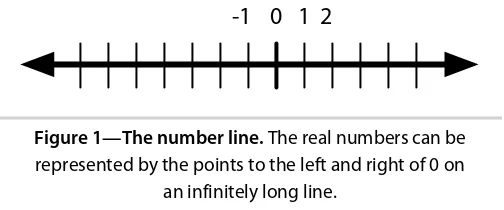
An informal and intuitive way to depict the real numbers is the number line that we learned in elementary school. Imagine a line that goes on forever in both directions. You can pick a spot on it and label it 0. To the right of 0, you mark
report erratum • discuss
off a second spot and label it 1. The distance between 0 and 1 is the distance between any two adjacent integers. So go the same distance to the right, make another mark, and label it 2. Keep doing that as far as you want. Then start going to the left from 0. The first mark is –1, the second –2, etc. That’s a basic number line. I’ve drawn a version of that in the
fol-lowing figure. Anyplace on that line that you look is areal
real number. Halfway between 0 and 1 is the real number 1/2. Halfway between 0 and 1/2 is 1/4. You can keep dividing it forever: between any two real numbers you can always find another real number.
0 1 2
-1
Figure 1—The number line.The real numbers can be represented by the points to the left and right of 0 on
an infinitely long line.
Using the number line, most of the important properties of the real numbers can be described in very nice, intuitive ways. The ideas of addition, subtraction, ordering, and continuity are all very clear. Multiplication may seem tricky, but it can also be explained in terms of the number line (you can look at my blog for posts about slide rules to get an idea of how1).
What the number line gives us to start isn’t quite the real numbers. It’s therationalnumbers. The rationals are the set of numbers that can be expressed as simple fractions: they’re theratioof one integer to another. ½, ¼,⅗, 124342/58964958. When we look at the number line, we usually think about it in terms of the rationals. Consider for a moment the way that I described the number line a couple of paragraphs ago: “You can keep dividing it forever: between any two real numbers, you can always find another real number.” That division process will always give us a rational number.
1. http://scientopia.org/blogs/goodmath/2006/09/manual-calculation-using-a-slide-rule-part-1
3. Real Numbers
•
16
report erratum • discuss
Divide any fraction into any number of equal parts, and the result is still a fraction. No matter how many times we divide using rationals and integers, we can never get anything that isn’t another rational number.
But even with the rational numbers, there are stillgapsthat can’t be filled. (We know about some of the numbers that fit into those gaps—they’re irrational numbers like the familiarπande. We’ll see more about the irrational numbers in4,Irrational and Transcendental Numbers, on page 23, and aboutespecifically in6,e: The Unnatural Natural Number, on page 37.) Looking at the rationals, it’s hard to see how there can be gaps. No matter what you do, no matter how small the distance between two rational numbers is, you can always fit an infinite number of rational numbers between them. How can there be gaps? The answer is that we can easily define sequences of values that have a limit but whose limit cannot possibly be a rational number.
Take any finite collection of rational numbers and add them up. Their sum will be a rational number. But you can define infinite collections of rational numbers, and when you add
them up, the result isn’t a rational number! Here’s an
example:
Every term of this sequence is obviously a rational number. If you work out the result of the first two terms, then the first three, then the first four, and so on, you get 4.0, 2.666…, 3.4666…, 2.8952…, 3.3396… and after 100,000 terms, it’s about 3.14158. If you keep going, it’s clearly converging on a specific value. But no finite sequence of rationals will ever be exactly the limit of that sequence. There’s something that is the limit of this sequence, and it’s clearly a number; and no matter what we do, it’s never exactly equal to a rational number. It’s always somewhere between any two rational numbers that we can choose.
The real numbers are the integers, the rational numbers, and those strange numbers that fit into the gaps between the rational numbers.
report erratum • discuss
3. Real Numbers
•
17
The Reals, Axiomatically
The axiomatic definition is, in many ways, quite similar to the definition the number line provides, but it does the job
in a very formal way. An axiomaticdefinition doesn’t tell
you how to get the real numbers; it just describes them with rules that draw on simple set theory and logic.
When we’re building something like the real numbers, which are defined by a set of related components, mathematicians like to be able to say that what we’re defining is a single
object. So we define it as atuple. There’s no deep meaning to the construction of a tuple; it’s just a way of gathering com-ponents into a single object.
The reals are defined by a tuple:(R, +, 0, ×, 1,≤), whereRis an infinite set, “+” and “×” are binary operators on members
ofR, “0” and “1” are special distinguished elements ofR,
and “≤” is a binary relation over members ofR.
The elements of the tuple must satisfy a set of axioms, called thefield axioms. The real numbers are the canonical example of a mathematical structure called afield. A field is a funda-mental structure used all over the place in mathematics; it’s basically the structure that you need to make algebra work. We define a field axiomatically by a set offield axioms. The field axioms get a bit hairy, so instead of looking at them all at once, we’ll go through them one by one in the following sections.
Field Axioms Part 1: Addition and Multiplication
Let’s start with the most basic axioms. The real numbers (and all fields) have two main operations: addition and multiplication. Those two operations need to work together in specific ways:• (R, +, ×)are a field. Here’s what this means:
– “+” and “×” are closed, total, and onto inR.Closed
means that for any pair of real numbersrands, if
you add them together,r + sandr × swill be real
numbers.Totalmeans that for any possible pair of
real numbersrands, you can addr + sor multiply
r × s. (It may sound silly to say that, but remember:
3. Real Numbers
•
18
report erratum • discuss
we’re going to get to division soon, and for division, that’s not true. You can’t divide by zero.) And finally,ontomeans that if you have any real number
x, you can find pairs of real numbers likerandsor
tandu, wherer + s = xandt × u = x.
– “+” and “×” are commutative:a + b = b + a, a × b = b × a.
– “×” is distributive with respect to each “+.” That means that (3 + 4) × 5 = 3 × 5 + 4 × 5.
– 0 is the only identity value for “+.” For alla,a + 0 = a.
– For every memberxof the setR, there isexactly one
value–x, called theadditive inverseofx, so thatx + –x = 0, and for allx≠0, x≠–x.
– 1 is the only identity value for “×”; for alla,a × 1 = a.
– For every real numberxexcept 0, there is exactly
one valuex–1, called themultiplicative inverseofx, such thatx × x–1= 1; and unlessxis 1,xandx–1are not equal.
If you turn all of that into English, it’s really not hard. It just says that addition and multiplication work the way that we learned in school. The difference is that in school, we were taught that this is just how numbers work; now we’re stating the axioms explicitly as requirements. The real numbers are
the real numbersbecausethey work this way.
Field Axioms Part 2: Ordering
The next axioms are about the fact that the real numbers are ordered. Basically, it’s a formal way of saying that if you have two real numbers, one is less than the other unless they’re equal.
• (R,≤)is a total order:
1. For all real numbersaandb, eithera≤borb≤a(or both, ifa = b).
2. “≤” is transitive: ifa≤bandb≤cthena≤c. 3. “≤” is antisymmetric: ifa≤b, anda≠b, then it’s not
true thatb≤a.
report erratum • discuss
3. Real Numbers
•
19
• “≤” is compatible with “+” and “×”: 1. Ifx≤ythen(x + 1)≤(y + 1).
2. Ifx≤y, then for allzwhere0≤z,(x × z)≤(y × z). 3. Ifx≤y, then for allz≤0,(x × z)≤(y × z).
Field Axioms Part 3: Continuity
Now, we get to the hard one. The tricky bit about the real numbers is the fact that they’re continuous—meaning that given any two real numbers, there’s an infinite number of real numbers between them. And in that infinitely large collection of reals, the total order still holds. To say that, we have to talk in terms ofupper bounds:
• For every subsetSinRwhereSis not the empty set, if
Shas an upper bound, then it has aleast upper bound,l,
such that for any real numberxthat is an upper bound
forS,l≤x.
That really says this: if you take a bunch of real numbers, no matter how close together or how far apart they are, there is one number that is the smallest number that’s larger than all of the members of that set.
That’s an extremely concise version of the axiomatic defini-tion of reals. It describes what properties the real numbers must have, in terms of statements that could be written out in a formal, logical form. A set of values that match that description is called a model for the definition; you can show that there are models that match the definition and that all of the models that match the definition are equivalent.
The Reals, Constructively
Finally, theconstructivedefinition—a constructive definition is a procedure for creating the set of real numbers. We can think of the real numbers as the union of several different sets.
First, we’ll take the integers. All of the integers are real numbers, with exactly the properties they had as integers.
Then we’ll add fractions, which are formally calledrational
numbers. A rational number is defined by a pair of non-zero
3. Real Numbers
•
20
report erratum • discuss
integer numbers called aratio. A ration/drepresents a real
number that when multiplied bydgives the valuen. The set
of numbers constructed this way ends up with lots of equivalent values, such as 1/2, 2/4, 3/6, and so on. As we did with the integers, we’ll define the rationals as a set of equiv-alence classesover the ratios.
Before we can define the equivalence classes of the rational numbers, we need to define a couple of other things that we’ll need:
1. If(a/b)and(c/d)are rational numbers, then(a/b) × (c/d) = (a × c)/(b × d).
2. For every rational number except 0, there’s another rational called itsmultiplicative inverse. Ifa/bis a rational number, then its multiplicative inverse, written(a/b)–1, is(b/a). For any two rational numbersxandy, ify = x–1
(ifyis the multiplicative inverse ofx), thenx × y = 1. We can use the definition of the multiplicative inverse to define ratio equivalence. Two ratiosa/bandc/dare equivalent if(a/b) × (c/d)–1= 1; that is, if multiplying the first ratio by the multiplicative inverse of the second ratio is 1. The equiva-lence classes of ratios are the rational numbers, and every rational number is also a real number.
That gives us the complete set of the rational numbers. For
convenience, we’ll use Q to represent the set of rational
numbers. Now we’re kind of stuck. We know that there are irrational numbers. We can define them axiomatically, and they fit the axiomatic definition of reals. But we need to be able to construct them. How?
Mathematicians have a bunch of tricks at their disposal that they can use to construct the real numbers. The one I’m going to use is based on something called aDedekind cut. A Dedekind cut is a mathematical object that can represent a real numberr as a pair(A, B)of sets:Ais the set of rational numbers smaller thanr;Bis the set of rational numbers larger thanr. Because of the nature of the rationals, these two sets have really peculiar properties. The setAis a set containing valuessmaller thansome numberr; but there is nolargest valueofA.Bis similar: there is no smallest value inB.ris the number in the gap between the two sets in the cut.
report erratum • discuss
3. Real Numbers
•
21
How does that get us the irrational numbers? Here’s a simple example: let’s define the square root of 2 using a Dedekind cut:
A = { r : r × r < 2 or r < 0 } B = { r : r × r > 2 and r > 0 }
Using Dedekind cuts makes it easy to define the real num-bers constructively. We can say that the set of real numnum-bers is the set of numbers that can be defined using Dedekind cuts of the rationals.
We know that addition, multiplication, and comparisons work nicely on the rationals—they form a field and they are totally ordered. Just to give you a sense of how we can show that the cuts also fit into that, we can show the definitions of addition, equality, and ordering in terms of cuts.
• Addition: This shows the sumX + Yof two cuts,X = (XL, XR)andY = (YL, YR)=(ZL, ZR), whereZL= { x + y : x in XLand y in YL}andZR= { x + y : x in XRand y in YR}.
• Equality: Two cutsX = (XL, XR)andY = (YL, YR)are equal if and only ifXLis a subset of YLandXRis a subset of YR.
• Ordering: If you have two cuts,X = (XL, XR)andY = (YL, YR),Xis less than or equal toYif and only ifXLis a
subset ofYLandYRis a subset ofXR.
Now that we’ve defined the reals and shown how we can construct good models of them, we’ve gotten to the point where we know what the most familiar numbers are and how they work mathematically. It might seem like now we really understand numbers. But the fact is, we don’t really. Numbers are still full of surprises. To give you a very quick taste of what’s coming, it turns out that we can’twritemost numbers. Most numbers go on forever and ever, and we can’t write them down. In fact, most numbers, we can’t even give a name to. We can’t write a computer program that will find them. They’re real and they exist; but we can’t point at them, name them, or describe them individually! In the next section, we’ll look at a class of numbers called theirrational numbersthat are the root of this uncomfortable fact.
3. Real Numbers
•
22
report erratum • discuss
4
Irrational and
Transcendental Numbers
In the history of math, there’ve been a lot of disappointments for mathematicians. They always start off with the idea that math is a beautiful, elegant, perfect thing. They pursue it, and they eventually discover that it’s not.
This leads us to a collection of strange numbers that we need to deal with: the irrational and transcendental numbers. Both were huge disappointments to the mathematicians who discovered them.
What Are Irrational Numbers?
Let’s start with the irrational numbers. These are numbers that aren’t integers and also aren’t a ratio of any two integers. You can’t write them as a normal fraction. If you write them as a continued fraction (which we’ll describe in11,Continued Fractions, on page 69), then they go on forever. If you write them in decimal form, they go on forever without repeating. They’re called irrational because they can’t be written as ratios. Many people have claimed that they’re irrational because they don’t make sense, but that’s just a rationaliza-tion after the fact.
They do make sense, but they are uncomfortable and ugly to many mathematicians. The existence of irrational numbers means that there are numbers that you cannot write down, and that’s an unpleasant fact. You can’t ever be precise when you use them: you’re always using approximations because
report erratum • discuss
you can’t write them down exactly. Any time you do a cal-culation using a representation of an irrational number, you’re doing an approximate calculation, and you can only get an approximate answer. Unless you manipulate them symbolically, no calculation that involves them can ever be solved exactly. If you’re looking for perfection—for a world in which numbers are precise and perfect—this isn’t it.
The transcendental numbers are even worse.Transcendental
numbers are irrational; but not only can transcendental numbers not be written as a ratio of integers, not only do their decimal forms go on forever without repeating, tran-scendental numbers are numbers that can’t be described by algebraic operations. There are irrational numbers like the square root of 2, which you can easily define in terms of an algebraic equation: it’s the value ofxin the equationy = x2
– 2wherey = 0. You can’t write the square root of 2 as a
decimal or a fraction, but you can write it with that simple equation. When you’re looking at a transcendental number, you can’t even do that. There’s no finite sequence of multi-plications, divisions, additions, subtractions, exponents, and roots that will give you the value of a transcendental number. The square root of 2 is not transcendental, because you can describe it algebraically; buteis.
The
Argh!
Moments of Irrational Numbers
According to legend, the first disappointment involving the irrational numbers happened in Greece around 500 BC. A rather brilliant man by the name of Hippasus, who was part of the school of Pythagoras, was studying roots. He worked out a geometric proof of the fact that the square root of 2 could not be written as a ratio of integers. He showed it to his teacher, Pythagoras. Pythagoras, like so many other mathematicians, was convinced that numbers were clean and perfect and he could not accept the idea of irrational numbers. After analyzing Hippasus’s proof and being unable to find any error in it, he became so enraged that hedrowned
poor Hippasus.
A few hundred years later, Eudoxus worked out the basic theory of irrationals, and it was published as a part of Euclid’s mathematical texts.
4. Irrational and Transcendental Numbers
•
24
report erratum • discuss
From that point, the study of irrationals pretty much disap-peared for nearly two thousand years. It wasn’t until the seventeenth century that people really started looking at them again. And once again, it led to disappointment, but at least no one got killed this time.
With the acceptance of irrational numbers, the idea of numbers as something that allowed us to capture the world precisely fell apart. Even something like calculating the cir-cumference of a circle couldn’t be done precisely. But mathematicians didn’t give up on perfection. They came up with a new idea for what the perfection of numbers in mathematics meant, this time based on algebra. This time they theorized that while you might not be able to write down all numbers as ratios, all numbers must be describable using algebra. Their idea was that for any number, whether integer, rational, or irrational, there was a finite polynomial equation using rational coefficients that had the number as a solution. If they were correct, then any irrational number could be computed by a finite sequence of addition, subtrac-tion, multiplicasubtrac-tion, division, exponents, and roots. But it was not to be. The German philosopher, mathemati-cian, and man about town Gottfried Wilhelm Leibniz (1646–1716) was studying algebra and numbers, and he’s the one who made the unfortunate discovery that lots of irrational numbers are algebraic but lots of them aren’t. He discovered it indirectly by way of the sine function. Sine is one of the basic operations of trigonometry, the ratio of two sides of a right triangle. The sine function is one of the fundamentals of analytic geometry that has real-world implications and is not just a random weird function that someone made up. But Leibniz discovered that you couldn’t compute the sine of an angle using algebra. There’s no algebraic function that can compute it. Leibniz called sine a transcendental function, since it went beyond algebra. This wasn’t quite a transcendentalnumber, but it really introduced the idea that there were things in math that couldn’t be done with algebra.
Building on the work of Leibniz, the French mathematician Joseph Liouville (1809–1882) worked out that you could easily construct numbers that couldn’t be computed using
report erratum • discuss
4. Irrational and Transcendental Numbers
•
25
algebra. For example, the constant named after Liouville consists of a string of 0s and 1s where for digitx, 10–xis a 1 if and only if there is some integernsuch thatn! = x. Once again, mathematicians tried to salvage the beauty of numbers. They came up with a new theory: that
transcen-dental numbers existed, but they needed to beconstructed.
They theorized that while there were numbers that couldn’t be computed algebraically, they were all contrived things, things that humans designed specifically to be pathological. They weren’tnatural.
Even that didn’t work. Not too much later, it was discovered
that e was transcendental. And as we’ll see in 6, e: The
Unnatural Natural Number, on page 37, e is a natural, unavoidable constant. It is absolutely not a contrived
cre-ation. Onceewas shown to be transcendental, other numbers
followed. In one amazing proof,πwas shown to be
transcen-dentalusing e. One of the properties that they discovered
after recognizing that ewas transcendental was that any
transcendental number raised to a non-transcendental power was transcendental. Since the value ofeiπis not tran-scendental (it’s –1), thenπmust be transcendental.
An even worse disappointment in this area came soon. One of the finest mathematicians of the age, Georg Cantor (1845–1918) was studying the irrationals and came up with the infamous “Cantor’s diagonalization,” which we’ll look at in16,Cantor's Diagonalization: Infinity Isn't Just Infinity, on page 127, which shows that there are more transcendental numbers than there are algebraic ones. Not only are there numbers that aren’t beautiful and that can’t be used in
pre-cise computations, butmost numbers aren’t beautiful and
can’t be used in precise computations.
What Does It Mean, and Why Does It Matter?
Irrational and transcendental numbers are everywhere. Most numbers aren’t rational. Most numbers aren’t even algebraic. That’s a very strange notion: we can’t write most numbers down.Even stranger, even though we know, per Cantor, that most numbers are transcendental, it’s incredibly difficult to prove
4. Irrational and Transcendental Numbers
•
26
report erratum • discuss
that any particular number is transcendental. Most of them are, but we can’t even figure out which ones!
What does that mean? That our math-fu isn’t nearly as strong as we like to believe. Most numbers are beyond us. Here are some interesting numbers that we know are either irrational or transcendental:
• e: transcendental
• π: transcendental
• The square root of 2: irrational, but algebraic
• The square root ofx, for allxthat are not perfect squares: irrational
• 2square root of 2: irrational
• Ω, Chaitin’s constant: transcendental
What’s interesting is that we really don’t know very much about how transcendentals interact; and given the difficulty of proving that something is transcendental, even for the most well-known transcendentals, we don’t know much of what happens when you put them together.π+e;π×e;πe,ee
are all numbers wedon’t knoware transcendental. In fact,
forπ+ e, we don’t even know if it’s irrational!
That’s the thing about these numbers. We have such a weak grasp of them that even things that seem like they should be easy and fundamental, we just do not know how to do. And as we keep studying numbers, it doesn’t get any better. For the people who want numbers to make sense, the disap-pointments keep coming. Not too long ago, an interesting fellow (and former coworker of mine) named Gregory Chaitin (1947–), showed that the irrational numbers are even worse than we thought. Not only are most numbers not rational, not only are most numbers not algebraic, most
numbers cannot even bedescribed in any way. It’s not a big
surprise that they can’t be written down, because we already know that we can’t really write down any irrational num-ber—the best we can do is write a good approximation. In fact, for most numbers, we can’t write a description, an equation, or a computer program to generate them. We can’t identify them precisely enough to name them. We know
report erratum • discuss
4. Irrational and Transcendental Numbers
•
27
they exist, but we’re absolutely helpless to describe or identify them in any way at all. It’s an amazing idea. If you’re interested in it, I highly recommend reading Greg’s book,
The Limits of Mathematics [Cha02].
4. Irrational and Transcendental Numbers
•
28
report erratum • discuss
Part II
Funny Numbers
When we think about numbers, even if we’re thinking abstractly, we don’t usually think of anything like an axiomatic definition such as Peano arithmetic. We think about specific numbers and their symbols. From a mathematical viewpoint, some numbers tell us important things. For example, the number zero, which for eons wasn’t even considered a number, practically changed the entire world once people understood it!
In this part of the book, we’re going to look at some of the special numbers used by mathematicians and scientists because they tell us interesting things about the world and how we, as human beings, understand it. Because their properties are sometimes startling, I call themfunnynumbers.
We've left this page blank to make the page numbers the same in the electronic and
paper books.
We tried just leaving it out, but then people wrote us to ask about the missing pages.
Anyway, Eddy the Gerbil wanted to say “hello.”
5
Zero
When we look at strange numbers, the starting place has to be zero. Zero may not seem strange to you because you’re used to it. But the idea of zero really is strange. Think about what we said numbers mean: if you think in terms of cardi-nals and ordicardi-nals, in terms of counting and position, what does zero mean?
As an ordinal, what does it mean to be the zeroth object in a collection? And what about zero as a cardinal? I can have one something and count it. I can have 10 somethings and count them. But what does it mean to have zero of some-thing? It means that I don’t have any of it. So how can I count it?
And yet, without the concept of zero and the numeral 0, most of what we call math would just fall apart.
The History of Zero
In our pursuit of the meaning of zero, let’s start with a bit of history. Yes, there’s an actual history to zero!
If we were to go back in time and look at when people started working with numbers, we’d find that they had no concept of zero. Numbers really started out as very practical tools, primarily for measuring quantity. They were used to answer questions like “How much grain do we have stored away?” and “If we eat this much now, will we have enough to plant crops next season?” When you think about using numbers in a context like that, ameasurementof zero doesn’t really mean much. A measurement can only make sense if there’s something to measure.
report erratum • discuss