IMPROVING STUDENTS' FLUENCY THROUGH VOICE
RECORDING MEDIA IN EDI MANCORO ISLAMIC BOARDING
SCHOOL
A GRADUATING PAPER
Submitted to the Board of Examiners as a Partial Fulfillment of the
Requirements for the Degree of Sarjana Pendidikan (S.Pd)
in English Education Department
By:
AMALIA ISMAYANTI
113 12 041
ENGLISH EDUCATION DEPARTMENT
TEACHER TRAINING AND EDUCATION FACULTY
STATE INSTITUTE FOR ISLAMIC STUDIES (IAIN)
SALATIGA
STATEMENT OF THE WORKS OF SCIENTIFIC PUBLICATIONS
Bismillahirrahmanirrohim
The undersigned bellow:
Name : Amalia Ismayanti
NIM : 113-12-041
Faculty / Department : Teacher Training and Education Faculty / English Education
Department
Type : Graduating paper
Title : Improving Students' Fluency Through Voice Recording
Media In Edi Mancoro Islamic Boarding School
Hereby, declares that I agree to:
1. Provide a royalty-free rights to the library of IAIN Salatiga for my scientific work, for the sake of science development.
2. Granting store, managing in the form of a database, distribute, and display them in soft-copy for academic interest to the Library of IAIN Salatiga, without needing to ask permission from me during my name is listed as the author.
3. Willing and guarantees to underwrite private way without involving Library of IAIN Salatiga from all forms of lawsuits arising copyright infringement in this scientific work.
This statement I make with real and hopefully used properly.
Salatiga, March 15th 2017 The Researcher
MOTTO
Love is The Strongest Motives To Do Anything
So,
Keep Loving Anyone
DEDICATION
This paper is dedicated to:
1.My great God, ALLAH SWT the most gracious and the most merciful.
2.State Institute for Islamic Studies (IAIN) Salatiga especially to English
Education Department of Teacher Training and Education Faculty.
3.Edi Mancoro Boarding School and all boarding schools around Salatiga.
4.My beloved father and mother, Bapak Salim Munawar and Ibu Paryati.
5.My beloved sibling, Muhammad Syarif Khusna.
6.Desaku Maju Foundation (YDM)
7.My beloved close friends, Itsna Millatul Himmayati, Siwi Saraswati, Selvi
Alviana Rafida, Kholishotul Umami, Mas Agus Farizal, Kakak Faisal and Mas
Ulin. Thanks for always by my side anytime I need.
8.LAZEM and KH. Mahfudz Ridwan's biography writing team.
9.KDII and "Kampung Bahasa" of Language Service Unit of PPEM
10.My roommates of fifth room of Edi Mancoro Boarding School Suci, Alfi,
Mbak Wardah, Mbak Asya, Mbak Jamilatun, Mbak Diyah and Munhamiroh,
ACKNOWLEDGMENT
Bismillahirrahmanirrahim,
In the name of ALLAH, the most gracious and merciful, the kings of universe and
space. Thanks to ALLAH because the writer could complete this paper as the
requirement for the Degree of Sarjana Pendidikan (S.Pd) in English Education
Department, Teacher Training and Education Faculty of State Institute for Islamic
Studies (IAIN) Salatiga.
This paper would not have been completed without support, guidance and help from
individual and institution. Therefore, I would like to express special thanks to:
1. Dr. H. Rahmat Hariyadi, M.Pd. as the Rector of State Institute for Islamic Studies
(IAIN) Salatiga.
2. Suwardi, M.Pd. as a Dean of Teacher Training and Education Faculty of IAIN
Salatiga.
3. Noor Malihah, Ph.D. as a Head of English Education Department of IAIN Salatiga.
4. Rifqi Aulia Erlangga, S.Fil, M.Hum as a Counselor and also my inspiring lecturer
who has educated, supported, directed and given the researcher advice, suggestion
and recommendation for this research report from beginning until the end. Thanks
for your patience and care.
6. K.H. Mahfudz Ridwan, Lc and the big family, who have given educated us
especially in terms of religion in Edi Mancoro Boarding School.
7. Great crew of Desaku Maju Foundation (YDM), Muhamad Hanif, M.Hum,
Saifudin Zuhri, M.Si, Ahmad Faidi, M.Hum, M. Nazil Iqdami, M.A, Najmuddin,
S.Sy. Thanks for every support of writing this paper until finish.
8. ZISKAF and KH. Mahfudz Ridwan's biography writing team who always
impressive, Agus Farizal Azuan, Akrom Musabbihiin, Alfian Jauhari, Ashadil,
Asnawi, Choiril Anwar, Fahidatul Zunita, Hesti, Hidayah, Ifadatul Habibah, Imam
Sufi, Indah Asfaradina, Indy Lutfiatun, Kholishotul Umami, Khozainul Muna,
Kuni, Sulkhan, Maratus S., Mufidatul Mahmudah, Naila Rajiha, Syukri Abadi,
Taufikhurrohman, Taufiq Ashari, Tika, Rahma and Zabid.
7. All of lecturers of IAIN Salatiga who have bestowed their knowledge to us.
8. All of staffs of IAIN Salatiga who have helped the researchers in processing
administration.
9. Our big family, thanks for their kindness and support.
10. All of participants who have helped me to make self voice recording.
11. All of my friends in Edi Mancoro Boarding School and IAIN Salatiga.
Finally, this paper is expected to be able to provide useful knowledge and information
to the readers.
Salatiga, January 26th 2017
ABSTRACT
Ismayanti, Amalia. 2017. Improving Students' Fluency Through Voice Recording
Media In Edi Mancoro Islamic Boarding School. Councelor : Rifqi Aulia
Erlangga, S.Fil, M.Hum
This paper is aimed to describe voice recording as one of media to improve
students' speaking fluency in Edi Mancoro Islamic Boarding School. In this action
research, the writer collect the data from test, observation, documentation and
questionnaire. To improve the students' speaking fluency through voice recording
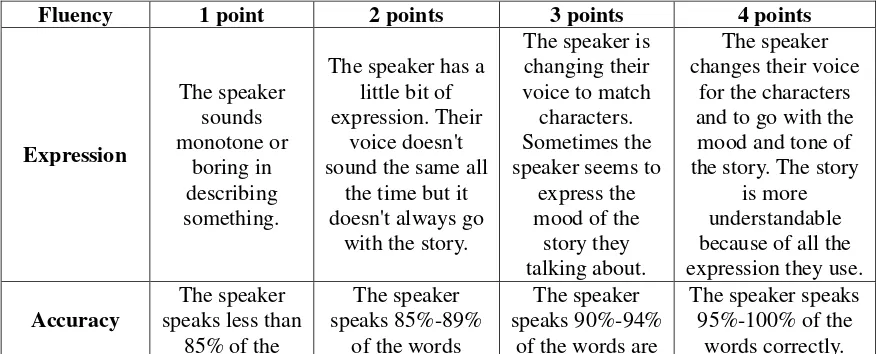
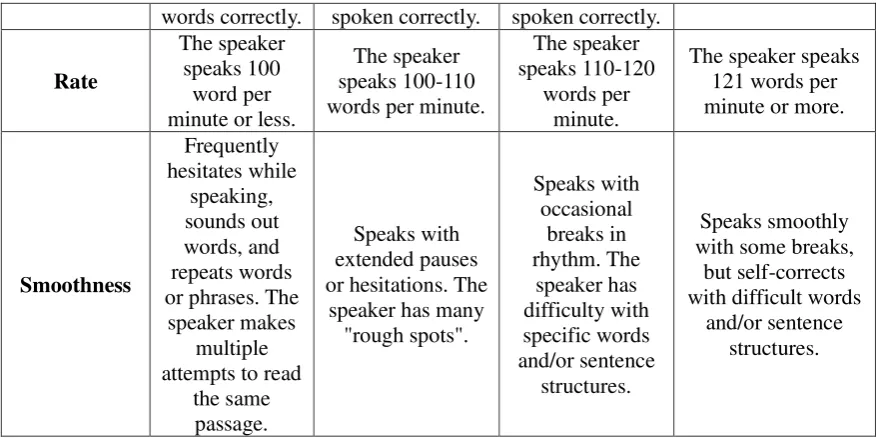
media in “Kampung Bahasa” program, a rubric is used. The rubric shows the 4
aspects of fluency, they are expression, accuracy, rate and smoothness. The results
show that through voice recording, students can improve their speaking fluency and
this medium works properly in “Kampung Bahasa” program of Edi Mancoro Islamic
Boarding school. Voice recording has many advantages for teachers, students, and
readers.
TABLE OF CONTENTS
TITLE ... i
DECLARATION ... ii
ATTENTIVE COUNSELOR NOTES ... iii
VALIDATION ... iv
STATEMENT OF THE WORKS OF SCIENTIFIC PUBLICATIONS ... v
MOTTO ... vi
DEDICATION... vii
ACKNOWLEDGMENT ... viii
ABSTRACT ... x
TABLE OF CONTENT ... xi
LISTS OF TABLES ... xiv
LISTS OF FIGURES ... xv
CHAPTER I ... 1
INTRODUCTION... 1
A. Background of the Study ... 1
B.Limitation of Study ... 5
C.Research Questions ... 5
D.Purpose of the Study ... 5
G. Review of Previous Research ... 7
H. Research Paper Outline ... 9
CHAPTER II ... 11
REVIEW OF THE RELATED LITERATURE ... 11
A. Speaking ... 11
1. Definition of speaking ... 11
2. Types of Speaking Performances ... 12
3. Characteristics of Speaking Skill ... 14
4. The Delivery Methods of Speaking ...Error! Bookmark not defined. 5. The Elemets of Speaking ...Error! Bookmark not defined. B. Fluency ... 20
1. Definition of Fluency ... 20
2. Components of Fluency ... 21
C. Voice Recording ... 22
1. Audio Video ... 23
2. The Benefit of Using Audio Video in Teaching ... 24
3. Audio as a Learning Tool ... 25
4. Voice Recording Application...26
D. The Stage of Fluency Rubric...27
E. Action Research ... 29
CHAPTER III... 34
METHOD OF RESEARCH ... 34
A. Research Subject ... 34
1. Place ... 34
2. Time... 39
B. Research Design ... 39
1. Research Method ... 39
2. Research Procedure ... 40
3. Instrument and Technique of Collecting Data ... 42
CHAPTER IV ... 49
RESULT AND DISCUSSION ... 49
A. Data Analysis... 49
1. The Analysis of Presentation ... 49
2. The Analysis of Cycle ... 49
B. Discussion... 61
C. Summary of Cycle I and Cycle II ... 62
CHAPTER V ... 63
CLOSURE... 63
A. Conclusion ... 63
B. Suggestion ... 64
LISTS OF TABLES
Table 1 audio to support learning ... 25
Table 2 voice recording application ... 26
Table 3 fluency rubric by Brown ... 27
Table 4 fluency rubric ... 28
Table 5 profile of students in Edi Mancoro ... 38
Table 6 rubric to measure speaking fluency ... 42
Table 7 example of giving score ... 43
Table 8 scoring speaking fluency in the first cycle ... 51
Table 9 scoring speaking fluency in the second cycle ... 56
LISTS OF FIGURES
Figure 1 cyclical action research by Kemmis and Taggart ... 30
Figure 2 action research interacting spiral by Stringer ... 32
CHAPTER I
INTRODUCTION
In this first chapter, the writer explain about the background of study, limitation
of study, research questions, purpose of the study, benefit of the study, definition of key
term, review of previous research and research paper outline.
A. Background of the Study
Language is very important for human life. It is produced as a vital means
to deliver messages or to communicate messages by the use of speaking (the act of
sound production), symbol or symbol writing (Risdianto, 2013). With language,
human can communicate with other human beings. They can express their thoughts,
ideas and messages to others by spoken or written. Every country in this world has
their own language to communicate with. It asked the society to make an
agreement of using some languages as international language to communicate inter
countries. One of them is English. It is one of the widely used international
languages. English is an international language and the most widespread medium
of communication because the number and geographical areas of its speakers are
very large. Therefore technology and scientific are mostly communicated in
English in almost all countries. Thus, it is not surprising that the teaching of
English is carried out in many parts of the world.
As an international language, English becomes a language that must be
introduced as a compulsory subject to be thought from elementary school to
university. Not only formal schools but also non-formal schools such boarding
schools also learn English. To make the communication goes well, human required
to master language skills.
Language skills includes four aspects, namely listening, speaking, reading
and writing. The four language skills are supported by language aspect, for
examples: pronunciation, vocabulary and structure. The most important aspect of
language skill is speaking.
Speaking is an interactive process of constructing meaning that involve
producing and receiving and processing information (Brown, 1994; Burns & Joyce,
1997). Actually, not only an interactive process, the context of speaking also
include one way communication such as giving announcements, notifications and
telling something that the listener do not need to give answer. Every language skills
should be exercised to improve the students ability, so does the speaking skill.
There are five basic types of speaking; imitative, intensive, responsive,
interactive and extensive. Most of them need a feedback to communicate with each
other. Only in limited contexts of speaking (monologues, speeches, or telling a
story and reading aloud) can we assess oral language without the aural participation
of an interlocutor (Brown, 2003). There are 5 element of speaking: pronunciation,
grammar, vocabulary, fluency and comprehension. The most common element
Fluency is a part of speaking skill which shows the listener that the speaker
can talk easily with good intonation, rhythm, and stress without any hesitation. It
makes both single words and combinations of words, like phrases, clauses, and
whole sentences, understandable to the listeners. Grammar is the structure of the
language and vocabulary holds the individual building blocks, so both are also
essential to fluency. As a basic skill that should be had by everyone in this world,
speaking English becomes one skill that must be learned by students in almost all
schools in Java. Not only formal schools but also non-formal schools such
boarding schools have to learn English too.
Edi Mancoro Islamic Boarding School is one of Islamic boarding schools in
Semarang, Central Java in which English should be learned by the students. In this
boarding school, English subject is given once a week in the evening at 9.00 P.M.
The students study English in 60 minutes effectively. This activity named
"Kampung Bahasa" program. This program conducted by Language Developing
Unit of Students Organization of Edi Mancoro Islamic Boarding School. There,
students taught by senior students who master the subject.
However, 60 minutes a week is not enough for students to practice English
well, especially in speaking skill. Moreover to improve their speaking fluency.
Thus, teacher should think seriously how to improve the students' ability in
Edi Mancoro Islamic Boarding School is one of modern boarding school
that allow the students use many kind of technologies, such as, notebook, hand
phone, etc. Almost students in Edi Mancoro Islamic Boarding School are using
smart phone as their communication tool in the main purpose. Beside that, smart
phone is a mobile phone with an advance mobile operating system which combines
features of a personal computer operating system with other feature useful for
mobile or handheld use. It typically combines the features of a cell phone with
those of other popular mobile device, such as Personal Digital Assistant (PDA),
media player, sound/voice recorder, digital camera and GPS navigation unit. Most
smart phones can access the internet and can run third-party apps. By using one of
the smart phone features, that is audio/voice recorder, the students can record their
own voice to assess their speaking skill.
Based on the condition above, the researcher was thinking about how to
improve Edi Mancoro Students' speaking skill especially in the fluency aspect in
limited time by way of media. After choosing the audio or voice recorder as the
correct media, the writers would like to conduct research about improving fluency
aspect in speaking skill entitled "Improving Students' Fluency Through Voice
B.Limitation of the Study
Based on the background of study above, we can see that there are many
elements of speaking to be improved. After considering the time, money and
energy, this research emphasizes on the improving students' fluency only. The
study was conducted in the C class of Kampung Bahasa Program in Edi Mancoro
Islamic Boarding School in the academic year of 2015/2016. The study uses a
media named Smart Voice Recorder to input the speaking. The topic the writer used
to read by the students through voice recorder is descriptive text.
C. Research Question
1.How is the implementation of using Voice Recorder media in improving
speaking fluency of Edi Mancoro Islamic Boarding School's students?
2.Is there any improvement in using Voice Recorder media to the students'
speaking fluency of Edi Mancoro Islamic Boarding School's students?
D. Purpose of the Study
Based on the research questions above, the purpose of the study will be as
follows:
1.To describe the implementation of using Voice Recorder media in speaking class
of Edi Mancoro Islamic Boarding School.
2.To find out the improvement in using Voice Recorder media in speaking fluency
E.Benefit of the Study
The result of this study will give some benefits to the readers, especially
teacher of English speaking and students. The benefits are as follows:
1.For teacher
Teachers will have the new method and media to improve students' English
speaking especially in fluency. The teachers also have the alternative way to
assess the students in speaking.
2.For students
The students have the other way to improve the speaking fluency and
represent their speaking skill through a medium.
3.For the reader
The reader will know the other improvisation techniques in English
speaking skill.
F.Definition of Key Terms
The writer wanted to clarify and explain the terms of the title to avoid the
ambiguity in perception of some terms used in this study. The definitions are as
bellow:
1. Improve
Improve means become or make something or somebody better (Oxford
2. Fluency
Fluency means an ability to speak a language easily and well (Oxford
Learner's Pocket Dictionary (4th ed. 2008). In this paper, the writer use four
components of fluency to measure the students speaking fluency; expression and
volume, phrasing, smoothness and pace.
3. Voice Recording
Voice is sounds produced through the mouth by a person speaking (Oxford
Learner's Pocket Dictionary (4th ed. 2008). Recording is sounds or pictures
recorded on a tape or disc (Oxford Learner's Pocket Dictionary (4th ed. 2008). In
this study, the writer means voice recording as a media to input students' voice in
order to improve their speaking fluency.
G. Review of the Previous Research
The writer adapted some researches which related to this research’s topic.
The first, Nesapiradana and Murtiana (2013) conducted a research entitled
Improving Students' Fluency Through Voice Recording in LBPP LIA Banjarmasin.
They used classroom action research as design of research.
Two classes of intermediate 4 at LIA Banjarmasin were selected to be
object of their research. The students in both classes were asked to read a
monologue and their voice was recorded. The result was then played, and the
modeled the correct chunks, intonation and stress.the next step the students were
asked to re-read the monologue and re-record their voice, and play the result to see
the improvement. The result is, through this procedure most of students were able
to improve their reading fluency, as evidenced by their correct use of chunking,
phrasing, intonation, and word stress.
The second was by Greg Kessler (2010) entitled Fluency and Anxiety in
Self-Access Speaking Task: The Influence of Environment. This study compares
characteristics of fluency in student audio journals recorded in a laboratory setting
with those recorded using mobile audio devices. Forty graduate students enrolled
in four oral communication courses at an American university recorded weekly
audio journals for a 10 week term. Students chose the environment in which they
recorded these journal, provided that they recorded at least once in the audio
laboratory and at least once using mobile audio devices.
The frequency of preferred recording environment was observed. Two
independent raters assigned rank scores to the students’ volume, pausing, utterance
length, and rate in relation to the observable influence of anxiety upon fluency in
order to determine if there is a significant difference between fluency in these two
environments. Implications for language learning are discussed.
The third was by Paul Nation entitled Improving Speaking Fluency. The
study examines the improvement of learners of English during the performance of
during the short time spent doing the activity, learners performed at a level above
their normal level of performance. It is argued hat working at this higher than usual
performance is a way of bringing about long-term improvement in fluency.
Considering these three researches, the writer would analyze the similar
topic. In this case, the writer conduct a research about improving students' fluency
through voice recording in Kanpung Bahasa class of Edi Mancoro Islamic
Boarding School. The aim of this research is to know the students' improvement of
fluency and the advantages of using audio recording in learning speaking for
Kampung Bahasa students.
The difference of those researches above with the writer's is about the
setting of place which the previous researches were done in formal institute than
the writer's is in semi-formal institute. Some techniques are also not be same at all.
H.Research Paper Outline
The writer organize the research paper in the five chapters. In order to the
research paper can be arranged clearly. The first chapter is introduction. It
introduces the background of study, limitation of the study, research questions,
purpose of the study, benefit of the study, definition of key term, review of
previous research, and the last is research paper outline.
The second chapter contain with the review of the related literature. In this
performance, characteristics of speaking skill, the importance, the delivery methods
and the elements. Fluency, including the definition and the components. Voice
recording; audio video, audio as a learning tool and voice recording application.
Then the stage of fluency rubric,and the last of this chapter is about action research;
the definition and its steps.
Thirdly, in this chapter is method of research. In this chapter the writer
discussed about research subject and research design. As the subject in this
research, the profile of place where the research done would be written in this
chapter. Not only about the place, the writer also described about the time when she
did her research. In the research design part, there are research method, research
procedure, instrument and technique of collecting data would be discussed.
The fourth chapter is about result and discussion. There are two parts, data
analysis and discussion. In the data analysis, the writer served the analysis of
presentation and the analysis of cycle. The discussion would serve the result of this
research in complete view.
The last chapter is chapter five. In this chapter will contain with closure. In
the closure the writer will discuss the research conclusion and the suggestion. The
conclusion include the method and the result of research; the improvement of
students' fluency and the advantages of using the medium.
CHAPTER II
REVIEW OF THE RELATED LITERATURE
In this chapter, the writer explain about the theoretical foundation which
includes the definition of speaking, fluency, voice recording, and the stages of speaking
fluency rubric.
A. Speaking
1. Definition of Speaking
There are many definitions about speaking that have been proposed by some
experts in language learning. Brown (2001) said that when someone can speak a
language it means he can carry on a conversation reasonably competently. Speaking
here is not only produce syllables or a word. There is a meaningful sentences to be
understand by the listener. A conversation occur between two person or more who
speak linear theme they understand.
In addition, the definition of speaking was conveying by Richards and
Renandya (2002). They stated that effective oral communication requires the ability
to use the language appropriately in social interactions that involves not only verbal
communication but also paralinguistic elements of speech such as pitch, stress, and
intonation. Moreover, nonlinguistic elements such as gestures, body language, and
expressions are needed in delivering messages directly without any following
Again, Brown (2007) stated that social contact in interactive language
functions is an important key and in which it is not what you say that counts but how
you say it what you deliver with body language, gestures, eye contact, physical
distance and other nonverbal messages. Based on the definition speaking above,
speaking is one of skill in the English language that does an interaction with other
people with conversation, speech and other by body language, gesture, eye contact
and another style to convey the message.
2. Types of Speaking Performances
Brown (2003) describes six categories of speaking skill, there are:
a. Imitative
This category includes the ability to practice an intonation and focusing on
some particular elements of language form. That is just imitating a word, phrase or
sentence. The important thing here is focusing on pronunciation. The lecture uses
drilling in the teaching learning process. By using drilling, students can get
opportunity to listen and to orally repeat some words.
b. Intensive
This is the students' speaking performance that practices some phonological
and grammatical aspects of language. The students must do the task in pairs (group
work), for example, reading aloud that includes reading paragraph, reading dialogue
c. Responsive
Responsive performance includes interaction and test comprehension but at
the somewhat limited level of very short conversation, standard greeting and small
talk, simple request and comments. This is a kind of short replies to teacher or
student-initiated questions or comments, giving instructions and directions. Those
replies are usually sufficient and meaningful.
d. Transactional (dialogue)
It is carried out for the purpose of delivering or exchanging specific
information. For example, a conversation between a buyer who asking about the
price for a kilo of rice to the seller.
e. Interpersonal (dialogue)
It is carried out more for the purpose of maintaining social relationships than
for the transmission of facts and information. The forms of interpersonal speaking
performance are interview, role play, discussions, conversations, games and speech.
f. Extensive (monologue)
It is a kind of single speaking or there are no partner to make a direct
conversation. For example, teacher gives students extended monologues in the form
of oral reports, summaries, and storytelling and short speeches.
Based on the theory above, it can be concluded that there are many ways in
performing speaking. In this research, students are free to choose the type of
students have been ready and prepared for the activity, they can use the language
appropriately.
3. Characteristics of Speaking Skill
Speaking skill is seen as somewhat difficult for some language learners.
Here, a speaker should at least pronounce the words well, choose the suit dictions,
and try to do grammatically correct though, perhaps in any cases, it is common when
a speaker speaks without having good attention at accuracy or fluency. Brown
(2010) said that there are eight characteristics of spoken language can make oral
performance easy as well as, in some cases, there are:
a.Clustering
Because of fluent speech is phrasal, not word by word, so the learners should
be able to organize their output both cognitively and physically through such
clustering. In this case, speaker are demanded to memorize or figure out the phrasal
words.
b. Redundancy
It means that the speaker has an opportunity to make meaning clearer
through redundancy of language. Speaker can emphases the redundance word in
order to explain that the word which is redundance is important. Learners can
c. Reduced
All form special problems in teaching spoken English are; contractions,
elisions, reduced, vowels, etc. Students who don‘t learn colloquial contractions
sometimes can develop a stilted, bookish quality of speaking that in turn stigmatize
them.
d. Performance variable
As the process of thinking as we speak, it's possible allow us to manifest a
certain number of performance hesitations, pauses, backtracking, and corrections.
Some performance variables that can be taught to the learners are; how to pause and
hesitation, for example, in English our thinking time is not silent; we insert certain
fillers such us uh, um, well, you know, I mean, like, etc. One of the most silent
differences between native and non-native speakers of a language is their hesitation
phenomena.
e. Colloquial language
To make the students able to speak well, the teachers should introduce them
with the words, idioms, and phrases. Students are also can learn colloquial language
from film, novel, etc.
f. Rate of delivery
It is another important characteristic of fluency. One of our tasks in teaching
spoken English is to help learners achieve an acceptable speed along with other
g. Stress, rhythm, and intonation
This is the most important characteristic of English pronunciation. The
stress-timed rhythm of spoken English and its intonation patterns convey important
messages. Last character is interaction. Learning to produce waves of language in a
vacuum-without interlocutors-would rob speaking skill of its richest component: the
creativity of conversational negotiation (Brown, 2010).
i. Interaction
Speaking is about interaction. It is about how you interact and what kind of
language that you use that will make the communication goes smoothly. Speaker can
see the listener personality to balance the speaking style.
Based on the explanation above, the analysis showed how easily speaking
skill can be accommodated within this particular view of language. When lecturers
asks students to use the spoken language in the classroom, they needs them to take
part in a process where not only involves a knowledge of the target language, but
also a general knowledge of interaction between the speaker and audiences in order
that meanings and negotiate meanings are made clear. The example, the audiences
may respond or give feedback as to whether the audiences have understood or did
not understand with the speaker says.
4. The Delivery Methods of Speaking
Based on Grice and Skinner (1998) there are 4 basic methods of delivering
11.Speaking Impromptu
Speaking impromptu is speaking without advance preparation. For example,
when someone become known as a speaker, people will sometimes ask him to stand
up and give a talk at the moment. To make it running well, speaker need to know the
main point, know the purpose, work in a couple of good examples, try for a
memorable conclusion, be sure to make a circle (relate the conclusion back to the
opening).
12.Speaking from Memory
Speaking from memory or memorization is similarly appropriate only on
rare occasions. We speak from memory when we prepare a written text and then
memorize it word for word. The memorized speech allows a smooth, almost
effortless looking delivery, since the speaker has neither notes nor a manuscript and
can concentrate on interacting with the audience. For most of speakers, memorizing
takes a long time. Speakers concentration on the memory work they have done and
their fear of forgetting part of the speech can also make them sound mechanical or
programmed when reciting. For these reasons, the memorized method of delivery is
usually appropriate only for brief speeches, such as when introducing another
speaker, or presenting or accepting an award, for example.
13.Speaking from Manuscript or Reading Speaking
Speaking from manuscript can also state as reading speaking. Speaking from
only ensures that the speaker will not be at a loss for words, but is also essential in
some situations. An address that will be quoted or later published in its entirely is
typically delivered from a manuscript. For example, an ulama in mosques every
Friday deliver speeches before praying or a president who is conveying his speech in
front of his citizen. Any speaking situation calls for precise, well worded
communication is appropriate for manuscript delivery.
14.Speaking Extemporaneously
The final method of delivery, and by far the most popular, is speaking
extemporaneously, or from notes. It works best for almost every speaker. It means
being very well prepared, but not having every word set. From beginning, practice
using notes, but never a typed script. The idea of practicing is not to memorize the
speech, but to become thoroughly familiar with the expression and flow of ideas. Do
not memorize, but familiarize. We can also prepare by reciting our speech into a tape
recorder, using the outline to guide.
5. The Elements of Speaking
Speaking is a skill in the English teaching that deliver word and sound to
express ideas, opinions or feeling. In the speaking there are some elements that must
be considered by speaker ( Chaudy, 1997).
a. Pronunciation
Pronunciation is a feature of speech. In the pronunciation includes with many
language, such as sound, syllables, word and intonation. This particular range from
the individual sound made up recount, to the way which is pitch the rise and fall of
the voice or sound.
b. Grammar
Grammar is a system of rules governing the conventional arrangement and
relationship of word in a sentence (Brown, 2001). In the speaking English language
well in the formal situation, many people that mastered of grammar when they
speak.
c. Vocabulary
Vocabulary can be the build of word that is used by people to communication
with other people. To speaking English fluently, the students must master many
vocabularies.
d. Fluency
Hornby (1974) defines fluency as the quality of being able to speak smoothly
and easily. It means someone can speak without any hesitation. Someone can speak
fluently even though he makes errors in pronunciation a grammar.
e. Comprehension
The last speaking element is comprehension. Comprehension can make the
people getting the information that they want. It is defined as the ability to
understand something by a reasonable comprehension of the subject or as the
B. Fluency
1.Definition of Fluency
Fluency has many definitions based on someone's point of view. For
example, a secretarial staff said that fluency is something that keeps going without
pause, whether it is speech or anything else without hesitation. In other hand, a
drama lecturer said that fluency is ability to understand, respond, express yourself
spontaneously. Those are the definition of fluency in informal accounts. It can be
described conditionally based on someone experiences (Guillot,1999).
Here, the writer put the definition about fluency in formal account such as
dictionaries and from author. Based on Oxford Learner's Pocket Dictionary (2008),
Fluency means an ability to speak a language easily and well. Same to Oxford,
Longman dictionary (2000) also describe fluency as an anility to speak easily or
something of speech coming easily. While an author named Carol Bainbridge
defines reading fluency refers to the ability to read quickly, smoothly, easily, and
with expression.
More specific definition came from Fillmore (1979) in Nation (1989), he
mentioned that fluency is the ability to fill time with talk...a person who is fluent in
this way does not have to stop many times to think of what to say next or how to
phrase it. Based on those definitions, person can measure someone fluency by the
characteristics.
fluency from a foreign language teaching point of view. Fluency is said to describe
the level of proficiency in communication, which include:
a.The ability to produce written and/or spoken language with ease
b.The ability to speak with a good but not necessarily perfect command of
intonation, vocabulary and grammar
c.The ability to communicate ideas effectively
d.The ability to produce continuous speech without causing comprehension
difficulties or a breakdown of communication.
Dictionary of Applied Linguistics definition (Richards, Platt & Weber,
1985) in Guillot (1999) define the features of fluency. The features which give
speech the qualities of being natural and normal, including native like use of
pausing, rhythm, intonation, stress, rate of speaking and the use of interjections and
interruptions. Whilst Willis (2008) said that When reading out loud, students with
successful fluency read expressively, naturally and effortlessly as they mentally
divide the text into meaningful, distinct, related phrases. But in this paper, the
writer used four feature from Rasinsky, which include expression and volume,
phrasing, smoothness and pace.
2.Components of Fluency
a.Accuracy, the quality or state of being correct or precise (oxford dictionary).
b.Automaticity, the automaticity evident in perceptual motor skill extend to
cognitive skills. There are four common characteristics; speed, effortlessness,
autonomy and lack of conscious awareness (Breznitz, 2005).
c.Prosody, according to Carroll and Slowiaczek in Breznits (2005), prosody is
comprised of meter, intonation, and inflection, and constitutes an abundantly
organized pattern that provides additional information regarding the sentence.
Almost same definition, other author Dowhower (1991) defines, Prosody is a
general linguistic term to describe rhythmic and tonal features of speech. These
elements usually cover more than one phoneme segment (e.g., syllables, words,
and larger units of speech), they are also called supra-segmental features.
There are 3 Prosodic features; Pitch (intonation), stress (loudness), and
duration (timing). Intonation is the sound changes by the rise and fall of the
voice when speaking, especially when this has an effect on the meaning of what
is said. Stress is the intensity with which a phoneme, syllable, or word is uttered
(Dowhower. 1991). Duration is the length of time that the speaking lasts.
C. Voice Recording
Voice recording is an application help teacher in using audio as a medium for
teaching and learning process. Before the writer write more about this application,
1. Audio and Video
Audio and video are considered to be the media that can be profited in the
English teaching and learning process. It has been proven to be an effective tool in
the teaching English as a foreign/ second language for young and adult learners
(Rammal, 2006).
Using audio and video as media in teaching learning process is important. It
enables students to access resources that support learning wherever they are;
without the need to attend a specific location at a defined time. The use of audio
and video also makes it possible to present knowledge in different ways and
enables different forms of interaction with learners. Utilizing audio and video to
support learning is now more accessible than ever.
Audio and video materials can be used to enhance learning resources by
showing real life scenarios, explaining concepts, observing social groups, and
acting as triggers for discussion. They are also able to bring experts and viewpoints
to the student learning experience and are excellent at bringing subjects ‘to life’ to
engage discussion and inspire learning.
In this research, the writer encouraged the students to learn more about
creating their own audio and video resources to ensure they have the skills to
deliver rich, engaging content. Both audio and video have been used to support
learning for some time, but as new technologies have become available and the
educators to capture their own audio and video using every day, accessible
technology. So that, students are able to create anything when the teacher lets the
students use voice recording by themselves.
2.The benefit of Using Audio and Video in Teaching
In deakin.edu.au, there are some benefit of using audio and video for
students that can support their learning in the following ways. It provides diverse
teaching techniques for learning, gives the teacher a voice, this can reduce the
feeling of isolation for cloud based students, but also helps located students feel
connected, can be used to simplify and explain complex problems, can allow
students to access the learning materials as often as required, allows students to
learn at their own pace, with instant playback, rewind and pause, reduces
frequently asked questions from students, and can be re-used.
From the explanations above, it is clear that audio and video have many
advantages. Audio and video can support the teaching learning process and also give
advantage for the students to assess themselves to see if they improve their speaking
skill or not. The students can learn language not only by listening how native
speakers pronounce some words but also by observing their expression. They can
also learn about culture from other countries what other people in other countries
3. Audio as a Learning Tool
From the audiocassettes of the 1970s to digitally recorded music, audio has
come a long way as a teaching and learning aid and is an extremely valuable
method for capturing and presenting information. Audio provides a quick,
cost-effective alternative to text for connecting with your students and providing
up-to-date content, interviews, discussions or lecture materials.
Middleton in Deakin highlights that audio has a demonstrated capacity to
facilitate authentic engagement, allowing students to connect in various ways to the
outside world as both listeners and publishers. Audio can easily be created with
many desktop tools and small digital recording devices such as smartphones.
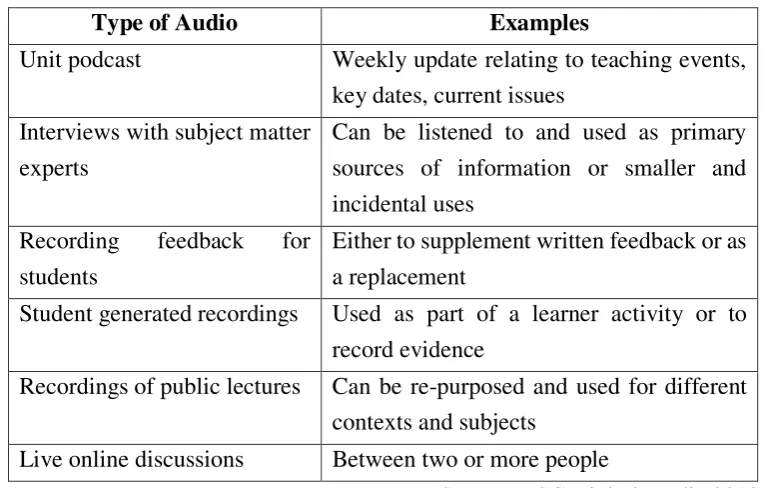
Table 1
Some ways in which people can use audio to support learning
Type of Audio Examples
Unit podcast Weekly update relating to teaching events,
key dates, current issues
Interviews with subject matter
experts
Can be listened to and used as primary
sources of information or smaller and
incidental uses
Recording feedback for
students
Either to supplement written feedback or as
a replacement
Student generated recordings Used as part of a learner activity or to
record evidence
Recordings of public lectures Can be re-purposed and used for different contexts and subjects
4. Voice Recording Application
Voice recorder is simple application which records sound from microphone.
This application had given by the producer of each cell phones in all types.
Nowadays, this application also can found in every smart phones and you can find
various voice recording applications in Google Play Store. There, users can get
better voice recorder that suitable with their needed, but they should download the
application first. Then, users can record their voice and after recording they can trim
the sound and save it to their computer.
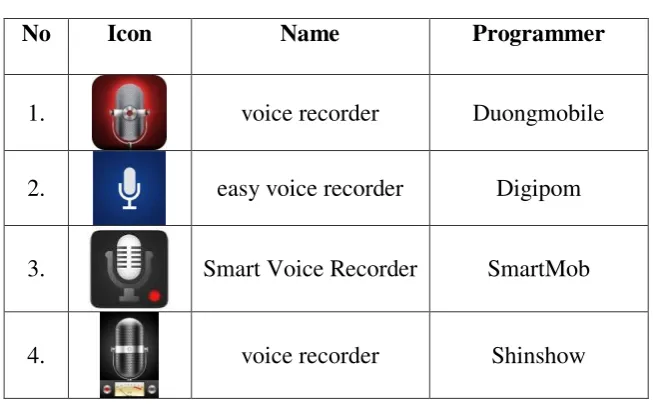
There are some diverse voice recording application in Google Play Store:
Table 2
Voice Recording Applications
No Icon Name Programmer
1. voice recorder Duongmobile
2. easy voice recorder Digipom
3. Smart Voice Recorder SmartMob
4. voice recorder Shinshow
Every voice recorder application in the Google Play Store have rates for their
recorder. There, viewer can rate by clicking the star. And another viewer can see the
review highlights on the Play Store windows.
D. The Stages of Fluency Rubric
Fluency is one of speaking elements that very important. To know the
progress of speaking fluency, teacher need to measure the students' speaking
fluency. To measure their fluency teacher need standards to decide, one of them is
rubric which has form of skills measurement. It contents scores and criteria of each
elements.
In measuring fluency, teachers also have rubric form to measure. Here,
writer takes some the rubrics from authors.
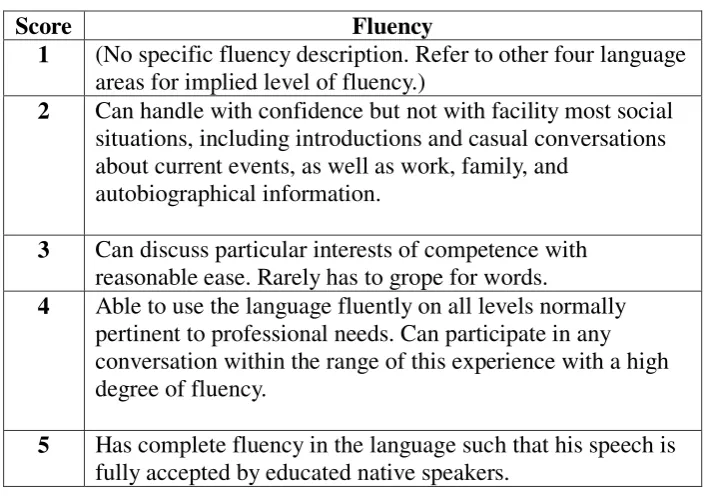
Table 3
Fluency Rubric from Oral proficiency scoring categories (Brown, 2003) :
Score Fluency
1 (No specific fluency description. Refer to other four language areas for implied level of fluency.)
2 Can handle with confidence but not with facility most social situations, including introductions and casual conversations about current events, as well as work, family, and
autobiographical information.
3 Can discuss particular interests of competence with reasonable ease. Rarely has to grope for words.
4 Able to use the language fluently on all levels normally pertinent to professional needs. Can participate in any conversation within the range of this experience with a high degree of fluency.
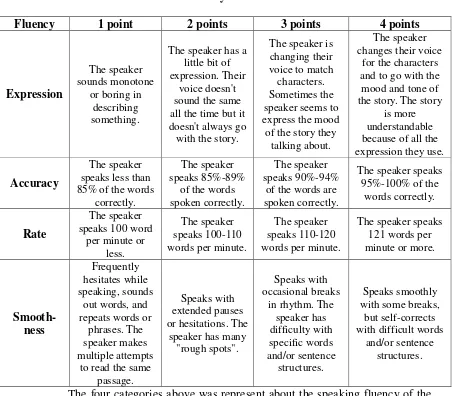
In this case, the writer used a rubric based on the lesson plan and as the
The four categories above was represent about the speaking fluency of the
students. Each categories has four score level. By this rubric, the teacher can
E. Classroom Action Research
1.Definition of Classroom Action Research
This research uses classroom action research. Action research is trying out
an idea in practice with a view to improving or changing something, trying to have
a real effect on the situation (Kemmis in Hopkins, 1993:45). Classroom Action
Research (CAR) is research organized by teacher in the class on the pressing of
completing or improvement process and learning practice. In this research, the
teacher was the writer. She taught the class, while her friend, as the observer,
wrote and took video of everything that happened in the class.
Action research is concerned equally with changing individuals,on the
one hand, and, on the other, the culture of the groups, institutions and societies
to which they belong (Kemmis and McTaggart, 1992). The culture of a group
can be defined in terms of the characteristic substance and forms of the
language and discourses, activities and practices, and social relationships and
organization which constitute the interactions of the group.
Bassey (1998) in Koshi (2005) describes ‘action research as an inquiry
which is carried out in order to understand, to evaluate and then to change, in
order to improve educational practice’. Cohen and Manion (1994) describe the
emergent nature of action research in their definition. They describe action
research as essentially an on the spot procedure designed to deal with a concrete
step process is constantly monitored over varying periods of time and by a
variety of mechanisms (questionnaires, diaries, interviews and case studies, for
example) so that the ensuing feedback may be translated into modifications,
adjustment, directional changes, redefinitions, as necessary, so as to bring about
lasting benefit to the ongoing process itself rather than to some future occasion.
2.Steps in Classroom Action Research
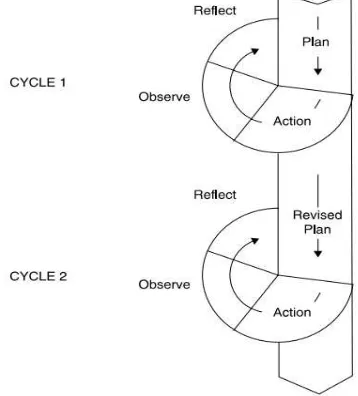
According to Kemmis and McTaggart (1988) in Burns 2010, Action
Research typically involves four broad phases in a cycle of research. The first
cycle may become a continuing, or iterative, spiral of cycles which recur until
the action researcher has achieved a satisfactory outcome and feels it is time to
stop.
Figure 1
Here the explanation about the cyclical above;
a. Planning
In this phase researcher identifies a problem or issue and develop a
plan of action in order to bring about improvements in a specific area of the
research context. This is a forward looking phase where researcher considers:
what kind of investigation is possible within the realities and constraints of
researcher's teaching situation and what potential improvements researcher
thinks are possible.
b. Action
The plan is a carefully considered one which involves some deliberate
interventions into researcher's teaching situation that researcher put into action
over an agreed period of time. The interventions are 'critically informed' as the
researcher question researcher's assumptions about the current situation and
plan new and alternative ways of doing things.
c. Observation
This phase involves researcher in observing systematically the effects
of the action and documenting the context, actions and opinions of those
involved. It is a data collection phase where researcher uses 'open-eyed' and
'open-minded' tools to collect information about what is happening.
d. Reflection
of the action in order to make sense of what has happened and to understand
the issue the researcher has explored more clearly. Researcher may decide to
do further cycles of Action Research to improve the situation even more, or to
share the 'story' of the research with others as part of researcher ongoing
professional development.
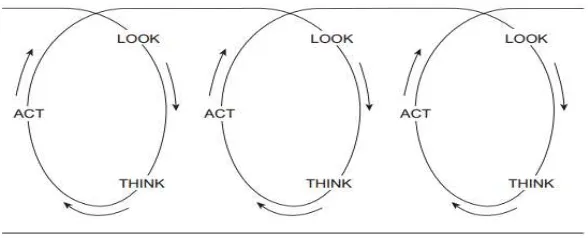
In other hand, another author, Stringer (2007) gave a different
formulation of the step in Action Research. Figure 2: Action Research
Interacting Spiral based Ernest T. Stringer (2007)
Figure 2
Action Research Interacting Spiral based Ernest T. Stringer (2007)
In this cycling, every cycle, researcher does 3 main activities; look, think
and act. Basically, this routine is the simplification of Kemmis and McTaggart's
a.Look
As the first step that should be done is almost same to observation. In
this step, the researcher gathered relevant information (gathering data), build a
picture, describe the situation (define and describe).
b. Think
As the second step here is focus on correlate the theories and the result
of its look and analyze what the researcher got there. In other word, this step
included explore and analyze, interpret and explain (theorize).
c. Act
As the third step contain making plan for the research and report,
CHAPTER III
METHOD OF RESEARCH
In this chapter, the writer explained about research subject, and research
design.
B.Research Subject
1.Place
The research was conducted in Edi Mancoro Islamic Boarding School
which located in Gedangan, kec. Tuntang, kab. Semarang.
a. The Profile of Edi Mancoro Islamic Boarding School
Edi Mancoro is one of Boarding Schools in Semarang Regency which
has an unique name. Most of boarding schools use arabic word in labeling
theirs, but Edi Mancoro uses Javanese language to label it. Originate from Edi
which has meaning Good or Nice and Mancoro has meaning shine. So then,
Edi Mancoro mean a boarding school that would have a nice bright shine
shining all over the world. At first, Edi Mancoro Islamic Boarding School is
only a place to do education and train for non government organizations
(NGO) a society of Desaku Maju in the last 80's and beginning 90's. KH
Mahfud Ridwan, Lc is the one who started the founding and take care of this
boarding school since December 26, 1989 until now.
At first, the working area of this boarding school was focused on
with practice, humanist and inclusive features. Nowadays, the dynamic of
society flows so fast and the complexity of society is very variative.
Furthermore, boarding school should became as a responsive, pro-active and
accommodative institution.
Edi Mancoro Islamic Boarding School attempts to harmonize,
integrate and turn enterprises over to the indigenous people (pribumisasi) the
dimension of religious, social and nationality collectively.
The profile of Edi Mancoro Islamic Boarding School can explained
briefly as below;
b. The Founder of Edi Mancoro Islamic Boarding School
The first idea of founding Edi Mancoro Islamic Boarding School is
Desaku Maju foundation. This foundation motored by the 80's activist, they
are KH. Mahfudz Ridwan, Lc., KH. Muhammad HM. Sholeh BA., Matori
Abdul Jalil and Zainal Arifin,BA.. Furthermore, this foundation led by KH.
Mahfudz Ridwan, Lc., built an alternative boarding school, that is Edi
Mancoro Islamic Boarding School on December 26, 1989 as a base camp and
a place of educating and training. In 2013, boarding school management
joined in Edi Mancoro Foundation that had registered in Indonesian Law
Ministry.
c. The Vision dan Mission of Edi Mancoro Islamic Boarding School
forming the students which have religion's insight and to be the serve for
ummah in the Indonesian pluralism context. In addition to built the students
which have big sympathize with a good ability to accompanying vast society.
“Mencetak Santri Sebagai Pendamping Masyarakat Sesungguhnya”.
d. The Characteristics of Edi Mancoro Islamic Boarding School
Edi Mancoro Islamic Boarding School had non profit characteristic,
Independently, be autonomous in picked the wisdom and struggle's bound.
e. Programs of Edi Mancoro Islamic Boarding School
The programs of Edi Mancoro Islamic Boarding School are;
1)Carried out recite and studies about Islam in a intensive manner without
interruption in a textual perspective which have normative characteristics as
well as Indonesian contextual.
2)Organized scientific discusses, religions dialogue, discuss about the cross
races understanding for all Indonesian societies components plurally.
3)Make socialites’ on the process of turning enterprises over to the indigenous
people.
4)Operate training and education programs for student activist of Edi
Mancoro Islamic Boarding School as the way of endeavoring societies.
5)Formed cooperation network in the meanwhile boarding school, societies
institutions, non-government organizations, social organizations, and all the
f. Address of Edi Mancoro Islamic Boarding School
Village : Gedangan
Subdistrict : Tuntang
Regency : Semarang Regency
Province : Central Java
Telephone : (0298) 313329
Mobile phone : 081392393873/085865561152
Email : [email protected]
g. Structure of di Mancoro Boarding School
Leader : KH. Mahfud Ridwan, Lc.
Student's Guardian : Muhamad Hanif, S.S., M.Hum.
Pengasuh santri tahfidz : Rosyidah, Lc.
Leader of Edi Mancoro Foundation: Muhamad Hanif, S.S., M.Hum.
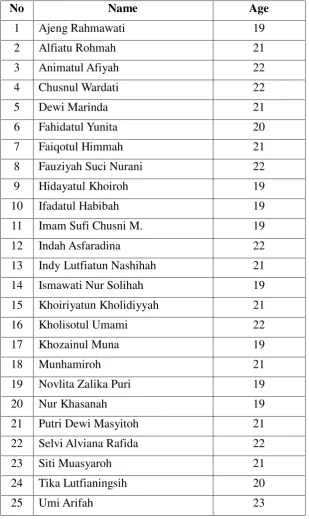
The subject of research isthe students in the C class of Kampung Bahasa
Program in Edi Mancoro Islamic Boarding School in the academic year of
2015/2016. They are 25 students; 24 are girls and 1 is boy. Most of them are in the
range 19 until 23 years old. The students study English in 60 minutes effectively.
This program conducted by Language Developing Unit of Students Organization
Table 5
Profile of the Students in Edi Mancoro Islamic Boarding School
No Name Age
1 Ajeng Rahmawati 19
2 Alfiatu Rohmah 21
3 Animatul Afiyah 22
4 Chusnul Wardati 22
5 Dewi Marinda 21
6 Fahidatul Yunita 20
7 Faiqotul Himmah 21
8 Fauziyah Suci Nurani 22
9 Hidayatul Khoiroh 19
10 Ifadatul Habibah 19
11 Imam Sufi Chusni M. 19
12 Indah Asfaradina 22
13 Indy Lutfiatun Nashihah 21
14 Ismawati Nur Solihah 19
15 Khoiriyatun Kholidiyyah 21
16 Kholisotul Umami 22
17 Khozainul Muna 19
18 Munhamiroh 21
19 Novlita Zalika Puri 19
20 Nur Khasanah 19
21 Putri Dewi Masyitoh 21
22 Selvi Alviana Rafida 22
23 Siti Muasyaroh 21
24 Tika Lutfianingsih 20
2.Time
The research was conducted from April28th 2016 until December 23th 2016 in
Edi Mancoro Islamic Boarding School. It was included conducting the class,
planning strategies, collecting theories and data, and also writing the report.
B. Research Design
1.Research Method
This research uses action research. Action research is trying out an idea
in practice with a view to improving or changing something, trying to have a
real effect on the situation (Kemmis in Hopkins, 1993:45). Classroom Action
Research (CAR) is research organized by teacher in the class on the pressing of
completing or improvement process and learning practice. In this research, the
teacher was the writer. She taught the class, while her friend, as the observer,
wrote and took video of everything that happened in the class.
Action research is concerned equally with changing individuals,on
the one hand, and, on the other, the culture of the groups, institutions and
societies to which they belong. The culture of a group can be defined in
terms of the characteristic substance and forms of the language and
discourses, activities and practices, and social relationships and organization
which constitute the interactions of the group (Kemmis and McTaggart
2.Research Procedure
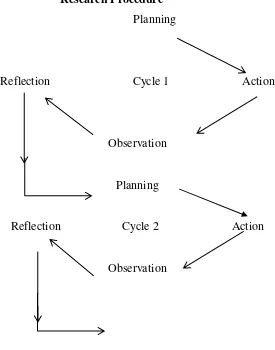
There are many experts who propose action research model with
different design, but generally there are four steps that usual done. They are
planning, action, observation and reflection, the action research cycle, as
interpreted by Arikunto in Suyadi (2010) can be explained in the following
design:
Figure 3
Research Procedure
Planning
Reflection Cycle 1 Action
Observation
Planning
Reflection Cycle 2 Action
The following is the explanation of the description of every meeting
in the research.
1. Planning.
Researcher prepared the teaching strategy and preparing media.
2. Action
After the researcher has planed in preparing the teaching strategy, further
more, the design plan will be implemented in teaching learning process.
Teacher and researcher entered the class. Teacher opened the lesson by
greet the students. She explained the activity that will be done in the class.
After that, teacher gave warming up questions about descriptive text and
explained the material.
In the end of the class, the teacher asked students to record their
descriptive task using Smart Voice Recording and collect to the teacher.
3. Observation
The researcher observed the teaching learning process in the class. She
wrote the data during the learning process.
4. Reflection
In the reflecting step, the researcher discussed and analyzed about the
teaching learning activity in the classroom. Then, the researcher prepared
3.Instrument and Technique of Collecting Data
a. Test
Test is used by researcher to examine the result of the subjects
by using questions or other instruments which measure the students’
result of the lesson that is researched.In other words, Test is the sequence
of questions or exercises and other instruments used to measure of skill,
intelligence, ability or talent belonging to an individual or a group. In this
research, the researcher will use test two times. It contains of pre-test and
post-test in each cycle. The formulations to analyze the test are:
a. Students' Score
In measuring students' speaking fluency, the writer use the
rubric below. To pass the task, the minimum score the students get must
be 70 or more.
Table 6
Rubric to measure speaking fluency
words correctly. spoken correctly. spoken correctly.
To get the total score, the teacher should give the score in each component
based on the rubric above.
Table 7
Example of giving score
The score is (total points :16 *100)
Explanation:
P: Percentage
F: Frequently
N: Number of students
Adapted from Tri Kukuh Andarbeni (2010)
5.Mean
Where:
= Mean of students’ score
= The sum of students’ score
= The total number of students
6.Standard Deviation
Where:
= Deviation Standard
D = Different between pre-test and post-test
N = Number of observation in sample
7.T-test
After calculating SD, the researcher calculate t-test to know is there
any significant differences or not between pre-test and post-test
Where:
= T-test for the differences of pre-test and post-test
= Deviation standard for one sample t-test
= Difference between pre-test and post-test
N = Number of observation in sample
b. Observation
Observation is the activity of researcher that looking at what
people actually do (Robert, 2007). So, observation is the activity that
is done by a researcher to view the people behavior. Observation is
used to study observation is used to behavior of people and context in
which the behavior occurs. Also, find out activity of students do in the
interpreting subject.
The benefits of observational data are that the researcher is able
to describe some element of the subject. They are included the setting
people who participated in those activities, and the meaning of the
setting (Patton, 1991).
To collect the data, the writers conducted an observation of
class. The observation is done by the writer on Wednesday, April21
2016. The writer came into the classroom to see the activities in the
"Kampung Bahasa" program during the teaching and learning process
of English. The writer joined "Kampung Bahasa" program from 9.00
pm to 10.00 pm.
The writer was teaching while her peer as the researcher
observed the speaking activities process in the class. The observation
was used by the writer to know the ability of students' speaking when
they joined this class. The students were given the material by the tutor,
and they discussed it together.
In the observation, the writer used note taking to write
everything that happened in the teaching and learning process. In the
same occasion the writer also announced a research meeting which
would conducted by the writers on Thursday, April28 2016 at 9.00pm.
In the meeting, the writer asked the students to take their
self-voice recording. The material was descriptive. The students
should make an oral descriptive in 2 minutes. Then, they have to
c. Documentation of Students Task
According to Arikunto (2006), documentation is a number of
data that present verbal data like correspondence, journal, memory,
report and other which can mutually responsible. Documentation is the
past event note. Documents also can be form as written note, picture,
or monumental creation from someone.
In this research, the writer used the students' self-voice
recording about their description which is submitted by the students, to
analysis of students speaking skill. The writer got these task
documentations on Wednesday, May18 2016. After the writer got the
task documentations, the writer could analysis the result of the
students' self-voice recording to know the students' speaking skill
using descriptive text in the “Kampung Bahasa” program.
4. Data Analysis Method
The data analyses that gotten by the researcher when in the teaching
learning process.
The steps of the data analysis in this research are as follows:
1.Analyzing the problems
In this case, the researcher should figure the class out where the
2.Analyzing the score obtained by students
The researcher analyzed the score obtained by students based on the
test after getting test with achieving some cycles mentioned.
3.Analyzing the students’ activities in the classroom.
The researcher wrote and observed the activities which happened in
teaching learning process. Here, the teacher are demanded to be sharp