159 СЕЛСКОСТОПАНСКА АКАДЕМИЯ●ЖИВОТНОВЪДНИ НАУКИ, LI, 1-2/2014
The increased number of population growth needs enough food stock to fulill the food necessity. Protein-sources food stuffs resulted by the farmers, such as meat, egg, or milk, are between the food stock which must be increased. Furthermore, it is known that meat is the primary source of animal protein. Demand rate of chicken meat is four per cent more than its produc-tion rate. Chicken meat can be supplied from the poul-try farm, either from the broiler hens or from the layer hens. Layer hens have double beneits, beside produc-ing eggs, they can also produce meat after their pro-duction period over. Unproductive layer hens also can be used to produce meat, and then to be sold as culled layer meat, since they have tough meat (Lengkey, 1991). The broiler industry is gaining rapid momentum and consumer usually do not prefer old culled birds for table use because of the poor quality due to lack of ten-derness. The quality of meat for commercial purpose and acceptability depend on the amount and nature of biochemical constituent (Sinku, et al., 2002). Papa-in is Papa-in the dried latex obtaPapa-ined from the papaya fruit (Carica papaya L). It is the protease which is most
commonly used for the food processing. Tenderness is considered to be the most important organoleptic char-acteristic of meat.
According to Archile-Contreras et al. (2011), the toughness associated with spent chicken meat is pri-marily due to the increased cross-linking in the con-nective tissue of older animals. Culled hens which were being used for meat purpose are going to be discarded by the quality concious consumers due to inherent quality differences especially tenderness of spent hen meat. Therefore, the farmers are facing a problem in disposing their old-unproductive layers. The treatment of proteolytic enzymes is one of the popular methods for meat tenderization. The latex of the papaya plant and its green fruits contains two proteolytic enzymes, papain and chymopapain. The latter is most abundant
THE EFFECT OF LENGTH OF SOAKING IN PAPAIN
ON MEAT WATER CONTENT, pH AND TENDERNESS
OF CULLED LAYER HENS
HENDRONOTO ARNOLDUS W. LENGKEY, DANI GARNIDA, LILIES SURYANINGSIH
Animal Husbandry, Universitas Padjadjaran, Bandung, Indonesia
but papain is twice as potent (Virdi, 2009). The us-age of tenderizer can be done by injection (Lengkey, 1991), by dipping the meat cut in a solution contain-ing proteolytic enzymes (Gerelt, et al., 2000) or wrap-ping the meat with fresh papaya leaves (Abdalla, et al., 2013). Papain is in the dried latex obtained from the papaya fruit (Carica papaya L). It is the protease
which is most commonly used for the food processing. Using for papain is in the meat industry for the ten-derisation of meat. Carica papaya is a native to tropical countries. The latex is a complex mixture of chemical compounds with diverse chemical activities (El Mous-saoui et al., 2001) and serves as an excellent meat ten-derizer (Huet, et al., 2006).
MATERIAL AND METHODS
Culled Laying Hens
The experimentals culled laying hens were 63 weeks of Hyline strain, and the weight was between 1.1 – 1.6 kg. These birds were randomly divided into four groups, and each group containing 5 birds. The breast were chosen randomly for dipped in papain so-lution.
Papain
The papain is a commercial papain. The papain used in this study at 3% level (w/w) to improve the tenderness and functional properties such as water content and pH of culled layer hens meat. The papain, was divided in four groups, where the meat was dipped for 15’, 30’, 45’ and 60’.
Preparation and cooking of the meat :
160 СЕЛСКОСТОПАНСКА АКАДЕМИЯ●ЖИВОТНОВЪДНИ НАУКИ, LI, 1-2/2014
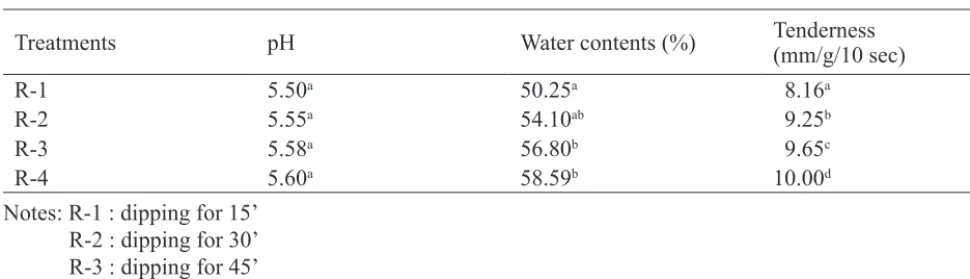
Table 1. pH, Water Contents and Tenderness of Culled Laying Hens in Papain treated groups
Treatments pH Water contents (%) Tenderness (mm/g/10 sec)
R-1 5.50a 50.25a 8.16a
R-2 5.55a 54.10ab 9.25b
R-3 5.58a 56.80b 9.65c
R-4 5.60a 58.59b 10.00d
Notes: R-1 : dipping for 15’ R-2 : dipping for 30’ R-3 : dipping for 45’ R-4: dipping for 60’
a,b,c,d means bearing same superscript did not differ signiicantly.
slaughter and then dipped in papain solution, using pH meter. The water content is using oven method, and the tenderness using Universal penetrometer 1/10 TH MM DV. The breast was cooked after putting in plas-tic bag until boiled for 10 minutes. This experimental was done at Laboratorium Bahan Makanan and Labo-ratorium Teknologi Pengolahan Produk Peternakan, Fakultas Peternakan Universitas Padjadjaran, Band-ung, Indonesia.
The experimental method and statistical analysis :
The experimental method is Completely Random-ized Design 4 x 5. Data collected in these experiment were subjected to analysis of variance (ANOVA) test under Completely Randomized Design (CRD) 4 x 5. Duncan’s multiple range tests was used to determine the differences among the treatments means.
RESULTS AND DISCUSSION
Data pertaining to the effect of papain on pH, wa-ter content and tenderness of culled laying hens is pre-sented in Table 1.
The effect of treatment on meat pH
The means on pH of culled layer hens, has no sig-niicancy, even the longest it was dipped in the papain gave more pH and this results indicated that there is no signiicancy because the carcass has the same treat-ments and the pH was measured after the birds was slaughtered and then the meat was soaked in papain solution. The pH of meat plays important role in main-taining the meat quality. The thoughness of the meat, occurs at low pH. In this treatment, the pH of the meat are between 5.50 – 5.60. The meat pH level rise as the dipping time is longer. It means that the dipping time has effect on pH level. So there is an activity of papain
towards the meat pH, even there is no signiicancy on this treatment. According to Sinku et. al (2002), the pH of culled layers are 5.63, and Khan and Natamura (1970) reported an ultimate pH near 5.7 as desirable for maintaining quality of poultry breast meat. But when the carcass was injected with papain, and then slaugtered after 1 – 3 minutes, the pH were between 5.967 – 6.233 (Lengkey, 1991).
The effect of treatment on Meat Water Content In Table 1, the water content are between 50.25 till 58.59%. The water content was rise as the dipping time is longer. The means from R-1 treatment was sig-niicantly effect to R-3 and to R-4; but between R-1 and R-2 has no signiicantly effect, and between R-2 vs R-3, and also between R-3 vs R-4. The water con-tent will effected the tenderness of the meat. It means that the papain has effect on the meat water content. There is an increasing on meat water content when the dipping time more longer. The meat ability to bind the water will increase because of the papain. According to Sinku et al. (2003) there is signiicantly increased of water content in breast muscle after treatment with proteolytic enzyme.
The effect of papain on Meat Tenderness
161 СЕЛСКОСТОПАНСКА АКАДЕМИЯ●ЖИВОТНОВЪДНИ НАУКИ, LI, 1-2/2014
CONCLUSIONS
It can be concluded that soaking the carcass in the papain solution, had a positive effect on water content, pH and tenderness of culled layer hens meat. The lon-ger the soaking time, will increase the water content, pH and tenderness; even there is no signiicancy in the meat pH, but there is signiicancy in the water content and the tenderness of culled layer hens meat.
REFERENCES
1. Abdalla, H. O., N. N. A. Ali, F. S. Siddiq and S. A. M. Ali, 2013. Improving Tenderness of Spent Layer Hens Meat Using Papaya Leaves (Carica papaya).
Pakistan Veterinary Journal. 33(1) : 73-76. www.pvj. com.pk.
2. Archile-Contreras, A. C., M. C. Cha, I. B. Mandell, S.P. Miller and P.P. Purslow, 2011. Vitamin E and C may increase collagen turnover by intramus-cular ibroblasts. Potential for improved meat quality. J. Agric Food Chem. 59: 608-614.
3. El Moussaoui, A., M. Nijs, C. Paul, R. Win-ljens, J. Vincentelli, M. Azarkan and Y. Looze, 2001. Revisiting the enzymes stored in the laticifers of
Carica papaya in the context of their possible
partici-pation in the plant defence mechanism. Cell Mol Life Sci. 85: 556-570.
4. Gerelt, B., Y. Ikeuchi, A. Suzuki, 2000. Meat tenderization by proteolytic enzymes after osmoric de-hydration. Meat Science. Vol. 56, Issue 3. November 2000, pages 311 – 318.
5. Huet, J., Y. Looze, K. Bartik, V. Raussens, R. Wintjens and P. Boussard, 2006. Structural charac-terization of the papaya cysteine proteinasses at low pH. Biochem Biophys Res Commun, 341:620-626.
6. Khan, A.W. and R. Nakamura, 1970. Effect of pH and postmortem glycolysis on poultry tenderness. J. Food Sci. 35: 266.
7. Lengkey, H A. W., 1991. Pengaruh Penyuntikan Papain Terhadap Keempukan Karkas Ayam Petelur Afkir. Majalah Ilmiah Universitas Padjadjaran No. 2 Vol 9, hal. 57 – 6.
8. Sinku, R. P., R. L. Prasad, A. K. Pal, S. B. Jad-han, 2003. Effect of Plant Proteolytic Enzyme on the Physico-chemical Properties and Lipid Proile of Meat from Culled, Desi and Broiler Chicken.Asian-Aust. J. Anim. Sci. 2003. Vol. 16, No. 6: 884-888.
9. Virdi, M. S.. 2009. Papain from Papaya. Science Tech Entrepreneur, Nov. 2009. p. 1 – 5.
THE EFFECT OF LENGTH OF SOAKING IN PAPAIN ON MEAT WATER CONTENT, pH AND TENDERNESS
OF CULLED LAYER HENS
H. A. W. Lengkey, D. Garnida , L. Suryaningsih
Animal Husbandry, Universitas Padjadjaran - Bandung, Indonesia
SUMMARY
Twenty culled layer hens was test on the effect of length of soaking in papain on meat water content, pH and tenderness. The length of soaking are 15, 30, 45 and 60 minutes; and the experiment used Completely Random-ized Design (CRD), and each treatment was repeated ive times. Results indicated that 60 minutes soaking has the best on water content (58.59%), pH (5.60) and tenderness (10 mm/g/10 sec).
Key words : papain, water content, pH, tenderness, culled layer hens