157
TEACHING ENGLISH WITH AN INTERNET-BASED NATURE
OF GOOGLE DOCS TO IMPROVE STUDENTS’
CRITICAL THINKING
Erly Wahyuni
Faculty of Teacher Training and Education, University of Muhammadiyah, Malang, Indonesia
[email protected]
First draft received: 18 August 2017 Accepted: 12 Dec 2017 Final proof received: 5 Feb 2018
Abstract
One of the 4C skills required by the students in today’s global community is critical thinking. Critical
thinking skill is not a skill that can evolve by itself along with the development of human body.
Accordingly, it requires creativity on teachers’ side. The teacher can consider strategies and methods that can enhance students’ thinking ability. One of the strategies used by the teacher in teaching
language to enhance learners’ critical thinking is internet-based nature of Google docs, an online application that can enrich learning environment by transferring teaching instruments that is user-centered. The objectives of this study are a) to identify the learning activities designed by the teacher to develop critical thinking, b) to describe the activities that expose the skill and to know the students’
responses toward the activities of teaching English with Google docs. This study employed descriptive qualitative method. The subjects consisted of an English teacher and 24 senior high school students in Malang. The instruments used included observation and open-ended questionnaire. The result of the analysis indicates that the English teacher designed the learning activities consist of three main parts: a) pre-teaching focuses on the orientation and register students to use email or user account to access
to Google Apps b) during teaching focuses on students’ engagement of remembering, understanding, applying, analyzing, evaluating, and creating; and c) post-teaching includes sharing and providing students with opportunities to receive immediate feedback on their work. Meanwhile, the learning activities to develop students’ critical thinking not only refer to the teaching of English skills and those of language components but also integrating literary texts with answering effective questions. The students have positive response toward the activities and they feel comfortable using technology as a medium to learn. Furthermore, they expect technology to be used in classroom as they completely adopted it in their lives.
Keywords: teaching English; critical thinking; Google docs
To cite this paper (in APA style):
Wahyuni, E. (2018). Teaching English with an internet-based nature of Google Docs to improve students’
critical thinking. International Journal of Education, 10(2), 149-161. doi: http://dx.doi.org/
INTRODUCTION
Partnership for 21st Century Learning (2014) mentions that one of the 4C skills required by the
students in today’s global community is critical
thinking. Meanwhile, critical thinking skills are not a skill that can evolve by itself in line with the physical development of human. These skills must be trained through the provision of stimulus that requires a person to think critically. School as an institution of education providers has a responsibility to help students develop other skills beside academic competence that is essential to their lives such as critical thinking skills.
The 2013 curriculum emphasizes modern pedagogic dimension in learning with the aim at improving the ability of high-level thinking (Ministry of Education and Cultures, 2013). Critical thinking skills need to be given to students regarding the implementation of language learning, especially reading for high school students still directed at the intellectual level that is cognitive. In terms of literacy, the average student are only able to find information, but very weak to interpret, reflect and evaluate the content of reading. In other words, language learning
method ignores other cognitive developments, for example to improve critical thinking (Yusuf, 2013). Due to the importance of implementing critical thinking for language learning, teachers should pay attention to these skills for students who have good thinking skills, the better the ability to formulate strategies and tactics in order to achieve success in global competition in the future. Through critical thinking, students are invited to participate actively and effectively to build their own knowledge (Ramsey, 2009).
Previous research on critical thinking in language learning has been done by Junining (2015)
with the result that the students’ ability of cognitive,
affective and psychomotor has appeared as in K-13 which is a national curriculum in 2013 for primary and secondary education in the context of Indonesia. However, the implementation needs to be evaluated regularly.
Keeping students exited and active in the
classroom requires creativity on teachers’ side. Once
158
students’ thinking ability. Nowadays a wide diversity of methods is available, both teacher and students can choose a way to meet their need. The goal of teaching is not only to pass the knowledge, but also to encourage students to self-development.
Technology can enrich learning environment by transfering teaching instruments toward user centered (Marcus-Quinn, 2013). Internet based-nature of Google docs is one of an online application that can enrich learning environment by transferring teaching instruments toward user centered.
Furthermore researches on the use of internet for language learning activities have been conducted by Zhang (2013) about developing an EFL teaching and learning website; sharing the various English resources; cultivating teacher and learner autonomy. Meanwhile online training organized by SEAMEO Community Development (2017) conducted language learning with the topic of HOTs as Teaching Strategy (improving HOTS through language) addressed to language teachers of Junior and Senior High School in Indonesia to become participants to facilitate group task. Every group of language teacher practices to identify the level of HOTs from the e-literary texts and share the result through distance learning.
The above facts underline and motivate researcher to know the learning activities done by the
English teacher to enhance learners’ critical thinking and the students’ response toward the activity with internet–based nature of Google docs.
METHOD
The design chosen for this research study is a descriptive qualitative one which investigates the nature of phenomena that exist by observing and describing the behavior of a subject without influencing it in any way (Johnson, 2005).The location of the research was in SMA Muhammadiyah I Batu Malang; one of the private Senior High Schools in Malang, East Java Indonesia.
Participant
The data was compiled from an English teacher as the subject of the research and the 21 students of the eleventh grade of SMA Muhammadiyah I Batu Malang. The instruments used were observation, questionnaire and document.
The observation was done to identify the activities designed by the English teacher, the implementation during the learning process from pre-activity, during-activity and post-activity. The document is a lesson plan that provides additional data regarding the main research question. Meanwhile, the open-ended questions consist of 5 questions. Here, the students are free to answer the question based on their own knowledge or feelings.
Data collection and data analysis
After the data were collected, they were then
started with data reduction, data presentation, and conclusion: drawing or verifying (Miles and Huberman, 2013).
RESULTS AND DISCUSSION
The result of the study indicated that the English teacher of SMA Muhammadiyah I Batu Malang designed the lesson plan with the activities using internet-based nature of Google Docs. The teacher, in this case implemented 6 integrated activities referring to the revision of Bloom taxonomy’s (2006,
retrieved on March 2nd, 2013) such as: a) remembering, b) understanding, c) applying, d) analyzing, e) evaluating and f) creating.
The learning activities designed by the teacher to develop critical thinking consist of three main parts: a) pre-teaching focused on the orientation and register students to use email or user account to access to Google Apps, b) during teaching focused
on students’ engagement of remembering, understanding, applying, analysing, evaluating, and creating and, c) post-teaching included sharing and commenting students with opportunities to receive immediate feedback on their work.
Based on the observation, the teaching English to improve students’ critical thinking in language
classes is split into two main parts with reference to the integrated teaching activities of English and those of language components: grammar-structure and vocabulary.
The following is the tasks of teaching and learning English should require student interaction, creativity, and critical thinking.
a) Pre-Teaching
The activity starts with simple tasks that allow students to become familiar with the structure and content of the site, and then move on to tasks that foster critical analysis and evaluation of information. The students get orientation and create an email and an account of Google Apps. The first activity is to download a literary text (narrative text) online and instruct them to identify the language features of the short story “Jack and the Beanstalk” such as verbs, nouns, adjectives, adverds etc. The verbs found such as give, grind, smell, etc.(present tense), hid, crept out, ate, laid etc. (past tense), is stealing (present continuous tense), poor, angry,big, fearsome, fool ,etc.(adjective), once upon a time, sometime,etc. (adverb), long and short vowels (/ͻ/ and /ͻ:/) in the
words like not, from, morning (/i/ and /i:/ ) big and his, diphthongs /ou/ in the words cow, bone, gold and so on. The students have to be able to recall verbs, nouns, adjectives, adverbs etc. The second is brainstorming with examining the text (surveying the title, illustrations) and making questions like "What do you think this title will be about"? Or "Tell me three things you will be learning in this lesson about this topic or story"?
b) While-Teaching
159 purely devoted to listening and trying to work out what the missing words are; the second time deals with filling the gaps; and the third time consists of checking to confirm whether the answers are right or wrong.The students collaborate in pairs then discuss and share the answers online and practise pronouncing the words with the teacher through further listening to the audio exposure of the words. The purpose of the activities is to sharpen students’
listening and speaking ability in learning pronunciation of different verbs forms and others (Saha, 2008).
The students are provided with the text of a set of comprehension questions. The students read the text and the teacher gives them some time to do the silent reading, focusing their attention on questions geared toward the surface understanding of the text. Student in pairs then create their own description and question and answers of the subject. After doing the exercises collaboratelly, students should have not only a general understanding of the text but also the ability to be able to describe and compare certain subjects. The students then swap the result of their work with other students and share together online.
By examining the text, language learners learn not only about the grammar and vocabulary but also the writing mechanics and organization. They can see how correct punctuation is applied, how ideas, events and facts are organized into good paragraphs and finally how the paragraphs are combined into captivating stories.The next activity related to writing skill is by asking students to write down sentences or paragraphs based on their own experience and understanding about a certain topic then create it in a
story. It is a part of personal jurnal witing. During these activities the students expand their knowledge individually and then discuss and share the opinions with group members. The students present their result using web tool and together with the teacher check the language components by using Google Docs comment function or discussion function.
c) Post-Teaching includes sharing and commenting students with opportunities to receive immediate feedback on their work. The students together with the teacher evaluate the discussion by identifying their weaknesses and afterward practice solving the problem.
The Students’ Respose Toward the Learning Activities with the Internet-based Nature of Google Docs
The items below are the open-ended questions given to the students.
1. What do you know about Google Aps or Google Docs?
2. What activity do you like with Google Docs in class?
3. What are the benefit of the activity using Google Docs in class for you yourself? 4. How is your feeling after having activity with
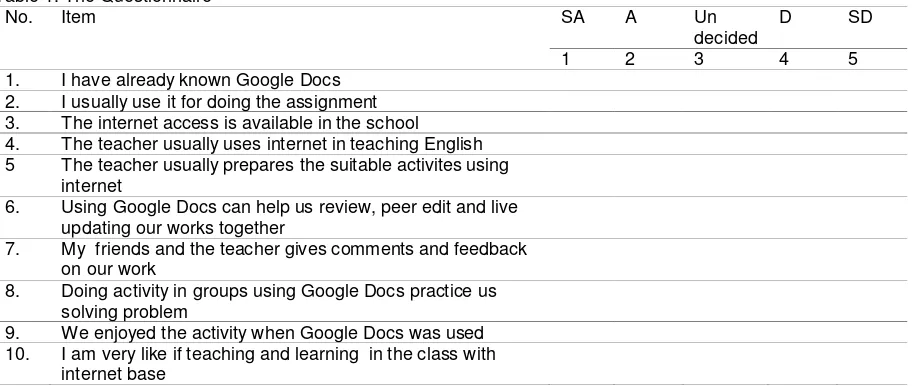
internet-based of Google Docs ? 5. How is the internet access in the school? Table 1 presents the questionnaire that requires students to indicate the extent to which they agree or disagree with the collaborative activity.
Table 1. The Questionnaire
No. Item SA A Un
decided D SD
1 2 3 4 5
1. I have already known Google Docs 2. I usually use it for doing the assignment 3. The internet access is available in the school
4. The teacher usually uses internet in teaching English 5 The teacher usually prepares the suitable activites using
internet
6. Using Google Docs can help us review, peer edit and live updating our works together
7. My friends and the teacher gives comments and feedback on our work
8. Doing activity in groups using Google Docs practice us solving problem
9. We enjoyed the activity when Google Docs was used 10. I am very like if teaching and learning in the class with
internet base
Nowadays students depend on the internet and feel confortable using technology as a medium to learn. It can be seen from result of the questionnaire that among the 21 students, 16 (76.19%) of them had been familiar with Google App and they knew about it. The students used Google Docs only in the class for the activities such as writing descriptive and narrative texts and also paragraph writing. Meanwhile based on the observation the teacher implemented the lesson plan in teaching and she sometimes used Google Docs for integrated writing and reading, and very rare
for listening and speaking. The teacher prepared
suitable activities in groups’ discussion using Google Docs to make students active and creative in class eventhough the access of internet in the school did not run well and it sometimes disturbed the learning process. Otherwise, according to the students that the activities with Google Docs not only help them identify their mistakes and weaknesses but also solve their problem directly. Anyway, the percentage of students’
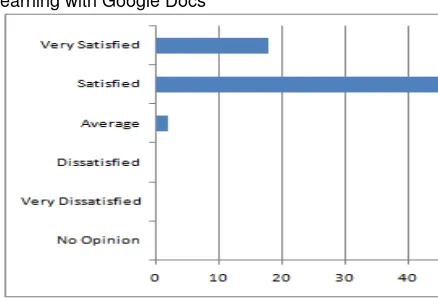
160 (9.52%) said agree, 1 student (4.76 %) says undecided and no student says strongly disagree with collaborative activities. Meanwhile the students who feel very satisfied are 4 students (19.29%), satisfied are 16 students (76.19%) and average is 1 student (4,76%). No student feels very dissatisfied with this. Anyway, students expect technology to be used in classroom as they completely adopted it in their lives (Gonzales-Vera, 2016, p.52). Furthermore the level of students’ satisfaction of learning English collaboratively with Google Docs can be seen in the graph in Figure 1.
Figure 1. Students’ Satisfaction on Collaborative
Learning with Google Docs
Research shows that educational experiences that are active, social, contextual, engaging, and student-owned lead to deeper learning. The benefits of collaborative learning include: development of higher-level thinking, oral communication, self-management, and leadership skills.
Critical thinking skill cannot evolve by itself along with the physical development of human but it must be trained through a stimulus that requires a person to think critically. School as an institution of education providers has a responsibility to help students develop critical thinking skills therefore, teacher was required to be creative to design and build the students competence (Kameo, 2007). Based on Ministry of Education and Cultures RI Number 81 A Year 2013 that the competencies students should have are attitude, skill and knowledge (cognitive, affective and psychomotor). Therefore, it is a must for a teacher to provide the students with such domain by creating many activities in the teaching and learning process.
Internet is a very essential tool to create an interactive media. Redecker et al. (2011) maintain that twenty-first century teacher education must place greater emphasis on instructional design, team-building, facilitating learning and new ways to foster creativity and innovation. ICTs must be integrated into teacher education programmes and become commonplace as a tool used throughout teaching careers (Ó Grádaigh, 2014). However, that nowadays using internet is appropriate to create integrated activities that can expose the skill (Poore, 2013). Literary texts are the authentic reading material that can provide teacher with the integrated activities. Without any creativity and activities created, the class will be boring and not interested anymore. Google
Docs is one of share resources and a web-based collaborative system means of cooperation between the students or group of students with other subject in doing their works and media interactive learning. The teachers together with the students can each editing, reviewing and correcting one another in doing their works online and exchange ideas among fellow students and teachers and this is one of the examples
that can build and develop students’ creativity, critical reading, critical thinking, and also problem solving.
CONCLUSION
Based on the result of the finding, it can be summarized that the learning activities designed by the teachers have a characteristic that is solving problem. Collaborative learning assists students to develop critical thinking skills and achieves richer knowledge generation through shared goals, shared exploration, and a shared process of making meaning. The learning activity help foster students’
critical thinking with three phases activities that are a) pre-activity with orientation, giving motivation and asking student to register an account of Google Apps, b) while-activity integrates English skills with steps of remembering, understanding, applying, analyzing, evaluating, and creating and c) post-activity is giving feedback and evaluating the result of learning process. Furthermore, the teaching English with internet-based nature of Google Docs not only enable the students to create sets of cognitive, affective and behavioral competencies but also by combining that
abilities the students’ competence will be able to
maximize so that adult who have critical thinking skill attain good ability to analyze and to think logically so as to produce proper consideration and decision to face the challenges of the future.
REFERENCES
Bloom, J. (2006). Selected concepts of curriculum. Retrieved from
www.jeffbloom.net/docs/Selected Concepts of Curriculum. pdf, retrieved on March 2nd, 2013).
Gonzales-Vera,P. (2016). The e-generation: The use of technology for foreign language learning, in A .Pareja-Lora, C. Calle-Martinez, & P. Rodriguez-Arancon (Eds), New prespective on teaching and working with languages in the digital era (pp. 51-61). Dublin: Research-publishing.net
Johnson, R. B. (2005) “Educatioal Research :
Quantitative and Qualitative” Retrieved from
www.south.edu/coe/bset/johnson Oktober, 2010.
Junining, E. (2015). Developing Critical Thinking Skill in Language Teaching: Oral Interpretation Class. Proceedings of ICTTE FKIP UNS, 1(1).
Kameo, R. M. (2007). Critical thinking in the classroom: some cultural constraints. English Edu. Journal of Language Teaching and Research, 7(1), 1-13.
161
national learning. Cambridge: Cambridge
Scholars Publishing.
Miles, M. B., & Huberman, M. (2013). Qualitative data
analysis: A methods sourcebook. U.K:
SAGE Publications.
Ministry of Education and Cultures. (2012). Supported by Government Regulations Number 32 Year 2013 (The revision of Government Regulations Number 19 Year 2005 about the National Standards of Education). Curriculum 2013.
Ministry of Education and Cultures RI Number 81 A Year 2013 aboutThe Implementation of Curriculum. Jakarta: Ministry of Education and Cultures.
Ó Grádaigh, S. 2014. School in a Box – Burkina Faso (Interviews: 20 February 2014 and 20 June 2014). National University of Ireland Galway, Galway, Ireland. http://vimeo.com/87853453 (Retrieved 21 March 2014).
Page-Bucci, H. (2003). The Value of Likert Scales in Measuring Attitudes of Online Learners." HKA Designs. Retrieved from
<http://www.hkadesigns.co.uk/websites/msc/ reme/likert.htm>.
Poore, M. (2013). Using social media in the
classroom a best practice guide (1st ed.).
U.K.: SAGA Publication.
Partnership for 21st century skill. (April 2014). [Online]. Framework for 21st century
learning. Retrieved from
http://www.p21.org/storage/documents/1.p21 _framework_2-pager.pdf
Redecker, C., Ala-Mutka, K., Leis, M., Leendertse, M., Punie, Y., Gijsbers, G., Kirschner, P., Stoyanov, S., & Hoogveld, B. (2011). The Future of Learning: Preparing for Change. Luxembourg, Publications Office of the European Union. Retrieved from http://ftp.jrc.es/EURdoc/JRC66836.pdf Ramsey, P., et al. (2009). Blooming with the pouis:
Critical thinking, reading and writing across the curriculum. Miami, Florida: Ian Randle. Saha, M. (2008). Teaching listening as an English
Language Skill. Retrieved September 18, 2008, from:
http://www.articlesbase.com/languagesarticle s/teaching-listening-as-an- english-language-skill-367095.html
SEAMEO (Southeast Asian Ministers of Education Organization) Secretariat. (Online Training) HOTS as Teaching Strategy (improving HOTS through Language) Bangkok 10110 Thailand. 2017
Yusuf, S. (2013). International Student’ Assessment
in Indonesia. HD Learning Week
Washington DC, February 6‐7, 2013. Zhang, C. (2013) A Study of Internet Use in EFL