ABSTRACT
Purwaningsih, Paulina. (2013). Students Perceptions on The Effects of an English Hour as a Teaching Strategy to Improve Students Speaking Skill in SMK Marsudi Luhur II Yogyakarta. Yogyakarta: Sanata Dharma University.
English hour, as a monolingual instruction in language teaching, was created by the English teacher in SMK Marsudi Luhur II Yogyakarta. It was done once a week. This strategy was created by the English teacher in order to encourage or motivate the students to speak English. In this teaching strategy, the students were expected to improve their speaking skill in the communication context, such asking permission, asking and answering questions in the discussion, and communicating with the teacher and the students during the teaching-learning activities. Since the English hour is the teaching strategy which was used to improve the students’ speaking skill, the English hour teaching strategy were expected to affect the students’ speaking skill.
In this research, there were two research problems: 1. How is the English hour teaching strategy applied during the teaching-learning activities? 2. What are the perceptions of the students on the English hour teaching strategy applied during the teaching-learning activities?
This research used mixed method. The participants of this research were 52 students grade X of SMK Marsudi Luhur II Yogyakarta and an English teacher who applied the English hour teaching strategy. This research used three instruments: an observation, a questionnaire, and an interview. The observation was done by observing the teaching-learning activities, the questionnaire was distributed to 52 students, and the interview was done by interviewing the English teacher.
For the first research problem, it could be concluded that the English hour was applied starting from listening to the teacher’s explanation about the materials up to practicing to speak English. Moreover,there were some aspects which were given attention in applying the English hour teaching strategy: the grammatical and pronunciation mistakes, the use of Bahasa Indonesia, and the correction which were given by the teacher. Furthermore, the students could also follow the teaching strategy well. Therefore, for the second research problem, it could be concluded that the English hour affected the students’ speaking skill in terms of
(1) students’ improvement in speaking English, (2) students’ willingness to speak English, and (3) students’ confidence to speak English.
ABSTRAK
Purwaningsih, Paulina. (2013). Students’ Perceptions on The Effects of an English Hour as a Teaching Strategy to Improve Students Speaking Skill in SMK Marsudi Luhur Yogyakarta. Yogyakarta: Universitas sanata Dharma
English hour merupakan sebuah strategi pengajaran yang dibuat oleh guru Bahasa Inggris SMK Marsudi Luhur II Yogyakarta dan dilaksanakan selama satu jam pelajaran setiap minggunya. Strategi pengajaran ini dibuat oleh guru dengan tujuan mendorong atau memotivasi siswa untuk berbicara bahasa Inggris. Dalam strategi pengajaran ini, siswa diharapkan mampu berbicara bahasa Inggris dalam konteks komunikasi seperti meminta izin, bertanya dan menjawab pertanyaan pada diskusi, dan komunikasi dengan guru dan teman sekelas selama kegiatan belajar mengajar. Karena strategi pengajaran English hour diciptakan untuk mengembangkan kemampuan berbicara siswa, English hour diharapkan mempengauhi kemampuan berbicara siswa.
Pada penelitian ini, ada dua rumusan masalah: 1. Bagaimana English hour diterapkan selama kegiatan belajar mengajar? 2. Apa pendapat siswa terhadap strategi pengjaran English hour yang diterapkan dalam kegiatan belajar mengajar?
Penelitian ini menggunakan metode campuran, kualitatif dan kuantitatif. Subyek penelitian adalah 52 siswa kelas X SMK Marsudi Luhur II Yogyakarta dan satu guru Bahasa Inggris yang menerapkan strategi pengajaran English hour. Dalam penelitian ini ada tiga instrumen yang digunakan, observasi, kuisioner, dan wawancara. Observasi dilakukan dengan mengamati kegiatan belajar mengajar, kuisioner disebarkan ke 52 siswa, dan wawancara dilakukan dengan mewawancarai guru bahasa Inggris.
Untuk rumusan masalah yang pertama dapat disimpulkan bahwa strategi pengajaran English hour dilaksanakan mulai dari siswa mendengarkan penjelasan guru mengenai materi pelajaran sampai praktek berbicara bahasa Inggris. Selain itu, pada penerapan strategi pengajaran English hour, ada beberapa aspek yang diperhatikan: kesalahan grammar dan pelafalan, penggunaan bahasa Indonesia, dan perbaikan dari guru. Kemudian, siswa juga dapat mengikuti pelajaran dengan baik melalui strategi pengajaran English hour. Untuk rumusan masalah yang kedua dapat disimpulkan bahwa English hour mempengaruhi kemampuan berbicara siswa. Ada tiga efek yang diperoleh dari penggunaan English hour (1) Perkembangan siswa pada kemampuan berbicara, (2) keinginan siswa untuk berbicara Bahasa Inggris, dan (3) Kepercayaan diri siswa untuk berbicara Bahasa Inggris.
STUDENTS’ PERCEPTION
S ON THE EFFECTS OF AN
ENGLISH HOUR AS A TEACHING STRATEGY TO
IMPROVE STUDENTS’ SPEAKING SKILL IN
SMK MARSUDI
LUHUR II YOGYAKARTA
A SARJANA PENDIDIKAN THESIS
Presented as Partial Fulfillment of the Requirements to Obtain the Sarjana Pendidikan Degree
in English Language Education
TITLE
PAGEBy
Paulina Purwaningsih Student Number: 091214011
ENGLISH LANGUAGE EDUCATION STUDY PROGRAM DEPARTMENT OF LANGUAGE AND ARTS EDUCATION FACULTY OF TEACHERS TRAINING AND EDUCATION
SANATA DHARMA UNIVERSITY YOGYAKARTA
A Sarjana Pendidikan Thesis on
STUDENTS’ PERCEPTION
S ON THE EFFECTS OF AN
ENGLISH HOUR AS A TEACHING STRATEGY TO
IMPROVE STUDENTS’ SPEAKING SKILL IN
SMK MARSUDI
LUHUR II YOGYAKARTA
By
Paulina Purwaningsih Student Number: 091214011
APPROVAL PAGES
Approved by
Sponsor
A Sarjana Pendidikan Thesis on
STUDENTS’ PERCEPTION
S ON THE EEFECTS OF AN
ENGLISH HOUR AS A TEACHING STRATEGY TO
IMPROVE STUDENTS
’ SPEAKING SKILL IN
SMK MARSUDI
LUHUR II YOGYAKARTA
By
Paulina Purwaningsih Student Number: 091214011
Defended before the Board of Examiners on December 5, 2013
and Declared Acceptable
Board of Examiners
Chairperson : C. Tutyandari, S.Pd., M.Pd. __________ Secretary : Drs. Barli Bram, M.Ed., Ph.D. __________ Member : Christina Kristiyani, S.Pd., M.Pd. __________ Member : C. Tutyandari, S.Pd., M.Pd. __________ Member : F.X. Ouda Teda Ena, S.Pd., M.Ed., Ed.D. __________
Yogyakarta, December 5, 2013
Faculty of Teachers Training and Education Sanata Dharma University
DEDICATION PAGE
I dedicate this thesis to: 1. Jesus Christ
2. My beloved parents, Fransiscus Sarman and Theresia Purwanti 3. My sisters and brother, Lia, Ire, and Bernhard
STATEMENT OF WORK’S ORIGINALITY
I honestly declare that this thesis, which I have written, does not contain the work or parts of the work of other people, execpt those cited in the quotations and the references, as a scientific paper should.
Yogyakarta, December 5, 2013
The Writer
PERNYATAAN PERSETUJUAN PUBLIKASI
LEMBAR PERNYATAAN PERSETUJUAN PUBLIKASI KARYA ILMIAH UNTUK KEPENTINGAN AKADEMIS
Yang bertanda tangan di bawah ini, saya mahasiswa Universitas Sanata Dharma: Nama : Paulina Purwaningsih
Nomor Mahasiswa : 091214011
Demi pengembangan ilmu pengetahuan, saya memberikan kepada Perpustakaan Universitas Sanata Dharma karya ilmiah saya yang berjudul:
STUDENTS’ PERCEPTIONS ON THE EEFECTS OF ENGLISH HOUR
AS A TEACHING STRATEGY TO IMPROVE STUDENTS’ SPEAKING SKILL IN SMK MARSUDI LUHUR II YOGYAKARTA
beserta perangkat yang diperlukan (bila ada). Dengan demikian, saya memberikan kepada Universitas Sanata Dharma hak untuk menyimpan, mengalihkan dalam bentuk media lain, mengelolanya dalam bentuk pangkalan data, mendistribusikan secara terbatas, dan mempublikasikannya di Internet atau media lain untuk kepentingan akademis tanpa perlu minta ijin dari saya maupun memberikan royalti kepada saya selama tetap mencantumkan nama saya sebagai penulis.
Demikian pernyataan ini saya buat dengan sebenarnya.
Dibuat di Yogyakarta
ABSTRACT
Purwaningsih, Paulina. (2013). Students’ Perceptions on The Effects of an English Hour as a Teaching Strategy to Improve Students Speaking Skill in SMK Marsudi Luhur II Yogyakarta. Yogyakarta: Sanata Dharma University.
English hour, as a monolingual instruction in language teaching, was created by the English teacher in SMK Marsudi Luhur II Yogyakarta. It was done once a week. This strategy was created by the English teacher in order to encourage or motivate the students to speak English. In this teaching strategy, the students were expected to improve their speaking skill in the communication context, such asking permission, asking and answering questions in the discussion, and communicating with the teacher and the students during the teaching-learning activities. Since the English hour is the teaching strategy which was used to improve the students’ speaking skill, the English hour teaching strategy were expected to affect the students’ speaking skill.
In this research, there were two research problems: 1. How is the English hour teaching strategy applied during the teaching-learning activities? 2. What are the perceptions of the students on the English hour teaching strategy applied during the teaching-learning activities?
This research used mixed method. The participants of this research were 52 students grade X of SMK Marsudi Luhur II Yogyakarta and an English teacher who applied the English hour teaching strategy. This research used three instruments: an observation, a questionnaire, and an interview. The observation was done by observing the teaching-learning activities, the questionnaire was distributed to 52 students, and the interview was done by interviewing the English teacher.
For the first research problem, it could be concluded that the English hour was applied starting from listening to the teacher’s explanation about the materials up to practicing to speak English. Moreover,there were some aspects which were given attention in applying the English hour teaching strategy: the grammatical and pronunciation mistakes, the use of Bahasa Indonesia, and the correction which were given by the teacher. Furthermore, the students could also follow the teaching strategy well. Therefore, for the second research problem, it could be concluded that the English hour affected the students’ speaking skill in terms of (1) students’ improvement in speaking English, (2) students’ willingness to speak English, and (3) students’ confidence to speak English.
ABSTRAK
Purwaningsih, Paulina. (2013). Students’ Perceptions on The Effects of an English Hour as a Teaching Strategy to Improve Students Speaking Skill in SMK Marsudi Luhur Yogyakarta. Yogyakarta: Universitas sanata Dharma
English hour merupakan sebuah strategi pengajaran yang dibuat oleh guru Bahasa Inggris SMK Marsudi Luhur II Yogyakarta dan dilaksanakan selama satu jam pelajaran setiap minggunya. Strategi pengajaran ini dibuat oleh guru dengan tujuan mendorong atau memotivasi siswa untuk berbicara bahasa Inggris. Dalam strategi pengajaran ini, siswa diharapkan mampu berbicara bahasa Inggris dalam konteks komunikasi seperti meminta izin, bertanya dan menjawab pertanyaan pada diskusi, dan komunikasi dengan guru dan teman sekelas selama kegiatan belajar mengajar. Karena strategi pengajaran English hour diciptakan untuk mengembangkan kemampuan berbicara siswa, English hour diharapkan mempengauhi kemampuan berbicara siswa.
Pada penelitian ini, ada dua rumusan masalah: 1. Bagaimana English hour diterapkan selama kegiatan belajar mengajar? 2. Apa pendapat siswa terhadap strategi pengjaran English hour yang diterapkan dalam kegiatan belajar mengajar?
Penelitian ini menggunakan metode campuran, kualitatif dan kuantitatif. Subyek penelitian adalah 52 siswa kelas X SMK Marsudi Luhur II Yogyakarta dan satu guru Bahasa Inggris yang menerapkan strategi pengajaran English hour. Dalam penelitian ini ada tiga instrumen yang digunakan, observasi, kuisioner, dan wawancara. Observasi dilakukan dengan mengamati kegiatan belajar mengajar, kuisioner disebarkan ke 52 siswa, dan wawancara dilakukan dengan mewawancarai guru bahasa Inggris.
Untuk rumusan masalah yang pertama dapat disimpulkan bahwa strategi pengajaran English hour dilaksanakan mulai dari siswa mendengarkan penjelasan guru mengenai materi pelajaran sampai praktek berbicara bahasa Inggris. Selain itu, pada penerapan strategi pengajaran English hour, ada beberapa aspek yang diperhatikan: kesalahan grammar dan pelafalan, penggunaan bahasa Indonesia, dan perbaikan dari guru. Kemudian, siswa juga dapat mengikuti pelajaran dengan baik melalui strategi pengajaran English hour. Untuk rumusan masalah yang kedua dapat disimpulkan bahwa English hour mempengaruhi kemampuan berbicara siswa. Ada tiga efek yang diperoleh dari penggunaan English hour (1) Perkembangan siswa pada kemampuan berbicara, (2) keinginan siswa untuk berbicara Bahasa Inggris, dan (3) Kepercayaan diri siswa untuk berbicara Bahasa Inggris.
ACKNOWLEDGEMENTS
First of all, I would like to thank my Jesus Christ for His blessing to me, so I could finish my thesis. His blessing always gives me health, spirit, and inspiration in writing my thesis.
I would also like to thank my thesis advisor Christina Kristiyani, S.Pd., M.Pd. for her guidance, feedback, and advice during the process of writing my thesis. I could learn so many things from her feedback and advice to complete my thesis. My appreciation also goes to all of PBI lecturers and PBI staff in Sanata Dharma University
I would also like to deeply thank Argo Budi Rahayu, S.Pd. as an English teacher of SMK Marsudi Luhur II Yogyakarta for the opportunity given to me, so I could conduct the research in SMK Marsudi Luhur II Yogyakarta. I also thank the students grade X of SMK Marsudi Luhur II Yogyakarta as for being the participants of this research.
I would like to thank my parents, my beloved father, Fransiscus Sarman, and my beloved mother, Theresia Purwanti, for their support, prayer, and love to me. I also thank my sister, Mirella Tri Ratnasari, for supporting and accompanying me to do my thesis, my older sister and brother, Laurensia Mike Kusumawati and Bernhard Tjahyono, for their support, love, help, and prayer to me. I also thank all my aunts and uncles for their support and prayer.
I would also like to thank my friends Deta, Anggi, Mira, Galih, Bayu, Helen, Yudith, Dian, Awang, Vivi for their support, their time to me when I found the difficulties in the process of writing my thesis, and their patience to listen to my difficulties. I also thank all of my friends batch 2009
I also thank my friends in my boarding house, Hilda, kak Venny, Ina, Citra, Aul, for supporting me when I was getting bored in writing my thesis. I thank them for their joke, support, and help to me.
TABLE OF CONTENTS
TITLE PAGE ... i
APPROVAL PAGES ... ii
DEDICATION PAGE ... iv
STATEMENT OF WORK’S ORIGINALITY ... v
PERNYATAAN PERSETUJUAN PUBLIKASI ... vi
ABSTRACT ... vii
ABSTRAK ... viii
ACKNOWLEDGEMENTS ... ix
TABLE OF CONTENTS ... xi
LIST OF FIGURES ... xiii
LIST OF APPENDICES ... xiv
CHAPTER I ... 1
INTRODUCTION ... 1
A. Research Background ... 1
B. Research Problem ... 5
C. Problem Limitation ... 5
D. Research Objectives ... 5
E. Research Benefits ... 6
CHAPTER II ... 11
REVIEW OF RELATED LITERATURE ... 11
A. Theoretical Description ... 11
B. Theoretical Framework ... 22
CHAPTER III ... 25
RESEARCH METHODOLOGY ... 25
A. Research Method ... 25
B. Research Setting ... 26
C. Research Participants ... 26
D. Instruments and Data Gathering Technique ... 26
E. Data Analysis Technique ... 28
F. Research Procedure ... 30
CHAPTER IV ... 31
RESEARCH RESULTS AND DISCUSSION ... 31
A. Research Results ... 31
B. Discussion ... 42
CHAPTER V ... 48
CONCLUSIONS AND SUGGESTIONS ... 48
A. Conclusions ... 48
B. Suggestions... 49
LIST OF FIGURES
Figure
1.1 Aspects of Production ... 18
1.2 Maslow’s hirarcy of needs ... 21
1.3 Students’ Improvement in Speaking Skill ... 39
LIST OF APPENDICES
Appendix A. Letter of Permission ……… 53
Appendix B. Research Instruments ………...55
Questionnaire………...57
Teacher’s interview………....61
CHAPTER I INTRODUCTION
In this research, the writer would like to investigate the effects of applying the English hour as a teaching strategy on monolingual instruction to improve the students’ speaking skill. This chapter is divided into five parts, namely research
background, research problem, problem limitation, research objectives, research benefits, and definition of terms. In the research background, the writer will discuss the topic of the research and the reasons why the writer chose this topic. In the research problem part, there are two research problems that will be discussed in this research. The first one is the way of applying the English hour in the teaching- learning activities and the second one is about the students’ perceptions on the use of the English hour teaching strategy in the teaching-learning activities. The next part will discuss the limitation of the problems. Furthermore, this chapter also provides the benefits of the research for English teachers and vocational schools; and the definition of terms used in this research.
A. Research Background
use English in terms of communication. Barbara (2001) defines that as the result of being an international language, many countries set English as a second language and foreign language. In Indonesia, English belongs to the foreign language in which English is used only in a formal level; school, university, and accupation field.
As the result of being English as the foreign language, Indonesian government has set English for junior high school students and senior high school students in order to prepare the students having a good English ability. In learning English, the students should master four skills: speaking, listening, reading, and writing.
In this research, the writer will discuss the English hour teaching strategy in improving students’ speaking skill. The focuses of this study are the application
of the English hour teaching strategy and the effects of the English hour toward the students’ speaking skill based on the students’ perception. The purpose of this research is to investigate the effects of the English hour as the teaching strategy in improving the students’ speaking skill.
Based on that case, the students were not really confident to speak English because they were not accustomed to speak English in their daily life and they were afraid of making mistakes. However, the students have to be able to speak English to fulfill standar isi 2006 of English for vocational school which stated “Mata pelajaran Bahasa Inggris bertujuan agar peserta didik memiliki
kemampuanmenerapkan penguasaan kemampuan dan keterampilan Bahasa
Inggris untuk berkomunikasi baik lisan maupun tertulis pada level intermediate.”
To be able to speak English, the English teacher of SMK Marsudi Luhur II creates a strategy called “English hour” as a motivation to encourage the students to speak
English so that the students can improve their speaking skill. According to Rivers (1983: 112), giving motivation to the students is an important thing in order to encourage individual students building up their self-confidence and increasing their motivation. Communicative English hour as the goal of the teaching strategy is expected to encourage and give motivation to the students to speak English. According to the English teacher of SMK Marsudi Luhur II, communicative goal means that the students are expected to be able to speak English actively without considering their grammar and pronunciation. From the previous explanation, it can be concluded that the English hour teaching strategy is used to build students’ self-confidence and increase students’ motivation to speak English. If the students are confident to speak English, they will be able to speak English.
B. Research Problem
In this research, there are two research problems, they are:
1. How is the English hour teaching strategy applied during the teaching-learning activities in SMK Marsudi Luhur II?
2. What are the perceptions of the students on the English hour teaching strategy applied during the teaching-learning activities??
C. Problem Limitation
The scope of this research is the use of the English hour teaching strategy in the English subject during the teaching-learning activities. This research will focus on the use of the English hour teaching strategy for the students of SMK Marsudi Luhur II. As stated previously, this research focused on the application of the English hour during the teaching-learning activities and the effects of the English hour teaching strategy towards students’ speaking skill based on students perception. The researcher chose students grade X of SMK Marsudi Luhur II as the subjects of the research.
D. Research Objectives
effects of the English hour toward the students’ speaking skill based on the students perception.
E. Research Benefits
This section deals with the benefits of the study for the English teachers and the vocational schools. The English teachers can use this study as a new strategy in teaching speaking of the English subject. In addition, the school can use this research to create a new program which can be used for the school to improve the speaking skill in larger situation.
1. The English teacher
This research can give inspiration to the English teachers in creating other strategies that can be used to help the students in improving the students’ speaking skill. Speaking is not easy for the students to do because English is not their first language; English is used as the foreign language. However, the students have to be able to speak English to fulfill the curriculum. Because of that reason, the English teacher should create the strategy as interesting as possible to grab students’ attention and give motivation to the students to speak English. The
others in English without considering on the grammar and pronunciation. Based on the previous explanation, it can be said that the English teachers can use the English hour teaching strategy to help the students building up their self-confidence and increasing the students’ motivation in speaking English.
2. Vocational schools
This research can be used by the schools to create a new program which can be used for the school to improve speaking skill of school members. It means that the English hour is not only used as the teaching strategy in teaching English, but also can be used as the program in improving speaking skill for the whole members of the schools (principal, teachers, and students). The students will be accustomed to use English when the students use English in daily life. In other words, the students do not only use English in the classroom, but also use English outside the classroom. In addition, the schools can change the English hour strategy into “English day” so that the whole members of school should speak
English in a day. In addition, the schools can decide what day will be the English day.
F. Definition of Terms
In this part the writer explains the terms that are used in the research. There are four definitions will be explained in this part: perception, teaching strategy, English hour, and speaking skill.
Huffman, Mark, and vernoy (2000) say that perception deals with making sense of stimuli input. Perception is the process of selecting, organizing, and interpreting the stimuli which is sent to the brain (p.88). In 1982, Gibson, Ivancevich, Donnelly define perception as the process of the stimulus in giving meaning to an object through different ways. It means that everyone has their own perception which is affected by the process of stimulus (p. 53). In addition, Gibson et al. (1982) state that perception deals with receiving the stimulus, organizing the stimulus, and interpreting the stimulus organized. This process influences attitudes and personality (p.54).
In this research, the meaning of perception is the students’ point view which is based on the results of selecting, organizing, and interpreting the use of the English hour strategy. It will present the perceived improvement of the students on their speaking skill.
2. English hour
question, discussion, etc. For the students who are not really fluent in speaking English, they have to speak English so the students will not be afraid to make mistakes anymore or the students will be more confident to speak English.
3. Teaching strategy
According to Byers, Dee, Kershner, Rouse et al. (2004), teaching strategy is an effective strategy that is used to develop students’ skill of social interaction. Social interaction is making conversation with others in order to show social behavior.
In this research, the teaching strategy means the way of teaching English by using a strategy that is created by the English teacher in order to help the students to achieve the goal of the subject based on 2006 curriculum. One of the goals of the English subject based on 2006 curriculum is that the students should be able to apply mastery of oral and written English in intermediate level.
4. Speaking skill
CHAPTER II
REVIEW OF RELATED LITERATURE
This chapter discusses some theories used in this research and each theory will be explained deeper. The theories are used to solve the research problems of this research. This chapter will be divided into two parts, namely the theoretical description and the theoretical framework. In the theoretical description will be discussed: (1) The definition of the teaching strategy, the definition of the English hour as the teaching strategy, (2) The definition of Communicative Language Teaching, the principles of communicative language teaching to support the characteristics of the English hour, (3) Curriculum for vocational school, and (4) the definition of speaking skill.
A. Theoretical Description
1. Perception
Everyone has their own way in interpreting and facing everything in this life. Szilagyi and Wallace (1980: 70) state that perception is a process of interpreting stimuli which influences behaviour. The process of interpreting is started from organizing an incoming stimuli. The different perception is influenced by some factors. According to Szilagyi and Marc (1980: 70), there are three factors influencing perceptions:
a. Attributes of the object
There are three things deal with the object’s attribute: intensity of stimulus, motion, and physical size. The intensity of the stimulus is related to sound. The sound can attract someone’s attention through the level of the sound. The high sound will be more effective to attract someone’s attention and it affects person’s perceptions. The motion is also the stimulus characteristic that can attract someone’s attention. The most important thing that is related to the object’s attribute is interpersonal perceptions.
b. Attributes of the situation
Attributes of the situation means an environment or a work situation which can influence someone’s interpretation and attention. It happens in predictable ways in the process of working. Someone’s interpretation and attention influence their own perceptions
c. Attributes of the person
Characteristics of the person are the most important source in influencing perception. Those are namely motive, habit, and personality. According to Huffman et al. (2000: 107), there are three stages of perceptions: selection, organization, and interpretation.
a. Selection: choosing the stimuli that we will pay attention.
b. Organization: organizing the incoming information into patterns that will help them to understand the information.
c. Interpretation: the use of the information in explaining and giving judgment about the stimuli we pay attention. Some factors which influence interpretation are experiences, perceptual expectations, cultural factors, and personal motivations and frame of reference.
2. Teaching Strategy
Teaching strategy as a matter of delivering materials to the students is really important because it has an essential effect for students’ understanding.
Cited in Widiati an Yudi, Fraenkel (1980) defines teaching strategy as a combination of “a procedure or operation, grouped and ordered” in a certain place that can be used in the classroom to achieve the learning objectives. The procedure is often called “the position of a technique is at the implementation phase”. Moreover, Procedure is a tactic and strategy used by the teachers and the
techniques which are created by the teacher. Based on the previous explanation, teaching strategy is a matter of developing and applying a technique that can be used in the classroom to achieve the learning objectives.
The English hour as the teaching strategy of language teaching has a goal. The goal of conducting English hour is a communicative goal. It means the English hour as a language teaching expects the students to be able to communicate and interact with others in English.
3. Communicative Language Teaching
As stated above that the goal of the English hour is the communicative goal in which the students are expected to be able to communicate with others or to use language in the communication, the principle of communication should be clear. As cited in Richards & Rodgers (2001: 161), Johnson (1982) states that the principle of communication is activities that involve language in the real context of learning. As cited in Richards and Rodgers (2001: 155), American and British experts state that Communicative Language Teaching as a teaching approach which has two purposes. The first purpose is to create a communicative competence of the language teaching. The second purpose is that Communicative Language Teaching is used to develop a strategy of the teaching English skills in which those has a relation to language and communication. Richards and Rodgers (2001: 172) write some principles of Communicative Language Teaching as a reflection of a communicative view of a language and language learning. Those principles are: learners learn a language using that language to communicate, the goal of classroom activities should be authentic and meaningful, fluency is an important aspect of communication, communication involves the combination of language skills, learning is a process of creative construction and involves trial and error.
As cited in Richards and Rodgers (2001: 155), Howatt (1984) defines the theory of Communicative Language Teaching by dividing into “strong” and “weak” version of Communicative Language Teaching. The strong version of
communication. The learners got a language when they use the language to communicate with others. It also can be said that the strong version of Communicative Language Teaching is using language to learn. The weak version of Communicative Language Teaching is providing opportunities to the learners to use English for communicative purposes. In another term, the weak version of Communicative Language Teaching is learning to use English.
Communicative Language Teaching is an approach of a language teaching which has two main purposes: (1) to create the communicative competence of teaching English in which the students are expected to use the language for communication, (2) to develop the strategy of teaching English skills (speaking, listening, reading, and writing) which has relation to the language and communication. In this research, Communicative Language Teaching is used to develop the English hour teaching strategy as the speaking teaching strategy. When looking at the Howatt’s theory, the English hour belongs to the weak version of Communicative Language Teaching because the English hour provides a chance for the students to learn how to use the language. The students are invited to use English in the communication context during the teaching-learning activities such as asking permission, asking and answering questions, and communicating with their friends.
4. Curriculum
2006 which has two goals. The first goal is that the students are expected to be able to master English knowledge and skills in order to support the vocational program. The second goal is that the students are able to apply the English knowledge and skills in the communication context (oral and written form) at intermediate level. This is the goals of the curriculum of English 2006 for vocational school:
1. Menguasai pengetahuan dan keterampilan dasar Bahasa Inggris untuk mendukung pencapaian kompetensi program keahlian
2. Menerapkan penguasaan kemampuan dan keterampilan Bahasa
Inggris untuk berkomunikasi baik lisan maupun tertulis pada level intermediate.
Two goals that have been stated in curriculum 2006 should be achieved by the students step by step. Step by step means that every grade has different competence standards. Because of that reason, the communicative teaching is needed in teaching-learning process. The communicative teaching invites the students to use English in the communication without considering the errors so that the students are not afraid to make mistakes such as pronunciation and grammar.
5. Speaking Skill
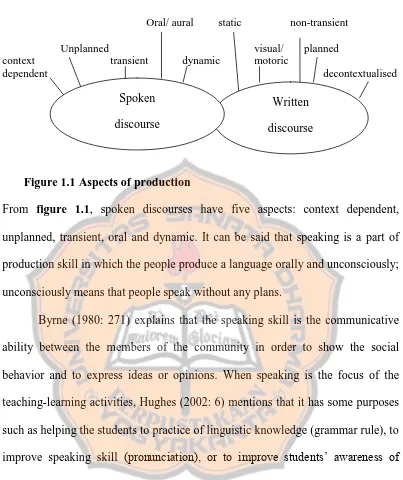
Oral/ aural static non-transient
Unplanned visual/ planned
context transient dynamic motoric
dependent decontextualised
Figure 1.1 Aspects of production
From figure 1.1, spoken discourses have five aspects: context dependent, unplanned, transient, oral and dynamic. It can be said that speaking is a part of production skill in which the people produce a language orally and unconsciously; unconsciously means that people speak without any plans.
Byrne (1980: 271) explains that the speaking skill is the communicative ability between the members of the community in order to show the social behavior and to express ideas or opinions. When speaking is the focus of the teaching-learning activities, Hughes (2002: 6) mentions that it has some purposes such as helping the students to practice of linguistic knowledge (grammar rule), to improve speaking skill (pronunciation), or to improve students’ awareness of some sociolinguistic or pragmatic (making conversation with others). From the previous explanation, teaching the speaking skill actually has some purposes in terms of expressing the ideas, improving the English pronunciation, and making some conversations with others.
Written discourse Spoken
6. Motivation
Motivasi biasanya didefinisikan sebagai keadaan internal yang membangkitkan, mengarahkan, dan mempertahankan perilaku.
As cited in Brown (2001: 72), a motivation is the extent to which the people make choices about (a) the goals to pursue and (b) the efforts you will devote to that pursuit. Brown (2001: 75) states that the motivation refers to the power of stimulation which is given to motivate people.
know four factors which influence motivation in order to accomplish the action of encouraging the intrinsic motivation and giving the extrinsic motivation to the students. The four factors which influence the students’ motivations are behavioral approach, humanistic approach, cognitive approach, and sociocultural approach.
1. Behavioristic Approach
Based on the behavioral point of view, the concept of the student’s motivation is started by analyzing the incentive and reward which are given in the classroom (Woolfolk, 2009: 189). The incentive is an object or a situation which is given to encourage or attempt behavior. The reward is an object or a situation which is given to the students as a result or an effect of the behavior. A behavioristic approach attempts to the extrinsic motivation.
2. Humanistic Approach
As cited in Woolfolk (2009: 190), Interpretation of humanistic motivation attempts to the sources of the intrinsic motivation of human needs, such as self-actualization, actualizing tendency, and self-determination. Based on Maslow theory, human needs begin from the lowest foundation of pyramid and continue until the highest part of Maslow’s pyramid to get the motivation. A person who
Figure 1.2 Maslow’s hirarchy of needs
The important key of the Maslow’s hierarchy of needs is a person is not satisfied to pursue some of the higher needs until the lower part of the foundation of human needs have been fulfilled. For the classroom’s activities which are considered as the motivation, Maslow explains that the classroom’s activities do not need to be outstanding obvious, innovative, or inspirational. In addition, based on Maslow’s theory, the humanistic approach which is need by the students are
physical needs, emotional, and intellectual.
3. Cognitive Approach
Based on the cognitive theory, a cognitive approach is attempted to the intrinsic motivation because human being will do something and look for information to solve the problems. As cited in Brown (2001: 75), Hunt (1971) as a cognitive psychologist explains that the human being needs to decide what to
Self-Actualization
Esteem: Status Esteem:
Strength
Love Belongingness Affection
Safety Security Protection Freedom From Fear
think or feel or do. In other words, human being can be said as a decision maker for themselves. In the classroom, when the learners can make their own decisions or choices, the extrinsic motivation can wane because the learners know what to pursue and not to pursue. After that, the students will have their own motivation to achieve their wishes and commands.
4. Sociocultural Approach
Based on Woolfolk (2009:192), a sociocultural approach is applied to the participation of the learners or the community of practicing. In this case, a person participates in many activities in order to defend their identities. In the teaching-learning activities, the students can motivate themselve when the students consider themselve as the members of the school. The students learn to be the better students by learning from the other members of the school, such as teachers and students. From the explanation above, the sociocultural approach is defined as the intrinsic motivation in which people are the active participants in order to defend their identities.
B. Theoretical Framework
teaching strategy is based on the 2006 curriculum. The goals of the 2006 curriculum are the students are expected to be able to master and apply the knowledge and skills of English in oral and written form at intermediate level. Therefore, the English teacher used this strategy to achieve that goal. The English hour as the teaching strategy needs a procedure to make the activities in an order and group. The procedure can be made by the English teacher referring to the book. The most important thing in making the procedure is the way of achieving the Communicative Language Teaching goal. As mentioned previously, Communicative Language Teaching is based on the five principles: learners learn a language by using that language to communicate, the goal of the classroom activities should be authentic and meaningful, fluency is an important aspect of communication, communication involves the combination of language skills, learning is a process of creative construction and involves trial and error (Richards & Rodger, 2001: 172). The theory of Communicative Language Teaching needs to discuss in this research because of the goal of the English hour teaching strategy. The English hour teaching strategy is expected to encourage or motivate the students to be more confident to speak English.
as how the teacher applied the English hour teaching strategy during the teaching-learning process.
The English hour is done in the teaching-learning process for one meeting hour every week. In this strategy, the students are asked to speak in order to practice the students’ speaking skill in terms of communicating with their friends
CHAPTER III
RESEARCH METHODOLOGY
In this chapter, the writer discussed how the research was conducted, in terms of obtaining the data and analyzing the data gathered to answer the research problems of this research. This chapter consists of six parts, namely research method, research setting, research participants, instruments and data gathering technique, data analysis technique, and research procedure. The explanation of each part will be explained in the following part.
A. Research Method
B. Research Setting
The research was conducted in SMK Marsudi Luhur II Yogyakarta. This school is located in Bintaran Kidul, Yogyakarta. SMK Marsudi Luhur II as a vocational school offers automotive and electronic programs. The research was conducted in three days in April.
C. Research Participants
According to Backstrom and Cesar (1981), purposive sampling is a strategy of choosing the sample the the research by knowing the characteristic of the people. Sampling used in this research was purposive sampling. This research used purposive sampling because the sample was taken based on the participants who had an experience in applying the English hour teaching strategy. The participants of the research were the tenth grade students of automotive and electronic class of SMK Marsudi Luhur II. There were 52 students as the participants of the research to answer the questionnaire and one English teacher as the participant of the interview. The students are between 15-17 years old.
D. Instruments and Data Gathering Technique
1. Observation
Observation was done by observing the application of the English hour in the teaching-learning activities. The purpose of conducting the observation was to know the procedure or the application of the English hour during the teaching-learning process. The observation was done once before distributing the questionnaire and interviewing the English teacher. To obtain the data from the observation, the researcher took a field note of the English hour application.
2. Questionnaire
The type of questionnaire was directly administered questionnaire. According to Fraenkel & Wallen (2006), directly administered questionnaire was the way of distributing the questionnaire by asking the teacher to administer the questionnaire. This research used administered questionnaire in order to obtain the high response rate. The purpose of distributing questionnaire was to know students’ opinions and attitudes toward the use of English hour as the teaching
strategy in the teaching English, to know the process of conducting English hour teaching strategy, to know the perceived effects of the English hour teaching strategy toward students’ speaking skill, and to give the inspiration to the teacher
for creating other strategies.
closed-ended questions, those questions were divided into two categories: the process of conducting English hour teaching strategy and the effects of English hour teaching strategy in students’ speaking improvement based on the students’
perception. Seven questions out of 15 questions (questions number 2, 3, 8, 9, 10, 11, 12) belong to the first category. Questions number 4, 5, 6, 13, 14 belong to the second category. Question number 1 asked about the nature of English hour teaching strategy.
3. Interview
The interview was conducted as a personal interview. According to Fraenkel (2006), personal interview is the interview which was conducted face-to-face with the respondent. In this research, the English teacher was interviewed directly or face-to-face. There were six question in the interview with the English teacher. The aim of interviewing the teacher was to know the process and the schedule of applying English hour teaching strategy and to know the effects of English hour in teaching English, especially to improve students’ speaking skill.
E. Data Analysis Technique
questionnaire analysis was in the form of percentage. The percentage of questionnaire analysis was calculated as the following formula:
Percentage = ∑X
∑X = Sum of respondent’s answer for each statement
N = Number of respondent
After calculating the result of the data analysis of the questionnaire, the researcher analyzed the questionnaire results of the effects of the English hour toward students’ perceived improvement in speaking skill and the use of the English hour during the teaching-learning activities.
The analysis of the observation was done by analyzing of the field note. The field note determined the steps or procedure of the application of the English hour teaching strategy during the teaching-learning activities. The steps were arranged sequentially starting from the first activities until the last activities of the teaching-learning activities by using English hour. The results of the observation analysis was in the form of words.
After analyzing the observation field note, the researcher analyzed the interview. The result of the interview was about further information of the application of the English hour and the effects of the English hour toward the students’ speaking skill. The result of the interview in the form of words.
N
F. Research Procedure
This part shows the procedure of conducting the research starting from the beginning of conducting the research until reporting the data gathered. The steps are explained in the point form and will be explained more on each point:
1. The researcher met the English teacher to have an informal interview related to the topic of the research on the use of the English hour teaching strategy in teaching English.
2. The researcher prepared an official letter from the faculty and sent the official letter to SMK Marsudi Luhur II Yogyakarta. The official letter was sent to ask permission for conducting the research.
3. The researcher prepared the instruments that were used to collect the data. The data was used to answer the research problems.
CHAPTER IV
RESEARCH RESULTS AND DISCUSSION
This chapter discusses the results of the research and the discussion of the findings. There are two sections to be discussed in this chapter. The first section discusses the results of the observation, the questionnaire and the interview. The second section focuses on the discussion of the application of the English hour to answer the first research problem and the effects of the English hour toward the students’ perceived improvement to answer the second research problem.
A. Research Results
This part consists of the results of the observation, the questionnaire and the results of the interview. The results of the questionnaire were based on the students’ experience; and the results of the interview were based on the teacher’s
experience and perceptions during the application of the English hour teaching strategy.
1. The Application of the English Hour
really have a good ability in English such as vocabulary and grammar. Because of that reason, the students were afraid of speaking English or interacting with others in English.
The English hour was only applied inside the class during the teaching-learning process. Firstly, the teacher used this strategy to motivate the students to speak English. The students were accustomed to listen to what the teacher said and practice to communicate with their friends and the teacher by using English during the teaching-learning activities. As cited in Richards & Rodgers (2001), Johnson (1982) states that communication is an activities which involve the language in the real context of learning. The teacher asked the students to communicate with others in English such as asking permission before leaving the class, asking and answering questions, asking and giving something. By practicing English in the real context of life, the students could enrich their vocabulary so that the students were more confident to speak English. The process of conducting the English hour is as follows.
students will have a speaking habit. In addition, the teacher used English as the main language during the teaching-learning activities by using the English hour teaching strategy.
The purpose of creating the listening habit as the first step of conducting the English hour was the students could listen to the correct pronunciation of the words. The teacher said that sometimes the students knew the vocabulary, but they did not know the correct pronunciation of the words. Furthermore, the listening habit was used as the first step of conducting the English hour in order to enrich students’ vocabulary. The teacher said that by listening to the teacher’s
explanation of the certain topic in the English subject, the students found some new words that were rarely used by the students. As what the teacher said in the interview:
Dalam pelaksanaan English hour pertama-tama guru menjelaskan tentang
suatu materi dengan tujuan agar siswa mengetahui pelafalan suatu kata. Selain
itu, agar siswa dapat menambah kosa kata baru yang jarang siswa gunakan.
Setelah mendengarkan penjelasan materi pelajaran, siswa diberikan
kesempatan untuk berbicara bahasa Inggris.
(In the application of the English hour teaching strategy, firstly, the teacher explained the materials in order to give the true pronunciation of a word to the
students in the teacher’s explanation. Besides, the students could add their
vocabularies which were rarely used by them. After that, the students were asked to practice speaking in English.)
Moreover, the purpose of practicing English by asking some questions and communicating with others was to build students’ self-confidence and to help the
Each week, the teacher used one meeting hour or 45 minutes for applying the English hour teaching strategy and the teacher used about 15 minutes to explain the materials. For discussing the materials and practicing to use English, the students were given 30 minutes. Based on the result of the interview to the teacher, the teacher applied the English hour teaching strategy as interesting as possible to take students’ interest such as giving the chance to the students for
speaking English in the group discussion and interacting with others. Moreover, the teacher also tolerated students’ grammatical and pronunciation mistakes so that the students were not afraid of trying to speak English.
Dalam pelaksanaan English hour kesalahan grammar dan pronunciation diterima
karena tujuan English hour untuk memotivasi siswa berani berbicara bahasa
Inggris dimana sebelumnya siswa berbicara bahasa Inggris hanya 25% hingga
30% saat proses belajar mengajar berlangsung.Oleh karena itu, kesalahan
grammar dan pronunciation diterima untuk menjaga agar siswa tetap berani
berbicara.
(In the application of the English hour, the grammar and pronunciation mistakes were accepted because the purpose of the English hour was motivating the students to speak English. Motivating was given to the students because the students used English only 25% up to 30% outside the English hour teaching strategy. Because of that, the grammar and pronunciation mistakes were accepted
to keep students’ confidence.)
However, the teacher also gave correction to the students’ mistakes in
English in the learning process. In addition, the students sometimes used Bahasa Indonesia for communicating with others; and the students sometimes used English word by word when they did not know the vocabulary.
In the questionnaire, there were three questions related to the teacher’s statement that the English hour was created and applied as interesting as possible to take students’ interest such as giving the chance to the students to speak
English in terms of discussing and interacting with others in English. There were 98% of the respondents who answered that the English hour teaching strategy was an interesting teaching strategy and 2% of the respondents who answered that English hour teaching strategy was not an interesting teaching strategy. The next question, there were 96% of the respondents who answered that they were given a chance to speak English and 4% of the respondents who answered that they were not given the chance to speak in English. The next question, there were 81% of the respondents that answered yes, 17% of the respondents that answered no, and 2% of the respondents who did not give the answer that the students interacted or communicated with others in English. From the results of the questionnaire, it showed that the English hour teaching strategy was an interesting teaching strategy in which the students were given the chance to practice speaking English after the teacher explained the material. The students could also have a lot of practice to communicate and interact with others in English during the teaching-learning process.
communicating with their friends during the teaching-learning process in the English hour teaching strategy, there were two questions related to those things. There were 85% of the respondents that answered yes and 15% of the respondents who answered no, meaning that the grammatical and pronunciation mistakes were tolerated during the teaching-learning process in the English hour teaching strategy. For the next question, there were 73% of the respondents who answered that they asked to translate Bahasa Indonesia into English when they used Bahasa Indonesia as language to communicate with others during the English hour teaching strategy and 23% of the respondents who answered that they did not ask to translate Bahasa Indonesia into English.
From the results of the questionnaire, the grammatical and pronunciation mistakes were accepted during the teaching-learning process in the English hour teaching strategy. Moreover, the students were asked to translate Bahasa Indonesia into English when the students used Bahasa Indonesia for communicating with others during the English hour teaching strategy.
Based on the result of the interview to the teacher, the teacher also gave correction to the students’ mistakes during practicing of speaking English. As
stated previously that giving correction was given to improve the students’ English ability. In the interview, the teacher said:
Kesalahan grammar dan pronunciation diterima selama pelaksanaan English
hour agar siswa tidak takut untuk berbicara bahasa Inggris, tetapi guru tetap
memberi koreksi jika perluagar siswa tahu kesalahannya kemudian siswa dapat
(The grammar and pronunciation mistakes were accepted during the application of the English hour teaching strategy to keep the students’ confidence on
speaking English. However, the teacher still gave correction towards students’
speaking if it was needed to give correction so that the students would know the mistakes and made correction by themselves.)
It means that the teacher still made an interesting application of the English hour teaching strategy. There were two questions related to the way of giving correction to the students’ mistakes and students’ feeling toward the teacher’s correction. There were 41% of the respondents who answered that the
teacher gave correction to the students’ mistakes by giving the correct sentence with the same context and 56% of the respondents who answered that the teacher gave correction by addressing the wrong sentence and correcting into the correct sentence. The result for the next question, there were 98% of the respondents who answered that they accepted and used the teacher’s correction and 2% of the
respondents who answered that he was afraid of speaking English after he got the correction from the teacher. From the results of the questionnaire, Most of the students accepted the teacher’s correction and they were not afraid of speaking English.
2. The Effects of the Strategy
The English hour is as the teaching strategy has many effects to the students’ speaking skill. The effects mean the change of the students’ ability or
the students’ speaking skill. The three questions out of the six questions asked about the English hour teaching strategy related to the students’ improvement in speaking English, the students’ willingness to speak English, and the students’ confidence to speak or communicate with others in English. The three effects will be explained deeper to make a clear understanding.
a. The Students’ Improvement in Speaking English
There were three questions related to the students’ improvement in
speaking skill. The result of the first question, there were 94% of the respondents who answered that they improved their speaking skill through the English hour teaching strategy while 6% of the respondents who answered that they could not improve their speaking skill. They were not really able to speak English although the teacher had created the English hour as the teaching strategy. Based on the results of the interview with the teacher, at the first time, the students did not speak English because they did not know much vocabulary. When the students followed the English hour, the students got many new words because the teacher used English and the students were forced to speak English. In addition, the students also knew how to pronounce the words and knew the correct grammar of the sentences.
the results of the questionnaire, the English hour teaching strategy affected the students’ speaking skill in terms of enriching students’ vocabulary, knowing the
correct pronunciation of a word, and knowing the correct grammar of a sentence. From the results of the interview with the teacher and the results of the questionnaire, the English hour teaching strategy improved the students’ speaking skill. The students could enrich their vocabulary, know the correct pronunciation of the words, and know the correct grammar of the sentence. Figure 1.3 shows the results of the questionnaire related to the teaching strategy towards the students’ improvement.
Figure 1.3 The students’ improvement in speaking skill Notes:
a. The English hour teaching strategy improved students’ speaking skill b. The English hour teaching strategy gave many advantages
b. The Students’ Willingness to Speak English
English teacher, the teacher said that the English hour was created to encourage the students to speak English. The teacher created this strategy to improve and increase the students’ speaking skill in which the students had a low ability in speaking English. There were 98% of the respondents that answered yes, 2% respondents who answered no, meaning that they want to speak English during the teaching-learning activities in the English hour teaching strategy. Based on the result of the interview with the teacher, most of the students wanted to try for speaking English during the application of the English hour teaching strategy because they got much new knowledge.
c. The Students’ Confidence to Speak English
There were two questions of the questionnaire related to the students’ confidence to use English in the case of communication. For the result of the first question, there were 77% respondents who said yes and 23% who said no, meaning that they were more confident to communicate with others in English. Based on the interview with the teacher, the students, who were not confident to speak English, did not follow the teaching-learning activities seriously. The students were passive in the classroom or they did what they wanted to do.
English hour did not help them to increase their speaking skill because the English hour was applied only one meeting hour every week. The students needed more practice.
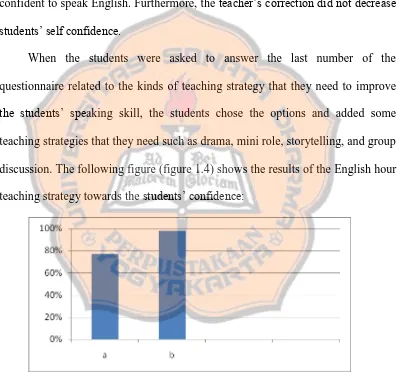
From the results of the interview with the teacher and the results of the questionnaire, the English hour teaching strategy encouraged them to be more confident to speak English. Furthermore, the teacher’s correction did not decrease students’ self confidence.
When the students were asked to answer the last number of the questionnaire related to the kinds of teaching strategy that they need to improve the students’ speaking skill, the students chose the options and added some
teaching strategies that they need such as drama, mini role, storytelling, and group discussion. The following figure (figure 1.4) shows the results of the English hour teaching strategy towards the students’ confidence:
Figure 1.4 The students’ confidence to speak English Note: a. The students were more confident to speak English
B. Discussion
1. The Application of the English Hour Teaching Strategy
Based on the results of the observation and interview, the English hour teaching strategy was applied in interesting way to encourage or motivate the students to speak English. In addition, the objective of the English hour teaching was communicative goal. Because of that, Communicative Language Teaching was done in the application of the English hour teaching. Based on the theory of Richards and Rodgers (2001), Communicative Language Teaching as the teaching approach has two purposes (1) to create communicative competence of language teaching, (2) is used to develop the strategy of the teaching English skills (speaking, listening, reading, and writing) in which those have relation to the language and communication. In this research, the English hour teaching strategy which was created by the English teacher to improve students’ speaking skill was
on those principles, this research showed the process of conducting the English hour teaching strategy one by one.
The first process was the teacher explained the material and the students were asked to listen to the teacher’s explanation. Based on the teacher’s interview, the English hour was the strategy which was used to create the listening habit for the students. After that, the students would have the speaking habit so the students were motivated to speak English. Based on the motivation’s theory, Wolfolk (2009) states the teachers should create the students’ intrinsic motivation in order to encourage the students to do something which comes up from themselves. However, the teacher also should consider that the extrinsic motivation supports the teaching-learning activities.
teacher asked the students to communicate with others in English such as asking permission before leaving the class, asking and answering questions, asking and giving something.
As stated in the chapter two that the teaching strategy is a matter of developing and applying a technique that can be used in the classroom to achieve the learning objectives. The English hour teaching strategy was applied inside the classroom during the teaching-learning process of the English subject. In the application of the English hour strategy, the teacher used this strategy to motivate the students to speak English. Based on the last principle of Richards and Rodger (2001: 177), learning is a process of creative construction and involves trial and error, the application of the English hour teaching strategy was suitable to achieve the communicative goal. Based on the results of the questionnaire, 85% of the respondents said that the grammatical and pronunciation mistakes were accepted. Moreover, the students were also asked to translate Bahasa Indonesia into English when the students used Bahasa Indonesia for communicating during the teaching-learning process in the English hour teaching strategy.
2. The Effects of The Strategy