Other uses, including reproduction and distribution, or selling or
licensing copies, or posting to personal, institutional or third party
websites are prohibited.
In most cases authors are permitted to post their version of the
article (e.g. in Word or Tex form) to their personal website or
institutional repository. Authors requiring further information
regarding Elsevier’s archiving and manuscript policies are
encouraged to visit:
Clean energy
fi
nancing at Asian Development Bank
Laurence L. Delina
Independent Scholar
a b s t r a c t
a r t i c l e
i n f o
Article history:
Received 16 February 2010 Revised 4 April 2011 Accepted 21 April 2011 Available online 18 May 2011
Keywords:
Climate change mitigation Financial mechanism Clean energy policy Multilateral development bank Asian Development Bank
Presenting data from Asian Development Bank (ADB), this paper attempts to examine the bank's energy for development portfolio within a 12-year period beginning in 1997, the year when the Kyoto Protocol was adopted. This paper seeks to understand the implications of this particular assistance to climate change mitigation in terms offilling the gaps in providing resources for energy-related projects. With more than US $12 billion development assistance to support the energy sector in the last 12 years, ADB was able to mobilize substantial support from 2005 onwards. The paper also shows that annual energy assistance was virtually stagnant and even lacking before 2005. Evidence suggests that some efforts are being made tofill the resource gap and to mitigate climate change especially in 2008. While analysis suggests that there has been a substantial increase infinancing to lower greenhouse gas emitting energy projects, the shift tends to be fragile. ADB still favorsfinancing large profitable projects and concentrates its portfolio mostly to selected regions and countries. For ADB to provide significant contribution to climate change mitigation, several challenges remain to be met in the future from increasing funding to meet demands for increasing number of renewable and efficiency projects to expanding assistance especially in underserved countries and regions.
© 2011 International Energy Initiative. Published by Elsevier Inc. All rights reserved.
Introduction
The promotion of additional development assistance especially for cleaner energy projects could have been attributed to the stimulus provided when the UNFCCC entered into force in 1994. Specifically, the call for additional assistance is mentioned in Articles 4.3 and 4.5 of the Convention asking all developed countries to provide new and additionalfinancial resources to meet the agreed costs of developing countries in complying with their obligations, including measures in mitigating climate change by addressing anthropogenic emissions at sources. Article 11.5 of the same Convention also stipulates that developing countries may avail themselves of financial resources related to the implementation of the Convention from both bilateral and multilateral sources.
Financing issues were further reinforced when the Kyoto Protocol to the UNFCCC was adopted in 1997. This was made through the context of the Clean Development Mechanism (CDM) allowing developed countries to invest in climate mitigation efforts in developing countries and take credits from it. At the 13th Conference of Parties meeting in Bali in 2007, the necessity offinancing and access to it was again assigned a front seat for addressing climate change (UNFCCC, 2007). This is especially expressed in Paragraph 1(b) part (ii) of the Bali Action Plan which conditions“nationally appropriate mitigation actions by developing country Parties” in providing
“technology,financing and capacity building.”Moreover, Paragraph 1(e) parts (i), (v) and (vi) call for“enhanced action on the provision of financial resources to support action on mitigation” including “improved access to adequate, predictable and sustainablefinancial resources,”“mobilization of public- and private-sector funding,”and “financial and technical support for capacity-building.”
In 2009, at the 15th Conference of Parties meeting, the Copenha-gen Accord was released reinforcing climate change mitigation finance (UNFCCC, 2009). This is specifically put forward in Paragraph 8 where parties agreed for“scaled up, new and additional, predictable and adequate funding as well as improved access” to developing countries including “technology development and transfer and capacity building… Developed countries collectively committed to provide new and additional resources…approaching US$30 billion for the period 2010–2012. They also committed to a goal of jointly mobilizing US$100 billion a year by 2020 to address the needs of developing countries.”The Copenhagen Accord has also established the Copenhagen Green Climate Fund to support projects in developing countries related to mitigation, and the Technology Mechanism to enhance action on development and transfer of technology.
This article attempts to show the promotion of development assistance for clean energy projects in Asia and the Pacific as seen through the lens of Asian Development Bank's (ADB's) energy portfolio between 1997, the year Kyoto Protocol was adopted, and 2008. In evaluating and examining the data on ADB energy development assistance, this article seeks to identify critical energy policy issues which need to be addressed to established a suitable condition to maximize opportunity for energyfinancing at ADB. E-mail addresses:[email protected],[email protected].
0973-0826/$–see front matter © 2011 International Energy Initiative. Published by Elsevier Inc. All rights reserved. doi:10.1016/j.esd.2011.04.005
Contents lists available atScienceDirect
The principal source of data for this article is the online ADB Project Database available atwww.adb.org/projectsaccessed between Octo-ber 2008 and March 2009. The database contains information related to an ADB-assisted project categorized as follows: country, sector, type of assistance, or keywords. During data gathering, project documents, Reports and Recommendations of the President, Project Performance Audit Reports, Technical Assistance Completion Reports, and project summaries among others were retrieved from the database. This article has reviewed a total of 145 energy sector-related projects.
In the course of the assessment, it was acknowledged that energy sector funding at ADB continues to evolve. This continuing internal process at ADB may therefore suggest that funding volume could not provide the overall picture. Nonetheless, it is hoped that this article could add value in terms of providing an overview of the historical antecedent of ADB financing and extracting lessons as the bank further provides assistance for clean energy projects in the future.
Sources of clean energyfinance
Energy development, which has long been a province of both the public and the private sectors, continues to be a contentious issue especially in many developing countries due to its scale and high investment cost. Financing, therefore, is important for developing economies if they are to meet their energy requirements and reach economic development. Official development assistance (ODA) re-mains an important channel among developing countries in accessing finance for energy development. Based on the Organization for Economic Co-operation and Development (OECD) Query Wizard for International Development Statistics (QWIDS), approximately US $1 trillion from 1997 to 2008 has been disbursed for all purposes of which around US $219 billion was extended to Asia and the Pacific (OECD, 2010).
Foreign direct investment (FDI) is another important determinant offinancing inflows in developing economies. From 1997 to 2008, FDI flow to developing countries totaled over US $3.65 trillion (UNCTAD, 2010). Of this, more than US $2 trillion was invested in Asia and the Pacific. Although FDI provides the necessary investment, its selective nature allows it to flow only to countries with relatively strong enabling environment for investment (such as stable political conditions, stable macroeconomic statistics, strong legal and gover-nance systems and institutions, etc.). Since many poor countries do not possess these favorable governance conditions,Ellis et al. (2007) opined that ODA remains to be the significant source of funding for developing economies.
Multilateral agencies are another important source of develop-ment assistance. These are international institutions with govern-mental membership which conduct all or a significant part of their activities in favor of development. These include multilateral development banks (MDBs), United Nations agencies, and regional groupings (such as certain European Union agencies). From 1997 to 2008, multilateral agencies have disbursed a total of around US $94 billion for development assistance (OECD, 2010).
One important multilateral agency having significant financing mechanism for climate change mitigation is the Global Environment Facility (GEF). Created in 1991 to fund projects to improve the global environment and restructured in 1994 into an independent institu-tion to become thefinancial mechanism for the UNFCCC, the Facility had committed US $1.6 billion for all projects relating to climate (GEF, 2004), but was able to successfully extend US $5 billion from 2004 to 2008 (UNCTAD, 2010).
Among MDBs, energyfinancing has also been a trend. Together, MDBs have been giving priority to energy efficiency,“bringing small-scale renewable energy technologies to client countries, and embark-ing on efforts to catalyze low-carbon investments through new financial instruments which can mobilize additional funding, promote
innovation, and help fund the incremental costs of these projects” (ADB et al., 2007). The World Bank Group has been the leader from this important fund source with a contribution of nearly 39% of all funding to energy development projects from 1997 to 2005. Other regional development banks had individually provided less than a quarter of what World Bank had extended (Tirpak and Adams, 2008).
ADB and its energy development policy
ADB is the sole MDB in Asia and the Pacific region. Beginning in early 1980s, the bank has been involved in the development of the energy sector of its developing member countries (DMCs). Itsfirst energy policy was approved in 1981 just after the second oil crisis of 1979. This policy paper defined the bank's role in the energy sector through recommending major investments in infrastructure and maximizing the use of indigenous sources of supply (ADB, 1981). The second energy policy paper did not materialize until 15 years later. Approved in 1995, the bank's second energy policy paper identified major sectoral issues and concerns centered on defining an appro-priate role for governments, enhancing the efficient production, transportation, and end use of energy, and integrating environmental considerations in all energy sectors activities to enable sustainable development (ADB, 1995). The 1995 policy was reviewed in 2000 to focus on revised operational priorities including poverty reduction, private sector involvement, addressing social and environmental impacts, and regional cooperation (ADB, 2000).
A follow-up review initiated in 2008 brought about the most recent ADB energy policy. Released in 2009, the latest policy was approved in light of ADB Strategy 2020 that emphasizes the importance of clean energy as a key component of the infrastructure core of the bank's operations. This policy aligns the bank's energy operations to meet energy security needs, facilitate a transition to a low-carbon economy, and achieve ADB vision of a region free of poverty (ADB, 2009). Energy Policy 2009 has three pillars: promoting energy efficiency and renewable energy, maximizing access to energy for all, and promoting energy sector reform, capacity building, and governance. Furthermore, it supports the prioritization and broaden-ing of energy efficiency improvements and renewable energy projects to reach as many sectors in as many ways as possible. Through this policy, ADB aims to lend US $2 billion per year for energy programs by 2013.
Promoting clean energy technology in ADB has become a primary concern in terms of increasing the bank's energy sector portfolio and also as part of its climate change mitigation efforts. Clean energy promotion involves assistance to facilitate an environment for renewable energy and energy efficiency technology which seeks to achieve lower greenhouse gas emissions and support inclusive economic growth. In the context of ADB assistance, clean energy involves the following:
• renewable energy: wind, solar, small hydro, geothermal, biomass, biofuels, biogas, landfill gas, municipal waste;
• energy efficiency: demand side energy efficiency, supply side energy efficiency such as new power plants, and supply side fuel switching such as switch from coal or oil to gas;
• cleaner fuel, especially natural gas.
ADB energy sector developmentfinancing
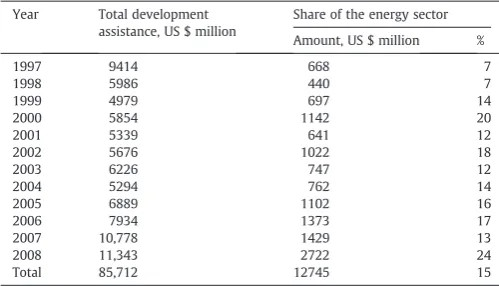
In total, ADB energy development assistance reached nearly US $13 billion representing around 15% of the total development funding during the period 1997–2008. At US $2.7 billion in 2008, energy funding was at its highest level; whereas it was at its lowest in 1998 at around US $440 million (seeTable 1).
Using ADB project database to examine energy projects, it appears that the bank has assisted its DMCs' energy sector with 108 technical
assistance and 35 projects since 1968 (see Tables 2 and 3) (ADB, 2010). One may notice a considerable discrepancy betweenTable 1 compared withTables 2 and 3due to various reasons. This could be primarily attributed to different data sources. For instance,Table 1 was generated from Annual Reports which are mostly provided in aggregated format, while figures in Tables 2 and 3 are from ADB Project Database which are more specific and disaggregated. Another reason for this discrepancy pertains to the methodology adopted by the bank to estimate its investments in renewable energy and energy efficiency projects. In 2008, the bank came out with guidelines on estimating clean energy investments by quantifying its investments not only for projects which are apparently renewable and efficient as well as projects where clean energy is only a component (ADB, undated).
In classifying energy projects, this article distributes ADB assis-tance to the energy sector as follows:
• renewables: assistance which cover wind, solar, hydro, geothermal, biomass, biofuels, biogas, landfill gas, municipal waste projects; • efficiency: includes assistance to address demand side energy
efficiency, supply side energy efficiency such as new power plants, and supply side fuel switching such as switch from coal or oil to gas; • combined: assistance with both renewables and efficiency
component;
• general power: assistance to the energy sector which neither have renewable nor efficiency component.
Assistance does not only involve physical projects but also technical assistance. Also considered vital in ADB development strategy, technical assistance provides DMCs the opportunities to identify, formulate and implement projects; improve the institutional capabilities of governments and executing agencies; formulate development strategies; promote technology transfer; and foster regional cooperation. Technical assistance for the energy sector oftentimes takes the form of institutional building, capacity building, energy audits, energy policy studies, feasibility studies, and other support programs including training of project personnel. Since 1968, ADB has been providing a number of energy-related technical assistance. These are summarized inTable 2.
Despite demands for energy to alleviate poverty, increase economic growth and address climate change, the trend of ADB technical assistance for the energy sector has been virtually stagnant until 2007. As seen inTable 2, the volume of technical assistance was doubled in 2008 (from US $10 million to US $21 million) but slumped in 2009.
In terms of actual energy sector-related projects,Table 3reveals ADB funding 35 projects with most of these approved from 2006 onwards. The year 2008 was pivotal for ADB operations as itfinanced more than US $2 billion for energy development. The US $800 million loan for India's Himachal Pradesh Clean Energy Development Investment Program aimed at constructing four medium to large hydropower plants in Western Himalayas took the majority of ADB financing that year. Another major project in 2008 involved the US $570 millionfinancing for the development of Afghanistan's energy sector.
Tables 2 and 3clearly indicate that the increase in ADB support for energy sector in terms of technical assistance and projects had only began in 2006. Years before that, the level offinancing was virtually stagnant. There are even years when ADB has not provided any assistance (in 1997 during the adoption of the Kyoto Protocol and in 1999). The reason for this remains unclear. Nevertheless, it reveals that the focus on climate change mitigation tended to be a marginal consideration in ADB operations even after the adoption of Kyoto Protocol. The small volume of investment allocated for the energy sector particularly on projects involving cleaner technologies during the period 1997–2005 evidenced this trend. However, the situation Table 1
Volume and trend of ADB energy sector-relatedfinancing vis-à-vis total development assistance between 1997 and 2008.
Year Total development assistance, US $ million
Share of the energy sector
Amount, US $ million %
1997 9414 668 7
Nominal count (in parenthesis) and amount (in US $ million) of ADB technical assistance for the energy sector since 1968.
Year Renewables Efficiency Combined General power
Nominal count (in parenthesis) and amount (in US $ million) of energy sector projects supported by ADB since 1968.
was never static as significant increase began to be visible in 2006 and the following years which could stem in part from the development of the ADB Clean Energy and Environment Programme which was launched that year. The program, which is made up of several initiatives including the one billion dollar Energy Efficiency Initiative, involves project screening for efficiency opportunities and monitoring efficiency components in the bank's energy portfolio. Through this process, energy efficiency components in ADB projects that are not 100% energy-sector related had been accounted for.
As mentioned earlier, the reasons for stagnation (and even absence of funding) are undoubtedly complex but may be attributed to competition with other sectoral needs (especially social which mainly focused on poverty alleviation and building infrastructure), shifting ADB and developing country priorities, the long process of project identification and implementation (which is very common among energy projects), and probably the abundance and ease of access to private sector capital and other mode offinancing in some large countries (such as China). The stagnation and absence of funding however represent a real challenge to the development goals of many developing countries especially in many small countries, such as those in developing Pacific, which often have no easy access to capital and oftentimes tend to rely on overseas funding institutions to help launch energy-related projects.
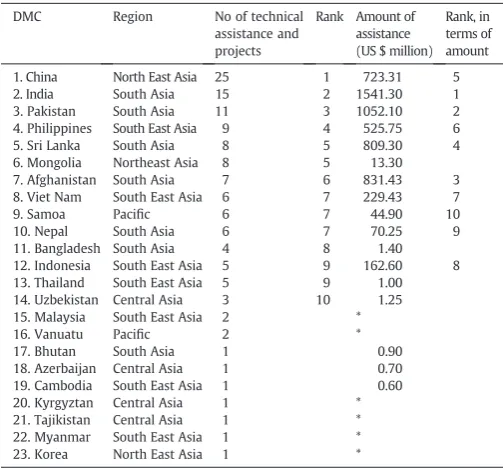
Such low funding level is particularly evident in many Pacific and Central Asian countries where ADB had exposed a very minimal investment in their energy sector. Compared to other regions which obviously received more investments, it is obvious fromTable 4that the Pacific and Central Asian regions are left out in terms of project assistance. For Central Asian countries, however, this could be due to lack of disaggregated data in years when these countries were still part of the USSR. Since 1968, the large countries of China, India and Pakistan led the list in terms of volume of ADB technical assistance and projects; these projects are mostly large ones.
Conclusions and recommendations
Based on aggregated data from ADB Annual Reports, support for energy projects totaled over US $86 billion from 1997 to 2008. ADB
Project Database showed that 43% of the bank's total energy sector investments are for renewables, while 26% are for efficiency. Although it is recognized that in many cases these trends have probably been driven by factors other than climate change, there apparently has been at least some recognition that cleaner energy technologies—both renewable and efficient—need to be promoted and diffused in developing Asia and the Pacific.
As reflected in the bank's 2009 Energy Policy, it is clear that ADB understands that the goals of climate change mitigation, sustainable development promotion and poverty reduction can be complemen-tary and integrated into its operational portfolio. However, the variability of funding levels for lower GHG-emitting technologies over the 1997 and 2009 period as shown in this article suggests that programs addressing the three-pronged issues of poverty, sustainable energy and climate change remain fragile.
In summary, several challenges are needed to be addressed in the future if ADB is to address the need for a revolution to transform the energy system in Asia and the Pacific. Nonetheless, this action would call for a much broader and sustained commitment in the following three fronts.
Increase ADB funding
In the turn of the new decade, the demand for energy and financing in developing Asia and the Pacific is expected to be great. The cost of expanding and modernizing the region's energy systems is estimated at US $375 billion per year (or over US $9 trillion from 2006 to 2030) (UNESCAP, 2008:79). The availability offinancing, therefore, will continue to be critical for energy supply projects. Generation efforts, power plants and transmission systems are among the most capital-intensive projects in any economy. Thus, expectations for sustained economic growth are based on assumed availability of a bulk of investment available for the power sector.
Increase the volume of technical assistance
Increasingly, developmentfinancing for project-based activities is being supplemented with macro-economic and sector-wide assis-tance which include capacity building, promoting policy reforms and institutional changes. ADB is on track in terms of supporting these kinds of activities as shown by the number of technical assistance it has provided to DMCs. Nevertheless, it remains to be seen whether these may lead to more lasting and far-reaching changes. Therefore the question as to how the opportunities and consequences of these related approaches should be addressed, and whether these new reforms are“climate friendly”at all, could not be answered as it is not evident at this point.
Increase the volume offinancing in the Pacific and Central Asia
As it stands, ADB is yet to expand the number and amount of its financial assistance to these two Asian regions. Recent trends in terms of ADB investment to clean energy have been promising. While ADB has adopted specific targets to increase support for new renewable energy and energy efficiency respectively, there remains enormous scope to scale up these efforts especially in the Pacific and Central Asia.
References
ADB. Role of the bank in the energy sector in the region. Working Paper No. 2-81. Manila; 1981.
ADB. The bank's policy initiatives in the energy sector. Manila. available athttp://www. adb.org/Documents/Policies/Energy_Initiatives/default.asp.1995.
ADB. Energy 2000: review of the energy policy. Manila. available a thttp://www.adb. org/Documents/Policies/Energy/default.asp.2000.
ADB. Energy policy. Manila. available athttp://www.adb.org/Documents/Policies/ Energy-Policy/Energy-Policy-2009.pdf.2009.
Table 4
Distribution of ADB energy sector assistance to DMCs energy sector, nominal count, amount, and rank.
DMC Region No of technical assistance and
1. China North East Asia 25 1 723.31 5
2. India South Asia 15 2 1541.30 1
3. Pakistan South Asia 11 3 1052.10 2 4. Philippines South East Asia 9 4 525.75 6 5. Sri Lanka South Asia 8 5 809.30 4 6. Mongolia Northeast Asia 8 5 13.30 7. Afghanistan South Asia 7 6 831.43 3 8. Viet Nam South East Asia 6 7 229.43 7
9. Samoa Pacific 6 7 44.90 10
10. Nepal South Asia 6 7 70.25 9
11. Bangladesh South Asia 4 8 1.40 12. Indonesia South East Asia 5 9 162.60 8 13. Thailand South East Asia 5 9 1.00 14. Uzbekistan Central Asia 3 10 1.25 15. Malaysia South East Asia 2 *
16. Vanuatu Pacific 2 *
17. Bhutan South Asia 1 0.90
18. Azerbaijan Central Asia 1 0.70 19. Cambodia South East Asia 1 0.60 20. Kyrgyztan Central Asia 1 * 21. Tajikistan Central Asia 1 * 22. Myanmar South East Asia 1 * 23. Korea North East Asia 1 *
*No data.
Source: ADB Database.
ADB. ADB Project Database. available athttp://www.adb.org/projects.2010. ADB. Guidelines for Estimating Asian Development Bank (ADB) Investments in
Renewable Energy and Energy Efficiency Projects. Asian Development Bank. available at http://www.adb.org/Documents/Clean-Energy/Guidelines-Estimating-ADB-Investments.pdf.
ADB, AfDB, EBRD, EIB, IADB, WBG. The multilateral development banks and the climate change agenda: a joint report. Asian Development Bank, Africa Development Bank, European Bank for Reconstruction and Development, European Investment Bank, Inter-American Development Bank, World Bank Group. available at http://www.cslforum.org/publications/documents/ MDBstudy101007.pdf.2007.
Ellis J, Winkler H, Corfee-Morlot J, Gagnon-Lebrun F. CDM: taking stock and looking forward. Energy Policy 2007;35:15–38.
GEF. Program study on climate change, document GEF/ME/C.24/Inf.2. Washington, DC: Global Environment Facility; 2004.
OECD. Query Wizard for International Development Statistics (QWIDS). Organisation for Economic Co-operation and Development. available athttp://stats.oecd.org/qwids/. 2010.
Tirpak D, Adams H. Bilateral and multilateralfinancial assistance for the energy sector of developing countries. Climate Policy 2008;8:135–51.
UNCTAD. FDI Statistics United Nations Conference on Trade and Development. available athttp://stats.unctad.org/FDI.2010.
UNESCAP. Energy security and sustainable development in Asia and the Pacific. Bangkok, Thailand: United Nations Economic and Social Commission for Asia and the Pacific; 2008.
UNFCCC. Bali Action Plan. United Nations Framework Convention on Climate Change. available athttp://unfccc.int/files/meetings/cop_13/application/pdf/cp_bali_action.pdf. 2007.
UNFCCC. The Copenhagen Accord. United Nations Framework Convention on Climate Change. available athttp://unfccc.int/resource/docs/2009/cop15/eng/l07.pdf.2009.