L
Journal of Experimental Marine Biology and Ecology, 241 (1999) 107–136
Settlement-driven, multiscale demographic patterns of large
benthic decapods in the Gulf of Maine
a ,* b b
Alvaro T. Palma , Robert S. Steneck , Carl J. Wilson
a
´ ´
Departamento Ecologıa, Pontificia Universidad Catolica de Chile, Alameda 340, Casilla 114-D, Santiago,
Chile
b
Ira C. Darling Marine Center, School of Marine Sciences, University of Maine, Walpole, ME 04573, USA Received 3 November 1998; received in revised form 30 April 1999; accepted 5 May 1999
Abstract
Three decapod species in the Gulf of Maine (American lobster Homarus americanus Milne Edwards, 1837, rock crab Cancer irroratus Say, 1817, and Jonah crab Cancer borealis Stimpson, 1859) were investigated to determine how their patterns of settlement and post-settlement abundance varied at different spatial and temporal scales. Spatial scales ranged from centimeters to hundreds of kilometers. Abundances of newly settled and older (sum of several cohorts) individuals were measured at different substrata, depths, sites within and among widely spaced regions, and along estuarine gradients. Temporal scales ranged from weekly censuses of new settlers within a season to inter-annual comparisons of settlement strengths. Over the scales considered here, only lobsters and rock crabs were consistently abundant in their early post-settlement stages. Compared to rock crabs, lobsters settled at lower densities but in specific habitats and over a narrower range of conditions. The abundance and distribution of older individuals of both species were, however, similar at all scales. This is consistent with previous observations that, by virtue of high fecundity, rock crabs have high rates of settlement, but do not discriminate among habitats, and suffer high levels of post-settlement mortality relative to lobsters. At settlement, large, habitat-scale differences exist for lobsters but not for rock crabs; these are probably the result of larval settling behavior. In contrast, patterns at the largest, inter-regional, spatial scales suggest oceanographic control of larval delivery. Increased mobility and vagility with greater body size for both species reduces demographic differences among older individuals over a range of spatial scales. 1999 Elsevier Science B.V. All rights reserved.
Keywords: Settlement; Post-settlement; Newly settled individuals; Spatial scale; Temporal scale; Predation; Subtidal; Gulf of Maine; Cancer irroratus; Cancer borealis; Homarus americanus
*Corresponding author. Tel.:156-2-686-2971; fax:156-2-686-2621.
E-mail address: [email protected] (A.T. Palma)
1. Introduction
Ecologists seeking to understand factors that affect patterns of distribution and abundance of organisms must consider the problem over a daunting range of temporal and spatial scales. Understanding the appropriate scale in ecological research presents both practical and theoretical challenges (Levin, 1992, 1993). Central among these is the challenge of linking the scale of demographically important patterns with the scale of the pattern-driving processes (Horne and Schneider, 1994).
Dispersal among marine organisms with pelagic larvae is scale-dependent. The abundance of larval stages (Roughgarden et al., 1991), early post-larval stages (Jones, 1991) or a combination of both (Roughgarden et al., 1988) has a major impact on the demography of these of organisms. If population densities of benthic marine organisms are regulated by settlement success, as has been shown for reef fish (Doherty and Fowler, 1994), barnacles (Connell, 1985; Gaines and Roughgarden, 1985), and many other benthic and demersal marine organisms (Underwood and Fairweather, 1989), then factors contributing to successful settlement into appropriate nursery grounds may be as important as broodstock abundance in determining the size of future populations. However, larvae may select particular habitats at the scale of millimeters when settling, while the ocean currents may have transported those larvae hundreds of kilometers. Similarly, larvae may settle in regular patterns within a season but show significant inter-annual variability.
In general, successful settlement, hence recruitment to the benthos, requires (1) available competent larvae, which depends on both sufficient egg and larval production and oceanographic dispersal (Underwood and Fairweather, 1989), (2) the propensity to settle [sounding behavior and appropriate tactile, visual or chemical cues (Boudreau et al., 1992)] and (3) available nursery ground habitats where post-settlement survivorship is high (Gotceitas and Brown, 1993).
Identical patterns in post-settlement abundance can result from very different settlement and early post-settlement processes, all dependent on the scale of observation (Jones, 1997). For example the abundance of newly settled individuals in nursery grounds can result from (1) individuals actively selecting certain habitats (Steger, 1987; Wahle and Steneck, 1991; Fernandez et al., 1993; Eggleston, 1995; Eggleston and Armstrong, 1995; Morgan et al., 1996), or (2) individuals settling indiscriminately but surviving in nursery grounds through differential mortality between nursery grounds and other habitats (Lough et al., 1989; Gotceitas and Brown, 1993; Palma et al., 1998).
from oceanographic forcing functions. Since the former is invariably controlled by the latter, the problem is general. However, determining the scale of such interactions requires considerable exploring research focused on the question of relevant scale for ecological processes. Our study is one of the first in the western North Atlantic to consider this question.
In the Gulf of Maine three large decapods, the American lobster Homarus
ameri-canus, the rock crab Cancer irroratus, and the Jonah crab Cancer borealis, are
ecologically and economically important as large-bodied benthic invertebrates (Krouse and Cowger, 1980; Ojeda and Dearborn, 1990; Fogarty, 1995; Lawton and Lavalli, 1995). The occurrence of these species was recorded in several sites within four widely-separated coastal regions in the Gulf of Maine. Individuals were quantified on different substrate types, on habitats of different exposure relative to prevailing currents, and along bathymetric and estuarine gradients.
The purpose of this study was to consider the scale at which patterns of abundance occur among decapods in the Gulf of Maine and integrate this with recent scale-dependent process-level surveys. Different age groups, newly settled vs. older in-dividuals, were studied at spatial scales ranging from different microhabitats centimeters apart to regions hundreds of kilometers apart. Temporal scales ranged from weekly to inter-annual comparisons. One goal of this study is to consider how and at what scales the abundance of settlers translates into the demography of older segments of populations. This study elucidates the emergent demography of these species at all these scales.
The approach followed throughout this study considered the comparison of the number of individuals at these various spatial and temporal scales. For each case the underlying hypothesis is that their abundances do not differ. The acceptance or rejection of these multiple hypotheses will allow us to discuss our findings within the scope of the more general hypothesis stated above.
2. Materials and methods
2.1. Survey sites and methods
Field surveys were made at several sites within four regions along the coast of Maine, from west to east: York, Pemaquid, Penobscot Bay, and Mount Desert Island (Fig. 1A). In all sites, the abundance of the three study species, Homarus americanus, Cancer
irroratus, and Cancer borealis (hereafter also referred to as lobster, rock crab, and Jonah
crab, respectively), was quantified through visual and air-lift suction sampling SCUBA surveys. The former method is primarily used to estimate the abundance of larger, less cryptic individuals, normally older than 1 yr. (hereafter also referred to as 1YR1). Size criteria for the 1YR1 group were: .10 mm CW (carapace width) crabs and CL (carapace length) lobsters. In each site over the same depth range (around 10 m below
2
less-Fig. 1. Four coastal study regions and sites within (A) the Gulf of Maine: (B) York (A, B, C, D), (C) Pemaquid and Damariscotta River (GL, Glidden Ledge; McGP, McGuire Point; PI, Peters Island; JC, Jones Cove; HIC, Holly Inn Cove; KRE, Kresge; XMAS, Christmas Cove; TOL, Thread of Life; FIW, Fisherman Is.; DIW, Damariscove Is. West Side; DIE, Damariscove Is. East Side), (D) Penobscot Bay (SP, Squaw Point; OC, Orr Cove; DT, Ducktrap; TH, Thomaston; HI, Hurricane Is.; IAH, Isle Au Haut; AI, Allen Is.; RI1, Ragged Is. 1; RI2, Ragged Is. 2), and (E) Mount Desert Island (BI, Baker Is.; BLI, Black Is.; GDI, Great Duck Is.; LIS, Long Is. South Side).
2
0.25 m size quadrats were used. For details on the air-lift suction sampling procedure, see Wahle and Steneck (1991). The abundance of YOY and 1YR1 individuals along
2
depth gradients and along estuarine conditions was estimated employing 0.24 m decapod-settler collectors constructed of PVC (polyvinyl chloride) pipe. Collectors were SCUBA deployed before the settlement season started (mid-July) and retrieved after the season was over (end September). Collectors were square structures (6034039 cm) made of 3 cm diameter grey PVC pipes spaced 1 cm apart and stacked three rows deep in alternating tiers. The stack was placed on AstroturfEinside a wire basket lined with 1 mm mesh nylon screen. The basket was made of 3.5 cm mesh vinyl-coated wire commonly used for lobster traps. For more details on collector description and similar general field methodology, see Palma et al. (1998).
2.2. Patterns between substrata (centimeter to meter scale)
The use of substrate by newly settled and older individuals of all species was studied through seasonal surveys made in the seven outer-coastal sites in the Pemaquid region between 1994 and 1997 (Fig. 1C). In each site suction samples were taken from specific substrate types (sand and cobble) considered extremes in a continuum of grain sizes. This choice was made also based on the high preference for cobble habitats by the early benthic phase of lobsters (Wahle and Steneck, 1991; 1992) and the fact that at least rock crabs had been found capable of settling on coarse sand as well as on cobble with comparable densities (Palma et al., 1998). Estimates of the abundance of older individuals were more efficient by visual surveys since they are more conspicuous. In addition, the densities of older stages of either decapod species are normally lower than that of settlers, and also because boulders were added as another type of substrate utilized by these larger individuals, not efficiently surveyed using the air-lift method. The comparisons of abundance between substrata and among species corresponded to the average densities found at seven sites during 4 years, although not all sites were surveyed every year. Thus, the sample size considered here was: eight and 11 averages on sand and cobble, respectively, for newly settled individuals and 15 and 16 on sand and cobble1boulder, respectively, for older individuals.
2.3. Patterns among depths (meters to tens of meters scale)
2.4. Predator exclusion experiment (tens to hundreds of meters scale)
To test the effect of benthic predators on newly settled rock crabs in sites separated by hundreds of meters, we deployed a meso-scale exclusion experiment on opposite sides of Damariscove Island (DIW and DIE) during the settlement season of 1997 (August– September) (Fig. 1C). The difference in abundance of new settlers inside and out of cages would also indirectly indicate potential differences in physical factors (i.e. wind, currents) that could have influenced these differences. The island is approximately 3 km long by less than 1 km wide and is aligned nearly north–south. Twenty exclusion and open cages were placed at each side of the island near a narrow isthmus (less than 50 m) that separates the two experimental sites. The experiment was deployed at 10 m below MLW on similar sand patches. In each site 10 open and 10 predator-exclusion cages were randomly interspersed and placed 1.5 m apart in a square design. Each unit
2
consisted of a 0.5 m (71371 cm) wooden frame filled with sand. The sand, obtained days earlier in the same area, was washed and dried in the laboratory to ensure no artificial addition of already settled individuals then brought to the study site. The total exclusion treatment consisted of frames covered with 4 mm size mesh (for more details on design, see Palma et al., 1998). Previous tests with partial cages (roofs but not sides) showed no cage effect. All frames (open and caged) were suction-sampled completely before starting the experiment 1 week later. This experiment was designed only to quantify newly settled rock crabs; lobsters were not expected to be found because the small size of the mesh and the type of substrate (sand) was not appropriate for this species. The experiment started on August 21 and continued through September 10. In this period all cages were surveyed weekly (three times) using the same air-lifting technique as described above. From a total of 30 plots considered in this design (30 for each treatment and island side), 28 and 29 corresponded to the exclusion treatment on the west and east side of the island, respectively, and 27 and 28 for the open treatment on the west and east side of the island, respectively. The missing data corresponded to cages that broke open or plots that were lost. After each survey the cages were filled with new sand and the experiment restarted. This was a two-factor experimental design with island side (west and east) and cage treatment (full cage and no cage) as independent variables. The response variable was number of newly settled rock crabs /
2
0.5 m . It was possible to pool the three separate surveys since their mean square errors were very similar (54.43, 48.13, 44.72), so the data were analyzed with a two-factor ANOVA.
2.5. Intra-regional patterns (hundreds of meters to tens of kilometers scale)
were only performed in cobble beds, while sand was also considered for crabs. For each case, the sample size corresponds to the number of quadrats surveyed at each site during these years combined.
2.6. Patterns up estuaries (tens of kilometers scale)
In the summer of 1995, PVC collectors were placed at 10 m below MLW in five sites several kilometers apart up the Damariscotta estuary. Collectors were randomly placed from the outer-coastal DIW to four sites along the river (JC, PI, McGP and GL, Fig. 1C) in numbers of 8, 16, 14, 12, and 14, respectively. In addition to ensuring the standardization of substratum with collectors, all sites had a westward exposure. The salinity gradient along the Damariscotta River is minimal, varying during the summer from 31‰ at the open coast and river mouth, to about 29‰ at Glidden ledge (McAlice, 1977). Despite little change in the overall salinity, the Damariscotta River has a typical estuarine circulation, however poorly stratified, particularly during the summer (McAlice, 1977; Mayer et al., 1996). A similar pattern exists in Penobscot Bay, where despite a greater freshwater input, salinity values only fluctuate between 27 and 31‰ at the head and mouth of the bay, respectively (N. Pettigrew, personal communication). Because these salinities are well within the tolerance units of the larval and adult phases of these species, this study represents a useful test of how settlement patterns may be influenced by estuarine transport processes. Estimates of the abundance of newly settled and older individuals in Penobscot Bay were made at the end of the settlement season of 1997 (September) in nine sites throughout the Bay (Fig. 1D). Estimations of abundance were made by surveying only natural cobble substrata. The abundance of new settlers
2
was estimated by haphazardly tossing twelve 0.25 m quadrats at each site and collecting all decapods using the air-lift. The quantification of older individuals on
2
cobble substrata at the same sites was made by surveying a similar number of 1.0 m haphazardly tossed quadrats. The selected sites had equivalent coverage of cobble substrata and were scattered throughout Penobscot Bay.
2.7. Inter-regional patterns (hundreds of kilometers scale)
The same sites considered for the intra-regional comparisons (within Pemaquid and Mount Desert) were combined to compare abundances among regions. Two more regions were added to this analysis (York and Penobscot Bay). Data from York came from four sites with similar exposure (Fig. 1B), and data from Penobscot Bay came from only the six, more exposed, sites near the mouth of the Bay (Fig. 1D). In the case of the last two regions, suction sample data were only available for 1997; visual surveys for 1995 and 1997 in York; and only 1997 in Penobscot Bay. The sample size for each region is indicated in the legend of Fig. 9.
2.8. Temporal patterns (weekly and annual scales)
(DIW, Fig. 1C) was chosen for its long history of high post-larval supply and recruitment (Incze and Wahle, 1991; Wahle and Incze, 1997; Palma et al., 1998; Incze et
2
al., 1999). Four 1.0 m previously placed square plots filled with cobble were surveyed every week using the air-lift (see Palma et al., 1998, for more details on the experimental design).
The inter-annual comparison of abundance was made only with data from the sites in Pemaquid between 1994 and 1997. The methodology was the same as described earlier. The sample size for each year is indicated in the legend of Fig. 11.
The data were analyzed using parametric approaches, and given the correlational nature of the data (primarily, measurements of the abundance of individuals in numbers /
2
m ), the predominant method for overall comparison was by means of ANOVAs for fully factorial models (SYSTAT 1992). The identification of lower-level differences was always done (although not always shown) mainly using Tukey’s HSD and Fisher’s LSD post-hoc tests for simultaneous pairwise mean comparison, with significances chosen so that overall probabilities were equal to the critical value of 0.05. Assumptions of normality, homogeneity of variance, and independence of observations were tested and the appropriate transformations performed when necessary (Zar, 1974; Sokal and Rohlf, 1981).
To investigate how abundance varied among replicate quadrats and what proportion of its overall variation was explained at this scale, a subset of abundance data were analyzed at three different spatial scales (quadrat, sites, and regional scales). This analysis was done for newly settled individuals (YOY) and older stages (1YR1) of H.
americanus and C. irroratus. The data were analyzed using a nested analysis of variance, where the F-ratios were obtained considering the mean square estimates (see Underwood and Chapman, 1996; Underwood, 1997).
3. Results
3.1. Patterns between substrata (centimeters to meters scale)
In the surveys performed in the Pemaquid region from 1994 to 1997, newly settled lobsters were found only on cobble substrata (F1,17510.84, P50.004, Fig. 2A). Similar surveys on adjacent finer-sediment substrata (sand of varying coarseness) yielded a conspicuous lack of newly settled lobsters, or densities below detection. In comparison, rock crabs settled at significantly higher densities, and with no significant differences between cobble and sand (F1,1750.017, P50.899, Fig. 2A). Newly settled Jonah crabs were never observed in the Pemaquid region surveys. Older individuals of the three species occurred on both types of substrata, and Jonah crabs were significantly less abundant than the other two decapods (F2,90528.1, P,0.001). The abundance of lobsters and rock crabs older than 1 year on cobble and boulder bottoms was higher than on sand, but that difference did not exist for Jonah crabs (F1,29532.07, P,0.001;
Fig. 2. Centimeter to meter scale substrate-related patterns of abundance for (A) newly settled (YOY), and (B)
2
older (1YR1) decapods in the Pemaquid region. Number of 0.25 m quadrats used to quantify YOY and 1.0
2
m for 1YR1individuals (61 SE) for each substrata shown inside legend frame. Dashed horizontal lines represent comparison between species and continuous horizontal lines represent comparison within species by substrate. Interrupted lines represent significant differences.
(lobsters: F1,3353.85, P50.046; rock crabs: F1,3355.60, P50.024), but for Jonah crabs it was lower (F1,33511.46, P50.002).
3.2. Patterns among depths (meters to tens of meters scale)
significant difference between 5 and 10 m, and below detectable levels at 20 m (F2,3352.33, P50.113, Fig. 3A). In comparison, newly settled rock crabs were more abundant at all three depths, although densities were significantly higher, but equal, at 5 and 10 m (F2,3358.01, P50.001, Fig. 3B). The abundance of older individuals that walked into the collectors was similar throughout the depth range for both species (Fig. 3C,D). Only older lobsters showed significantly higher densities at 5 compared to 20 m (lobsters: F2,3354.50, P50.019; rock crabs: F2,3352.24, P50.122).
3.3. Intra-regional patterns and predator exclusion experiment (tens of meters to tens
of kilometers scale)
From data obtained during the settlement season of 1994, the abundance of both newly settled and older lobsters and rock crabs was estimated in two nearby sites on opposite sides of Damariscove Island (DIW and DIE). These sites are separated by only a few hundred meters across an island isthmus, but more than 2 km along shore (see Fig. 1C). In those observations the ratio of newly settled lobsters was six-fold (4.561.5 at
2
DIW versus DIE 0.860.5 indiv. / m 61 SD) compared to more similar densities for
2
newly settled rock crabs (12.368.1 at DIW versus DIE 9.464.0 indiv. / m 61 SD).
However, the abundance of older individuals of both species was similar on the two sides of the island (lobsters: 4.561.1 and 2.560.6; rock crabs: 6.061.9 and 8.262.2
2
indiv. / m 61 SD at DIW and DIE, respectively).
The above data are consistent with those found for lobsters from the same two sites by Wahle and Incze (1997). This suggests that the supply of larvae at this scale is different for these two species. Wahle and Incze (1997) proposed that different supply regimes (wind-driven currents) were the main factor responsible for such difference in post-settlement abundances of lobsters. The results obtained from the exclusion experiment on the two sides of the island in 1997 strongly suggest that this is not the case for rock crabs. Abundance of newly settled rock crabs inside the exclusion cages (less than 1 week after they reach the benthos) was not significantly different between sides of the island (Table 1). Although the difference in absolute abundance between the total exclusion and the open treatments was significant, the differences were proportional for the two sides of the island (Fig. 4). Thus, collections made on a weekly basis still appear to reflect the supply signal on both sides.
The abundance of newly settled lobsters was similar when three sites with identical south-westward exposure in the Pemaquid region were compared (F2,8851.32, P5
0.273, Fig. 5A), however newly settled rock crabs showed more variability and an up to five-fold difference among sites was detected (e.g., FIW vs. KRE, F2,15757.10,
P50.001, Fig. 5B). The abundance of older individuals was lower but within the same
2
magnitude for both species in all sites (,1.0 indiv. / m ). Values were significantly lower for lobsters at KRE and significantly higher for rock crabs at DIW (lobsters: F2,9915
8.86, P,0.001; rock crabs: F2,99154.90, P50.008, Fig. 5C,D). For each site in the Pemaquid region the difference between the abundance of newly settled and older individuals was always significant for both species (see Fig. 5).
At the four sites in Mount Desert region, the abundance of newly settled lobsters occurred at levels below detection. The abundance of older individuals, although with slight differences among sites (Fig. 6A) (F3,1139510.67, P,0.001), was significantly
2
lower than that recorded in the Pemaquid region (0.89 vs. 0.25 indiv. / m , F1,656.47,
P,0.001). Density of newly settled rock crabs, although lower than that reported for
2
Pemaquid (22.61 vs. 4.57 indiv. / m , F1,216518.044, P50.001), was quantifiable in three of the four sites with no significant difference among them despite a high density of settlers in LIS (Fig. 6B) (F3,7151.71, P50.173). Similarly, the abundance of older individuals was remarkably similar among all sites (F3,113950.86, P50.459). Despite the overall greater abundance of settlers compared to older individuals, there was no
Table 1
Two-factor ANOVA to compare the abundance of newly settled C. irroratus at the east and west sides of Damariscove Island (Island side) under open or exclusion of predators (Treatment) conditions. The response
2
variable is number of new settlers 0.5 m . Sample sizes as shown in Fig. 4
Source df SS MS F-value P-value
Island side 1 86.620 86.620 0.896 0.346
Treatment 1 5477.121 5477.121 56.643 ,0.0001
Island side3Treatment 1 46.554 46.554 0.481 0.489
Fig. 4. Cancer irroratus. Abundance of newly settled individuals inside predator-free exclusion and open control cages on the east and west side of Damaricove Island (61 SE). Experiment was conducted during the settlement season of 1997. Continuous horizontal lines represent comparison by treatment and dashed horizontal lines represent comparison by island side. Interrupted lines represent significant differences.
significant difference between their densities when the data of the four sites were pooled and compared (T51.537, df574, P50.129).
3.4. Patterns up estuaries (tens of kilometers scale)
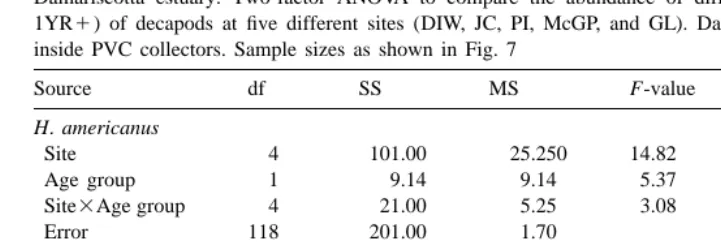
The abundance of settling lobsters inside PVC collectors significantly decreased from an outer coastal site (DIW) up the Damariscotta River estuary. At DIW, the abundance of older lobsters was greater than that of newly settled ones, and although equal between age groups, significantly lower at JC and below detectable levels in any of the three sites further up the estuary (Fig. 7). When all sites were considered, there was a significant decrease of all lobsters up the river, with a significant interaction between site and age group (Table 2). Similarly, the abundance of newly settled rock crabs decreased with increasing distance from DIW, however settlers were still observed much higher up the estuary (McGP, 18.3 km from DIW). Except for JC, no site showed a significant difference between settlers and older rock crabs (Fig. 7, Table 2).
In Penobscot Bay, newly settled lobsters were found in a few of the southern study sites (Allen to Hurricane Island), all near the mouth of the bay (Fig. 1D). Densities were low to below detection and highly variable, no significant differences were detected (F8,10951.38, P50.212). On the other hand, older individuals were present in all nine sites at highly variable densities, with the lowest densities up the bay (F8,708523.06,
Fig. 5. Hundreds of meters to tens of kilometers scale among-site pattern of abundance in the Pemaquid region. Abundance of (A,B) newly settled (YOY) and (C,D) older decapods (1YR1) (61 SE). Values
2
represent the averages of all quadrats surveyed. The number of 0.25 m quadrats used to quantify YOY and 1.0
2
m for 1YR1 individuals is shown inside bars. For each species and age group, different letters above bars mean significant differences among sites.
sea (F8,109518.511, P,0.001). In contrast, and like lobsters, older rock crabs were recorded in most sites at low and quite variable densities (F8,70858.505, P,0.001). Although the site-specific differences between YOY and 1YR1 were not significant (except Ragged Is. 1 and 2), the significances were marginal, and most likely due to very low values with large variance. The overall significance was due to comparatively high densities of settlers in two sites, with significant interaction between site and age group (Ragged Is. 1 and 2; Fig. 8, Table 3).
3.5. Inter-regional patterns (hundreds of kilometers scale)
Fig. 6. Hundreds of meters to tens of kilometers scale among-site pattern of abundance in the Mount Desert region. Mean number of newly settled (YOY, black bars) and older decapods (1YR1, open bars) (61 SE).
2
Numbers of 1.0 m quadrats for quantifying 1YR1individuals were 189, 201, 320, and 433 and the numbers
2
of 0.25 m quadrats for quantifying YOY individuals were 24, 24, 4, and 23 in LIS, BLI, GDI, and BI, respectively. For each species, different letters above bars mean significant differences among sites. Prime letters identify 1YR1 comparisons for C. irroratus.
2
among regions (,1.0 indiv. / m ). Older lobsters occurred at significantly lower densities in Mount Desert (F3,63515.15, P,0.001, Fig. 9D) and older rock crabs at significantly higher densities in Pemaquid (F3,6357.62, P,0.001, Fig. 9E). Jonah crabs occurred at similar densities in all the regions (F3,6353.37, P50.064, Fig. 9F). There was an overall tendency for the density of settlers to be greater than that of older individuals (although not always significant). This tendency was particularly strong for rock crabs in York (F1,18519.92, P,0.001) and Pemaquid (F1,10756.26, P50.014), and to a lesser extent for lobsters in Pemaquid (F1,10754.06, P50.046).
3.6. Temporal patterns (weekly and annual scales)
Although the abundance of newly settled lobsters and rock crabs in DIW was variable over time, when seven consecutive weeks were considered, the temporal variability for the two species followed similar trends, with a positive and significant relationship
2
(r 50.515, P50.005, Fig. 10). Both species started settling within the same first 2 weeks of the surveying period, peaked within the same 2 weeks, and only diverged at the end of the experimental period when crab settlement started to decline while lobster’s was still high.
On an inter-annual scale the abundance of newly settled lobsters in PEM was not significantly different among years (1994–97) (F3,1250.177, P50.910, Fig. 11A). In contrast, newly settled rock crabs showed much higher temporal variability, with significantly greater abundance in 1997 compared with the two preceding years (F3,125
Fig. 7. Tens of kilometers scale up-estuary pattern of abundance in five sites along the Damariscotta River [Damariscove Island west (DIW), Jones Cove (JC), Peters island (PI), McGuire Point (McGP), and Glidden Ledge (GL)]. Mean number of newly settled (YOY) and of older individuals (1YR1) (61 SD) inside (8, 16,
2
14, 12, and 14, respectively) 0.24 m PVC collectors from the open coastal site (DIW) up the river. For each species and site, horizontal lines represent comparisons between age groups. Interrupted lines mean significant differences.
crabs was also variable, with 1994 having the highest abundance (lobsters: F3,1456.88,
P50.004; rock crabs: F3,14514.95, P,0.001, Fig. 11C,D).
4. Discussion
4.1. Spatial small- and meso-scale-related patterns
Table 2
Damariscotta estuary. Two-factor ANOVA to compare the abundance of different age groups (YOY vs. 1YR1) of decapods at five different sites (DIW, JC, PI, McGP, and GL). Data are number of individuals inside PVC collectors. Sample sizes as shown in Fig. 7
Source df SS MS F-value P-value
H. americanus
Site 4 101.00 25.250 14.82 ,0.0001
Age group 1 9.14 9.14 5.37 0.022
Site3Age group 4 21.00 5.25 3.08 0.019
Error 118 201.00 1.70
C. irroratus
Site 4 4390.81 1097.70 29.59 ,0.0001
Age group 1 90.28 90.28 2.43 0.121
Site3Age group 4 1958.14 489.54 13.20 ,0.0001
Error 118 4377.05 37.09
varying spatial and temporal scales. The largest differences between lobsters and rock crabs occurs at the smallest spatial scales and at the time of settlement. Settlement densities of H. americanus are consistently lower than those of C. irroratus, and lobster settlement is restricted only to rocky, cobble bottoms. Newly settled lobsters were conspicuously absent in sand, and given the number of quadrats surveyed, temporal coverage (1994–97), and techniques used (exhaustive air-lift suction sampling and visual surveys), it is unlikely that the sampling effort was not large enough to detect any (but see Barshaw and Rich, 1997). Rock crabs, on the other hand, settled indiscriminate-ly on rocky and sandy bottoms. The absence or extremeindiscriminate-ly low densities of newindiscriminate-ly settled Jonah crabs does not allow further conclusions about their potential settlement-substrate preferences. Newly settled Jonah crabs were found only in the southern-most region of York in 1997. In contrast, the abundances of older individuals of the three species (particularly in the case of rock crabs) were within the same order of magnitude (,1.0
2
indiv. / m ). Overall, the abundances of older lobsters and rock crabs (on hard and soft substrata) were similar to each other and higher than that of Jonah crabs. The strong pattern of cobble habitat selection in newly settled lobsters is lost with age, as older lobsters become more common on soft bottoms. Rock crabs that settled indistinctly on both substrata showed a slight preference for hard substrata as they became larger, whereas Jonah crabs showed no clear preference
Fig. 8. Tens of kilometers scale up-estuary pattern of abundance in Penobscot Bay. Mean number of newly
2 2
settled (YOY) and of older individuals (1YR1) (61 SD) from surveys using twelve 0.25 m and 1.0 m quadrats, respectively. The number of quadrats surveyed at each site is indicated by the numbers at the bottom. For each species and site, horizontal lines represent comparison between age groups. Interrupted lines mean significant differences.
Table 3
Penobscot Bay. Two-factor ANOVA to compare the abundance of different age groups (YOY vs. 1YR1) of
2
H. americanus and C. irroratus at nine different sites. Data are number of individuals within 0.25 m (for
2
YOY) and 1.0 m (for 1YR1) quadrats. Sample sizes as shown in Fig. 8
Source df SS MS F-value P-value
H. americanus
Site 8 44.47 5.56 6.78 ,0.001
Age group 1 30.81 30.81 37.56 ,0.001
Site3Age group 8 9.54 1.19 1.45 0.171
Error 817 670.18 0.82
C. irroratus
Site 8 855.37 106.92 90.89 ,0.001
Age group 1 184.82 184.82 157.10 ,0.001
Site3Age group 8 689.33 86.17 73.24 ,0.001
Error 817 961.14 1.18
Fig. 9. Hundreds of kilometers scale among-regions (separated by 20 to 230 km and arranged from west to east) pattern of abundance along coastal Gulf of Maine. Abundance of (A,B,C) newly settled (YOY) (61 SD),
2
and (D,E,F) older individuals (1YR1) (61 SE). Values for YOY represent the average abundances in 0.25 m quadrats: 12 in York region in 1997, 91 for H. americanus and 160 for C. irroratus and C. borealis between 1994 and 1997 in Pemaquid region, 82 in Penobscot Bay in 1997, and 35 in Mount Desert Island between
2
Fig. 10. Weekly scale pattern of settlement at a single site (DIW) in the Pemaquid region. Settlement densities
2
of H. americanus and C. irroratus during the late-summer of 1994 on four standardized 1.0 m natural cobble
2
plots (61 SE). The relationship between the numbers of lobsters and crabs is significant: r 50.515,
P50.005.
move among older individuals of both species. The greater densities of older individuals inside collectors, compared to adjacent natural substrata (Fig. 2B), was likely due to (1) the tendency of relatively small-sized juveniles to colonize unoccupied and shelter-providing habitat, and (2) the fact that these observations were made only during one settlement season (1995) and compared to the average densities from 4 years of data for older individuals outside collectors, which exhibited greater variability.
Fig. 11. Annual scale pattern of settlement at three sites (DIW, FIW, KRE) in the Pemaquid region. Abundance of (A,B) newly settled (YOY) and of (C,D) older individuals (1YR1) (61 SE). Values for YOY
2
represent the combined average abundances in 0.25 m quadrats surveyed at different numbers of sites between
2
1994 and 1997: 2, 7, 4, and 3 for each respective year. For 1YR1the numbers of 1.0 m quadrats were 3, 5, 5, and 5, respectively. Different letters above bars mean significant differences between years.
post-settlement events that might overwhelm signals obtained only by measuring the abundance of individuals before they settle. On the other hand, for each species the abundance of older individuals on either side of the island was similar, without necessarily showing a clear link with new settlers. This suggests that, at this spatial scale, the abundance of older rock crabs is likely to be the result of events occurring after settlement such as post-settlement mortality or migration. Evidence of seasonal short- and long-distance movements have been described for lobsters and rock crabs (Krouse, 1980, 1981; Ennis, 1984; Pezzack and Duggan, 1986; Rebach, 1987).
The abundances of newly settled lobsters and rock crabs decreased up the estuary. An interpretation of this pattern should consider the increasing distance from the potential off-shore larval source together with factors such as larval mobility and physiological tolerance. On the other hand, barnacles, also with planktotrophic larvae, show significant recruitment densities even in the upper-most sections of the same river (Leonard et al., 1998), suggesting that other crustaceans can have local settlement. The influence of onshore wind-driven currents as well as tidal amplitude has been shown to have an important influence on the entry of larvae of other decapods into estuaries (Eggleston and Armstrong, 1995; Mense et al., 1995; Morgan et al., 1996). Consequently, the narrowness and almost straight south–north orientation of the Damariscotta River may represent a barrier affecting the supply of rock crab and lobster larvae. As with the depth-related experiment, the use of collectors in this experiment permitted a more objective measure of the settlement pattern by standardizing the substratum, especially since most of the river bed is composed of soft bottom. Lobsters clearly settled only in the southern-most sites, close to the mouth of Penobscot Bay, whereas older individuals were distributed throughout with similar densities, despite some local differences. This coincides with the higher abundances of newly settled rock crab near the mouth, which gradually disappear further up the bay. Older rock crabs were also distributed more evenly throughout the bay. Hence, and despite the differences in size and shape of these two geographic features, the pattern of up-estuary and up-bay decrease in settlement densities of the two species was comparable.
shown in Dungeness crabs, Cancer magister (Smith and Jamieson, 1991), and green ´
crabs, Carcinus meanas (Abello et al., 1997), under similarly protected conditions. 4.2. Spatial large-scale patterns
At the largest, inter-regional, spatial scale considered in this study, where regions are 25 to 235 km apart, the abundance of newly settled individuals of all species was highest in the two western-most regions, or only farthest west for Jonah crabs. This pattern is only proportional to the abundance of older individuals for lobsters in all regions, except in Penobscot Bay. The low abundance of older rock crabs had no relationship with the pattern of settlement abundance at this scale; the same is true for Jonah crabs, since in three of the four regions settlement for this species was not detected.
The correlation between the abundance of settlers and that of older individuals was in general much stronger for lobsters than for any of the crab species at most of the scales considered in this study. In studies at broader geographic scales (i.e., the Gulf of Maine), offshore sources of lobster larvae may largely contribute to coastal patterns of recruitment (Harding and Trites, 1988; Steneck and Wilson, 1998). For lobsters, subsidy from nearby offshore sources have been suggested as the main mechanism for larval supply, as opposed to surface currents and wind-induced transport (Katz et al., 1994). In an intra-regional scale study in Rhode Island, Clancy and Cobb (1997) described how wind- and tidal-driven directional transport appeared to be the mechanism of larval delivery for C. irroratus. In their study, a significant relationship between transport direction and collection dates was detected for megalopae. Megalopae collected at fine (meters) scales were found to be similarly distributed, compared to those collected at broader (hundreds of meters) scale.
As indicated by Caley et al. (1996), the majority of marine populations are demographically open; therefore, understanding the dynamics of larval delivery will help understand the dynamics of local populations and harvested stocks. Our observations agree with this view; however, we emphasize the importance of perspectives that include other potential limiting phases in the life history of organisms. Finally, these observa-tions should be sensitive to the wide spectrum of spatial and temporal scales involved. 4.3. Temporal scale-related patterns
At the different time scales considered here, the variation in abundance of lobsters and rock crabs was not always proportional. Similar settlement pulses for the two species in one location during one summer may reflect similar oceanographic conditions to which post-larvae of both species are exposed (Fig. 10). Although this was not a direct measurement of larvae present in the water column, newly settled individuals were quantified within a week after reaching the bottom, and possible negative effects (such as substrate quality, or presence of already-settled individuals on the bottom) were
2
inter-annual abundance of older individuals may not necessarily reflect past settlement events, since the estimations of abundance took more than one single cohort into account. Therefore, it is likely that more than one single settlement season was quantified.
4.4. Multiscale patterns
Although a multiscale view was taken, the whole distribution range or all possible habitats for these species and their different life stages were not explored. No other study describes the combined patterns of distribution and abundance of these sympatric decapods. Most studies are largely restricted to a single area (within a region) (Ojeda and Dearborn, 1989, 1990; Palma et al., 1998) or discuss behavioral interactions (Richards et al., 1983; Hudon and Lamarche, 1989; Richards, 1992; Miller and Addison, 1995). Most ecological studies, however, have been focused on the American lobster (for a review, see Elner and Campbell, 1991), describing patterns at a local (intra-regional) scale (but see Harding and Trites, 1988; Pezzack, 1989), emphasizing processes of post-larvae habitat selection (Barshaw and Rich, 1997), the importance of appropriate nursery grounds for post-larvae (Boudreau et al., 1990; Wahle and Steneck, 1991), the effect of physical factors affecting recruitment (Aiken and Waddy, 1986; Katz et al., 1994; Wahle and Incze, 1997), or the effect of predation on early benthic stages (Wahle, 1992; Wahle and Steneck, 1992; Barshaw et al., 1994; Spanier et al., 1998). In comparison, our knowledge of essential ecological factors that affect populations of Cancer irroratus and
C. borealis is less complete, focusing on general biological (Winget et al., 1972; Sastry, 1977a,b; Reilly and Saila, 1978; Bigford, 1979b) or behavioral aspects of older individuals (Rebach, 1987; Richards, 1992).
size-related mobility within a given habitat at the local scales (substratum and depth). Such a local scale pattern was shown by Ennis (1984) where bathymetric migration in American lobsters occurred in relation to changes in the seasonal thermocline. Seasonal migrations of rock crabs have been attributed to unidentified exogenous cues (Rebach, 1987).
In order to determine how much of the variation in abundance belongs to each spatial scale, the data of abundance for the different life stages of H. americanus and C.
irroratus were analyzed at different spatial scales (Table 4). The greatest variability for
newly settled lobsters occurred at the largest spatial scale (regional) while the opposite was true for older individuals, where significant variability was only observed among quadrats. Rock crabs, on the other hand, showed no significant differences in the variance of their abundance at any of the spatial scales considered here. Although with a slight significance for older lobsters at the smallest scale, the percentage contribution of variation for older individuals was greater at the quadrat and site scales. These additional results corroborate the previously discussed results, where different processes can be invoked for the observed patterns of these two species at different life stages.
Several studies in marine systems have shown the existence of scale-dependent patterns and associated processes for a variety of organisms on a wide range of scales. For example, inter-regional comparisons of variability in density estimates and mor-phometric relationships in subtidal kelp stands (Camus and Ojeda, 1992), fine-scale gregarious settlement patterns mediated by larval behavior (Hills and Thomason, 1996)
Table 4
or multiscale patterns resulting from a combination of larval supply and behavior in barnacles (Raimondi, 1990), different post-settlement use of space by older stages of demersal fish (Levin, 1994a,b), spatial- and temporal-scale dependent variability in larval supply of tropical shorefish (Thorrold et al., 1994), and kilometer-scale density-independent recruitment patterns in bivalves (David et al., 1997). McConaugha (1992) points to different spatial and temporal scales where diverse biological and physical processes affect decapods, particularly at their larval stages.
The differences described here, between the two most common large benthic decapod species in coastal Maine, suggest that even though rock crabs are more capable of settling at higher densities under more variable conditions (i.e., substratum, depth, distance up-estuaries), high post-settlement losses are responsible for significant de-creases in numbers, ultimately yielding similar adult population densities to those of lobsters. The wide scale ranges at which rock crabs settle and the important post-settlement losses that they undergo (Clancy, 1995; Palma et al., 1998) agree with predictions from the general life history strategy differences between lobsters and crabs (Cobb et al., 1997), that is, rock crabs mature earlier and are more fecund (Bigford, 1979a,b) than lobsters (Krouse, 1973; Waddy et al., 1995).
In our study we emphasize how the abundance of these species shows a scale-dependent variability for different ontogenetic stages. Furthermore, we propose several processes that may explain this variability, along with the acceptance of the hypothesis that very small-scale variability can result from organismic behaviors, in contrast to large-scale variability that can result from oceanographic conditions.
Especially for the American lobster, early life-history characteristics that may affect the number of recruits, such as fecundity and duration of the larval period, could ultimately affect their population dynamics (Cobb and Wahle, 1994; Cobb et al., 1997). Furthermore, for commercially valuable species like this, knowledge about the link between settlement and older (harvestable) stages of the population, as well as the scales at which processes operate, is of the utmost importance. The necessity of integrating the different scales that operate throughout the fishery into management schemes has, for example, been emphasized for groundfish in the western north Atlantic (Langton et al., 1995). Moreover, having a better understanding of the population dynamics of other similar, less exploited, species should help in considering what common and unique processes, at what scales, are particularly important to consider for management or conservation.
Acknowledgements
We want to thank the enthusiastic field assistance of H. Peckham, L. Van Bergen, K. Dearborn, C. Rigaud, B. McMillan, and E. Eisenhardt. We also want to thank P. White (Maine Lobstermen Association) for support in the York region and D. Cousins in the Thomaston area, and The Island Institute for support with the Penobscot Bay project. This manuscript was greatly improved by the helpful comments of M. Fogarty, M.
UCAZP 94-121 and U. Maine / U. New Hampshire Sea Grant Program to R.S.S. A.T.P. acknowledges support by the Association of Graduate Students at the University of Maine. Thanks to the Darling Center for great facilities and working atmosphere. This is contribution No. 331 to the Darling Marine Center.
References
´
Abello, P., Aagaard, A., Warman, C.G., Depledge, M.H., 1997. Spatial variability in the population structure of the shore crab Carcinus meanas (Crustacea: Brachyura) in a shallow-water, weakly tidal fjord. Mar. Ecol. Prog. Ser. 147, 97–103.
Aiken, D.E., Waddy, S.L., 1986. Environmental influence on recruitment of the American lobster, Homarus
americanus: a perspective. Can. J. Fish. Aquat. Sci. 43, 2258–2270.
Barshaw, D.E., Able, K.W., Heck, K.L., 1994. Salt marsh peat reefs as protection for postlarval lobsters
Homarus americanus from fish and crab predators: comparison with other substrates. Mar. Ecol. Prog. Ser.
106, 203–206.
Barshaw, D.E., Rich, D.R., 1997. An analysis of substrate selection by postlarval American lobsters, Homarus
americanus, using a dynamic optimization model. Oikos 80, 554–564.
Bigford, T.E., 1977. Effects of oil on behavioral responses to light, pressure, and gravity in larvae of the rock crab Cancer irroratus. Mar. Biol. 43, 133–148.
Bigford, T.E., 1979a. Ontogeny of light and gravity responses in rock crab larvae (Cancer irroratus). Mar. Biol. 52, 69–76.
Bigford, T.E., 1979b. Synopsis of biological data on the rock crab, Cancer irroratus Say. NOAA Technical Report NMFS Circular 426, 26 pp.
Blanton, J., Wenner, E., Werner, F., Knott, D., 1995. Effects of wind-generated coastal currents on the transport of blue crab megalopae on a shallow continental shelf. Bull. Mar. Sci. 57, 739–752.
Boudreau, B., Bourget, E., Simard, Y., 1990. Benthic invertebrate larval response to substrate characteristics at settlement: shelter preferences of the American lobster Homarus americanus. Mar. Biol. 106, 191–198. Boudreau, B., Simard, Y., Bourget, E., 1992. Influence of a thermocline on vertical distribution and settlement
of post-larvae of the American lobster Homarus americanus Milne-Edwards. J. Exp. Mar. Biol. Ecol. 162, 35–49.
Caley, M.J., Carr, M.H., Hixon, M.A., Hughes, T.P., Jones, G.P., Menge, B.A., 1996. Recruitment and the local dynamics of open marine populations. Annu. Rev. Ecol. Syst. 27, 477–500.
Camus, P.A., Ojeda, F.P., 1992. Scale-dependent variability of density estimates and morphometric relation-ships in subtidal stands of the kelp Lessonia trabeculata in northern and central Chile. Mar. Ecol. Prog. Ser. 90, 193–200.
Clancy, M., Cobb, J.S., 1997. Effects of wind and tidal advection on distribution patterns of rock crab Cancer
irroratus megalopae in Block Island Sound, Rhode Island. Mar. Ecol. Prog. Ser. 152, 217–225.
Clancy, M., 1995. Recruitment of the rock crab, Cancer irroratus. Ph.D. Thesis, University of Rhode Island, Providence, RI, USA.
Cobb, J.S., Wahle, R.A., 1994. Early life history and recruitment processes of clawed lobsters. Crustaceana 67, 1–25.
Cobb, S.J., Booth, J.D., Clancy, M., 1997. Recruitment strategies in lobsters and crabs: a comparison. Mar. Freshwater Res. 48, 797–806.
Connell, J.H., 1985. The consequences of variation in initial settlement vs. post-settlement mortality in rocky intertidal communities. J. Exp. Mar. Biol. Ecol. 93, 11–45.
Connolly, S.R., Roughgarden, J., 1998. A latitudinal gradient in Northeast Pacific intertidal community structure: evidence for an oceanographically based synthesis of marine community theory. Am. Nat. 151, 311–326.
Doherty, P., Fowler, T., 1994. An empirical test of recruitment limitation in a coral reef fish. Science 263, 935–939.
Eggleston, D.B., 1995. Recruitment in Nassau grouper Epinephelus striatus: post-settlement abundance, microhabitat features, and ontogenetic habitat shifts. Mar. Ecol. Prog. Ser. 124, 9–22.
Eggleston, D.B., Armstrong, D.A., 1995. Pre- and post-settlement determinants of estuarine Dungeness crab recruitment. Ecol. Monogr. 65, 193–216.
Elner, R.W., Campbell, A., 1991. Spatial and temporal patterns in recruitment for American lobster, Homarus
americanus, in the northwestern Atlantic. Mem. Queensland Museum 31, 349–363.
Ennis, G.P., 1984. Small-scale seasonal movements of the American lobster Homarus americanus. Trans. Am. Fish. Soc. 113, 336–338.
Epifanio, C.E., 1995. Transport of blue crab (Callinectes sapidus) larvae in the waters off Mid-Atlantic States. Bull. Mar. Sci. 57, 713–725.
Fernandez, M., Iribarne, O., Armstrong, D., 1993. Habitat selection by young-of-the-year Dungeness crab
Cancer magister and predation risk in intertidal habitats. Mar. Ecol. Prog. Ser. 92, 171–177.
Fogarty, M.J., 1995. Population, fisheries, and management. In: Factor, J.R. (Ed.), Biology of the Lobster
Homarus americanus, Academic Press, San Diego, pp. 111–137.
Gaines, S., Roughgarden, J., 1985. Larval settlement rate: a leading determinant of structure in an ecological community of the marine intertidal zone. Proc. Natl. Acad. Sci. USA 82, 3707–3711.
Gotceitas, V., Brown, J.A., 1993. Substrate selection by juvenile Atlantic cod (Gadus morhua): effect of predation risk. Oecologia 93, 31–37.
Harding, G.C., Trites, R.W., 1988. Dispersal of Homarus americanus larvae in the Gulf of Maine from Browns Bank. Can. J. Fish. Aquat. Sci. 45, 416–425.
Hills, J.M., Thomason, J.C., 1996. A multi-scale analysis of settlement density and pattern dynamics of the barnacle Semibalanus balanoides. Mar. Ecol. Prog. Ser. 138, 103–115.
Horne, J.K., Schneider, D.C., 1994. Analysis of scale-dependent processes with dimensionless ratios. Oikos 70, 201–211.
Hudon, C., Lamarche, G., 1989. Niche segregation between American lobster Homarus americanus and rock crab Cancer irroratus. Mar. Ecol. Prog. Ser. 52, 155–168.
Incze, L.S., Wahle, R.A., 1991. Recruitment from pelagic to early benthic phase in lobsters Homarus
americanus. Mar. Ecol. Prog. Ser. 79, 77–87.
Incz, L.S., Wahle, R.A., Palma, A.T., 1999. Advection and settlement rates in a benthic invertebrate: recruitment to first benthic stage in Homarus americanus. ICES J. Mar. Sci. (in press).
Jones, G.P., 1991. Post-recruitment processes in the ecology of coral reef fish populations: a multifactorial perspective. In: Sale, P.F. (Ed.), The Ecology of Fishes On Coral Reefs, Academic Press, San Diego, pp. 294–328.
Jones, G.P., 1997. Relationships between recruitment and postrecruitment processes in lagoonal populations of two coral reef fishes. J. Exp. Mar. Biol. Ecol. 213, 231–246.
Katz, C.H., Cobb, J.S., Spaulding, M., 1994. Larval behavior, hydrodynamic transport, and potential offshore recruitment in the American lobster, Homarus americanus. Mar. Ecol. Prog. Ser. 103, 265–273. Krouse, J.S., 1973. Maturity, sex ratio, and size composition of the natural population of the American lobster,
Homarus americanus, along the Maine coast. Fish. Bull. 71, 165–173.
Krouse, J.S., 1980. Summary of lobster, Homarus americanus, tagging studies in American waters (1898– 1978). Can. Tech. Rep. Fish. Aquat. Sci. 932, 135–140.
Krouse, J.S., 1981. Movement, growth and mortality of American lobsters, Homarus americanus, tagged along the coast of Maine. U.S. Department of Commerce, NOAA Tech. Rep. NMFS SSRF-747, 12 pp. Krouse, J.S., Cowger, J., 1980. The Maine Cancer crab fishery. Maine Department of Marine Resources
Lobster Informational Leaflet[8, 18 pp.
Langton, R.W., Auster, P.J., Schneider, D.C., 1995. A spatial and temporal perspective on research and management of groundfish in the Northwest Atlantic. Rev. Fish. Sci. 3, 201–229.
Lawton, P., Lavalli, K.L., 1995. Postlarval, juvenile, adolescent, and adult ecology. In: Factor, J.R. (Ed.), Biology of the Lobster Homarus americanus, Academic Press, San Diego, pp. 47–88.
Levin, P.S., 1994a. Fine-scale temporal variation in recruitment of a temperate demersal fish: the importance of settlement versus post-settlement loss. Oecologia 97, 124–133.
Levin, P.S., 1994b. Small-scale recruitment variation in a temperate fish: the roles of macrophytes and food supply. Environ. Biol. Fish. 40, 271–281.
Levin, S.A., 1992. The problem of pattern and scale in ecology. Ecology 73, 1943–1967.
Levin, S.A., 1993. Concepts of scale at the local level. In: Ehleringer, J.R., Field, C.B. (Eds.), Scaling Physiological Processes: Leaf to Globe, Academic Press, San Diego, pp. 7–19.
Lough, R.G., Valentine, P.C., Potter, D.C., Auditore, P.J., Boltz, G.R., Neilson, J.D., Perry, R.I., 1989. Ecology and distribution of juvenile cod and haddock in relation to sediment type and bottom current on eastern Georges Bank. Mar. Ecol. Prog. Ser. 56, 1–12.
Mayer, L.M., Townsend, D.W., Pettigrew, N.R., Loder, T.C., Wong, M.W., Kistner, D., Laursen, A.K., Schoudel, A.D., Conairis, C., Brown, J., Newell, C., 1996. The Kennebec, Sheepscot and Damariscotta River etuaries: seasonal oceanographic data. University of Maine Tech. Rep. No. 9601, 110 pp. McAlice, B.J., 1977. A preliminary oceanographic survey of the Damariscotta River Estuary, Lincoln County,
Maine. Maine Sea Grant Tech. Rep. No. 43.
McConaugha, J.R., 1992. Decapod larvae: dispersal, mortality, and ecology. A working hypothesis. Am. Zool. 32, 512–523.
Mense, D.J., Posey, M.H., West, T., Kincheloe, K., 1995. Settlement of brachyuran postlarvae along the North Carolina coast. Bull. Mar. Sci. 57, 793–806.
Miller, R.J., Addison, J.T., 1995. Trapping interactions of crabs and American lobster in laboratory tanks. Can. J. Fish. Aquat. Sci. 52, 315–324.
Morgan, S.G., Zimmer-Faust, R.K., Heck, Jr. K.L., Coen, L.D., 1996. Population regulation of blue crabs
Callinectes sapidus in the northern Gulf of Mexico: postlarval supply. Mar. Ecol. Prog. Ser. 133, 73–88.
Ojeda, F.P., Dearborn, J.H., 1989. Community structure of macroinvertebrates inhabiting the rocky subtidal zone in the Gulf of Maine: seasonal and bathymetric distribution. Mar. Ecol. Prog. Ser. 57, 147–161. Ojeda, F.P., Dearborn, J.H., 1990. Diversity, abundance, and spatial distribution of fishes and crustaceans in the
rocky subtidal zone of the Gulf of Maine. Fish. Bull. 88, 403–410.
Palma, A.T., Wahle, R.A., Steneck, R.S., 1998. Different early post-settlement strategies between American lobsters Homarus americanus and rock crabs Cancer irroratus in the Gulf of Maine. Mar. Ecol. Prog. Ser. 162, 215–225.
Pezzack, D.S., Duggan, D.R., 1986. Evidence of migration and homing of lobsters (Homarus americanus) on the Scotian Shelf. Can. J. Fish. Aquat. Sci. 43, 2206–2211.
Pezzack, D.S., 1989. Comments on ‘Dispersal of Homarus americanus larvae in the Gulf of Maine from Browns Bank’ by G.C. Harding and R.W. Trites. Can. J. Fish. Aquat. Sci. 46, 1077–1078.
Raimondi, P.T., 1990. Patterns, mechanisms, consequences of variability in settlement and recruitment of an intertidal barnacle. Ecol. Monogr. 60, 283–309.
Rebach, S., 1987. Entrainment of seasonal and nonseasonal rhythms by the rock crab Cancer irroratus. J. Crustacean Biol. 7, 581–594.
Reilly, P.N., Saila, S.B., 1978. Biology and ecology of the rock crab, Cancer irroratus Say, 1817, in southern New England waters (Decapoda, Brachyura). Crustaceana 34, 121–140.
Richards, R.A., 1992. Habitat selection and predator avoidance: ontogenetic shift in habitat use by the Jonah crab Cancer borealis (Stimpson). J. Exp. Mar. Biol. Ecol. 156, 187–197.
Richards, R.A., Cobb, J.S., Fogarty, M.J., 1983. Effects of behavioral interactions on the catchability of American lobster, Homarus americanus and two species of Cancer crab. Fish. Bull. 81, 51–60. Roughgarden, J., Gaines, S., Possingham, H., 1988. Recruitment dynamics in complex life cycles. Science 241,
1460–1466.
Roughgarden, J., Running, S.W., Matson, P.A., 1991. What does remote sensing do for ecology? Ecology 72, 1918–1922.
Sastry, A.N., 1977a. The larval development of the rock crab, Cancer irroratus Stimpson, 1859, under laboratory conditions (Decapoda Brachyura). Crustaceana 32, 155–168.
Sastry, A.N., 1977b. The larval development of the Jonah crab, Cancer borealis Stimpson, 1859, under laboratory conditions (Decapoda Brachyura). Crustaceana 32, 290–303.
Sokal, R.R., Rohlf, F.J. (Eds.), 1981. Biometry: the Principles and Practice of Statistics in Biological Research, 2nd ed., W.H. Freeman, San Francisco, pp. 859.
Spanier, E., McKenzie, T.P., Cobb, J.S., Clancy, M., 1998. Behavior of juvenile American lobsters, Homarus
americanus, under predation risk. Mar. Biol. 130, 397–406.
Steger, R., 1987. Effects of refuges and recruitment on gonodactylid stomatopods, a guild of mobile prey. Ecology 68, 1520–1533.
Steneck, R.S., Wilson, C., 1998. Why are there so many lobsters in Penobscot Bay? In: Platt, D.D. (Ed.), Rim of the Gulf: Restoring Estuaries in the Gulf of Maine, Island Institute, Rockland Maine, pp. 68–71. Sulkin, S.D., 1984. Behavioral basis of depth regulation in the larvae of brachyuran crabs. Mar. Ecol. Prog.
Ser. 15, 181–205.
Thorrold, S.R., Shenker, J.M., Wishinski, E., Mojica, R., Maddox, E.D., 1994. Larval supply of shorefishes to nursery habitats around Lee Stocking Island, Bahamas. I. Small-scale distribution patterns. Mar. Biol. 118, 555–566.
Underwood, A.J., Fairweather, P.G., 1989. Supply-side ecology and benthic marine assemblages. Trends Ecol. Evol. 4, 16–20.
Underwood, A.J., Chapman, M.G., 1996. Scales of spatial patterns of distribution of intertidal invertebrates. Oecologia 107, 212–224.
Underwood, A.J., 1997. Experiments in Ecology: Their Logical Design and Interpretation Using Analysis of Variance, 1st ed., Cambridge University Press.
Waddy, S.L., Aiken, D.E., De Kleijn, D.P.V., 1995. Control of growth and reproduction. In: Factor, J.R. (Ed.), Biology of the Lobster Homarus americanus, Academis Press, San Diego, pp. 217–266.
Wahle, R.A., 1992. Body-size dependent anti-predator mechanisms of the American lobster. Oikos 65, 52–60. Wahle, R.A., 1993. Recruitment to American lobster populations along an estuarine gradient. Estuaries 16,
731–738.
Wahle, R.A., Incze, L.S., 1997. Pre- and post-settlement processes in recruitment of the American lobster. J. Exp. Mar. Biol. Ecol. 217, 179–207.
Wahle, R.A., Steneck, R.S., 1991. Recruitment habitats and nursery grounds of the American lobster Homarus
americanus: a demographic bottleneck? Mar. Ecol. Prog. Ser. 69, 231–243.
Wahle, R.A., Steneck, R.S., 1992. Habitat restrictions in early benthic life: experiments on habitat selection and in situ predation with the American lobster. J. Exp. Mar. Biol. Ecol. 157, 91–114.
Williams, A.B., Wahle, R.A., 1992. Distinguishing juvenile stages of Jonah and Atlantic rock crabs, Cancer
borealis and C. irroratus (Decapoda: Cancridae). J. Crustacean Biol. 12, 464–466.
Winget, R.R., Maurer, D., Seymour, H., 1972. Occurrence, size composition and sex ratio of the rock crab,
Cancer irroratus Say and the spider crab, Libinia emarginata Leach in Delaware Bay. J. Nat. Hist. 8,
199–205.





![Fig. 7. Tens of kilometers scale up-estuary pattern of abundance in five sites along the Damariscotta River[Damariscove Island west (DIW), Jones Cove (JC), Peters island (PI), McGuire Point (McGP), and GliddenLedge (GL)]](https://thumb-ap.123doks.com/thumbv2/123dok/3101291.1376032/15.612.122.355.76.422/kilometers-estuary-pattern-abundance-damariscotta-damariscove-mcguire-gliddenledge.webp)