For your convenience Apress has placed some of the front
matter material after the index. Please use the Bookmarks
Contents at a Glance
Preface
. . . ixAbout the Author
. . . xiiiIntroduction
. . . xvPART I
■ ■ ■
Whole Consistency
CHAPTER ONE
Orientation
. . . 3CHAPTER TWO
Bi-design
. . . 25CHAPTER THREE
Untangled Web
. . . 45PART II
■ ■ ■
Derived Simplicity
CHAPTER FOUR
x = Why
. . . 71CHAPTER FIVE
Live and Unscripted
. . . 87CONCLUSION
. . . 123APPENDIX A
. . . 129APPENDIX B
. . . 143APPENDIX C
. . . 151DATA-ORIENTED DICTIONARY
. . . 153INDEX
. . . 179ix
Preface
T
his book is directly aimed to eliminate exhausting amounts of frustration in getting to know and working with software objects in the most effective ways. It is concise and broad—and definitely notsimplistic—specifically to strengthen each reader’s object-oriented mentality and to mentally solidify individual pieces of information. This is because conciseness is more compatible with memory, and broadness is more compati-ble with understanding.Very often, a book must be read once, just to get a general feeling for it; then, most or all of it must be read a second time to begin to thoroughly absorb the details. That’s because each layer of the subject has been broken up into completely separate pieces of the book, which go from the most general to the most specific information for each aspect. As a result, the reader doesn’t know much about the overall structure and, therefore, doesn’t know how the details fit into it.
topics; multiple views of any topic intersectin a strong overall feeling for it. But other books can be recommended for only Part I of this book, because Part II advances to places where no other books go.
This book is driven by the fact that accuracy—consistently aligned mentality—has fundamental and far-reaching benefits for beginners and veterans alike. Being accurate translates into not cutting important corners, which translates into eliminating holes at all levels of designs, causing them to flow muchmore smoothly. The end result is developers’ powerover the software. After all, the entire object-oriented concept is based onclarity. It’s based on a flow of thinking. And it’s the flow that provides something extra. This is a parallel to the fact that aligned molecules produce a flow of energy that provides a magnetic force.
The explanations of this book leverage both straightforward logic and significant new points of view to establish consistent orientation at all levels, eliminate bottlenecks in think-ing and development, and create asingle feelfor the spectrum of object orientation. This is an example of the fact that consistency in any endeavor eliminates complication. This book was specifically written acrossconcepts of object orientation, in order to establish contextfor any focus. It explains some concepts and uses some vocabulary as other explanations don’t, allowing it to tie everything together as other explanations can’t. Especially for a subject like this, having a clear mentality for all of its ramifications, all at the same time, is integral to real success. Without that, it’s possible to make things work, but they’re then far from optimal. Having a clear mentality frees developers to concentrate their efforts on the most effective solutions for each situation.
This book draws simple parallels between aspects of the entire development process. Its explanations make other explanations easier to understand, explicitlyproviding the cohe-sion and intuition that they don’t. Also, it addresses explicitly points and concepts that are commonly perceived only vaguely. Further, it introduces comprehensive tools to best manage and work with object orientation; these actually further clarify the characteristics of software and its development. All of this is immediately very useful to every member of any software development team, at every level of responsibility. And the fact that it’s fun-damentally easier to understand and manage systems through these approaches will make them extremely valuable industrywide.
With a strong mentality, training requirements are much less of an impediment to choosing the best technology for the job at hand. The task is not about what exactly the team members (and potential team members) have done before. It’s not about making the problem fit the solution. And it’s not about just rolling the dice and doing what’s trendy. It’s about the practical ability to jump into a project and learn just the relevant details, at every level, very quickly; this is a parallel to the concept of a class structure and its extensions. More fundamentally, it applies to unobstructed mentality and directed checklists, working together to achieve optimal productivity. It’s ultimately an extension of the principle that mental flexibility enables the best systems. Straightforward actions are just as helpful to developers as they are to users; further, straightforward mentality allows developers to con-tinually and comprehensively relate to users—which enables the best systems.
■P R E FA C E xi
separate but compatible technologies are brought together to create advancements. These can be baby-steps or leaps, with little more effort or even less effort. In more general terms, the same thing in a different context can take on much more power. And, actually, this phenomenon is at the heart of object-oriented software.
Organization of This Book
Iterating Infusionhas a comprehensive introduction and five chapters in two parts, each feeding the next, building to the last. It is highly recommended that all be read, in order, by any audience. Skimming or skipping around is not nearly as effective. It’s the entire book that demonstrates iterating infusion, a phenomenon that is independent of the subjects that are examined explicitly.
The first segment of the book, “Introduction”, is crucial to the book as a whole. It’s actually a set of introductions, one for each part of the book, all in one place. With this device, the course through the entire book is made immediately thoroughly familiar.
Part I, “Whole Consistency”, contains the following:
• Chapter One, Orientation: Comparisons Among Objects and Structures, presents basic object-oriented concepts in the context of more traditional views. It addresses designing and programming properties and common language syntax—tools provided to signifi-cantly ease further study.
• Chapter Two, Bi-design: Object-Oriented Designing Strategies, is very much geared to a designing mind-set. It breaks down characteristics of object-oriented systems and discusses strategies for gaining control of the overall development effort.
• Chapter Three, Untangled Web: The Evolution of an Enterprise-Level Design, lays out a very common example of how a framework of devices and classes evolves to accom-modate a specific need. It ties together the previous abstract points concretely.
Part II, “Derived Simplicity”, consists of the following:
• Chapter Four, x = Why: Interaction Algebra for Analyzing and Designing, explains a specialized mathematically-based notation for describing object interac-tions. This highly structured technique helps to eliminate design holes and illuminate characteristics of object relationships, both general and specific.
• Chapter Five, Live and Unscripted: Object Animation, a Clearer View of
Finally, the “Conclusion” element is a very brief wrap-up. It clearly demonstrates how much simpler and more advanced software development is with the understandings that the rest of the book provides.
Also, this book uses visual techniques that are specifically designed to best reinforce con-veyance. First and foremost, it presents each diagram beforethe text that applies to it. This arrangement fosters mental focus, as opposed to trailing diagrams, which, ultimately, only tame scattered thoughts. Because of the common parallel, this technique is called “picture captioning”. Next, the book throws a “spotlight” on key points, in a bordered box with a different font, immediately following the paragraph in which the point appears. Last, it rearranges series of related information each into a list, immediately following the para-graph in which the series appears. Additionally, it employs all of these visual attributes in shades of gray, to contrast with the black text, for extra visual dimension.
A HELPFUL REMINDER
It should be kept in mind that many books, including the titles recommended by this one, have code examples that can be fundamentally difficult to follow, in at least three ways.
First, most of them don’t have any degree of explanation of the code until after it, even to explain the basic functionality of other code that the example uses. They unfortunately don’t employ the tech-nique of “telegraphing”—that is, explaining the basic flow of the example, then showing the code, and then explaining it in detail. An effect of this is that interpreting the code can have a lot of gaps. In reading untelegraphed code, skipping to the explanation and referencing the code along the way is the quickest way to understanding the example.
Second, many complex examples present the code in fragments, between sets of explanation text, with very little visual assistance. These fragments are from both the same class and differing classes, again with very little visual differentiation. Even something as simple as separation lines between the text and the code, and a note-font class name header for each fragment, help to make all of the parts immediately distinctive. This has an effect of losing conveyance of the organization of the code—the whole point of object orientation. The only compensation for this is reviewing the example, mentally combining the fragments in the appropriate ways.
Introduction
xv
This is a comprehensive introduction to each part of the book, preceded by a very brief history, for complete context.
A Very Brief History
Computer software development has been occurring for decades. Everyone knows that the purpose of computer software is to help them to accomplish things. Software is appliedto a variety of tasks, processes, and methods—for example, documentation (word processing), accounting, and picture manipulation—so each of these is called an application.
On first thought, the best way to create an application is to arrange all of it in onebig group, but when an application has several major tasks, it’s better to break up them into multiple units (programs), one for each major task. Further, it seems that the best way to arrange each program is consecutively, from beginning to end; this is known as procedural or fall-throughcode.
But software is fundamentally changeable, as opposed to hardware, which is funda-mentally unchangeable, or firmware, which is hardware with switches (for logical options). And software has never occurred in completely consecutive steps; that began with the basic concept of branching—selecting the next step based on a condition while the program is running (executing). Over time, the more flexible software needed to be, the more complex branching became, and changing an application came to require a lotof searching through code to figure out execution paths—the actual order of the steps.
To managebranching, the concept of structuringsoftware came about. Most succinctly put, this grouped the steps between the branches, creating alogical organization, with each branch referencinga group. Further, this created modules, isolatedpieces of software, and even categorizedthem, meaning that different modules could accomplish the same types of things. It reduced searching significantly, but changing an application still required making changes in multiple pieces of code to accomplish a single functional change and figuring out how to improve one function without harming another.
Whole Consistency (Part I)
The principles of object orientation have made the processes of software development simpler. But, from its most introductory teaching, the principles themselves have com-monly been made too complex. Further, this has led to the exponential complexity that comes with trying to have an off-the-shelf approach to every conceivable situation; so development is again becoming more and more of an effort, instead of less and less. This is because of the overhead of extensive conformity—and the fact that required closely related code modules effectively result in just structured software with more referencing. (This is also the fundamental flaw that many structured software veterans see, causing them to stay away from newer technologies.)
The vast benefits of object-oriented software require investments of managing and working with complex designs, which include many interdependent and dynamic com-ponents. Misunderstandings, large and small, about these complexities detract from the designs’ effectiveness, blatantly and esoterically. And, compared with the earlier orienta-tions, most of the techniques of object orientation are each only aslightlydifferent approach to a task, with a different name; sometimes, the name is the onlything that is different. But a few things are significantlydifferent, and the complication is that these are what the rest fall around. Over the years, as the popularity of object orientation has spread, designers and engineers have developed many pointed strategies for improving their effectiveness. But more comprehensive—more fundamentally effective—strategies tend to elude them, and far too many projects still fail, because knowing only technical devices is not enough.
There is a growing movement to simplify—to keep systems as simple as possible, as often as possible—to minimize developmental overhead. Much the way systems have historically needed to be overhauled, at a higher level, there is a growing movement to fundamentally overhaul the world of object-oriented software and its development. This higher level of overhaul becomes more necessary because of the open nature of the indus-try’s evolution, specifically facilitated and intensified by the self-contained changeability of object orientation, which allows one group’s changes to be plugged into several others’. Very effectively, however, this higher level of overhaul incorporates the newer technology of “hot swapping”, because it must be driven by mental shifting—seeing existing, functional systems in new ways. This maximizes derived practical effectiveness. (It also allows all of those structured veterans to make the leap that they haven’t yet.) And understanding how the spectrum of concepts fits together allows simplification without loss of power.
Orientation: Comparisons Among Objects and Structures
(Chapter One)
under-■I N T R O D U C T I O N xvii
Further, there are established keywords and explanations of some aspects of object orien-tation that are misleading, so they unnecessarily complicate overall comprehension. For example, ambiguous meanings show a lack of accuracy: commonly in object orientation, “parent” and “child” are used to describe both object definitionrelationships and object collection relationships, and these relationships entail very different things. Most directly here, instead of the leapthat is commonly required to get the feeling of object orientation, accuracy provides an easy bridge. This book delineates both the standard and more accurate vocabularies, so whenever the standard words are misleading, the more accurate words can simply be mentally substituted.
Sometimes, differing words for the same thing are reasonably driven by differing points of view—differing contexts. In fact, the history of software has had manyinstances of one entity being seen in multiple ways. Among many other benefits, being able to understand everything from a consistent point of view eliminates the frequent need for extra effort at figuring out context.
And two things should be kept in mind:
• Procedureorientation was the prestructured orientation.
• The structured software development process has created a great deal of excellent software.
The first thing that is needed in this overview is a comparable overview of the structured software development process. Ultimately, the structured process requires a system analy-sis that arrives at a design of a hierarchic structure of objectives, from the most general to the most specific. At all levels, this defines data items and what happens to them (processes). With each level of the hierarchy ordered chronologically, the system functions are clear. At that point, scenarios (also known as use cases) can be run through the structure, chaining the components in execution sequence, as a cross-check to make sure that nothing is missed. The structure also directly accommodates data flow diagrams (and process flow diagrams, which aren’t really necessary when data flow diagrams are geared to low-enough levels of the system structure—but that’s a later subject). It even includes the code-level objectives; structured programs are contiguous subsets of the overall system structure. Common functions are usually repeated and tailored to each particular usage.
The object-oriented software development process requires a system analysis that arrives at a design of a network of setsof objectives. This puts more focus on the functions than just how they fit into the system. The object-oriented process actually can continue from the point of the scenarios running through the structure. Objects are defined by the similari-ties and differences between the execution scenarios. This includes varying degrees of likely future scenarios, both common and system-specific. The combinations of similarities and differences define how code can be shared. A parallel to this can be found with conditional combinations—“and” and “or” conditions, sometimes with multiple sets of parentheses, in an “if” test—in their separation into progressing segments—with individual tests. Objects can then be further separated by whether shared segments are (very) closely related.
Of course, there are very different ways of looking at the object-oriented development process, especially as familiarity brings feeling for objects. Other views prove to be more direct, but this one can always serve as context for them. Universally, the most critical skill, in anyorientation, is the ability to recognize patterns—commonalities, differentiations, and dependencies.
■I N T R O D U C T I O N xix
cases, no code, in any form, is written without an application in mind; there, at the very least, code can be created more independently than in pure structured development. This even allows piecesof systemwide functionality to be explicitly coded. Before this approach, the only way to handle pieces of functionality was with standard methods (protocols). Ultimately, object orientation is a very thorough way of approaching the traditional sepa-ration of shared code into utility programs.
The well-known idea of software objects is that they model objects that physically exist in the real world. Their data and processes are seen to be characteristics. But one reality of software objects is that they can also model objects that don’t (yet) physically exist in the real world; these are conceptual objects. Looking at that more broadly, every built object that does physically exist was a conceptual object first; in other words, every physical object was a mental object first. And, often, there’s no justification for building the physi-cal object; but software is more flexible. This includes that a conceptual object can be shared with—in other words, implicitly duplicated for—other objects.
However, in an even more fundamental way, each object isn’t really based on a real object; it’s more based on functions that a real object needs. The significant practical difference between the two concepts is that interobject checks and balances are needed in the real world because of the factor of a lack of object integrity, but this factor doesn’t exist in soft-ware. A very good example is that, in the real world, an employee can’t be relied on to do his or her own payroll with complete integrity, but this is a perfect function to have in an employee object, simply because it serves the employee. This understanding is commonly utilized but not much mentioned. Commonly, a description of a particular class is that it “represents” a particular real object; here, it can be helpful to mentally substitute the word “serves”.
Bi-design: Object-Oriented Designing Strategies (Chapter Two)
understanding the components, individually and collectively, and balancing all of their needs at the same time; it requires orchestration. And it requires adedicatedthought process. As they are in many things, simple philosophies are the best guide through all levels of designing. Also, the biggest reason why there is a gap between cutting-edge (research-developed) designing techniques and everyday (business-practiced) ones is that the organization and length of common teaching techniques make it too difficult both to see the thinking that drives a comprehensive process and to understand how to apply it. This results in an inability to managethe process. What’s needed is a comprehensive set of simple object-oriented designing philosophies and a dynamic overall strategy for applying them in various situations.
Interaction Mechanisms
Initial development requires creation of a network of classes beforethey can be combined to create an application, although third-party sets can be acquired and tailored for common functions. Combining sets to more easily create multiple applications requires areas of flexibility. The degree of flexibility that any part of the software must have has a direct impact on how complex its interaction mechanisms must be. Simply put, flexibility is served by a mechanism of variability. This is where objects (and polymorphism) contribute; they are used, in essence, as network variables—logically replacing hard-coded conditionals. This entails some factor of separation (indirection) between interacting methods, which is loose coupling, instead of tight coupling. The mechanism acts as atranslator, typically between parts of the class’s implementation or between its interface and its implementation.
■I N T R O D U C T I O N xxi
base 10 to base 16, yields the same result. And, with this configuration, any beginning and ending bases are possible with no further programming. (Because letters are used for digit values above 9, the highest practical base is 36—10 numerals + 26 letters.) This concept also relates to the properties of probabilities: the possible permutations—combinations consid-ering sequence—of two factors are the possibilities of each, multiplied by the other; being able to deal with them separately is usually much less overall work. It’s also why digital (representative individualized) processing has much more power than analog (quantitative overall) processing.
These loosely coupled parts are each atypeof class (or part of a class); they each specialize in a particular type of role. This understanding brings object-oriented design-ing up another level. It’s then fairly easy to see how individual parts of the same type can be swapped for each other, and how a team (an interdependent collection) of types of parts can be needed to build a whole logical function. While a usage of loose coupling is more difficult to comprehend, a usage of tight coupling is more difficult to change. Tight cou-pling means that parts are directly dependent on each other, which means that changes in one part are more likely to adversely affect other parts and thus require more changes. So, tight coupling (direct dependence) cascades the effects of changes.
It’s very enlightening, here, to take a look at a bit of software history. When there was very little memory available for any one program, programs were very restricted in size; each was, therefore, a functional module. As memory availability grew, so did programs; few developers recognized the value of the interdependent pieces of code. The most pop-ular thing to do was the easier thing, which didn’t include the extra considerations of the ability to directly swap one piece of code for another; consequently, the inherent modularity was lost. It can easily be seen that those extra considerations at that time could have caused object orientation to become popular much earlier in software’s history; it can easily be seen that the trends of software designing might actually have just gone in the wrong direction at that time.
Across all of the object-oriented systems that have ever existed, all of the countless interaction mechanisms have been of only a relatively few types; all of the interaction mechanisms of any particular type have common characteristics (components and behav-iors). These types are commonly known as design patterns, and learning them makes designing simpler and smoother. Ultimately, they are standardized techniques for manip-ulating interaction variables. But it should be clearly understood that these are design patterns, not designingpatterns, which are part of what are commonly known as method-ologies. A pattern of designing needsand ways to serve them defines a designing pattern (which includes an analyzing phase). There are many designing patterns, from many sources, public and private—and the public designing patterns must be tailored to best serve each (private) environment.
typesneed to be identifiedin the analyzingefforts, and interaction mechanismsneed to be appliedin the designingefforts. Ultimately, the best software design creation requires being able to feelthe mechanisms.
Ultimately, design patterns are standardized techniques for manipulating interaction variables.
At a higher level, having a feel for combinations of all of these things, in combinations of circumstances, determines designing strategies.
Untangled Web: The Evolution of an Enterprise-Level Design
(Chapter Three)
The open nature of the industry’s evolution continually allows the better ideas to be built on—sometimes directly, sometimes only logically (through the lessons learned from them)— and to often gain popularity—which then feeds good ideas, and so on. This is based on ongoing occurrences of practical usage, adjustments for deficiencies, discussions and judgments, and comparisons of effectiveness. Overall, it fosters the best designs.
All software applications have the same basic characteristics. Most basically, to help people accomplish things, an application must interact with its users, manipulate infor-mation for them, and save relevant inforinfor-mation for later usage. The common 3-tier architecturedesign is of user presentation, core logic, and data storage. The separation of these most-basic functions is another example of serving flexibility.
■I N T R O D U C T I O N xxiii
Applications have also always required ways to store data for later usage. These avenues and their management have likewise, independently, expanded and become much more effective. Hardware for this has built from cards, to paper tape, to magnetic tape, to mag-netic disk—logically, a tape roll turned on its side—to optical (laser-based) disk; these have increased storage density, and practical capacity, all along the way. Cards could accommo-date only fixed-length records; beginning with tapes, variable-length records were possible. The only storage method possible until disks came about was sequentially accessed files. Disks enabled indexed (effectively randomly accessed) files and databases, which are combinations of indexed logical files. (They can be physical files, but databases are most efficiently managed as physical partitions of a single file.)
And, of course, applications have always been mostly thought of as what they do. At their heart, their processing is various calculations—comparisons, searches, extractions, duplications—and combinations of all of these. The basic functions have always been the same. But the ever-increasing speed of hardware and the ever-increasing flexibility of techniques continue to make more and more applications practical.
Also independently, only relatively recently have the client/server and added internet con-cepts come about and become widespread.
Early on, there was one user interface per computer; it was very similar to a typewriter, so the interaction was one line at a time. This interface could be shared by multiple users, taking turns. Eventually, the interface became a screen, but the interaction was still by sin-gle line. The idea of multiple interfaces per computer was made possible by the idea that the computer would give each interface a turn; so, many screens were part ofone central computer.
OPERATING SYSTEMS
Computers have long separated more computer-dedicated operations and more user-dedicated appli-cations with an operating system(OS). There have been and are many operating systems. An OS is actually just a set of programs—some of which the computer is always running. An OS has one main program, the kernel, and several extension programs,system programs, that the kernel runs only when needed.
Also, user interfaces grew to include a degree of formatting. Each of the positions on each of the lines of the screen became identified by its coordinates, so many pieces of informa-tion could be addressed in one interface. Eventually, agraphical user interface(GUI) was made possible through the much finer coordinates of picture elements (pixels).
Early on, computers were huge—taking up to entire warehouses. Over time, multiple-user computers became muchsmaller, even as they became much more powerful. Again independently, the idea of one user interface per verysmall (personal) computer grew; over time, these computers went from having very little power to having more power than the warehouse-sized computers of decades earlier. Their growing capabilities spawned the idea of making the large computers even more powerful by using them in place of screens and shifting some of the overall processing to them. So, each of the small computers became aclientof a large computer, which became aserverof the application. Most directly, the client and the server are not the computers but corresponding softwareon the computers.
The client and the server are software.
■I N T R O D U C T I O N xxv
The 3-tier design can be applied on a single computer or a client/server configuration, using the client for the presentation tier and the server for the core (middle) tier and the storage tier. The storage tier can even have a separate server, to shift some heavy process-ing; this is a level of indirection. (In a context focused on the core/storage relationship, the software that manages the usage of this type of server has been called middleware.) A computer that is used as a server can actually have an application that has existed for a long time—a legacysystem—and mightstill have users.
Further, there can be multiplestorage servers. That configuration can even be used for multiple legacy systems, effectively combined by the core tier. Even further, the design can be applied to distributed processing, as multiple coreservers. So, a single tier can have many instances; this is commonly called n-tier, but it’s still the 3-tier design, just with nnodes. The term enterprise softwarerefers to an application for shared data, typically among employ-ees of a company; this can actually be applied to any shared configuration, but the term was created for the 3-tier design on the client/server configuration, because of its complexity.
Occurring at the same time as object orientation, and adding to its uses, all of these tech-nologies are also becoming more organized—and more extensive. The newer ones have increasing infrastructure, fairly standardized, built by relatively few organizations. While this significantly intensifies each learning curve, at the same time, it allows designers and programmers to have more and more examples of (usually) very solid software to study and, to varying degrees, pattern after, because the infrastructures are built by experts— developers who are closest to the origin of the technologies or developers who have specific insights. So, this aspect is a compensation; it diminishes the learning curve.
The open nature of the industry defines the industry as a whole as the collectionof experts. On the other hand, the occurrences of lack of simple philosophy throughout the industry cause this expertise to not be distributed as thoroughly as possible. Further, they cause varying degrees of confusion—which then feeds errors being built on errors. But understanding the various aspects of each design, and how the designs are related, cuts through both of these issues.
For complete context, for a fundamentally thorough demonstration of examples of designing and programming, and to serve simple philosophies, it’s very important to under-stand how user and storage interfaces have been implemented in various hardware and software configurations—and the reasons behind the design decisions. And it’s especially important to examine how the later approaches were built on the older ones, sometimes directly, sometimes only logically.
Then, all of this provides strong feeling for possibilities.
Derived Simplicity (Part II)
Structured software is very application specific. Object-oriented software is less application specific and very function specific. In fact, structured software could comparably be called application oriented. And, looking deeper, objects are actually logical sets of functions; object-oriented software could, more completely, be called “function-set oriented” or, more fundamentally, function oriented. (Calling the software function oriented is the subject of some debate, because objects have data outside of functions also, but these are separated into function sets by functionalityand shared by the functions and separate executions of the same function.) And each complex logical function is still structured, in multiple code functions. For conceptual clarity (and fundamental benefits throughout the concepts), function orientation is the name that is generally used in this book.
■I N T R O D U C T I O N xxvii
Function-oriented thinking sees application-oriented thinking as fragmenting logical sets of functions and, additionally, unnecessarily duplicating many of those fragments. Without the duplication of fragments, each function—data and processing—is ownedby a set; other sets must interact with that set to use the function. Developers must know what parameters each function requires and what allof its external effectsare; but this has always been true of utilities. (And, actually, the best designs separateany side effect into its own function, allowing selective combination.) The most organized function-oriented approach is to have a database of the functions with “uses” and “is used by” references— as part of an integrated development environment (IDE). These added efforts allow each logical function to occur physically only once, so changes are centralized—and distributed by the computer; ongoing development is facilitated, so the added efforts are an investment in the future.
The main point of function orientation is easing of the ongoing development effort.
For perspective, it is very important to remember that both application-oriented and function-oriented systems are only logical views of a system. The actual system occurs at execution, in a sequence, and that is essentially the same for both. (This understanding is also very important for debugging and optimizing efforts.) Additional perspective requires some design-level vocabulary. It includes understanding that the word “object” is less-frequently appropriate in function-oriented development than the word “class”. (This overusage is partly a product of overfocus on “object” orientation.) A class defines an object; it’s a classification. So, mostly, a class is a function set in its definition form, and an object is a function set in its usage form. Further, in various ways, a class is thought of internally, and an object is thought of externally. Any object—real-world or software—can easily be representedby another object—a symbol or a piece of code—but that’s external; that object is still servedby the internal.
■I N T R O D U C T I O N xxix
Both application-oriented and function-oriented systems are only logical views of a system. The actual system occurs at execution, in a sequence, and that is the same for both.
Now, a class structure is commonly referred to as a hierarchy, but it isn’t really a hierarchy. In that representation, the higher levels wouldn’t manage the lower levels; in fact, the reverse would be true. The clearest representation of a class structure is a literal tree structure (an upside-down hierarchy), which denotes that descendants are built on top of ancestors; descendants are more defined. Actually, the tree structure points out that they are really ascendants; this is a word that will be used from here on. A tree and a hier-archy (a near-literal pyramid, or a literal rootstructure) are mirror images, so they have a lot in common, and that causes confusion between them, but it’s fundamentally impor-tant to understand the differences—and their effects. A child class is commonly referred to as asubclass, and a parent class is commonly referred to as asuperclass, but these names, again, are compatible with a hierarchy. (Just to check the thinking, standard set theory can look at sets from two different points of view: abstract [from above] and concrete [from the side]. It’s the abstract view, which serves theorization [digging to foundations], that says that a variable encompasses all of its constants. The concrete view, which serves application [building functionality], says that a superset has all of the characteristics of its subsets. A class structure is analyzed from the top and viewed from the side.) Each class structure can simply be called afamily, and each class has alineage. Other appropriate terminology refers to a parent as an extendedclass and a child as an extensionclass. Also appropriate, extending can be referred to as specializingor growing. The structure of a class and its ascendants is abranch; alternately, a descendant (ancestor) can be seen as aplatter (or platform) for its ascendants. It’s important to note that this is a static system, because each child can be in only one part of the family at a time. Further, it’s adoublystatic system, because each child can be in only one part of the family ever.
x = Why: Interaction Algebra for Analyzing and Designing
(Chapter Four)
Beyond class network characteristics—from family structures to individual functions— the cooperative processes between classes in function-oriented systems can be very cumbersome and (therefore) difficult to communicate from one developer to another. So, comfort with a design among a team of developers (of all levels) spreads slowly—and discomfort (of varying degrees) lingers for the life of the system. This is a fundamental disabling factor in initial and continuing development. But it doesn’t have to be.
It’s frequently valuable to convey information with visual organization. Commonly, it’s believed that text cannot be organized very visually and that the best way to present information visually is with diagrams. Specifically, for cooperative processes in function-oriented systems, the Unified Modeling Language (UML), especially its “structure” and “sequence” diagrams, is popular. Some problems with diagrams, however, are that they often take more space than text for the amount of information that they contain, and they are comparatively time-consuming to produce well.
Of course, text canbe organized visually, in many ways. Further, when it’s possible, the most efficient way to convey information visually is with mathematical notations. And an important part of the simplification movement is minimization of separate documentation effort.
An extremely clarifying view of class interaction mechanisms comes from a very structured, very concise technique for analyzing interactions and designing mechanisms, with a notation called interaction algebra. This concept grew out of the fact that there are several common characteristics between interaction mechanisms and standard algebra, including core manipulation concepts.
■I N T R O D U C T I O N xxxi
The fact that interaction algebra is oriented to the user of any mechanism focuses attention on the purposeof the mechanism, which is an extremely important factor for analyzing and designing, especially as it applies to classes and their interactions. And a fundamen-tally important feature of interaction algebra is that, as with any structured approach, it eliminates design holes that free-form representations let slip by.
Interaction algebra is based on equations, just as is standard algebra. But it’s geared to software entity interaction mechanisms; it has a specific format for its expressions. Further, it has two sets of syntax: one to represent classes and the other to represent data-base tables.
Live and Unscripted: Object Animation, a Clearer View of
Automation (Chapter Five)
Even function orientation is a design that doesn’t address the largest aspect of automation. Aside from the orientation to structures or functions, systems can be oriented to processes or data. In that larger context, function orientation, in its common form, is really a function-oriented procedure design. And, of course, common function-function-oriented languages are extended procedure-orientedlanguages. This is because each step of any process is commonly seen as procedural.
Inside of each function, code is mostly procedure oriented. The simple concept of a function set is geared to answering the “whats” of a system, ultimately thought of as a set of data. Digging deeper, the function set’s role (responsibilities) in the system must be well understood; this is geared to answering the “hows” of the system, ultimately thought of as the functions that support the data. So, ultimately, the data is the priority of function orientation. But the code—the procedure-oriented code—becomes more geared to answer-ing the hows than the whats, makanswer-ing the procedure the priority. This causes a conflict.
In software development, designing is more from the users’ point of view, to get the computer to serve whatthe users need. With procedure orientation, programming has been more from the computer’s point of view, to serve the computer also. Complete software development has always required thinking in both directions at once. This is a huge com-plication and, therefore, a huge bottleneck in the software development timeline. But it doesn’t have to be.
Thinking this through, the reasons why any system really exists are to produce its outputs, which are whats. This isn’t allof its outputs, because some of them are an intermediate form to facilitate further functions, but the purposes of any system are to produce its outputs. This reinforces the fact that data orientation is more important than procedure orientation. And the productis the focus of data orientation.
So, data orientation isn’t about just anydata, because a system has goals—to produce its products, and data orientation is about data that is the focus, or subject, of each step along the way. It could also be called “product orientation”, which can be derived to “purpose orientation” or, further, to “goal orientation”. Or it could be seen, probably controver-sially, but definitely ironically, as “subject orientation”. But the most straightforward and comprehensive name is data orientation.
Data Orientation
Simply put, each system exists for a reason—more accurately, a set of reasons. This fact easily translates to the fact that any system is geared to whats—individually or in combi-nation; that’s the system as a whole and, with the complete concept of function orientation, at any level. Even each function set exists for a set of reasons.
■I N T R O D U C T I O N xxxiii
The necessary derivative of focus on the products of a system is focus on the items that are necessary to assemble them—their components. For several years already, fourth-generation and CASE tools have commonly handled outputs in a data-oriented manner, with lists of components and their characteristics. It’s extremely helpful to be able to extend that handling to account for value changes, but the limiting factor is that the value changes seldom occur in the order of the components of the output, so this aspect of these tools still requires coding and, therefore, (awkwardly) has still been procedure oriented. A data-oriented language enables this extension.
Value changes seldom occur in the order of the components of the output, so they have always been procedure oriented.
Effects on Development
The most far-reaching effect of data orientation is the fact that it allows a single mind-set throughout the entire development process. It keeps focus on all of the possible components of the system, at any level; the conditions under which each component is created are secondary to that. This focus drives development, making all efforts clearer and bringing all pieces together with less effort.
Data orientation keeps focus on all of the possible components of the system, at any level. The conditions under which each component is created are secondary to that.
Effectively, the process of software development becomes much more like the process of ideadevelopment. This effort is fundamentally more natural and intuitive.
By the way, because testing is oriented to system purposes, data orientation even facilitates that. No longer is it necessary for developers to shift gears again, to change mental direction, to flip back to the other side of the development coin.
Data-oriented translators simply translate specifications that come from a different point of view. This philosophy elevates the concept of the intelligence of computers. It makes procedure-oriented computers seem dumb by comparison. The dumb computer is just a (processing) servant; the smart computer is a (data analyzing) partner and then a servant. Whether for designing or for programming, the heart of a data-oriented language is the specification of how related pieces of data interact with each other, in the proper sequence. This task is most simply described as data relationship management, or DRM, most easily pronounced “dream”. And a DRM language is made possible through a few observations about procedure-oriented languages, built on all of the observations of the earlier parts of this book.
Whole Consistency
The first part beyond common views of software presents the range of effects of singular
feeling. It specifically ties together many levels of common details, working from how
concepts can be applied, individually, to how they have been applied, collectively.
3
■ ■ ■
Orientation
Comparisons Among Objects
and Structures
T
his chapter presents several important concepts, old and new, geared to common programming languages.Some Other Ramifications
C H A P T E R O N E■ O R I E N TAT I O N
4
Again, function orientation produces more of a network than a structure. The standard approach to managing the network is to have a huge diagram with arrows everywhere to indicate relationships among the function sets and, further, the individual functions of those sets. This approach has a high learning curve. Ironically, the network of sets of func-tions is similar to aprocedure-oriented problem: the network of commands that defined “spaghetti code”. Of course, the function-oriented version of the problem is of a much lower occurrence.
Another approach that can be very helpful for a given application, immediately and on an ongoing basis, is to map the important functions onto the application structure. In other words, this mapping shows how the function sets are applied to a particular appli-cation, to serve as an example. It is a view of the function sets as application oriented. Function orientation is geared to “what”, then “how”; application orientation is geared to “why”, which is actually a combination of whats.
must also accommodate an application; in other words, function-oriented designing is bidirectional—and that is also its most significant balance. The difference that adds the most complexity is that set interrelationships are more intensive than individualized ones. To address this, function-oriented interaction mechanisms are more sophisticated than application-oriented ones.
Set interrelationships are more intensive than individualized ones; to address this, function-oriented interaction mechanisms are more sophisticated than application-oriented ones.
Related to Programming
Much of function orientation could actually be accomplished with traditional structure-oriented languages; “traditional” means, especially, “nonblock”—languages with which every data item exists for the entire execution of the program. Block languages can have data items that exist in just a “block” of code; this grouping of data and processing already encompasses a function-oriented concept.
COMPILERS AND RUN-TIME SYSTEMS
Applications can be coded in various programming languages. A language is typically created to address programmers’ needs from a specific point of view. To support the point of view, when the programming code is translated to computer (machine) code, it’s automatically infused with some standard code, tailored to the program; so the overall process is compiling.
Also to support the point of view, and to eliminate repetition, some other standard code—for services, which aren’t tailored to each program—is kept in a set of programs called arun-time system(RTS), which is used by the program automatically as it runs. Of course, both of these approaches, together with the operating system, allow programmers to focus more on the applications.
The big draw with function-oriented languages is that the compiler takes care of a lot of things that programmers have had to do manually. Modules could always be separate programs, thereby always grouping data and process definitions. Code could always be copied and portions rewritten with comments that indicate the differences. Programs could always be written from skeletons. And links could always be dynamic (variable-based).
Based on Intermediate (Block) Languages: The establishing definitions seem obvious. An intermediate-language function is a function-oriented method. A program is aclass.
• A call from one function to another is amessage.
• The fact that a program needs operational integrity in both data and processes is encapsulation.
• Each occurrence of data or functions is amember (of the class).
• The functional scope of a program (class) is its granularity.
• A program can be implicitly copied in its derived class—the copy is hidden—and any function can be rewritten (overridden).
• A copied program is abase class.
• The process of implicitly copying is inheritance.
• A program template is an abstract class; comparably, a program is aconcrete class.
• Declaration of usage of one program in another is a logical object. (Actual objects exist only at execution—except for something like a file, which is apersistent object.)
• An executing program’s exact combination of data (values) is its state.
• A set of programs is alibraryor package.
• The format of a call is the called function’s signature.
• A program’s collection of call formats is its interface.
• The program’s way of handling calls is its implementation.
• The ability of more than one program to handle a particular call format is poly-morphism.
• When a program’s function name is used for more than one call format, that is overloading (the method).
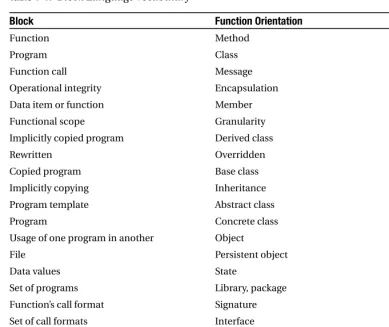
These translations are spotlighted in Table 1-1.
C H A P T E R O N E■ O R I E N TAT I O N
Table 1-1. Block Language Vocabulary
Block Function Orientation
Function Method
Program Class
Function call Message
Operational integrity Encapsulation
Data item or function Member
Functional scope Granularity Implicitly copied program Derived class
Rewritten Overridden
Copied program Base class
Implicitly copying Inheritance
Program template Abstract class
Program Concrete class
Usage of one program in another Object
File Persistent object
Data values State
Set of programs Library, package
Function’s call format Signature Set of call formats Interface
Call handling process Implementation
Individualized call handling processes Polymorphism
Function name with multiple call formats Overloading
Based on Structure-oriented (Nonblock) Languages: These definitions are not as straightforward. For most of them, “function” is substituted with “program”, and, separately, “program” is substituted with “library”.
• A structured program is a function-oriented method (of handling data).
• A set of programs—a limited-purpose library—is aclass.
• A call from one program to another is amessage.
• The fact that a library needs operational integrity in both data and processes is encapsulation.
• Each occurrence of data or programs is amember (of the class).
• A library can be implicitly copied in its derived class—the copy is hidden—and any program can be rewritten (overridden).
• A copied library is abase class.
• The process of implicitly copying is inheritance.
• A library template is an abstract class; comparably, a library is aconcrete class.
• Declaration of usage of one library in another is a logical object. (Actual objects exist only at execution—except for something like a file, which is apersistent object.)
• An executing library’s exact combination of data (values) is its state.
• A set of (structure-oriented) libraries is a (function-oriented) libraryor package; this is the most succinct example of the comparative grandness of function-oriented languages.
• The format of a call is the called program’s signature.
• A library’s collection of call formats is its interface.
• The library’s way of handling calls is its implementation.
• The ability of more than one library to handle a particular call format is poly-morphism.
• When a library’s program name is used for more than one call format, that is overloading (the method).
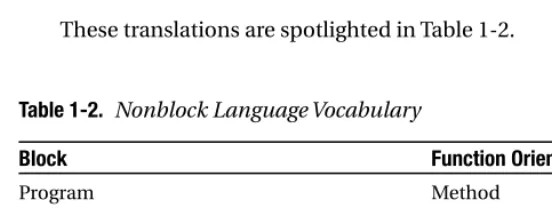
These translations are spotlighted in Table 1-2.
Table 1-2. Nonblock Language Vocabulary
Block Function Orientation
Program Method
Library Class
Program call Message
Operational integrity Encapsulation
Data item or program Member Functional scope Granularity
C H A P T E R O N E■ O R I E N TAT I O N
Block Function Orientation
Implicitly copied library Derived class
Rewritten Overridden
Copied library Base class
Implicitly copying Inheritance
Library template Abstract class
Library Concrete class
Usage of one library in another Object
File Persistent object
Data values State
Set of libraries Library, package Program’s call format Signature
Set of call formats Interface
Call handling process Implementation
Individualized call handling processes Polymorphism
Program name with multiple call formats Overloading
The idea of encapsulation is extended to include the direct usability of a class’s data and processes by other classes. (Code accessibility by developers is a different issue.) The prac-tical power of encapsulation is that it functionally separates interfaces from implementations. With limited scoping, each function produces a product, fulfilling a set of objectives in its production. The product can be what the function returns to the caller; or it can be an effect on the system, with the function returning a notation about that effect or not returning anything. When functions are designed well (without side effects), developers mostly don’t need to think about how the functions fulfill their objectives; they need to think only about how to use those functions. From the providers’ side, one basic implementation can have multiple interfaces; this is actually a parallel to class specializing, or even mental directing.
For more perspective, some function-oriented languages define their simple (primitive) data types, including how they are processed, with classes instead of directly in the com-piler. (Handling them in the compiler is faster.) This is an extreme clue to the fact that other classes simply define complex (compound) data types and how they are processed. These compound data types can be composed of any other data types (simple and complex). Further, just as simply typed data can be passed to a method, so can complexly typed data; they are all (logical) objects. With an object passed, the applicable calls from the receiving object can go to methods of the passed object; this is the practical usage of polymorphism. So, any of these calls is actually a blind (variable) reference to any applicable method. And an ascendant-class object method is acceptable where its ancestor class is specified (with the exact same signature). Then, it can be handled as the ancestor class. This ties back into, and explodes the power of, polymorphism. Simply put, it enables inherited messages.
Applications have long had individual utility programs, but a class network is a system of utility programs. Third-party software and operating systems have long had some individ-ual utility programs executing, mostly out of the mind of developers, but a class network typically has many little interdependent utility programs executing at the same time, and the developers are very aware of them. This view is reinforced by each language’s standard class (network) library, which virtually extends the language itself. Looking at each language as a set of building blocks for applications, each developer class network actually extends the language at a higher level (up a level). A complication, though, is that the standard class network also extends the learning curve for the most efficient programming effort, and the developer class network extends the learning curve for the most efficient (and, therefore, best) designing effort. But function-oriented developers become accustomed enough to this to hardly notice it, just as application-oriented developers become accustomed to copy-ing and modifycopy-ing code all over an application for a scopy-ingle functional change.
C H A P T E R O N E■ O R I E N TAT I O N
10
When processes don’t require individual dynamic data(set at execution time) shared between functions, they don’t require explicit objects; these are class functions. Looked at from the other direction, the only time an object needs to be created is when a new structure is needed. Also, shared data (static and dynamic) is its own single structure; it’s a global object—a class object.
All of this also demonstrates that classes are usually best thought of as functions first, then data (items), and objects are best thought of as data (values) first, then functions.
Some Languages
After understanding reasons for its parts, the next aspect that makes learning any language easier is knowing its syntax structure, because this makes it much easier to study code samples for syntax details and underlying functionality. The structures of function-oriented languages are particularly tricky. The two most important things to understand are as follows:
• Whereas structure-oriented languages flow smoothly from the beginning to the end of each command (except for parenthesized code, including custom functions in some languages), function-oriented languages have a lot of class interaction (method calls) in many commands. Some of them are implied, and many of them might be customized. In essence, a command’s flow can be two-dimensional, so tracking execution can be very complex.
• Whereas the most popular structure-oriented languages have plainly labeled com-mands, the most popular function-oriented languages differentiate many types of commands just by their structure.
GENERATIONS OF LANGUAGES
There is a term,fourth generation, regarding programming tools and languages. This term indicates various extents of precompiling—generating code through various types of directives—for specific processing flows. Fourth generation tools serve fairly simple establishing of relationships between the application’s components. And fourth-generation languages allow more complex processing, to extend the standard flow, plugged in at points that the fourth-generation system provides. These languages are typically very close to the language of the code generated, varied to facilitate the standard flow.
But nearly never are the previous generations mentioned.
C H A P T E R O N E■ O R I E N TAT I O N
12
close to decimal, and it uses exactly half of a byte: 16 is 24. (And the fact that this operates on electrons
is why it’s electronics.)
The second generation is a fairly direct alphabetic representation of the numbered operations, as words and abbreviations—a language, mostly verbs. This is easier for programmers to interpret. It also has the operands of any operation in separate columns, for readability. This configuration must be trans-lated into machine code; a very functional benefit of this step is that the translator can bring together separate pieces of code. So, the second generation entails assembly, and its code is an assembler language.
The third generation is the one that has been the most common. It’s of the languages that are created to serve programmers’ points of view. These are also commonly called high-level languages, and they include the popular function-oriented languages. In the process of compiling a program, many compilers also interpret directives that affect that whole compilation; these are commonly called compiler directives.
The two most popular function-oriented languages are Java and C++, and they have the same syntax structure, although they have a few differing syntax details. This section describes that structure.
The first thing to note with these languages is that methods are identified by the fact that they end with parentheses and, sometimes, a parameter list: method-name()or
method-name(parameter-list)(more specifically, method-name(data-name,other-data-name)). Data items—simple and complex—are identified, when they are in the same place as a method could be, by the fact that they don’tend with parentheses: data-name. Arrays use brackets to differentiate their syntax from methods: data-name[index]. Also, each array position is indexed minus one: the first item is at data-name[0]. Parentheses (and brackets) can be separated from the name by a space.
The next thing to note is that class (and object) members are accessed using a period:
class-name.data-nameor class-name.method-name(). (C++ uses other symbols, ::and ->, in some situations.) And it’s important to keep in mind that case matters: itemand Itemare two different items. Further, by convention, class names have their first letter uppercase, and object names—and functions—have their first letter lowercase. Also, by convention, because these names cannot have embedded spaces, multiple word names, of any type, have each word after the first word title-cased (where only the first letter of each word is uppercase):multipleWordFunction().
Braces, {and }, define the beginning and end of a block (of subordinate code), respec-tively. These are used most frequently in conditionals, method definitions, and class definitions, which are statements. And a block can have subordinate blocks. By convention, for some visual clarity, each of the braces is aligned under the beginning of the statement it corresponds to, and the code in the block is indented by four spaces. A variation on the convention puts the left brace at the end of the corresponding statement.
statement {
and
statement {
subordinate code }
The simplest command declares usage of a data item. It is of the form
data-type data-name
and
class-name object-name
data-type [] data-name
declares an array.
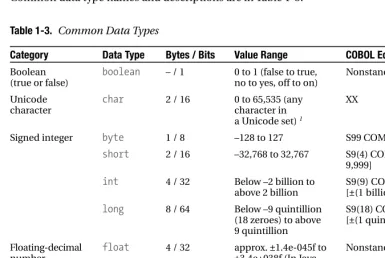
Common data type names and descriptions are in Table 1-3.
Table 1-3. Common Data Types
Category Data Type Bytes / Bits Value Range COBOL Equivalent
Boolean boolean – / 1 0 to 1 (false to true, Nonstandard (true or false) no to yes, off to on)
Unicode char 2 / 16 0 to 65,535 (any XX
character character in
a Unicode set) 1
Signed integer byte 1 / 8 –128 to 127 S99 COMP [–99 to 99] short 2 / 16 –32,768 to 32,767 S9(4) COMP [–9,999 to
9,999] int 4 / 32 Below –2 billion to S9(9) COMP
above 2 billion [±(1 billion – 1)] long 8 / 64 Below –9 quintillion S9(18) COMP
(18 zeroes) to above [±(1 quintillion – 1)] 9 quintillion
Floating-decimal float 4 / 32 approx. ±1.4e-045f to Nonstandard number ±3.4e+038f (In Java,
the f indicates afloat.)
double 8 / 64 Approx. ±4.9e-324 to Nonstandard ±1.8e+308 2 (In Java,
doubleis the default floating number.)
1. As opposed to ASCII (or EBSIDIC), which is 1 byte per character, Unicode is double byte–based, to accom-modate both phonetic characters, as for English, and whole-word characters, as for Chinese.
C H A P T E R O N E■ O R I E N TAT I O N
14
This type of command can be prefixed with one or more independent usage indicators:
usage usage usage data-type data-name
The most common type of usage indicator indicates the usability of the item. The most common usages of this type are public, which means that it can be used by any other class; private, which means that it cannotbe used by any other class; and protected, which means that it can be used only by ascendant classes. Other types indicate the durability of the item and the rigidity of its definition.
Assignments are of the form
data-name = other-data-name
and
data-name = method-name()
and
data-name = operation
Data item declarations and assignments can be combined. This is common data initial-ization:
data-type data-name = new method-name(parameter-list)
Other assignment operators, like +=and *=, simplify self-operation assignments:
data-name += other-data-name
is equivalent to
data-name = data-name + other-data-name
Two operators, ++and --, give +1 and –1 self-assignments a completely different form:
data-name++
is equivalent to
data-name = data-name + 1
For comparisons, ==is used instead of =, and all comparisons are enclosed in paren-theses. It’s very clarifying, here, to understand that conditionals most directly test for atrue
it is doing an assignment first, and the result is tested. Additionally, !means “not”. Several kinds of conditionals are as follows:
if (data-name = -1)is always true.
if (data-name = 0)is always false.
if (data-name == 0)might be true or false.
if (data-name != 0)might be true or false.
if (data-name)tests for the data item being nonzero and non-null.
if (!data-name)tests for the data item being zero or null.
while (true)(and, in C++, while (1), for example) begins an infinite loop, which is broken with abreakor areturn.
Method declarations closely resemble data declarations, but, instead of the data type defin-ing the method, it’s the other way around: the data type is what is returned (to the caller) by the method. Here, the parameter list format is used to definethe parameter list. Also, void
as the data type indicates that the method does not return data to the caller; voidas the parameter definition list indicates that the method does not accept data:
usage usage data-type method-name(parameter-definition-list)
more specifically:
data-type method-name(data-type data-name)
and
void method-name(data-type data-name, other-data-type other-data-name)
and
void method-name()
or, in C++
void method-name(void)
Each block has its own scopeof items. Items declared in a block do not exist outside of that scope. This means that the same exact name in two different scopes represents two different items, including when one scope is a subscope of the other. Also, the thiskeyword repre-sents the objectin which it appears.
C H A P T E R O N E■ O R I E N TAT I O N
16
matches the class name; this is aconstructormethod, which initializes the object’s data items and returns the address of the object. (This is very important to note because a con-structor is invoked any time an object is created.) An object-creation command usually looks redundant, but it is easy to understand what the command is indicating:
class-name object-name = new class-name(parameter-list)
and
ancestor-class-name object-name = new class-name(parameter-list)
More specifically, a common example, which looks veryredundant, is
Common common = new Common()
It’s possible to combine commands through existing parentheses (and brackets):
method-name(new class-name())sends the address of the object to the message, and
data-name[index-name++]looks for the next position in the array.
Another usage of parentheses is in conversion of an item from one type to another, or casting. In one way, casting is just helpful, because it saves developers from needing to declare two items, which would need to have different names. Looked at another way, cast-ing is essential, because needing to have two items would defeat polymorphism. A cast is declared with parentheses surrounding just a type, beforethe item:
data-type data-name = (data-type)other-data-name
and
data-name = (data-type)method-name(parameter-list)
It can be helpful to mentally translate a cast to <data-type>to easily differentiate it:
data-name = <data-type>method-name(parameter-list)
Finally, on the subject of syntax structure, the naming conventions of methods can be misleading in the context of a command. For example, object.getItem()does not indicate that that object is getting the item; rather, it indicates that another object is using that object to get the item for itself. It might be helpful to mentally translate this to object.giveItem(). Nor does object.setItem()indicate that the object is setting the item, but that another object is; it might