Muhammad Irfan Ferlanda, 2016
Microstructural Level Analysis of Equivalence above Word Level in the Translation of Brown’s “Inferno
Universitas Pendidikan Indonesia | repository.upi.edu | perpustakaan.upi.edu
CHAPTER III
RESEARCH METHODOLOGY
After revealing a number of theories related to the study, the next step is discussing the research methodology used in the study. It provides the description about the way of the study carried out and how the data are collected and analyzed. This chapter covers research design, subject of the study, data collection, and data analysis. Firstly, research design will discuss the method employed in this study. Secondly, the subject of the study will elaborate the literary work which will be used in the research. Thirdly, data collection will emphasize on the technique will be used in collecting data. Lastly, data analysis will explain the procedure of analyzing the data.
3.1Research Design
This research was carried out using a descriptive qualitative method through data collections analysis. According to Merriam in Tajudin (2013), qualitative method can process meaning and understanding that had been gathered through words or pictures. In addition, descriptive qualitative method as stated by Strider (as cited in Maulida, 2013), “provides an answer to the questions of how something happened and who was involved” (p. 21). The aforementioned statement is also supported by Monsen & Horn (2008) who state that to gain information used in planning hypotheses and suggesting association, descriptive qualitative is an effective way. The researcher analyzed the collocations and fixed expressions and idioms in the novel and link them to the theories to discover the strategies used in the translation.
3.2 Subject of the Study
In this research, the researcher conducted an analysis of a novel entitled
“Inferno” written by an American author, Dan Brown. This novel is the fourth
26
and the movie adaptation of “Inferno” will be released in U.S. on October 28th,
2016. “Inferno” was first published in May 2013 by Doubleday, debuted as #1
bestselling book in the U.S. and sold more than 6 million copies worldwide to date. The Indonesian version of this novel, “Neraka”, has been published in the same year. The book was translated by Ingrid Dwijani Nimpoeno and Berliani Mantili Nugrahani.
The main reason of choosing this novel is because this novel was sold more than 6 million copies worldwide and undoubtedly was read by many readers in Indonesia. The other reason is because the film adaptation of this novel will be released in 2016. It means the popularity of this novel will rise even further because movie enthusiasts will get curious and the number of this
novel‟s readers will increase. Also, one of the translators of this book has already agreed to help the researcher in carrying out this research by willingly letting the researcher to ask her any questions regarding the translation process of the book.
About ten-percent of this novel or 11 chapters out of 104 chapters of this novel was taken as the sample of this research. The sampling method used was purposive sampling. According to Notoadmodja in Masfulah (2013), purposive
sampling is a sampling method by selecting some items with some
considerations such as the characteristics of the population or features that were known before. In this research, the 11 chapters taken as sample have all variables of the „equivalence above word level‟ within it: collocations and fixed expressions and idioms. The chapters taken as sample are chapter 14, chapter 17, chapter 22, chapter 31, chapter 48, chapter 62, chapter 78, chapter 82, chapter 94, chapter 99, and chapter 102.
3. 3 Data Collection
27
version, then finding and underlining the equivalents of the identified groups of words in the Indonesian version. To check the availability of a collocation, the researcher used Oxford Collocation Dictionary while to check the availability of fixed expressions, the researcher used Moon‟s Fixed Expression and Idioms in English: A Corpus-Based Approach. To check the availability of idioms, the
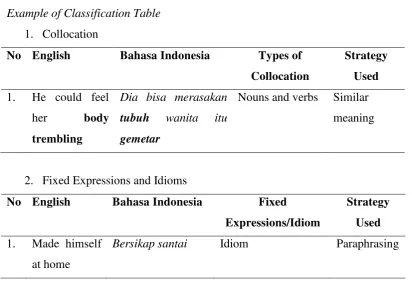
researcher used Oxford Dictionary of Idioms, Cambridge Idioms Dictionary, and McGraw-Hill’s Dictionary of American Idioms and Phrasal Verb. The next step is collecting the identified collocations and fixed expressions and idioms into a table in the following:
Table 3.1
Example of Classification Table
1. Collocation
No English Bahasa Indonesia Types of
Collocation
No English Bahasa Indonesia Fixed
Expressions/Idiom
Strategy
Used
1. Made himself at home
Bersikap santai Idiom Paraphrasing
3.4 Data Analysis
28
To answer the first formulation of the problem, the identified
„equivalence above word level‟ was classified using Baker‟s „equivalence above
word level‟ theory: collocations and fixed expressions and idioms.
To answer the second formulation of the problem, the identified collocations and fixed expressions and idioms, and their equivalents in the Indonesian version were analyzed using Baker‟s strategies of translating the
„equivalence above word level‟.
After analyzing the data based on their categories and the translation strategies, the next step was calculating the number of collocations and fixed expressions and idioms found in the novel and their translation procedure. The researcher determined the percentage by presenting all numeric data for collocations and fixed expressions and idioms and the translation procedures.
Based on the result of the numeric data and the analysis, the last step of data analysis was drawing conclusions.
3.5 Concluding Remark