CODE SWITCHING IN THE TOBA BATAK
WEDDING CEREMONY
A Thesis
By
RAKHMAT WAHYUDIN SAGALA
Registration Number: 8106112018Submitted to the English Applied Linguistic Study Program in
Partial Fulfillment of the Requirements for the Degree of
Magister Humaniora
ENGLISH APPLIED LINGUISTICS STUDY PROGRAM
POSTGRADUATE SCHOOL
STATE UNIVERSITY OF MEDAN
MEDAN
CODE SWITCHING IN THE TOBA BATAK
WEDDING CEREMONY
A Thesis
By
RAKHMAT WAHYUDIN SAGALA
Registration Number: 8106112018Submitted to the English Applied Linguistic Study Program in
Partial Fulfillment of the Requirements for the Degree of
Magister Humaniora
ENGLISH APPLIED LINGUISTICS STUDY PROGRAM
POSTGRADUATE SCHOOL
STATE UNIVERSITY OF MEDAN
MEDAN
ABSTRACT
Sagala, Rakhmat Wahyudin. Registration number: 8106112018. Code Switching in the Toba Batak Wedding Ceremony. A Thesis. English Applied Linguistics Study Program, Post Graduate School State University of Medan. 2013
ACKNOWLEDGEMENT
All glory and thankfulness are addressed to Allah SWT for granting the writer to finish his education in English Applied Linguistics Study Program.
He would like to extend his deepest gratitude to the writers’ first adviser, Prof. Dr. Lince Sihombing, M.Pd. and his second adviser, Dr. Anni Holila Pulungan, M.Hum., who did not give up on him when it seemed there is no way out to manage every unsuitable and inappropriate data for completing this thesis. Their guidance and support made all the difference for their insight and contribution.
The writer also wishes to thank to Prof. Dr. Busmin Gurning, M.Pd. and Dr. Sri Minda Murni, MS., Head and Secretary of English Applied Linguistics Study Program who welcomed him to this program and tirelessly continued to offer their moral support.
He would like to thank to his parents, Prof. Dr. H. Syaiful Sagala, S.Sos, M.Pd. and Dra. Hj. Sri Rahayu for their financial and moral support. And also to his parents-in-law, Saifuddin, S.Pd. and Agusdariani Hsb, S.PdI. for the endless love and prayers that they have given to him.
Also, he is grateful to his brother Gaffar Hafiz Sagala, S.Pd. and Luthfi Ahmad Syafri Sagala for their words of encouragement.
A very special thankfulness to his wife, Tri Indah Rezeki, S.Pd., for encouraged him to continue his education, moral and technical support during those challenging years. And the inspirer with confidence belongs to my daughter Naylana Khanza Zaneeta Razky Sagala who has sustained him and made this possible.
understanding, prayers, and moral support during challenging moments. His sincere appreciation to all lecturers and administrative staff of the Post Graduate Program of LTBI.
Needless to say, however, while he is grateful, for all that the people mentioned above have taught him, responsibility for errors and omissions in this thesis rests on him alone.
Medan, September 2013 The writer,
2.4.4 To clarify or or qualify a message ... 14
2.4.5 To specify an adressee ... 15
2.4.6 To reiterate ... 16
2.4.7 To carry out a referential ... 16
2.5 Causes of Using Code Switching ... 17
2.6 Traditional Marriage in Toba Batak ... 18
2.6.1 The Ritus ... 18
2.6.2 Functions and Roles of Toba Batak Traditional Wedding Ceremony ... 19
2.6.3 Event of Giving Dowry and Taking “Sinamot” ... 20
2.7 Traditional Marriage Distinctiveness in Toba Batak ... 21
2.7.1 Characteristics ... 21
2.8 Stages of Traditional Marriage in Toba Batak ... 23
2.8.1 Stages of the Moslem Toba Batak Wedding Ceremony ... 26
3.3 The Instruments of Data Collection ... 33
3.4 Technique of Data Analysis ... 33
3.5 Trustworthiness ... 34
CHAPTER IV DATA ANALYSIS, FINDINGS AND DISCUSSIONS ... 36
4.1 The Data ... 36
4.2 The Data Analysis ... 37
4.2.2 Data Analysis of Intra Sentential Code Switching ... 47
4.2.3 Data Analysis of Tag Code Switching ... 55
4.3 The Process of Code Switching in Toba Batak Wedding Ceremony ... 54
4.4 Causes of Participants Use Code Switching ... 57
4.5 Research Findings ... 58
4.6 Discussions ... 59
CHAPTER V CONCLUSIONS AND SUGGESTIONS ... 61
5.1 Conclusions ... 61
5.2 Suggestions ... 61
REFERENCES ... 63
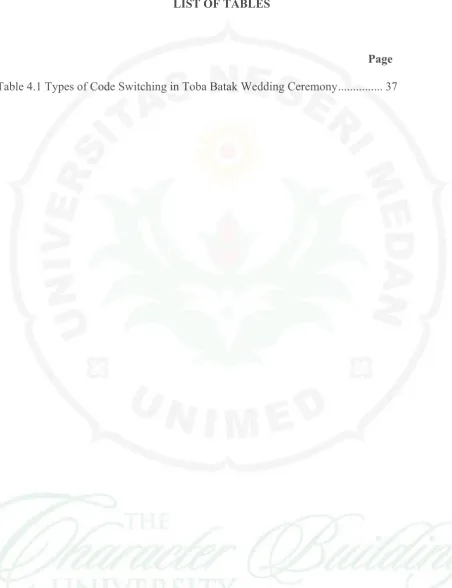
LIST OF TABLES
i
LIST OF APPENDICES
Page
Appendix A. Transcript of Marhaban Stage in Toba Batak Wedding Ceremony:
Data I ... 66
Appendix B. Transcript of Replying and Exchanging the Verses of Rhymes Stage: Data II ... 67
Appendix C. Transcript of Exchanging of Tepak Stage: Data III ... 69
Appendix D. Transcript of Upah-Upah I Stage: Data IV ... 72
Appendix E. Transcript of Upah-Upah II Stage: Data V ... 76
Appendix F. Analysis of Code Switching Types in Marhaban Stage ... 85
Appendix G. Analysis of Code Switching Types in Replying and Exchanging The Verses of Rhymes Stage ... 87
Appendix H. Analysis of Code Switching Types in Exchanging of Tepak Stage .. 91
Appendix I. Analysis of Code Switching Types in Upah-Upah I Stage ... 98
1 CHAPTER I
INTRODUCTION
1.1Background of the Study
Sociolinguistics is one of linguistics branches that can be analyzed from
various point of views. Sociolinguistics is a term including the aspects of linguistics
applied toward the connections between language and society and the way it is used
in different social situations. It ranges from the study of the wide variety of dialects
across a given region down to the analysis between the way men and women speak
one to another. Sociolinguistics often shows the language users the humorous realities
of human speech and how a dialect of a given language can often describe the age,
sex, and social class of the speaker. It codes the social function of a language. (Baker,
2010).
In using language, the language users are not aware that they make a language
choice. Language choice is a variation of language that is used by a person when he /
she talks to one or more other person. Sumarsono and Paina (2002) state that in a
bilingualism or multilingualism society, there are some codes, such as language,
dialect, variation and style that used in social interaction. With those codes, a person
can or will choose a code according to some factors. This process called language
choice. This language choice depends on some factors such as participants, setting,
topic and so on.
Sumarsono and Paina (2002) state that there are some terms in language
2
1. Variation within the same language. It is applied to a variation in a language,
for example; the variation of informal and formal French in Europe and
French in Quebec, Canada.
2. Code switching. It usually happens when a person can speak two or more
language fluently. For example, A has Batak language as his first language
and Indonesian as his second language also A can speak English. In a trip A
meets with D then he starts a conversation by using Indonesian, but when A
knows that D can speak Batak too, A sometimes speak in Batak language.
Suddenly, A and D meet with a tourist and he asks them about something in
English. Automatically, A and D speak in English. What A does is a code
switching and what language A’s language use is depending on some factors
of sociolinguistics such as participants, topic, setting, etc.
3. Code mixing. Code mixing is similar with intervention from a language to
other language. In code mixing, the speaker inserts another language such as
word or phrase when he / she speaks in a language.
This study focuses on the phenomenon of code switching. Code switching is
considered as a sociolinguistic phenomenon – a linguistic product of language
contact, determined in various ways by the social circumstances in which it occurs.
Code switching is now considered to be a normal and natural product of interaction.
Richard (2005) describes that the term code switching means switching from one
language variety to another when situation demands. According to Appel and
Musyken (1987), code switching is the process of switchovers the language action
because of the situation change. Besides that, Hymes (1974) also stated that code
3
Talking about code switching, there are some types of code switching.
Romaine (2000) distinguishes three types of code switching. They are Inter sentential
Code Switching, Intra sentential Code Switching, and Tag Code Switching. Inter
Sentential switches occur between sentences, as their name indicates. Intra Sentential
Code switching occurs in the middle of sentence as in ‘I start acting real CURIOSA.’
This type of intimate switching is often called code mixing. Tag Code switching
involves an exclamation, a tag, or parenthetical in another language then rest of
sentence. (Appel and Musyken, 1987)
Generally, code switching happens on discourse. Halliday (2004) explains that
discourse is defined as a meaning that is realized in text. Discourse is realized by text
as meaning is represented in expression. In other words, analogously or
correspondingly to the relationship of meaning to expression is that of discourse to
text. Thus, discourse finds its expression in text. Discourse is also regarded as mode
of talking which is associated to social institutions. This is to say that certain areas of
social life or institutions have specific modes or ways of talking. With reference to
social life
The overall people around the world use language for their communication
and interaction. Most of them have a mastery more than one language, especially in
Indonesia country. In Indonesia most of the members of society are using more than
one language. There exists (in Indonesia) local language (Bahasa Daerah) and
national language (Bahasa Nasional). Local language is the language that is used in a
region, ethnic language i.e. Javanese, Sundanese, and Bataknese (Sugono and Zaidan,
2008).
This study focuses on the phenomenon of code switching which happens in
4
utterances of participants in Toba Batak wedding ceremony. Most of Toba Batak
people usually are bilinguals or multilingual, though their first language is Toba Batak
language. Toba Batak people who live in outside areas use more than two languages
because of the situational factors. It also happens in the wedding ceremony especially
Toba Batak people who get married with different tribe. It happens too in the writer’s
wedding itself. The researcher is a Toba Batak man and his wife is Sundanese. The
process of their wedding is done by mixing the cultures of them. The language used in
the wedding was not pure Batak language but the mixture of some languages such as
Toba Batak, Mandailing and also Indonesian.
The purpose of this study is to find out the use of code switching in discourse
of Toba Batak wedding ceremony. This study investigates the types of code switching
which occur in the conversation of the Toba Batak wedding ceremony, how the
participants switch their languages and why they switch their languages in the process
of wedding ceremony. The data are collected by transcribing the discourse in the texts
containing code switching and then marking switched phrases or sentences in the
dialogues in the events. The data are analyzed by using Romaine’s theory of types and
factors of code switching.
1.2 Problems of the Study
The problems to be answered in this study are formulated as the following:
1. What types of code switching are used in the Toba Batak wedding ceremony?
2. How do the participants switch language used in the process of the Toba Batak
wedding ceremony?
3. Why do the participants switch language in the process of the Toba Batak
5 1.3 Objectives of the Study
With reference to the problems previously, the objectives of the study are:
1. to find out the types of code switching used in the Toba Batak wedding
ceremony,
2. to find out how the participants switch language in the process of Toba Batak
wedding ceremony, and
3. to find out the reason why the participants switch language in the process of Toba
Batak wedding ceremony
1.4 Scope of the Study
The scope of this study is code switching in the Toba Batak wedding
ceremony. In this case, it is limited on the Moslem traditional Batak Toba. The
collecting of the data in this research are based on wedding ceremony of the Moslem
traditional Batak Toba namely Marhaban, replying and exchanging the verses of
rhymes, exchanging of Tepak, and upah-upah. The data are analyzed based on types
of code switching are based on Romaine (2000). Code switching itself consists of
three types namely Inter sentential Code Switching, Intra sentential Code Switching,
and Tag Code Switching. This study focuses on the types of code switching which
occur in the conversation of the Toba Batak wedding ceremony, how the participants
switch their languages and why they switch their languages. The analyzed data were
taken from the process of Rakhmat Wahyudin Sagala and Tri Indah Rizky’s wedding
ceremony which was hold in 2012.
6
The findings of this study are expected to be useful theoretically and practically.
1. Theoretically, the readers can enlarge knowledge on code switching in order
to get some information on types of code switching.
2. Practically, this findings are useful for:
a. The other researchers who want to learn more about code switching,
especially the types, the factors and the functions of code switching in the
Toba Batak wedding ceremony discourse and can participate in giving
knowledge contribution related to language theory especially in code
switching and other sociolinguistic aspects,
b. The post graduate students especially majoring in English who want get
more knowledge about sociolinguistic aspects especially in code
switching, and the result of the research will be an additional literature
which can be used by the next researcher.
67 CHAPTER V
CONCLUSIONS AND SUGGESTIONS
5.1 Conclusions
In reference to the problems of the study, conclusions are drawn as the
following:
1. Participants in Toba Batak wedding ceremony especially in the five stages
such as Marhaban, replying and exchanging the verses of rhymes, exchanging
of Tepak, and upah-upah use types of code switching namely there are 20
utterances which contain Inter sentential code switching, 39 utterances which
contain Intra sentential code switching and 4 utterances which contain Tag
code switching.
2. Participants in Toba Batak wedding ceremony mix some languages based on
participants’ tribes which involved in the process of Toba Batak wedding
ceremony and they also adjust the situation and the condition of the people
which involved in the process of wedding ceremony.
3. There are three reasons why participants switch their languages during the
process of Toba Batak wedding ceremony namely the differences of family’s
tribes, religion factor and place of wedding ceremony be held.
5.2 Suggestions
In relation to the findings of this study, suggestions are staged as in the
68
1. It is suggested for the future researchers to develop their findings in wider area
not only in the process of wedding ceremony but also in various types of texts,
such as educational, cultural, science, technological, business, etc to get better
description about code switching.
2. It is also suggested that students of applied linguistics should be exposed to a
wide range not only in oral texts but also in printed texts.
3. It suggested that the readers, especially the readers who want to enlarge their
knowledge about code switching should learn more about code switching
because their understanding about code switching would help them especially
for them who want to do research about code switching.
68
REFERENCES
Adelaar, K. Alexander. 1995. Comparative Austronesian. London: Mouton de
Gruyter
Appel, R., & Musyken, P. 1987. Language Contact and Bilingualism. London: Edward Arnold.
Ary, D.J. & Razarviech, H. 1979. Introduction to Research in Education. New Yok: Holt Rinehart & Winston
Baker, P. (2010) Sociolinguistics and Corpus Linguistics. Edinburgh: Edinburgh University Press
Belazi, H.M., E.J. Rubin and A.J. Toribio. 1994. Code switching and X-bar theory: The Functional Head Constraint. Linguistic Inquiry
Best, J.W. 1982. Research in Educational. New Delhi: Pretince-Hall
Blanc, M. H. A., & Hamers, J. F. 2000. Bilinguality and Bilingualism. Cambridge, UK: Cambridge University Press
Bogdan, R. & Biklen, S. 1982. Qualitative Research for Education (2nd Ed.) Boston: Allan and Bacon
Bogdan, R.1992. Qualitative Research in Education. USA: Allan & Bacon
Bokamba, Eyamba G. 1989. Are there syntactic constraints on code-mixing? World Englishes. Referens ur Schmied
Chaer and Agustina L. 2004. Sosiolinguistik Perkenalan Awal. Jakarta: PT. Rineka
Cipta.
Chas, M.D. 2005. Review of: Borrowing Versus Code-Switching, by Richard J. Indonesia : Linguist List 16
Creswell, J.W. 1994. Research Design: Qualitative & Quantitative Approaches. Thousands Oaks: Sage publications, Inc
Denzin, N.K. & Lincoln, Y.S. 1994. Handbook of Qualitative Research. Thousand Oaks: Sage Publication
Ferrara, Meirissa. 2011. A Study on Code Switching Used by English Teachers of State Senior High School 1 Batu (R SMA BI Negeri 1 Batu). English Letters and Language Department, Faculty of Humanities and Culture Malang University. Unpublished Thesis. Malang
Halliday, M. A. K. 2004. An Introduction to Functional Grammar. Second Edition.
69
Hoffman, C. 1991. An Introduction to Bilingualism. New York: Longman.
Holmes, J. 2008. An introduction to sociolinguistics Learning about Language Series.
Pearson Longman
Huberman, M. & Miles, M.B. 1984. Qualitative Data Analysis: A sourcebook of New Method. Beverly Hills: Sage Publication
Hymes, D. 1974. Foundations in Sociolinguistics: an Ethnographic Approach. Vol. 65. University of Pennsylvania Press
Kanom. 2011. Code Switching Among the Sasak Community at Kuta Central Lombok.
English Department Faculty of Teacher Training and Education Malang University. Unpublished Thesis. Malang
Lester, Hyginus. 2010. Code Switching in the Teaching of English as a Second Language to Secondary School Students. Malaysian Journal of ELT Research. Vol. 6 No. 1, April, pp. 73 – 82
Lusius, S. 2005. Inkulturasi Ritus Perkawinan Adat Batak Toba. Unpar: FF Unpar
Manel, Dehimi. 2010. Code-Switching Among English Students. A Case Study of Mentouri University-Constantine Students. Letters and Languages Department of English Faculty Mentouri University. Chicago
McCormick, K. 1995. Code-switching, code-mixing and convergence in Cape Town.
In R.
Romaine, S. 2000. Language in Society: An Introduction to Sociolinguistics. Oxford University Press: New York.
Sinaga, Richard. 1999. The Toba-Batak High God-Transcendence and Immanence. Jakarta: Dian Utama.
70
Sugono, D and Zaidan A.R. 2008. Bahasa Daerah dan Otonomi Daerah: Risalah Konferensi Bahasa Daerah. Universitas Michigan: Pusat Bahasa, Departemen Pendidikan Nasional
Sumarsono and Paina, P. 2002. Sociolinguistic. Yogyakarta: Word.
Susanto, H.D. 2008. Code Switching in Indonesian Islamic Religious Discourse A Sociolinguistic Perspective. Malang: UIN-Malang Press
Suwito. 1983. Alih Kode, Campur Kode, Interferensi. Surakarta: Binary Offset
Suwito. 1985. Sosiolinguistik: Pengantar Awal. Surakarta:Henary Offset
Syahdan. 1996. Several Factors Motivating Code Switching in Fluent Adult Bilingual in Gema Rinjani No. 31. FKIP Mataram University. Mataram.
Ulfa, Maria. 2012. Code Switching Used by The Characters of ‘SALT’ movie. English Letters and Language Department, Faculty of Humanities and Culture Malang University. Unpublished Thesis. Malang
Wardhaugh, Ronald. 1986. An Introduction to Sociolinguistics. New York.: Basil
Blackwell.