Business Process Management Journal
An analysis of BPM lif ecycles: f rom a lit erat ure review t o a f ramework proposal
Rinaldo Macedo de Morais, Samir Kazan, Silvia Inês Dallavalle de Pádua, André Lucirton Costa,
Article information:
To cite this document:Rinaldo Macedo de Morais, Samir Kazan, Silvia Inês Dallavalle de Pádua, André Lucirton Costa, (2014) "An analysis of BPM lifecycles: from a literature review to a framework proposal", Business Process Management Journal, Vol. 20 Issue: 3,pp. 412-432, doi: 10.1108/BPMJ-03-2013-0035
Permanent link t o t his document :
http://dx.doi.org/10.1108/BPMJ-03-2013-0035
Downloaded on: 30 March 2017, At : 21: 30 (PT)
Ref erences: t his document cont ains ref erences t o 47 ot her document s. To copy t his document : permissions@emeraldinsight . com
The f ullt ext of t his document has been downloaded 1819 t imes since 2014*
Users who downloaded this article also downloaded:
(2014),"Ten principles of good business process management", Business Process Management Journal, Vol. 20 Iss 4 pp. 530-548 http://dx.doi.org/10.1108/BPMJ-06-2013-0074
(2009),"Business process management (BPM) standards: a survey", Business Process Management Journal, Vol. 15 Iss 5 pp. 744-791 http://dx.doi.org/10.1108/14637150910987937
Access t o t his document was grant ed t hrough an Emerald subscript ion provided by emerald-srm: 602779 [ ]
For Authors
If you would like t o writ e f or t his, or any ot her Emerald publicat ion, t hen please use our Emerald f or Aut hors service inf ormat ion about how t o choose which publicat ion t o writ e f or and submission guidelines are available f or all. Please visit www. emeraldinsight . com/ aut hors f or more inf ormat ion.
About Emerald www.emeraldinsight.com
Emerald is a global publisher linking research and pract ice t o t he benef it of societ y. The company manages a port f olio of more t han 290 j ournals and over 2, 350 books and book series volumes, as well as providing an ext ensive range of online product s and addit ional cust omer resources and services.
Emerald is both COUNTER 4 and TRANSFER compliant. The organization is a partner of the Committee on Publication Ethics (COPE) and also works with Portico and the LOCKSS initiative for digital archive preservation.
*Relat ed cont ent and download inf ormat ion correct at t ime of download.
An analysis of BPM lifecycles:
from a literature review to
a framework proposal
Rinaldo Macedo de Morais
Computer Department, Federal Institute of S~
ao Paulo,
Catanduva, Brazil
Samir Kazan
Kazan & Associates, Ribeir
ao Preto, Brazil, and
~
Silvia Ineˆs Dallavalle de P
adua and Andre´ Lucirton Costa
College of Economics, Business and Accounting at Ribeir
ao Preto,
~
University of S
ao Paulo, Ribeir
~
ao Preto, Brazil
~
Abstract
Purpose– Business process management (BPM) is an emerging research theme in management. BPM lifecycles are models that systematize the steps and activities that should be followed for conducting BPM projects. The theoretical and empirical studies present differences regarding the number of steps and activities that should be carried out for promoting BPM. Using the BPM lifecycle model of the Association of Business Process Management Professionals (ABPMP) – an entity that proposes a common body of knowledge on BPM, as a parameter, this paper conducts a literature review to investigate lifecycle models within the academic-scientific ambit, identify convergences and variations and analyze the alignment between business strategy and processes in BPM activities in these models. The purpose of this paper is to propose a framework that deals with alignment between strategy and business processes in an explicit manner.
Design/methodology/approach – A literature review was conducted aimed at prospecting papers about the BPM lifecycle. For such, the Scopus, Google Schoolar and Science Direct databases were accessed. The selection process was structured in two steps: the first filtered studies based on a reading of the title, abstract and key words; the second step consisted of selecting papers based on a complete reading of those papers resulting from the first step and from the references they contained.
Findings– Seven BPM lifecycle models were selected and analyzed. A comparison was presented between the model steps and the model proposed by ABPMP. The particularities of each model were identified and the study suggests an alignment of these models with the BPM lifecycle proposed by ABPMP, in particular with the analysis, design and modeling, implementation and monitoring and control steps. Four models do not include the planning step, whereas four others do not incorporate refining. The majority of models studied projects the automation of business processes. This study reinforces that ABPMP’s BPM lifecycle is a reference model, observing that the activities in the other models studied are projected in it. However, it was observed that in the ABPMP model as well as the models studied, there is little emphasis on organization strategy and on defining process architecture. Thus, this study suggests the incorporation of activities proposed by Burlton (2010) as an additional instrument for the ABPMP BPM lifecycle model to align strategy to processes in BPM projects. For such, a framework was proposed that deals with alignment between strategy and business process in an explicit manner.
Originality/value – This study presents a typology of BPM lifecycle models, with common characteristics and peculiarities, and it analyzes the alignment between processes and strategy in the models’ activities. This study can assist professionals in the adoption of a model for implementing BPM projects and for continuous improvement.
Keywords Strategy, Business process management, BPM lifecycle
Paper type Research paper
The current issue and full text archive of this journal is available at
www.emeraldinsight.com/1463-7154.htm
Received 10 March 2013 Revised 28 June 2013 Accepted 1 August 2013
Business Process Management Journal
Vol. 20 No. 3, 2014 pp. 412-432
rEmerald Group Publishing Limited 1463-7154
DOI 10.1108/BPMJ-03-2013-0035
412
BPMJ
20,3
1. Introduction
Organizations have historically structured themselves from a functional perspective, based on the concepts of hierarchy and the division of labor proposed by classic management theories that arose in the first half of the twentieth century. The functional approach favors the formation of “islands” in the organization: information tends to be compartmentalized; difficulties arise in integration and communication between departments, which results in inefficient management of the organization, restricting its performance (Paimet al., 2008). Loss of competitiveness due to functional management inefficiencies is reported in icons, such as IBM, Ford and Bell Atlantic (Dumaset al., 2013). An alternative to traditional functional management is business process management (BPM), defined by the Association of Business Process Management Professionals (ABPMP) as activities to identify, design, execute, document, measure, monitor, control and promote improvements in an organization’s processes and consequently effectively meet business objectives (Association of Business Process Management Professionals (ABPMP), 2009).
Houy et al. (2010) conducted a study with the objective of providing an overall perspective of the evolution of empirical research on BPM and they concluded that the growing number of papers published, of specialized journals, of conferences on the theme and of the institutionalization of undergraduate programs specialized in BPM at several universities, indicates its tendency for evolution in management science. However, according to Trkman (2010), although BPM is a popular concept, its theory has yet to be duly founded.
Although many organizations are involved in process improvement initiatives, only a small number of them follow a holistic vision and focus on the level of organizational processes (Neubauer, 2009). This occurs because changing the company’s functional management approach to a management by process approach implies defining responsibilities for process progress (Palmberg, 2010), minimizing transfers and thus reducing errors and waiting time, maximizing the grouping of activities and reducing efforts (Antonucci and Goeke, 2011). Paim et al. (2008) underscore that: in the functional approach, processes are managed in isolation, the organization has silo characteristics with low capacity for coordination and low market orientation and BPM does not eliminate an organization’s business units and functional units, but in a horizontal perspective, it prioritizes the structuring of its end-to-end work flow with an emphasis on the client: the organization molds its operations to optimize the generation of value for the client in the various processes it implements in its business portfolio.
BPM does not only deal with analyzing, designing, developing and executing business processes, but also with considering the interaction between these processes, controlling, analyzing and optimizing them, as pointed out by Kohlbacher (2010). BPM can help execute a strategic program, permitting improved correspondence between organizational strategy and the company’s business processes (Trkman, 2010). For such, it is important to validate strategic direction, determine the relationship between stakeholders, develop process architecture, align process governance, prioritize processes for change considering all stakeholders, align capacities with people, technology, installations and, finally, establish a transformation portfolio (Burlton, 2010). The BPM life cycle proposed by ABPMP (2009) establishes those activities that comprise managerial practice in BPM in six steps: planning, analysis, design and modeling, implementation, monitoring and control and refining. Literature describes several different life cycle models from the one proposed by ABPMP (2009), which
413
An analysis of
BPM lifecycles
include variations in the steps and activities proposed in the model, but Houyet al. (2010) state that although the number of steps and nomenclature used varies greatly, conceptually, cycle steps do not present fundamental variations and are normally just divided differently.
The planning step for the ABPMP model starts with an understanding of the organization’s strategies and goals. A plan is elaborated aimed at ensuring the alignment of these strategies and goals with BPM activities, roles and responsibilities of people within the context of the organization, executive sponsorship and performance measurement expectations. This step is strongly associated with governance since it involves the alignment of the business process portfolio and its architecture with the organization’s business strategy, allocation of resources and organizational performance. Based on these considerations, some questions arise:
Q1. What are the convergences between the various BPM life cycle models found in literature (including the ABPMP model)?
Q2. Are there semantic differences between the various proposals presented in literature in relation to the BPM life cycle proposed by ABPMP?
Q3. How do the BPM life cycle models apply to strategy? Is there any reference of alignment between strategy and business processes and the proposal for developing process architecture?
Q4. Is it possible to propose a framework that deals with alignment between strategy and business processes in an explicit manner?
The objective of this study is to investigate the BPM life cycle models proposed in literature and identify convergences and variations that exist in these models using the ABPMP model as a reference and analyze the alignment between strategy and processes and also propose a framework with activities for promoting BPM that deals with alignment between strategy and business processes. For such, the following specific objectives are proposed:
(1) conduct a study of BPM life cycle propositions based on the literature review;
(2) qualitatively evaluate the models proposed in literature in relation to the model defined by ABPMP (2009); and establish relations of similarity and disparity between them;
(3) analyze and propose improvements for activities that deal with the alignment between strategy and business process in the models studied; and
(4) propose a framework that deals with alignment between strategy and business processes in an explicit manner.
This paper contributes academically in three ways. First, it presents the differences and peculiarities of diverse BPM life cycle models. Second, it contributes with an analysis of the existence of a phase or activity in the life cycles that seek an alignment between processes and strategy. Finally, it proposes a BPM framework that emphasizes the alignment of processes with organization strategy. Besides the academic contribution, this study can help professionals promote BPM.
414
BPMJ
20,3
2. BPM
Business processes are enrooted in classic concepts of management, such as the principles proposed by Taylor related to optimizing activities through the division of labor (Antonucci and Goeke, 2011). Among the various definitions of process, a classic definition is given by Davenport (1994), where he states that “a process is a specific order of work activities in time and in space, with a beginning, an end and clearly identified inputs and outputs,” whereas Glykas (2011) defines a process as “a horizontal connection of activities needed to achieve a desired result” for an organization. This definition is similar to the one by the ABPMP (2009), which says a process is a set of activities for achieving a goal or for solving a specific problem. The ABPMP (2009) defines a business process as an “end-to-end” job that goes beyond functional limits, transposing the organization’s hierarchical structure to generate value for the client.
According to Antonucci and Goeke (2011), although there is no universally accepted definition of BPM, specialists in general agree BPM has evolved from an instruction based on applications to a management practice where the company’s processes are focussed on the client, with objectives, people and technology integrated in operational as well as strategic activities.
According to Pyon et al. (2011), BPM has the following basic premises: process mapping and documentation activities, focus on the client, measurement activities for evaluating performance and continuous optimization of processes, use of best practices for improving competitive positioning and an approach for culture change in the organization. According to Jeston and Nelis (2006), BPM can be defined as a holistic approach to the practice of organizational management where factors such as understanding and involvement by the company’s top management, clearly defined roles, fitting techniques, well-trained personnel and a receptive culture to business processes are fundamental for obtaining the desired result.
The principal idea in BPM is to develop an organization geared toward processes by eliminating activities that do not add value and improve process fluency within the limits of organizational functions (Kujansivu and Lo¨nnqvist, 2008). Thus, besides BPM’s importance in the transparency of the company in the internal environment, in a scenario of change in the market’s economic environment, it is one of the means for handling the challenge of improving the company’s business processes for optimizing performance (Trkman, 2010). BPM can thus contribute toward increased competitiveness of companies in diverse markets in which it is inserted and, according to Trkman (2010), answer questions about how a company’s efforts are geared toward analyzing and continuously improving the fundamental processes of its operation to add value for clients or satisfy other strategic objectives. In this context, Ravesteyn and Batenburg (2010) suggest that organizations that begin implementing BPM systems should realize this is not an information technology (IT) project, and that they should be supported by the business objectives due to their strategic importance.
For McCormacket al.(2009), by achieving greater maturity in BPM, the organization will have greater control over results, better projection of goals, costs and performance, gain more efficiency to achieve defined objectives and improve management of the ability to propose innovations. For ABPMP (2009), in order to add value for the end user with the perspective of processes, it is important to:
. analyze and monitor the process’ capacity to test upper and lower limits and to
determine whether the resources (machine and human) can properly achieve the scale to meet customer demands;
415
An analysis of
BPM lifecycles
. understand the customer’s interactions with the process, which is fundamental
for understanding whether the process is a positive factor in the success of the organization’s value chain; and
. analyze human involvement since the activities carried out by people are more
complex and involve judgments and abilities that cannot be automated.
BPM implies a “permanent and continuous organizational commitment to manage the organization’s processes” (ABPMP, 2009). This continuous and permanent commitment translates into a life cycle model with well-defined steps and feedback that establish a managerial practice for the organization, which is the basis for the organization to always be in a process of continuous improvement and to have its processes aligned with its strategic objectives.
When selecting techniques to promote the BPM cycle, a variety of aspects should be considered (ABPMP, 2009):
. deal with the complexity of the system with an unspecified number of variables;
. identify and encompass stakeholder needs to strengthen the use of results;
. identify system particularities (situation, organization, culture, governance,
change management, control, technology); and
. gather data on standards and varied processes to inform relevant stakeholders,
helping them understand the phenomenon observed.
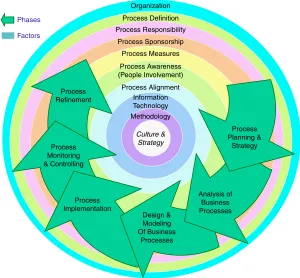
Figure 1 shows the model of the BPM life cycle proposed by ABPMP (2009), which is structured in six steps and begins with the planning and strategy activity, where project scope, roles and responsibilities, resources, technology, tools and feasibility studies are defined. The analysis step adds activities aimed at aligning business objectives with their processes, whether to establish them or update them, and based on the scope, techniques are applied to map the business context through interviews, documental analysis, simulations or other instruments of prospection. The design of business processes involves the creation of new specifications for them, their activities and tasks, rules and definitions for exchanging information among functional groups (handoffs), physical design and IT infrastructure. Management during implementation should be viewed as an “orchestration” activity and it involves training, metric policies and performance evaluation, strategic alignment evaluation and risk analysis and monitoring. The monitoring and control of processes deals with adjustments of resources to ensure process objectives through performance measurements and evaluation. The refining step is associated with organizational change, continuous improvement and optimization activities in search of the efficiency and effectiveness of processes implemented in the organization.
3. Method
The objective of this study is to investigate the BPM life cycle models proposed in literature and identify convergences and variations that exist in these models using the ABPMP model as a reference and analyze the alignment between strategy and processes and also propose a framework with activities for promoting BPM that deals with alignment between strategy and business processes. In order to achieve this objective, the following activities were carried out:
(1) Research and selection of studies about BPM life cycle models: this step consisted of research in international databases in search of scientific
416
BPMJ
20,3
articles about BPM cycle models to identify proposals for cycles from the academic environment, formulated from theoretical bases. This academic-scientific study was made with a search in database sites for literature that brought BPM life cycle proposals to light and in their respective study references. The search process observed the following guidelines:
. A1. Use of the Scopus, Science Direct and Google Schoolar databases;
. A2. Use of the following key words in a combined manner: “business”,
”process”, “management”, “modeling”, “cycle”, “life cycle/life-cycle” and “BPM”;
. A3. Prioritization of studies after the year 2000;
. A4. Use of ranking tools by relevance provided by the search sites;
. A5. Application of a subjective relevance filter through the analysis of texts,
in search of publications that present a BPM life cycle model; and
. A6. Search in references recovered from previous items.
(2) Evaluation of the alignment of activities between life cycle models: based on the complete reading of selected studies, a comparative analysis of the phases for each life cycle model was conducted, identifying the points of agreement and disagreement between the phases proposed in each model.
Phases
Factors
Organization
Process Definition Process Responsibility
Process Sponsorship
Process Measures
Process Awareness (People Involvement)
Process Alignment Information Technology Methodology
Culture & Strategy
Process Planning &
Strategy
Analysis of Business Processes Design &
Modeling Of Business
Processes Process
Implementation Process
Monitoring & Controlling
Process Refinement
Figure 1.
Life cycle proposed by ABPMP (2009, p. 27)
417
An analysis of
BPM lifecycles
(3) Evaluation of the alignment between processes and strategy for BPM life cycle models: the adherence of each model for each activity proposed by Burlton (2010) were analyzed for alignment between processes and strategy.
(4) Proposition for a BPM cycle model with an emphasis on strategy: this step presents a framework whose architecture includes the diverse BPM activities with the aggregation of activities that aim at the alignment of processes with organizational strategy.
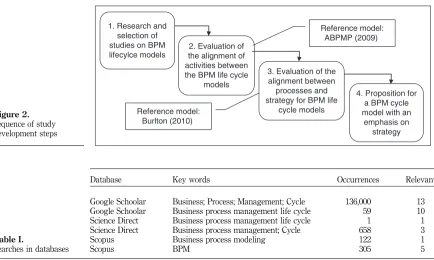
Figure 2 shows the procedure steps, a linear sequence of four activities. Analyses of phases 2 and 3 use the ABPMP (2009) reference model phases and the phases of activities proposed by Burlton (2010), respectively. These two models were also reused in phase 4, in the proposal for an integrated and incremental BPM framework.
4. Results and discussion
4.1 The search and selection process for studies in databases
The search in databases was conducted in six sessions in April 2011 and it resulted in a total of 137,145 occurrences, as shown in Table I. In relation to these occurrences, besides the relevance filter offered by the search tool and the prioritizing of papers published starting in 2000, an additional filter for analysis was adopted for the first one hundred occurrences. This step of the research permitted the identification of 33 potentially relevant papers for this study.
Based on the analysis of abstracts of previously selected publications, occurrences that did not have any relation to the theme proposed in this study were discarded, resulting in 16 papers eligible for later analysis.
2. Evaluation of the alignment of activities between the BPM life cycle
models
Reference model: ABPMP (2009)
3. Evaluation of the alignment between
processes and strategy for BPM life
cycle models Reference model:
Burlton (2010)
4. Proposition for a BPM cycle model with an
emphasis on strategy 1. Research and
selection of studies on BPM lifecylce models
Figure 2.
Sequence of study development steps
Database Key words Occurrences Relevant
Google Schoolar Business; Process; Management; Cycle 136,000 13
Google Schoolar Business process management life cycle 59 10
Science Direct Business process management life cycle 1 1
Science Direct Business process management; Cycle 658 3
Scopus Business process modeling 122 1
Scopus BPM 305 5
Table I.
Searches in databases
418
BPMJ
20,3
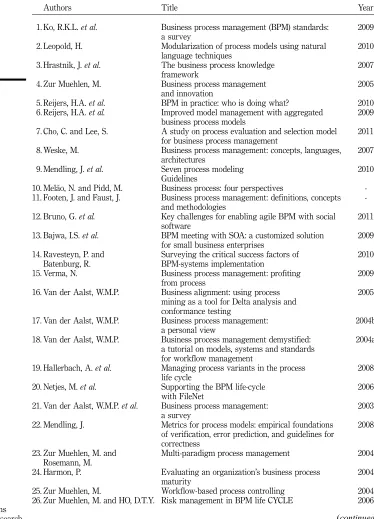
The 16 scientific publications found were then examined in search of relevant references for the objectives of this study. Then, another 16 eligible studies were observed for later analysis, for a total of 32 publications, listed in Table II.
Finally, after an analysis of content in the original and complete texts to identify BPM life cycle proposals in the chosen publications, a total of seven publications was obtained and they were adopted as the object of study for this paper, representing their academic-scientific results: the BPM life cycle models proposed by Hallerbach et al. (2008), Houy et al. (2010), Netjes et al. (2006), Van der Aalst (2004a), Verma (2009), Weske (2007) and Zur Muehlen and Ho (2006).
The search process was replicated in April 2012. This second search process was conducted with the intent of validating the process performed previously. Although there were differences in total occurrences of searches and in the order of results in the second search, the studies selected in the first search process were also part of the second process.
4.2 Analyzed BPM life cycle models
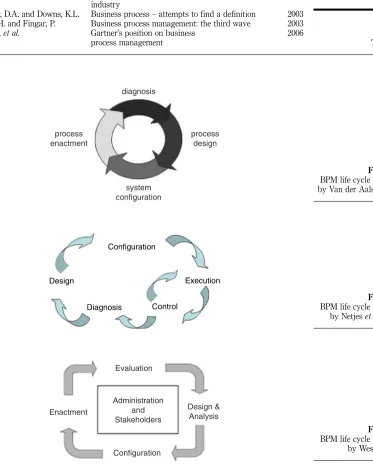
4.2.1 The Van de Aalst model. Van der Aalst (2004a) proposed a BPM life cycle with four steps, according to Figure 3:
(1) process design, which involves the construction of “AS-IS” or “TO-BE” models for a better understanding of the organization’s operational processes;
(2) system configuration, when the organization’s execution systems are prepared or configured for implementing the constructed process designs;
(3) process enactment, through the configured execution systems; and
(4) diagnosis, with monitoring and analysis of processes executed in search of problems and opportunities for improvement.
This model is strongly associated with process automation for developing information systems.
4.2.2 The Netjes et al. model. The model proposed by Netjeset al.(2006), shown in Figure 4, encompasses five steps:
(1) design, with the definition of the process structure, resource structure, resource allocation logic and interfaces among collaborators through experimenting and evaluating designs;
(2) configuration, with the detailed specification of process designs with an emphasis on their realization;
(3) execution, involving the operationalization of the configured work flow;
(4) control, with monitoring of execution, at the process performance level as a whole as well as at the activities level; and
(5) diagnosis, providing information for identifying opportunities for improvement, such as work flow bottlenecks and other eventual critical points.
4.2.3 The Weske model. Figure 5 shows the proposal by Weske (2007), which has a cycle with four steps:
(1) design and analysis, which encompasses the identification and modeling of business processes and validation through simulations;
419
An analysis of
BPM lifecycles
Authors Title Year
1. Ko, R.K.L.et al. Business process management (BPM) standards: a survey
2009
2. Leopold, H. Modularization of process models using natural language techniques
2010
3. Hrastnik, J.et al. The business process knowledge framework
2007
4. Zur Muehlen, M. Business process management and innovation
2005
5. Reijers, H.A.et al. BPM in practice: who is doing what? 2010
6. Reijers, H.A.et al. Improved model management with aggregated business process models
2009
7. Cho, C. and Lee, S. A study on process evaluation and selection model for business process management
2011
8. Weske, M. Business process management: concepts, languages, architectures
2007
9. Mendling, J.et al. Seven process modeling Guidelines
2010
10. Mel~ao, N. and Pidd, M. Business process: four perspectives -11. Footen, J. and Faust, J. Business process management: definitions, concepts
and methodologies
-12. Bruno, G.et al. Key challenges for enabling agile BPM with social software
2011
13. Bajwa, I.S.et al. BPM meeting with SOA: a customized solution for small business enterprises
2009
14. Ravesteyn, P. and Batenburg, R.
Surveying the critical success factors of BPM-systems implementation
2010
15. Verma, N. Business process management: profiting
from process
2009
16. Van der Aalst, W.M.P. Business alignment: using process mining as a tool for Delta analysis and conformance testing
2005
17. Van der Aalst, W.M.P. Business process management: a personal view
2004b
18. Van der Aalst, W.M.P. Business process management demystified: a tutorial on models, systems and standards for workflow management
2004a
19. Hallerbach, A.et al. Managing process variants in the process life cycle
2008
20. Netjes, M.et al. Supporting the BPM life-cycle with FileNet
2006
21. Van der Aalst, W.M.P.et al. Business process management: a survey
2003
22. Mendling, J. Metrics for process models: empirical foundations of verification, error prediction, and guidelines for correctness
2008
23. Zur Muehlen, M. and Rosemann, M.
Multi-paradigm process management 2004
24. Harmon, P. Evaluating an organization’s business process maturity
2004
25. Zur Muehlen, M. Workflow-based process controlling 2004
26. Zur Muehlen, M. and HO, D.T.Y. Risk management in BPM life CYCLE 2006
(continued)
Table II.
Eligible publications resulting from the search
420
BPMJ
20,3
diagnosis
process design
system configuration process
enactment
Figure 3.
BPM life cycle proposed by Van der Aalst (2004a)
Authors Title Year
27. Houy, C.et al. Empirical research in business process management – analysis of an emerging field of research
2010
28. Reijers, H.A. Design and control of workflow processes: business process management for the service industry
2003
29. Lindsay, D.A. and Downs, K.L. Business process – attempts to find a definition 2003 30. Smith, H. and Fingar, P. Business process management: the third wave 2003 31. Hill, J.B.et al. Gartner’s position on business
process management
2006
Table II.
Design
Diagnosis Control
Execution Configuration
Figure 4.
BPM life cycle proposed by Netjeset al.(2006)
Evaluation
Configuration Enactment
Administration and Stakeholders
Design & Analysis
Figure 5.
BPM life cycle proposed by Weske (2007)
421
An analysis of
BPM lifecycles
(2) configuration, which considers selection, implementation and tests of systems for execution;
(3) enactment, which involves the operationalization, monitoring and maintenance of processes; and
(4) evaluation, of the performance of business processes.
The same author also underscores stakeholder participation and management in the BPM life cycle, in the planning and development of business processes aligned with the organization’s strategic objectives.
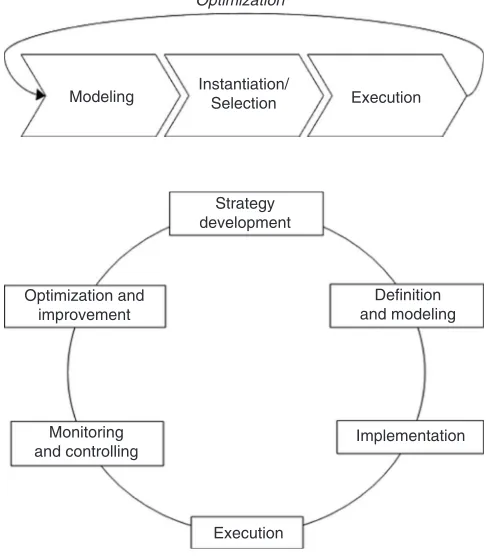
4.2.4 The Hallerbach et al. model. Hallerbachet al. (2008) defined the process life cycle beginning with: first, modeling, in which the variations of processes and their relationships are identified; second, instantiation/selection, with the configuration or selection of variations according to the context; third, execution, of business process variations monitoring their performances; and fourth, optimization, identifying “best practices” and evolving processes, as shown in Figure 6.
Observe that Hallerbachet al.’s (2008) model is restricted: it refers to the process life cycle, but it does not provide a holistic representation of BPM by not dealing with planning and strategy in their cycle, or aligning business objectives with processes.
4.2.5 The Houy et al. model. Houyet al.(2010) conducted a study that evaluated life cycle proposals from other authors, but who keep their model similar to the one proposed by ABPMP (2009). The life cycle steps for these authors, seen in Figure 7,
Strategy development
Optimization and improvement
Monitoring and controlling
Execution
Implementation Definition and modeling
Figure 7.
BPM life cycle proposed by Houyet al.(2010)
Optimization
Modeling Instantiation/Selection Execution
Figure 6.
The life cycle model proposed by Hallerbachet al.(2008)
422
BPMJ
20,3
are: strategy development; definition and modeling; implementation; execution; monitoring and controlling; and optimization and improvement.
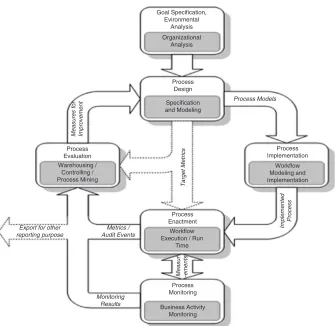
4.2.6 The Zur Muehlen and Ho model. Zur Muehlen and Ho (2006) believe the iterative and cyclical approach permits achieving objectives, keeping standards and improving process quality. The cycle proposed by the authors, shown in Figure 8, is comprised of the following steps: specification of objectives and analysis of the environment; process design; process implementation; process enactment; process monitoring and process evaluation. Although it involves six steps, observe that the first – goal specification and environmental analysis – is not in the life cycle. It is simply a previous step. This model also focusses on business process automation, explicitly including IT activities.
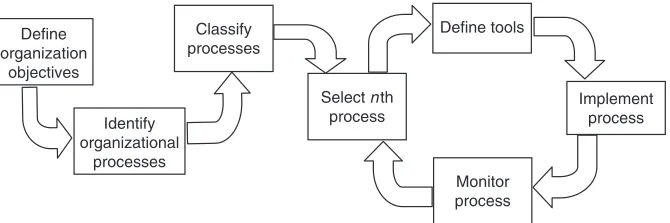
4.2.7 The Verma model. Verma (2009) affirms there are several ways to conduct a life cycle for the continuous improvement of processes, ranking the BPM as an excellent initiative for improving processes. The life cycle proposed is comprised of seven steps, shown in Figure 9:
(1) define organization objectives; (2) identify organizational processes;
Goal Specification, Evironmental
Analysis Organizational
Analysis
Process Design
Specification and Modeling
Process Implementation
Workflow Modeling and Implementation Process
Evaluation Warehousing /
Controlling / Process Mining
Process Enactment
Process Monitoring
Monitoring
Results Business Activity
Monitoring Workflow Execution / Run
Time
Export for other reporting purpose
Metrics / Audit Events
Measur -ements Measures for Improvement
Target Metrics
Implemented Process
Process Models
Figure 8.
BPM life cycle proposed by Zur Muehlen and Ho (2006)
423
An analysis of
BPM lifecycles
(3) classify processes: rank processes according to contribution criteria for organizational objectives, providing related benchmarks and potential for financial improvement;
(4) choose the process that has the best contribution;
(5) determine the use of the most appropriate tool, whether it is for incremental or radical change;
(6) implementation of the improvement project; and
(7) process monitoring.
The author can be seen to obtain a large number of steps due to the level of detail of the initial steps of planning, analysis and modeling. In this case, steps 4-7 only shape the cycle, where they are prior to application of the BPM, but not in a cyclical manner.
4.3 Analysis of the alignment between BPM life cycle models
Table III summarizes the differences and similarities between the BPM model proposed by ABPMP (2009) and the other models studied, which were taken from literature. The table associates each step of the ABPMP life cycle with the steps of those life cycles studied. The reader should interpret the table observing the horizontal alignment of a step of the ABPMP BPM life cycle in the first column with the corresponding step in the other model: if the cell is blank, there is no corresponding step in the method associated with the ABPMP model. The table shows there are cases in which a step of a model corresponds to two or more steps of another model and vice versa.
When analyzing what each model has as original or particular, it was observed that the Hallerbachet al.(2008) model implements the last four steps of the ABPMP BPM, and it is a restricted model that does not deal with planning, strategy and alignment of processes with the business. The Netjeset al.(2006) model also does not map planning and strategy. The Houyet al.(2010) model has steps that coincide with the ABPMP model. In the Zur Muehlen and Ho (2006) model, the first steps, of defining objectives and analyzing the environment are not part of the cycle, are described as steps prior to the iterative process and do not include the refining step. The Van der Aalst (2004a) model is strongly associated with the implementation of processes in information system and it also does not include the planning step. In the Verma (2009) model, the first three steps do not belong to the cycle and are more segmented compared to the ABPMP model. They are also more used in projects that focus on IT tools and do not
Define organization
objectives
Classify processes
Select nth
process
Define tools
Monitor process
Implement process Identify
organizational processes
Figure 9.
BPM life cycle proposed by Verma (2009)
424
BPMJ
20,3
Authors Cycle steps
BPM (ABPMP)
Hallerbach et al.(2008)
Netjeset al.
(2006) Houyet al.(2010)
Zur Muehlen and Ho (2006)
Van der Aalst
(2004a) Verma (2009) Weske (2007)
Planning and strategy
Development of strategy
Specification of objectives and analysis of environment
Define objectives Administration and Stakeholders
Analysis Design Definition and
Modeling
Design Design Identify process Design and
Analysis Design and
modeling
Modeling Configuration Implementation Implementation Configuration Classify Process Configuration
Implementation Frequency and
Selection
Execution Execution Monitoring Execution Choose process Operation
Monitoring and control
Execution and monitoring
Control Monitoring and
control
Evaluation Diagnosis Define tool and
implement process
Performance Evaluation
Refining Optimization Diagnosis Optimization and
Improvement
Monitor process
T
ab
le
III.
Alignment
of
studied
life
cy
cle
models
with
the
ABPMP
model
425
An
analysis
of
BPM
lifecy
cles
project a refining step. The Weske (2007) model emphasizes stakeholder participation in BPM projects, but it does not explicit the planning and refining steps.
Convergences can be observed between steps of the ABPMP model and the models studied in literature, specifically in design and modeling, implementation and monitoring and control steps. These steps reinforce Houyet al.(2010) affirmation that states that although the number of steps and the nomenclature used varies, the steps are only divided differently, without fundamental variations.
The main differences between the ABPMP (2009) reference model and the life cycle models studied are that the first and last steps of the ABPMP (2009) model are observed only in some of the models analyzed, as can be seen in Table III: the steps in the “middle” of the ABPMP model are recurring, appear in the models proposed by the studied authors, different from the planning and refining steps.
4.4 Alignment between processes and strategy for BPM life cycle models
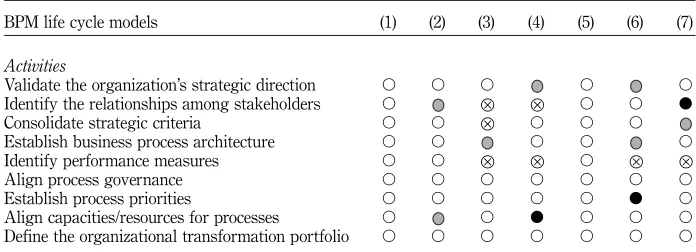
One of the search questions in this study refers to how BPM life cycle models apply strategy, whether there are references to the activities associated with alignment between organization strategy and processes. Based on the activities proposed by Burlton (2010) in Table IV, the activities needed for alignment between processes and strategy are presented and if the activity is present, moderately present or absent from the models studied.
4.5 Proposal of framework with an emphasis on strategy
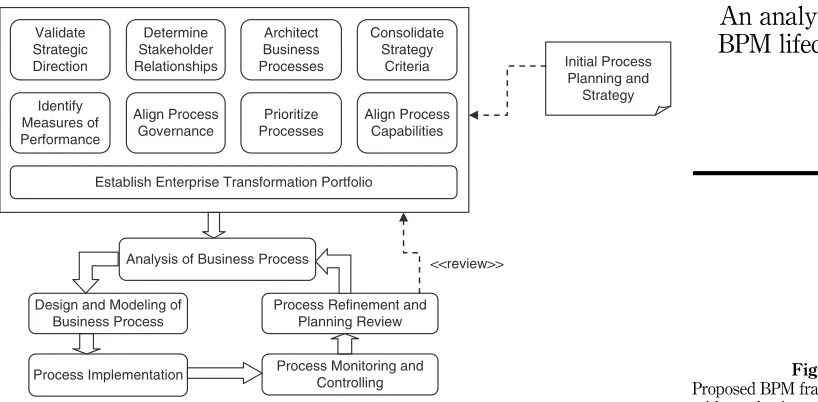
The low presence of activities associated with strategy in BPM in life cycle models studied suggests a demand for propositions on how to handle strategy in BPM. A initial proposal that adds strategy to a BPM life cycle model in a stronger manner can be obtained by combining strategy activities proposed by Burlton (2010) to the ABPMP BPM (2009) life cycle model, as per the framework shown in Figure 10.
The framework begins with the practices proposed by Burlton (2010) for planning and strategy. Starting with the process architecture established in step 1, the analysis, project and modeling, implementation and monitoring and control of business processes steps follow. The refining and planning review step precedes each new interaction of the cycle projected in the framework, which reviews the activities associated with strategy for the business process portfolio.
BPM life cycle models (1) (2) (3) (4) (5) (6) (7)
Activities
Validate the organization’s strategic direction J J J J J
Identify the relationships among stakeholders J # # J J K
Consolidate strategic criteria J J # J J J
Establish business process architecture J J J J J
Identify performance measures J J # # J # #
Align process governance J J J J J J J
Establish process priorities J J J J J K J
Align capacities/resources for processes J J K J J J
Define the organizational transformation portfolio J J J J J J J
Notes:K, Present;J, absent; , moderate;#, not identified
Sources:(1) Hallerbachet al.(2008), (2) Netjeset al.(2006), (3) Houyet al.(2010), (4) Zur Muehlen and Ho (2006), (5) Van der Aalst (2004), (6) Verma (2009), (7) Weske (2007)
Table IV.
Alignment between processes and strategy in BPM life cycle models
426
BPMJ
20,3
The nine activities specified in the initial phase of the proposed life cycle model, presented in Figure 10, aim at guaranteeing an initial structuring of the process architecture that, in an evolutionary process, revise this architecture. Thus, the proposed framework covers the deficiencies identified in the life cycle models identified, and also deal with the gap pointed out in literature, about the need for a holisitc approach in BPM (Kujansivu and Lo¨nnqvist, 2008; Jeston and Nelis, 2006; Trkman, 2010).
Figure 11 aims to comparatively situate the studied models. The relative projection of each model in the horizontal axis indicates the adherence to the ABPMP (2009) reference model. The least adherent models include the intermediate phases of the ABPMP model and are oriented toward process automation through information systems, whereas the more adherent models include the planning, architecture structuring, refinement and process improvement phases. The vertical axis is
Weske (2007), Zur Muehlen and Ho (2006)
Van der Aalst (2004a) Hallerbach et al. (2008)
Modeling of processes and/or Implementation of information systems
Strategy
Planning/Refinement Netjes et al. (2006)
Houy et al. (2010) Verma (2009)
ABPMP (2009) alignment Burlton (2010) alignment
framework proposed
Figure 11.
BPM life cycles: contexts of applicability and adherence to standard models
<<review>>
Process Refinement and Planning Review
Process Implementation
Sources: Based on Burlton (2010) and ABPMP (2009)
Analysis of Business Process
Design and Modeling of Business Process
Process Monitoring and Controlling Validate
Strategic Direction
Prioritize Processes Identify
Measures of Performance
Align Process Governance
Consolidate Strategy
Criteria Architect
Business Processes Determine
Stakeholder Relationships
Establish Enterprise Transformation Portfolio
Align Process Capabilities
Initial Process Planning and
Strategy
Figure 10.
Proposed BPM framework with emphasis on strategy
427
An analysis of
BPM lifecycles
associated with adherence of models to strategic process alignment practices, included in the Burlton (2010) reference model.
5. Conclusions
The objective of this study was to investigate BPM life cycle models proposed in literature and identify similarities and variations that exist in these models using the ABPMP (2009) model as reference. For such, a search was carried out in academic databases using a search strategy with keywords associated with the theme and using pre-established filters, analysis of original and complete text content for identifying BPM life cycle proposals, obtaining a total of seven publications that were adopted as the object of study in this paper. The search questions for this study relate to adherence of those models found in literature with the ABPMP reference model and how strategy is handled in BPM life cycle models:
Q1. What are the convergences between the various BPM life cycle models found in literature (including the ABPMP model)?
Q2. Are there semantic differences between the various proposals presented in literature in relation to the BPM life cycle proposed by ABPMP?
Q3. How do the BPM life cycle models apply to strategy? Is there any reference of alignment between strategy and business processes and the proposal for developing process architecture?
Q4. Is it possible to propose a framework that deals with alignment between strategy and business processes in an explicit manner?
With regard toQ1, this study indicates a moderate convergence of models in literature with the ABPMP reference model, essentially in the models’ intermediate steps: for the analysis, design and modeling, implementation and monitoring and control phases, the activities of studied models were mapped to the ABPMP (2009) BPM life cycle, so that each step of the studied models corresponds to two or more steps of the ABPMP model or various steps of a studied model correspond to a step of the reference model. In relation to Q2, it should be pointed out that the ascertainment that the first phase of the ABPMP reference model, the planning phase, is not observed in four of the investigated models (Hallerbachet al., 2008; Netjeset al., 2006; Van der Aalst, 2004a; Weske, 2007), and the final phase, the refinement phase, is not observed in Verma (2009), Weske (2007) and Zur Muehlen and Ho (2006). Two of the studied models (Verma, 2009; Zur Muehlen and Ho, 2006) present an initial planning phase that precedes the cycle itself. These models suggest an initial step of strategy definition for BPM. Weske’s (2007) proposal includes an activity that encompasses other cycle activities that emphasize cycle administration with an emphasis on the effective participation of stakeholders involved in the project. With the exception of the model proposed by Weske (2007), all others project the automation of business processes. Another common observed in the models is that most models studied emphasize and/or project the automation of business processes, which is not addressed in the ABPMP model (Ruzeviciuset al., 2012).
With regard to questionQ3, few life cycle models studied included the planning phase and those that did presented little emphasis on strategy in defining process architecture. When considering the activities proposed by Burlton (2010) – validate
428
BPMJ
20,3
the strategic direction, determine the relationship between stakeholders, develop the architecture for the processes, align process governance, prioritize processes for change considering all stakeholders, align the capacities with people, technology, installations and finally, establish a transformation portfolio – a low frequency of these activities was observed for guaranteeing an alignment between strategy and business processes in organizations. For that reason, this study suggests adding those activities proposed by Burlton (2010) to the life cycle model as an instrument for aligning strategy to processes in BPM activities.
In relation toQ4, a framework was proposed that explicitly deals with strategy and business processes based on the activities proposed by Burlton (2010) for planning and strategy. Starting with the process architecture established in step 1, it then moves on to the analysis, design and modeling, implementation and monitoring and control of business processes steps. The planning refinement and review step precedes each new iteration of the cycle projected in the framework, which reviews the activities associated with strategy for the business process portfolio.
With regard to the limitations of this study, observational studies are needed in different business areas that can be compared to cases in literature. In order to evaluate the degree of effectiveness of the proposed model, the specification and collection of metrics is planned to evaluate the alignment between process architecture and strategy. For these future studies, the qualitative methodology can be improved with a quantitatively founded generalized sampling.
This paper is expected to contribute toward the maturing of organizational BPM practices by analyzing and comparing life cycle models found in literature compared to the ABPMP (2009) reference model. By presenting a comparative perspective of the various BPM life cycle models, this study contributes toward the academic community by presenting a typology of BPM life cycle models with common characteristics and peculiarities, as well as assisting professionals in adopting a model that supports them in BPM projects. The framework presented can contribute for researchers interested in conducting empirical studies related to BPM. The framework also contributes toward managers interested in promoting BPM with strong alignment with strategy.
References
Association of Business Process Management Professionals (ABPMP) (2009), Guia para Gerenciamento de Processos de Negocio – Corpo Comum de Conhecimento, Vers~ao 2.0. ABPMP, S~ao Paulo.
Antonucci, Y.L. and Goeke, R.J. (2011), “Identification of appropriate responsibilities and positions for business process management success”, Business Process Management Journal, Vol. 17 No. 1, pp. 127-146.
Bajwa, I.S., Samad, A., Mumtaz, S., Kazmi, R. and Choudhary, A. (2009), “BPM meeting with SOA: a customized solution for small business enterprises”,Proceedings of International Conference on Information Management and Engineering (ICIME), Kuala Lampur, April,pp. 677-682. Bruno, G., Dengler, F., Jennings, B., Khalaf, R., Nurcan, S., Prilla, M., Sarini, M., Schmidt, R. and
Silva, R. (2011), “Key challenges for enabling agile BPM with social software”,Journal of Software Maintenance and Evolution: Research and Practice, Vol. 23 No. 4, pp. 297-326. Burlton, R.T. (2010), “Delivering business strategy through process management”, in Vom Brocke, J.
and Rosemann, M. (Eds),Handbook on Business Process Management: Strategic Alignment, Governance, People and Culture, Springer, Berlin and Heidelberg, Vol. 2 Part. 1, pp. 5-37. Cho, C. and Lee, S. (2011), “A study on process evaluation and selection model for business
process management”,Expert Systems with Applications, Vol. 38 No. 5, pp. 6339-6350.
429
An analysis of
BPM lifecycles
Davenport, T.H. (1994), Reengenharia de Processos: Como Inovar na Empresa Atrave´s da Tecnologia da Informac¸~ao, Campus, Rio de Janeiro.
Dumas, M., La Rosa, M., Mendling, J. and Reijers, H.A. (2013),Fundamentals of Business Process Management, Springer, Berlin, 399p.
Glykas, M.M. (2011), “Effort based performance measurement in business process management”,
Knowledge and Process Management, Vol. 18 No. 1, pp. 10-33.
Hallerbach, A., Bauer, T. and Reichert, M. (2008), “Managing process variants in the process life cycle”,Proceedings of the Tenth International Conference on Enterprise Information Systems (ICEIS), Barcelona, Vol. 2, pp. 154-161.
Harmon, P. (2004), “Evaluating an organization’s business process maturity”,Business Process Trends, Vol. 2 No. 3, pp. 1-11.
Hill, J.B., Sinur, J., Flint, D. and Melenovsky, M.J. (2006), “Gartner’s position on business process management, 2006”, Business Issues Gartner Research, Gartner, Stamford, CT, Vol. ID Number G00136533.
Houy, C., Fettke, P. and Loos, P. (2010), “Empirical research in business process management – analysis of an emerging field of research”,Business Process Management Journal, Vol. 16 No. 4, pp. 619-661.
Hrastnik, J., Cardoso, J. and Kappe, F. (2007), “The business process knowledge framework”,
Proceedings of the Ninth International Conference on Enterprise Information Systems
(CEIS), Funchal, Madeira, June 12-16.
Jeston, J. and Nelis, J. (2006),Business Process Management Practical Guidelines to Successful Implementations, 3rd ed., Butterworth-Heinemann, Oxford.
Ko, R.K.L., Lee, S.S.G. and Lee, E.W. (2009), “Business process management (BPM) standards: a survey”,Business Process Management Journal, Vol. 15 No. 5, pp. 744-791.
Kohlbacher, M. (2010), “The effects of process orientation: a literature review”,Business Process Management Journal, Vol. 16 No. 1, pp. 135-152.
Kujansivu, P. and Lo¨nnqvist, A. (2008), “Business process management as a tool for intellectual capital management”, Knowledge and Process Management, Vol. 15 No. 3, pp. 159-169.
Leopold, H. (2010), “Modularization of process models using natural language techniques”, master thesis in Information Systems at the School of Business and Economics of Humboldt Universitat, Zu Berlin.
Lindsay, D.A. and Downs, K.L. (2003), “Business process – attempts to find a definition”,
Information & Software Technology, Vol. 45 No. 15, pp. 1015-1019.
McCormack, K., Willems, J., van den Bergh, J., Deschoolmeester, D., Willaert, P., Stemberger, M.I., Skrinjar, R., Trkman, P., Ladeira, M.B., Oliveira, M.P.V., Vuksic, V.B. and Vlahovic, N. (2009), “A global investigation of key turning points in business process maturity”,
Business Process Management Journal, Vol. 15 No. 5, pp. 792-815.
Mendling, J. (2008), “Metrics for process models: empirical foundations of verification, error prediction, and guidelines for correctness”, Lecture Notes in Business Information Processing, Springer, Berlin, Vol. 6, p. 193.
Mendling, J., Reijers, H.A. and van der Aalst, W.M.P. (2010), “Seven process modeling guidelines (7PMG)”,Information and Software Technology, Vol. 52 No. 2, pp. 127-1360.
Netjes, M., Reijers, H. and Van der Aalst, W.P. (2006), “Supporting the BPM life-cycle with FileNet”, Proceedings of the Workshop on Exploring Modeling Methods for Systems Analysis and Design (EMMSAD), Namur University, Namur,pp. 497-508.
Neubauer, T. (2009), “An empirical study about the status of business process management”,
Business Process Management Journal, Vol. 15 No. 2, pp. 166-183.
430
BPMJ
20,3
Paim, R., Caulliraux, H.M. and Cardoso, R. (2008), “Process management tasks: a conceptual and practical view”,Business Process Management Journal, Vol. 14 No. 15, pp. 694-723. Palmberg, K. (2010), “Experiences of implementing process management: a multiple-case study”,
Business Process Management Journal, Vol. 16 No. 1, pp. 93-113.
Pyon, C.U., Woo, J.Y. and Park, S.C. (2011), “Service improvement by business process management using customer complaints in financial service industry”,Experts Systems with Applications, Vol. 38 No. 4, pp. 3267-3279.
Ravesteyn, P. and Batenburg, R. (2010), “Surveying the critical success factors of BPM-systems implementation”, Business Process Management Journal, Vol. 16 No. 3, pp. 492-507.
Reijers, H.A. (2003),Design and Control of Workflow Processes: Business Process Management for the Service Industry, Springer, 320pp.
Reijers, H.A., Mans, R.S. and Van der Toorn, R.A. (2009), “Improved model management with aggregated business process models”,Journal Data & Knowledge Engineering, Vol. 68 No. 2, pp. 221-243.
Reijers, H.A., Van Wijk, S., Mutschler, B. and Leurs, M. (2010), “BPM in practice: who is doing what?”,Lecture Notes in Computer Science, Vol. 6336, pp. 45-60.
Ruzevicius, J., Milinaviciute, I. and Klimas, D. (2012), “Peculiarities of the business process management life cycle at different maturity levels: the banking sector’s case”,Issues of Business and Law, Vol. 4 No. 1, pp. 69-85.
Smith, H. and Fingar, P. (2003),Business Process Management: The Third Wave, Meghan-Kiffer Press, Tampa, FA.
Trkman, P. (2010), “The critical success factors of business process management”,International Journal of Information Management, Vol. 30 No. 2, pp. 125-134.
Van der Aalst, W.M.P. (2004a), “Business process management: a personal view”, Business Process Management Journal, Vol 10 No. 2, pp. 248-253.
Van der Aalst, W.M.P. (2004b), “Business process management demystified: a tutorial on models, systems and standards for workflow management”, in Dese, J., Reisig, W. and Rozengerb, G. (Eds),Lectures on Concurrency and Petri Nets: Advances in Petri Nets, Springer, Berlin, pp. 1-65.
Van der Aalst, W.M.P. (2005), “Business alignment: using process mining as a tool for Delta analysis and conformance testing”, Journal Requirements Engineering, Vol. 10 No. 3, pp. 198-211.
Van der Aalst, W.M.P., ter Hofstede, A.H.M. and Weske, M. (2003), “Business process management: a survey”, Proceedings of International Conference on Business Process Management(BPM), Lecture Notes in Computer Science, Springer-Verlag, Berlin,pp. 1-12. Verma, N. (2009), Business Process Management: Profiting from Process, Global India,
New Delhi.
Weske, M. (2007),Business Process Management: Concepts, Languages, Architectures, Springer, Berlin.
Zur Muehlen, M. (2004), Workflow-Based Process Controlling: Foundation, Design, and Application of Workflow-Driven Process Information Systems, Logos Verlag, Berlin. Zur Muehlen, M. (2005), “Business process management and innovation”,Stevens Alliance for
Technology Management, Vol. 9 No. 3, pp. 1-8, available at: www.stevens.edu/howe/sites/ default/files/SATM_Summer2005_0.pdf (accessed 17 April 2014).
Zur Muehlen, M. and Ho, D.T.Y. (2006), “Risk management in the BPM Life cycle”, in Bussler, C.
et al. (Eds), Lecture Notes in Computer Science-BPM 2005 Workshops, Vol. 3812, pp. 454-466.
431
An analysis of
BPM lifecycles
Zur Muehlen, M. and Rosemann, M. (2004), “Multi-paradigm process management”,Proceedings of CAiSE’04-5th Workshop on Business Process Modeling, Development and Support (BPMDS), Riga, Latvia,pp. 169-175.
Further reading
Footen, J. and Faust, J. (2008), The Service-Oriented Media Enterprise: SOA, BPM and Web Services in Professional Media Systems, Focal Press, New York, NY, 544p.
Melao, N. and Pidd, M. (2008), “Business processes: four perspectives”, in Grover, V. and Markus, M.L. (Eds), Business Process Transformation (Advances in Management Information Systems), Armonk, New York, NY, Vol. 9, pp. 41-46.
Corresponding author
Professor Rinaldo Macedo de Morais can be contacted at: [email protected]
To purchase reprints of this article please e-mail:[email protected]
Or visit our web site for further details:www.emeraldinsight.com/reprints
432
BPMJ
20,3
This article has been cited by:
1. BernardoRonaldo Ronaldo Bernardo [email protected] GalinaSimone Vasconcelos Ribeiro Simone Vasconcelos Ribeiro Galina [email protected] PáduaSilvia Inês Dallavalle de Silvia Inês Dallavalle de Pádua [email protected] College of Economics, Business and Accounting, University of Sao Paulo,
Ribeirão Preto, Brazil . 2017. The BPM lifecycle. Business Process Management Journal23:1, 155-175.
[Abstract] [Full Text] [PDF]
2. Wolfgang Kratsch, Jonas Manderscheid, Daniel Reißner, Maximilian Röglinger. 2017. Data-driven Process
Prioritization in Process Networks. Decision Support Systems . [CrossRef]
3. Carolina Resende Haddad Department of Industrial Engineering, Federal University of Santa Catarina, Florianópolis, Brazil Diego Hernando Florez Ayala Department of Industrial Engineering, Federal University of Santa Catarina, Florianópolis, Brazil Mauricio Uriona Maldonado Department of Industrial Engineering, Federal University of Santa Catarina, Florianópolis, Brazil Fernando Antônio Forcellini Department of Industrial Engineering, Federal University of Santa Catarina, Florianópolis, Brazil Álvaro Guillermo Rojas Lezana Department of Industrial Engineering, Federal University of Santa Catarina, Florianópolis, Brazil . 2016. Process improvement for professionalizing non-profit organizations: BPM
approach. Business Process Management Journal22:3, 634-658. [Abstract] [Full Text] [PDF]
4. Ali Khosravi Macquarie University, North Ryde, Australia . 2016. Business process rearrangement and
renaming. Business Process Management Journal22:1, 116-139. [Abstract] [Full Text] [PDF]
5. Stefania Bisogno Department of Enterprise Engineering, University of Rome "Tor Vergata", Rome, Italy Armando Calabrese Department of Enterprise Engineering, University of Rome "Tor Vergata", Rome, Italy Massimo Gastaldi Department of Industrial and Electronical Engineering and Economics, University of L'Aquila, L'Aquila, Italy Nathan Levialdi Ghiron Department of Enterprise Engineering, University
of Rome "Tor Vergata", Rome, Italy . 2016. Combining modelling and simulation approaches. Business
Process Management Journal22:1, 56-74. [Abstract] [Full Text] [PDF]
6. Tomislav Hernaus Department of Organization and Management, Faculty of Economics and Business, University of Zagreb, Zagreb, Croatia Vesna Bosilj Vuksic Department of Business Computing, Faculty of Economics and Business, University of Zagreb, Zagreb, Croatia Mojca Indihar Štemberger Faculty of Economics, University of Ljubljana, Ljubljana, Slovenia . 2016. How to go from strategy to results?
Institutionalising BPM governance within organisations. Business Process Management Journal 22:1,
173-195. [Abstract] [Full Text] [PDF]
7. Martin Berner, Jino Augustine, Alexander Maedche. 2016. The Impact of Process Visibility on Process
Performance. Business & Information Systems Engineering58:1, 31-42. [CrossRef]
8. Teija Aarnio. 2015. The Strengthened Business Process Matrix - A Novel Approach for Guided
Continuous Improvement at Service-Oriented SMEs. Knowledge and Process Management22:3, 180-190.
[CrossRef]